As I noted earlier today, many ballplayers have answered the call of duty, especially during the World Wars. What I didn’t note was that, especially in WWII, there were so many players that either volunteered or were drafted into the service that there was some discussion of whether baseball could even continue, especially as those who would be left to play would generally be old or unfit physically for military service (and thus probably not fit physically for Major League Baseball either). Commissioner Kennesaw Mountain Landis wrote President Franklin Delano Roosevelt asking his opinion. He received back what has been called the “Green Light Letter”.
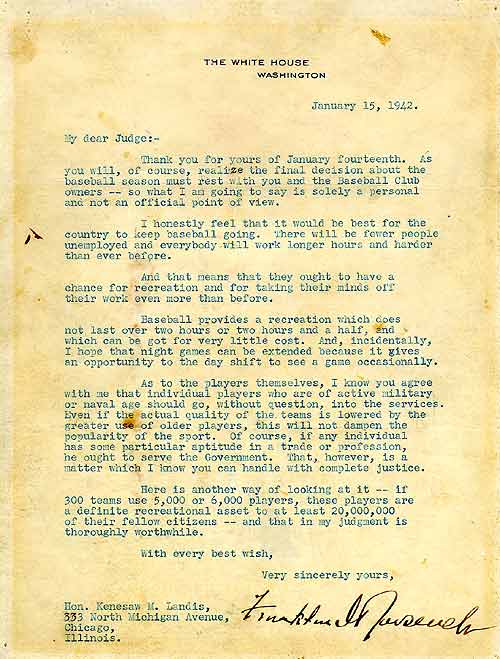 (A full transcription is available here)
And thus, baseball continued through WWII. It led to some strange things. For example, in 1943 rubber rations led to a brief time where balls were used that had balata (a substance more similar to the golf balls of the time) in them, which wouldn’t have been a problem except for the fact that it created one of the deadest baseballs in history. There was the rise of the All-American Girls Professional League in areas of the Midwest that had had their minor league teams fold due to lack of players (although, unlike in League Of Their Own, it was, during the war years, more of a modified form of softball). And, in perhaps the biggest indication of how strange baseball had become while the players were in the service, the St. Louis Browns made the World Series. I seem to recall reading somewhere that a joke at the time was that it was because the Army didn’t want them. By the next season, the Browns then, in 1945, had Pete Gray play the outfield. Who was Pete Gray? Well, he’s the only ballplayer in history who only had one arm.
But, as FDR wrote would happen, baseball continued to provide much-needed recreation to a war-weary nation. Even if it was a bit less Major League than usual.
 The Baseball Continuum
Pingback: Some presidential quotes about baseball for Election Day | The Baseball Continuum