Another book I’m reviewing in eBook form, this is 2007’s The 25 Greatest Sports Conspiracy Theories of All Time, by Elliott Kalb. While not just about baseball, at least ten of the “conspiracies” that Kalb talks examines are focused on baseball, and another (the “Michael Jordan’s first retirement was actually a gambling suspension” theory) involves baseball.

(JUMP)
Kalb, a writer/researcher on sports at various networks over the years, looks at the conspiracies and assigns them a ranking based on “Oswalds”- five Oswalds means a proven conspiracy (such as the “Gentleman’s Agreement” that segregated baseball or the collusion scandal of the 1980s), while having only one Oswald means he believes it is all-but-certainly a false accusation (such as the occasional claim that Super Bowl III may have been fixed), with three Oswalds being about a 50/50 chance of something weird having happened, according to Kalb’s opinion.
What is great about this book is it’s breadth: it does not simply go to those well-known and theories that have entire books already written about them, but also some of the more obscure, such as how there is a good amount of evidence to suggest that Commissioner Kennesaw Mountain Landis (who, this book reminds us again and again, was also a racist, anti-Semitic jerk) let Ty Cobb and Tris Speaker retire from managing as a way of escaping a possible game-fixing scandal, possibly due to Cobb’s political connections. In addition, Kalb does not really stop at the “25”, as some chapters look at multiple conspiracy theories that share a common thread, such as a chapter on supposed “too good to be true” NASCAR results or a chapter about conspiracies to keep players from breaking records or winning statistical crowns due to their religion, ethnicity or nationality.
As could be expected with the subject of this book, however, there are some issues of contention I have:
For example, he more-or-less dismisses that the use of sign-stealing helped the Giants win the 1951 pennant. Oh, he doesn’t deny that it happened, but he doesn’t think that it made that much of a difference, especially in that 3-game series that culminated in Bobby Thomson‘s HR. The problem with this, though, is that he forgets that, had the sign-stealing been responsible for the Giants winning even one game in the 1951 season, then had there not been sign-stealing it follows that there wouldn’t have been a tiebreaker series needed, as the Dodgers would have had the best record at the end of the year instead of being tied with the Giants. This error in Kalb’s logic is made all the more plain when he notes how the 1961 Reds did a similar scheme and more-or-less states that it was probably the only way they made it to the World Series. That said, it is kind of funny that the 1961 Reds had Frank Robinson, who later would be in charge of baseball discipline, dealing with things like what the 1961 Reds did.
For another thing, there is the steroid chapter. After noting some of the history of the steroid era as well as the collective ignorance everyone had, he noted how other factors such as smaller ballparks, better nutrition and training, more aggressive approaches at the plate and expansion also contributed to more offense. While he does not deny that steroids no doubt played a large role, these two paragraphs leave a bat taste in my mouth:
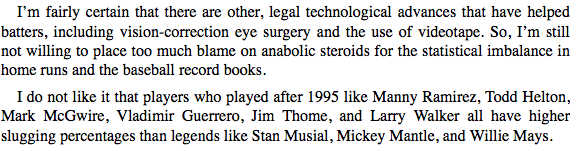
These two paragraphs leave much to interpretation. On one hand, he doesn’t place blame on anabolic steroids for the statistical imbalance, and then the next he lists several players- some of whom (most notably Jim Thome) were to the best of our knowledge not involved in steroids whatsoever and basically says that he doesn’t like the fact they have better stats than some of the game’s immortals.
What, exactly, is Kalb trying to say here?
If steroids, despite him not “willing to place too much blame”* on them, are the reason why he doesn’t like that those late-90s stars are ahead of some of the legends, he is more-or-less implying that all of them used steroids.
If his meaning is what I think it is though, and that he doesn’t like the 90s stars being ahead of Musial, Mantle and Mays because of all of the factors- including steroids (which, remember, he in the previous paragraph had said he didn’t put too much blame on), then he is being ignorant of the eternally changing state of sports, and sounds almost bitter about the fact that baseball has moved on at all from mid-century, as well as somewhat hypocritical, as he A) is lumping totally legal ways of improvement with illegal ways of improvement and B) neglecting that some of the records of Musial, Mantle and Mays were no doubt built partly on the fact that they had had better equipment or training than, say, players in the deadball era. That said maybe I’m reading into this too much, or misinterpreting what he’s saying.
(Also, some of the formatting of the book makes it hard to read and a bit haphazard to follow, and sometimes a word is out of place but this is more than likely just a result of the eBook format it was in or a scanning problem, so I’m not going to blame Kalb for it. Similar not Kalb’s fault are some conspiracies that are now “done”, such as Dennis Rodman not being in the Basketball Hall of Fame- he is now.)
Despite the fact that I just wrote several paragraphs of gripes, though, I don’t want you to get the wrong impression: I liked this book. A lot. It is a good read that covers many subjects and is in a good style that is easy to pick up. So if you get the chance, check out The 25 Greatest Sports Conspiracy Theories of All Time.
This review was done using an eBook from my local library.
*I would be interested to know if Kalb’s opinions have changed since 2007, given the new information that has been revealed since then.
 The Baseball Continuum
Pingback: Continuum Week in Review (7-29 to 8-4) and Preview (8-5 to 8-11) | The Baseball Continuum