(Blogathon ’16) Jen Mac Ramos: Baseball Bonds

This guest-post is part of the 2016 Baseball Continuum Blogathon For Charity, benefiting the Roswell Park Alliance Foundation. The Roswell Park Alliance Foundation is the charitable arm of Roswell Park Cancer Institute and funds raised will be “put to immediate use to increase the pace from research trials into improved clinical care, to ensure state-of-the-art facilities, and to help improve the quality of life for patients and their families.” Please donate through the Blogathon’s GoFundMe page. Also, please note that the opinions and statements of the writer are not necessarily those of the Baseball Continuum or it’s webmaster.

I was 16 when I first took an interest in baseball. I didn’t grow up with sports and I leaned more toward art than anything else.

Something changed, though. I watched an NLDS game on a whim in 2007 and thought, “Hey, I actually like this sport.” I grew more invested as the Postseason went on and I knew this wasn’t going to be something that leaves me.

***

My father was a Mets fan when he lived in New Jersey in the 1980s. He can tell you stories about watching the 1986 Mets.

Growing up, a love of baseball was never instilled in me, though. Instead, I was the one who brought baseball into the family.

At first, my father thought that I had gotten interested in baseball because my friend at the time loved baseball.

I remember getting into a fight about it with him before my first game—Boston Red Sox at Oakland Athletics, May 24, 2008. He told me that it wasn’t something that I had ever been interested in before, but I know that I was going to be interested in it for a long time.

***

I dragged my father to more games. I was about 18 then and I didn’t have a car. After a while, I guess he realized that I truly loved the sport and everything surrounding it.

He began watching games when I wasn’t around. I had gone to college in Oakland—about two hours away from my hometown—and he would call me after the Giants game to talk about it. He would also watch A’s games, because my brother became a fan after that game in 2008.

***

2014 came around and my dad and I went to New Jersey. I had originally planned to go to Trenton alone to see the Richmond Flying Squirrels, the Giants’ Double-A affiliate, take on the Thunder. My dad wanted to come with and drive me there, so we did.

As the Flying Squirrels came out of the dugout, I started greeting the players—most of them responding with, “Hey, what are you doing here!” I had covered the team when they were in High-A the year before and most were surprised to see me in New Jersey.

Matt Duffy came out of the dugout and I said hi to him. Excitedly after, I told my dad that Duffy is one to watch.

***

August rolls around and Matt Duffy gets called up. I remember telling my dad, “Remember him?? We saw him in Trenton with the Flying Squirrels!” My dad didn’t forget. Not because he was intrigued by the way he played, though I’m sure that’s a part of it, but because he was surprised Duffy had remembered me from his short time in the California League.

From then on, whenever Matt Duffy did anything great for the Giants, we would call each other up and say, “DID YOU SEE MATT DUFFY DO THAT.”

***

The Giants made the postseason. Even year and all that. I decided to buy two tickets to Game 4 of the NLDS against the Washington Nationals. My dad had never gone to a postseason game before and I figured this would be a great father-daughter bonding moment.

This game ended up being the Hunter Pence Fence Catch game and I had never seen my dad more into baseball than at that game.

I wanted to take my dad to a World Series game, but so many factors derailed that idea. He told me to go, though, because he wanted me to go to a World Series game.

***

When the Giants won the World Series, I called my dad up immediately. I yelled, “MATT DUFFY GETS A RING.” Instantaneously, my dad started recalling how we saw him in Trenton and how he remembered me and now he’s a World Series champion.

***

It’s 2016 now. My dad still reminds me of that time in Trenton and asks me if I’m ever going to interview Matt Duffy now that he’s a fully fledged big leaguer.

Duffy placed second in National League Rookie of the Year voting in 2015, which exceeded my expectations for how well he would perform at the Major League level.

“You should interview Duffy at spring training,” my dad continues to tell me.

“I’ll try, Dad,” I say. “I’ll try.”


Jen Mac Ramos is a writer who is currently a grad student at the University of Southern California and has a bachelor’s degree in English. As a life-long resident of the Golden State, Jen grew up in Northern California and roots for most sports teams in the area. Their work can be found at Purple Row and Today’s Knuckleball. When they’re not writing, they can be found on Twitter talking about a variety of different subjects at @jenmacramos, or knitting.

This guest-post has been part of the 2016 Baseball Continuum Blogathon For Charity, benefiting the Roswell Park Alliance Foundation. The Roswell Park Alliance Foundation is the charitable arm of Roswell Park Cancer Institute and funds raised will be “put to immediate use to increase the pace from research trials into improved clinical care, to ensure state-of-the-art facilities, and to help improve the quality of life for patients and their families.” Please donate through the Blogathon’s GoFundMe page. Also, please note that the opinions and statements of the writer were not necessarily those of the Baseball Continuum or it’s webmaster.
(Blogathon ’16) Jessica Quiroli- The Minor League Baseball Lawsuit: Wealth vs. the Working Class

This guest-post is part of the 2016 Baseball Continuum Blogathon For Charity, benefiting the Roswell Park Alliance Foundation. The Roswell Park Alliance Foundation is the charitable arm of Roswell Park Cancer Institute and funds raised will be “put to immediate use to increase the pace from research trials into improved clinical care, to ensure state-of-the-art facilities, and to help improve the quality of life for patients and their families.” Please donate through the Blogathon’s GoFundMe page. Also, please note that the opinions and statements of the writer are not necessarily those of the Baseball Continuum or it’s webmaster.

Few things personify living the American Dream better than professional sports.

From poverty to fame and fortune, we’ve learned their remarkable stories, and drawn inspiration from them. Willie Mays was the son of a steel mill worker, and the grandson of a sharecropper. Joe Namath’s grandfather came to Ellis Island from Hungary, and he too, and later his son, worked in the steel and coal mills. LeBron James was raised by a single mother, who became pregnant when she was sixteen, then worked tirelessly to make ends meet. James credits her for his success and wealth. It was their specialness, their rare physical talents and physicality that led them there. Many make it, but many, many more fall through the cracks.

In baseball, the trick is not falling through the cracks. The minor leagues are made up of a few thousand players and player cuts are common. Reaching the majors isn’t. The minor leagues are the workshop, where players must condition their bodies and minds to play every day, and not burn out, or fall behind, because the next guy is trailing you and ready to replace you. The odds aren’t great they’ll see major league time for more than a few days or weeks, if at all. A Mother Jones study found that just 10% of minor league players make it to the major leagues. That stacked-with-odds challenge is one player’s commit themselves to. They room together, live with host-families; they take their meal-money per diem, $25 a day, compared to major leaguers who receive $100 a day. Minor league players start out making $1,100 a month in the salary pyramid.

Being major league-ready and transitioning to the highest level of the game is one part of the developmental experience. Add to that the challenge of remaining healthy and strong, well-fed, rested and able to care of themselves and anyone depending on them.

In December of 2014, at the annual Baseball Winter Meetings, Stan Brand, the VP of Minor League Baseball, delivered a speech addressing a lawsuit filed against MLB regarding wage and labor issues, Senne vs. the Office of the Commissioner of Baseball. The meetings, a mix of social and professional engagement, are conducted with a drink in hand if you choose, as major trades are made and breaking news emerges from a high-end hotel full of players, ex-players, executives, reporters and those hoping to get in the business. Some attendees are just fans hoping to catch a glimpse of the action.

But as the usual business dealings transpired at the 2014 gathering, another story rose to the surface. Brand came forward to explain MiLB’s stance on the lawsuit. Baseball America’s Josh Leventhal reported Brand’s comments.

“In the coming year, we will be seeking legislation to clarify that professional baseball players are not covered by these federal wage and hour laws. Just as we did in the 1990s to save the antitrust exemption, we will need your help to explain to our legislators the importance of minor league baseball and their communities’ investments…I do not want to overstate the threat this suit presents, but I think my honest assessment is that it is equally perilous for our future…I will ask you to heed the clarion call, man the battle stations and carry the message to Congress loudly and clearly.”

Of Note: Major league players make a minimum of $84,000 a year. Minor league players make a maximum $2,150. Major League Baseball makes more than $8 million dollars annually, with the major league salary rising 2,500 percent in the last forty years. Minor league salaries have increased 75 percent.

The lawsuit was filed by three former minor league players, with the intention of applying the terms of the Fair Labor Standards Act to minor leaguers. But to this point, MLB has an antitrust exemption. The lawsuit later expanded to include 34 former minor league players.

Brand could prove to be a tough opponent. A lawyer with a wealth of experience dealing with lobbyists and politicians is well-known in Washington, DC where he’s litigated cases for forty years, including Supreme Court cases. He clarified that, in major league baseball, minor leaguers must know their place. They weren’t expected to rise up and disrupt the framework of the minor league business model, but to continue working as contributors to the wealth that eludes them. Brand’s speech presented minor leaguers as an enemy among them in baseball. His determination to protect the financial interests of Major League Baseball, in effect, established an us-against-them class war.

Leventhal filed a second report for Baseball America in April of 2015, in which Brand “contends that playing minor league baseball was never meant to be a career.” Leventhal wrote that Brand likened playing in the minors to an internship.

The corporate system of Major League Baseball seems impenetrable, but Garrett Broshuis emerged as a willing fighter. The former San Francisco Giants minor leaguer, a pitcher and 5th round pick in 2004 retired from professional baseball and began practicing law. He’s not just one of the players that took part in the original filing; he’s also representing them collectively.

Broshuis responded to Brand’s winter meetings comments, laughing at first, amused or baffled, maybe both, then, after some thought, sought to describe Brand’s stance.

“It’s fear-mongering,” Broshuis said by telephone in mid-January. “It’s inconceivable that a $10 billion dollar a year business is lobbying congress for an exemption.”

They’re men without a union. The powerful MLBPA, with all its protections can wield power in any number of situations, making sure major leaguers are treated fairly and reap the financial benefits of their work.

Brand first portrayed the minor leaguers suing as some kind of outlaws wreaking havoc on a quiet town. He later tried to sell an idea that minor leaguers are comparable to college interns. For the numerous players who went to college and proudly don the cap of the major league team that’s drafted them for the cameras, that’s often news to them. The minor leagues are for developmental time, acting as a unique step ladder to the majors. But they are no amateur hours. And the interns are in the office.

With the annual earnings MLB pulls, working class baseball fans aren’t likely to deeply sympathize with MLB and view it as a sacred institution being threatened by big bad minor leaguers making meal money. Sure, some fans scoff at minor league players asking for more, viewing them as spoiled. But if they regard them within the context of major league greed, maybe they’d see the fight differently. They might see themselves in those guys, working for a giant, money-making company where thousands of employees make a miniscule percentage of those at the top.

All of this doesn’t rest on Brand’s shoulders, however. He’s the voice of the cause, not the leader. Fans know that MLB is full of corporate greed. They knew when they learned that MLB was a willing participant in the use of steroids in the game, by doing little to nothing to stop the problem. Had they done anything, they would’ve risked losing a cash windfall from fans high with baseball fever in the late 1980’s, and throughout the 90’s.

Brand’s speech simply served as a reminder of what’s been proven. But this time, there were no gods of baseball being torn down. Players with little money and an uncertain future were being belittled, ridiculed and shamed. Brand’s word choice made the face of this fight the Grinch, or, perhaps, that fictional hero of Wall Street, Gordon Gekko. Brand could’ve easily bellowed, ‘Greed is good, now let’s play ball!’

Gleaning the meaning behind his words isn’t so tough: minor league players are worthless.

Minor league teams are worth everything. The players are the component, the trusty cog, which allows MLB to continue to adding increasing its considerable wealth. We’re given to understand that minor league baseball players, by asking for a living wage, would hurt the community, the employees in the stadium they play in, and the entire way baseball’s run. Minor League Baseball is a community-driven enterprise. Hurt the system as it is, hurt the community. Essentially, they’d ruin everything.

One player, speaking on the condition of anonymity, reached out privately the same January weekend that Broshuis spoke about the lawsuit.

“I need to make sure that if I do sign up that it would not affect my opportunity to play in the big leagues, or have me being released because of it,” he said.

MLB’s powerful hand has to be a driving factor for any players considering, then re-considering, joining the lawsuit. Why risk it? They might ask themselves. The players fighting for a fairer wage aren’t making millions and have no sense of job security. Those high-ranked players can clearly see the payday. They aren’t treated as disposable.

“I’ve considered it. The amount we get paid is deplorable,” the player said.

But he points out that that’s not enough for him to join. He indicated uncertainty about how the outcome would impact teams and players. Knowing the truth might not be enough to motivate players to put themselves on the front lines.

“I’ve felt mistreated. But I think that’s the reason so many guys push themselves to get better [and] get out of the minors. It almost acts as motivation for us to move up as quickly as we can,” he said, then continued, “even though that’s not up to us. It’s survival of the investments teams make, and who can help them now. It’s cutthroat. But it’s a business.”

And business is good.

As reported in a 2015 report by Lindsay Kramer, minor league baseball drew the third-highest attendance in its history, also marking the 11th consecutive year MiLB drew over 41 million fans.

The driving force of the community-driven entertainment of minor league baseball is based on the tested theory that if you build a stadium, employment will come. When a stadium’s built, or a team affiliate is established or moved, the hope is that fans will show up for an affordable summer activity. For families, particularly those with multiple kids, seeing a sporting event for less than twenty dollars is a very big deal. It relieves parents of the school’s-out dilemma, and allows them to see a baseball game with their kids. If all goes well, a major league player’s injury could lead to his rehab at the stadium they’re attending. Oddly put, but a rehab appearance by a top player in the majors draws crowds. Maybe a young kid’s never seen his favorite player in a big league game outside of on TV. In the minor leagues, he or she not only gets a glimpse, but an intimate one.

A minor league team as a business works for many, including interns gaining experience working in professional sports and executives looking for a foot in the door. The players, for their part, suit up and play the game. They fit in the business model that serves families and communities. They work for everyone else’s families, but struggle to support their own or even themselves.

“For the long term, we should all be able to come to the table and strike an agreement,” Broshuis said.

The business is clicking along, a well-oiled machine in no danger of losing fuel. The rich definitely get richer. The poor, well, they stay the same, get poorer, or try to figure out a new way. Soon, retirement is unavoidable; maybe before the age of thirty. Few can become those icons of sports history, Mays, Namath or James. Few can make it to even elite status. But minor league baseball players know what they’re up against. At a certain point, just surviving and getting a uniform must be preferable to giving up the dream altogether.

Many play out their professional careers, notable, known, and with a considerable amount to retire with. Many, many, many more scrap, scrape, hope, and work to get the hell out of the minors, with even the possibility of a cup of coffee in the majors often a glimmer. Those are the players Broshuis is fighting for; brandished as trouble-makers.

A scout once said something about the minor leagues while standing in the press box of then Waterfront Stadium, home of the Trenton Thunder. Watching the game, with a distant look in his eyes, without arrogance or joy, he said. “The top prospects need guys to play with.” It was a clarifying moment, impossible to forget. That’s the reality.

Broshuis described the process as now in the “discovery phase”, the longest portion of building a case.

A few weeks after initially speaking, in response to follow-up questions, the player who’d requested anonymity said he was still on the fence about joining the lawsuit, explaining that he had to be “careful.”

“I haven’t decided,” he said. “I’m an outsider in professional baseball.”

Broshuis said that they’re now in the “discovery phase”, the longest portion of building a case. The trial is set for February 2017. The outsiders, those rabble-rousers looking for a living wage, will have their day in court.

Jessica Quiroli is a Minor League Baseball writer/reporter and the creator of ‘Heels on the Field: A Minor League Blog‘. Her work has appeared on MiLB.com and FanGraphs and in Junior Baseball Magazine. She is also the screenwriter of the so-far-unfilmed screenplay, “Minor League Guys.

This guest-post has been part of the 2016 Baseball Continuum Blogathon For Charity, benefiting the Roswell Park Alliance Foundation. The Roswell Park Alliance Foundation is the charitable arm of Roswell Park Cancer Institute and funds raised will be “put to immediate use to increase the pace from research trials into improved clinical care, to ensure state-of-the-art facilities, and to help improve the quality of life for patients and their families.” Please donate through the Blogathon’s GoFundMe page. Also, please note that the opinions and statements of the writer were not necessarily those of the Baseball Continuum or it’s webmaster.

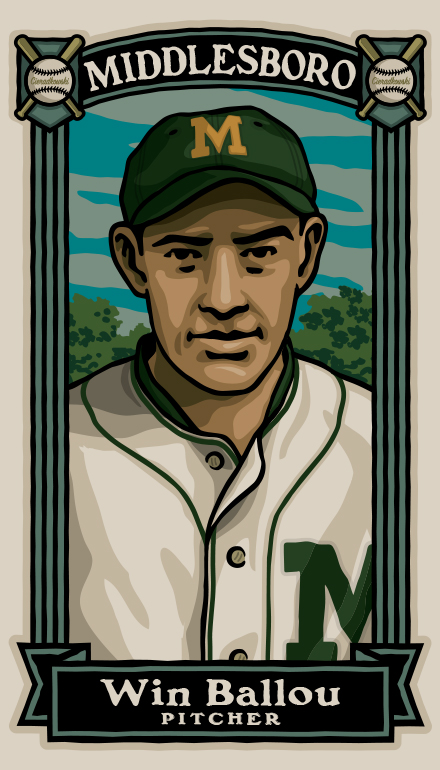
(Blogathon ’16) Gary Cieradkowski: Win Ballou

This guest-post is part of the 2016 Baseball Continuum Blogathon For Charity, benefiting the Roswell Park Alliance Foundation. The Roswell Park Alliance Foundation is the charitable arm of Roswell Park Cancer Institute and funds raised will be “put to immediate use to increase the pace from research trials into improved clinical care, to ensure state-of-the-art facilities, and to help improve the quality of life for patients and their families.” Please donate through the Blogathon’s GoFundMe page. Also, please note that the opinions and statements of the writer are not necessarily those of the Baseball Continuum or it’s webmaster.

winSince I was a kid, I was always more fascinated with baseball’s “small stories”. While guys like The Babe and Hank Aaron have great stories, I gravitated towards the players you don’t find in the record books. For every Walter Johnson there were hundreds of players who toiled anonymously. Each one had a unique and often interesting story to tell. This is one of those “small stories”.

Back during the teens and twenties, professional teams would schedule exhibition games against small town semi-pro teams to both generate revenue and scout young ball players. When the minor league Chattanooga Lookouts came to Middlesboro, Kentucky in 1920 to play the local nine, they expected an easy win. Unfortunately this small Kentucky town possessed a secret weapon named “Win”.

Noble Winfred Ballou was a recent Eastern Kentucky University grad from Mount Morgan. By the time he pitched and beat Chattanooga that day, Win had earned a reputation as a pitcher for hire who lived up to his name. Like many other young ball players, each weekend Win Ballou suited up for a few different town or factory teams, a temporary superstar brought in to even the odds or settle once and for all a heated town rivalry.

After Chattanooga’s loss, their manager tried his best to sign Ballou, but the pitcher’s friends convinced him to remain in Kentucky. Later that summer, Chattanooga’s manager secretly arranged for a town farther away to hire Ballou. Separated from his friends, the young pitcher was convinced to sign a professional contract.

The Washington Senators brought Ballou up to the majors at the end of the 1925 season, and within weeks he was pitching in the World Series against the Pirates. Ballou jumped around from the Senators to the Browns and finally the Dodgers before he was returned to the minors in 1930. Playing in the Pacific Coast League, Ballou found his niche as a relief pitcher, one of the first to perfect that role. A fan favorite and nicknamed “Old Pard” because of his age and reliability, Ballou pitched for the Los Angeles Angels and San Francisco Seals until he was 45. When Win Ballou passed away in 1963 he was admiringly eulogized in the West Coast newspapers as a beloved fixture of West Coast baseball.

Ol’ Win Ballou didn’t set any records, nor did he leave any mark on the history of the game besides some forgotten box scores. Yet it’s guys like Win who make the history of the game fun. Imagine what he must have felt like – a kid reluctant to leave to hills of his native Kentucky and just a few years later pitching in a World Series! Sure it’s a small story, but it’s those small stories that combine to make up the greatest game ever invented.

Gary Joseph Cieradkowski is the artist and writer behind The Infinite Baseball Card Set blog and the book “The League of Outsider Baseball: An Illustrated History of Baseball’s Forgotten Heroes“. He is also the 2015 recipient of the Tony Salin Award for contributions to baseball history. An award winning graphic artist and illustrator, chances are you have visited or bought something he designed: Bicycle Playing Cards, the music department of Barnes & Noble, the Folgers Coffee can, and the graphics for Oriole Park at Camden Yards, still regarded as the best designed ballpark in the Majors. Growing up a New York Mets fan in the 1970s, Gary learned to live with pain and disappointment until he married his beautiful wife Andrea. The two live happily in Northern Kentucky, unless they discuss the merits of the designated hitter rule. You can visit his blog at www.infinitecardset.blogspot.com.

This guest-post is part of the 2016 Baseball Continuum Blogathon For Charity, benefiting the Roswell Park Alliance Foundation. The Roswell Park Alliance Foundation is the charitable arm of Roswell Park Cancer Institute and funds raised will be “put to immediate use to increase the pace from research trials into improved clinical care, to ensure state-of-the-art facilities, and to help improve the quality of life for patients and their families.” Please donate through the Blogathon’s GoFundMe page. Also, please note that the opinions and statements of the writer are not necessarily those of the Baseball Continuum or it’s webmaster.
(Blogathon ’16) CONTINUUM CLASSIC: 2007 AAA BASEBALL HEROES

This piece from the blog’s archives is part of the 2016 Baseball Continuum Blogathon For Charity, benefiting the Roswell Park Alliance Foundation. The Roswell Park Alliance Foundation is the charitable arm of Roswell Park Cancer Institute and funds raised will be “put to immediate use to increase the pace from research trials into improved clinical care, to ensure state-of-the-art facilities, and to help improve the quality of life for patients and their families.” Please donate through the Blogathon’s GoFundMe page.

Originally published June 19, 2013.

In Bizarre Baseball Culture, I take a look at some of the more unusual places where baseball has reared it’s head in pop culture and fiction.

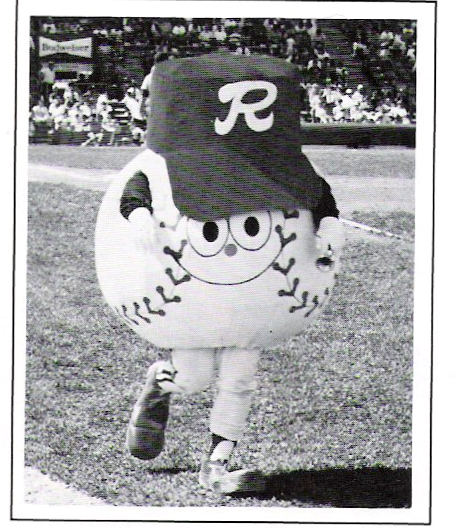
I warned you. I told you it was coming. You could have gone away, but, no, you had to go and actually come here and read this installment of Bizarre Baseball Culture. This is a very special Bizarre Baseball Culture, as, for the first time, it’s something that I actually have in my very small personal collection of comic books. You see, in 2007, each Triple-A baseball team had a day celebrating superheroes, and as a giveaway, there was this comic:

2007GiveawayComic copyAnd, as you can probably guess, I was at that game and got the giveaway. And so, it sat in a drawer for almost seven years, ignored. Until today. Yes, true believers, tremble and prepare yourself for the 2007 edition of Triple-A Baseball Heroes, featuring the superheroes of Marvel Comics.

Now, a few notes before we get going here:

  • All of the images in this post were scanned by yours truly, and any problems with the quality of the images are my fault.
  • All characters and logos in the comic are property of their respective owners (such as Marvel Comics or Minor League Baseball). The excerpts from this comic used in this post are being used under fair use doctrine and are meant merely to support and enhance the opinions and facts stated in said post.
  • Click on any of the images to make them bigger.
  • To the best of my knowledge, the only way to get this comic nowadays is to find it on eBay or have gone to the games that had them released.

Now, go below the jump for the rest of the post:

Continue reading

(Blogathon ’16) Rochester Red Wings Programs of the Past: 1990

This post is part of the 2016 Baseball Continuum Blogathon For Charity, benefiting the Roswell Park Alliance Foundation. The Roswell Park Alliance Foundation is the charitable arm of Roswell Park Cancer Institute and funds raised will be “put to immediate use to increase the pace from research trials into improved clinical care, to ensure state-of-the-art facilities, and to help improve the quality of life for patients and their families.” Please donate through the Blogathon’s GoFundMe page.

The 1990 Rochester Red Wings program was, in a word, a bit boring, at least relative to the previous two I’ve looked at. It is not a giant leap like going from 1981 to 1989, and it doesn’t have anything too weird or amazing either. As a result (and also of my blogathon process with these later posts), this one is a bit shorter than the previous installments.

Still, it definitely has some neat things.

Good Stuff

First off, the cover is fantastic:

90wingscoverThat is a cool looking cover. The Red Wings should bring back artsy covers like this. Nowadays it’s usually a picture. Last year had Miguel Sano on it prominently… and then he skipped Rochester entirely. Whoops.

With the new decade, the Rochester Red Wings decided to take a look back at the 80s with an article by Josh Lewin (now the radio announcer for the Mets and Chargers, who I covered a bit on in the 1989 program lookback) that included this snippet:

90wingspieceoflewin80slookbackIt’s sort of odd that three of the five most memorable games of the 1980s were losses.

Also nice is that they finally gave the mascot his time of day, even if it was Homer, the worst mascot in Red Wings history (not counting the times when they had people dressed up as Indians):

90wingshomerFred Costello’s lists:

R90fredlist

Interesting Stuff:

Brady Anderson:

90wingsbradyJose Mesa:

R90mesaThe Columbus Clippers featuring Kevin Maas, Bernie Williams and Hensley “Bam Bam” Meulens:

R90columbus

Russ Brandon, now the President of the Buffalo Bills, Buffalo Sabres and Rochester Americans, and thus one of the most powerful people in Western NY sports:

Screen Shot 2016-01-29 at 9.43.55 PM

Weird Stuff:

Okay, this Big Bird advertisement is vaguely unsettling: 90wingsbigbirdMaybe it’s the black-and-white printing mixed with Big Bird’s eyes. It’s like he’s looking deep into your soul as he asks if your child has visited his best friend today. Also, why “his”, why not “their”? Jeez, Big Bird, don’t be sexist.

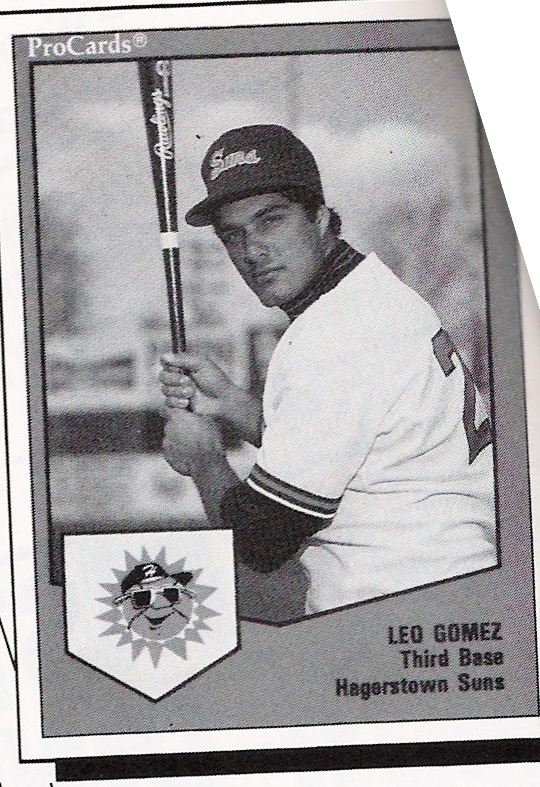
For some reason, some players literally had Hagerstown baseball cards as their profiles, like Leo Gomez here:

R90LeoGomezThe many looks of Josh Lewin:

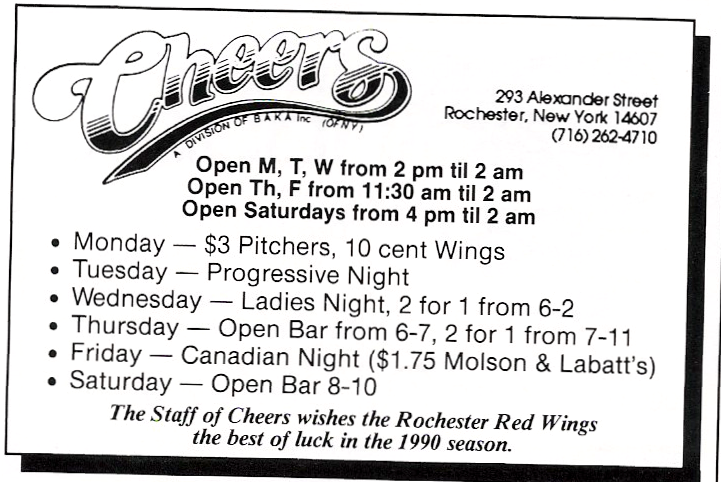
R90lewinWait… Cheers was a chain?

R90cheersFuture Red Wings GM Dan Mason with a mullet:

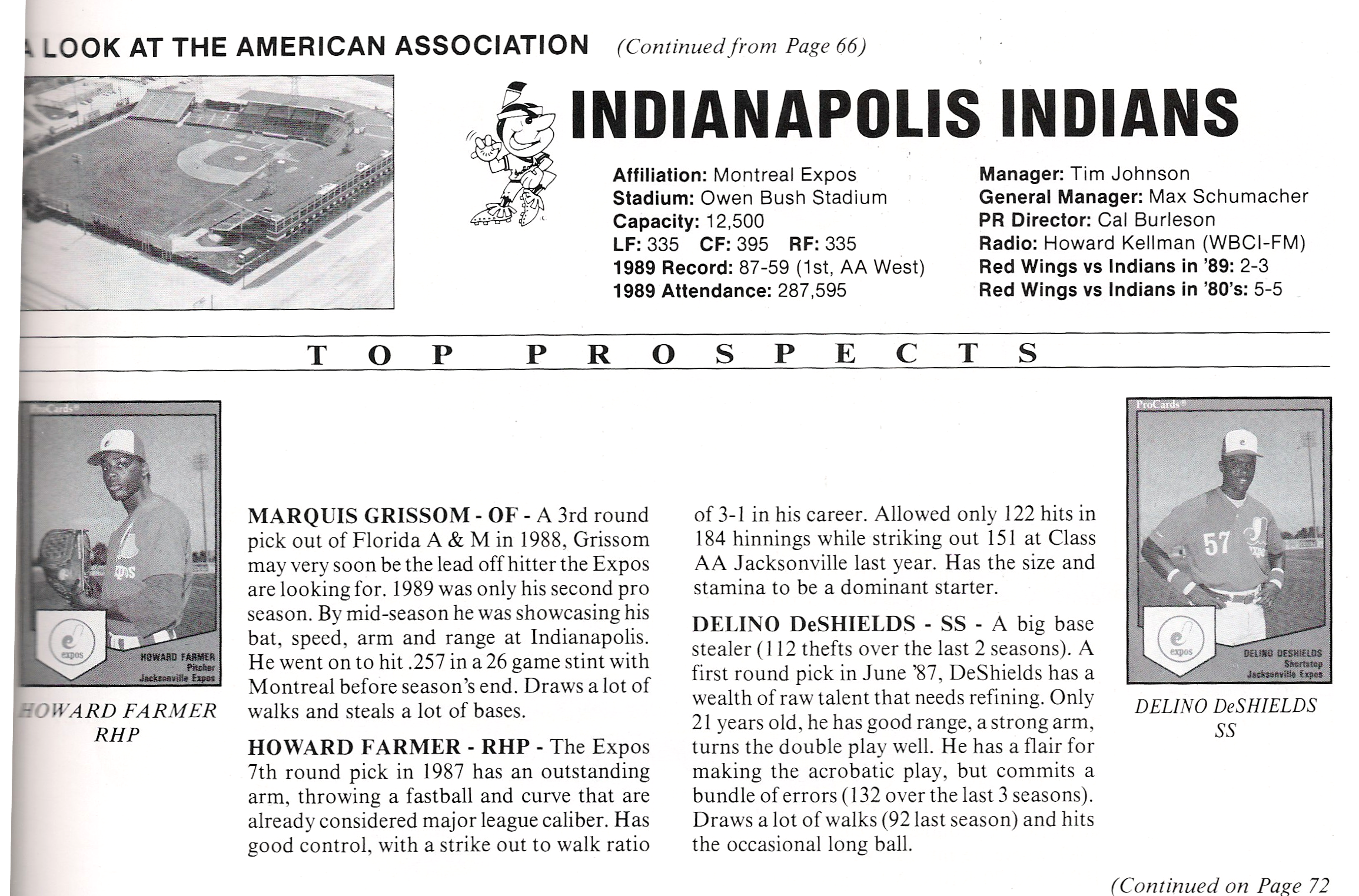
Screen Shot 2016-01-29 at 9.43.42 PMAnd, finally, the horribly racist logo of the Indianapolis Indians (although the rest is pretty cool):

R90indianapolisSo how did the season go? The 1990 Rochester Red Wings, led by Leo Gomez, Chris Hoiles, David Segui and 36-year-old Danny Boone, would go on to win the Governor’s Cup after a 89-56 record. It would be the final Governor’s Cup title in Silver Stadium history.

Next time: 1991

At 11 PM: The worst post ever.

This post has been part of the 2016 Baseball Continuum Blogathon For Charity, benefiting the Roswell Park Alliance Foundation. The Roswell Park Alliance Foundation is the charitable arm of Roswell Park Cancer Institute and funds raised will be “put to immediate use to increase the pace from research trials into improved clinical care, to ensure state-of-the-art facilities, and to help improve the quality of life for patients and their families.” Please donate through the Blogathon’s GoFundMe page.

(Blogathon ’16) First References to Off-The-Field Innovations and Innovators

This post is part of the 2016 Baseball Continuum Blogathon For Charity, benefiting the Roswell Park Alliance Foundation. The Roswell Park Alliance Foundation is the charitable arm of Roswell Park Cancer Institute and funds raised will be “put to immediate use to increase the pace from research trials into improved clinical care, to ensure state-of-the-art facilities, and to help improve the quality of life for patients and their families.” Please donate through the Blogathon’s GoFundMe page.

One of the great perks of SABR membership is access online to The Sporting News’ archives. While it now is dedicated to all sports, for a good chunk of it’s earlier history it was almost entirely focused on baseball. This allows us to see how players, ideas, teams and even countries first got the attention of the baseball press. This time, I take a look at off-the-field innovations and innovators:

Bill James

The first appearance of the founding father of Sabermetrics came in advertising, as he hawked his early Baseball Abstract editions with ads like this one that can be found in the May 14, 1977 edition of Sporting News:

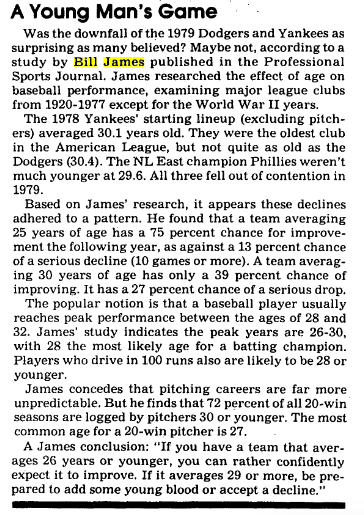
Screen Shot 2016-01-29 at 2.35.32 PMHowever, James’ first appearance in a print story seems to be in this November 10, 1979 snippet about the fall of the ’79 Dodggers and Yankees:

Screen Shot 2016-01-29 at 2.37.20 PMRotisserie Baseball

The first reference to Rotisserie Baseball comes, as far as I can tell, in a advertisement for it in the Feb. 27, 1983 edition of Sporting News:

Screen Shot 2016-01-29 at 2.41.50 PMThe first reference in-story to Rotisserie, as far as I can see, is in a story about Dan Quisenberry from May 19, 1986. He says he knows his poor save stats are letting his roto-owners down:

Screen Shot 2016-01-29 at 2.45.23 PMNote that it’s possible that there were references to “roto” or “fantasy” before this, but I didn’t include them in the search.

Strat-O-Matic

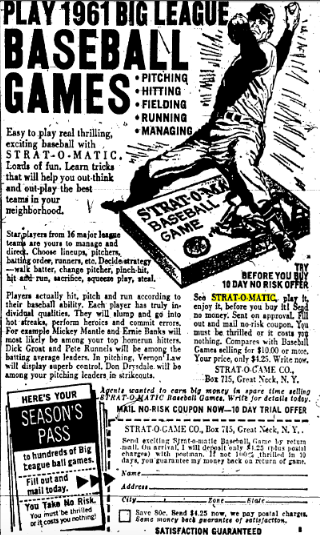
Strat-O-Matic began in 1961 and they put advertising in Sporting News right away, like in this August 23, 1961 ad.

Screen Shot 2016-01-29 at 2.52.32 PMI can’t find the first reference in a story, but it probably happened eventually. Maybe next time…

ESPN

The first reference to ESPN came in a September 22, 1979 column by Dick Young, where he mentioned that Jim Simpson (who passed away recently) was joining the network:

Screen Shot 2016-01-29 at 3.08.44 PMAnd, finally… Bobbleheads:

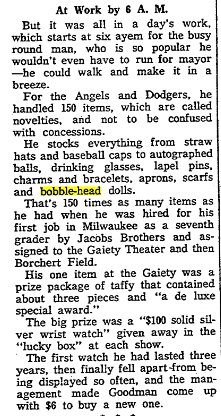
The first reference to bobbleheads comes in a profile of Danny Goodman on October 27, 1962. Goodman was one of the first big souvenir salesmen and was based on the west coast:

Screen Shot 2016-01-29 at 3.16.41 PM

At 7 pm: Breaking OOTP

This post has been part of the 2016 Baseball Continuum Blogathon For Charity, benefiting the Roswell Park Alliance Foundation. The Roswell Park Alliance Foundation is the charitable arm of Roswell Park Cancer Institute and funds raised will be “put to immediate use to increase the pace from research trials into improved clinical care, to ensure state-of-the-art facilities, and to help improve the quality of life for patients and their families.” Please donate through the Blogathon’s GoFundMe page.


(Blogathon ’16!) The Sliding Scale of Fictional Baseball Realism

This post is part of the 2016 Baseball Continuum Blogathon For Charity, benefiting the Roswell Park Alliance Foundation. The Roswell Park Alliance Foundation is the charitable arm of Roswell Park Cancer Institute and funds raised will be “put to immediate use to increase the pace from research trials into improved clinical care, to ensure state-of-the-art facilities, and to help improve the quality of life for patients and their families.” Please donate through the Blogathon’s GoFundMe page.

Earlier today, in my look at Touch, I mentioned that you can make a 0-10 scale of baseball realism in works of fiction, with zero being baseball-in-name-only and ten being actual footage of a game.

Well, I’m going to expand upon that:

0: Baseball In Name Only

In this category, it’s not really baseball at all. They may call it baseball, but it certainly isn’t the actual sport that we know. The Moe Cronin version of baseball fits here.

1: Utterly Absurd

In this category, while it’s clearly meant to be baseball, the rules of the game and the laws of physics have clearly taken a vacation. Some classic cartoons fall into this category.

2: Very Absurd, but still with some realism

In this category, the work might have cartoonish physics and occurrences, but it still is grounded in reality enough to have the rules of baseball still be mostly the same. In theory, a baseball movie where the rules are not consistent or are wildly different but where everything else is played straight could also qualify here. Classic cartoons that aren’t “utterly absurd” usually fall in this category.

3: Absurd, but mostly consistent

Works in this category are clearly absurd and cartoonish, but are at least consistent: the laws of physics may not be what they are in the real world, but they don’t suddenly change mid-game, nor do the rules suddenly change simply because the story demands it. Most “cartoon” baseball video games, like Backyard Baseball and the Mario Baseball series, fit in this category.

4: Many absurd elements

While clearly meant to be a realistic world that has our baseball’s rules and our laws of physics, the amount of absurd, cartoonish or unrealistic elements in the work make it more strange than realistic. Consider Mr. Go, for example, which has two baseball-playing gorillas, a little girl acting as a first-base coach and a finale that involves the baseball coming undone into a million pieces, which sort of overwhelms what would probably otherwise be a 6 if, say, it only had one gorilla.

5: Equal Mix of Realism and Fantasy

A work that sort of teeters between being realistic and being bizarre. This is more of a transitional spot on the scale, as it’s rare that anything ever stays at 5, inevitably going to 4 or 6 instead.

6: Realistic, but with one or two “big lies”

This is mostly realistic but it has one or two big elements (or the equivalent of one or two big elements made up of lots of smaller elements) that keep it from being something that you can honestly expect to ever happen in the real world. Sidd Finch could fit here, as could most of the movies in which a kid becomes a big league skipper or ballplayer.

7: Realistic, but highly unlikely

There’s nothing in this work that couldn’t happen, but it’s highly unlikely and any real event like this would probably instantly become one of the most notable things in baseball history. You could argue that Major League fits here, sort of.

8: Near total-realism

While some rules might be bent or not enforced on a strict basis, and some things might happen that are unlikely (although not nearly as unlikely as things that fall at seven on the scale), this is pretty realistic. Casey At The Bat, the classic poem, could be considered as this, with only the ability of everybody to seemingly hear everything keeping it from being a nine.

9: Utter realism

The only things that are not realistic in works of this category are omnipresent techniques like camerawork and editing for time, or stylish touches added in to indicate, say, that a player is angry. Bull Durham could, in theory, fit in this category, as could most (but not all) fairly true-to-history biopics and most realistic baseball video games.

10: Actual Baseball Footage used/Documentary

If you are watching an actual baseball game, or watching a documentary that uses baseball footage and does so without changing things for dramatic effect, you are watching a 10.


Feel free to consider where on the sliding scale your favorite piece of baseball fiction would fall!

6 PM: First References

This post has been part of the 2016 Baseball Continuum Blogathon For Charity, benefiting the Roswell Park Alliance Foundation. The Roswell Park Alliance Foundation is the charitable arm of Roswell Park Cancer Institute and funds raised will be “put to immediate use to increase the pace from research trials into improved clinical care, to ensure state-of-the-art facilities, and to help improve the quality of life for patients and their families.” Please donate through the Blogathon’s GoFundMe page.


(Blogathon ’16) Musings on AAA Baseball

This post is part of the 2016 Baseball Continuum Blogathon For Charity, benefiting the Roswell Park Alliance Foundation. The Roswell Park Alliance Foundation is the charitable arm of Roswell Park Cancer Institute and funds raised will be “put to immediate use to increase the pace from research trials into improved clinical care, to ensure state-of-the-art facilities, and to help improve the quality of life for patients and their families.” Please donate through the Blogathon’s GoFundMe page.

And now, random musings about AAA Baseball:

AAA baseball is the best baseball in North America outside of the Major Leagues and perhaps certain fall/winter leagues (it varies). This is not in doubt. The athletes who play in cities like Sacramento, Buffalo, Charlotte, New Orleans, and Rochester are some of the best ballplayers on the planet.

However, they are not necessarily the best prospects. This is something often forgotten. Oh, to be sure, many of the best players in the majors have stopped in AAA for at least some time, but the idea that the minors is a ladder where players go up rung by rung is for the most part out of date. The truth is that, with certain exceptions, the vast majority of players in AAA are not prospects anymore, but rather players who have reached or are close to reaching their ceiling, but aren’t good enough to play for their MLB club. AAA has the most accumulated talent outside of MLB, but it doesn’t have the players with potential talent. No, it’s increasingly common that those players with the potential talent skip over AAA, only going back if they get injured or are clearly out of their league in the Majors.

Most people, however, don’t realize that. They still expect that every major prospect will come through, regardless. When Miguel Sano and (for a time) Byron Buxton skipped over Rochester last season, some fans took it as a betrayal. Never mind that, at the time, the Red Wings were pretty set in outfield and third base, or that the two of them were so clearly better than AA that only a fool wouldn’t call them up to the big leagues to help in an unexpected playoff hunt, as the Twins were in.

The solution to this, if there even needs to be a solution (aside from the fact that it might be in baseball’s best interest to have the more-populated cities of AAA see more future stars than the less-populated AA cities, there really isn’t a true problem to be solved), is unknown. Perhaps eliminating the very lowest of the minor leagues- the Arizona and Gulf Coast Leagues, could recombobulate the systems a bit and lead to it becoming more of a rung-by-rung set-up again. Who knows?

Perhaps because of the fact that you are watching the-best-who-aren’t-the-best in front of crowds filled with people just there for beer and/or fireworks, AAA can be a surreal place, especially if you sit behind the visitor’s dugout.

I have heard the late Jose Lima tell a group of half-drunken bros to be polite to the ladies and to remember that kids are around. I have seen Dmitri Young talk down a heckler and then proceed to hit for the cycle on a rehab assignment. I once spent something like 18 innings watching a game with the immortal Corky Miller standing in front of me, his mullet protecting him from a chilly Rochester night.

All of this for the price of a ticket that probably wouldn’t even get you in the door at many MLB stadiums, much less close enough to hear a reliever swear and throw his glove after a bad performance, inevitably leading to Mary, the first lady of the third-base side, telling him that it wasn’t the glove’s fault.

That there is not a Mike Trout Zooperstar is obscene. I mean, c’mon, it’s so obvious.

At one point, Jenny Finch’s husband, Casey Daigle, was a member of the Red Wings. Hopefully their kids get their mother’s arm, because it felt like every time he came on the mound, something bad happened. I don’t know if this is statistically true, but it sure felt like it.

Finally, a story. The Rochester Red Wings are owned by shareholders in the community, the result of lawyer Morrie Silver’s stock drive to buy the team from the Cardinals, who wanted to move the team.

However, I never had been able to get stock. While in practice the shares have no true value, in reality they can be really expensive and it’s really hard to get active shares. This is mainly because many of them have lapsed in the half-century-plus since the stock drive and many that do go up are reportedly bought by the Silver family. In addition, there is the fact that, unlike other community-owned teams like the Packers, there have never been additional sales of stock, which is kind of ridiculous from both a PR standpoint as well as the fact you’d have to imagine that the sales of shares could help fund stadium improvements (this, by the way, is why the Packers did their most recent shares-drive).

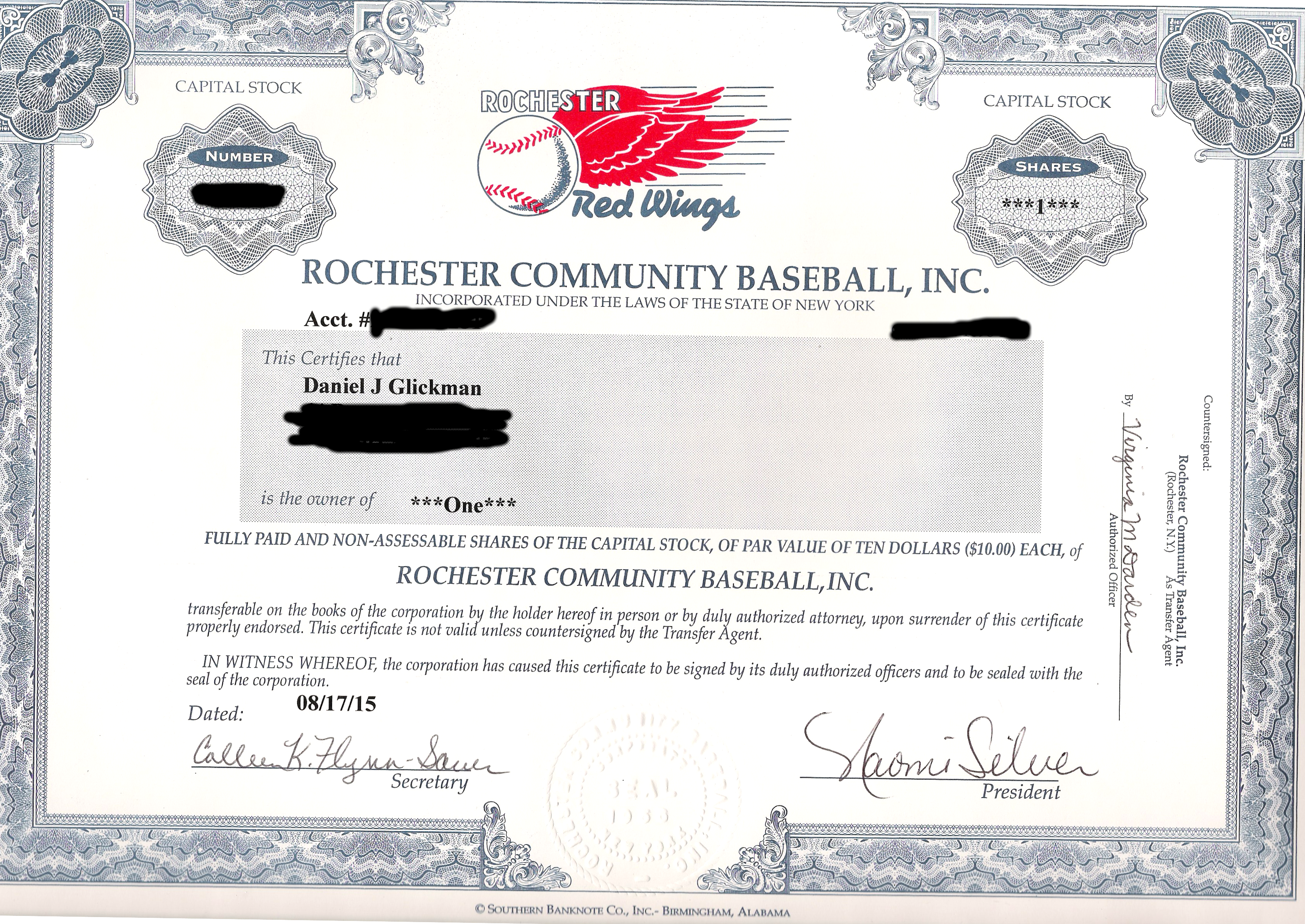
At one point, I thought I’d gotten one, but it turned out that it had expired and been given to the state (in theory I could have gone through New York State to get it back, but that would have required me finding the heir of the guy who had bought it originally and a bunch of other complicated things). But, this past year, I finally got one. I became a owner of Rochester Community Baseball:

RCBstockWhat does it mean? Officially, nothing. One share isn’t enough to get me a personal luxury box, or give me the power to demand that they bring back those Abbott’s Milk Shakes, or even get me a ring if they were to win a Governor’s Cup next season. But it does provide something that is unique about small-city baseball in America: a sense of ownership.

You see, when I go to the ballpark this summer, I’ll be going knowing that, in a very small way, this is my team, my field, and my souvenir cup with Kyle Gibson and Logan Darnell on it (well, that’s what it was last year, probably will be different this year). Fans in St. Louis or Boston can claim they own their favorite team, but they are only speaking in metaphor. For me, it’ll be reality, no matter how small or insignificant that reality is.

And that’s something that AAA will hopefully always have over the majors, no matter how many uber-Prospects jump directly from AA.

(Seriously though, if any Twins front office members are reading this, can we at least have Max Kepler for a month before he gets called up? Please?)

At 5 PM: The Sliding Scale of Fictional Baseball Realism

This post has been part of the 2016 Baseball Continuum Blogathon For Charity, benefiting the Roswell Park Alliance Foundation. The Roswell Park Alliance Foundation is the charitable arm of Roswell Park Cancer Institute and funds raised will be “put to immediate use to increase the pace from research trials into improved clinical care, to ensure state-of-the-art facilities, and to help improve the quality of life for patients and their families.” Please donate through the Blogathon’s GoFundMe page.

(Blogathon ’16) WBC News for January 29, 2016

This post is part of the 2016 Baseball Continuum Blogathon For Charity, benefiting the Roswell Park Alliance Foundation. The Roswell Park Alliance Foundation is the charitable arm of Roswell Park Cancer Institute and funds raised will be “put to immediate use to increase the pace from research trials into improved clinical care, to ensure state-of-the-art facilities, and to help improve the quality of life for patients and their families.” Please donate through the Blogathon’s GoFundMe page.

It’s time for a World Baseball Classic update! With the first qualifiers coming up, more news has started to come out. Let’s take a look at some of the news:

Sydney Qualifying Pool Rosters and Schedules released:

On Wednesday, the rosters and schedules for the Sydney qualifying pool came out. They can be found over here on Baseball America. I’ll have a more thorough preview as we get closer to the event, but it’s definitely a case where Australia should be considered the heavy favorite, full of players with experience in MLB or the Minors. After Australia, it’s a fight for the second spot to face them in a winner-take-all game to get to the main tournament. Clay Rapada is probably the most notable player outside of the Australians, as he will be playing for the Philippines, the country of his father’s birth, before retiring. Former All-Star Jason Bartlett, also of Filipino descent, was also expected to play, but I don’t see him on the roster.

News from other qualifying pools:

As I mentioned last time, the qualifiers, unlike the main tournament, are not events where MLB teams are required to allow 40-man roster players to take part if there’s an overlap with official team acitivites. This will most hurt a team like Mexico, where the Blue Jays are unlikely to allow their three Mexican players from taking part in the March qualifier in Mexicali.

Jon Morosi, one of the best people to follow for WBC news, had information on his Twitter feed on the German team, who will be managed by Garth Iorg (yes, that Garth Iorg). Depending on what difficulties Mexico has, they could be a threat in Mexicali, even with Max Kepler likely skipping as he tries to win a spot on the Twins, they will have Donald Lutz, one of the few Germans with MLB experience.

Bruce Chen, who retired last season, is apparently willing to pitch for Panama.

Other WBC News:

Ozzie Guillen is totally up for managing Team Venezuela in 2017.


And that’s it… for now.

Keep an eye out for more WBC news on the Baseball Continuum as it occurs.

At 9 AM: International Baseball Culture

This post has been part of the 2016 Baseball Continuum Blogathon For Charity, benefiting the Roswell Park Alliance Foundation. The Roswell Park Alliance Foundation is the charitable arm of Roswell Park Cancer Institute and funds raised will be “put to immediate use to increase the pace from research trials into improved clinical care, to ensure state-of-the-art facilities, and to help improve the quality of life for patients and their families.” Please donate through the Blogathon’s GoFundMe page.

(Blogathon ’16!) Related To Somebody Famous For Something Else: Tony Lupien, WWE Star John Cena’s Grandpa

This post is part of the 2016 Baseball Continuum Blogathon For Charity, benefiting the Roswell Park Alliance Foundation. The Roswell Park Alliance Foundation is the charitable arm of Roswell Park Cancer Institute and funds raised will be “put to immediate use to increase the pace from research trials into improved clinical care, to ensure state-of-the-art facilities, and to help improve the quality of life for patients and their families.” Please donate through the Blogathon’s GoFundMe page.

I’m not much of a wrestling fan, but I know a great meme when I see one, and the meme related to WWE Superstar John Cena is a good one:

For those of you who don’t want to watch that, in essence, it is what happens when a completely unrelated scene is suddenly interrupted by the cry of “JOHN CENA!” or “HIS NAME IS JOHN CENA!” and his theme music begins to play. It’s very stupid, but also hilarious.

But, did you know that the “public face” of the WWE is the grandson of a baseball player? And not just any baseball player, but an honest-to-goodness MLB player: Tony Lupien of the 1940s Red Sox, Phillies and White Sox. In fact, the first-baseman even received MVP votes during the depleted years of WWII:

Screen Shot 2016-01-27 at 11.00.11 AMHere are his Minor League stats:

Screen Shot 2016-01-27 at 11.01.46 AMAfter his career, Lupien went on to be manager and coach, including bringing Dartmouth University to the 1970 College World Series. He was also involved- both during and after his career- with the labor movement, including help co-author The Imperfect Diamond, a history of baseball’s labor relations up through the 1970s.

At 8 AM: The start of “International Morning”, several hours of international baseball content

This post has been part of the 2016 Baseball Continuum Blogathon For Charity, benefiting the Roswell Park Alliance Foundation. The Roswell Park Alliance Foundation is the charitable arm of Roswell Park Cancer Institute and funds raised will be “put to immediate use to increase the pace from research trials into improved clinical care, to ensure state-of-the-art facilities, and to help improve the quality of life for patients and their families.” Please donate through the Blogathon’s GoFundMe page.