(Blogathon ’16) Jessica Quiroli- The Minor League Baseball Lawsuit: Wealth vs. the Working Class

This guest-post is part of the 2016 Baseball Continuum Blogathon For Charity, benefiting the Roswell Park Alliance Foundation. The Roswell Park Alliance Foundation is the charitable arm of Roswell Park Cancer Institute and funds raised will be “put to immediate use to increase the pace from research trials into improved clinical care, to ensure state-of-the-art facilities, and to help improve the quality of life for patients and their families.” Please donate through the Blogathon’s GoFundMe page. Also, please note that the opinions and statements of the writer are not necessarily those of the Baseball Continuum or it’s webmaster.

Few things personify living the American Dream better than professional sports.

From poverty to fame and fortune, we’ve learned their remarkable stories, and drawn inspiration from them. Willie Mays was the son of a steel mill worker, and the grandson of a sharecropper. Joe Namath’s grandfather came to Ellis Island from Hungary, and he too, and later his son, worked in the steel and coal mills. LeBron James was raised by a single mother, who became pregnant when she was sixteen, then worked tirelessly to make ends meet. James credits her for his success and wealth. It was their specialness, their rare physical talents and physicality that led them there. Many make it, but many, many more fall through the cracks.

In baseball, the trick is not falling through the cracks. The minor leagues are made up of a few thousand players and player cuts are common. Reaching the majors isn’t. The minor leagues are the workshop, where players must condition their bodies and minds to play every day, and not burn out, or fall behind, because the next guy is trailing you and ready to replace you. The odds aren’t great they’ll see major league time for more than a few days or weeks, if at all. A Mother Jones study found that just 10% of minor league players make it to the major leagues. That stacked-with-odds challenge is one player’s commit themselves to. They room together, live with host-families; they take their meal-money per diem, $25 a day, compared to major leaguers who receive $100 a day. Minor league players start out making $1,100 a month in the salary pyramid.

Being major league-ready and transitioning to the highest level of the game is one part of the developmental experience. Add to that the challenge of remaining healthy and strong, well-fed, rested and able to care of themselves and anyone depending on them.

In December of 2014, at the annual Baseball Winter Meetings, Stan Brand, the VP of Minor League Baseball, delivered a speech addressing a lawsuit filed against MLB regarding wage and labor issues, Senne vs. the Office of the Commissioner of Baseball. The meetings, a mix of social and professional engagement, are conducted with a drink in hand if you choose, as major trades are made and breaking news emerges from a high-end hotel full of players, ex-players, executives, reporters and those hoping to get in the business. Some attendees are just fans hoping to catch a glimpse of the action.

But as the usual business dealings transpired at the 2014 gathering, another story rose to the surface. Brand came forward to explain MiLB’s stance on the lawsuit. Baseball America’s Josh Leventhal reported Brand’s comments.

“In the coming year, we will be seeking legislation to clarify that professional baseball players are not covered by these federal wage and hour laws. Just as we did in the 1990s to save the antitrust exemption, we will need your help to explain to our legislators the importance of minor league baseball and their communities’ investments…I do not want to overstate the threat this suit presents, but I think my honest assessment is that it is equally perilous for our future…I will ask you to heed the clarion call, man the battle stations and carry the message to Congress loudly and clearly.”

Of Note: Major league players make a minimum of $84,000 a year. Minor league players make a maximum $2,150. Major League Baseball makes more than $8 million dollars annually, with the major league salary rising 2,500 percent in the last forty years. Minor league salaries have increased 75 percent.

The lawsuit was filed by three former minor league players, with the intention of applying the terms of the Fair Labor Standards Act to minor leaguers. But to this point, MLB has an antitrust exemption. The lawsuit later expanded to include 34 former minor league players.

Brand could prove to be a tough opponent. A lawyer with a wealth of experience dealing with lobbyists and politicians is well-known in Washington, DC where he’s litigated cases for forty years, including Supreme Court cases. He clarified that, in major league baseball, minor leaguers must know their place. They weren’t expected to rise up and disrupt the framework of the minor league business model, but to continue working as contributors to the wealth that eludes them. Brand’s speech presented minor leaguers as an enemy among them in baseball. His determination to protect the financial interests of Major League Baseball, in effect, established an us-against-them class war.

Leventhal filed a second report for Baseball America in April of 2015, in which Brand “contends that playing minor league baseball was never meant to be a career.” Leventhal wrote that Brand likened playing in the minors to an internship.

The corporate system of Major League Baseball seems impenetrable, but Garrett Broshuis emerged as a willing fighter. The former San Francisco Giants minor leaguer, a pitcher and 5th round pick in 2004 retired from professional baseball and began practicing law. He’s not just one of the players that took part in the original filing; he’s also representing them collectively.

Broshuis responded to Brand’s winter meetings comments, laughing at first, amused or baffled, maybe both, then, after some thought, sought to describe Brand’s stance.

“It’s fear-mongering,” Broshuis said by telephone in mid-January. “It’s inconceivable that a $10 billion dollar a year business is lobbying congress for an exemption.”

They’re men without a union. The powerful MLBPA, with all its protections can wield power in any number of situations, making sure major leaguers are treated fairly and reap the financial benefits of their work.

Brand first portrayed the minor leaguers suing as some kind of outlaws wreaking havoc on a quiet town. He later tried to sell an idea that minor leaguers are comparable to college interns. For the numerous players who went to college and proudly don the cap of the major league team that’s drafted them for the cameras, that’s often news to them. The minor leagues are for developmental time, acting as a unique step ladder to the majors. But they are no amateur hours. And the interns are in the office.

With the annual earnings MLB pulls, working class baseball fans aren’t likely to deeply sympathize with MLB and view it as a sacred institution being threatened by big bad minor leaguers making meal money. Sure, some fans scoff at minor league players asking for more, viewing them as spoiled. But if they regard them within the context of major league greed, maybe they’d see the fight differently. They might see themselves in those guys, working for a giant, money-making company where thousands of employees make a miniscule percentage of those at the top.

All of this doesn’t rest on Brand’s shoulders, however. He’s the voice of the cause, not the leader. Fans know that MLB is full of corporate greed. They knew when they learned that MLB was a willing participant in the use of steroids in the game, by doing little to nothing to stop the problem. Had they done anything, they would’ve risked losing a cash windfall from fans high with baseball fever in the late 1980’s, and throughout the 90’s.

Brand’s speech simply served as a reminder of what’s been proven. But this time, there were no gods of baseball being torn down. Players with little money and an uncertain future were being belittled, ridiculed and shamed. Brand’s word choice made the face of this fight the Grinch, or, perhaps, that fictional hero of Wall Street, Gordon Gekko. Brand could’ve easily bellowed, ‘Greed is good, now let’s play ball!’

Gleaning the meaning behind his words isn’t so tough: minor league players are worthless.

Minor league teams are worth everything. The players are the component, the trusty cog, which allows MLB to continue to adding increasing its considerable wealth. We’re given to understand that minor league baseball players, by asking for a living wage, would hurt the community, the employees in the stadium they play in, and the entire way baseball’s run. Minor League Baseball is a community-driven enterprise. Hurt the system as it is, hurt the community. Essentially, they’d ruin everything.

One player, speaking on the condition of anonymity, reached out privately the same January weekend that Broshuis spoke about the lawsuit.

“I need to make sure that if I do sign up that it would not affect my opportunity to play in the big leagues, or have me being released because of it,” he said.

MLB’s powerful hand has to be a driving factor for any players considering, then re-considering, joining the lawsuit. Why risk it? They might ask themselves. The players fighting for a fairer wage aren’t making millions and have no sense of job security. Those high-ranked players can clearly see the payday. They aren’t treated as disposable.

“I’ve considered it. The amount we get paid is deplorable,” the player said.

But he points out that that’s not enough for him to join. He indicated uncertainty about how the outcome would impact teams and players. Knowing the truth might not be enough to motivate players to put themselves on the front lines.

“I’ve felt mistreated. But I think that’s the reason so many guys push themselves to get better [and] get out of the minors. It almost acts as motivation for us to move up as quickly as we can,” he said, then continued, “even though that’s not up to us. It’s survival of the investments teams make, and who can help them now. It’s cutthroat. But it’s a business.”

And business is good.

As reported in a 2015 report by Lindsay Kramer, minor league baseball drew the third-highest attendance in its history, also marking the 11th consecutive year MiLB drew over 41 million fans.

The driving force of the community-driven entertainment of minor league baseball is based on the tested theory that if you build a stadium, employment will come. When a stadium’s built, or a team affiliate is established or moved, the hope is that fans will show up for an affordable summer activity. For families, particularly those with multiple kids, seeing a sporting event for less than twenty dollars is a very big deal. It relieves parents of the school’s-out dilemma, and allows them to see a baseball game with their kids. If all goes well, a major league player’s injury could lead to his rehab at the stadium they’re attending. Oddly put, but a rehab appearance by a top player in the majors draws crowds. Maybe a young kid’s never seen his favorite player in a big league game outside of on TV. In the minor leagues, he or she not only gets a glimpse, but an intimate one.

A minor league team as a business works for many, including interns gaining experience working in professional sports and executives looking for a foot in the door. The players, for their part, suit up and play the game. They fit in the business model that serves families and communities. They work for everyone else’s families, but struggle to support their own or even themselves.

“For the long term, we should all be able to come to the table and strike an agreement,” Broshuis said.

The business is clicking along, a well-oiled machine in no danger of losing fuel. The rich definitely get richer. The poor, well, they stay the same, get poorer, or try to figure out a new way. Soon, retirement is unavoidable; maybe before the age of thirty. Few can become those icons of sports history, Mays, Namath or James. Few can make it to even elite status. But minor league baseball players know what they’re up against. At a certain point, just surviving and getting a uniform must be preferable to giving up the dream altogether.

Many play out their professional careers, notable, known, and with a considerable amount to retire with. Many, many, many more scrap, scrape, hope, and work to get the hell out of the minors, with even the possibility of a cup of coffee in the majors often a glimmer. Those are the players Broshuis is fighting for; brandished as trouble-makers.

A scout once said something about the minor leagues while standing in the press box of then Waterfront Stadium, home of the Trenton Thunder. Watching the game, with a distant look in his eyes, without arrogance or joy, he said. “The top prospects need guys to play with.” It was a clarifying moment, impossible to forget. That’s the reality.

Broshuis described the process as now in the “discovery phase”, the longest portion of building a case.

A few weeks after initially speaking, in response to follow-up questions, the player who’d requested anonymity said he was still on the fence about joining the lawsuit, explaining that he had to be “careful.”

“I haven’t decided,” he said. “I’m an outsider in professional baseball.”

Broshuis said that they’re now in the “discovery phase”, the longest portion of building a case. The trial is set for February 2017. The outsiders, those rabble-rousers looking for a living wage, will have their day in court.

Jessica Quiroli is a Minor League Baseball writer/reporter and the creator of ‘Heels on the Field: A Minor League Blog‘. Her work has appeared on MiLB.com and FanGraphs and in Junior Baseball Magazine. She is also the screenwriter of the so-far-unfilmed screenplay, “Minor League Guys.

This guest-post has been part of the 2016 Baseball Continuum Blogathon For Charity, benefiting the Roswell Park Alliance Foundation. The Roswell Park Alliance Foundation is the charitable arm of Roswell Park Cancer Institute and funds raised will be “put to immediate use to increase the pace from research trials into improved clinical care, to ensure state-of-the-art facilities, and to help improve the quality of life for patients and their families.” Please donate through the Blogathon’s GoFundMe page. Also, please note that the opinions and statements of the writer were not necessarily those of the Baseball Continuum or it’s webmaster.
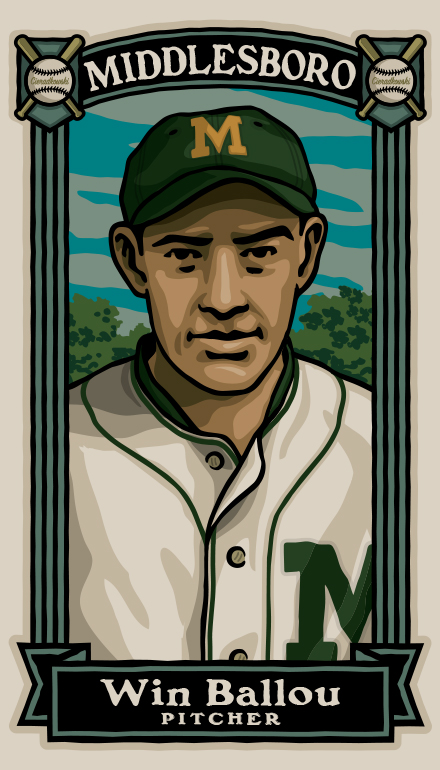
(Blogathon ’16) Gary Cieradkowski: Win Ballou

This guest-post is part of the 2016 Baseball Continuum Blogathon For Charity, benefiting the Roswell Park Alliance Foundation. The Roswell Park Alliance Foundation is the charitable arm of Roswell Park Cancer Institute and funds raised will be “put to immediate use to increase the pace from research trials into improved clinical care, to ensure state-of-the-art facilities, and to help improve the quality of life for patients and their families.” Please donate through the Blogathon’s GoFundMe page. Also, please note that the opinions and statements of the writer are not necessarily those of the Baseball Continuum or it’s webmaster.

winSince I was a kid, I was always more fascinated with baseball’s “small stories”. While guys like The Babe and Hank Aaron have great stories, I gravitated towards the players you don’t find in the record books. For every Walter Johnson there were hundreds of players who toiled anonymously. Each one had a unique and often interesting story to tell. This is one of those “small stories”.

Back during the teens and twenties, professional teams would schedule exhibition games against small town semi-pro teams to both generate revenue and scout young ball players. When the minor league Chattanooga Lookouts came to Middlesboro, Kentucky in 1920 to play the local nine, they expected an easy win. Unfortunately this small Kentucky town possessed a secret weapon named “Win”.

Noble Winfred Ballou was a recent Eastern Kentucky University grad from Mount Morgan. By the time he pitched and beat Chattanooga that day, Win had earned a reputation as a pitcher for hire who lived up to his name. Like many other young ball players, each weekend Win Ballou suited up for a few different town or factory teams, a temporary superstar brought in to even the odds or settle once and for all a heated town rivalry.

After Chattanooga’s loss, their manager tried his best to sign Ballou, but the pitcher’s friends convinced him to remain in Kentucky. Later that summer, Chattanooga’s manager secretly arranged for a town farther away to hire Ballou. Separated from his friends, the young pitcher was convinced to sign a professional contract.

The Washington Senators brought Ballou up to the majors at the end of the 1925 season, and within weeks he was pitching in the World Series against the Pirates. Ballou jumped around from the Senators to the Browns and finally the Dodgers before he was returned to the minors in 1930. Playing in the Pacific Coast League, Ballou found his niche as a relief pitcher, one of the first to perfect that role. A fan favorite and nicknamed “Old Pard” because of his age and reliability, Ballou pitched for the Los Angeles Angels and San Francisco Seals until he was 45. When Win Ballou passed away in 1963 he was admiringly eulogized in the West Coast newspapers as a beloved fixture of West Coast baseball.

Ol’ Win Ballou didn’t set any records, nor did he leave any mark on the history of the game besides some forgotten box scores. Yet it’s guys like Win who make the history of the game fun. Imagine what he must have felt like – a kid reluctant to leave to hills of his native Kentucky and just a few years later pitching in a World Series! Sure it’s a small story, but it’s those small stories that combine to make up the greatest game ever invented.

Gary Joseph Cieradkowski is the artist and writer behind The Infinite Baseball Card Set blog and the book “The League of Outsider Baseball: An Illustrated History of Baseball’s Forgotten Heroes“. He is also the 2015 recipient of the Tony Salin Award for contributions to baseball history. An award winning graphic artist and illustrator, chances are you have visited or bought something he designed: Bicycle Playing Cards, the music department of Barnes & Noble, the Folgers Coffee can, and the graphics for Oriole Park at Camden Yards, still regarded as the best designed ballpark in the Majors. Growing up a New York Mets fan in the 1970s, Gary learned to live with pain and disappointment until he married his beautiful wife Andrea. The two live happily in Northern Kentucky, unless they discuss the merits of the designated hitter rule. You can visit his blog at www.infinitecardset.blogspot.com.

This guest-post is part of the 2016 Baseball Continuum Blogathon For Charity, benefiting the Roswell Park Alliance Foundation. The Roswell Park Alliance Foundation is the charitable arm of Roswell Park Cancer Institute and funds raised will be “put to immediate use to increase the pace from research trials into improved clinical care, to ensure state-of-the-art facilities, and to help improve the quality of life for patients and their families.” Please donate through the Blogathon’s GoFundMe page. Also, please note that the opinions and statements of the writer are not necessarily those of the Baseball Continuum or it’s webmaster.

(Blogathon ’16) Alex Skillin: Are we entering the Golden Age of Shortstops?

This guest-post is part of the 2016 Baseball Continuum Blogathon For Charity, benefiting the Roswell Park Alliance Foundation. The Roswell Park Alliance Foundation is the charitable arm of Roswell Park Cancer Institute and funds raised will be “put to immediate use to increase the pace from research trials into improved clinical care, to ensure state-of-the-art facilities, and to help improve the quality of life for patients and their families.” Please donate through the Blogathon’s GoFundMe page. Also, please note that the opinions and statements of the writer are not necessarily those of the Baseball Continuum or it’s webmaster.

Few positions on a baseball diamond come with as much acclaim and scrutiny as shortstop. The shortstop is the so-called “captain of the infield,” a performer whose glove does much of the talking, and, from little league all the way up to the pros, often the best player on the team.

That hasn’t been the case in the majors of late. In fact, the shortstop position has been in a sorry state for some time, especially at the plate. In 2014, MLB shortstops hit a collective .251/.306/.363, and while some of that can be attributed to the decline in offense throughout the league, the days of shortstops starring with the glove and the bat felt like a distant memory. Nearly 15 years after Derek Jeter, Alex Rodriguez and Nomar Garciaparra formed an exciting, young triumvirate, the bar for sticking at the position had sunk very low.

Yet this past season provided reason to believe that the state of the shortstop in MLB is primed to improve considerably. The impressive debuts of rookie Carlos Correa and Francisco Lindor and the rise of Xander Bogaerts gives the league three young shortstops who look likely to excel for quite some time. Indeed, Correa, Lindor and Bogaerts conjure up recollections of that Jeter, A-Rod and Nomar trio, and their budding potential could make shortstop a position filled with promise once again.

Correa might just have the brightest future of the bunch after enjoying one of the more impressive rookie debuts in recent memory. In 99 games, Correa batted .279/.345/.512 with 22 home runs, and his call-up to the majors in June bolstered the Astros’ playoff push. That he turned 21 years old in September makes his inaugural campaign all the more remarkable. Just over three years after graduating high school and being taken with the No. 1 overall pick, Correa helped lead Houston to the brink of an ALCS berth before the Royals and their #devilmagic intervened.

Considering his performance at such a young age, Correa should have a few more chances to carry the Astros deep into October. One can only imagine what he’ll do over a full season in 2016.

Lindor’s glove had long been praised down in the minors, and given his extended status as one of the game’s top prospects, Cleveland fans had long-awaited his arrival. That day came on June 14 (he debuted less than a week after Correa), but the most surprising part of Lindor’s rookie year was his production in the batter’s box. The Puerto Rican native hit .313/.353/.482 with 38 extra-base hits over 438 plate appearances, and less surprisingly, his defense proved as stellar as expected. Lindor’s all-around play helped the Indians turn their season around and nearly claim a Wild Card berth.

Despite playing in just 99 games, he finished with the second-highest fWAR among shortstops in baseball at 4.6. If he can show his offensive output was no fluke, Lindor’s future potential looks even better than expected.

A relative veteran compared to Correa and Lindor, Bogaerts finally began fulfilling that long-hyped promise in 2015. After struggling in his first full season, Bogaerts bounced back to bat .320/.355/.421 this past year and finished third in the major leagues in hits with 196. Even more encouragingly, the 23-year-old improved mightily on defense and now looks likely to stick at the position for years to come.

That’s good news for the Red Sox and the shortstop position as a whole. For despite his meager home-run totals in 2015, Bogaerts, like Correa, has the chance to hit for the type of middle-of-the-order power rarely seen in shortstops.

There are plenty of other young shortstops to get excited about too, of course. Addison Russell held his own for the Cubs at the age of 21, and Corey Seager earned a starting job after the Dodgers called him up late in the season. Down in the minors, moreover, some of the game’s top prospects look set to follow in the footsteps of Correa, Lindor and Bogaerts. Players like J.P. Crawford, Orlando Arcia, Tim Anderson and Raul Mondesi Jr., among others, could soon become household names and indicate the position won’t be lacking for young talent in the coming years.

And all the different places these players come from demonstrate how much the game has grown over the past couple decades. Both Correa and Lindor were born and raised in Puerto Rico before being selected in the draft, while the Red Sox signed Bogaerts out of Aruba. Crawford, Seager and Anderson all grew up in the U.S., but Arcia and Mondesi Jr. were both signed as international free agents out of Venezuela and the Dominican Republic respectively.

That’s a wide swath of talent teams now have access to, and it’s beginning to pay dividends for the shortstop position and MLB as a whole. Given all the talented prospects that debuted in the majors last season, the rise of so many precocious shortstops is likely no coincidence. In a league now filled with promising, young stars, no position may have a brighter future than shortstop.

Alex Skillin writes about baseball for The Hardball Times and the Red Sox at Over the Monster and BP Boston. His work has previously appeared at SB Nation, Sports on Earth, The Classical, Beyond the Box Score and in The Hardball Times Annual. You can follow him on Twitter at @AlexSkillin.

This guest-post has been part of the 2016 Baseball Continuum Blogathon For Charity, benefiting the Roswell Park Alliance Foundation. The Roswell Park Alliance Foundation is the charitable arm of Roswell Park Cancer Institute and funds raised will be “put to immediate use to increase the pace from research trials into improved clinical care, to ensure state-of-the-art facilities, and to help improve the quality of life for patients and their families.” Please donate through the Blogathon’s GoFundMe page. Also, please note that the opinions and statements of the writer were not necessarily those of the Baseball Continuum or it’s webmaster.

(Blogathon ’16) Patrick Dubuque: A Ghost Among Cardboard

This guest-post is part of the 2016 Baseball Continuum Blogathon For Charity, benefiting the Roswell Park Alliance Foundation. The Roswell Park Alliance Foundation is the charitable arm of Roswell Park Cancer Institute and funds raised will be “put to immediate use to increase the pace from research trials into improved clinical care, to ensure state-of-the-art facilities, and to help improve the quality of life for patients and their families.” Please donate through the Blogathon’s GoFundMe page. Also, please note that the opinions and statements of the writer are not necessarily those of the Baseball Continuum or it’s webmaster.

Baseball cards are a kind of clumsy yearbook, a collection of forgotten names and awkward photographs. Each bears a moment frozen unnaturally, the cheesy portrait grin followed by the unnatural, bent-back elbow of the pitcher. They demonstrate the historian’s drive to squeeze the eyes tight and remember: not only the championships, not only the highlights and the heroes, but the busted prospects and the utility infielders. All the losing teams and players get their 1/nth share.

GAC1But no set has room for every player, let alone every moment; there are too many minor league callups, too many injury replacements who come and go. Topps neglected to create a Ken Griffey, Jr. rookie card in 1989, his having no major league experience, but picked Mark McGwire out of the Olympic roster two years before anyone else. Rookies are hard to predict, but guessing the right ones, giving kids a whale to hunt, is good salesmanship.

It’s a little strange that, given the parabolic path of the average career, a player’s most valuable card is generally his first one, and always descends from there. Perhaps in our hearts, all rookies are Babe Ruth or Cy Young until time gives them the opportunity to prove otherwise. Perhaps it’s our drive to feel like investors, to get in on the ground floor. But while rookie cards are traded and sold at a premium, the opposite, the last cards, rarely even exist.

There’s no real pattern as to who gets a final stat line. Mantle got a final card in 1969, but Aaron was left off of the 1977 set; Mays got a card in 1974, but not his own, only a World Series highlight, his bat looking heavy in his hands. It’s a common paradox for baseball cards: representing the year before, they’re sold the year after. So many retired players, no longer around to root for on summer afternoons, rarely have their final year’s stats commemorated. Some of it is timing in the print runs; some of it, one assumes, is alchemical.

GAC2There’s a variation in one of the 1988 Topps checklists. You couldn’t be blamed for missing it: one line has been changed, #455, Steve Carlton. The Hall of Famer was cut from the set at the last second, replaced by orange chip prospect Shawn Hillegas.

Lefty was essentially done by 1986; starting the year with the Phillies, he was cut just shy of 4,000 strikeouts, and signed with the Giants to reach the milestone. When they gave up on him as well, he moved on to the White Sox, and pitched just well enough to latch on to a last-place Indians ballclub in the offseason. Topps dutifully gave him three different cards with three different teams: a White Sox regular 1987 issue, an Indians traded issue, and a Giants box-bottom highlight card (his jersey and cap painted on him, since no photographer caught up with him in his six-game San Francisco career). Perhaps it was too much.

Apparently in 1988, Topps had had enough, and even though he put in 150 innings with the Indians and Twins, and refused to retire even then, they decided to ignore his sad final full season. Fleer alone, of the Big Four companies of the time, gave Carlton a final card. It proved a fitting tribute. It’s a strangely tragic still life, an old man in a foreign uniform on an empty bench, staring off camera at the rest of his life. He looks speechless.

GAC3Did Carlton deserve that final card more than Hillegas and his 58 innings of middle relief? It seems strange that an industry couched so deeply in nostalgia flinches at the final sad days of a ballplayer. Maybe Topps didn’t want that last image of Hall of Famer Steve Carlton, throwing slop down the middle of the plate, to burn into our retinas. And maybe it’s a good thing they stop making yearbooks after high school. But sports aren’t about what we want to have happen; they don’t let us choose our memories. Only rain can undo a game.

It’s ironic that Griffey’s own denouement, twenty-some years later, proved just as tragic as Carlton’s. And like Lefty, he too failed to receive that final card when he closed his own career midseason. But while it requires extrapolation to combine that Griffey with the one of our childhood, we all do it; we can appreciate them all as one man. Heroes can be young and old at the same time, even frail and human. Carlton’s weary despair, caught on a single, worthless card, is every bit as much baseball as Griffey’s boyish smile.

Patrick Dubuque co-edited the 2016 BP Annual and serves as jester/editor at Lookout Landing. You can follow him on Twitter @euqubud.

This guest-post has been part of the 2016 Baseball Continuum Blogathon For Charity, benefiting the Roswell Park Alliance Foundation. The Roswell Park Alliance Foundation is the charitable arm of Roswell Park Cancer Institute and funds raised will be “put to immediate use to increase the pace from research trials into improved clinical care, to ensure state-of-the-art facilities, and to help improve the quality of life for patients and their families.” Please donate through the Blogathon’s GoFundMe page. Also, please note that the opinions and statements of the writer were not necessarily those of the Baseball Continuum or it’s webmaster.

(Blogathon ’16) Stacey Folkemer: Baseball is more than a game, it’s part of the family

This guest-post is part of the 2016 Baseball Continuum Blogathon For Charity, benefiting the Roswell Park Alliance Foundation. The Roswell Park Alliance Foundation is the charitable arm of Roswell Park Cancer Institute and funds raised will be “put to immediate use to increase the pace from research trials into improved clinical care, to ensure state-of-the-art facilities, and to help improve the quality of life for patients and their families.” Please donate through the Blogathon’s GoFundMe page. Also, please note that the opinions and statements of the writer are not necessarily those of the Baseball Continuum or it’s webmaster.

Baseball has always been a part of my family life. I can’t remember a time when summer evenings didn’t include the ballgame on the radio or television, or when a holiday passed that my uncle didn’t offer his opinions on how to fix the rotation while my grandfather complained about a slugger who strikes out too much.

For most of my life, the Baltimore Orioles have been a bad baseball team. They’ve had their moments, but I was born after their glory years. And for my entire adult life until four years ago, the Orioles weren’t just bad, they were a laughing stock. But it was during those years that they became an even bigger part of my familial relationships as I grew into adulthood and my grandparents, especially my grandmother, advanced in age and became less a part of the everyday world.

If you have spent time with someone who doesn’t often leave the house, you understand how difficult it can be to come up with new and fresh things to talk about. My grandmother spent many of her last years confined to her home, limiting her ability to speak about things that she didn’t see on TV or hear about from someone else. But thanks to baseball, we always had plenty to say during our visits. She watched every game from her living room and had strong opinions on every player.

She and my grandfather were two very different types of fans. She was the ultimate pessimist. The Orioles were never good enough, they’d never going to return to their former glory with these players or this manager. It was an extension of her personality at large, where she was often times harsh but passionate for those people and things that she cared about. But she never gave up on them, even if she expected them to lose. If the game was close in the ninth inning, she couldn’t take it. She’d take refuge on the patio, smoking a cigarette and waiting for me to come out and tell her who won. If the answer was the Orioles, she’d smile but comment on how it’s just like them to almost throw it away.

My grandfather, on the other hand, has always been a baseball optimist. Even in the darkest years, as the O’s losing streak stretched across a decade, he always believed they could win. Every year during Spring Training, as reports flooded in that players were in the best shape of their lives, my grandfather believed them all. “They’ve got the hitters, the pitching might come around,” he’d say, as my grandmother and I disagreed and told him he was crazy. He and I had a conversation before the 2012 season in which he repeated the same optimism he’d shown every year prior, and I laughed at how misguided he was. We made a bet on their record, with him claiming they’d be over .500 and me stating that they didn’t have a chance.

Well, if you recall the 2012 season, the Orioles won 93 games, captured the Wild Card, and made it to game five of the ALDS before their season came to an end. I heard a lot about my pessimism that year, let me tell you. I still hear about it sometimes, almost four years later.

As a fan myself, I have to admit that I’m more like my grandmother. Even now, with the Orioles having four straight non-losing seasons and two playoff appearances since 2012, my natural instinct is to think the worst. The starting pitcher will always implode, the offense will never get a hit in the clutch, the Orioles of 2012-15 were a fluke.

I wish I didn’t have that attitude. Outwardly, I have tried to take on the more optimistic view that has always been modeled by my Granddad. Over the last few years I have argued on Twitter and my internet home of CamdenChat.com about how the Orioles are better than people think. When the game is on the line late I profess my faith in my team despite a sinking feeling in my stomach. I am trying to fake it until I make it, basically, but I don’t think I’ll ever be fully successful.

We lost my grandmother to cancer in 2008, so I was never able to share the winning Orioles with her as an adult. As the O’s participated in the 2012 playoffs, I thought about her a lot, wondering if she would have changed her pessimistic ways after watching the magical 2012 team. Probably not. We are who we are, after all. I imagine that she would have seen Jim Johnson’s implosion coming from a mile away (or at least claimed she did). She wouldn’t have witnessed Brian Matusz giving up a walk-off home run to Raul Ibanez in game three of the ALDS (she would have been on the porch, unable to take it) but she never would have forgiven Matusz for as long as he was in an Orioles uniform. But she still would have been ecstatic for our guys even as she cursed them, and I’m sad I didn’t get to experience that with her.

I have been able to spend the last four seasons of good Orioles baseball with my grandfather, and for that I’m grateful. Finally, he has seen a return on his optimism. The ultimate payoff would be a World Series win (though he, unlike me, has at least gotten to see three of those for the Orioles in his life), and maybe he’ll soon be rewarded for his faith in his team.

I wouldn’t count on it, though. Have you seen the starting rotation?

Stacey Folkemer has been writing for Camden Chat, SB Nation’s Baltimore Orioles blog, since 2008. You can find her there or follow her @StaceyMFolk. She lives in Maryland with her husband, who is also a sports writer. In the winter she dreams of baseball. In the summer she watches it from section 334 at Oriole Park at Camden Yards.

This guest-post has been part of the 2016 Baseball Continuum Blogathon For Charity, benefiting the Roswell Park Alliance Foundation. The Roswell Park Alliance Foundation is the charitable arm of Roswell Park Cancer Institute and funds raised will be “put to immediate use to increase the pace from research trials into improved clinical care, to ensure state-of-the-art facilities, and to help improve the quality of life for patients and their families.” Please donate through the Blogathon’s GoFundMe page. Also, please note that the opinions and statements of the writer were not necessarily those of the Baseball Continuum or it’s webmaster.

(Blogathon ’16) The Answer Key to Diane Firstman’s Crossword Puzzle

Yesterday, Diane Firstman kindly gave us all a crossword puzzle to try our hands at.

Well, it’s now been 24 hours, so here is the answer key:

Screen Shot 2016-01-31 at 12.48.46 AMSo, go and check to see how you did, then get ready because the Blogathon resumes in one hour! And don’t forget to donate!

(Blogathon ’16) James Attwood: Slow to Change is Not Always a Bad Thing

This guest-post is part of the 2016 Baseball Continuum Blogathon For Charity, benefiting the Roswell Park Alliance Foundation. The Roswell Park Alliance Foundation is the charitable arm of Roswell Park Cancer Institute and funds raised will be “put to immediate use to increase the pace from research trials into improved clinical care, to ensure state-of-the-art facilities, and to help improve the quality of life for patients and their families.” Please donate through the Blogathon’s GoFundMe page. Also, please note that the opinions and statements of the writer are not necessarily those of the Baseball Continuum or it’s webmaster.

Baseball, as we know it, has evolved greatly over the years. Prior to the 1880s, the ball was actually tossed underhand to a “striker”, not a batter, and it was tossed up there, not how the pitcher wished it, but how the striker called for it. There was rarely an outfield fence, and like the flagpole that recently sat in center field in Houston, trees and the like were not uncommon in the field of play. No gloves were used, and catching the ball on a single bounce still resulted in the striker being out. Also, there was only one umpire, and that person sat or stood slightly behind and to the side of play. When calls were contested, sportsmanship was expected to win out. When it did not, the umpire could consult the crowd for input on making a definitive ruling.

Once the game underwent the fundamental change of being played for money in 1871, the gentlemanly nature of the sport took a back seat, and the competitive edge was ratcheted up. Yet, despite all the changes that have taken place, the game has always more or less resembled the one we have now. Baseball has always been a mutable sport. But just how mutable? Sure, all those differences seem extreme when compared to the game we watch now, but the vast majority of changes all came about before 1900. That’s right, the vast majority of changes to the game came within the sports first 45-50 years of play. Over the following 115 years, the changes to play have been minimal, and have come only after the slowest of deliberations.

The biggest, and most fundamentally changing was the integration of baseball with the debut of Jackie Robinson during the World War II era. In 1903 it was determined that foul balls would be considered strikes. In 1910, cork was added to the interior of the baseball, marking the end of the “dead ball era”. Today’s uniform size and weight ball standard was established in 1934. In 1969, a year after pitching dominated the game like no time since 1918, the pitcher’s mound was lowered five inches, a change that was years in the offing and brought to a head by the likes of 30-game winner Denny McLain (the last of the 30-win pitchers) and the ever-intimidating 1968 NL Cy Young winner and HOF pitcher, Bob Gibson. The last big change to come about that was anything other than a technological evolution (machined bats, instant replay, games under the lights) occurred in January of 1973 when commissioner Bowie Kuhn. This new rule, much like the changing of foul balls to strikes was cut from whole cloth and not some gradual evolution, making it one of the biggest changes made to the game in the modern era.

Sure, over the last 30 years, we have added extra divisions, expanded playoffs, gone with interleague play during the regular season, and even made the All-Star Game “count” for something in allowing it to determine home field advantage in the World Series. None of that actually impacts how the game is played though.

Rob Manfred worries for the future of baseball. Manfred’s solution is to “modernize” baseball by implementing some changes to the game. Unlike the previous changes though, Manfred is in a hurry to get there as soon as possible. The minor leagues have already started implementing pace of play rules and pitch clocks. Those rules are likely headed to MLB in the near future. Even bigger though, Rob Manfred wants to take the AL DH experiment and make it a part of both leagues as a permanent part of the game.

This change would indeed “level the playing field” between the leagues, something that is not nearly as skewed as some would like to claim. It would allow pitchers to pitch and hitters to hit. A few extra aging sluggers would get to artificially extend their careers. It would also all but eliminate an entire aspect of baseball that has existed since the earliest days, that of in-game strategy, most notably, that tied to playing small ball.

With all due respect to Madison Bumgarner and the mind-boggling performance he turned in during the 2014 World Series, without the DH there is no way he gets to put on that show. Some might say that allowing the DH both ways only increases the chances of such a performance. Really though, how often is a performance for the ages going to be turned in? How much different does that game playout if the managers, especially Bruce Bochy, has to start worrying about making a pitching change after only 2 innings of Bumgarner? Other than filling out a lineup card and making the rare defensive switch in the 8th or 9th inning, exactly how much influence does a manager’s ability to call a game matter if the game is turned into hitters hitting and pitchers pitching?

Manfred says he wants to appeal to a younger crowd. How many youths will be trying to decide by the time they are 10 or 12 if they want to throw the ball or hit the ball? Part of what has always set baseball apart from the other sports was the number of athletic skills a player needed to be good at all at once in order to excel at the game. Only the very best of the best hitters and pitchers can reasonably expect to go deep into amateur careers and possibly reach the majors if they are not able to, at some point, hit field, run, catch, and throw all with some semblance of authority.

There is a push to possibly have these changes in as soon as 2017. That is an awful lot of fundamental change in a very short period of time. One could argue that NL organizations cold need as many as three seasons to properly align themselves to adopt the DH. As far as pace of play goes, these changes are not cutting significant time off of the game. In many cases, it is under 15 minutes being shaved from the average league-wide. Baseball was never designed for or intended to be consumed by a generation of people looking for and expecting instant gratification. Furthermore, if the DH is adopted across both leagues, scoring will go up, this will erase any pace of play gains made by keeping the game on a clock.

There is nothing wrong with wanting to modernize the game and appeal to a younger demographic. Baseball makes changes of such a magnitude at a glacial pace though. That’s something that should never change. Small tweaks followed by periods of evaluation to determine what is and is not working can have just as big of an impact as those changes that fundamentally change how the game is played.

Regardless, this game will continue to resemble the one I have grown up loving. I will not walk away simply because I can no longer watch a chess game between managers in the dugouts. For a game so steeped in history, and so tied to the identity of all-around athletic excellence, I do wonder if the game could ever “feel” like it always has, or if it will simply feel like a poor imitation.

(Blogathon ’16) Hawkins DuBois- Searching for Baseball’s New Frontier: Examining the World of Mental Skills Training

This guest-post is part of the 2016 Baseball Continuum Blogathon For Charity, benefiting the Roswell Park Alliance Foundation. The Roswell Park Alliance Foundation is the charitable arm of Roswell Park Cancer Institute and funds raised will be “put to immediate use to increase the pace from research trials into improved clinical care, to ensure state-of-the-art facilities, and to help improve the quality of life for patients and their families.” Please donate through the Blogathon’s GoFundMe page. Also, please note that the opinions and statements of the writer are not necessarily those of the Baseball Continuum or it’s webmaster.

When analytics became the hot new craze in baseball 15 years ago, the teams at the forefront of the movement gained a level of competitive advantage that propelled them back into competition with the massively bankrolled clubs. A decade and a half later, analytics are no longer the secret weapon they once were for those small-market teams.

In today’s game, analytics are everywhere. You can find statistics online that attempt to measure defensive value, analysts on MLB Network and ESPN discuss the merits of WAR, and every major league team (yes, even the Phillies) has implemented their own baseball analytics department.

The advantage that small-market teams such as the Oakland A’s and Tampa Bay Rays gained by being the first to acknowledge the relevance of certain unheralded statistics, is now gone. Sabermetrics have become a focal point of the baseball world, not only for the front offices of major league baseball teams, but also for a significant portion of the sport’s fan base. Anyone and everyone can now learn about these advanced statistics.

With the usage of analytics being so widespread, teams must now look elsewhere to gain an edge. So, where do these teams look next?

One widely untapped possibility for the next great area of competitive advantage may be found right inside our own skulls. As one of baseball’s greats once said: “Baseball is ninety percent mental, and the other half is physical.” It’s a quote that I’m sure many of you are aware comes from the late Yogi Berra, and while his math might be off (he played before sabermetrics were around), his emphasis on the mental aspect of baseball is important to note.

Baseball players are under constant pressure to make decisions. A pitcher must decide what pitch to throw, a hitter whether to swing, a fielder where to position themselves. All of these decisions require the use of one’s mental skills. As Matt Krug, the Brewers director of psychological services put it, “the more down time you have in your sport, the more quote-unquote mental it is. There’s a lot of down time in baseball, which allows your thoughts to wander.”i Baseball provides a disproportionate amount of time for thinking as opposed to actually doing, so teaching players the right way to think, in preparation for performing their actions, is an incredibly important skill.

Unfortunately, the training and development of these mental skills has been fairly nonexistent throughout much of baseball history. While professional players spend hours every day lifting weights, fielding ground balls, and taking batting practice, they spend little to no time working to enhance their mental capabilities, despite often acknowledging the value of maintaining a calm and collected head.

In the past, teams have recognized the usefulness of psychology, but it has yet to find its way into the sport as a developmental tool on a large scale. One of the first, and most well-known, mental consultants in the game of baseball was Harvey Dorfman. Dorfman worked for nearly three decades with professional teams, as well as the Boras Corporation, becoming one of the first full-time mental skills consultants. He believed that to enhance a player’s performance, the player needed to reduce their stress by removing on-field distractions. Dorfman spent years within the game pushing his mental enhancement platform, making a profound impact on the world of mental training, and while he passed away in 2011, his legacy continues on.

Dorfman was only employed by three major league organizations (the A’s, Marlins and Devil Rays), but his reach stretched far beyond just the athletes on those teams. Numerous players, from Kevin Brown, to Brad Lidge, to Greg Maddux credited Dorfman with helping them improve their game. Jamie Moyer dedicated his 2013 memoir to Dorfmanii, and Rick Ankiel has taken up a job with the Washington Nationals as their life skills coordinator, in the hopes that he can pass on the wisdom that Dorfman imparted to him. Dorfman may be gone, but his teachings will progress, as players continue to utilize his techniques.

Since Dorfman, there haven’t been many hugely recognizable names in the baseball mental skills community, but Alan Jaeger is an excellent example of someone who is furthering the practice of mental skills training. Jaeger runs his own company, Jaeger Sports, where he promotes a mental training regimen of his own design, as well as rounding out his company through research and development of a long-toss guide to throwing, and the creation of the Jaeger-bands. Jaeger’s approach to mental training is detailed in his book, “Getting Focused Staying Focused,” where he emphasizes a program based on the practice of meditation. Jaeger remains active in the mental training aspect of his company, continuing to give talks to high schools and colleges, as well as consulting with professional players on improving their mental approach to the game, earning the praise of players such as Trevor Hoffman, Randy Wolf and Trevor Bauer.

Beyond just the spiritual successors that Dorfman spawned in people like Jaeger, his work also created an entirely new field of jobs within major league baseball organizations. Psychologists had been dabbling in baseball research since Babe Ruth’s playing days, but Dorfman’s work paved the way for the implementation of more mental training consultants with MLB teams. These mental training consultants, are well on their way to becoming a fixture in MLB organizations. Whereas it was once a viewed as a bad thing if a player went to speak to someone about something going on in their head, the baseball environment has now opened up to become far more accepting of sports psychology and the idea of mental training.

The Mariners have even gone so far as to provide sports psychologist Andy McKay with one of the highest positions in the front office, making him their director of player development. McKay will seek to fuse the worlds of physical and mental training, as he attempts to develop and enhance baseball players in a way that hasn’t been done before. It is McKay’s belief, as well as Mariners General Manger Jerry Dipoto’s, that psychology and mental training are the next great frontier in baseball. As McKay says, “there’s nobody that is doing it well. There’s an enormous gap between where we are as an industry and where we can get to.”iii

With McKay becoming one of the first major front office players to be trained in the field of psychology, what decisions he makes, and the success of his plans could make tidal waves in the sport. If McKay is able to master the art of mental training, there is no doubt that other teams will jump on the bandwagon to copy his strategies, and if/when that happens, it won’t be long before everyone in the game puts themselves back on a level playing field.

Ken Ravizza, an early contemporary of Dorfman’s and a current employee of the Chicago Cubs, provides an emphatic support of McKay and Dipoto’s belief: “People realize now that we’ve tapped the physical conditioning aspect. We’ve tapped the mechanics aspect. We’re tapping the computer aspect and all the numbers. I think now they’re realizing the next edge is the six inches between the ears.”iv

Hawkins is primarily a Dodgers fan, but has taken a strong rooting interest in the Mariners in recent years, due to the Dodgers’ television situation. He is currently finishing up his undergraduate degree at Loyola Marymount University in Los Angeles, while also coaching a local high school team. His writing about baseball (and movies) can be found at dancelikedevito.com.

i Joe Lemire, “With psychologists, MLB teams try to win “six inches between the ears””. USA Today, accessed on January 8, 2016 from http://www.usatoday.com/story/sports/mlb/2015/06/02/major-league-baseball-sports-psychology/28366403/

ii Tyler Kepner, “The Giants’ Pieces Remain, and Fall Apart”. New York Times, accessed on January 8, 2016 from http://www.nytimes.com/2013/09/15/sports/baseball/the-pieces-remain-and-fall-apart.html?pagewanted=all&_r=0

iii Greg Johns, “McKay steering Mariners through new frontier”. MLB.com, accessed on January 9, 2016 from http://m.mariners.mlb.com/news/article/157245156/andy-mckay-brings-new-ideas-to-mariners

iv Lemire

This guest-post has been part of the 2016 Baseball Continuum Blogathon For Charity, benefiting the Roswell Park Alliance Foundation. The Roswell Park Alliance Foundation is the charitable arm of Roswell Park Cancer Institute and funds raised will be “put to immediate use to increase the pace from research trials into improved clinical care, to ensure state-of-the-art facilities, and to help improve the quality of life for patients and their families.” Please donate through the Blogathon’s GoFundMe page. Also, please note that the opinions and statements of the writer were not necessarily those of the Baseball Continuum or it’s webmaster.
(Blogathon ’16) CLASSIC CONTINUUM- BIZARRE BASEBALL CULTURE: COSMIC SLAM

This piece from the blog’s archives is part of the 2016 Baseball Continuum Blogathon For Charity, benefiting the Roswell Park Alliance Foundation. The Roswell Park Alliance Foundation is the charitable arm of Roswell Park Cancer Institute and funds raised will be “put to immediate use to increase the pace from research trials into improved clinical care, to ensure state-of-the-art facilities, and to help improve the quality of life for patients and their families.” Please donate through the Blogathon’s GoFundMe page.

In Bizarre Baseball Culture, I take a look at some of the more unusual places where baseball has reared it’s head in pop culture and fiction.

Originally posted Nov. 19, 2013

I’m coming to you from the Auxiliary Headquarters of the Continuum… AKA a Living Room instead of my usual Family Room or Bedroom writing area, due to the great Wi-Fi Crisis of 2013. The reason I have braved such perils is simple: Cosmic Slam. The sequel to Shortstop Squad, and another great epic from the folks at Ultimate Sports Entertainment (AKA “Ultimate Sports Force”). Just as Shortstop Squad brought us late-90s shortstops fighting monsters and aliens, Cosmic Slam does the same with late 1990s sluggers. Jeff Bagwell, Sammy Sosa, David Justice and Mark McGwire all grace the cover, and Gary Sheffield, Bobby Bonilla and Frank Thomas all show up in the story as well.

It also involves Bagwell complaining about missing a fishing trip, Sosa making a corked bat joke, Greg Maddux‘s fastball being insulted, and of course, the making of a baseball bat out of the body of your defeated foes.

No, I’m not joking about the last one. Seriously, that really happens.

So, place your tongue firmly in cheek and go below the jump for Cosmic Slam.

Continue reading

(Blogathon ’16) CLASSIC CONTINUUM- Bizarre Baseball Culture’s “SHORTSTOP SQUAD”

This piece from the blog’s archives is part of the 2016 Baseball Continuum Blogathon For Charity, benefiting the Roswell Park Alliance Foundation. The Roswell Park Alliance Foundation is the charitable arm of Roswell Park Cancer Institute and funds raised will be “put to immediate use to increase the pace from research trials into improved clinical care, to ensure state-of-the-art facilities, and to help improve the quality of life for patients and their families.” Please donate through the Blogathon’s GoFundMe page.

Originally published October 25, 2013

In Bizarre Baseball Culture, I take a look at some of the more unusual places where baseball has reared it’s head in pop culture and fiction.

In the last years of the 20th century and the first years of the 21st, there existed a company called “Ultimate Sports Force”. It is gone now, existing only in old websites and undeleted news items, but in it’s day, it was a staple advertisement in things like Sports Illustrated for Kids.

What was “Ultimate Sports Force”, you ask?

Ultimate Sports Force was a comic company that made books in which professional athletes were superheroes, that’s what! They had licenses with MLB, NBA, NFL and others, and they made comics that involved them saving the world. And then, like a shooting star across the sky, they were gone.

But, oh, man, the stuff they left behind. I’ve come into possession of many of their great products, and while their quality varies from “surprisingly good” to “OH-DEAR-GOD-KILL-IT-WITH-FIRE”, they all represent a special point in our history, a time when we could think of our sports heroes as actual superheroes, and not individuals who got into arguments, used PEDs, had tumultuous love lives, politics we disagree with or other flaws. No, Ultimate Sports Force was the last Golden Age before we all became so jaded.

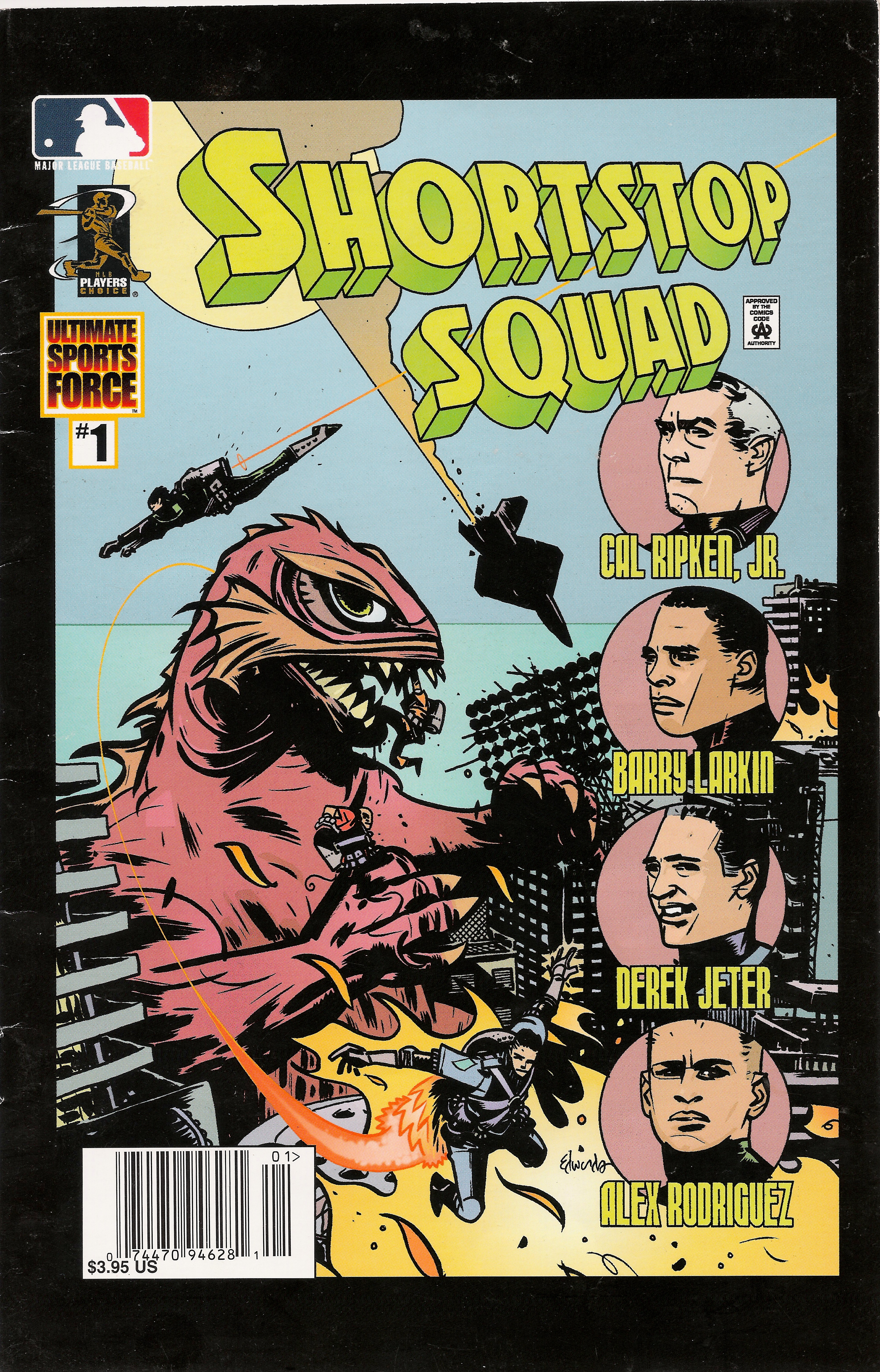
Perhaps the crown jewel of Ultimate Sports Force’s non-team-affiliated content was Shortstop Squad. Truly a marvel of the Bizarre Baseball Culture arts, it paid tribute to those that went before and followed in their traditions, as Cal Ripken led his team of Barry Larkin, Derek Jeter and Alex Rodriguez against a fish-monster that basically is meant to be fish-Godzilla.

You may think I’m being sarcastic, and you are probably right, but, well, this is SHORTSTOP SQUAD, so your logic is irrelevant.

After all, just LOOK at this cover:

SHORTSTOPSQUADcover

Your mind is now blown.

So, let’s get started with Shortstop Squad #1 from 1999… after the jump, of course:

Continue reading