(Blogathon ’16) Kazuto Yamazaki: NPB Bat-Flip Juggernauts to Watch For

This guest-post is part of the 2016 Baseball Continuum Blogathon For Charity, benefiting the Roswell Park Alliance Foundation. The Roswell Park Alliance Foundation is the charitable arm of Roswell Park Cancer Institute and funds raised will be “put to immediate use to increase the pace from research trials into improved clinical care, to ensure state-of-the-art facilities, and to help improve the quality of life for patients and their families.” Please donate through the Blogathon’s GoFundMe page. Also, please note that the opinions and statements of the writer are not necessarily those of the Baseball Continuum or it’s webmaster.

Baseball in Asia offers so many obscurities to the fans on the other side of the sea; Relentless, boisterous chants throughout a game. Incomprehensible, yet fascinating amount of pitches in bullpen sessions. Towering eephus pitches. And, of course,  glorious bat flips that make rounds on the Internet every now and then.

Lately, it’s the KBO who usually demonstrate those mind-boggling pieces of fine art. However, while getting its thunder stolen by the neighbor league, the NPB remains a goldmine of awesome bat flips.  In this post, I’ll introduce some bat-flip extraordinaires to keep an eye for the upcoming 2016 season.

Yoshio Itoi

https://www.youtube.com/watch?v=kLsbEamtv84

Despite the down year he had in 2015, in which he slashed .262/.366/.413 – pedestrian for his standards with the worst average and on-base percentage in a full season -, Itoi is still considered one of,  if not the most, talented players in the NPB. At thirty-four, he’s stepping into the decline phase of his career. But if he recovers from the knee problems that bothered him for the entire 2015 season, he’s on track to display some more of these magnificent flips in 2016.

Takahiro Arai

Some bat flips are not like the others. And when it comes to bat flip inordinateness, Takahiro Arai is the one excelles. Every single time he knows he got it, bar none, he finishes his swing two-handed, takes a step or two towards to first base, then gently jettisons the bat, as if he’s putting  it on the top of a Jenga tower made of bats.

Alas, he just turned thirty-nine on January 30th, the 17-year NPB veteran’s peak is far behind in the rearview mirror, and the clock for him as a player is about strike midnight. Yet he may have gotten just enough in the tank to reach the 300 career home runs plateau, which he’s just 13 more trips around the diamond away.

Ryota Arai

Unlike his brother, the younger Arai does it in a more traditional way. Unlike his brother, Ryota has smashed just thirty-two long balls in his ten-year career. But on most of them, he’s display the iconic, sky-high bat flips that seem to be in the air as long as the ball.

Norihiro Nakamura

The Bat Flip Emperor, Nakamura clubbed 404 dingers – 382 in twenty-two years in Japan and twenty-two more in his one-year stint in the States, in which he spent more of the season at Triple-A. In his heyday, both his power and flips were prodigious. Sadly, at forty-two, his career is likely to be over. But his legacy lives forever. Watch the video above. It captures some Crème de la crème flips the human race ever seen.


Taiga Egoshi

http://www.youtube.com/watch?v=ngD81zYUw4g

After reading about the four players  I mentioned above, you may be thinking all the spectacular flippers in the NPB are either old or not good enough to secure a full-time role. No worries. We’ve got some young, up-and-coming potential stars with magnificent bat-flip ability.

Taiga Egoshi is the one whom I believe will become the next big thing in the bat flip industry. In 2015, his rookie campaign, the twenty-two year-old unleashed five homers with sumptuous flips, like the one captured in the video, on all of them.

Entering his sophomore year, Egoshi is seen as the frontrunner for the Hanshin Tigers’ starting centerfielder job. If he does win the position, we could count on him to flourish.


Yuto Takahama (Click for video)

Takahama is another rookie who made debut in 2015. Though he had just two plate appearances with the ichi-gun (top level) squad. But down on the farm, he flipped the heck outta the bat here and there, every now and then. He doesn’t give a damn if it actually clears the wall or not. Ladies and gentlemen, we might be witnessing the dawn of the career of a legendary bat flipper.

And here are compilations of the rest of bat flippers in the NPB. Enjoy:


Kaz is a Tokyo-based baseball fanatic. He contributes to multiple websites in multiple languages. You can follow him on Twitter @Kazuto_Yamazaki.

This guest-post has been part of the 2016 Baseball Continuum Blogathon For Charity, benefiting the Roswell Park Alliance Foundation. The Roswell Park Alliance Foundation is the charitable arm of Roswell Park Cancer Institute and funds raised will be “put to immediate use to increase the pace from research trials into improved clinical care, to ensure state-of-the-art facilities, and to help improve the quality of life for patients and their families.” Please donate through the Blogathon’s GoFundMe page. Also, please note that the opinions and statements of the writer are not necessarily those of the Baseball Continuum or it’s webmaster.

(Blogathon ’16) Andrew Mearns: The 2015 All Out-of-Position Team

This guest-post is part of the 2016 Baseball Continuum Blogathon For Charity, benefiting the Roswell Park Alliance Foundation. The Roswell Park Alliance Foundation is the charitable arm of Roswell Park Cancer Institute and funds raised will be “put to immediate use to increase the pace from research trials into improved clinical care, to ensure state-of-the-art facilities, and to help improve the quality of life for patients and their families.” Please donate through the Blogathon’s GoFundMe page. Also, please note that the opinions and statements of the writer are not necessarily those of the Baseball Continuum or it’s webmaster.

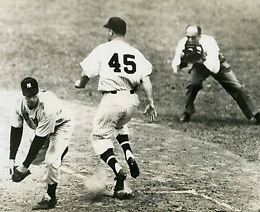
Joe DiMaggio was petrified.

This was a sensation he had almost never experienced on a baseball field in his life. On July 3, 1950, after 1,550 major league games and a Hall of Fame resume already on the ledger, DiMaggio jogged onto the field at Griffith Stadium in Washington, D.C, but instead of heading to his customary position in center, he stopped at first base. It was the first time DiMaggio had ever played anywhere other than the outfield in his storied career.

DiMaggio was only there because manager Casey Stengel was desperate. Incumbent first baseman Tommy Henrich’s career ended due to injury in 1950, and Stengel didn’t think replacement Joe Collins hit well enough to man the position. So through owner Dan Topping, Stengel had asked DiMaggio if he would try first base for a game.

It was a press frenzy—the iconic “Yankee Clipper” at first and not in center? Photos had to be taken, and the results weren’t pretty. As recalled in Jerome Charyn’s Joe DiMaggio: The Last Vigil, although DiMaggio did not make any errors, he stumbled a couple times, was nervous the whole game, and drenched his uniform in sweat. The immensely proud Yankee was furious at Stengel for not coming to him directly about the idea and that he made him look bad. It was indeed the only game of DiMaggio’s career spent away from the outfield.

Nonetheless, it probably would have been an amusing sight for modern baseball fans. A player appearing out of position is one of the more entertaining aspects of the game. Perhaps that’s because it seems to humanize these great athletes. For the past two years, I wrote guest posts at Baseball Prospectus that revealed each season’s “All Out-of-Position Team.” It’s always fun putting this together, and I’m happy to do so this year for Baseball Continuum’s 2016 Blogathon for Charity.

As one might guess, this is a lineup of nine players at nine positions where they absolutely do not belong. Yet for one reason or another, each ended up there at one point in 2015. Kneel and tremor before this fierce defense.

Pitcher: Jonny Gomes

The 13-year veteran Gomes had an up-and-down season that led to his second World Series ring even though he didn’t make the Royals’ playoff roster. Unfortunately, most of his intrigue came from off-the-field entertainment, such as accidentally helicoptering his daughter into a child running at him or having his status as a good luck charm turn into an “Effectively Wild” podcast meme.

Before he joined Kansas City though, he was on a dismal Atlanta Braves team that was sinking like an anchor. Through June 21st, they were actually .500 at 35-35. Then they went 32-60 the rest of the way. The absolute nadir was a three-game series against the Yankees from August 28th through the 30th. This was the middle of a 12-game losing streak, and in that sweep, the Yankees outscored them 38-11.

Atlanta’s bullpen was getting destroyed in the first game, and manager Fredi Gonzalez decided to take pity on his relievers by asking Gomes if he could pitch one of the innings. Give credit to Gomes—he was a team player on a club going nowhere. He took the lump. Chris Young was the first hitter to face him, and he quickly gave Gomes a scare:


The ball jumps off the bat a lot faster from sixty feet, six inches away rather than in the outfield. That pitch ended up in the seats, the Yankees crushed two more doubles, and another run scored. Mercifully, the inning ended on a strikeout. Yes, pitcher Jonny Gomes got a strikeout. Pay no attention to the fact that it was Yankees reliever Bryan Mitchell taking his first MLB at-bat.

Catcher: Wilin Rosario

Everyone who caught at least a portion of an inning in 2015 was a legitimate catcher at one point. So instead, we will pay our final respects to Rosario’s career behind the plate.

Rosario was once an exciting Rockies prospect, particularly when he hit 28 homers and finished fourth in the 2012 NL Rookie of the Year voting. Defense was always a question for him though, and by BP metrics, he struggled with framing and blocking pitches. The most damage was done on passed balls; he led the NL for three years in a row from 2012-14. In 307 games, he had 42 passed balls. Only one other catcher in all of baseball even had more than 30—Josh Thole, knuckleballer R.A. Dickey’s personal catcher.

Despite his offensive potential, Colorado could no longer bear watching Rosario fumble around. They moved him to first base in 2015; the switch coincided with an offensive malaise that led to a demotion to Triple-A. He eventually returned and spent just two games at catcher, both meaningless September starts. Nothing bad in particular happened in either of them, but it was clear that Rosario was no longer a major league catcher.

Earlier in January, Rosario signed a deal with the Hanwha Eagles of the Korean Baseball Organization. The word is that he will continue to fight the good fight and try to keep catching there. Even with only two games caught in 2015, he remains the MLB leaders in passed balls since 2012.

First base: Alex Rodriguez

Like him or not, A-Rod has to be considered among the greatest infielders in baseball history. He spent 1,272 games at shortstop, where he was not only a tremendous hitter but also among baseball’s defensive elite. When he moved to third base upon the Yankees’ trade for him in 2004, it obviously wasn’t because Derek Jeter was the superior defender. While A-Rod had never played third base in his life beforehand, he worked hard and became an excellent defender there as well until his hips began to fail him.

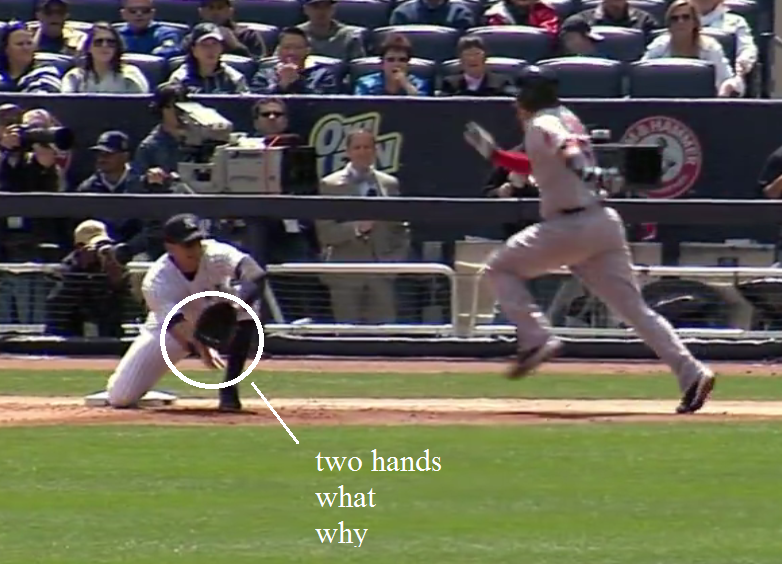
A player on the left side moving down the defensive spectrum to first base is far from unprecedented. Ernie Banks spent over half his career at first, and George Brett made just 14 starts at third in his final seven seasons. So when the Yankees suggested in spring training that A-Rod would get some reps at first base, it wasn’t stunning. He looked shaky in camp, but they gave him a shot anyway on April 11th against the Red Sox.

Boy, was it awkward.

Um, Alex…

That’s not how you…

a-rod

Well… okay then. Unsurprisingly, A-Rod made just one emergency appearance at first for the remainder of the season. “DH-Rod” worked out pretty well, but first base was just bizarre.

Second base: Carlos Gomez

Few centerfielders in baseball cover the position like Gomez, who has both the defensive skill and flair of Willie Mays out there. In 12 years of professional baseball though, he had never played the infield. Why should he?

Well, the early 2015 Brewers made it happen. Skipper Ron Roenicke was not long for the campaign, dismissed after a 7-18 start that included a game when his superstar had to play second base. They were about to lose their fourth straight to begin the season. Roenicke had already used infielders Luis Jimenez and Hector Gomez to pinch-hit for pitchers when second baseman Scooter Gennett lost his temper on a called strike three to end the eighth and was ejected by home plate umpire Mike Estabrook.

With no infielders left, Roenicke was forced to choose between Carlos Gomez and Ryan Braun to cover second (Braun would have also been a good pick for the All Out-of-Position Team had he been selected). Roenicke let Gomez do it since he occasionally took ground balls in the infield during practice for fun. He never got a chance to field anything during his one inning, but it was quite a sight to see a Gold Glove-caliber outfielder stuck in the infield.

Third base: Albert Pujols

albert

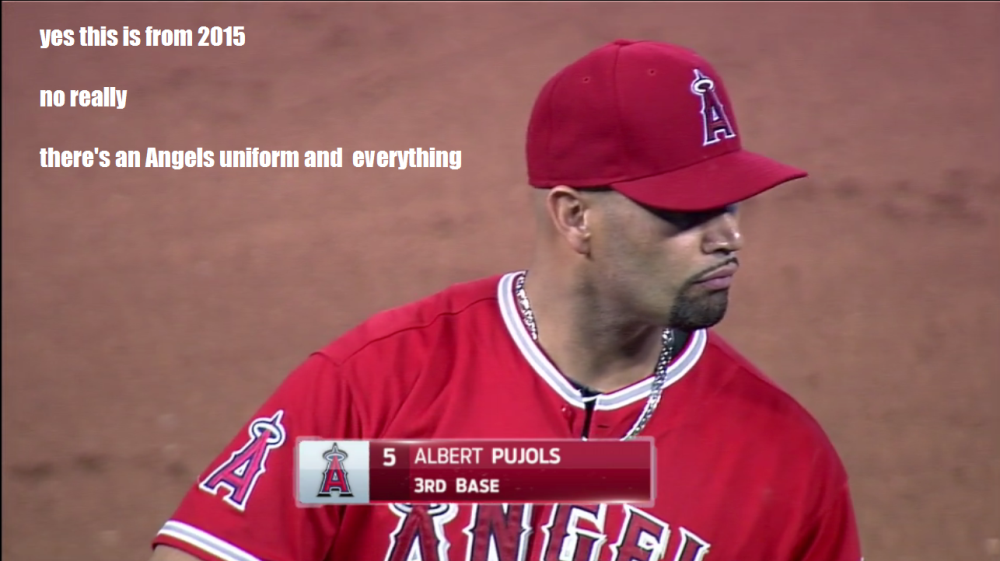
For the second consecutive year, an aged Pujols somehow made an appearance at third base, and accordingly, he must appear on the All Out-of-Position team again. As noted last year, Pujols won his 2001 NL Rookie of the Year award playing most of his games at third; Mark McGwire was still active for the Cardinals. He spent a little time there again in 2002, but in the past 13 years, it’s pretty much been only in an emergency.

The Angels/Royals game on August 13th was weird enough anyway. Iron man catcher Sal Perez actually got a day off. The steady Garrett Richards was outpitched by Jeremy Guthrie, who carried an unsightly 5.84 ERA into action. The overpowering Wade Davis shockingly gave up two runs in the eighth, allowing the Angels to get back into the game with a 5-3 deficit. They went on to score four in the ninth against ailing closer Greg Holland. It was the first time in 114 games that Davis had allowed a multi-run inning.

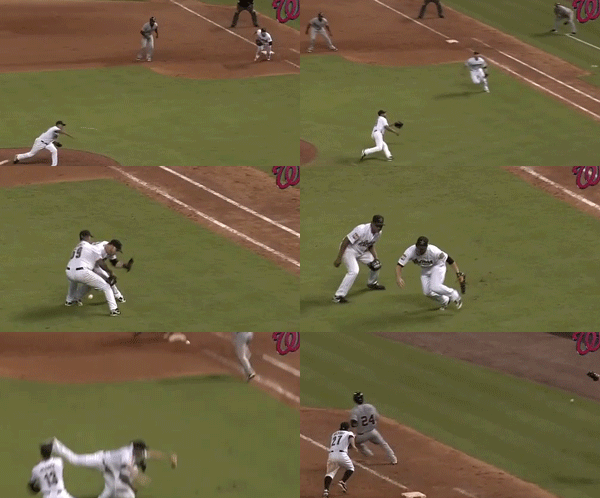
Then, of course, there was Pujols at third. During the rally off Holland, Angels manager Mike Scioscia gambled by pinch-hitting the powerful C.J. Cron for shortstop Taylor Featherston. It paid off, as Cron launched the game-tying two-run double. Scioscia took another risk by pinch-running Shane Victorino for Cron, and he scored the go-ahead run on Kole Calhoun’s two-run double. Armed with a 7-5 lead but a short bench thanks to both the moves and normal shortstop Erick Aybar’s tight lower back, Scioscia went full ¯\_(ツ)_/¯.

Victorino went to right field. Calhoun shifted from right to first base. Third baseman Conor Gillaspie moved to second for the first time in his eight-year professional career, forcing Johnny Giavotella to play shortstop for the first time in his eight-year professional career. Pujols took over at third. It worked out for Scioscia, as closer Huston Street kept the ball from going to any of the numerous inexperienced players, and the Angels won, 7-6.

That makes two straight years of Scioscia ending up victorious in a game with Pujols at third. What a time to be alive.

Shortstop: Brandon Phillips

brandon

Whenever Phillips chooses to retire from this game, his legacy will be intrinsically tied to defensive excellence at second base. There are nigh-countless highlight reels of his amazing work there, and he’s been doing it for a decade now, no easy feat.

That’s what makes it so jarring to see Phillips at shortstop, much like it was when Robinson Cano appeared there in 2013. All but six of his 1,582 career games have been spent at second, and he had not appeared there even in an emergency role since July 25, 2007. It was almost eight years to the day on July 19th of this year when Phillips reemerged at the position he called home when he was a mere Montreal Expos prospect.

Like Scioscia, Reds manager Bryan Price did not have much of a bench at that point in the game. It was the 11th inning, and Price had already used 19 players. In a failed 10th inning rally where Aroldis Chapman was due up, Price pinch-hit the last position player on his roster, Tucker Barnhart. Clearly unwilling to make the 2015 All Out-of-Position team even more entertaining with a pitcher in the field (shortstop Raisel Iglesias, anyone?), Price replaced Chapman on the mound with Pedro Villareal, put Barnhart in right, and made a series of moves that ended up with Phillips at shortstop. The Indians assembled a game-winning rally, but Phillips’ defense played no role in it.

Left field: Hanley Ramirez

There was a lot to write about with the circumstances that led to the other people on this team ending up at their positions. This was ludicrous though—the Red Sox tried to use the defensively inept Ramirez in left field at Fenway Park all season long. This was their plan. It should surprise no one that he is preparing for 2017 at first base.

So since Shakespeare once said “Brevity is the soul of wit,” this entry simply needs the outstanding tweet video by Joon Lee:

//platform.twitter.com/widgets.js

Center field: Joey Gallo

Most of the players on the All Out-of-Position team are old veterans who wind up at odd places in the field. That’s the nature of the beast—the hypothetical of David Ortiz in center field is just far more amusing than, say, Francisco Lindor out there. Sure, Lindor would be out of position, but he’s young and athletic enough that it makes some sense in a pinch.

The idea of rookie masher Joey Gallo playing center field, however, seemed completely absurd. In fact, when Baseball America writer Josh Norris heard that Gallo played a 2014 instructional league game in center field, he thought it was “more as a goof than anything.” After all, Gallo was a third baseman and occasional left fielder, and he still needed considerable defensive work.

When Rangers manager Jeff Banister said that he was going to start Gallo in center field on June 27th in Toronto, Adam J. Morris of Lone Star Ball succinctly summed up baseball Twitter’s reaction:

//platform.twitter.com/widgets.js

Although Gallo had never played center in a professional game, Banister had mentioned a week prior that he was shagging fly balls there “just in case.” Baseball Twitter was bemused then, but casual talk became reality.

Look at the big guy go. Gallo only played five innings in center before Banister subbed Leonys Martin for Ryan Rua in the sixth, putting Martin in center and bumping Gallo to left. If Gallo goes on to become one of the great power hitters of his generation as some suspect, then this detour to center will be something to remember.

Right field: John Jaso

jaso

A catcher his entire career, the 32-year-old Jaso is still primarily associated with that position. Unfortunately, his exile from catching was the result of too many concussions behind the plate. So when the Rays brought him back to Tampa this year, he was to be a DH only.

There were eight games though when Jaso had to appear in the outfield, and since he was originally a catcher, it was a strange sight. He actually started seven games in left, but his appearance in right field was a unique occasion. Jaso pinch-hit for Brandon Guyer in a game on August 17th and came up with a single that jumped the Rays’ lead to 6-2.

Rays skipper Kevin Cash didn’t want to lose Jaso’s bat since it was only the sixth inning at the time, so during the home half, Jaso moved to Guyer’s spot in right field. Since being drafted by Tampa Bay in 2003, he had never played there. It was a strange situation, and the look on Jaso’s face says it all. He received no chances and departed for a defensive replacement in the eighth.

So behold this team:

diamond

Remarkable. Yet still probably a better defense than the 2013 Astros.

Andrew Mearns has been a writer and editor for the SB Nation Yankees blog Pinstripe Alley since 2012. He hosts the site’s podcast and has also had work published by Baseball Prospectus, Sports on Earth, and BP Bronx. He aspires to keep his writer value higher than Andy Stankiewicz’s player value. You’ll most often find him tweeting nonsense @pinstripealley or @MearnsPSA.

This guest-post has been part of the 2016 Baseball Continuum Blogathon For Charity, benefiting the Roswell Park Alliance Foundation. The Roswell Park Alliance Foundation is the charitable arm of Roswell Park Cancer Institute and funds raised will be “put to immediate use to increase the pace from research trials into improved clinical care, to ensure state-of-the-art facilities, and to help improve the quality of life for patients and their families.” Please donate through the Blogathon’s GoFundMe page. Also, please note that the opinions and statements of the writer were not necessarily those of the Baseball Continuum or it’s webmaster.

 

//s.imgur.com/min/embed.js

//platform.twitter.com/widgets.js

(Blogathon ’16) The Author of @OldHossRadbourn: Three Catches

This guest-post is part of the 2016 Baseball Continuum Blogathon For Charity, benefiting the Roswell Park Alliance Foundation. The Roswell Park Alliance Foundation is the charitable arm of Roswell Park Cancer Institute and funds raised will be “put to immediate use to increase the pace from research trials into improved clinical care, to ensure state-of-the-art facilities, and to help improve the quality of life for patients and their families.” Please donate through the Blogathon’s GoFundMe page. Also, please note that the opinions and statements of the writer are not necessarily those of the Baseball Continuum or it’s webmaster.

I would have enjoyed seeing Game 6 of the 1947 World Series.  It was yet another Dodgers/Yankees affair, when both the event and the outcome seemed inevitable.  It had been a hell of a Series, including a stunner in Game 4: the Yanks’ Bill Bevens pitched a ten-walk no-hitter into the ninth when, with two outs and two runners on in a 2-1 game, Cookie Lavagetto smacked a game-winning double to right — the last hit of his career! — that Tommy Henrich could not reach. Game to the Dodgers.

By Game 6 the Yanks were up 3 games to 2 with Allie Reynolds, in his first year in the Bronx, on the mound. He had nothing, and was done in the third.  Relief ace Joe Page also got lit, though the Yankees slowly crept back. Down 8-5 in the 6th, Joe DiMaggio came up to bat with 2 on and 2 out. He crushed Joe Hatten’s pitch to left center. Left fielder Al Gionfriddo raced toward the visitors’ bullpen, over 400 feet from home plate, and managed to jjuusstt make the catch. DiMaggio, sure he’d just lost at least a double, did something extremely rare: he showed emotion, and kicked a patch of dirt between first and second. Inning over.  The Yankees would go on to lose 8-6.

This catch has been on my mind after a recent bit of baseball reading.  What stands out after looking at three works — Roger Kahn’s The Era 1947-1957; David Halberstam’s Summer of ‘49; and Richard Ben Cramer’s Joe DiMaggio: The Hero’s Life, — is how differently they portray this one catch, DiMaggio’s reaction, and the man himself.

I have mixed feelings about Kahn.  I’m the father of a special needs son, and reading his description in The Boys of Summer of Carl Erskine raising a “Mongoloid” is a nice reminder that, despite Kahn’s desire, the glory days of the past have no place in my present.  But, goddammit, the man can tell a story.  He describes the catch over several pages, focusing on Gionfriddo’s reaction, including (according to Gionfriddo) comments made by DiMaggio about the man who stole his hit: “…[he] never gave up and he made the greatest catch that anybody ever made in the whole history of baseball.”

It’s not hard to imagine DiMaggio, even then aware of his aura, describe the catch this way.  Only the greatest catch of all time denies the Yankee Clipper his glory.  DiMaggio would return to this topic years later: asked to evaluate Willie Mays’ catch off Vic Wertz in the ‘54 Series (a catch, one scribe noted, that would “have left any other park than the Polo Grounds, including Yellowstone”), DiMaggio invoked his past, telling Kahn “…Mays had plenty of room. Running back, all he had to worry about was the ball. On my drive, Gionfriddo had to worry about the ball and those iron gates. He had to worry about running out of room, about getting hurt. With all that, I say he made the greater catch.”

DiMaggio, as Kahn portrays him, is aware of his image, proud of it, and ceaselessly builds on it. Not so in Cramer, who describes the catch as follows:

As DiMaggio rounded first, he could see the outfielder Al Gionfriddo dancing a spirited tarantella — unsure where to run, which way to turn, how to get under the ball. Joe was digging for second base when Gionfriddo, in an act of God, stumbled under the ball, stuck his glove over the wire fence and — Cazzo! Figlio di putana! — stole the home run away from DiMaggio.

This . . . well, this is different.  It’s not a good catch.  It’s a lucky grab by a fool who stumbled to just the right place to become a part of history.  The tone here is also different.  Cramer’s DiMaggio is a miserable figure, aloof and alone, proud only of his legacy, and a prisoner of it.  After the game, in the locker room, came the following:

“The Catch” might not have burned Joe up, if Gionfriddo hadn’t been out of position, clueless in that outfield, and a busher in the first place . . . after the game, he didn’t answer questions, and told the photographers: no pictures. The next day, when one cameraman asked Joe to autograph a picture of that home run theft, DiMaggio snarled him away: “Whyn’cha get the other guy? He made the catch.”

Two takes, two tones.  There’s overlap, sure, but Cramer’s DiMaggio comes across again and again as just a colossal son of a bitch.  This version of DiMaggio will not compliment the bush-league Gionfriddo on his catch. It’s unlikely he saw it as superior to Mays’.

And then there’s Halberstam, who has a pretty significant deviation:

During the 1947 World Series, in a rare burst of emotion, he kicked the ground near second base after a Brooklyn player named Al Gionfriddo made a spectacular catch, robbing him of a three-run home run. The net day while he was dressing, a photographer who had taken a picture of him kicking the ground asked him to sign a blowup of it. At first DiMaggio demurred and suggested that the photographer get Gionfriddo’s signature. “He’s the guy who made the play,” DiMaggio said. But the photographer persisted, and so reluctantly DiMaggio signed it. Then he turned to a small group of reporters sitting by him. “Don’t write this in the paper,” he said. “but the truth is, if he had been playing me right, he would have made it look easy.”

Again a different take.  This is a bad catch once again – DiMaggio would have effortlessly made it – but this time, you’ll note, he signs the photo.  This DiMaggio is graceful.  Halberstam is writing about a man in his early thirties, but it’s hard not to see the silver-haired, immaculately dressed gentleman of DiMaggio’s later years leaning over to reporters with a conspiratorial wink and telling them how he really felt about that catch.  The legend is strong here.

Does any of this matter?  I don’t know.  We have one catch, three stories, and three somewhat different men featured in each.  I am reminded, however, of what is so fascinating and frustrating about history: at the end of the day, I have no idea what DiMaggio thought about that catch.  I know what our authors thought of it, and of the man himself.  Cramer gives us a DiMaggio fierce in his misanthropy, alone with nothing except the memory of his greatness.  I’m not sure Kahn or Halberstam get us closer to the truth.  Kahn, like all old men, wants us to remember an era better than our own, when giants walked the land.  So, too does Halberstam, though he understands baseball – as Bill James reminds us – perhaps the least of these three authors.   In the end we’re left with three sources describing a catch made under an October sky, a man so shrouded by a legacy that his thoughts are lost, the mentalités of three historians imposed upon the past, and the recession of an event from history to myth.

The Author of @OldHossRadbourn is the individual behind the @OldHossRadbourn Twitter account.

This guest-post has been part of the 2016 Baseball Continuum Blogathon For Charity, benefiting the Roswell Park Alliance Foundation. The Roswell Park Alliance Foundation is the charitable arm of Roswell Park Cancer Institute and funds raised will be “put to immediate use to increase the pace from research trials into improved clinical care, to ensure state-of-the-art facilities, and to help improve the quality of life for patients and their families.” Please donate through the Blogathon’s GoFundMe page. Also, please note that the opinions and statements of the writer are not necessarily those of the Baseball Continuum or it’s webmaster.

(Blogathon ’16) Jessica Quiroli- The Minor League Baseball Lawsuit: Wealth vs. the Working Class

This guest-post is part of the 2016 Baseball Continuum Blogathon For Charity, benefiting the Roswell Park Alliance Foundation. The Roswell Park Alliance Foundation is the charitable arm of Roswell Park Cancer Institute and funds raised will be “put to immediate use to increase the pace from research trials into improved clinical care, to ensure state-of-the-art facilities, and to help improve the quality of life for patients and their families.” Please donate through the Blogathon’s GoFundMe page. Also, please note that the opinions and statements of the writer are not necessarily those of the Baseball Continuum or it’s webmaster.

Few things personify living the American Dream better than professional sports.

From poverty to fame and fortune, we’ve learned their remarkable stories, and drawn inspiration from them. Willie Mays was the son of a steel mill worker, and the grandson of a sharecropper. Joe Namath’s grandfather came to Ellis Island from Hungary, and he too, and later his son, worked in the steel and coal mills. LeBron James was raised by a single mother, who became pregnant when she was sixteen, then worked tirelessly to make ends meet. James credits her for his success and wealth. It was their specialness, their rare physical talents and physicality that led them there. Many make it, but many, many more fall through the cracks.

In baseball, the trick is not falling through the cracks. The minor leagues are made up of a few thousand players and player cuts are common. Reaching the majors isn’t. The minor leagues are the workshop, where players must condition their bodies and minds to play every day, and not burn out, or fall behind, because the next guy is trailing you and ready to replace you. The odds aren’t great they’ll see major league time for more than a few days or weeks, if at all. A Mother Jones study found that just 10% of minor league players make it to the major leagues. That stacked-with-odds challenge is one player’s commit themselves to. They room together, live with host-families; they take their meal-money per diem, $25 a day, compared to major leaguers who receive $100 a day. Minor league players start out making $1,100 a month in the salary pyramid.

Being major league-ready and transitioning to the highest level of the game is one part of the developmental experience. Add to that the challenge of remaining healthy and strong, well-fed, rested and able to care of themselves and anyone depending on them.

In December of 2014, at the annual Baseball Winter Meetings, Stan Brand, the VP of Minor League Baseball, delivered a speech addressing a lawsuit filed against MLB regarding wage and labor issues, Senne vs. the Office of the Commissioner of Baseball. The meetings, a mix of social and professional engagement, are conducted with a drink in hand if you choose, as major trades are made and breaking news emerges from a high-end hotel full of players, ex-players, executives, reporters and those hoping to get in the business. Some attendees are just fans hoping to catch a glimpse of the action.

But as the usual business dealings transpired at the 2014 gathering, another story rose to the surface. Brand came forward to explain MiLB’s stance on the lawsuit. Baseball America’s Josh Leventhal reported Brand’s comments.

“In the coming year, we will be seeking legislation to clarify that professional baseball players are not covered by these federal wage and hour laws. Just as we did in the 1990s to save the antitrust exemption, we will need your help to explain to our legislators the importance of minor league baseball and their communities’ investments…I do not want to overstate the threat this suit presents, but I think my honest assessment is that it is equally perilous for our future…I will ask you to heed the clarion call, man the battle stations and carry the message to Congress loudly and clearly.”

Of Note: Major league players make a minimum of $84,000 a year. Minor league players make a maximum $2,150. Major League Baseball makes more than $8 million dollars annually, with the major league salary rising 2,500 percent in the last forty years. Minor league salaries have increased 75 percent.

The lawsuit was filed by three former minor league players, with the intention of applying the terms of the Fair Labor Standards Act to minor leaguers. But to this point, MLB has an antitrust exemption. The lawsuit later expanded to include 34 former minor league players.

Brand could prove to be a tough opponent. A lawyer with a wealth of experience dealing with lobbyists and politicians is well-known in Washington, DC where he’s litigated cases for forty years, including Supreme Court cases. He clarified that, in major league baseball, minor leaguers must know their place. They weren’t expected to rise up and disrupt the framework of the minor league business model, but to continue working as contributors to the wealth that eludes them. Brand’s speech presented minor leaguers as an enemy among them in baseball. His determination to protect the financial interests of Major League Baseball, in effect, established an us-against-them class war.

Leventhal filed a second report for Baseball America in April of 2015, in which Brand “contends that playing minor league baseball was never meant to be a career.” Leventhal wrote that Brand likened playing in the minors to an internship.

The corporate system of Major League Baseball seems impenetrable, but Garrett Broshuis emerged as a willing fighter. The former San Francisco Giants minor leaguer, a pitcher and 5th round pick in 2004 retired from professional baseball and began practicing law. He’s not just one of the players that took part in the original filing; he’s also representing them collectively.

Broshuis responded to Brand’s winter meetings comments, laughing at first, amused or baffled, maybe both, then, after some thought, sought to describe Brand’s stance.

“It’s fear-mongering,” Broshuis said by telephone in mid-January. “It’s inconceivable that a $10 billion dollar a year business is lobbying congress for an exemption.”

They’re men without a union. The powerful MLBPA, with all its protections can wield power in any number of situations, making sure major leaguers are treated fairly and reap the financial benefits of their work.

Brand first portrayed the minor leaguers suing as some kind of outlaws wreaking havoc on a quiet town. He later tried to sell an idea that minor leaguers are comparable to college interns. For the numerous players who went to college and proudly don the cap of the major league team that’s drafted them for the cameras, that’s often news to them. The minor leagues are for developmental time, acting as a unique step ladder to the majors. But they are no amateur hours. And the interns are in the office.

With the annual earnings MLB pulls, working class baseball fans aren’t likely to deeply sympathize with MLB and view it as a sacred institution being threatened by big bad minor leaguers making meal money. Sure, some fans scoff at minor league players asking for more, viewing them as spoiled. But if they regard them within the context of major league greed, maybe they’d see the fight differently. They might see themselves in those guys, working for a giant, money-making company where thousands of employees make a miniscule percentage of those at the top.

All of this doesn’t rest on Brand’s shoulders, however. He’s the voice of the cause, not the leader. Fans know that MLB is full of corporate greed. They knew when they learned that MLB was a willing participant in the use of steroids in the game, by doing little to nothing to stop the problem. Had they done anything, they would’ve risked losing a cash windfall from fans high with baseball fever in the late 1980’s, and throughout the 90’s.

Brand’s speech simply served as a reminder of what’s been proven. But this time, there were no gods of baseball being torn down. Players with little money and an uncertain future were being belittled, ridiculed and shamed. Brand’s word choice made the face of this fight the Grinch, or, perhaps, that fictional hero of Wall Street, Gordon Gekko. Brand could’ve easily bellowed, ‘Greed is good, now let’s play ball!’

Gleaning the meaning behind his words isn’t so tough: minor league players are worthless.

Minor league teams are worth everything. The players are the component, the trusty cog, which allows MLB to continue to adding increasing its considerable wealth. We’re given to understand that minor league baseball players, by asking for a living wage, would hurt the community, the employees in the stadium they play in, and the entire way baseball’s run. Minor League Baseball is a community-driven enterprise. Hurt the system as it is, hurt the community. Essentially, they’d ruin everything.

One player, speaking on the condition of anonymity, reached out privately the same January weekend that Broshuis spoke about the lawsuit.

“I need to make sure that if I do sign up that it would not affect my opportunity to play in the big leagues, or have me being released because of it,” he said.

MLB’s powerful hand has to be a driving factor for any players considering, then re-considering, joining the lawsuit. Why risk it? They might ask themselves. The players fighting for a fairer wage aren’t making millions and have no sense of job security. Those high-ranked players can clearly see the payday. They aren’t treated as disposable.

“I’ve considered it. The amount we get paid is deplorable,” the player said.

But he points out that that’s not enough for him to join. He indicated uncertainty about how the outcome would impact teams and players. Knowing the truth might not be enough to motivate players to put themselves on the front lines.

“I’ve felt mistreated. But I think that’s the reason so many guys push themselves to get better [and] get out of the minors. It almost acts as motivation for us to move up as quickly as we can,” he said, then continued, “even though that’s not up to us. It’s survival of the investments teams make, and who can help them now. It’s cutthroat. But it’s a business.”

And business is good.

As reported in a 2015 report by Lindsay Kramer, minor league baseball drew the third-highest attendance in its history, also marking the 11th consecutive year MiLB drew over 41 million fans.

The driving force of the community-driven entertainment of minor league baseball is based on the tested theory that if you build a stadium, employment will come. When a stadium’s built, or a team affiliate is established or moved, the hope is that fans will show up for an affordable summer activity. For families, particularly those with multiple kids, seeing a sporting event for less than twenty dollars is a very big deal. It relieves parents of the school’s-out dilemma, and allows them to see a baseball game with their kids. If all goes well, a major league player’s injury could lead to his rehab at the stadium they’re attending. Oddly put, but a rehab appearance by a top player in the majors draws crowds. Maybe a young kid’s never seen his favorite player in a big league game outside of on TV. In the minor leagues, he or she not only gets a glimpse, but an intimate one.

A minor league team as a business works for many, including interns gaining experience working in professional sports and executives looking for a foot in the door. The players, for their part, suit up and play the game. They fit in the business model that serves families and communities. They work for everyone else’s families, but struggle to support their own or even themselves.

“For the long term, we should all be able to come to the table and strike an agreement,” Broshuis said.

The business is clicking along, a well-oiled machine in no danger of losing fuel. The rich definitely get richer. The poor, well, they stay the same, get poorer, or try to figure out a new way. Soon, retirement is unavoidable; maybe before the age of thirty. Few can become those icons of sports history, Mays, Namath or James. Few can make it to even elite status. But minor league baseball players know what they’re up against. At a certain point, just surviving and getting a uniform must be preferable to giving up the dream altogether.

Many play out their professional careers, notable, known, and with a considerable amount to retire with. Many, many, many more scrap, scrape, hope, and work to get the hell out of the minors, with even the possibility of a cup of coffee in the majors often a glimmer. Those are the players Broshuis is fighting for; brandished as trouble-makers.

A scout once said something about the minor leagues while standing in the press box of then Waterfront Stadium, home of the Trenton Thunder. Watching the game, with a distant look in his eyes, without arrogance or joy, he said. “The top prospects need guys to play with.” It was a clarifying moment, impossible to forget. That’s the reality.

Broshuis described the process as now in the “discovery phase”, the longest portion of building a case.

A few weeks after initially speaking, in response to follow-up questions, the player who’d requested anonymity said he was still on the fence about joining the lawsuit, explaining that he had to be “careful.”

“I haven’t decided,” he said. “I’m an outsider in professional baseball.”

Broshuis said that they’re now in the “discovery phase”, the longest portion of building a case. The trial is set for February 2017. The outsiders, those rabble-rousers looking for a living wage, will have their day in court.

Jessica Quiroli is a Minor League Baseball writer/reporter and the creator of ‘Heels on the Field: A Minor League Blog‘. Her work has appeared on MiLB.com and FanGraphs and in Junior Baseball Magazine. She is also the screenwriter of the so-far-unfilmed screenplay, “Minor League Guys.

This guest-post has been part of the 2016 Baseball Continuum Blogathon For Charity, benefiting the Roswell Park Alliance Foundation. The Roswell Park Alliance Foundation is the charitable arm of Roswell Park Cancer Institute and funds raised will be “put to immediate use to increase the pace from research trials into improved clinical care, to ensure state-of-the-art facilities, and to help improve the quality of life for patients and their families.” Please donate through the Blogathon’s GoFundMe page. Also, please note that the opinions and statements of the writer were not necessarily those of the Baseball Continuum or it’s webmaster.
Blogathon stuff you missed while you were sleeping

Sometimes, you just don’t have enough room to give everybody a daytime Blogathon spot. But that doesn’t make them any less worthy of your attention! So, please, look at these great contributions that went up during the night:

Nate Fish: Ezra, the Ballplayer

Ron Kaplan- Read All About It: Blogs That Will Keep You Up on Baseball Books

Andrew Martin: A talk with Alex George

Greg Gay: Victim of Circumstance

Hawkins DuBois- Searching for Baseball’s New Frontier: Examining the World of Mental Skills Training

Dan Weigel: Ranking the 15 most entertaining European baseball team names

James Attwood: Slow to Change is Not Always a Bad Thing

Thank you! Please read those and don’t forget to donate!


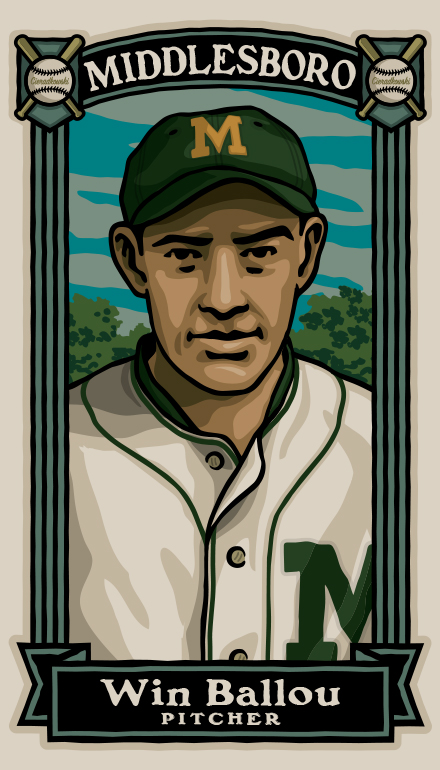
(Blogathon ’16) Gary Cieradkowski: Win Ballou

This guest-post is part of the 2016 Baseball Continuum Blogathon For Charity, benefiting the Roswell Park Alliance Foundation. The Roswell Park Alliance Foundation is the charitable arm of Roswell Park Cancer Institute and funds raised will be “put to immediate use to increase the pace from research trials into improved clinical care, to ensure state-of-the-art facilities, and to help improve the quality of life for patients and their families.” Please donate through the Blogathon’s GoFundMe page. Also, please note that the opinions and statements of the writer are not necessarily those of the Baseball Continuum or it’s webmaster.

winSince I was a kid, I was always more fascinated with baseball’s “small stories”. While guys like The Babe and Hank Aaron have great stories, I gravitated towards the players you don’t find in the record books. For every Walter Johnson there were hundreds of players who toiled anonymously. Each one had a unique and often interesting story to tell. This is one of those “small stories”.

Back during the teens and twenties, professional teams would schedule exhibition games against small town semi-pro teams to both generate revenue and scout young ball players. When the minor league Chattanooga Lookouts came to Middlesboro, Kentucky in 1920 to play the local nine, they expected an easy win. Unfortunately this small Kentucky town possessed a secret weapon named “Win”.

Noble Winfred Ballou was a recent Eastern Kentucky University grad from Mount Morgan. By the time he pitched and beat Chattanooga that day, Win had earned a reputation as a pitcher for hire who lived up to his name. Like many other young ball players, each weekend Win Ballou suited up for a few different town or factory teams, a temporary superstar brought in to even the odds or settle once and for all a heated town rivalry.

After Chattanooga’s loss, their manager tried his best to sign Ballou, but the pitcher’s friends convinced him to remain in Kentucky. Later that summer, Chattanooga’s manager secretly arranged for a town farther away to hire Ballou. Separated from his friends, the young pitcher was convinced to sign a professional contract.

The Washington Senators brought Ballou up to the majors at the end of the 1925 season, and within weeks he was pitching in the World Series against the Pirates. Ballou jumped around from the Senators to the Browns and finally the Dodgers before he was returned to the minors in 1930. Playing in the Pacific Coast League, Ballou found his niche as a relief pitcher, one of the first to perfect that role. A fan favorite and nicknamed “Old Pard” because of his age and reliability, Ballou pitched for the Los Angeles Angels and San Francisco Seals until he was 45. When Win Ballou passed away in 1963 he was admiringly eulogized in the West Coast newspapers as a beloved fixture of West Coast baseball.

Ol’ Win Ballou didn’t set any records, nor did he leave any mark on the history of the game besides some forgotten box scores. Yet it’s guys like Win who make the history of the game fun. Imagine what he must have felt like – a kid reluctant to leave to hills of his native Kentucky and just a few years later pitching in a World Series! Sure it’s a small story, but it’s those small stories that combine to make up the greatest game ever invented.

Gary Joseph Cieradkowski is the artist and writer behind The Infinite Baseball Card Set blog and the book “The League of Outsider Baseball: An Illustrated History of Baseball’s Forgotten Heroes“. He is also the 2015 recipient of the Tony Salin Award for contributions to baseball history. An award winning graphic artist and illustrator, chances are you have visited or bought something he designed: Bicycle Playing Cards, the music department of Barnes & Noble, the Folgers Coffee can, and the graphics for Oriole Park at Camden Yards, still regarded as the best designed ballpark in the Majors. Growing up a New York Mets fan in the 1970s, Gary learned to live with pain and disappointment until he married his beautiful wife Andrea. The two live happily in Northern Kentucky, unless they discuss the merits of the designated hitter rule. You can visit his blog at www.infinitecardset.blogspot.com.

This guest-post is part of the 2016 Baseball Continuum Blogathon For Charity, benefiting the Roswell Park Alliance Foundation. The Roswell Park Alliance Foundation is the charitable arm of Roswell Park Cancer Institute and funds raised will be “put to immediate use to increase the pace from research trials into improved clinical care, to ensure state-of-the-art facilities, and to help improve the quality of life for patients and their families.” Please donate through the Blogathon’s GoFundMe page. Also, please note that the opinions and statements of the writer are not necessarily those of the Baseball Continuum or it’s webmaster.

(Blogathon ’16) Alex Skillin: Are we entering the Golden Age of Shortstops?

This guest-post is part of the 2016 Baseball Continuum Blogathon For Charity, benefiting the Roswell Park Alliance Foundation. The Roswell Park Alliance Foundation is the charitable arm of Roswell Park Cancer Institute and funds raised will be “put to immediate use to increase the pace from research trials into improved clinical care, to ensure state-of-the-art facilities, and to help improve the quality of life for patients and their families.” Please donate through the Blogathon’s GoFundMe page. Also, please note that the opinions and statements of the writer are not necessarily those of the Baseball Continuum or it’s webmaster.

Few positions on a baseball diamond come with as much acclaim and scrutiny as shortstop. The shortstop is the so-called “captain of the infield,” a performer whose glove does much of the talking, and, from little league all the way up to the pros, often the best player on the team.

That hasn’t been the case in the majors of late. In fact, the shortstop position has been in a sorry state for some time, especially at the plate. In 2014, MLB shortstops hit a collective .251/.306/.363, and while some of that can be attributed to the decline in offense throughout the league, the days of shortstops starring with the glove and the bat felt like a distant memory. Nearly 15 years after Derek Jeter, Alex Rodriguez and Nomar Garciaparra formed an exciting, young triumvirate, the bar for sticking at the position had sunk very low.

Yet this past season provided reason to believe that the state of the shortstop in MLB is primed to improve considerably. The impressive debuts of rookie Carlos Correa and Francisco Lindor and the rise of Xander Bogaerts gives the league three young shortstops who look likely to excel for quite some time. Indeed, Correa, Lindor and Bogaerts conjure up recollections of that Jeter, A-Rod and Nomar trio, and their budding potential could make shortstop a position filled with promise once again.

Correa might just have the brightest future of the bunch after enjoying one of the more impressive rookie debuts in recent memory. In 99 games, Correa batted .279/.345/.512 with 22 home runs, and his call-up to the majors in June bolstered the Astros’ playoff push. That he turned 21 years old in September makes his inaugural campaign all the more remarkable. Just over three years after graduating high school and being taken with the No. 1 overall pick, Correa helped lead Houston to the brink of an ALCS berth before the Royals and their #devilmagic intervened.

Considering his performance at such a young age, Correa should have a few more chances to carry the Astros deep into October. One can only imagine what he’ll do over a full season in 2016.

Lindor’s glove had long been praised down in the minors, and given his extended status as one of the game’s top prospects, Cleveland fans had long-awaited his arrival. That day came on June 14 (he debuted less than a week after Correa), but the most surprising part of Lindor’s rookie year was his production in the batter’s box. The Puerto Rican native hit .313/.353/.482 with 38 extra-base hits over 438 plate appearances, and less surprisingly, his defense proved as stellar as expected. Lindor’s all-around play helped the Indians turn their season around and nearly claim a Wild Card berth.

Despite playing in just 99 games, he finished with the second-highest fWAR among shortstops in baseball at 4.6. If he can show his offensive output was no fluke, Lindor’s future potential looks even better than expected.

A relative veteran compared to Correa and Lindor, Bogaerts finally began fulfilling that long-hyped promise in 2015. After struggling in his first full season, Bogaerts bounced back to bat .320/.355/.421 this past year and finished third in the major leagues in hits with 196. Even more encouragingly, the 23-year-old improved mightily on defense and now looks likely to stick at the position for years to come.

That’s good news for the Red Sox and the shortstop position as a whole. For despite his meager home-run totals in 2015, Bogaerts, like Correa, has the chance to hit for the type of middle-of-the-order power rarely seen in shortstops.

There are plenty of other young shortstops to get excited about too, of course. Addison Russell held his own for the Cubs at the age of 21, and Corey Seager earned a starting job after the Dodgers called him up late in the season. Down in the minors, moreover, some of the game’s top prospects look set to follow in the footsteps of Correa, Lindor and Bogaerts. Players like J.P. Crawford, Orlando Arcia, Tim Anderson and Raul Mondesi Jr., among others, could soon become household names and indicate the position won’t be lacking for young talent in the coming years.

And all the different places these players come from demonstrate how much the game has grown over the past couple decades. Both Correa and Lindor were born and raised in Puerto Rico before being selected in the draft, while the Red Sox signed Bogaerts out of Aruba. Crawford, Seager and Anderson all grew up in the U.S., but Arcia and Mondesi Jr. were both signed as international free agents out of Venezuela and the Dominican Republic respectively.

That’s a wide swath of talent teams now have access to, and it’s beginning to pay dividends for the shortstop position and MLB as a whole. Given all the talented prospects that debuted in the majors last season, the rise of so many precocious shortstops is likely no coincidence. In a league now filled with promising, young stars, no position may have a brighter future than shortstop.

Alex Skillin writes about baseball for The Hardball Times and the Red Sox at Over the Monster and BP Boston. His work has previously appeared at SB Nation, Sports on Earth, The Classical, Beyond the Box Score and in The Hardball Times Annual. You can follow him on Twitter at @AlexSkillin.

This guest-post has been part of the 2016 Baseball Continuum Blogathon For Charity, benefiting the Roswell Park Alliance Foundation. The Roswell Park Alliance Foundation is the charitable arm of Roswell Park Cancer Institute and funds raised will be “put to immediate use to increase the pace from research trials into improved clinical care, to ensure state-of-the-art facilities, and to help improve the quality of life for patients and their families.” Please donate through the Blogathon’s GoFundMe page. Also, please note that the opinions and statements of the writer were not necessarily those of the Baseball Continuum or it’s webmaster.

(Blogathon ’16) Patrick Dubuque: A Ghost Among Cardboard

This guest-post is part of the 2016 Baseball Continuum Blogathon For Charity, benefiting the Roswell Park Alliance Foundation. The Roswell Park Alliance Foundation is the charitable arm of Roswell Park Cancer Institute and funds raised will be “put to immediate use to increase the pace from research trials into improved clinical care, to ensure state-of-the-art facilities, and to help improve the quality of life for patients and their families.” Please donate through the Blogathon’s GoFundMe page. Also, please note that the opinions and statements of the writer are not necessarily those of the Baseball Continuum or it’s webmaster.

Baseball cards are a kind of clumsy yearbook, a collection of forgotten names and awkward photographs. Each bears a moment frozen unnaturally, the cheesy portrait grin followed by the unnatural, bent-back elbow of the pitcher. They demonstrate the historian’s drive to squeeze the eyes tight and remember: not only the championships, not only the highlights and the heroes, but the busted prospects and the utility infielders. All the losing teams and players get their 1/nth share.

GAC1But no set has room for every player, let alone every moment; there are too many minor league callups, too many injury replacements who come and go. Topps neglected to create a Ken Griffey, Jr. rookie card in 1989, his having no major league experience, but picked Mark McGwire out of the Olympic roster two years before anyone else. Rookies are hard to predict, but guessing the right ones, giving kids a whale to hunt, is good salesmanship.

It’s a little strange that, given the parabolic path of the average career, a player’s most valuable card is generally his first one, and always descends from there. Perhaps in our hearts, all rookies are Babe Ruth or Cy Young until time gives them the opportunity to prove otherwise. Perhaps it’s our drive to feel like investors, to get in on the ground floor. But while rookie cards are traded and sold at a premium, the opposite, the last cards, rarely even exist.

There’s no real pattern as to who gets a final stat line. Mantle got a final card in 1969, but Aaron was left off of the 1977 set; Mays got a card in 1974, but not his own, only a World Series highlight, his bat looking heavy in his hands. It’s a common paradox for baseball cards: representing the year before, they’re sold the year after. So many retired players, no longer around to root for on summer afternoons, rarely have their final year’s stats commemorated. Some of it is timing in the print runs; some of it, one assumes, is alchemical.

GAC2There’s a variation in one of the 1988 Topps checklists. You couldn’t be blamed for missing it: one line has been changed, #455, Steve Carlton. The Hall of Famer was cut from the set at the last second, replaced by orange chip prospect Shawn Hillegas.

Lefty was essentially done by 1986; starting the year with the Phillies, he was cut just shy of 4,000 strikeouts, and signed with the Giants to reach the milestone. When they gave up on him as well, he moved on to the White Sox, and pitched just well enough to latch on to a last-place Indians ballclub in the offseason. Topps dutifully gave him three different cards with three different teams: a White Sox regular 1987 issue, an Indians traded issue, and a Giants box-bottom highlight card (his jersey and cap painted on him, since no photographer caught up with him in his six-game San Francisco career). Perhaps it was too much.

Apparently in 1988, Topps had had enough, and even though he put in 150 innings with the Indians and Twins, and refused to retire even then, they decided to ignore his sad final full season. Fleer alone, of the Big Four companies of the time, gave Carlton a final card. It proved a fitting tribute. It’s a strangely tragic still life, an old man in a foreign uniform on an empty bench, staring off camera at the rest of his life. He looks speechless.

GAC3Did Carlton deserve that final card more than Hillegas and his 58 innings of middle relief? It seems strange that an industry couched so deeply in nostalgia flinches at the final sad days of a ballplayer. Maybe Topps didn’t want that last image of Hall of Famer Steve Carlton, throwing slop down the middle of the plate, to burn into our retinas. And maybe it’s a good thing they stop making yearbooks after high school. But sports aren’t about what we want to have happen; they don’t let us choose our memories. Only rain can undo a game.

It’s ironic that Griffey’s own denouement, twenty-some years later, proved just as tragic as Carlton’s. And like Lefty, he too failed to receive that final card when he closed his own career midseason. But while it requires extrapolation to combine that Griffey with the one of our childhood, we all do it; we can appreciate them all as one man. Heroes can be young and old at the same time, even frail and human. Carlton’s weary despair, caught on a single, worthless card, is every bit as much baseball as Griffey’s boyish smile.

Patrick Dubuque co-edited the 2016 BP Annual and serves as jester/editor at Lookout Landing. You can follow him on Twitter @euqubud.

This guest-post has been part of the 2016 Baseball Continuum Blogathon For Charity, benefiting the Roswell Park Alliance Foundation. The Roswell Park Alliance Foundation is the charitable arm of Roswell Park Cancer Institute and funds raised will be “put to immediate use to increase the pace from research trials into improved clinical care, to ensure state-of-the-art facilities, and to help improve the quality of life for patients and their families.” Please donate through the Blogathon’s GoFundMe page. Also, please note that the opinions and statements of the writer were not necessarily those of the Baseball Continuum or it’s webmaster.

(Blogathon ’16) Stephanie Liscio- Forgotten Champions: The 1945 Cleveland Buckeyes

This guest-post is part of the 2016 Baseball Continuum Blogathon For Charity, benefiting the Roswell Park Alliance Foundation. The Roswell Park Alliance Foundation is the charitable arm of Roswell Park Cancer Institute and funds raised will be “put to immediate use to increase the pace from research trials into improved clinical care, to ensure state-of-the-art facilities, and to help improve the quality of life for patients and their families.” Please donate through the Blogathon’s GoFundMe page. Also, please note that the opinions and statements of the writer are not necessarily those of the Baseball Continuum or it’s webmaster.

The 1945 Homestead Grays boasted five eventual Hall of Famers – Ray Brown, Josh Gibson, Buck Leonard, Cool Papa Bell, and Jud Wilson. They were a powerhouse team, the kind of team on which dynasties are built. So how were they defeated in the 1945 Negro League World Series by the Cleveland Buckeyes, a team with zero eventual Hall of Fame members that was relatively new to the Negro League circuit? That 1945 series is a true tale of David versus Goliath, one in which a vastly underrated team not only defeated their heavily-favored opponent, but shut them down completely.

Negro League baseball struggled in Cleveland for years before the Buckeyes came onto the scene. They city had their first entry into the formal league structure in 1922…it fell apart before the end of the 1923 season. Cleveland (and the league hierarchy) refused to give up on the Negro Leagues in the city. They continued to introduce brand new teams, sometimes as often as each year, between 1922 and 1940. In that 18-year span, the city hosted 10 different Negro League teams. The reasons for their failures varied; the Depression played a role in the demise of several teams, while poor management and bad play were behind some of the others. By the time the Buckeyes were formed in 1942, they were buoyed by a surge in popularity in Negro League baseball nationally, and war workers that had more disposable income to spend attending games.

Of those 10 early teams in Cleveland, only two had non-losing records – the short-lived 1931 Cleveland Cubs (which had a winning record), and the 1939 Cleveland Bears (who finished at .500). As an example of the struggles of some of these teams, the 1926 Cleveland Elites only won six games the entire season. It is no wonder that some folks were likely skeptical about the potential success of the Buckeyes. However, during their first year they already proved competitive in the Negro American League with powerhouse teams like the Kansas City Monarchs, Chicago American Giants, and the Birmingham Black Barons. In the past, when those teams travelled to Cleveland, they made a mockery of the home team. The Buckeyes managed to hold their own against some of the best competition the league could offer.

By 1945, the team started to pull everything together under the tutelage of new catcher/manager Quincy Trouppe. The local African-American newspaper, the Call and Post, dubbed the Buckeyes’ lineup as a “murder’s row” prior to the start of the season, and while they were quite good, they couldn’t compare to a Grays lineup that included one of the greatest power hitters of all time in Josh Gibson. The difference came from the Buckeyes’ pitching staff; a group of arms that were definitely not household names, and while talented, were viewed as somewhat unthreatening to the Grays. However, they shut Homestead’s offense down as they went on to win the series four games to none.

Game one saw a pitcher’s duel from Buckeyes hurler Willie Jefferson and the Grays’ starter, Roy Welmaker, as both took a shutout into the seventh inning. Trouppe hit a triple and was driven home on a sacrifice fly by second baseman Johnny Cowan to make the score 1-0. The other Buckeyes run came in the eighth inning on an RBI single from outfielder Willie Grace. The Grays managed to make some noise in the ninth inning, after the made the score 2-1 on an RBI single from Gibson. However, the Buckeyes managed to hold on for the 2-1 win.

In game two, the Buckeyes were shut out 2-0 until a solo home run from Grace to lead off the bottom of the seventh inning made it 2-1. They were able to tie the game later in that inning, after outfielder Buddy Armour scored on an error (he doubled to reach base). The game was still tied 2-2 in the bottom of the ninth, when Trouppe doubled and later moved to third on a passed ball. The Grays intentionally loaded the bases, but a sacrifice fly from pitcher Eugene Bremmer made that a moot point.

These first two games were played in Cleveland; game one was played downtown at the cavernous Cleveland Municipal Stadium, while game two was played at League Park in Cleveland’s Hough neighborhood. (The Indians split their time between Municipal Stadium and League Park until owner Bill Veeck chose to move the team downtown permanently in time for the 1947 season – the Buckeyes rented their facilities from the Indians). Game three was scheduled to take place in Pittsburgh; however, a rain-out moved it to Washington, D.C. This wasn’t completely out of the ordinary, since the Grays spent some of their time playing in DC, plus Negro League teams often traveled around to increase their gate receipts. Game four was played in Philadelphia.

The first two games in Cleveland were close affairs that were both won in the later innings. The same could not be said for games three and four; the Buckeyes were in the driver’s seat for both of those match-ups. George Jefferson (brother of game one starter Willie Jefferson) got the win in game three as the Buckeyes defeated the Grays 4-0. In the final game, the Buckeyes closed out the series with a 5-0 victory. Even though the Grays had what was considered the more threatening lineup, the Buckeyes managed to tame their bats and put some runs of their own on the board.

Even though this World Series win was the high point of Negro League baseball in Cleveland, a time when the city was finally able to put forth a team capable of running with the big boys (and beating them), it was still a bit bittersweet for them in hindsight. Just a month after they closed out their win against the Grays, Jackie Robinson signed with the Brooklyn Dodgers, a harbinger of the upcoming integration of the formerly all-white major leagues. Within a few years, other MLB teams started to sign players from the Negro Leagues; Cleveland became the first American League city to do so with Larry Doby in 1947 (formerly of the Negro National League Newark Eagles). While integration obviously was the first and most important priority, it essentially signaled the downfall for the Negro Leagues. The Buckeyes managed to return to the Negro League World Series in 1947 as they lost to the New York Cubans; but by 1949 the team attempted a move to Louisville, Kentucky in a bid to survive in a city without an integrated team like the Indians. That experiment failed, and they returned to Cleveland by the 1950 season. The Buckeyes had trouble making payroll though, and longtime star Eugene Bremmer went to the press in May to discuss the fact that he’d never been paid. The team’s owner and general manager owed money to what seemed like everyone; the team didn’t even make it to the end of the season, and collapsed and disbanded in the summer of 1950.

While some Negro League teams lost tons of players to the major leagues, only Quincy Trouppe and star outfielder Sam Jethroe would go on to play in the majors from the Buckeyes. Trouppe spent a very brief amount of time with the Indians in 1952 (and spent time in the minors prior to that), while Jethroe had a very successful rookie season in 1950 with the Boston Braves, earning him the title as the oldest person to win the Rookie of the Year award. However, the Buckeyes had to contend with an Indians team that not only signed Larry Doby in 1947, but also signed one of the Negro League’s biggest stars when they inked Satchel Paige to a deal halfway through the 1948 season. The Indians’ 1948 World Series title dramatically increased their popularity and set a single-season attendance record that held until 1962. In addition to their progressive moves on the field, the Indians also integrated the press box, hired African-American vendors, and hired track and field gold medalist Harrison Dillard to work in a public relations role with the team. African-American fans embraced the Indians and stopped attending Buckeyes games. While a few Negro American League teams were able to survive into the 1950s, the Buckeyes weren’t one of them.

Last fall, it was the seventieth anniversary of the Buckeyes’ surprising win over the Homestead Grays. Even though this was a great moment for Negro League baseball in the city of Cleveland, it’s often forgotten; overshadowed by an Indians team that continuously made headlines in the late 1940s. It deserves recognition as a great baseball series though, when the underdog unseated the giant.

A side note – The Buckeyes’ home park for the 1945 season, League Park, was recently refurbished by the city of Cleveland and features a brand new baseball diamond and the renovation of the park’s original ticket office building. Located at the corner of E. 66th St. and Lexington Ave. in Cleveland, it is also the home of the Baseball Heritage Museum. (http://baseballheritagemuseum.org/)

Stephanie Liscio (@stephanieliscio) is the author of Integrating Cleveland Baseball: Media Activism, the Integration of the Indians, and the Demise of the Negro League Buckeyes, and co-owner of the ESPN SweetSpot Indians affiliate blog It’s Pronounced Lajaway (http://itspronouncedlajaway.com).  A Ph.D. student in history, Stephanie has also spent the past six years as president of Cleveland’s SABR chapter.

This guest-post has been part of the 2016 Baseball Continuum Blogathon For Charity, benefiting the Roswell Park Alliance Foundation. The Roswell Park Alliance Foundation is the charitable arm of Roswell Park Cancer Institute and funds raised will be “put to immediate use to increase the pace from research trials into improved clinical care, to ensure state-of-the-art facilities, and to help improve the quality of life for patients and their families.” Please donate through the Blogathon’s GoFundMe page. Also, please note that the opinions and statements of the writer were not necessarily those of the Baseball Continuum or it’s webmaster.


(Blogathon ’16) Stacey Folkemer: Baseball is more than a game, it’s part of the family

This guest-post is part of the 2016 Baseball Continuum Blogathon For Charity, benefiting the Roswell Park Alliance Foundation. The Roswell Park Alliance Foundation is the charitable arm of Roswell Park Cancer Institute and funds raised will be “put to immediate use to increase the pace from research trials into improved clinical care, to ensure state-of-the-art facilities, and to help improve the quality of life for patients and their families.” Please donate through the Blogathon’s GoFundMe page. Also, please note that the opinions and statements of the writer are not necessarily those of the Baseball Continuum or it’s webmaster.
Baseball has always been a part of my family life. I can’t remember a time when summer evenings didn’t include the ballgame on the radio or television, or when a holiday passed that my uncle didn’t offer his opinions on how to fix the rotation while my grandfather complained about a slugger who strikes out too much.

For most of my life, the Baltimore Orioles have been a bad baseball team. They’ve had their moments, but I was born after their glory years. And for my entire adult life until four years ago, the Orioles weren’t just bad, they were a laughing stock. But it was during those years that they became an even bigger part of my familial relationships as I grew into adulthood and my grandparents, especially my grandmother, advanced in age and became less a part of the everyday world.

If you have spent time with someone who doesn’t often leave the house, you understand how difficult it can be to come up with new and fresh things to talk about. My grandmother spent many of her last years confined to her home, limiting her ability to speak about things that she didn’t see on TV or hear about from someone else. But thanks to baseball, we always had plenty to say during our visits. She watched every game from her living room and had strong opinions on every player.

She and my grandfather were two very different types of fans. She was the ultimate pessimist. The Orioles were never good enough, they’d never going to return to their former glory with these players or this manager. It was an extension of her personality at large, where she was often times harsh but passionate for those people and things that she cared about. But she never gave up on them, even if she expected them to lose. If the game was close in the ninth inning, she couldn’t take it. She’d take refuge on the patio, smoking a cigarette and waiting for me to come out and tell her who won. If the answer was the Orioles, she’d smile but comment on how it’s just like them to almost throw it away.

My grandfather, on the other hand, has always been a baseball optimist. Even in the darkest years, as the O’s losing streak stretched across a decade, he always believed they could win. Every year during Spring Training, as reports flooded in that players were in the best shape of their lives, my grandfather believed them all. “They’ve got the hitters, the pitching might come around,” he’d say, as my grandmother and I disagreed and told him he was crazy. He and I had a conversation before the 2012 season in which he repeated the same optimism he’d shown every year prior, and I laughed at how misguided he was. We made a bet on their record, with him claiming they’d be over .500 and me stating that they didn’t have a chance.

Well, if you recall the 2012 season, the Orioles won 93 games, captured the Wild Card, and made it to game five of the ALDS before their season came to an end. I heard a lot about my pessimism that year, let me tell you. I still hear about it sometimes, almost four years later.

As a fan myself, I have to admit that I’m more like my grandmother. Even now, with the Orioles having four straight non-losing seasons and two playoff appearances since 2012, my natural instinct is to think the worst. The starting pitcher will always implode, the offense will never get a hit in the clutch, the Orioles of 2012-15 were a fluke.

I wish I didn’t have that attitude. Outwardly, I have tried to take on the more optimistic view that has always been modeled by my Granddad. Over the last few years I have argued on Twitter and my internet home of CamdenChat.com about how the Orioles are better than people think. When the game is on the line late I profess my faith in my team despite a sinking feeling in my stomach. I am trying to fake it until I make it, basically, but I don’t think I’ll ever be fully successful.

We lost my grandmother to cancer in 2008, so I was never able to share the winning Orioles with her as an adult. As the O’s participated in the 2012 playoffs, I thought about her a lot, wondering if she would have changed her pessimistic ways after watching the magical 2012 team. Probably not. We are who we are, after all. I imagine that she would have seen Jim Johnson’s implosion coming from a mile away (or at least claimed she did). She wouldn’t have witnessed Brian Matusz giving up a walk-off home run to Raul Ibanez in game three of the ALDS (she would have been on the porch, unable to take it) but she never would have forgiven Matusz for as long as he was in an Orioles uniform. But she still would have been ecstatic for our guys even as she cursed them, and I’m sad I didn’t get to experience that with her.

I have been able to spend the last four seasons of good Orioles baseball with my grandfather, and for that I’m grateful. Finally, he has seen a return on his optimism. The ultimate payoff would be a World Series win (though he, unlike me, has at least gotten to see three of those for the Orioles in his life), and maybe he’ll soon be rewarded for his faith in his team.

I wouldn’t count on it, though. Have you seen the starting rotation?

Stacey Folkemer has been writing for Camden Chat, SB Nation’s Baltimore Orioles blog, since 2008. You can find her there or follow her @StaceyMFolk. She lives in Maryland with her husband, who is also a sports writer. In the winter she dreams of baseball. In the summer she watches it from section 334 at Oriole Park at Camden Yards.

This guest-post has been part of the 2016 Baseball Continuum Blogathon For Charity, benefiting the Roswell Park Alliance Foundation. The Roswell Park Alliance Foundation is the charitable arm of Roswell Park Cancer Institute and funds raised will be “put to immediate use to increase the pace from research trials into improved clinical care, to ensure state-of-the-art facilities, and to help improve the quality of life for patients and their families.” Please donate through the Blogathon’s GoFundMe page. Also, please note that the opinions and statements of the writer were not necessarily those of the Baseball Continuum or it’s webmaster.