(Blogathon ’16) James Attwood: Slow to Change is Not Always a Bad Thing

This guest-post is part of the 2016 Baseball Continuum Blogathon For Charity, benefiting the Roswell Park Alliance Foundation. The Roswell Park Alliance Foundation is the charitable arm of Roswell Park Cancer Institute and funds raised will be “put to immediate use to increase the pace from research trials into improved clinical care, to ensure state-of-the-art facilities, and to help improve the quality of life for patients and their families.” Please donate through the Blogathon’s GoFundMe page. Also, please note that the opinions and statements of the writer are not necessarily those of the Baseball Continuum or it’s webmaster.

Baseball, as we know it, has evolved greatly over the years. Prior to the 1880s, the ball was actually tossed underhand to a “striker”, not a batter, and it was tossed up there, not how the pitcher wished it, but how the striker called for it. There was rarely an outfield fence, and like the flagpole that recently sat in center field in Houston, trees and the like were not uncommon in the field of play. No gloves were used, and catching the ball on a single bounce still resulted in the striker being out. Also, there was only one umpire, and that person sat or stood slightly behind and to the side of play. When calls were contested, sportsmanship was expected to win out. When it did not, the umpire could consult the crowd for input on making a definitive ruling.

Once the game underwent the fundamental change of being played for money in 1871, the gentlemanly nature of the sport took a back seat, and the competitive edge was ratcheted up. Yet, despite all the changes that have taken place, the game has always more or less resembled the one we have now. Baseball has always been a mutable sport. But just how mutable? Sure, all those differences seem extreme when compared to the game we watch now, but the vast majority of changes all came about before 1900. That’s right, the vast majority of changes to the game came within the sports first 45-50 years of play. Over the following 115 years, the changes to play have been minimal, and have come only after the slowest of deliberations.

The biggest, and most fundamentally changing was the integration of baseball with the debut of Jackie Robinson during the World War II era. In 1903 it was determined that foul balls would be considered strikes. In 1910, cork was added to the interior of the baseball, marking the end of the “dead ball era”. Today’s uniform size and weight ball standard was established in 1934. In 1969, a year after pitching dominated the game like no time since 1918, the pitcher’s mound was lowered five inches, a change that was years in the offing and brought to a head by the likes of 30-game winner Denny McLain (the last of the 30-win pitchers) and the ever-intimidating 1968 NL Cy Young winner and HOF pitcher, Bob Gibson. The last big change to come about that was anything other than a technological evolution (machined bats, instant replay, games under the lights) occurred in January of 1973 when commissioner Bowie Kuhn. This new rule, much like the changing of foul balls to strikes was cut from whole cloth and not some gradual evolution, making it one of the biggest changes made to the game in the modern era.

Sure, over the last 30 years, we have added extra divisions, expanded playoffs, gone with interleague play during the regular season, and even made the All-Star Game “count” for something in allowing it to determine home field advantage in the World Series. None of that actually impacts how the game is played though.

Rob Manfred worries for the future of baseball. Manfred’s solution is to “modernize” baseball by implementing some changes to the game. Unlike the previous changes though, Manfred is in a hurry to get there as soon as possible. The minor leagues have already started implementing pace of play rules and pitch clocks. Those rules are likely headed to MLB in the near future. Even bigger though, Rob Manfred wants to take the AL DH experiment and make it a part of both leagues as a permanent part of the game.

This change would indeed “level the playing field” between the leagues, something that is not nearly as skewed as some would like to claim. It would allow pitchers to pitch and hitters to hit. A few extra aging sluggers would get to artificially extend their careers. It would also all but eliminate an entire aspect of baseball that has existed since the earliest days, that of in-game strategy, most notably, that tied to playing small ball.

With all due respect to Madison Bumgarner and the mind-boggling performance he turned in during the 2014 World Series, without the DH there is no way he gets to put on that show. Some might say that allowing the DH both ways only increases the chances of such a performance. Really though, how often is a performance for the ages going to be turned in? How much different does that game playout if the managers, especially Bruce Bochy, has to start worrying about making a pitching change after only 2 innings of Bumgarner? Other than filling out a lineup card and making the rare defensive switch in the 8th or 9th inning, exactly how much influence does a manager’s ability to call a game matter if the game is turned into hitters hitting and pitchers pitching?

Manfred says he wants to appeal to a younger crowd. How many youths will be trying to decide by the time they are 10 or 12 if they want to throw the ball or hit the ball? Part of what has always set baseball apart from the other sports was the number of athletic skills a player needed to be good at all at once in order to excel at the game. Only the very best of the best hitters and pitchers can reasonably expect to go deep into amateur careers and possibly reach the majors if they are not able to, at some point, hit field, run, catch, and throw all with some semblance of authority.

There is a push to possibly have these changes in as soon as 2017. That is an awful lot of fundamental change in a very short period of time. One could argue that NL organizations cold need as many as three seasons to properly align themselves to adopt the DH. As far as pace of play goes, these changes are not cutting significant time off of the game. In many cases, it is under 15 minutes being shaved from the average league-wide. Baseball was never designed for or intended to be consumed by a generation of people looking for and expecting instant gratification. Furthermore, if the DH is adopted across both leagues, scoring will go up, this will erase any pace of play gains made by keeping the game on a clock.

There is nothing wrong with wanting to modernize the game and appeal to a younger demographic. Baseball makes changes of such a magnitude at a glacial pace though. That’s something that should never change. Small tweaks followed by periods of evaluation to determine what is and is not working can have just as big of an impact as those changes that fundamentally change how the game is played.

Regardless, this game will continue to resemble the one I have grown up loving. I will not walk away simply because I can no longer watch a chess game between managers in the dugouts. For a game so steeped in history, and so tied to the identity of all-around athletic excellence, I do wonder if the game could ever “feel” like it always has, or if it will simply feel like a poor imitation.

(Blogathon ’16) Dan Weigel: Ranking the 15 most entertaining European baseball team names

This guest-post is part of the 2016 Baseball Continuum Blogathon For Charity, benefiting the Roswell Park Alliance Foundation. The Roswell Park Alliance Foundation is the charitable arm of Roswell Park Cancer Institute and funds raised will be “put to immediate use to increase the pace from research trials into improved clinical care, to ensure state-of-the-art facilities, and to help improve the quality of life for patients and their families.” Please donate through the Blogathon’s GoFundMe page. Also, please note that the opinions and statements of the writer are not necessarily those of the Baseball Continuum or it’s webmaster.

Minor League Baseball teams are notorious for using odd and unusual team names, logos, and mascots, much to the delight of many fans. For fans of the Montgomery Biscuits, Lehigh Valley Iron Pigs, or Fresno Tacos names, allow us to take odd names a few steps farther, across the Atlantic to European club baseball, where top minor league names find serious name competition.

Each of the 15 listed teams placed in the top 50 or received an honorable mention in Mister-Baseball’s latest rankings, meaning that they are all good baseball clubs! While they all may be good on the field, some make this list due to similar dominance of naming their team, but others make it for opposite reasons.

15. Beograd 96

Serbia’s capital city has a surprising number of athletic teams, including an American football squad. What they do not have, however, is a baseball team with an easily understandable name.

14. Astros

Despite ranking number 20 in Europe, Astros give us no clues as to where they play their home baseball games.

13. K. Borgerhout Squirrels

Borgerhout is a very good name for a suburb of Antwerp. Couple that with an ultra-threatening mascot like squirrels, and you have a winning team name.

12. Sant Boi

Technically a suburb of Barcelona, this Spanish team feels no need to include a mascot – understandable with a location that sounds as hip as Sant Boi. It remains to be seen if Big Boi is a fan.

bgi boi

11. SSHOR 42

I do not know what this means but this is a good name for a baseball team.

10. Zurich Barracudas

Switzerland loves Barracudas.

9. Montpellier Barracudas

Most French-sounding city pick least French-sounding mascot. Evidently barracudas are cool in France too.

8. Minsk

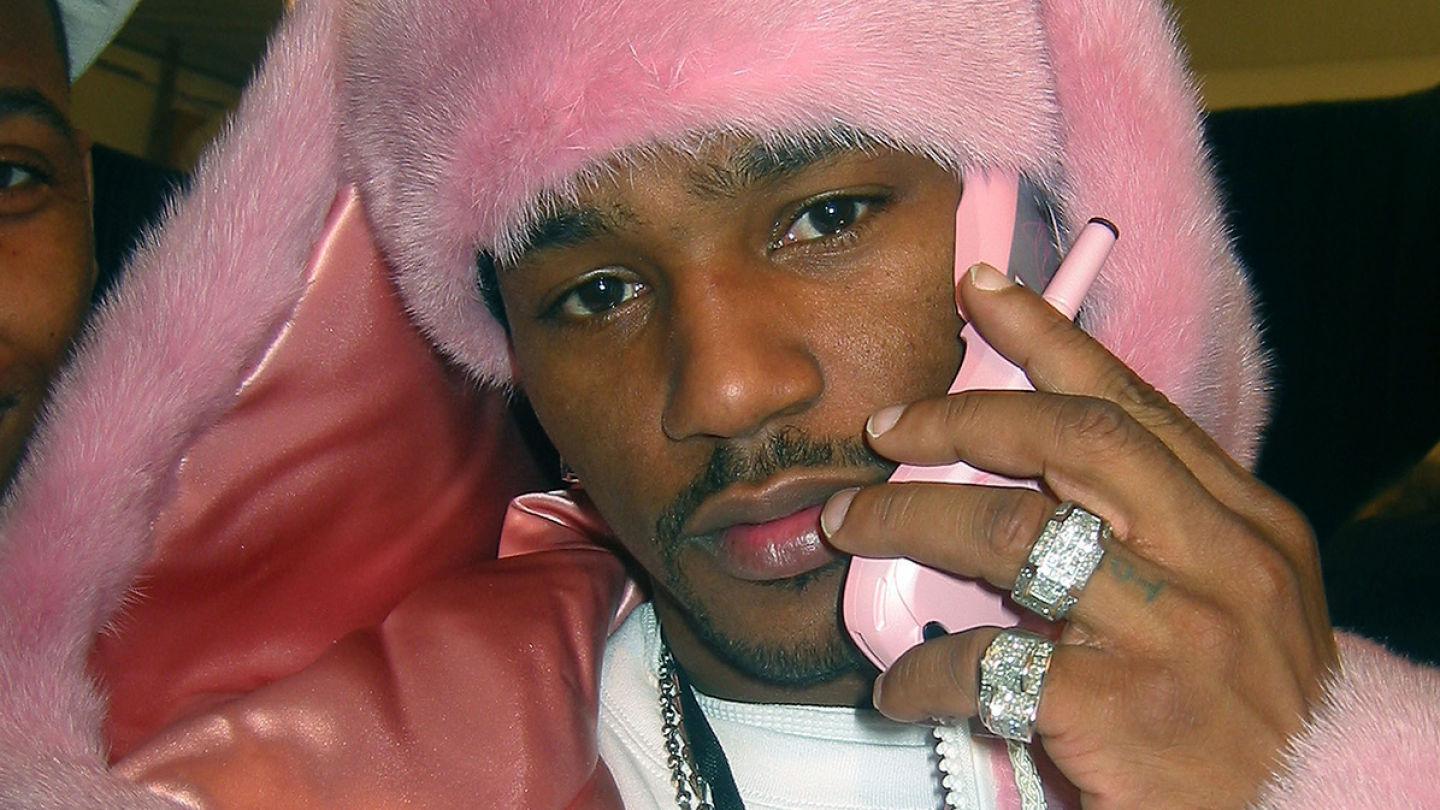
I’ll never rock a Minsk coat in the wintertime like Killa Cam

Or rock some Minsk boots in the summertime like Will.I.Am

wil i am7. Solingen Alligators

What’s cooler than a barracuda? German alligators. Europe loves cool animals.

6. Espoo Expos

Reaching into the honorable mentions here, but Finland’s top club includes both the classic Expos moniker and a location with tongue-twister alliteration. Well played.

5. Heidenheim Heidekopfe

Speaking of matching mascots and town names, the Philadelphia Phillies may have met their match.

4. SDUSOR – Diamonds

Similar to the Russian team with a similar name above, I do not wish to know the meaning behind this Ukrainian club’s rather unique name. The addition of Diamonds is a nice touch.

3. Baseball Klub Nada SSM Split

Less is definitely not more for this Croatian club. When in doubt, just make the name as long and odd as possible.

2. Reds Sleepwalkers

This club appears to have two nicknames…until you consider Hungary’s communist past. To be fair, it is unclear why “Reds” was chosen, but in any case, coupling it with sleepwalkers results in an odd mixture of politics and comatose baseball players.

1. Wiener Neustadt Diving Ducks

You get middle-school humor and a non-threatening mascot, but my favorite part of this name is the specificity that these are not just ordinary ducks – these are diving ducks! Oh the intimidation!

Dan Weigel writes about pitching at Sporting News and occasionally about pitching and sometimes other things at Beyond the Box Score. His former European club, the London Mets, slots at number 29 on Mister-Baseball’s rankings but unfortunately did not beat out Beograd 96 for the final spot on this list. Follow him on twitter at @danweigel38.

(Blogathon ’16) Hawkins DuBois- Searching for Baseball’s New Frontier: Examining the World of Mental Skills Training

This guest-post is part of the 2016 Baseball Continuum Blogathon For Charity, benefiting the Roswell Park Alliance Foundation. The Roswell Park Alliance Foundation is the charitable arm of Roswell Park Cancer Institute and funds raised will be “put to immediate use to increase the pace from research trials into improved clinical care, to ensure state-of-the-art facilities, and to help improve the quality of life for patients and their families.” Please donate through the Blogathon’s GoFundMe page. Also, please note that the opinions and statements of the writer are not necessarily those of the Baseball Continuum or it’s webmaster.

When analytics became the hot new craze in baseball 15 years ago, the teams at the forefront of the movement gained a level of competitive advantage that propelled them back into competition with the massively bankrolled clubs. A decade and a half later, analytics are no longer the secret weapon they once were for those small-market teams.

In today’s game, analytics are everywhere. You can find statistics online that attempt to measure defensive value, analysts on MLB Network and ESPN discuss the merits of WAR, and every major league team (yes, even the Phillies) has implemented their own baseball analytics department.

The advantage that small-market teams such as the Oakland A’s and Tampa Bay Rays gained by being the first to acknowledge the relevance of certain unheralded statistics, is now gone. Sabermetrics have become a focal point of the baseball world, not only for the front offices of major league baseball teams, but also for a significant portion of the sport’s fan base. Anyone and everyone can now learn about these advanced statistics.

With the usage of analytics being so widespread, teams must now look elsewhere to gain an edge. So, where do these teams look next?

One widely untapped possibility for the next great area of competitive advantage may be found right inside our own skulls. As one of baseball’s greats once said: “Baseball is ninety percent mental, and the other half is physical.” It’s a quote that I’m sure many of you are aware comes from the late Yogi Berra, and while his math might be off (he played before sabermetrics were around), his emphasis on the mental aspect of baseball is important to note.

Baseball players are under constant pressure to make decisions. A pitcher must decide what pitch to throw, a hitter whether to swing, a fielder where to position themselves. All of these decisions require the use of one’s mental skills. As Matt Krug, the Brewers director of psychological services put it, “the more down time you have in your sport, the more quote-unquote mental it is. There’s a lot of down time in baseball, which allows your thoughts to wander.”i Baseball provides a disproportionate amount of time for thinking as opposed to actually doing, so teaching players the right way to think, in preparation for performing their actions, is an incredibly important skill.

Unfortunately, the training and development of these mental skills has been fairly nonexistent throughout much of baseball history. While professional players spend hours every day lifting weights, fielding ground balls, and taking batting practice, they spend little to no time working to enhance their mental capabilities, despite often acknowledging the value of maintaining a calm and collected head.

In the past, teams have recognized the usefulness of psychology, but it has yet to find its way into the sport as a developmental tool on a large scale. One of the first, and most well-known, mental consultants in the game of baseball was Harvey Dorfman. Dorfman worked for nearly three decades with professional teams, as well as the Boras Corporation, becoming one of the first full-time mental skills consultants. He believed that to enhance a player’s performance, the player needed to reduce their stress by removing on-field distractions. Dorfman spent years within the game pushing his mental enhancement platform, making a profound impact on the world of mental training, and while he passed away in 2011, his legacy continues on.

Dorfman was only employed by three major league organizations (the A’s, Marlins and Devil Rays), but his reach stretched far beyond just the athletes on those teams. Numerous players, from Kevin Brown, to Brad Lidge, to Greg Maddux credited Dorfman with helping them improve their game. Jamie Moyer dedicated his 2013 memoir to Dorfmanii, and Rick Ankiel has taken up a job with the Washington Nationals as their life skills coordinator, in the hopes that he can pass on the wisdom that Dorfman imparted to him. Dorfman may be gone, but his teachings will progress, as players continue to utilize his techniques.

Since Dorfman, there haven’t been many hugely recognizable names in the baseball mental skills community, but Alan Jaeger is an excellent example of someone who is furthering the practice of mental skills training. Jaeger runs his own company, Jaeger Sports, where he promotes a mental training regimen of his own design, as well as rounding out his company through research and development of a long-toss guide to throwing, and the creation of the Jaeger-bands. Jaeger’s approach to mental training is detailed in his book, “Getting Focused Staying Focused,” where he emphasizes a program based on the practice of meditation. Jaeger remains active in the mental training aspect of his company, continuing to give talks to high schools and colleges, as well as consulting with professional players on improving their mental approach to the game, earning the praise of players such as Trevor Hoffman, Randy Wolf and Trevor Bauer.

Beyond just the spiritual successors that Dorfman spawned in people like Jaeger, his work also created an entirely new field of jobs within major league baseball organizations. Psychologists had been dabbling in baseball research since Babe Ruth’s playing days, but Dorfman’s work paved the way for the implementation of more mental training consultants with MLB teams. These mental training consultants, are well on their way to becoming a fixture in MLB organizations. Whereas it was once a viewed as a bad thing if a player went to speak to someone about something going on in their head, the baseball environment has now opened up to become far more accepting of sports psychology and the idea of mental training.

The Mariners have even gone so far as to provide sports psychologist Andy McKay with one of the highest positions in the front office, making him their director of player development. McKay will seek to fuse the worlds of physical and mental training, as he attempts to develop and enhance baseball players in a way that hasn’t been done before. It is McKay’s belief, as well as Mariners General Manger Jerry Dipoto’s, that psychology and mental training are the next great frontier in baseball. As McKay says, “there’s nobody that is doing it well. There’s an enormous gap between where we are as an industry and where we can get to.”iii

With McKay becoming one of the first major front office players to be trained in the field of psychology, what decisions he makes, and the success of his plans could make tidal waves in the sport. If McKay is able to master the art of mental training, there is no doubt that other teams will jump on the bandwagon to copy his strategies, and if/when that happens, it won’t be long before everyone in the game puts themselves back on a level playing field.

Ken Ravizza, an early contemporary of Dorfman’s and a current employee of the Chicago Cubs, provides an emphatic support of McKay and Dipoto’s belief: “People realize now that we’ve tapped the physical conditioning aspect. We’ve tapped the mechanics aspect. We’re tapping the computer aspect and all the numbers. I think now they’re realizing the next edge is the six inches between the ears.”iv

Hawkins is primarily a Dodgers fan, but has taken a strong rooting interest in the Mariners in recent years, due to the Dodgers’ television situation. He is currently finishing up his undergraduate degree at Loyola Marymount University in Los Angeles, while also coaching a local high school team. His writing about baseball (and movies) can be found at dancelikedevito.com.

i Joe Lemire, “With psychologists, MLB teams try to win “six inches between the ears””. USA Today, accessed on January 8, 2016 from http://www.usatoday.com/story/sports/mlb/2015/06/02/major-league-baseball-sports-psychology/28366403/

ii Tyler Kepner, “The Giants’ Pieces Remain, and Fall Apart”. New York Times, accessed on January 8, 2016 from http://www.nytimes.com/2013/09/15/sports/baseball/the-pieces-remain-and-fall-apart.html?pagewanted=all&_r=0

iii Greg Johns, “McKay steering Mariners through new frontier”. MLB.com, accessed on January 9, 2016 from http://m.mariners.mlb.com/news/article/157245156/andy-mckay-brings-new-ideas-to-mariners

iv Lemire

This guest-post has been part of the 2016 Baseball Continuum Blogathon For Charity, benefiting the Roswell Park Alliance Foundation. The Roswell Park Alliance Foundation is the charitable arm of Roswell Park Cancer Institute and funds raised will be “put to immediate use to increase the pace from research trials into improved clinical care, to ensure state-of-the-art facilities, and to help improve the quality of life for patients and their families.” Please donate through the Blogathon’s GoFundMe page. Also, please note that the opinions and statements of the writer were not necessarily those of the Baseball Continuum or it’s webmaster.

(Blogathon ’16) Greg Gay: Victim of Circumstance

This guest-post is part of the 2016 Baseball Continuum Blogathon For Charity, benefiting the Roswell Park Alliance Foundation. The Roswell Park Alliance Foundation is the charitable arm of Roswell Park Cancer Institute and funds raised will be “put to immediate use to increase the pace from research trials into improved clinical care, to ensure state-of-the-art facilities, and to help improve the quality of life for patients and their families.” Please donate through the Blogathon’s GoFundMe page. Also, please note that the opinions and statements of the writer are not necessarily those of the Baseball Continuum or it’s webmaster.

Circumstances conspire to form our major league baseball alliances. Perhaps we live near a team and going to games forms an unbreakable bond with the franchise. Maybe our rooting interests were handed down, family member to family member, a continuous line of Cubs or Reds or Orioles fans.

My circumstance was my mother handing me a pack of baseball cards.

She had just returned from the grocery store. It was 1974 and it was the first time I had ever seen or even heard of baseball cards. It was a cello pack, which contained around 35 cards back in the mid-1970s. Don’t ask me how I remember this, but the first card I pulled from that pack featured someone on the brink of a career-threatening injury. They thought he’d never pitch again.

I didn’t know any of that as an 8-year-old. I just knew that I liked this Tommy John fellow, standing there on this piece of cardboard, with a glove held up in front of his chest, his mouth half-open as if he wanted to tell me something. Instantly, I pledged allegiance to the team featured on that card, the Los Angeles Dodgers.

The Dodgers were my team from that moment, even though I lived 3,000 miles from where they played their games. It was a tenuous relationship, which could have withered and died, if not for circumstance.

A few years later, during the first year that I actively watched baseball on TV — my interest in cards had blossomed into a full-fledged love for baseball — the Dodgers made the World Series. My Dodgers. The guys I collected on bubble gum cards.

I lived in Upstate New York, Yankees country. Almost all of my classmates were Yankees fans. They were relentless. I could never hold onto Yankees cards because everyone around me always wanted to trade for them. Gradually, I grew tired of their hounding, their superior attitude as they bragged about how good their teams’ players were. And now my Dodgers were playing their Yankees.

My Dodgers lost. Something about Reggie Jackson hitting three home runs in Game 6. The following year, my Dodgers played their Yankees again in the World Series. Something about Reggie Jackson sticking out his hip. I was deflated. Two years in a row of my team losing to the team everyone around me thought was so superior.

I resented them. But the experience strengthened my resolve. Circumstance saw to it that I remained a Dodgers fan.

In 1981, the Dodgers obtained their revenge, beating the Yankees in six games, just as L.A. had been beaten in six in ‘77 and ‘78. I saw that my team COULD beat their team in the ultimate series. I went to school the next day and announced to the Yankees lovers in the hallway, “How about those Dodgers?”

In 1986, I picked up a book called “The Boys Of Summer.” I was in college, a journalism student. Roger Kahn’s famed memories of the 1952 Brooklyn Dodgers appealed to me as a fan and a future writer. But I didn’t know how fascinated I would become with my team, thanks to that book.

Kahn’s very human stories of the very human Dodgers, and what became of them, sealed my allegiance forever. I was proud of the stories my team had to tell. Jackie, Pee Wee and the Duke. Campy, Billy Cox and Joe Black. The Dodgers’ history is as rich as any team in  professional sports. I wanted to follow a team like that.

Circumstance — an interest in stories and the human condition — drew me tighter to this team. Forever to this team.

Today, I appreciate every moment of my Dodgers’ history. My favorites — Kirk Gibson in the ‘88 World Series, of course — are both large and small. Ron Cey’s crazy RBI April in 1977. Reading about Fernandomania from afar on the floor of my dining room in 1981. Shawn Green’s four home runs against the Brewers in 2002. I could go on for pages. And the characters–so many. Tommy Lasorda. Mickey Hatcher, Nick Punto.

The Dodgers, in my lifetime, have experienced highs (the epic 4+1 home run comeback game against the Padres)  and lows (which franchise gave up both Hank Aaron’s and Barry Bonds’ record-breaking home runs?) . They illustrate the humanity of baseball as well as any team. Bob Welch’s and Steve Howe’s battles with substance abuse. Brett Butler’s battle with cancer.

Living so far from my team, I have watched them play in person only once (Eric Gagne’s blown save in his hometown of Montreal in 2002). But thanks to my third-shift job and night owl habits, I can keep careful track of my favorite team from a distance, far better than when there was just a newspaper and a Saturday Game Of The Week.

I am a victim of circumstance. A faithful fan following his team from the other side of the country, spurred on by a single baseball card and some well-placed moments in time.

And to think my mother — not a baseball fan in the least — started it all by handing me a pack of cards in 1974.

Thanks, Mom.

Gregory Gay is a editor and sportswriter for a newspaper in Upstate New York. He operates the popular baseball card blog “Night Owl Cards,” under his blog alias “night owl.” His twitter handle is: @nightowlcards.

This guest-post has been part of the 2016 Baseball Continuum Blogathon For Charity, benefiting the Roswell Park Alliance Foundation. The Roswell Park Alliance Foundation is the charitable arm of Roswell Park Cancer Institute and funds raised will be “put to immediate use to increase the pace from research trials into improved clinical care, to ensure state-of-the-art facilities, and to help improve the quality of life for patients and their families.” Please donate through the Blogathon’s GoFundMe page. Also, please note that the opinions and statements of the writer were not necessarily those of the Baseball Continuum or it’s webmaster.
(Blogathon ’16) CLASSIC CONTINUUM- BIZARRE BASEBALL CULTURE: COSMIC SLAM

This piece from the blog’s archives is part of the 2016 Baseball Continuum Blogathon For Charity, benefiting the Roswell Park Alliance Foundation. The Roswell Park Alliance Foundation is the charitable arm of Roswell Park Cancer Institute and funds raised will be “put to immediate use to increase the pace from research trials into improved clinical care, to ensure state-of-the-art facilities, and to help improve the quality of life for patients and their families.” Please donate through the Blogathon’s GoFundMe page.

In Bizarre Baseball Culture, I take a look at some of the more unusual places where baseball has reared it’s head in pop culture and fiction.

Originally posted Nov. 19, 2013

I’m coming to you from the Auxiliary Headquarters of the Continuum… AKA a Living Room instead of my usual Family Room or Bedroom writing area, due to the great Wi-Fi Crisis of 2013. The reason I have braved such perils is simple: Cosmic Slam. The sequel to Shortstop Squad, and another great epic from the folks at Ultimate Sports Entertainment (AKA “Ultimate Sports Force”). Just as Shortstop Squad brought us late-90s shortstops fighting monsters and aliens, Cosmic Slam does the same with late 1990s sluggers. Jeff Bagwell, Sammy Sosa, David Justice and Mark McGwire all grace the cover, and Gary Sheffield, Bobby Bonilla and Frank Thomas all show up in the story as well.

It also involves Bagwell complaining about missing a fishing trip, Sosa making a corked bat joke, Greg Maddux‘s fastball being insulted, and of course, the making of a baseball bat out of the body of your defeated foes.

No, I’m not joking about the last one. Seriously, that really happens.

So, place your tongue firmly in cheek and go below the jump for Cosmic Slam.

Continue reading

(Blogathon ’16) CLASSIC CONTINUUM- Bizarre Baseball Culture’s “SHORTSTOP SQUAD”

This piece from the blog’s archives is part of the 2016 Baseball Continuum Blogathon For Charity, benefiting the Roswell Park Alliance Foundation. The Roswell Park Alliance Foundation is the charitable arm of Roswell Park Cancer Institute and funds raised will be “put to immediate use to increase the pace from research trials into improved clinical care, to ensure state-of-the-art facilities, and to help improve the quality of life for patients and their families.” Please donate through the Blogathon’s GoFundMe page.

Originally published October 25, 2013

In Bizarre Baseball Culture, I take a look at some of the more unusual places where baseball has reared it’s head in pop culture and fiction.

In the last years of the 20th century and the first years of the 21st, there existed a company called “Ultimate Sports Force”. It is gone now, existing only in old websites and undeleted news items, but in it’s day, it was a staple advertisement in things like Sports Illustrated for Kids.

What was “Ultimate Sports Force”, you ask?

Ultimate Sports Force was a comic company that made books in which professional athletes were superheroes, that’s what! They had licenses with MLB, NBA, NFL and others, and they made comics that involved them saving the world. And then, like a shooting star across the sky, they were gone.

But, oh, man, the stuff they left behind. I’ve come into possession of many of their great products, and while their quality varies from “surprisingly good” to “OH-DEAR-GOD-KILL-IT-WITH-FIRE”, they all represent a special point in our history, a time when we could think of our sports heroes as actual superheroes, and not individuals who got into arguments, used PEDs, had tumultuous love lives, politics we disagree with or other flaws. No, Ultimate Sports Force was the last Golden Age before we all became so jaded.

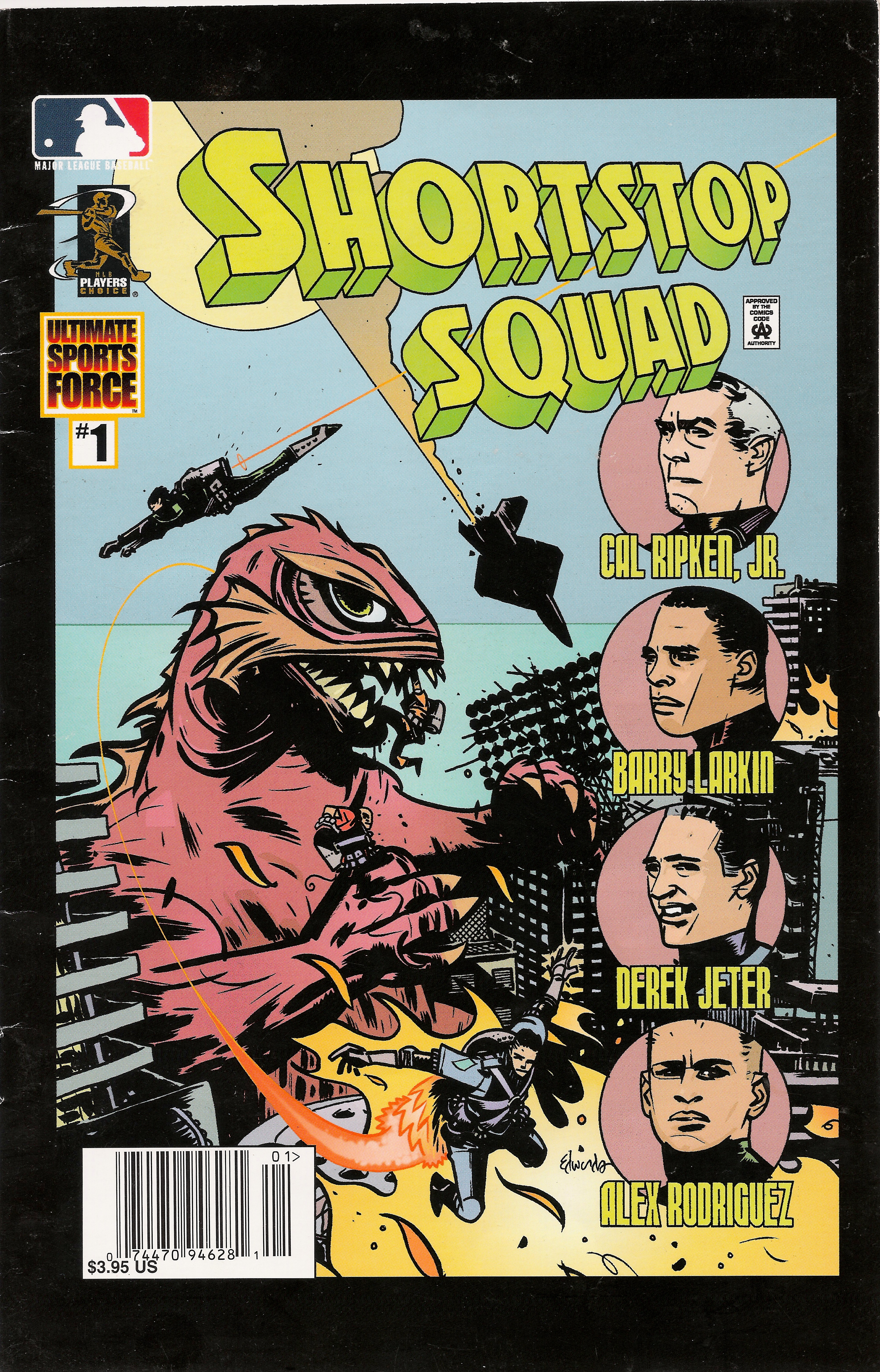
Perhaps the crown jewel of Ultimate Sports Force’s non-team-affiliated content was Shortstop Squad. Truly a marvel of the Bizarre Baseball Culture arts, it paid tribute to those that went before and followed in their traditions, as Cal Ripken led his team of Barry Larkin, Derek Jeter and Alex Rodriguez against a fish-monster that basically is meant to be fish-Godzilla.

You may think I’m being sarcastic, and you are probably right, but, well, this is SHORTSTOP SQUAD, so your logic is irrelevant.

After all, just LOOK at this cover:

SHORTSTOPSQUADcover

Your mind is now blown.

So, let’s get started with Shortstop Squad #1 from 1999… after the jump, of course:

Continue reading

(Blogathon ’16) Andrew Martin: A talk with Alex George

This guest-post is part of the 2016 Baseball Continuum Blogathon For Charity, benefiting the Roswell Park Alliance Foundation. The Roswell Park Alliance Foundation is the charitable arm of Roswell Park Cancer Institute and funds raised will be “put to immediate use to increase the pace from research trials into improved clinical care, to ensure state-of-the-art facilities, and to help improve the quality of life for patients and their families.” Please donate through the Blogathon’s GoFundMe page. Also, please note that the opinions and statements of the writer are not necessarily those of the Baseball Continuum or it’s webmaster.

What would be tougher? Being good enough to play major league baseball but to only get in to five games? Or having all of those five games come before your 17th birthday? Only one person knows that answer for sure, and it’s former shortstop Alex George, who reached the pinnacle of his baseball career as a teenager in the autumn of 1955.

Growing up in Kansas City, George was a multi-sport star and after graduating in 1955 at the age of 16, he enrolled at Kansas University with a dual scholarship in baseball and basketball. Upon reaching campus that fall he was introduced to his basketball team—including fellow newcomer, Wilt Chamberlain.

George had hardly cracked the books when he heard from his father that his hometown Kansas City Athletics wanted to sign him and have him join the team for the remainder of the season. That proved to be an offer too sweet to pass up, so he left campus and donned his glove and spikes.

The Athletics finished at 63-91 and were already well out of the pennant chase. This gave them the luxury at being able to look at prospects like George. The left-handed hitter got in five games, collecting a single and a walk in 10 official at bats. His seven strikeouts showed how overmatched he was, but he did pick up his lone hit on September 20th against fellow rookie Duke Maas and the Detroit Tigers, leading off what would be a 7-3 loss. He is still the sixth-youngest player to appear in the majors since World War I.

George spent the next seven seasons in the minors, experiencing modest levels of success (.254 batting average and 81 home runs) but never got back to the big leagues. By the time he was 24, he had been slowed by injuries to the point that it resulted in the end of his career.

He ended up returning to Kansas after his playing days were over and went on to have a successful career in radio and television sales. Now 77 and retired, he answered a few questions about his career when I contacted him (a few years back).

Who was your favorite coach or manager?: When I signed, Lou Boudreau was the manager. I had read a lot about him playing shortstop. Harry Craft was one of the coaches and was very nice to me. He had managed the Yankees Triple-A affiliate in Kansas City; the Kansas City Blues, so he was familiar with me and my family.

What was the strangest thing you ever saw as a player?: Probably the strangest play is when two or more infielders are all calling for a pop fly and then they all stop and look at one another and the ball drops between them. It’s not that unusual of a play, but it always struck me as odd and strange that they would just let the ball drop.

Who was the toughest pitcher you ever faced?: I didn’t faze too many major league pitchers, but I’ll always remember facing Billy Pierce in Chicago. He was a lefty and I just couldn’t catch up with his fastball.

If you could do anything differently about your career, what would that be?: I would probably wait until I was 18 to sign. At 16, I was really too young.

Andrew Martin writes The Baseball Historian blog. You can follow him on Facebook or Twitter @historianandrew

This guest-post has been part of the 2016 Baseball Continuum Blogathon For Charity, benefiting the Roswell Park Alliance Foundation. The Roswell Park Alliance Foundation is the charitable arm of Roswell Park Cancer Institute and funds raised will be “put to immediate use to increase the pace from research trials into improved clinical care, to ensure state-of-the-art facilities, and to help improve the quality of life for patients and their families.” Please donate through the Blogathon’s GoFundMe page. Also, please note that the opinions and statements of the writer were not necessarily those of the Baseball Continuum or it’s webmaster.

(Blogaton ’16) Chris Kabout: Former Red Sox farmhand gives a hand in battle against cancer

This guest-post is part of the 2016 Baseball Continuum Blogathon For Charity, benefiting the Roswell Park Alliance Foundation. The Roswell Park Alliance Foundation is the charitable arm of Roswell Park Cancer Institute and funds raised will be “put to immediate use to increase the pace from research trials into improved clinical care, to ensure state-of-the-art facilities, and to help improve the quality of life for patients and their families.” Please donate through the Blogathon’s GoFundMe page. Also, please note that the opinions and statements of the writer are not necessarily those of the Baseball Continuum or it’s webmaster.

For this first Blogathon for charity it seemed a good idea to me to write a piece on Swen Huijers’ Baseball Against Cancer foundation.

Swen signed a contract with the Boston Red Sox organization in 2008. He started to pitch for the GCL Red Sox. He played three seasons for the Boston Rookie team for which he posted a 9-4 record in 37 games. In 2011 Swen was promoted to the Lowell Spinners in the New York-Penn League (A Short Season). In that season with the Spinners, Swen posted two victories and two losses in ten games of which he started two. He finished the season with a 2.43 ERA. Despite the decent season he was released by the Red Sox. Back in the Netherlands, Swen startd to attend the police academy. That was very time consuming. Now he is a police officer, he has to deal with irregular shifts. And when you play in the Hoofdklasse, you have to practice at least twice a week. Together with three competition games per week, it was very difficult to combine. Due to the irregular shifts, his performance deteriorated. Eventually Swen decided to stop halfway the 2015 season, mainly because he could not combine his job with top sport.

Right now Swen doesn’t have time to play baseball at all. He is mainly occupied with organizing baseball clinics out of Baseball Against Cancer. If possible he wants to play baseball at a lower level

In the meantime Swen and a friend decided to participate in a big Dutch cycling event against cancer: Alpe d’HuZes. In this cycling event every participant has to cycle up to mount Alpe d’Huez, one of the biggest mountains during the Tour de France. To participate everyone needs to bring 2,500 Euros at least, which will be donated to the KWF (Koninging (=Queen) Wilhelmina Foundation), the Dutch foundation that fights against cancer. Despite pleas with friends and family they didn’t quite make it to raise the 2,500 Euros. At that point, Swen came up with the idea to raise money with a baseball clinic. 250 children attended the first edition of this clinic. These kids were taught the basics of baseball by several Dutch Hoofdklasse players, World Champions and other baseball players. This event raised the whopping amount of 4,167,25 Euro. Baseball Against Cancer was born.

But why did Swen decide to participate in Alpe dHuZes? His cousin is an ex cancer patient. He started to do voluntary work for the event Alpe d’HuZes. He arranged the yearly transportation. Other family members also traveled to France, to help in this magnificent event. Because Swen was playing baseball for the Red Sox organization at the time that the event took place, he made a vow that he would participate as soon as he had the chance. That chance came in 2012 after he was released by the Red Sox, when he could enlist for the 2013 edition of Alpe d’Huzes.

The second edition of Baseball Against Cancer drew even a lot more children. In the brand new baseball facility of Vaessen Pioniers from Hoofddorp, Swen’s hometown team, 275 children attended the event under the watchful eye of more baseball players. At the end of the day, over 8,000 Euro could be handed over to the KWF.

In 2015, Swen’s event even got bigger and even got the much deserved attention in the Dutch media as he was invited for an interview on Dutch national radio. The players that participated in that event were all Dutch Hoofdklasse (Major League) players like: Bas Nooij, Eric de Vries, Nick & Tom Stuifbergen, Sidney de Jong, Pim Walsma, Kevin Weijgertse, Bayron Cornelisse, Danny Rombley, Vince Rooi, David Bergman, Scott Ronnebergh, Sedley Karel, Damian Melis, Zerzinho Croes, Jasper de Jong and Lars Huijer. But next to these players, also young players that took the clinics in the first edition, now participate as instructors.

As far as Swen concerns, the media intention was nice for the battle against cancer. Not for the recognition. Swen just wants to collect as much money as possible for the battle against cancer.

In the Dutch baseball world there is much demand for events in which children can participate. Swen managed to organize a successful event.

A little step back to his participation in the Alpe d’HuZes event: On my question if he managed to climb the mountain six times, Swen answered that it was never his intention to do that. He drove up the mountain on a mountain bike instead of a racing bike, which makes it much harder. The night before the event he got very ill. On the day itself, he carried a backpack with two bottles of water and two canteens. About halfway up the mountain he drank all of his water supply. In the fifth curve of the climb, he was bothered by cramps in his thighs. He had to stretch for about fifteen minutes before he could finish the climb to the top.

This year the Baseball Against Cancer event will take place for the fourth time. It will take place on May 3 and 4. For the first time in the history of the event there will be a softball edition on May 3. The baseball edition will be on May 4. So far, Swen only had time to organize the softball part. He does this in cooperation with Golden League player (Dutch Hoofdklasse Softball) Ginger de Weert. Next to her the following softball players will participate in the clinic as instructor: Karen Tuk, Kirsten Scheele, Sophie Molee and Rebecca Soumeru.

Baseball nut born and raised in Amsterdam. Played for the oldest baseball club in Europe (AHC Quick, founded in 1913). Writer for Universo Beisbol (Cuban baseball magazine), for the website of the KNBSB (Dutch baseball and softball federation) and my own blog www.yankeebiscuitfansdutchblog.mlblogs.com

This guest-post has been part of the 2016 Baseball Continuum Blogathon For Charity, benefiting the Roswell Park Alliance Foundation. The Roswell Park Alliance Foundation is the charitable arm of Roswell Park Cancer Institute and funds raised will be “put to immediate use to increase the pace from research trials into improved clinical care, to ensure state-of-the-art facilities, and to help improve the quality of life for patients and their families.” Please donate through the Blogathon’s GoFundMe page. Also, please note that the opinions and statements of the writer were not necessarily those of the Baseball Continuum or it’s webmaster.

(Blogathon ’16) Ron Kaplan- Read All About It: Blogs That Will Keep You Up on Baseball Books

This guest-post is part of the 2016 Baseball Continuum Blogathon For Charity, benefiting the Roswell Park Alliance Foundation. The Roswell Park Alliance Foundation is the charitable arm of Roswell Park Cancer Institute and funds raised will be “put to immediate use to increase the pace from research trials into improved clinical care, to ensure state-of-the-art facilities, and to help improve the quality of life for patients and their families.” Please donate through the Blogathon’s GoFundMe page. Also, please note that the opinions and statements of the writer are not necessarily those of the Baseball Continuum or it’s webmaster.

It’s been often said that baseball is one of the most literary of sports. I think it’s safe to say without the benefit of, you know, actual facts, that there have been more books on the national pastime than any other sport.

I launched my Baseball Bookshelf with the idea of providing a wide array of news about the genre, including original pieces plus links to reviews; interviews with creators, not just of words, but art, music, film; and other pertinent items.

But lest you think this is the only game in town, here are some other great places to find out what’s good in the world of baseball lit:

  • John Thorn, the official historian of Major League Baseball, often writes about books on his blog, Our Game, especially those that deal with the early years.
  • The Society for American Baseball Research has lots of information about books. Sadly, their Bibliography Committee is no longer around, but the newsletters are still somewhere on the site, which can be a bit intimidating to navigate. Some pages of their site can be accessed for free; others are members-only. But it’s well worth the $65 fee since SABR includes several wonderful titles each year as part of its premiums. The most recent: An assessment of baseball through the hit animated TV series, The Simpsons.
  • The National Pastime Museum recently concluded its series on “The Baseball Book That Changed My Life,” with essays from an assortment of authors and scholars.
  • Spitball: The Literary Magazine has lots of news and reviews about books.
  • Gregg Kersey posts his original reviews about baseball books.
  • James Bailey’s site is still up and although he doesn’t add to it as often as in past years, you can still find a good chunk of material.
  • Baseballbookreview.com is another defunct site that can still be an asset.
  • The Baseball Almanac includes several dozen reviews on this page.

Of course, you can simply do a web search for “baseball book reviews,” but these are among the sites that will give you the biggest bang for your buck.

Ron Kaplan runs Ron Kaplan’s Baseball Bookshelf and the author of 501 Baseball Books Fans Must Read before They Die. A signed copy will be given to one lucky donor to the GoFundMe page.

This guest-post has been part of the 2016 Baseball Continuum Blogathon For Charity, benefiting the Roswell Park Alliance Foundation. The Roswell Park Alliance Foundation is the charitable arm of Roswell Park Cancer Institute and funds raised will be “put to immediate use to increase the pace from research trials into improved clinical care, to ensure state-of-the-art facilities, and to help improve the quality of life for patients and their families.” Please donate through the Blogathon’s GoFundMe page. Also, please note that the opinions and statements of the writer were not necessarily those of the Baseball Continuum or it’s webmaster.

(Blogathon ’16) Nate Fish: Ezra, the Ballplayer

This guest-post is part of the 2016 Baseball Continuum Blogathon For Charity, benefiting the Roswell Park Alliance Foundation. The Roswell Park Alliance Foundation is the charitable arm of Roswell Park Cancer Institute and funds raised will be “put to immediate use to increase the pace from research trials into improved clinical care, to ensure state-of-the-art facilities, and to help improve the quality of life for patients and their families.” Please donate through the Blogathon’s GoFundMe page. Also, please note that the opinions and statements of the writer are not necessarily those of the Baseball Continuum or it’s webmaster.

I got this email on November 18th, 2015.

“Hi Nate,
My name is Ezra Schwartz, I’m at yeshiva and heard about the baseball league. I played four years of high school baseball and would love to join the spring league if there is space. If you can send me details of how to register that would be great.
Thank you.”

I am the national director for the Israel Association of Baseball and get emails like this a lot, kids wanting to play, or invites to tournaments, and I breezed over it. I was not in Israel at the time. I was in New York, where I used to live, visiting family and friends for Thanksgiving, and was not in the mood to deal with work. When I did reply the next morning, it was short.

Great. Will add you to our list and send you a mail when spring training is getting ready to start. We should start Feb 10ish, season will start about a month later.”

But Ezra never got my e-mail.

I was on my parent’s couch looking at Facebook on my phone seeing what my friends were doing later. People were still talking about the Paris attacks that had happened a week earlier. And there were more stabbings back in Israel. I was more interested in my friends than news or people’s opinions on terrorism, but the forth or fifth time it came up on the screen, I saw it, “American Teen Ezra Shwartz Killed in Israel.” Shit, I said loud enough that my dad came in the room to ask what was wrong. I pulled up my e-mails to make sure. It was him.

Ezra was attending a gap year program at a school in Bet Shemesh, near Jerusalem. He was taking food and water to Israeli soldiers in the West Bank with some of his classmates and a teacher. For those of you who have never been to the West Bank, it is not a war zone. You could drive there a thousand times and nothing would happen. We have baseball teams there so I go out to see the fields and meet with coaches. I do not particularly like going. I find it a bit eerie, the check points and fences and security vehicles. There is a tension, but it is not by definition dangerous, no more dangerous than neighborhoods in Chicago or most major American cities, for example. It was a routine trip for the students. On their way back to the school, their car stopped at a red light, and they were ambushed by a Palestinian fighter who fired several shots at the cars lined up at the light. Along with Ezra, one Palestinian man, and an Israeli Jewish man were killed and five others were injured. Ezra was taken to a hospital. By the time I replied to his e-mail, he was dead.

I posted a note on Facebook about Ezra. Hundreds of people shared it, thousands liked it. I started hearing from Ezra’s former coaches and people who wanted to help The press and all the Jewish organizations got on the story. And Ezra quickly turned from a kid to an idea.

Ezra’s family came to Israel last week (Editor’s note: Nate got this to me in on January 8), his parents and four younger siblings. His three brothers threw out ceremonial first-pitches at our Junior League all-star game, and we will hopefully build a field in his honor in Raanana where some of Ezra’s family lives. It’s all good PR. But there is one thing Ezra’s family would like more than good PR, and that is to have their son and brother back. So when I take the field this spring to play one of my final baseball seasons for the Jerusalem Lions, I will try to remember Ezra the kid, not Ezra the idea – Ezra, the ballplayer.

Nate Fish is the director of the Israel Association of Baseball, his Twitter is @KingOfJBaseball.

This guest-post was part of the 2016 Baseball Continuum Blogathon For Charity, benefiting the Roswell Park Alliance Foundation. The Roswell Park Alliance Foundation is the charitable arm of Roswell Park Cancer Institute and funds raised will be “put to immediate use to increase the pace from research trials into improved clinical care, to ensure state-of-the-art facilities, and to help improve the quality of life for patients and their families.” Please donate through the Blogathon’s GoFundMe page. Also, please note that the opinions and statements of the writer were not necessarily those of the Baseball Continuum or it’s webmaster.