Ever wonder what the walk-up music for a certain MLB player is? Well, a site called Designated Hits seems to have the answers.
Category Archives: Non-Baseball
Link
Just in time for Man of Steel, our friend Michael Clair over at Old Time Family Baseball takes a look at a 1982 story in which Clark Kent has to manage a little league team. Go there.
The North Korean Hockey Team
Aside
Non-baseball-related thing I read that I found interesting: An article over at Deadspin on North Korea’s national ice hockey team. Yeah, they have one.
The Joys of Strike Zone
Reply
The most under-rated and overlooked piece of baseball television is the MLB Strike Zone channel.
You probably have no idea what I am talking about. That proves the above point about it being the most overlooked piece of baseball television.
Put simply, MLB Strike Zone is a twice-weekly (usually Tuesdays and Fridays, but occasionally Wednesday as well) injection of nonstop baseball. Available on it’s own channel on most cable and satellite systems that have a sports package, Strike Zone is similar to MLB Tonight, only with little-to-none of the talking heads and with zero commercials. It is, in many ways, similar to the NFL RedZone channel: minimal interruption, maximum game action.
Watching yesterday, for example, I was able to see, amongst many other things: the David Phelps‘ meltdown against the Mets, Ryan Zimmerman‘s first and second home runs (I only missed the last one because I did some channel surfing), several good defensive plays, the Orioles’ comeback and the start of the late games. I would have, had I just chosen one or two games and switched between them, missed a lot. But with Strike Zone, I saw more-or-less everything of note that happened in baseball last night, live or with only a short delay.
And yet, nobody seems to talk about Strike Zone all that much. Perhaps because it is relatively new- it just started last year, after all. Or maybe it is because it doesn’t seem to receive much publicity: I’ve only seen maybe one or two commercials for it, and it seems like MLB Network itself is more focused on getting eyes on the games they are showing on the network on the nights that Strike Zone is on.
With luck, more will start paying attention to Strike Zone, and, with luck, it could even be expanded to more days of the week. So if you haven’t already, check it out.
Famous For Something Else: Rethinking Jim Thorpe’s Baseball Career
It’s sometimes said that Jim Thorpe, for all his great talent, couldn’t hit a curveball, and that baseball was his worst sport.
Well, maybe, but then you look at his statistics. Take a look:
| Year | Age | Tm | Lg | G | PA | AB | R | H | 2B | 3B | HR | RBI | SB | BB | SO | Pos | |||||
|---|---|---|---|---|---|---|---|---|---|---|---|---|---|---|---|---|---|---|---|---|---|
| 1913 | 26 | NYG | NL | 19 | 36 | 35 | 6 | 5 | 0 | 0 | 1 | 2 | 2 | 1 | 9 | .143 | .167 | .229 | .395 | 12 | /O |
| 1914 | 27 | NYG | NL | 30 | 31 | 31 | 5 | 6 | 1 | 0 | 0 | 2 | 1 | 0 | 4 | .194 | .194 | .226 | .419 | 27 | /O |
| 1915 | 28 | NYG | NL | 17 | 54 | 52 | 8 | 12 | 3 | 1 | 0 | 1 | 4 | 2 | 16 | .231 | .259 | .327 | .586 | 81 | O |
| 1917 | 30 | TOT | NL | 103 | 404 | 308 | 41 | 73 | 5 | 10 | 4 | 40 | 12 | 14 | 45 | .237 | .275 | .357 | .632 | 96 | O97/8 |
| 1917 | 30 | NYG | NL | 4 | 69 | 2 | 2 | 1 | 0 | 0 | 0 | 0 | 0 | 0 | 0 | .500 | .500 | .500 | 1.000 | 211 | 9/78 |
| 1917 | 30 | CIN | NL | 77 | 269 | 251 | 29 | 62 | 2 | 8 | 4 | 36 | 11 | 6 | 35 | .247 | .267 | .367 | .634 | 97 | O97 |
| 1917 | 30 | NYG | NL | 22 | 66 | 55 | 10 | 10 | 3 | 2 | 0 | 4 | 1 | 8 | 10 | .182 | .297 | .309 | .606 | 88 | O |
| 1918 | 31 | NYG | NL | 58 | 119 | 113 | 15 | 28 | 4 | 4 | 1 | 11 | 3 | 4 | 18 | .248 | .286 | .381 | .666 | 103 | O7/98 |
| 1919 | 32 | TOT | NL | 62 | 172 | 159 | 16 | 52 | 7 | 3 | 1 | 26 | 7 | 6 | 30 | .327 | .359 | .428 | .787 | 142 | O78/93 |
| 1919 | 32 | NYG | NL | 2 | 4 | 3 | 0 | 1 | 0 | 0 | 0 | 1 | 0 | 0 | 0 | .333 | .333 | .333 | .667 | 101 | /O87 |
| 1919 | 32 | BSN | NL | 60 | 168 | 156 | 16 | 51 | 7 | 3 | 1 | 25 | 7 | 6 | 30 | .327 | .360 | .429 | .789 | 143 | O78/93 |
| 6 Yrs | 289 | 816 | 698 | 91 | 176 | 20 | 18 | 7 | 82 | 29 | 27 | 122 | .252 | .286 | .362 | .648 | 99 | ||||
| 162 Game Avg. | 162 | 457 | 391 | 51 | 99 | 11 | 10 | 4 | 46 | 16 | 15 | 68 | .252 | .286 | .362 | .648 | 99 | ||||
| NYG (6 yrs) | 152 | 379 | 291 | 46 | 63 | 11 | 7 | 2 | 21 | 11 | 15 | 57 | .216 | .262 | .323 | .585 | 78 | ||||
| BSN (1 yr) | 60 | 168 | 156 | 16 | 51 | 7 | 3 | 1 | 25 | 7 | 6 | 30 | .327 | .360 | .429 | .789 | 143 | ||||
| CIN (1 yr) | 77 | 269 | 251 | 29 | 62 | 2 | 8 | 4 | 36 | 11 | 6 | 35 | .247 | .267 | .367 | .634 | 97 | ||||
As you can see, early in his career, Thorpe was dreadful in his limited time playing baseball. But as time went on, he got better. By his final season in the big leagues, 1919, he was hitting a good .327/.359/.428 and his OPS was .787, which is above average. Hardly a world-beater, but definitely not the failure many make his baseball career out to be.
But, wait, what did he do in the minor leagues?
| Year | Age | Tm | Lg | Lev | G | AB | H | 2B | 3B | HR | TB | ||
|---|---|---|---|---|---|---|---|---|---|---|---|---|---|
| 1909 | 22 | Rocky Mount | ECAR | D | 44 | 138 | 35 | 4 | 0 | 1 | .254 | .304 | 42 |
| 1910 | 23 | 2 Teams | 1 Lg | D | 45 | 128 | 31 | 2 | 2 | 0 | .242 | .289 | 37 |
| 1910 | 23 | Rocky Mount,Fayetteville | ECAR | D | 45 | 128 | 31 | 2 | 2 | 0 | .242 | .289 | 37 |
| 1910 | 23 | Rocky Mount | ECAR | D | 29 | 76 | 18 | 2 | 1 | 0 | .237 | .289 | 22 |
| 1910 | 23 | Fayetteville | ECAR | D | 16 | 52 | 13 | 0 | 1 | 0 | .250 | .288 | 15 |
| 1915 | 28 | 2 Teams | 1 Lg | AA | 96 | 370 | 112 | 13 | 7 | 2 | .303 | .392 | 145 |
| 1915 | 28 | Newark/Harrisburg,Jersey City | IL | AA | 96 | 370 | 112 | 13 | 7 | 2 | .303 | .392 | 145 |
| 1915 | 28 | Jersey City | IL | AA | |||||||||
| 1915 | 28 | Newark/Harrisburg | IL | AA | |||||||||
| 1916 | 29 | Milwaukee | AA | AA | 143 | 573 | 157 | 25 | 14 | 10 | .274 | .419 | 240 |
| 1920 | 33 | Akron | IL | AA | 128 | 522 | 188 | 28 | 15 | 16 | .360 | .563 | 294 |
| 1921 | 34 | Toledo | AA | AA | 133 | 505 | 181 | 36 | 13 | 9 | .358 | .535 | 270 |
| 1922 | 35 | 3 Teams | 2 Lgs | AA-A | 131 | 501 | 168 | 26 | 15 | 10 | .335 | .507 | 254 |
| 1922 | 35 | Portland | PCL | AA | 35 | 120 | 37 | 3 | 2 | 1 | .308 | .392 | 47 |
| 1922 | 35 | Hartford | EL | A | |||||||||
| 1922 | 35 | Hartford,Fitchburg/Worcester | EL | A | 96 | 381 | 131 | 23 | 13 | 9 | .344 | .543 | 207 |
| 1922 | 35 | Fitchburg/Worcester | EL | A | |||||||||
| 7 Seasons | 720 | 2737 | 872 | 134 | 66 | 48 | .319 | .468 | 1282 | ||||
| AA (5 seasons) | AA | 535 | 2090 | 675 | 105 | 51 | 38 | .323 | .477 | 996 | |||
| D (2 seasons) | D | 89 | 266 | 66 | 6 | 2 | 1 | .248 | .297 | 79 | |||
| A (1 season) | A | 96 | 381 | 131 | 23 | 13 | 9 | .344 | .543 | 207 | |||
These minor league stats, as incomplete as they are, seem to suggest that Thorpe definitely had a talent at baseball- perhaps not against MLB pitching, but certainly good enough to wreck havoc upon lower levels. But, take a look at those years after his 1919 season- the one season where he hit pretty well in MLB. He kept hitting above .300- at times well above it, and in pretty good leagues like the International League and American Association.
So, what happened? Why didn’t he return to the big leagues after 1919? SABR’s BioProject suggests it was because he started to focus more on professional football- he was the first commissioner of what would one day become the NFL, for example. We’ll never know what he might have accomplished in any one sport if he had focused solely on it- but Thorpe was too great an athlete to be held to just one. Or two. Or three…
And that is and was a good thing.
Bizarre Baseball Culture: The Shield must solve “The Ballpark Murders”
In Bizarre Baseball Culture, I take a look at some of the more unusual places where baseball has reared it’s head in pop culture and fiction.
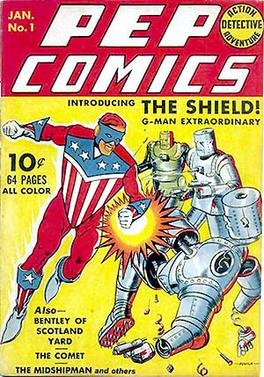
One of the main types of Superhero is the patriotic hero, wrapped in the flag, fighting crime and evil not just to protect a city, but to protect a country. The quintessential patriotic hero, of course, is Captain America. But, contrary to popular belief, he was not the first. No, that honor goes to The Shield, “G-Man Extraordinary”, who first showed up in Pep Comic #1 in January 1940. By contrast, Captain America didn’t appear until March 1941. The Shield- created by MLJ Comics (which eventually became Archie Comics)- is actually Joe Higgins, who gained his rather generic superpowers (strength, invulnerability, etc) from a chemical formula (much like, yes, Captain America eventually did).
Anyway, given his patriotic get-up, it was probably inevitable that the Shield would one day crossover with the National Pastime. And, in fact, it happened rather quickly in Pep Comics #7, which came out later in 1940. It can be found here, written by Harry Shorten and drawn by Irv Novick.
Anyway, onto the story:

We begin with the standard organized crime villains (these ones belonging to “Al Moroni”), not unlike the ones we’ve seen in plenty of previous installments of Bizarre Baseball Culture. It’s sort of weird that we don’t really ever seem to run into actual supervillains in these things, especially considering that the vast majority of these Bizarre Baseball Culture stories involve superheroes.
(JUMP for the rest of the story)
Cool Link: Diamond Mines Scouting Reports Database
Continuum Global News has been delayed until the First Anniversary Spectacular this Wednesday. In it’s stead, here is a cool link.
The Hall of Fame is opening an exhibit about scouting, which is neat. But even cooler is that they’ve started a website that has a searchable database of old scouting reports! While there aren’t that many for more recent players (you won’t find any scouting reports for Buster Posey, for example), it’s full of stuff for older players.
Here are some neat ones I’ve found:
A 1985 scouting report of the Cubs’ affiliate in Peoria: Rafael Palmeiro hits well to all fields, but Greg Maddux is not strong enough to be a starter, according to Duffy Dyer.
Orioles scout John Stokoe discusses Mariano Rivera, who he notes threw a rain-shortened no-hitter against Rochester and who he is impressed with. However, he notes that Rivera doesn’t really have any off-speed pitches, and would need one for future success. Turns out he didn’t need a true off-speed pitch. Much like everyone else, Stokoe never sees the cutter coming.
Mariners scouting report declares Alex Rodriguez is “similar to Jeter only bigger and better.”
Satchel Paige‘s faults in 1956? Too old. In 1958, a scouting report on him has “?” for age.
The Royals scout a young amateur Jim Thome… who was a shortstop at the time. Let that sink in. Jim Thome… was a shortstop. Oh, on a similar note, Frank Robinson was a 3B, and Joe Nathan was being scouted as a shortstop.
Mark McGwire pitched a bit in High School, had a body like Dave Kingman and his father was a dentist, according to a 1984 scouting report by Boston scout Joe Stephenson.
And that is just scratching the surface of what this site has… check it out.
Baseball Continuum Classic Story: The Biggest Stories That Haven’t Happened Yet (Originally published April 10, 2013)
In the wake of NBA Center Jason Collins “coming out of the closet” today, and becoming the first “Big Four” active player to do so, I was reminded of a post I did earlier this month: The Biggest Stories That Haven’t Happened Yet. If you want to read it, just click the link to the left, or go below the jump to read a reprint. With the exception of the deletion of a call to go below the jump to read after the first paragraph of the story, it is printed completely as it originally was, with no changes, updates or corrections.
Review of “42”
“Continuum Global News” will return next week, but better late than never, here’s my review of 42:
Jackie Robinson was, without question, the most important baseball player of the 20th century. While Babe Ruth may have been the most transcendent star, and Curt Flood proved a pivotal figure in the game’s labor history, Robinson’s effects did not simply stop at baseball. No, his effect was felt far beyond the diamond. How important was Jackie Robinson? Well, no less than Martin Luther King Jr. declared him an important member and symbol of the civil right movements. And, least we forget, Robinson was a great ballplayer as well, a career .311 hitter, a six-time All-Star, the Rookie of the Year in 1947 and MVP of 1949. Who knows what type of career he may have had (he didn’t make his MLB debut until age 28) if not for segregation and the war?
So given this, it’s sort of surprising that it’s taken this long for a modern biopic on Robinson. There was a biopic starring the man himself in 1950, and a TV movie about his court-martial in 1990 (starring Andre Braugher as Robinson), but nothing else. But, I guess good things come to those who wait, because 42, although far, far from perfect, is a fine movie that does well at honoring Robinson while also educating those who perhaps are not as familiar with the story.
(MORE AFTER JUMP)
Quote of the Day (April 25, 2013)
Today’s quote comes from pollster (and former baseball sabermatrician) Nate Silver:
Any one game in baseball doesn’t tell you that much, just as any one poll doesn’t tell you that much.
 The Baseball Continuum