Panthers over Broncos, 27-23.
Ridiculously short prediction for the 50th Super Bowl
Aside
Panthers over Broncos, 27-23.
Panthers over Broncos, 27-23.
This guest-post is part of the 2016 Baseball Continuum Blogathon For Charity, benefiting the Roswell Park Alliance Foundation. The Roswell Park Alliance Foundation is the charitable arm of Roswell Park Cancer Institute and funds raised will be “put to immediate use to increase the pace from research trials into improved clinical care, to ensure state-of-the-art facilities, and to help improve the quality of life for patients and their families.” Please donate through the Blogathon’s GoFundMe page. Also, please note that the opinions and statements of the writer are not necessarily those of the Baseball Continuum or it’s webmaster.
–
I would have enjoyed seeing Game 6 of the 1947 World Series. It was yet another Dodgers/Yankees affair, when both the event and the outcome seemed inevitable. It had been a hell of a Series, including a stunner in Game 4: the Yanks’ Bill Bevens pitched a ten-walk no-hitter into the ninth when, with two outs and two runners on in a 2-1 game, Cookie Lavagetto smacked a game-winning double to right — the last hit of his career! — that Tommy Henrich could not reach. Game to the Dodgers.
By Game 6 the Yanks were up 3 games to 2 with Allie Reynolds, in his first year in the Bronx, on the mound. He had nothing, and was done in the third. Relief ace Joe Page also got lit, though the Yankees slowly crept back. Down 8-5 in the 6th, Joe DiMaggio came up to bat with 2 on and 2 out. He crushed Joe Hatten’s pitch to left center. Left fielder Al Gionfriddo raced toward the visitors’ bullpen, over 400 feet from home plate, and managed to jjuusstt make the catch. DiMaggio, sure he’d just lost at least a double, did something extremely rare: he showed emotion, and kicked a patch of dirt between first and second. Inning over. The Yankees would go on to lose 8-6.
This catch has been on my mind after a recent bit of baseball reading. What stands out after looking at three works — Roger Kahn’s The Era 1947-1957; David Halberstam’s Summer of ‘49; and Richard Ben Cramer’s Joe DiMaggio: The Hero’s Life, — is how differently they portray this one catch, DiMaggio’s reaction, and the man himself.
I have mixed feelings about Kahn. I’m the father of a special needs son, and reading his description in The Boys of Summer of Carl Erskine raising a “Mongoloid” is a nice reminder that, despite Kahn’s desire, the glory days of the past have no place in my present. But, goddammit, the man can tell a story. He describes the catch over several pages, focusing on Gionfriddo’s reaction, including (according to Gionfriddo) comments made by DiMaggio about the man who stole his hit: “…[he] never gave up and he made the greatest catch that anybody ever made in the whole history of baseball.”
It’s not hard to imagine DiMaggio, even then aware of his aura, describe the catch this way. Only the greatest catch of all time denies the Yankee Clipper his glory. DiMaggio would return to this topic years later: asked to evaluate Willie Mays’ catch off Vic Wertz in the ‘54 Series (a catch, one scribe noted, that would “have left any other park than the Polo Grounds, including Yellowstone”), DiMaggio invoked his past, telling Kahn “…Mays had plenty of room. Running back, all he had to worry about was the ball. On my drive, Gionfriddo had to worry about the ball and those iron gates. He had to worry about running out of room, about getting hurt. With all that, I say he made the greater catch.”
DiMaggio, as Kahn portrays him, is aware of his image, proud of it, and ceaselessly builds on it. Not so in Cramer, who describes the catch as follows:
As DiMaggio rounded first, he could see the outfielder Al Gionfriddo dancing a spirited tarantella — unsure where to run, which way to turn, how to get under the ball. Joe was digging for second base when Gionfriddo, in an act of God, stumbled under the ball, stuck his glove over the wire fence and — Cazzo! Figlio di putana! — stole the home run away from DiMaggio.
This . . . well, this is different. It’s not a good catch. It’s a lucky grab by a fool who stumbled to just the right place to become a part of history. The tone here is also different. Cramer’s DiMaggio is a miserable figure, aloof and alone, proud only of his legacy, and a prisoner of it. After the game, in the locker room, came the following:
“The Catch” might not have burned Joe up, if Gionfriddo hadn’t been out of position, clueless in that outfield, and a busher in the first place . . . after the game, he didn’t answer questions, and told the photographers: no pictures. The next day, when one cameraman asked Joe to autograph a picture of that home run theft, DiMaggio snarled him away: “Whyn’cha get the other guy? He made the catch.”
Two takes, two tones. There’s overlap, sure, but Cramer’s DiMaggio comes across again and again as just a colossal son of a bitch. This version of DiMaggio will not compliment the bush-league Gionfriddo on his catch. It’s unlikely he saw it as superior to Mays’.
And then there’s Halberstam, who has a pretty significant deviation:
During the 1947 World Series, in a rare burst of emotion, he kicked the ground near second base after a Brooklyn player named Al Gionfriddo made a spectacular catch, robbing him of a three-run home run. The net day while he was dressing, a photographer who had taken a picture of him kicking the ground asked him to sign a blowup of it. At first DiMaggio demurred and suggested that the photographer get Gionfriddo’s signature. “He’s the guy who made the play,” DiMaggio said. But the photographer persisted, and so reluctantly DiMaggio signed it. Then he turned to a small group of reporters sitting by him. “Don’t write this in the paper,” he said. “but the truth is, if he had been playing me right, he would have made it look easy.”
Again a different take. This is a bad catch once again – DiMaggio would have effortlessly made it – but this time, you’ll note, he signs the photo. This DiMaggio is graceful. Halberstam is writing about a man in his early thirties, but it’s hard not to see the silver-haired, immaculately dressed gentleman of DiMaggio’s later years leaning over to reporters with a conspiratorial wink and telling them how he really felt about that catch. The legend is strong here.
Does any of this matter? I don’t know. We have one catch, three stories, and three somewhat different men featured in each. I am reminded, however, of what is so fascinating and frustrating about history: at the end of the day, I have no idea what DiMaggio thought about that catch. I know what our authors thought of it, and of the man himself. Cramer gives us a DiMaggio fierce in his misanthropy, alone with nothing except the memory of his greatness. I’m not sure Kahn or Halberstam get us closer to the truth. Kahn, like all old men, wants us to remember an era better than our own, when giants walked the land. So, too does Halberstam, though he understands baseball – as Bill James reminds us – perhaps the least of these three authors. In the end we’re left with three sources describing a catch made under an October sky, a man so shrouded by a legacy that his thoughts are lost, the mentalités of three historians imposed upon the past, and the recession of an event from history to myth.
–
The Author of @OldHossRadbourn is the individual behind the @OldHossRadbourn Twitter account.
–
This guest-post has been part of the 2016 Baseball Continuum Blogathon For Charity, benefiting the Roswell Park Alliance Foundation. The Roswell Park Alliance Foundation is the charitable arm of Roswell Park Cancer Institute and funds raised will be “put to immediate use to increase the pace from research trials into improved clinical care, to ensure state-of-the-art facilities, and to help improve the quality of life for patients and their families.” Please donate through the Blogathon’s GoFundMe page. Also, please note that the opinions and statements of the writer are not necessarily those of the Baseball Continuum or it’s webmaster.
This piece from the blog’s archives is part of the 2016 Baseball Continuum Blogathon For Charity, benefiting the Roswell Park Alliance Foundation. The Roswell Park Alliance Foundation is the charitable arm of Roswell Park Cancer Institute and funds raised will be “put to immediate use to increase the pace from research trials into improved clinical care, to ensure state-of-the-art facilities, and to help improve the quality of life for patients and their families.” Please donate through the Blogathon’s GoFundMe page.
–
In Bizarre Baseball Culture, I take a look at some of the more unusual places where baseball has reared it’s head in pop culture and fiction.
–
Originally posted Nov. 19, 2013
I’m coming to you from the Auxiliary Headquarters of the Continuum… AKA a Living Room instead of my usual Family Room or Bedroom writing area, due to the great Wi-Fi Crisis of 2013. The reason I have braved such perils is simple: Cosmic Slam. The sequel to Shortstop Squad, and another great epic from the folks at Ultimate Sports Entertainment (AKA “Ultimate Sports Force”). Just as Shortstop Squad brought us late-90s shortstops fighting monsters and aliens, Cosmic Slam does the same with late 1990s sluggers. Jeff Bagwell, Sammy Sosa, David Justice and Mark McGwire all grace the cover, and Gary Sheffield, Bobby Bonilla and Frank Thomas all show up in the story as well.
It also involves Bagwell complaining about missing a fishing trip, Sosa making a corked bat joke, Greg Maddux‘s fastball being insulted, and of course, the making of a baseball bat out of the body of your defeated foes.
No, I’m not joking about the last one. Seriously, that really happens.
So, place your tongue firmly in cheek and go below the jump for Cosmic Slam.
This piece from the blog’s archives is part of the 2016 Baseball Continuum Blogathon For Charity, benefiting the Roswell Park Alliance Foundation. The Roswell Park Alliance Foundation is the charitable arm of Roswell Park Cancer Institute and funds raised will be “put to immediate use to increase the pace from research trials into improved clinical care, to ensure state-of-the-art facilities, and to help improve the quality of life for patients and their families.” Please donate through the Blogathon’s GoFundMe page.
–
Originally published October 25, 2013
In Bizarre Baseball Culture, I take a look at some of the more unusual places where baseball has reared it’s head in pop culture and fiction.
In the last years of the 20th century and the first years of the 21st, there existed a company called “Ultimate Sports Force”. It is gone now, existing only in old websites and undeleted news items, but in it’s day, it was a staple advertisement in things like Sports Illustrated for Kids.
What was “Ultimate Sports Force”, you ask?
Ultimate Sports Force was a comic company that made books in which professional athletes were superheroes, that’s what! They had licenses with MLB, NBA, NFL and others, and they made comics that involved them saving the world. And then, like a shooting star across the sky, they were gone.
But, oh, man, the stuff they left behind. I’ve come into possession of many of their great products, and while their quality varies from “surprisingly good” to “OH-DEAR-GOD-KILL-IT-WITH-FIRE”, they all represent a special point in our history, a time when we could think of our sports heroes as actual superheroes, and not individuals who got into arguments, used PEDs, had tumultuous love lives, politics we disagree with or other flaws. No, Ultimate Sports Force was the last Golden Age before we all became so jaded.
Perhaps the crown jewel of Ultimate Sports Force’s non-team-affiliated content was Shortstop Squad. Truly a marvel of the Bizarre Baseball Culture arts, it paid tribute to those that went before and followed in their traditions, as Cal Ripken led his team of Barry Larkin, Derek Jeter and Alex Rodriguez against a fish-monster that basically is meant to be fish-Godzilla.
You may think I’m being sarcastic, and you are probably right, but, well, this is SHORTSTOP SQUAD, so your logic is irrelevant.
After all, just LOOK at this cover:
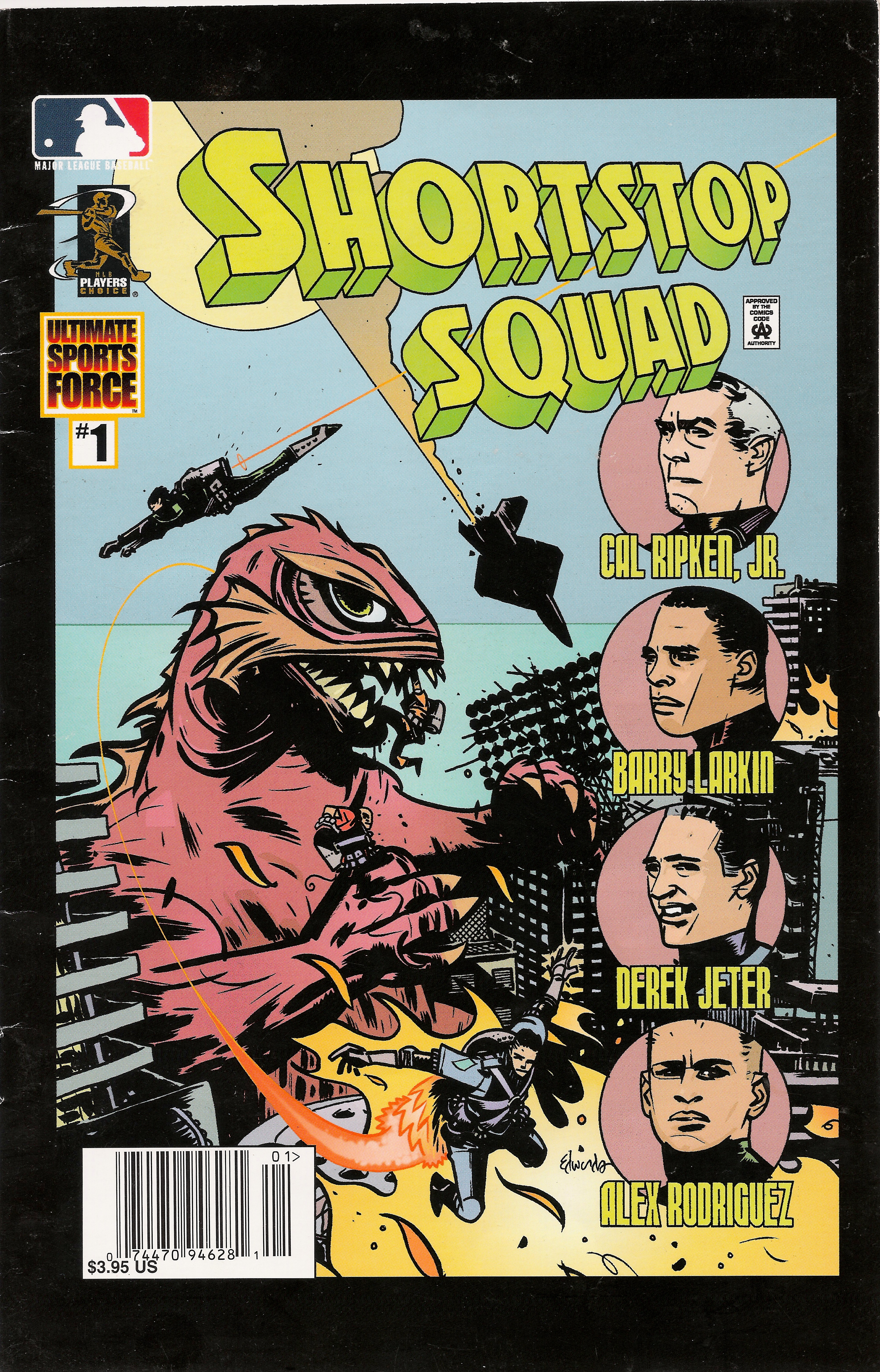
Your mind is now blown.
So, let’s get started with Shortstop Squad #1 from 1999… after the jump, of course:
This guest-post is part of the 2016 Baseball Continuum Blogathon For Charity, benefiting the Roswell Park Alliance Foundation. The Roswell Park Alliance Foundation is the charitable arm of Roswell Park Cancer Institute and funds raised will be “put to immediate use to increase the pace from research trials into improved clinical care, to ensure state-of-the-art facilities, and to help improve the quality of life for patients and their families.” Please donate through the Blogathon’s GoFundMe page. Also, please note that the opinions and statements of the writer are not necessarily those of the Baseball Continuum or it’s webmaster.
–
It’s been often said that baseball is one of the most literary of sports. I think it’s safe to say without the benefit of, you know, actual facts, that there have been more books on the national pastime than any other sport.
I launched my Baseball Bookshelf with the idea of providing a wide array of news about the genre, including original pieces plus links to reviews; interviews with creators, not just of words, but art, music, film; and other pertinent items.
But lest you think this is the only game in town, here are some other great places to find out what’s good in the world of baseball lit:
Of course, you can simply do a web search for “baseball book reviews,” but these are among the sites that will give you the biggest bang for your buck.
–
Ron Kaplan runs Ron Kaplan’s Baseball Bookshelf and the author of 501 Baseball Books Fans Must Read before They Die. A signed copy will be given to one lucky donor to the GoFundMe page.
–
This guest-post has been part of the 2016 Baseball Continuum Blogathon For Charity, benefiting the Roswell Park Alliance Foundation. The Roswell Park Alliance Foundation is the charitable arm of Roswell Park Cancer Institute and funds raised will be “put to immediate use to increase the pace from research trials into improved clinical care, to ensure state-of-the-art facilities, and to help improve the quality of life for patients and their families.” Please donate through the Blogathon’s GoFundMe page. Also, please note that the opinions and statements of the writer were not necessarily those of the Baseball Continuum or it’s webmaster.
This guest-post is part of the 2016 Baseball Continuum Blogathon For Charity, benefiting the Roswell Park Alliance Foundation. The Roswell Park Alliance Foundation is the charitable arm of Roswell Park Cancer Institute and funds raised will be “put to immediate use to increase the pace from research trials into improved clinical care, to ensure state-of-the-art facilities, and to help improve the quality of life for patients and their families.” Please donate through the Blogathon’s GoFundMe page. Also, please note that the opinions and statements of the writer are not necessarily those of the Baseball Continuum or it’s webmaster.
–
As someone who loves both hip-hop and baseball, it’s a daily disappointment that these two lanes of my life don’t intersect more often.
It happened recently, when Toronto Blue Jays pitcher Marcus Stroman made his rhyming debut, dropping a verse on Mike Stud’s “These Days” remix from his new album of the same name. There’s more here than just the same ol’ story of an athlete thinking he can spit a few bars. Stud is the nom de rap of Mike Seander, who was a college teammate of Stroman’s at Duke University.
After Duke, Stroman went on to a successful MLB career and Stud became a notable figure in the Drake-influenced frat-rap scene. So more than baseball players trying to get into rap, this was two friends reuniting for fun. Nonetheless, Stroman was surprisingly good. Better, in fact, than you’d think.
Using Stroman as a jumping off point, this seems like a timely opportunity to talk about other baseball-rap crossovers. Please enjoy this Abridged Version of the History of Baseball Players Rapping.
1. DEION SANDERS
When Prime Time jumped into the rap game, no one took it all that serious. He was hanging with MC Hammer and had already established himself as a profession-juggler. So, rapping, why not? He released an entire album in 1994, aptly titled “Prime Time” that people will mostly remember for the somewhat popular song “Must Be the Money.” It wasn’t good, but it was at least ahead of its time in the sense that modern day hip-hop also values people who rap about being rich even if they have no actual talent.
Notable lyric: “Hey, my snakeskin shoes gonna change into gators / Hey, my library cards gonna change into credit cards
/ You know what I’m sayin?”
2. KEN GRIFFEY JR.
Somehow, The Kid’s foray into rap doesn’t get nearly enough attention. In 1992, Seattle rapper Kid Sensation got Griffey to jump on a track called “The Way I Swing.” How that happened? Emoji shrug. History doesn’t remember any of this too well, but you know what? The beat to the song isn’t bad. Griffey isn’t a Hall of Famer spitter, but this is at least somewhat respectable.
Notable lyric: “Ken Griffey is a swinger, not a singer / A def rhyme bringer / A home-run hitter but I’m not a dope slinger.”
3. COCO CRISP
As part of the 2005 album, “Oh Say, Can You Sing,” veteran outfielder Coco Crisp showed his flows on an original song called “We Got That Thing.” This might be baseball’s version of Cedric Ceballos rapping on that NBA rap CD where you’re like, “Huh? This guy is rapping and … he’s not bad.” It’s bouncy and interesting and actually sounds good more than 10 years later. Well done, Coco.
Notable lyric: “That chain you wear is dental floss to me.”
4. JOSE REYES
It’s a surprise we don’t hear more Spanish-language rap coming from Latin baseball players. We do get it from Jose Reyes, though. His history in rap is more prolific than most people here, as he’s appeared on a number of different songs, usually as an offseason hobby. It’s hard to judge his lyrics, as a non-Spanish speaker, but his flow doesn’t sound bad.
Notable lyric (translated): “There are no friends / A friend is a dollar in my pocket / As soon as you turn your back your friends want to stab you in the back.”
5. TREVOR BAUER
The now-Indians pitcher made headlines a few years ago for his hobby rap tracks. There was even one that was perceived as a diss to former D-backs teammate Miguel Montero. That would be a baseball first. Bauer isn’t very good. Even he admits that. And these days, he seems more focused on pitching than rapping, but he at least has proven he can be his team’s hip-hopping cheerleader.
Notable lyric: “So what do y’all know bout Swisher and his swag / Smokin pitchers like cigars / Are you picturing that?”
6. MARCUS STROMAN
This brings us back to Stroman who, compared to Bauer, is easily the best rapping pitcher in the game. He doesn’t plan to rap a bunch — he’d much rather lead the Jays back to the postseason — but Stroman did sound at ease on his Mike Stud cameo.
Notable lyric:“Yeah, my vision is to get it while I’m living / I’ll keep winning / Legendary comeback, ACL incision”
–
Mike Oz is the editor of Big League Stew on Yahoo Sports. You can find him on Twitter at @mikeoz and on Facebook. He lives in Central California and likes dope beats and tacos.
–
This guest-post has been part of the 2016 Baseball Continuum Blogathon For Charity, benefiting the Roswell Park Alliance Foundation. The Roswell Park Alliance Foundation is the charitable arm of Roswell Park Cancer Institute and funds raised will be “put to immediate use to increase the pace from research trials into improved clinical care, to ensure state-of-the-art facilities, and to help improve the quality of life for patients and their families.” Please donate through the Blogathon’s GoFundMe page. Also, please note that the opinions and statements of the writer were not necessarily those of the Baseball Continuum or it’s webmaster.
This guest-post is part of the 2016 Baseball Continuum Blogathon For Charity, benefiting the Roswell Park Alliance Foundation. The Roswell Park Alliance Foundation is the charitable arm of Roswell Park Cancer Institute and funds raised will be “put to immediate use to increase the pace from research trials into improved clinical care, to ensure state-of-the-art facilities, and to help improve the quality of life for patients and their families.” Please donate through the Blogathon’s GoFundMe page. Also, please note that the opinions and statements of the writer are not necessarily those of the Baseball Continuum or it’s webmaster.
–
Throughout the baseball community, St. Louis baseball fans have a bad reputation. The “Best-Fans-In-Baseball” moniker is frequently used to ridicule Cardinals fans for their own brand of self-righteous blind homer-ism (to be fair, this is a phenomenon every single fan base exhibits to some extent). We’re not here today to discuss whether or not St. Louis has the best fans in baseball, we’re here to show you that St. Louis has THE best fan in baseball. His name is Cornell Iral Haynes Jr. — but you probably know him as Nelly.
Nelly is easily St. Louis’ most well known and successful rapper. His songs ‘Ride Wit Me’, ‘Hot in Herre’, ‘Dilemma’, and ‘Shake Ya Tailfeather’ have been certified platinum. But Nelly’s most important song — and thus his most important music video — is ‘Batter Up’, which combines a hook based on the theme song from The Jeffersons with Nelly’s love for baseball to form an undisputed artistic masterpiece.
Released in 2001, the music video for Batter Up is 4 minutes and 41 seconds of pure baseball delight. It’s got barbecue, bunt home runs, scantily clad women, and George Jefferson himself. So sit back, relax, and let us take you on a journey through the brilliant baseball mind of Cornell Haynes Jr.
0:03-0:14
Right off the bat we meet our announcers, two old balding white guys in ugly suits that are quite obviously not being portrayed by old balding white guys. Not trying to start a controversy here, but the one on the right bears a suspicious resemblance to Nelly.

0:17
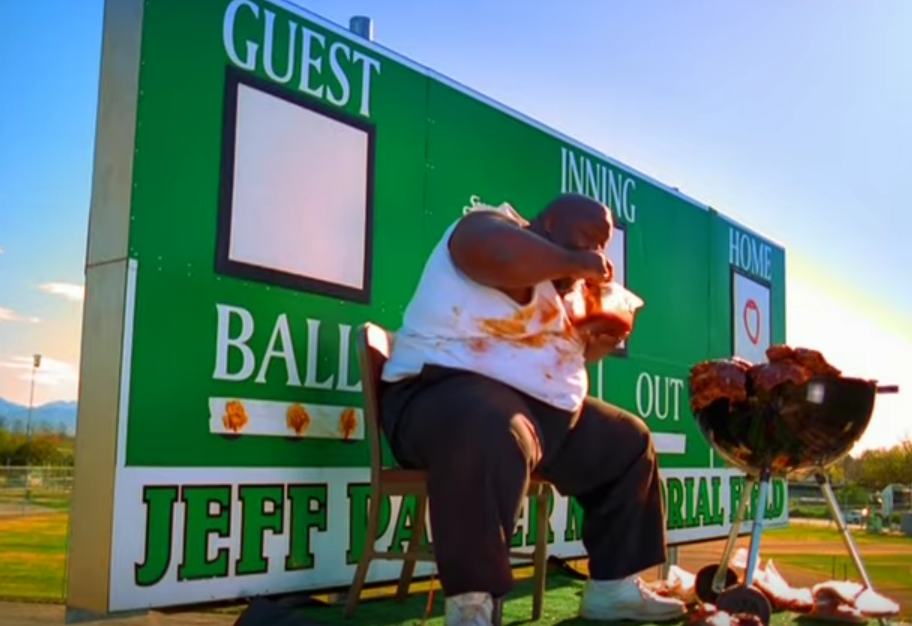
We are introduced to the scoreboard operator: a heavyset man in a white tank top that is absolutely doused in BBQ sauce. This gentleman seems to be using the ribs as a paintbrush in order to carry out changes to the scoreboard. Notice how not a single pitch has been thrown, yet there are already three balls.
0:20
Sherman Hemsley!

“And now, please rise for the singing of our National Anthem!” Hemsley proclaims. Was this a legitimate attempt to get Batter Up to be our new National Anthem? Nelly knows no bounds.
0:29
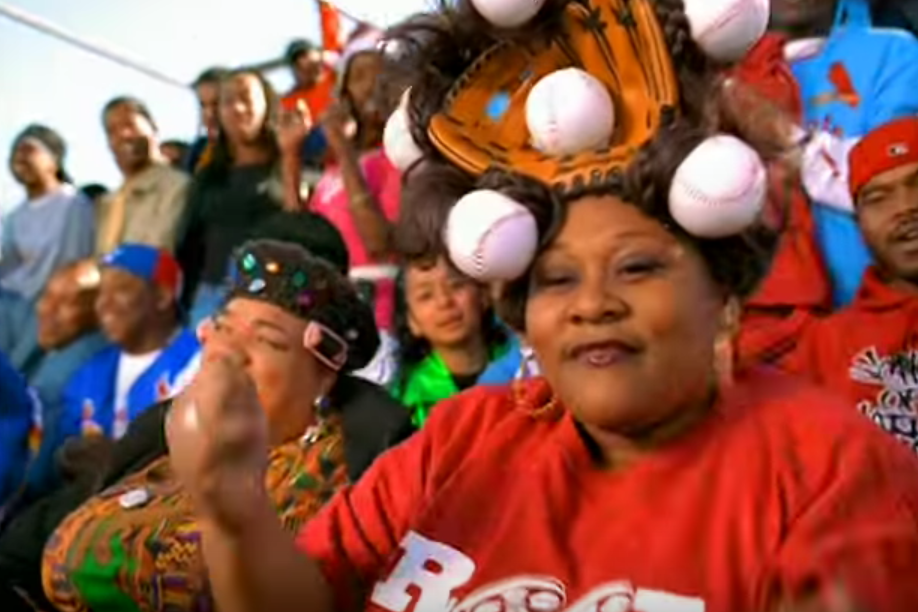
So many questions about this hat/hair combination. Is the glove embedded into the woman’s hairdo? Is it simply one enormous hair piece? Does Lids have any available in a 7 3/8?
0:39
Here we see something unprecedented in the baseball world: an entire team pre-inning huddle on the mound. Did the outfielders come into the infield after the catcher threw down to second? It looks like the coach is in there too. Maybe they’re drawing up some type of trick play.
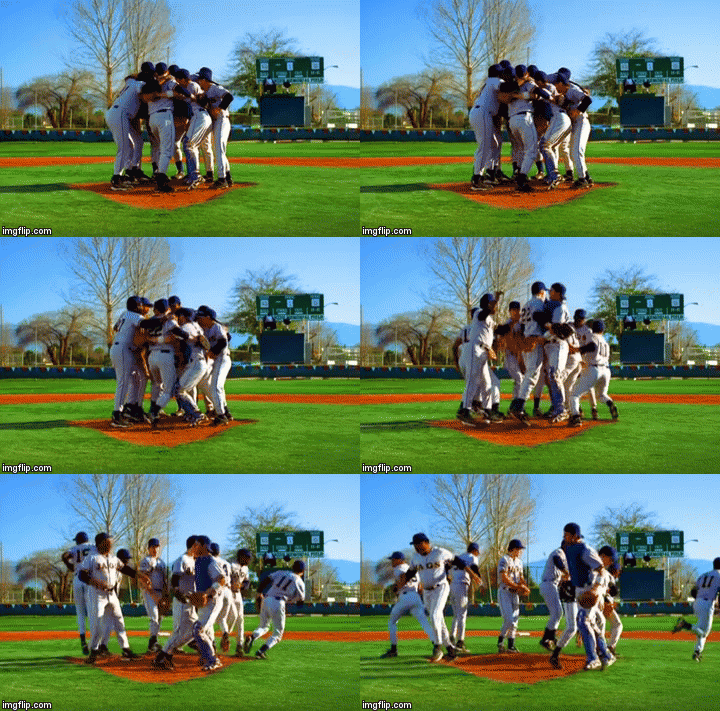
Let’s take a look at the scoreboard in centerfield. Under it we see our old friend, the heavy set barbecuin’ chef. And oh, the score is somehow 62-0 in the top of the 1st inning. 62-0! The first pitch of the game hasn’t even been thrown yet. Could it be that Nelly and his St. Lunatics were at such a disadvantage that the other, seemingly more put-together outfit, spotted them 62 runs? Just some food for thought. Perhaps more importantly, what is even the circumstance of this game? Is it just a men’s league? Independent ball? Are the St. Lunatics barnstorming around the country challenging any semi-pro team that thinks they can take down Nelly & Co.? It’s just a peculiar match-up by all accounts.
0:42
What kinda shift is this? There’s supposedly no one on base yet (as evidenced by the ridiculous team huddle) but the middle infielders are in double play depth. And even if there was a dude on first, this would be extreme.
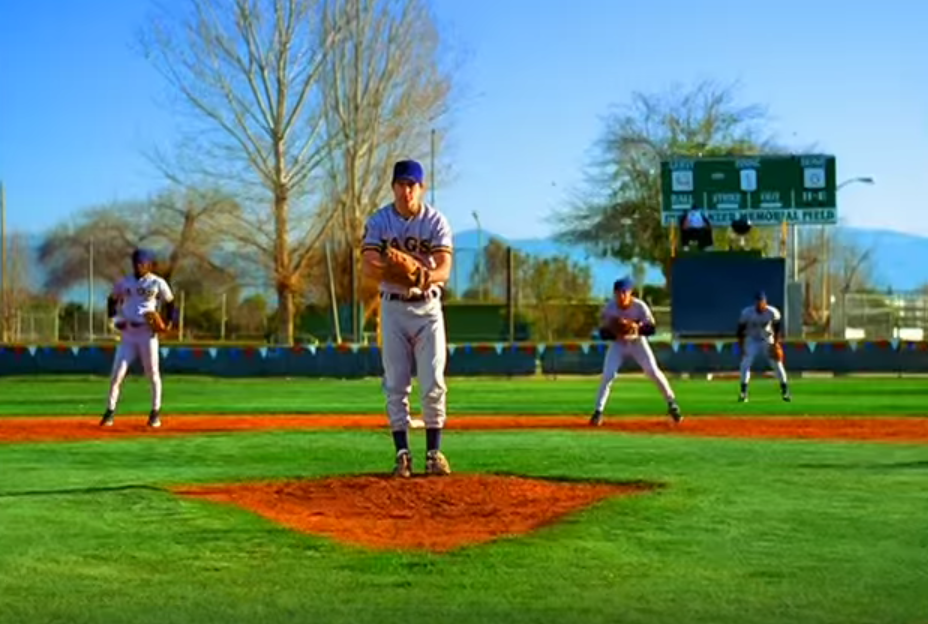
The bizarro double play shift looks even more absurd because this game is clearly being played on a field with Little League/softball dimensions. Making grown men play on a Little League size field has to be some sort of safety risk.
0:44
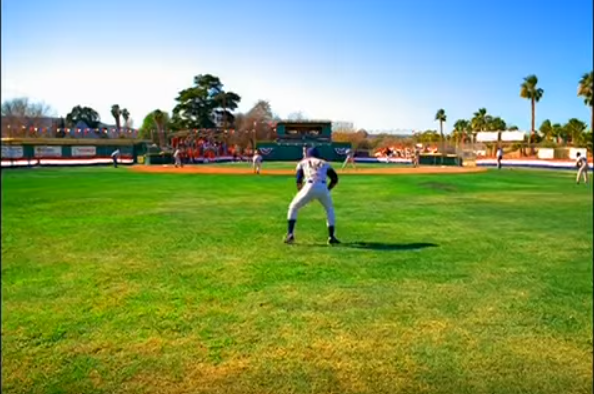
Yeah, that’s not a baseball field.
0:48

Posture – 40
Balance – 55
Torque – 30
Hat Content – 20
Early 2000’s Reebok Cleats – 80
0:55
Up first for the St. Lunatics is Ali. Let’s see what kind of swing he has… oh, that’s a pitbull.

If this game is being played in a baseball universe that permits batters to bring pitbulls up to the plate with them, the pitbulls should at the very least have to be in the batter’s box.
Despite the potential advantage intimidation-wise — is the pitcher even going to throw the ball if the catcher is too afraid to crouch? — you’d have to think that having a pitbull with you in the batter’s box would probably have a negative effect on offensive production. Not only does it force you to swing with only one hand, but you become significantly more susceptible pitches low in the zone.
1:00
Maybe because both the umpire and the opposing team are so intimidated by the presence of his pitbull, Ali bypasses the traditional rules of baseball and is awarded a single run without having to even swing the bat.
All you, barbecue scoreboard guy.

YOU CAN PUT IT ON THE BOOOOOOOARD, YESSSS.
1:22
Kyjuan steps up to the plate with, as far as we know, no one one base. Looks like he’s gonna try and bunt for a hit. Odd strategy at this point in the game, and considering his stolen base totals in recent years, but he must know something we don’t.

WELL THEN. The pitcher thought he could go up and in but Kyjuan brings his hands in and launches the ball over the centerfield wall…while bunting. He saunters down to first with pride. It’s basically Super Bunt from MLB 2K6.
2:17
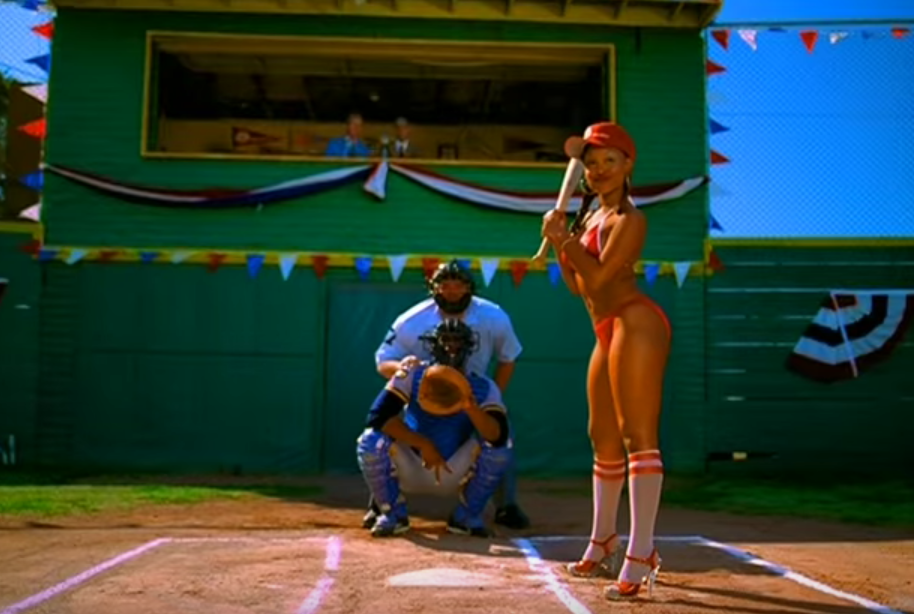
We’re usually all for unique uniforms, but this one just seems impractical. Can you imagine sliding headfirst on dirt in that thing? THE HIGH HEELS! Also, WHY ARE YOU CALLING A CURVEBALL! At least the pitcher is smart enough to shake him off.
2:28
And even after calling off the curveball, the pitcher manages to airmail it into the press box. The umpire rules that the runner go to first, which makes zero sense unless that was ball four. More confusing is the outrage expressed by the catcher, the opposing manager, as well as the announcers. Who are they mad at? The umpire for calling ball four? The pitcher for throwing ball four? The batter for not wearing any clothes? What we do know for sure is our scorekeeper is still very much enjoying his barbecue:

3:17
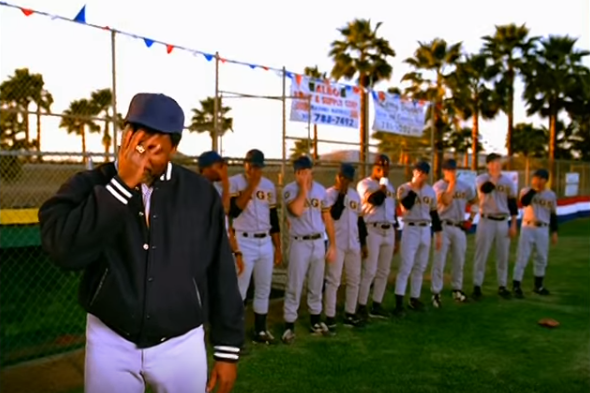
This is a confusing shot for a few reasons. While we acknowledged that this is clearly not a professional sized field, and the dugouts most likely aren’t very big, it’s still rather odd to see the entire team out of the dugout standing in a line, expressing their discontent simultaneously. Also…is the manager wearing a World Series ring? Is this team supposed to be good??!?!
3:28
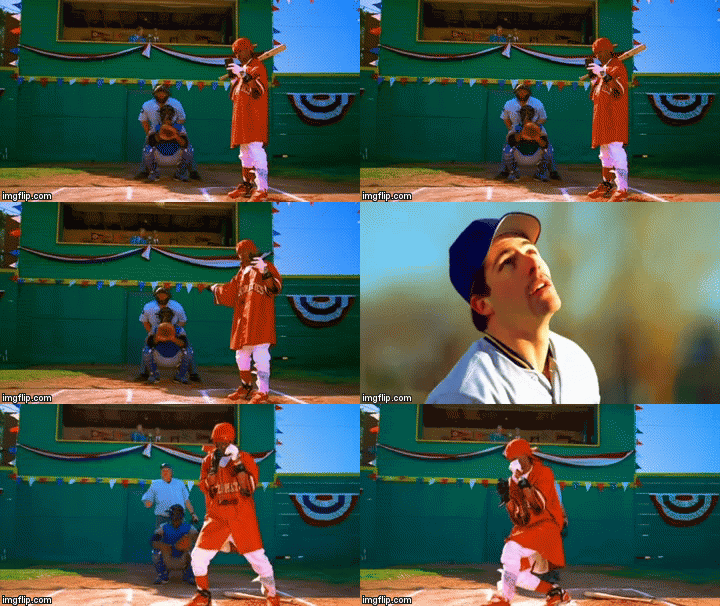
Our clean-up hitter for today’s game is Murphy Lee, who struts up to the plate with what appears to be his cell phone in one hand and his bat in the other. Without taking his eyes off his game of Tetris, he squares the first pitch up and launches it to right-center.
3:41
Murphy Lee apparently hit a 358-run dinger and now the score is 420-0. Starting to wonder why they needed to be spotted 62 runs from the start.
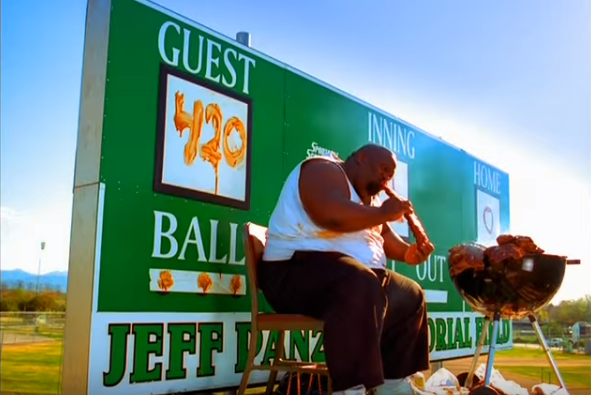
3:43
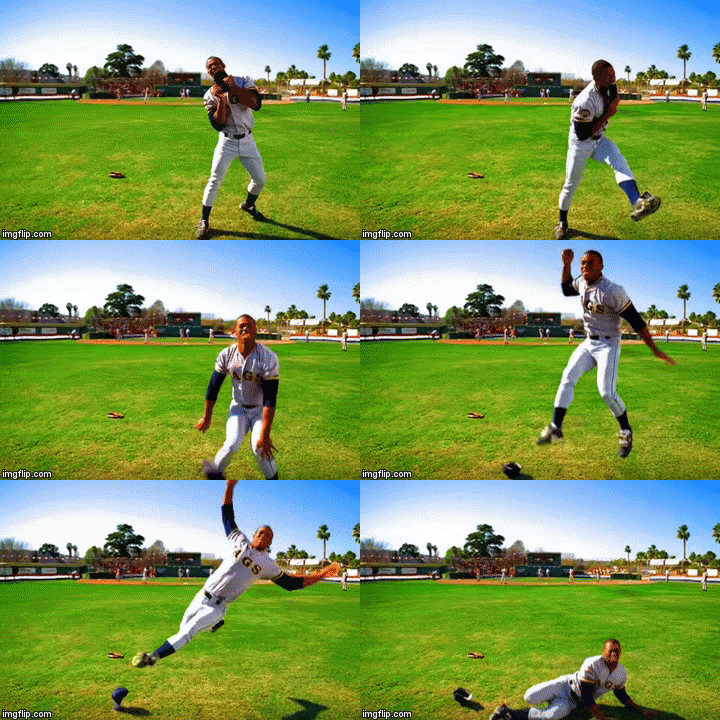
At least this ball actually went over the fence. Looking at you, Nyjer Morgan.
3:53

Our final batter of the day is Nelly, who promptly calls his shot. And the pitch…
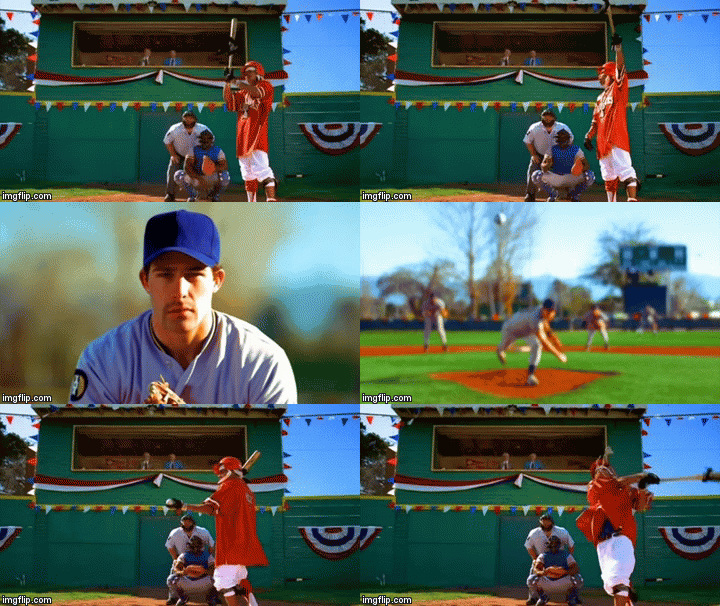
BOOM. Absolutely crushed. Time to trot…

Oh?
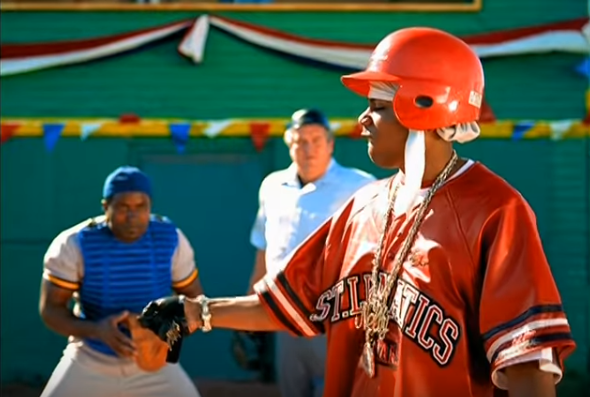
OH.
Nelly is now going to drive his car around the bases.

Based on previous at-bats, it’d be safe to assume that this monstrous hit was indeed a home run, and thus, no defense was in need of being played. But apparently not! As Nelly Tokyo drifts around third, we see him heading towards the catcher who is prepared to field the ball.

And you thought Chase Utley was reckless.
4:41

The St. Lunatics. The Best Fans in Baseball.
Jake Mintz and Jordan Shusterman are the guys behind “Cespedes Family BBQ” and co-host the “Cespedes Family Barbecast“. They can be followed at @CespedesBBQ.
–
This guest-post has been part of the 2016 Baseball Continuum Blogathon For Charity, benefiting the Roswell Park Alliance Foundation. The Roswell Park Alliance Foundation is the charitable arm of Roswell Park Cancer Institute and funds raised will be “put to immediate use to increase the pace from research trials into improved clinical care, to ensure state-of-the-art facilities, and to help improve the quality of life for patients and their families.” Please donate through the Blogathon’s GoFundMe page. Also, please note that the opinions and statements of the writer are not necessarily those of the Baseball Continuum or it’s webmaster.
This piece from the blog’s archives is part of the 2016 Baseball Continuum Blogathon For Charity, benefiting the Roswell Park Alliance Foundation. The Roswell Park Alliance Foundation is the charitable arm of Roswell Park Cancer Institute and funds raised will be “put to immediate use to increase the pace from research trials into improved clinical care, to ensure state-of-the-art facilities, and to help improve the quality of life for patients and their families.” Please donate through the Blogathon’s GoFundMe page.
Originally published June 19, 2013.
In Bizarre Baseball Culture, I take a look at some of the more unusual places where baseball has reared it’s head in pop culture and fiction.
I warned you. I told you it was coming. You could have gone away, but, no, you had to go and actually come here and read this installment of Bizarre Baseball Culture. This is a very special Bizarre Baseball Culture, as, for the first time, it’s something that I actually have in my very small personal collection of comic books. You see, in 2007, each Triple-A baseball team had a day celebrating superheroes, and as a giveaway, there was this comic:
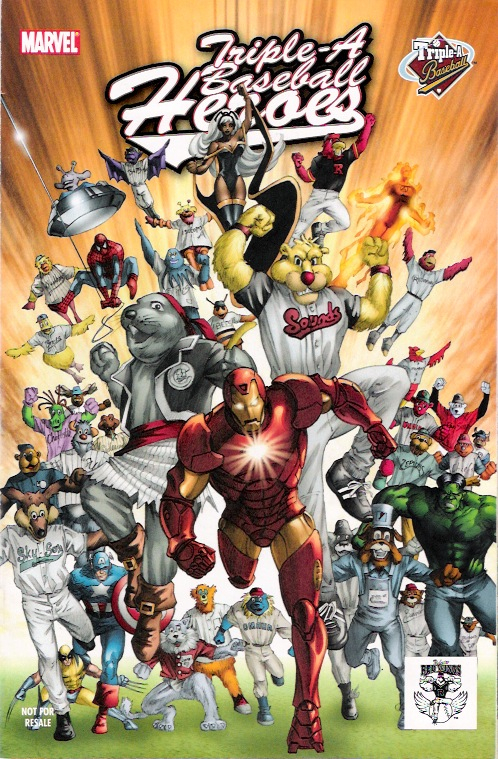 And, as you can probably guess, I was at that game and got the giveaway. And so, it sat in a drawer for almost seven years, ignored. Until today. Yes, true believers, tremble and prepare yourself for the 2007 edition of Triple-A Baseball Heroes, featuring the superheroes of Marvel Comics.
Now, a few notes before we get going here:
Now, go below the jump for the rest of the post:
This piece from the blog’s archives is part of the 2016 Baseball Continuum Blogathon For Charity, benefiting the Roswell Park Alliance Foundation. The Roswell Park Alliance Foundation is the charitable arm of Roswell Park Cancer Institute and funds raised will be “put to immediate use to increase the pace from research trials into improved clinical care, to ensure state-of-the-art facilities, and to help improve the quality of life for patients and their families.” Please donate through the Blogathon’s GoFundMe page.
Originally published August 15, 2014.
As you may know, I am a big fan of the old Backyard Baseball video games. In fact, I have a low-burn campaign to get the original games on Steam. So, with the Little League World Series here, I got to thinking: Whatever happened to those kids? Where are they now? I mean, I presume they lived in California, since that’s where Humongous Entertainment was, and I’m going to guess they’d be in their 20s nowadays (the oldest of them would have been, like, 13 in 1997 and the release of the first game, and the youngest would have probably been 6 or 7. Most of them seemed to be be around 10, 11 or 12), but… what would they be doing now? How did their lives turn out?
I did some research, and here’s what I found. It was a high-achieving group, with three individuals playing professional baseball, several others playing sports in college or professionally, and others going on to stardom or at least happy lives. Sadly, as with any large group of people, there were some who never achieved their dreams, others who lost their way, and even one who who is no longer with us. And then, there is one final person who is a story all of his own…
Pablo Sanchez. The Secret Weapon. The undisputed greatest of all the backyard kids, who was great no matter the sport but was greatest of all in baseball. Nobody ever truly knew much about him, as he only seemed to know Spanish and usually just let his skills do the talking. At least, that’s what everybody thought. In reality, Pablo spoke perfect English, he had learned Spanish- and become instantly fluent in it- in school. And, as he continued to rule anything and everything he tried his hand at, certain eyes were drawn to him. Rumors began to spread of a child who would break all existing sports paradigms, the sports equivalent of a nuclear weapon. Whatever team that would get him would instantly become the greatest on earth, whatever league that had him would become the most popular in the nation, and whatever he endorsed would instantly become the best-selling.
He would upset the balance of all sports and all the economies connected to them, bringing about chaos. Quite simply, the lords of sports decided, Pablo Sanchez could never be allowed to play sports above the youth level.
They came to him a few days before he started High School. All four commissioners of the Big 4, the heads of the IOC, FIFA, NASCAR, and ESPN’s X-Games divisions. Several major CEOs and a few big-name agents. Some say that even a few senators showed up. Never before or since had such a conglomeration come together.
They made Pablo and his family a simple offer: In exchange for not disrupting the natural order of competition and business in the sports world, they would give him a half-billion dollars. A year. Until the age of 50, at which point it would merely become a million dollars a year.
You’d like to think that Pablo would have been incorruptible. But, alas, even he had a price. And so, the greatest athlete of all time never stepped on the field.
Instead, he became something so much greater. You see, while others would have just taken that money, gotten a nice mansion, and lived a life of leisure, Pablo would have no such things. After college (where he was Summa Cum Laude, of course), he began to travel. And he began to help people. You see, over the years, Pablo looked out for his friends. It was he who saved Marky Dubois from the deepest part of the Bayou, it was he who wrote that letter to Mikey Thomas, it was he who helped fund Annie Frazier’s business, it was he who paid Ricky Johnson’s bills, and it was he who gave the tip that led the police to the man who had killed Jorge Garcia. And, yes, it was he who was the one who helped Vicki Kawaguchi turn her life around, something for which she dedicated her book to him for.
Yes, the Secret Weapon still has been amazing, and still can do no wrong. And to this day, if you see a man driving a purple car going “putt-putt-putt” down the road, know that he probably is on his way to do something amazing again, perhaps finding out what really happened with Vinnie the Gooch or looking for what happened to Earl Grey, the soccer announcer who hasn’t been seen in nearly a decade. And you can know that he has made a difference, even if it wasn’t on a sports field…
…well… maybe.
You see, once, during his travels, he came to a town in New Jersey. While there, he went to a youth baseball practice. He saw something in one of the players, something like he once was. He went up to that player. And, in the next few hours, he taught nearly everything he knew to that kid.
You may know that “kid” as Mike Trout.
The Secret Weapon lives on.
–
This piece from the blog’s archives has been part of the 2016 Baseball Continuum Blogathon For Charity, benefiting the Roswell Park Alliance Foundation. The Roswell Park Alliance Foundation is the charitable arm of Roswell Park Cancer Institute and funds raised will be “put to immediate use to increase the pace from research trials into improved clinical care, to ensure state-of-the-art facilities, and to help improve the quality of life for patients and their families.” Please donate through the Blogathon’s GoFundMe page.
This post is part of the 2016 Baseball Continuum Blogathon For Charity, benefiting the Roswell Park Alliance Foundation. The Roswell Park Alliance Foundation is the charitable arm of Roswell Park Cancer Institute and funds raised will be “put to immediate use to increase the pace from research trials into improved clinical care, to ensure state-of-the-art facilities, and to help improve the quality of life for patients and their families.” Please donate through the Blogathon’s GoFundMe page.
–
In Bizarre Baseball Culture, I take a look at some of the more unusual places where baseball has reared it’s head in pop culture and fiction.
What more can be said about DC Super-Stars #10 that has not already been said? Larry Granillo has looked at it, so did internet-based comics fan extraordinaire Chris Sims, a comic book blog ran a whole series on it, SI Kids actually pulled up WPA for the game, and probably plenty of others have also done a look at it.
But… if there is something better suited for the 50th installment of Bizarre Baseball Culture, this site’s signature series, I don’t know what it is. So buckle up, because here we go with DC Super-Stars #10 from 1976… “The Great Super-Star Game!”
 GO BELOW THE JUMP FOR MORE:
 The Baseball Continuum