Why nobody pays attention to College Baseball, outside of the CWS

In basketball, the NCAA tournament is in many ways a far bigger event than even the NBA Finals as the marquee event for the sport.

In football, the passions in some regions for college teams are larger than that of any NFL team. Okay, with the possible exception of Green Bay. Maybe.

Baseball, however, has it’s amateur competitions mostly forgotten. Yes, the draft is shown on MLB Network (at least the first round or two), and it isn’t too hard to find a college game on TV if you know where to look… but it is a afterthought unless it’s draft day (and even then, there usually are just as many high schoolers who are getting drafted) or the College World Series.

There are several reasons for this:

  • As I mentioned, lots of players are drafted out of high school, so the level of competition in NCAA isn’t quite what it is in football or basketball.
  • With the exception of the best of the best, it’ll be several years before you see a top college player in the big leagues, since they will go to the minors for seasoning. This ends any type of “hype” that can be built up around future pros, and why the MLB draft is so little followed beyond seamheads.
  • Aluminum bats. They may have been changed over the past decade or so to act more like baseball bats and not like trampolining home run machines, but there is still the PING! that, while tolerable when heard in Little League, seems to be grating when you see grown men swinging them around.
  • Lack of regional parity. If it seems like the BCS division of football is dominated by southern and western colleges, it’s even worse in baseball. After all, they can practice all year round, and don’t have to worry about the weather. A look at the winners of the College World Series over the years shows it. There hasn’t been a CWS winning team from above the old Mason-Dixon line (39 degrees and 43 minutes N) since Oregon State went back-to-back in 2006 and 2007. Before then, though, there hadn’t been one since (The) Ohio State University won it in 1966. Heck, there hadn’t even been a northern team that came in second place since Eastern Michigan lost to Arizona in 1976.
  • Baseball, unlike basketball and football, became a professional sport fairly early on, meaning the long traditions found in college hoops and gridiron aren’t as common in baseball, since they didn’t have time to form before the rise of the pros. The only big tradition it has that is known nationally is the fact that the College World Series is in Omaha, and ALWAYS in Omaha.

So what can be done? Well, MLB is apparently discussing helping fund scholarships and a transition to wooden bats in NCAA, which could be helpful. However, I think College Baseball will remain what it is: fun to watch come the College World Series, but generally ignored outside of that.

Exit, Magglio

Magglio Ordonez will retire this weekend. He’ll go down as one of the better right-handed hitters of his generation and should receive at least some consideration for the Hall of Fame. I don’t think he’ll make it, but he should at least be in the conversation.

Look over his statistics: In 1848 games and 7745 plate appearances, he hit .309, with a .871 OPS (on-base plus slugging), and a respectable 294 home runs and 1236 RBIs. He made it to six All-Star Games, won three Silver Sluggers and came in second to Alex Rodriguez in the 2007 MVP voting, the year he won the AL batting title. Had it not been for injuries, he could have accomplished even more.

There certainly have been people who have gotten into the HoF with less.

I, personally, don’t think he should make the HoF, but he is a better candidate than many of the other “Hall of the Very Good” candidates that get thrown out there every now and then.

There are only three games tonight

Presented for you, the games tonight:

Three games. That’s all. Seriously, I understand that sometimes the travel days just all line up, but the idea that MLB’s schedulers would have only three games is ridiculous. Seriously, try to space out the off days, MLB.

That is all.

Well, that was weird.

Okay, so yesterday:

  • The Texas Rangers lost to Seattle 21-8. Normally weird stuff like that happens when the Rangers play the Orioles.
  • Matt Kemp is hurt again. I blame the SI Cover Jinx.
  • Hawk Harrelson lost his mind.
  • The Orioles and Rays have done their best to make the AL East even more insane, going 2-8 and 4-6 respectively in the last 10 games. The AL East now has first and last separated by 2.5 games, with all teams above .500. Oh, and the Blue Jays are being accused of stealing signs. Again. I could have sworn this has happened before.
  • All the teams in the NL East are above .500 as well.
  • Pittsburgh’s win brought them back to .500. Which is always notable because, well, they are the Pirates.
  • The Marlins have now won 21 games in May. Well, I’d say April showers bring May flowers, but they have a retractable roof now, so…
  • Carlos Gonzalez had three home runs. Josh Hamilton is unimpressed, I’m sure.
  • Oh, and Justin Verlander hit a home run in batting practice.

Somebody sign Jamie Moyer, please

Jamie Moyer was designated for assignment on Wednesday. Only time will tell whether he will get picked up by somebody else. But I hope he will. He is, by all accounts, one of the best people in the game. And, what’s more, I think he probably could still do pretty well in a park that is more of a pitcher’s park.

You see, although the humidor has done wonders for changing Coors Field from a pinball machine into something more like a normal ballpark, it still is, in many ways, more of a place for hitters. Last season, for example, the Rockies hit .277 at home but .244 on the road, and hit over 50 more HRs at home than they did on the road.

A team like San Francisco, Anaheim, St. Louis, the Marlins or the Dodgers could use a guy like him near the back of the rotation, as their more pitcher-friendly parks would be better suited for Moyer’s style.

Bizarre Baseball Culture: Amazing Mystery Funnies #22 has exploding baseballs

There is a story that, during one of their several hundred attempts to assassinate or overthrow Fidel Castro during the 1960s, the CIA considered sending him baseballs that would, after a time, explode in his face.

With that in mind, perhaps the story featuring the “Fantom of the Fair” in Amazing Mystery Funnies #22 has more truth to it than it appears.

(more after the jump)

Continue reading

May 30: Helluva day in history for shortstops

May 30 is notable as a day for shortstops: It was the day of a unassisted triple play, and the day where some of the most notable achievements by shortstops started. Take a look:

May 30, 1927: Jimmy Cooney, Cubs’ shortstop, catches a Paul Waner liner, steps on second to get Lloyd Waner (Paul’s brother) out and then tags Clyde Barnhart for a unassisted triple play.

May 30, 1982: Cal Ripken, playing third, goes 0-2 with a walk and a strikeout. He doesn’t take a day off after that until Sept. 20, 1998.

May 30, 1995: Derek Jeter, batting ninth, gets a single off Mariners’ pitcher Tim Belcher, the first of 3,158 and counting.

Baseball Players who are within Six Degrees of Kevin Bacon

We all probably know about the Six Degrees of Kevin Bacon. It posits that Kevin Bacon is the center of the Hollywood universe, and that basically any actor is within seven movies of him. Technically, this isn’t true: Dennis Hopper is the “center” of the IMDB database, at least when you only count movies. However, you get the idea, and it gives us a good example of how the Degrees of Bacon works:

Dennis Hopper was in Cannes Man with Lloyd Kaufman, who was in Super with Kevin Bacon, thus Dennis Hopper’s Bacon Number is 2.

But what does this have to do with baseball? Well, you see, throughout history, baseball players have had some roles in movies. So let’s see how many degrees of Kevin Bacon baseball players are after the jump. As you’ll see they usually don’t need to travel far, although I’m sure I’ll be able to find something that is relatively far away from Bacon, right? Right?

Continue reading

Addendum to today’s earlier post: The Green Light Letter

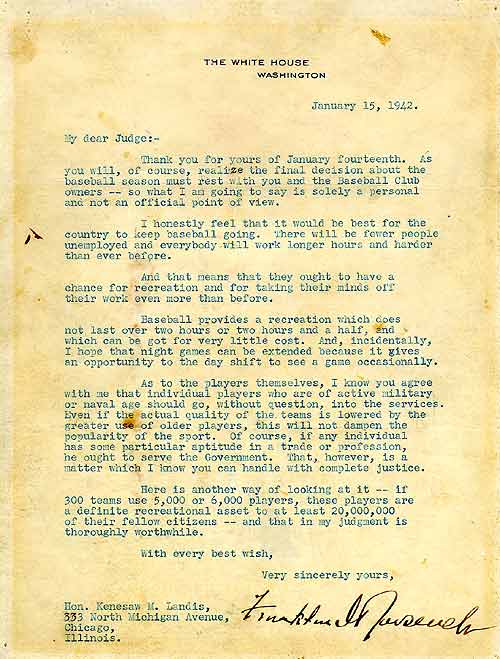
As I noted earlier today, many ballplayers have answered the call of duty, especially during the World Wars. What I didn’t note was that, especially in WWII, there were so many players that either volunteered or were drafted into the service that there was some discussion of whether baseball could even continue, especially as those who would be left to play would generally be old or unfit physically for military service (and thus probably not fit physically for Major League Baseball either). Commissioner Kennesaw Mountain Landis wrote President Franklin Delano Roosevelt asking his opinion. He received back what has been called the “Green Light Letter”.

(A full transcription is available here)

And thus, baseball continued through WWII. It led to some strange things. For example, in 1943 rubber rations led to a brief time where balls were used that had balata (a substance more similar to the golf balls of the time) in them, which wouldn’t have been a problem except for the fact that it created one of the deadest baseballs in history. There was the rise of the All-American Girls Professional League in areas of the Midwest that had had their minor league teams fold due to lack of players (although, unlike in League Of Their Own, it was, during the war years, more of a modified form of softball). And, in perhaps the biggest indication of how strange baseball had become while the players were in the service, the St. Louis Browns made the World Series. I seem to recall reading somewhere that a joke at the time was that it was because the Army didn’t want them. By the next season, the Browns then, in 1945, had Pete Gray play the outfield. Who was Pete Gray? Well, he’s the only ballplayer in history who only had one arm.

But, as FDR wrote would happen, baseball continued to provide much-needed recreation to a war-weary nation. Even if it was a bit less Major League than usual.

Ballplayers who gave everything

On this Memorial Day, it is as good a time as any to mention some of the ballplayers who gave their lives serving in America’s armed forces. The DeadBallEra site has a list of those who died while serving America, and there is also a good site entirely about Baseball in Wartime (primarily focused on WWII), but here are some notables (although, in the end, everyone who gives the ultimate sacrifice is notable). Not all of them died in combat, but all of them died while in military service or (in the case of people like Christy Mathewson) as a result of those actions:

  • Eddie Grant was a Harvard-educated infielder who spent time with Cleveland, Philly, Cincinnati and the Giants. On October 15, 1918, he died after being wounded by a artillery shell in the Argonne Forest of France. His unit had been fighting to rescue the “Lost Battalion” that had been pinned down by German forces. He was 35. A memorial to him was placed in the Polo Grounds (it is one of the plaques that can be seen in the expanded version of the Willie Mays catch photo), and a replica of it is now apparently in San Francisco.
  • Larry Chappell was a light-hitting outfielder in the 1910s who was at one point part of a trade for Shoeless Joe Jackson. In 1918, he died while in Army service only a few days before the armistice from the Spanish Flu pandemic that killed tens of millions of people. He was 28.
  • Ralph Sharman was a young outfielder who did well in a September stint with the Phillies in 1917. After the ’17 season, however, he was inducted into the army. He died in May, 1918 when he drowned while in Alabama, where he was undergoing training. He was only 23.
  • Christy Mathewson had retired from pitching by the beginning of America’s involvement in WWI, and was manager of the Cincinnati Reds. He left the club in the middle of the 1918 season, going to France, where he served in the Army’s chemical division. While there, he suffered the effects of poison gas, which left him with various respiratory ailments, including the tuberculosis that took his life in 1925.
  • Elmer Gedeon, who had had a cup of coffee with Washington in 1939, died while piloting a B-26 Marauder over France on April 20, 1944. He was 27.  He was one of only two people with Major League experience who died in WWII. The other being…
  • Harry O’Neill, who was a catcher in one game (with no plate appearances) for the Athletics in 1939. He was killed by a sniper on Iwo Jima on March 6, 1945.
  • Bob Neighbors, who had a cup of coffee with the Browns in 1939. In 1941, his baseball career came to an end when he had a poor season and, perhaps more importantly, lost his wife of only six months in a car accident while he was away on a road trip. He signed up for the United States Army Air Force after Pearl Harbor, and became a career military man from that point on. He went Missing In Action (and presumed dead) in 1952 when his B-26 went down over North Korea. He was both the only MLB-experienced man to die during the Korean War, and the last to have died in active service, period.

Of course, there were plenty of players who never made it to the big leagues who died in the line of duty, some of whom may have one day become Major Leaguers if not for the cruelty of war:


To them and all who have given the ultimate sacrifice, and to those who made it home, we salute you.