(Blogathon ’16) Rochester Red Wings Programs of the Past: 1990

This post is part of the 2016 Baseball Continuum Blogathon For Charity, benefiting the Roswell Park Alliance Foundation. The Roswell Park Alliance Foundation is the charitable arm of Roswell Park Cancer Institute and funds raised will be “put to immediate use to increase the pace from research trials into improved clinical care, to ensure state-of-the-art facilities, and to help improve the quality of life for patients and their families.” Please donate through the Blogathon’s GoFundMe page.

The 1990 Rochester Red Wings program was, in a word, a bit boring, at least relative to the previous two I’ve looked at. It is not a giant leap like going from 1981 to 1989, and it doesn’t have anything too weird or amazing either. As a result (and also of my blogathon process with these later posts), this one is a bit shorter than the previous installments.

Still, it definitely has some neat things.

Good Stuff

First off, the cover is fantastic:

90wingscoverThat is a cool looking cover. The Red Wings should bring back artsy covers like this. Nowadays it’s usually a picture. Last year had Miguel Sano on it prominently… and then he skipped Rochester entirely. Whoops.

With the new decade, the Rochester Red Wings decided to take a look back at the 80s with an article by Josh Lewin (now the radio announcer for the Mets and Chargers, who I covered a bit on in the 1989 program lookback) that included this snippet:

90wingspieceoflewin80slookbackIt’s sort of odd that three of the five most memorable games of the 1980s were losses.

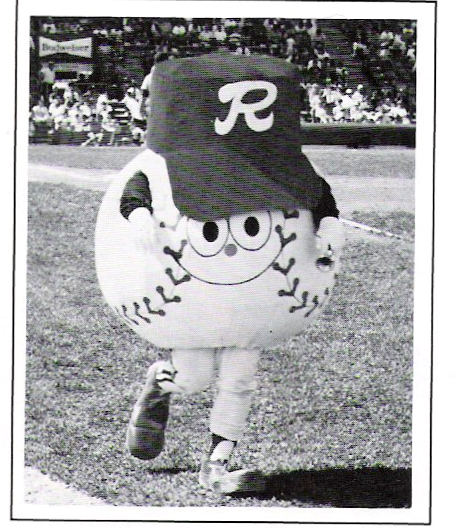
Also nice is that they finally gave the mascot his time of day, even if it was Homer, the worst mascot in Red Wings history (not counting the times when they had people dressed up as Indians):

90wingshomerFred Costello’s lists:

R90fredlist

Interesting Stuff:

Brady Anderson:

90wingsbradyJose Mesa:

R90mesaThe Columbus Clippers featuring Kevin Maas, Bernie Williams and Hensley “Bam Bam” Meulens:

R90columbus

Russ Brandon, now the President of the Buffalo Bills, Buffalo Sabres and Rochester Americans, and thus one of the most powerful people in Western NY sports:

Screen Shot 2016-01-29 at 9.43.55 PM

Weird Stuff:

Okay, this Big Bird advertisement is vaguely unsettling: 90wingsbigbirdMaybe it’s the black-and-white printing mixed with Big Bird’s eyes. It’s like he’s looking deep into your soul as he asks if your child has visited his best friend today. Also, why “his”, why not “their”? Jeez, Big Bird, don’t be sexist.

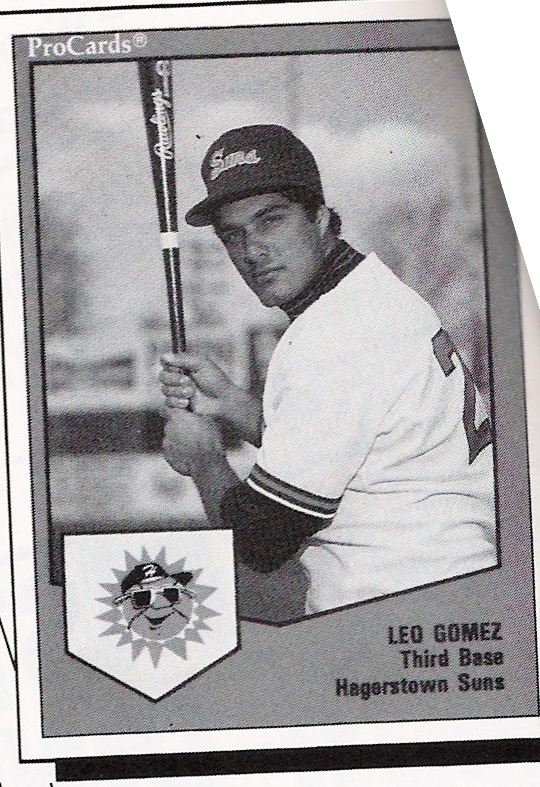
For some reason, some players literally had Hagerstown baseball cards as their profiles, like Leo Gomez here:

R90LeoGomezThe many looks of Josh Lewin:

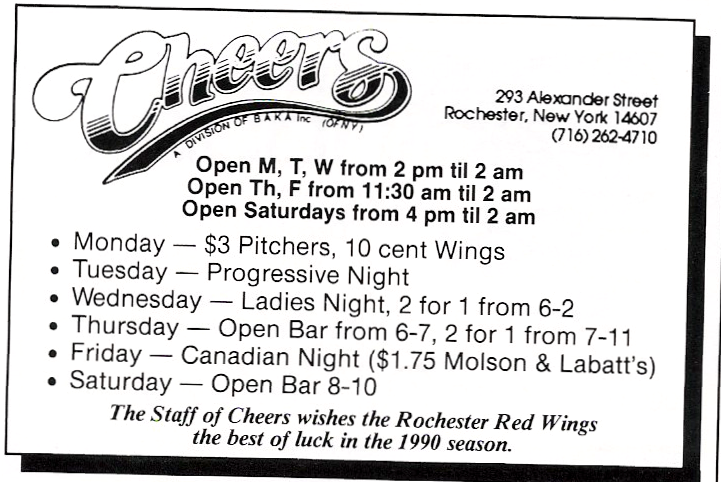
R90lewinWait… Cheers was a chain?

R90cheersFuture Red Wings GM Dan Mason with a mullet:

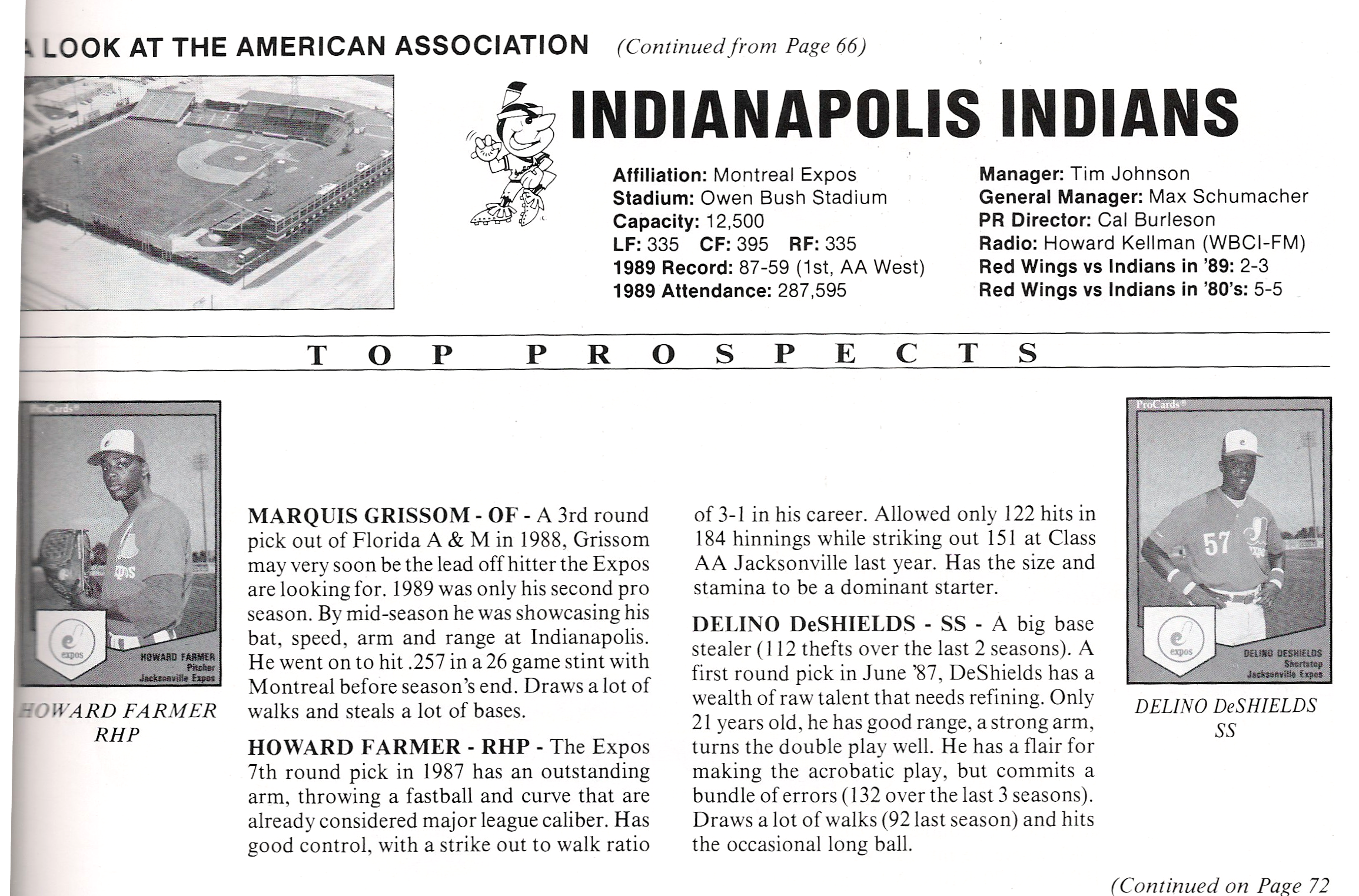
Screen Shot 2016-01-29 at 9.43.42 PMAnd, finally, the horribly racist logo of the Indianapolis Indians (although the rest is pretty cool):

R90indianapolisSo how did the season go? The 1990 Rochester Red Wings, led by Leo Gomez, Chris Hoiles, David Segui and 36-year-old Danny Boone, would go on to win the Governor’s Cup after a 89-56 record. It would be the final Governor’s Cup title in Silver Stadium history.

Next time: 1991

At 11 PM: The worst post ever.

This post has been part of the 2016 Baseball Continuum Blogathon For Charity, benefiting the Roswell Park Alliance Foundation. The Roswell Park Alliance Foundation is the charitable arm of Roswell Park Cancer Institute and funds raised will be “put to immediate use to increase the pace from research trials into improved clinical care, to ensure state-of-the-art facilities, and to help improve the quality of life for patients and their families.” Please donate through the Blogathon’s GoFundMe page.

Introducing the Guest Writers of Blogathon 2016!

Hello, I’m taking a second away from actual Blogathon content to introduce you to the 42 people who will be guest-posting here at the Continuum tomorrow for the Baseball Continuum Blogathon! Here they are, in no particular order:

  • Michael Clair
  • Diane Firstman
  • Mike Oz
  • “Yakyu Night Owl”
  • Seth Poho
  • Jen Mac Ramos
  • Stacey Gotsulias
  • Alex Skillin
  • Marc Normandin
  • Patrick Dubuque
  • Matthew Kory
  • Gary Cieradowski
  • Ron Kaplan
  • Dan Epstein
  • Sean Lahman
  • The “Cespedes Family BBQ” Guys
  • Stephanie Liscio
  • Andrew Martin
  • John O’Hara
  • Eric Stephen
  • Dan Szymborski
  • Kayla Thompson
  • Jessica Quiroli
  • Dan Weigel
  • Jonathan Weeks
  • Nate Fish
  • Chris Kabout
  • Stacey Folkemer
  • Jason Cohen
  • James Attwood
  • Matt Taylor
  • The “Graveyard Baseball” Guys
  • Greg Gay
  • Jason Turbow
  • Jeff Katz
  • Matt Wojciak
  • Hawkins Dubois
  • The author of @OldHossRadbourn
  • Dave Brown
  • Howard Cole
  • Dan Hirsch
  • Andrew Mearns

As you’ll notice, that’s not enough to fill the full 48 hours (it comes out to 43, as one piece will be in two parts), so hours where I don’t have anything will be filled with “Classic Continuum” pieces.

So… at midnight, look for the FIRST guest-piece! And don’t forget to donate!

But first, at 10 PM, look for a “Rochester Red Wings Programs of the Past” entry!

This post has been part of the 2016 Baseball Continuum Blogathon For Charity, benefiting the Roswell Park Alliance Foundation. The Roswell Park Alliance Foundation is the charitable arm of Roswell Park Cancer Institute and funds raised will be “put to immediate use to increase the pace from research trials into improved clinical care, to ensure state-of-the-art facilities, and to help improve the quality of life for patients and their families.” Please donate through the Blogathon’s GoFundMe page.

The 50th BIZARRE BASEBALL CULTURE: DC’s greatest heroes and villains… PLAY BASEBALL? (BLOGATHON ’16)

This post is part of the 2016 Baseball Continuum Blogathon For Charity, benefiting the Roswell Park Alliance Foundation. The Roswell Park Alliance Foundation is the charitable arm of Roswell Park Cancer Institute and funds raised will be “put to immediate use to increase the pace from research trials into improved clinical care, to ensure state-of-the-art facilities, and to help improve the quality of life for patients and their families.” Please donate through the Blogathon’s GoFundMe page.

In Bizarre Baseball Culture, I take a look at some of the more unusual places where baseball has reared it’s head in pop culture and fiction.

What more can be said about DC Super-Stars #10 that has not already been said? Larry Granillo has looked at it, so did internet-based comics fan extraordinaire Chris Sims, a comic book blog ran a whole series on it, SI Kids actually pulled up WPA for the game, and probably plenty of others have also done a look at it.

But… if there is something better suited for the 50th installment of Bizarre Baseball Culture, this site’s signature series, I don’t know what it is. So buckle up, because here we go with DC Super-Stars #10 from 1976… “The Great Super-Star Game!”

superstargamecoverGO BELOW THE JUMP FOR MORE:

Continue reading

(Blogathon ’16) BREAKING OOTP, Ep. 5: The No-Homers Club

This post is part of the 2016 Baseball Continuum Blogathon For Charity, benefiting the Roswell Park Alliance Foundation. The Roswell Park Alliance Foundation is the charitable arm of Roswell Park Cancer Institute and funds raised will be “put to immediate use to increase the pace from research trials into improved clinical care, to ensure state-of-the-art facilities, and to help improve the quality of life for patients and their families.” Please donate through the Blogathon’s GoFundMe page.

In BREAKING OOTP, I push Out Of The Park Baseball to it’s limits in various scenarios. Some will answer questions, some will settle scores, and some will push Out Of The Park Baseball to it’s very limits, to see if I can literally cause the game engine to beg for mercy.

Do you remember the Arena Baseball League? Y’know, the league where only an infield existed, an MVP had 213 HRs and a Cy Young winner had a ERA over 7? Well, now we are going in the opposite direction.
BEHOLD THE GIGANTOFIELD!

Gigantofield_webcastYes, it’s a field so big it can’t even fit in the picture. 500 foot walls to all fields. And, what’s more, it has a domed roof, a wild grass field that probably was last mowed reliably three months ago, and enough foul space to qualify for statehood.

And now, the Arena Baseball League will play in this monstrosity. Let’s look at it’s OOTP park factors:

Screen Shot 2016-01-29 at 3.39.13 PMSo, let’s see, according to this, batting averages will be cut in half from a neutral environment, but doubles will be twice as frequent and triples one-and-a-half times as frequent. Also, outside the park HRs should not exist.

Mommy.

So, after the now-anachronistically named “Arena Baseball League” expanded by two at the end of last season, ten teams will struggle against the darkness. No hope for hitters.

OR IS THERE?!?!

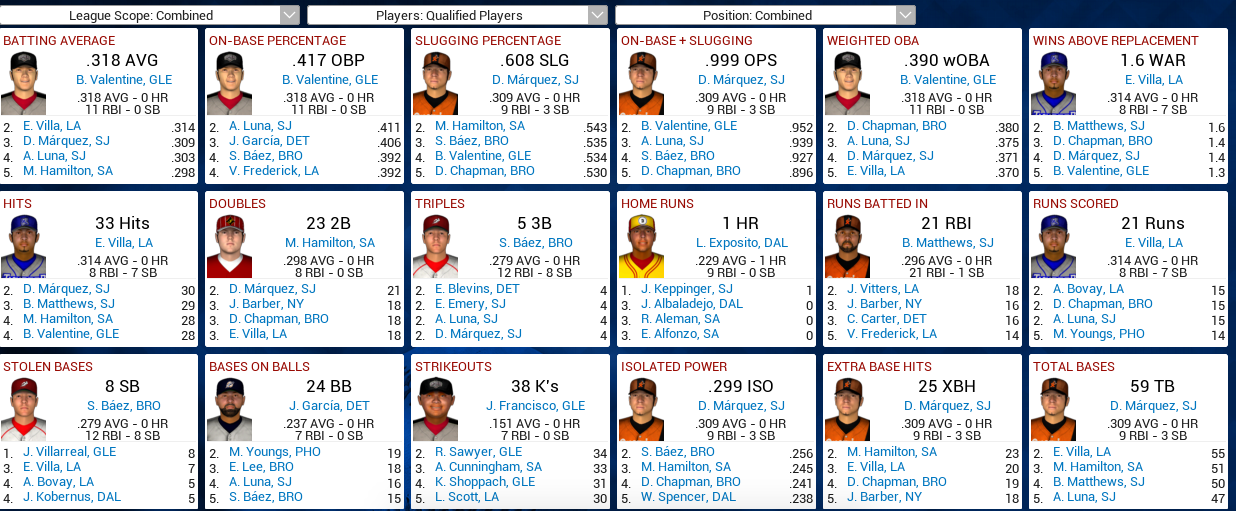
Let’s get started by simulating the opening month of April and then looking at the leaderboards… hmmm…

YEAAARRRGGGH:

Screen Shot 2016-01-29 at 3.46.28 PMThere have been two HRs (both inside-the-park) hit in the entire league. The batting leader is hitting just .318. Mark Hamilton of the San Antonio Coyotes has 28 hits… 23 of them doubles.

Now, let’s look at the pitchers:

Screen Shot 2016-01-29 at 3.50.34 PM0.58 is leading the league in ERA amongst starters. Manny Lopez, by the way, had a 8.53 ERA back when the Arena Baseball League lived up to it’s name.

Okay, now let’s zoom to the All-Star Break…

Screen Shot 2016-01-29 at 3.56.45 PMOof. As you can see, the total number of Home Runs now stands at 3. The leading batting average is .312, and that’s the only BA over 300. The leader in doubles would already be tied for 30th all-time in a single season in the real world.

The pitching standings similarly continue to be a bit off-kilter:

Screen Shot 2016-01-29 at 4.05.39 PMAmazingly, despite how good all of these pitchers seems to be, there has only been one no-hitter in the first half of the season… and it was barely in the top ten best pitching performances of the half!

Screen Shot 2016-01-29 at 4.06.45 PMWowzers.

Now, let’s go to the end of the regular season and look at what has come:

Oh. Oh dear…

Screen Shot 2016-01-29 at 4.14.51 PMThe best batting average is a .304. .304. That is 1968 level of bad hitting (in 1968, Yastrzemski won the AL title with a .301). However, the doubles record of 67 has been demolished, and Arturo Luna had more triples than any MLB player has had since 1925.

Now, how about pitchers?

Screen Shot 2016-01-29 at 4.21.00 PMA 0.99 ERA in 208.2 IP is very impressive, needless to say, and 306 strikeouts is more in a season than any pitcher has had since Randy Johnson was in his prime. Amazingly, there was only one no-hitter: Ron Turner’s in the first half.

Now, let’s look at the league as whole, shall we?

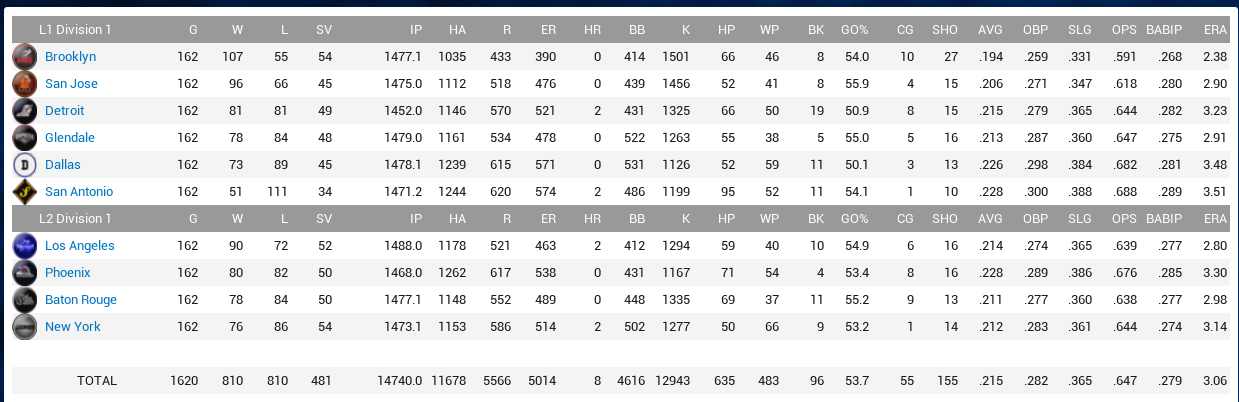
Screen Shot 2016-01-29 at 4.26.17 PM8 total home runs. 6998 total doubles. 564 total triples. The league as a total hit .215. Well, at least what hits did happen were usually exciting, right?

Screen Shot 2016-01-29 at 4.29.26 PMKind of surprised the league ERA was 3.06. I thought it’d be a little lower.

So… what did we learn? We learned that pushing the fences way back is bad for offense but will cause any balls that get past the outfielders to allow for extra bases. We learned that nothing particularly “game-breaking” occurs in OOTP if you do this. And, uhm, we learned that having deep outfield fences is nowhere near as fun to write about as arena-ball fences. I mean, yes, this is partly because I’m distracted by other blogathon concerns, but it was way more fun writing about insane scores statistics as opposed to what more-or-less was just a deadball era.

Next Time on Breaking OOTP: The most controversial Breaking OOTP yet

At 8 PM: BIZARRE BASEBALL CULTURE

This post has been part of the 2016 Baseball Continuum Blogathon For Charity, benefiting the Roswell Park Alliance Foundation. The Roswell Park Alliance Foundation is the charitable arm of Roswell Park Cancer Institute and funds raised will be “put to immediate use to increase the pace from research trials into improved clinical care, to ensure state-of-the-art facilities, and to help improve the quality of life for patients and their families.” Please donate through the Blogathon’s GoFundMe page.


(Blogathon ’16) First References to Off-The-Field Innovations and Innovators

This post is part of the 2016 Baseball Continuum Blogathon For Charity, benefiting the Roswell Park Alliance Foundation. The Roswell Park Alliance Foundation is the charitable arm of Roswell Park Cancer Institute and funds raised will be “put to immediate use to increase the pace from research trials into improved clinical care, to ensure state-of-the-art facilities, and to help improve the quality of life for patients and their families.” Please donate through the Blogathon’s GoFundMe page.

One of the great perks of SABR membership is access online to The Sporting News’ archives. While it now is dedicated to all sports, for a good chunk of it’s earlier history it was almost entirely focused on baseball. This allows us to see how players, ideas, teams and even countries first got the attention of the baseball press. This time, I take a look at off-the-field innovations and innovators:

Bill James

The first appearance of the founding father of Sabermetrics came in advertising, as he hawked his early Baseball Abstract editions with ads like this one that can be found in the May 14, 1977 edition of Sporting News:

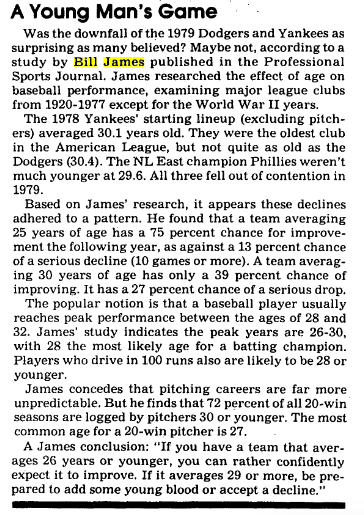
Screen Shot 2016-01-29 at 2.35.32 PMHowever, James’ first appearance in a print story seems to be in this November 10, 1979 snippet about the fall of the ’79 Dodggers and Yankees:

Screen Shot 2016-01-29 at 2.37.20 PMRotisserie Baseball

The first reference to Rotisserie Baseball comes, as far as I can tell, in a advertisement for it in the Feb. 27, 1983 edition of Sporting News:

Screen Shot 2016-01-29 at 2.41.50 PMThe first reference in-story to Rotisserie, as far as I can see, is in a story about Dan Quisenberry from May 19, 1986. He says he knows his poor save stats are letting his roto-owners down:

Screen Shot 2016-01-29 at 2.45.23 PMNote that it’s possible that there were references to “roto” or “fantasy” before this, but I didn’t include them in the search.

Strat-O-Matic

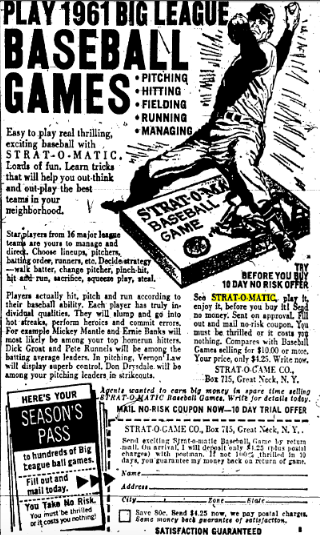
Strat-O-Matic began in 1961 and they put advertising in Sporting News right away, like in this August 23, 1961 ad.

Screen Shot 2016-01-29 at 2.52.32 PMI can’t find the first reference in a story, but it probably happened eventually. Maybe next time…

ESPN

The first reference to ESPN came in a September 22, 1979 column by Dick Young, where he mentioned that Jim Simpson (who passed away recently) was joining the network:

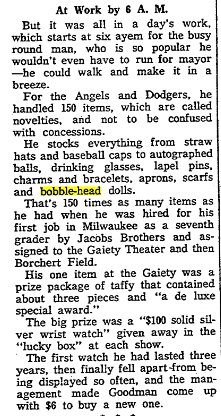
Screen Shot 2016-01-29 at 3.08.44 PMAnd, finally… Bobbleheads:

The first reference to bobbleheads comes in a profile of Danny Goodman on October 27, 1962. Goodman was one of the first big souvenir salesmen and was based on the west coast:

Screen Shot 2016-01-29 at 3.16.41 PM

At 7 pm: Breaking OOTP

This post has been part of the 2016 Baseball Continuum Blogathon For Charity, benefiting the Roswell Park Alliance Foundation. The Roswell Park Alliance Foundation is the charitable arm of Roswell Park Cancer Institute and funds raised will be “put to immediate use to increase the pace from research trials into improved clinical care, to ensure state-of-the-art facilities, and to help improve the quality of life for patients and their families.” Please donate through the Blogathon’s GoFundMe page.


(Blogathon ’16!) The Sliding Scale of Fictional Baseball Realism

This post is part of the 2016 Baseball Continuum Blogathon For Charity, benefiting the Roswell Park Alliance Foundation. The Roswell Park Alliance Foundation is the charitable arm of Roswell Park Cancer Institute and funds raised will be “put to immediate use to increase the pace from research trials into improved clinical care, to ensure state-of-the-art facilities, and to help improve the quality of life for patients and their families.” Please donate through the Blogathon’s GoFundMe page.

Earlier today, in my look at Touch, I mentioned that you can make a 0-10 scale of baseball realism in works of fiction, with zero being baseball-in-name-only and ten being actual footage of a game.

Well, I’m going to expand upon that:

0: Baseball In Name Only

In this category, it’s not really baseball at all. They may call it baseball, but it certainly isn’t the actual sport that we know. The Moe Cronin version of baseball fits here.

1: Utterly Absurd

In this category, while it’s clearly meant to be baseball, the rules of the game and the laws of physics have clearly taken a vacation. Some classic cartoons fall into this category.

2: Very Absurd, but still with some realism

In this category, the work might have cartoonish physics and occurrences, but it still is grounded in reality enough to have the rules of baseball still be mostly the same. In theory, a baseball movie where the rules are not consistent or are wildly different but where everything else is played straight could also qualify here. Classic cartoons that aren’t “utterly absurd” usually fall in this category.

3: Absurd, but mostly consistent

Works in this category are clearly absurd and cartoonish, but are at least consistent: the laws of physics may not be what they are in the real world, but they don’t suddenly change mid-game, nor do the rules suddenly change simply because the story demands it. Most “cartoon” baseball video games, like Backyard Baseball and the Mario Baseball series, fit in this category.

4: Many absurd elements

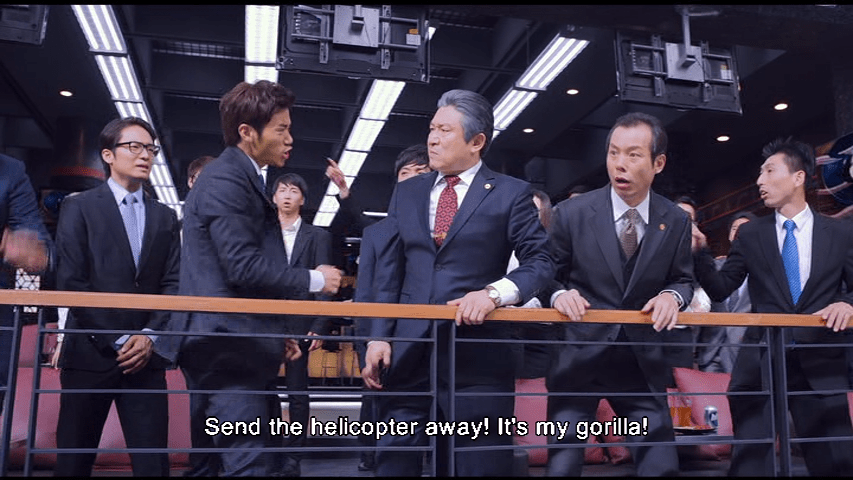
While clearly meant to be a realistic world that has our baseball’s rules and our laws of physics, the amount of absurd, cartoonish or unrealistic elements in the work make it more strange than realistic. Consider Mr. Go, for example, which has two baseball-playing gorillas, a little girl acting as a first-base coach and a finale that involves the baseball coming undone into a million pieces, which sort of overwhelms what would probably otherwise be a 6 if, say, it only had one gorilla.

5: Equal Mix of Realism and Fantasy

A work that sort of teeters between being realistic and being bizarre. This is more of a transitional spot on the scale, as it’s rare that anything ever stays at 5, inevitably going to 4 or 6 instead.

6: Realistic, but with one or two “big lies”

This is mostly realistic but it has one or two big elements (or the equivalent of one or two big elements made up of lots of smaller elements) that keep it from being something that you can honestly expect to ever happen in the real world. Sidd Finch could fit here, as could most of the movies in which a kid becomes a big league skipper or ballplayer.

7: Realistic, but highly unlikely

There’s nothing in this work that couldn’t happen, but it’s highly unlikely and any real event like this would probably instantly become one of the most notable things in baseball history. You could argue that Major League fits here, sort of.

8: Near total-realism

While some rules might be bent or not enforced on a strict basis, and some things might happen that are unlikely (although not nearly as unlikely as things that fall at seven on the scale), this is pretty realistic. Casey At The Bat, the classic poem, could be considered as this, with only the ability of everybody to seemingly hear everything keeping it from being a nine.

9: Utter realism

The only things that are not realistic in works of this category are omnipresent techniques like camerawork and editing for time, or stylish touches added in to indicate, say, that a player is angry. Bull Durham could, in theory, fit in this category, as could most (but not all) fairly true-to-history biopics and most realistic baseball video games.

10: Actual Baseball Footage used/Documentary

If you are watching an actual baseball game, or watching a documentary that uses baseball footage and does so without changing things for dramatic effect, you are watching a 10.


Feel free to consider where on the sliding scale your favorite piece of baseball fiction would fall!

6 PM: First References

This post has been part of the 2016 Baseball Continuum Blogathon For Charity, benefiting the Roswell Park Alliance Foundation. The Roswell Park Alliance Foundation is the charitable arm of Roswell Park Cancer Institute and funds raised will be “put to immediate use to increase the pace from research trials into improved clinical care, to ensure state-of-the-art facilities, and to help improve the quality of life for patients and their families.” Please donate through the Blogathon’s GoFundMe page.


(Blogathon ’16) Musings on AAA Baseball

This post is part of the 2016 Baseball Continuum Blogathon For Charity, benefiting the Roswell Park Alliance Foundation. The Roswell Park Alliance Foundation is the charitable arm of Roswell Park Cancer Institute and funds raised will be “put to immediate use to increase the pace from research trials into improved clinical care, to ensure state-of-the-art facilities, and to help improve the quality of life for patients and their families.” Please donate through the Blogathon’s GoFundMe page.

And now, random musings about AAA Baseball:

AAA baseball is the best baseball in North America outside of the Major Leagues and perhaps certain fall/winter leagues (it varies). This is not in doubt. The athletes who play in cities like Sacramento, Buffalo, Charlotte, New Orleans, and Rochester are some of the best ballplayers on the planet.

However, they are not necessarily the best prospects. This is something often forgotten. Oh, to be sure, many of the best players in the majors have stopped in AAA for at least some time, but the idea that the minors is a ladder where players go up rung by rung is for the most part out of date. The truth is that, with certain exceptions, the vast majority of players in AAA are not prospects anymore, but rather players who have reached or are close to reaching their ceiling, but aren’t good enough to play for their MLB club. AAA has the most accumulated talent outside of MLB, but it doesn’t have the players with potential talent. No, it’s increasingly common that those players with the potential talent skip over AAA, only going back if they get injured or are clearly out of their league in the Majors.

Most people, however, don’t realize that. They still expect that every major prospect will come through, regardless. When Miguel Sano and (for a time) Byron Buxton skipped over Rochester last season, some fans took it as a betrayal. Never mind that, at the time, the Red Wings were pretty set in outfield and third base, or that the two of them were so clearly better than AA that only a fool wouldn’t call them up to the big leagues to help in an unexpected playoff hunt, as the Twins were in.

The solution to this, if there even needs to be a solution (aside from the fact that it might be in baseball’s best interest to have the more-populated cities of AAA see more future stars than the less-populated AA cities, there really isn’t a true problem to be solved), is unknown. Perhaps eliminating the very lowest of the minor leagues- the Arizona and Gulf Coast Leagues, could recombobulate the systems a bit and lead to it becoming more of a rung-by-rung set-up again. Who knows?

Perhaps because of the fact that you are watching the-best-who-aren’t-the-best in front of crowds filled with people just there for beer and/or fireworks, AAA can be a surreal place, especially if you sit behind the visitor’s dugout.

I have heard the late Jose Lima tell a group of half-drunken bros to be polite to the ladies and to remember that kids are around. I have seen Dmitri Young talk down a heckler and then proceed to hit for the cycle on a rehab assignment. I once spent something like 18 innings watching a game with the immortal Corky Miller standing in front of me, his mullet protecting him from a chilly Rochester night.

All of this for the price of a ticket that probably wouldn’t even get you in the door at many MLB stadiums, much less close enough to hear a reliever swear and throw his glove after a bad performance, inevitably leading to Mary, the first lady of the third-base side, telling him that it wasn’t the glove’s fault.

That there is not a Mike Trout Zooperstar is obscene. I mean, c’mon, it’s so obvious.

At one point, Jenny Finch’s husband, Casey Daigle, was a member of the Red Wings. Hopefully their kids get their mother’s arm, because it felt like every time he came on the mound, something bad happened. I don’t know if this is statistically true, but it sure felt like it.

Finally, a story. The Rochester Red Wings are owned by shareholders in the community, the result of lawyer Morrie Silver’s stock drive to buy the team from the Cardinals, who wanted to move the team.

However, I never had been able to get stock. While in practice the shares have no true value, in reality they can be really expensive and it’s really hard to get active shares. This is mainly because many of them have lapsed in the half-century-plus since the stock drive and many that do go up are reportedly bought by the Silver family. In addition, there is the fact that, unlike other community-owned teams like the Packers, there have never been additional sales of stock, which is kind of ridiculous from both a PR standpoint as well as the fact you’d have to imagine that the sales of shares could help fund stadium improvements (this, by the way, is why the Packers did their most recent shares-drive).

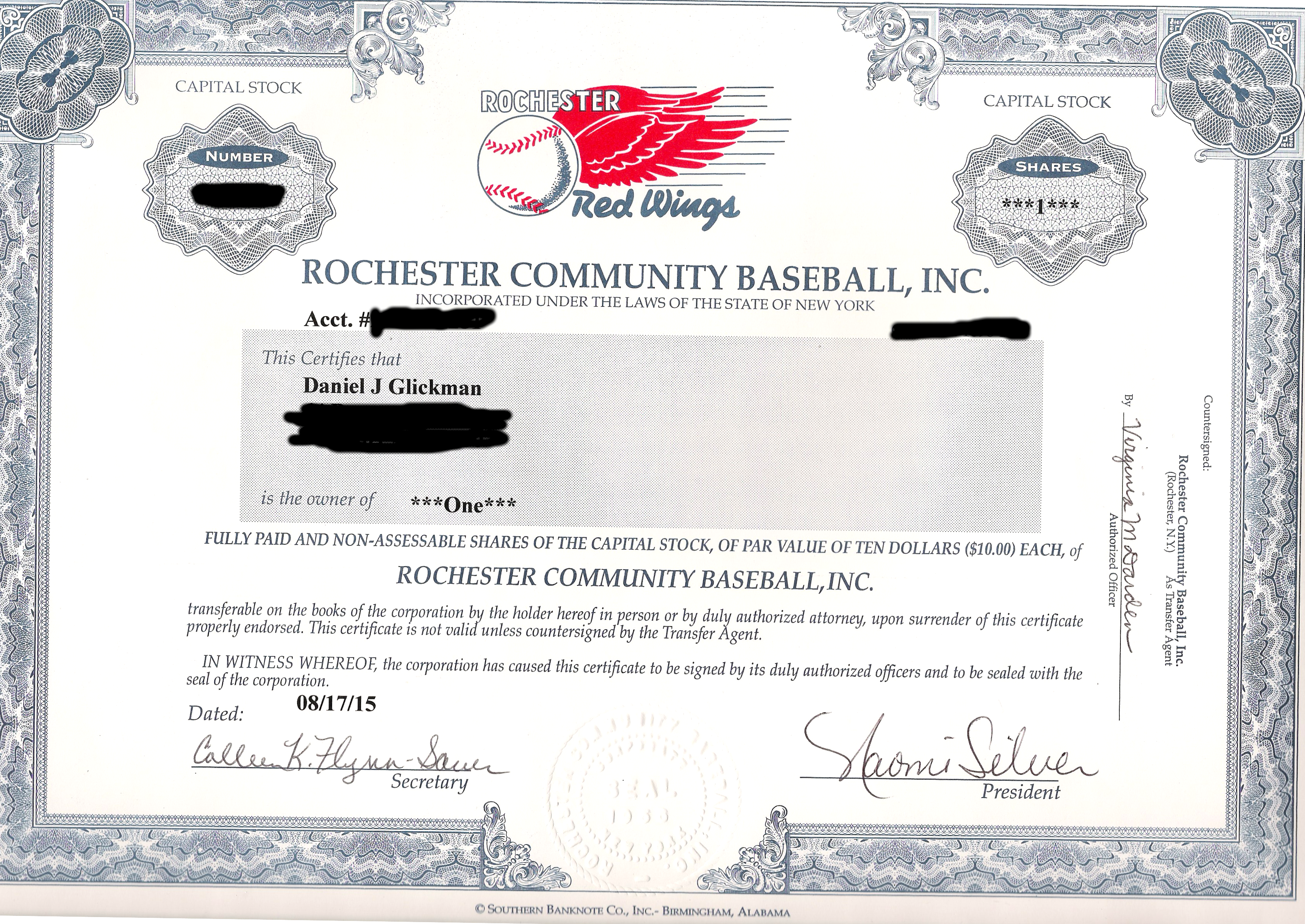
At one point, I thought I’d gotten one, but it turned out that it had expired and been given to the state (in theory I could have gone through New York State to get it back, but that would have required me finding the heir of the guy who had bought it originally and a bunch of other complicated things). But, this past year, I finally got one. I became a owner of Rochester Community Baseball:
RCBstockWhat does it mean? Officially, nothing. One share isn’t enough to get me a personal luxury box, or give me the power to demand that they bring back those Abbott’s Milk Shakes, or even get me a ring if they were to win a Governor’s Cup next season. But it does provide something that is unique about small-city baseball in America: a sense of ownership.

You see, when I go to the ballpark this summer, I’ll be going knowing that, in a very small way, this is my team, my field, and my souvenir cup with Kyle Gibson and Logan Darnell on it (well, that’s what it was last year, probably will be different this year). Fans in St. Louis or Boston can claim they own their favorite team, but they are only speaking in metaphor. For me, it’ll be reality, no matter how small or insignificant that reality is.

And that’s something that AAA will hopefully always have over the majors, no matter how many uber-Prospects jump directly from AA.

(Seriously though, if any Twins front office members are reading this, can we at least have Max Kepler for a month before he gets called up? Please?)

At 5 PM: The Sliding Scale of Fictional Baseball Realism

This post has been part of the 2016 Baseball Continuum Blogathon For Charity, benefiting the Roswell Park Alliance Foundation. The Roswell Park Alliance Foundation is the charitable arm of Roswell Park Cancer Institute and funds raised will be “put to immediate use to increase the pace from research trials into improved clinical care, to ensure state-of-the-art facilities, and to help improve the quality of life for patients and their families.” Please donate through the Blogathon’s GoFundMe page.

(Blogathon ’16) Mr. Go, if adapted for American audiences

This post is part of the 2016 Baseball Continuum Blogathon For Charity, benefiting the Roswell Park Alliance Foundation. The Roswell Park Alliance Foundation is the charitable arm of Roswell Park Cancer Institute and funds raised will be “put to immediate use to increase the pace from research trials into improved clinical care, to ensure state-of-the-art facilities, and to help improve the quality of life for patients and their families.” Please donate through the Blogathon’s GoFundMe page.

Mr. Go. The classic tale of a girl, a gorilla, and the Korean Baseball Organization. Truly, one of the greatest Bizarre Baseball Culture entries of all time, and one you should totally consider purchasing if you are a fan of such things. But what if it was brought to American screens? How would it be adapted?

I have a few ideas:

The cute little Chinese girl, Weiwei, would stay, as would the backstory of her and her gorilla, Ling Ling. Similarly, the main antagonist of the film would be Liao Xiaogang, AKA “Tianjin Guy”, a corrupt nouveau-rich businessman/gangster.

This is a purely economic move. China is now one of the leading movie-going countries in the world, and the only way a baseball movie is going to get any attention there is if it has a Chinese person in it. Also, so much of what drives the plot is the fact that Weiwei is an outsider just trying to keep her friends and circus at home from being folded up.

The jerk-with-a-heart-of-gold scout, Sung Choong-Su, would instead be an American named Samuel “Sunny” Chance, played by James Franco.

For one thing, James Franco has experience with apes, and also he is able to do both comedy and drama, which this film would require. Also, I think civilization in general needs to see James Franco make drunken confessions to a baseball-playing gorilla who is also drunk.

Instead of going to the Doosan Bears, Ling Ling/Mr. Go would be a member of the San Diego Padres.

Don’t try to argue with me on this, you aren’t going to win.

The general manager of the Padres will have an expanded role and be played by John Goodman.

Because, really, imagine John Goodman delivering this line:

Jonah Hill would make a cameo as a sabermetrics expert who suggests how they can best use Mr. Go.

Both because he’s always in movies with James Franco, and as a reference to Moneyball.

There would be a subplot about how some people think Mr. Go isn’t playing the game the right way after he unleashes an epic bat-flip.

It’d provide realism to the affair.

After Mr. Go’s rampage, Weiwei and him would go on Jimmy Kimmel to prove he isn’t a monster.

Of course they would.

Instead of a bidding war between the Chunichi Dragons and Yomiuri Giants, it would be the Red Sox and Yankees.

Because of course it would be.

The veterinarian’s role would be expanded and made into a female love interest for Franco’s character, probably played by somebody quirky like Zooey Deschanel or wittily sarcastic like Anna Kendrick.

Because every goddamn movie, it seems, needs a love interest of some sort, and it sure as heck isn’t going to be Weiwei and Franco.

The NC Dinos, the main opponent of Doosan, would be replaced by the Dodgers. Also, the Division Series at the end of Mr. Go would be replaced with a final regular season series where the NL West title is on the line.

This both would better explain why every game is a home game for Mr. Go (in the Korean movie, they come up with an excuse about renovations at NC’s stadium) while still providing plenty of drama.

Leiting, the evil pitching gorilla who faces Mr. Go, will be renamed “Lightning” instead of “Zeros”.

Because Zeros was a dumb name.

The ending would be left more open to the “Football-playing Gorilla” sequel than the original movie was.

Every movie needs to have a opening for a sequel.

And, finally, it goes without saying that Andy Serkis would be playing Mr. Go.

Duh.

At 4 PM: AAA.

This post has been part of the 2016 Baseball Continuum Blogathon For Charity, benefiting the Roswell Park Alliance Foundation. The Roswell Park Alliance Foundation is the charitable arm of Roswell Park Cancer Institute and funds raised will be “put to immediate use to increase the pace from research trials into improved clinical care, to ensure state-of-the-art facilities, and to help improve the quality of life for patients and their families.” Please donate through the Blogathon’s GoFundMe page.


(Blogathon ’16!) Renaming Moved Teams

This post is part of the 2016 Baseball Continuum Blogathon For Charity, benefiting the Roswell Park Alliance Foundation. The Roswell Park Alliance Foundation is the charitable arm of Roswell Park Cancer Institute and funds raised will be “put to immediate use to increase the pace from research trials into improved clinical care, to ensure state-of-the-art facilities, and to help improve the quality of life for patients and their families.” Please donate through the Blogathon’s GoFundMe page.

There are four teams in MLB who have kept their names despite moving to different cities (or at least parts of a town where it’s enough where they change the first words of the team): The Angels, the Dodgers, the Athletics, and the Giants. What, however, if they had had to change their names? And, no, I’m not letting them just take their old Pacific Coast League team-names.

Let’s go place by place:

Los Angeles Angels of Anaheim, Orange County, California, USA, North America, Northwestern Quadrant, Planet Earth, Sol System, Milky Way, Local Group, The Universe

There was a very good reason why the Angels were originally called the Angels when they started playing: they were actually in Los Angeles, playing at Chavez Ravine. In addition, the LA Angels had been one of the flagship franchises of the Pacific Coast League, so the name had history. But as they moved to Anaheim and went by “California Angels” and then “Anaheim Angels” and now “Los Angeles Angels of Anaheim”, they have become more and more detached from the name. So what if they had abandoned the “Angels” moniker as soon as they left Chavez Ravine? Assuming that they had adopted California as their “first name” after leaving the ravine, perhaps they would be California related, perhaps the “California Bears” or the “California Trout” (ha). Or maybe they’d be more Anaheim-focused, with a name like “Oranges”. Personally, I think they would have to go with “Anaheim Mice”. In addition to the obvious Disneyland connection, there is the fact that mice are said to scare elephants, which would be a nice little poke at the Athletics. Well… it would be if…

The Oakland Athletics

Kept their Elephant logo despite changing to a new name. I think it’d be cool if they still had an old-timey sort of name. How about the “Oakland Eurekas”, after the California State Motto? (For the curious, the Pacific Coast League Oakland team was called the Oaks.)

Los Angeles Dodgers

If the Dodger brand hadn’t been so firmly established in Brooklyn, it feels likely they would have been renamed when they headed west. After all, “Dodgers” has basically nothing to do with Los Angeles. But what would they have been called? I personally think that they would take advantage of Hollywood and go with the name “Los Angeles Stars”. Oh, yeah, that was the name of Hollywood’s PCL team, but, guess what, it wasn’t LA’s, so it counts. So, “Los Angeles Stars” it is.

San Francisco Giants

The San Francisco Prospectors, or “Pros”. That was easy.

At 3 PM: MR. GO!

This post has been part of the 2016 Baseball Continuum Blogathon For Charity, benefiting the Roswell Park Alliance Foundation. The Roswell Park Alliance Foundation is the charitable arm of Roswell Park Cancer Institute and funds raised will be “put to immediate use to increase the pace from research trials into improved clinical care, to ensure state-of-the-art facilities, and to help improve the quality of life for patients and their families.” Please donate through the Blogathon’s GoFundMe page.


What can you get if you donate to the 2016 Blogathon?

Hello, everybody. Taking a quick break from frantically writing the back half of my portion of the blogathon to tell you about what, exactly, you are eligible to possibly receive as a giveaway if you donate to our GoFundMe page:

  • Playing With The Enemy by Gary W. Moore
  • A “Living Baseball Card” mini-documentary on Andre Dawson
  • 2007 AAA Baseball Heroes comic
  • Signed copy of 501 Baseball Books Fans Must Read Before They Die by Ron Kaplan (contributed by Kaplan)
  • Wild and Inside by Stefan Fatsis (Contributed by Kayla Thompson)
  • Signed Copy of The Baseball Codes by Jason Turbow and Michael Duca (contributed by the authors)
  • One of three copies of Out of the Park Baseball (Contributed by Out of the Park Developments)
  • Hank Greenberg: The Hero of Heroes, by John Rosengren (Contributed by Sean Lahman)
  • The Last Hero: A Life of Henry Aaron,  by Howard Bryant (Contributed by Lahman)

Some of these are connected to the blogathon itself. For example, Ron Kaplan and Jason Turbow both will be contributing articles to the guest portion of the blogathon, while Kayla Thompson will be reviewing Wild and Inside and I will be utilizing Out of the Park Baseball for an installment of Breaking OOTP. So, if you want a shot to receive some of these great books, comics or video games, please donate. It won’t take long, and your donation to Roswell Park Alliance Foundation will be “put to immediate use to increase the pace from research trials into improved clinical care, to ensure state-of-the-art facilities, and to help improve the quality of life for patients and their families.”

Thank you.

At 2 PM: Name-Changing.

This post has been part of the 2016 Baseball Continuum Blogathon For Charity, benefiting the Roswell Park Alliance Foundation. The Roswell Park Alliance Foundation is the charitable arm of Roswell Park Cancer Institute and funds raised will be “put to immediate use to increase the pace from research trials into improved clinical care, to ensure state-of-the-art facilities, and to help improve the quality of life for patients and their families.” Please donate through the Blogathon’s GoFundMe page.