(Blogathon ’16) Stephanie Liscio- Forgotten Champions: The 1945 Cleveland Buckeyes

This guest-post is part of the 2016 Baseball Continuum Blogathon For Charity, benefiting the Roswell Park Alliance Foundation. The Roswell Park Alliance Foundation is the charitable arm of Roswell Park Cancer Institute and funds raised will be “put to immediate use to increase the pace from research trials into improved clinical care, to ensure state-of-the-art facilities, and to help improve the quality of life for patients and their families.” Please donate through the Blogathon’s GoFundMe page. Also, please note that the opinions and statements of the writer are not necessarily those of the Baseball Continuum or it’s webmaster.

The 1945 Homestead Grays boasted five eventual Hall of Famers – Ray Brown, Josh Gibson, Buck Leonard, Cool Papa Bell, and Jud Wilson. They were a powerhouse team, the kind of team on which dynasties are built. So how were they defeated in the 1945 Negro League World Series by the Cleveland Buckeyes, a team with zero eventual Hall of Fame members that was relatively new to the Negro League circuit? That 1945 series is a true tale of David versus Goliath, one in which a vastly underrated team not only defeated their heavily-favored opponent, but shut them down completely.

Negro League baseball struggled in Cleveland for years before the Buckeyes came onto the scene. They city had their first entry into the formal league structure in 1922…it fell apart before the end of the 1923 season. Cleveland (and the league hierarchy) refused to give up on the Negro Leagues in the city. They continued to introduce brand new teams, sometimes as often as each year, between 1922 and 1940. In that 18-year span, the city hosted 10 different Negro League teams. The reasons for their failures varied; the Depression played a role in the demise of several teams, while poor management and bad play were behind some of the others. By the time the Buckeyes were formed in 1942, they were buoyed by a surge in popularity in Negro League baseball nationally, and war workers that had more disposable income to spend attending games.

Of those 10 early teams in Cleveland, only two had non-losing records – the short-lived 1931 Cleveland Cubs (which had a winning record), and the 1939 Cleveland Bears (who finished at .500). As an example of the struggles of some of these teams, the 1926 Cleveland Elites only won six games the entire season. It is no wonder that some folks were likely skeptical about the potential success of the Buckeyes. However, during their first year they already proved competitive in the Negro American League with powerhouse teams like the Kansas City Monarchs, Chicago American Giants, and the Birmingham Black Barons. In the past, when those teams travelled to Cleveland, they made a mockery of the home team. The Buckeyes managed to hold their own against some of the best competition the league could offer.

By 1945, the team started to pull everything together under the tutelage of new catcher/manager Quincy Trouppe. The local African-American newspaper, the Call and Post, dubbed the Buckeyes’ lineup as a “murder’s row” prior to the start of the season, and while they were quite good, they couldn’t compare to a Grays lineup that included one of the greatest power hitters of all time in Josh Gibson. The difference came from the Buckeyes’ pitching staff; a group of arms that were definitely not household names, and while talented, were viewed as somewhat unthreatening to the Grays. However, they shut Homestead’s offense down as they went on to win the series four games to none.

Game one saw a pitcher’s duel from Buckeyes hurler Willie Jefferson and the Grays’ starter, Roy Welmaker, as both took a shutout into the seventh inning. Trouppe hit a triple and was driven home on a sacrifice fly by second baseman Johnny Cowan to make the score 1-0. The other Buckeyes run came in the eighth inning on an RBI single from outfielder Willie Grace. The Grays managed to make some noise in the ninth inning, after the made the score 2-1 on an RBI single from Gibson. However, the Buckeyes managed to hold on for the 2-1 win.

In game two, the Buckeyes were shut out 2-0 until a solo home run from Grace to lead off the bottom of the seventh inning made it 2-1. They were able to tie the game later in that inning, after outfielder Buddy Armour scored on an error (he doubled to reach base). The game was still tied 2-2 in the bottom of the ninth, when Trouppe doubled and later moved to third on a passed ball. The Grays intentionally loaded the bases, but a sacrifice fly from pitcher Eugene Bremmer made that a moot point.

These first two games were played in Cleveland; game one was played downtown at the cavernous Cleveland Municipal Stadium, while game two was played at League Park in Cleveland’s Hough neighborhood. (The Indians split their time between Municipal Stadium and League Park until owner Bill Veeck chose to move the team downtown permanently in time for the 1947 season – the Buckeyes rented their facilities from the Indians). Game three was scheduled to take place in Pittsburgh; however, a rain-out moved it to Washington, D.C. This wasn’t completely out of the ordinary, since the Grays spent some of their time playing in DC, plus Negro League teams often traveled around to increase their gate receipts. Game four was played in Philadelphia.

The first two games in Cleveland were close affairs that were both won in the later innings. The same could not be said for games three and four; the Buckeyes were in the driver’s seat for both of those match-ups. George Jefferson (brother of game one starter Willie Jefferson) got the win in game three as the Buckeyes defeated the Grays 4-0. In the final game, the Buckeyes closed out the series with a 5-0 victory. Even though the Grays had what was considered the more threatening lineup, the Buckeyes managed to tame their bats and put some runs of their own on the board.

Even though this World Series win was the high point of Negro League baseball in Cleveland, a time when the city was finally able to put forth a team capable of running with the big boys (and beating them), it was still a bit bittersweet for them in hindsight. Just a month after they closed out their win against the Grays, Jackie Robinson signed with the Brooklyn Dodgers, a harbinger of the upcoming integration of the formerly all-white major leagues. Within a few years, other MLB teams started to sign players from the Negro Leagues; Cleveland became the first American League city to do so with Larry Doby in 1947 (formerly of the Negro National League Newark Eagles). While integration obviously was the first and most important priority, it essentially signaled the downfall for the Negro Leagues. The Buckeyes managed to return to the Negro League World Series in 1947 as they lost to the New York Cubans; but by 1949 the team attempted a move to Louisville, Kentucky in a bid to survive in a city without an integrated team like the Indians. That experiment failed, and they returned to Cleveland by the 1950 season. The Buckeyes had trouble making payroll though, and longtime star Eugene Bremmer went to the press in May to discuss the fact that he’d never been paid. The team’s owner and general manager owed money to what seemed like everyone; the team didn’t even make it to the end of the season, and collapsed and disbanded in the summer of 1950.

While some Negro League teams lost tons of players to the major leagues, only Quincy Trouppe and star outfielder Sam Jethroe would go on to play in the majors from the Buckeyes. Trouppe spent a very brief amount of time with the Indians in 1952 (and spent time in the minors prior to that), while Jethroe had a very successful rookie season in 1950 with the Boston Braves, earning him the title as the oldest person to win the Rookie of the Year award. However, the Buckeyes had to contend with an Indians team that not only signed Larry Doby in 1947, but also signed one of the Negro League’s biggest stars when they inked Satchel Paige to a deal halfway through the 1948 season. The Indians’ 1948 World Series title dramatically increased their popularity and set a single-season attendance record that held until 1962. In addition to their progressive moves on the field, the Indians also integrated the press box, hired African-American vendors, and hired track and field gold medalist Harrison Dillard to work in a public relations role with the team. African-American fans embraced the Indians and stopped attending Buckeyes games. While a few Negro American League teams were able to survive into the 1950s, the Buckeyes weren’t one of them.

Last fall, it was the seventieth anniversary of the Buckeyes’ surprising win over the Homestead Grays. Even though this was a great moment for Negro League baseball in the city of Cleveland, it’s often forgotten; overshadowed by an Indians team that continuously made headlines in the late 1940s. It deserves recognition as a great baseball series though, when the underdog unseated the giant.

A side note – The Buckeyes’ home park for the 1945 season, League Park, was recently refurbished by the city of Cleveland and features a brand new baseball diamond and the renovation of the park’s original ticket office building. Located at the corner of E. 66th St. and Lexington Ave. in Cleveland, it is also the home of the Baseball Heritage Museum. (http://baseballheritagemuseum.org/)

Stephanie Liscio (@stephanieliscio) is the author of Integrating Cleveland Baseball: Media Activism, the Integration of the Indians, and the Demise of the Negro League Buckeyes, and co-owner of the ESPN SweetSpot Indians affiliate blog It’s Pronounced Lajaway (http://itspronouncedlajaway.com).  A Ph.D. student in history, Stephanie has also spent the past six years as president of Cleveland’s SABR chapter.

This guest-post has been part of the 2016 Baseball Continuum Blogathon For Charity, benefiting the Roswell Park Alliance Foundation. The Roswell Park Alliance Foundation is the charitable arm of Roswell Park Cancer Institute and funds raised will be “put to immediate use to increase the pace from research trials into improved clinical care, to ensure state-of-the-art facilities, and to help improve the quality of life for patients and their families.” Please donate through the Blogathon’s GoFundMe page. Also, please note that the opinions and statements of the writer were not necessarily those of the Baseball Continuum or it’s webmaster.
 

(Blogathon ’16) Stacey Folkemer: Baseball is more than a game, it’s part of the family

This guest-post is part of the 2016 Baseball Continuum Blogathon For Charity, benefiting the Roswell Park Alliance Foundation. The Roswell Park Alliance Foundation is the charitable arm of Roswell Park Cancer Institute and funds raised will be “put to immediate use to increase the pace from research trials into improved clinical care, to ensure state-of-the-art facilities, and to help improve the quality of life for patients and their families.” Please donate through the Blogathon’s GoFundMe page. Also, please note that the opinions and statements of the writer are not necessarily those of the Baseball Continuum or it’s webmaster.

Baseball has always been a part of my family life. I can’t remember a time when summer evenings didn’t include the ballgame on the radio or television, or when a holiday passed that my uncle didn’t offer his opinions on how to fix the rotation while my grandfather complained about a slugger who strikes out too much.

For most of my life, the Baltimore Orioles have been a bad baseball team. They’ve had their moments, but I was born after their glory years. And for my entire adult life until four years ago, the Orioles weren’t just bad, they were a laughing stock. But it was during those years that they became an even bigger part of my familial relationships as I grew into adulthood and my grandparents, especially my grandmother, advanced in age and became less a part of the everyday world.

If you have spent time with someone who doesn’t often leave the house, you understand how difficult it can be to come up with new and fresh things to talk about. My grandmother spent many of her last years confined to her home, limiting her ability to speak about things that she didn’t see on TV or hear about from someone else. But thanks to baseball, we always had plenty to say during our visits. She watched every game from her living room and had strong opinions on every player.

She and my grandfather were two very different types of fans. She was the ultimate pessimist. The Orioles were never good enough, they’d never going to return to their former glory with these players or this manager. It was an extension of her personality at large, where she was often times harsh but passionate for those people and things that she cared about. But she never gave up on them, even if she expected them to lose. If the game was close in the ninth inning, she couldn’t take it. She’d take refuge on the patio, smoking a cigarette and waiting for me to come out and tell her who won. If the answer was the Orioles, she’d smile but comment on how it’s just like them to almost throw it away.

My grandfather, on the other hand, has always been a baseball optimist. Even in the darkest years, as the O’s losing streak stretched across a decade, he always believed they could win. Every year during Spring Training, as reports flooded in that players were in the best shape of their lives, my grandfather believed them all. “They’ve got the hitters, the pitching might come around,” he’d say, as my grandmother and I disagreed and told him he was crazy. He and I had a conversation before the 2012 season in which he repeated the same optimism he’d shown every year prior, and I laughed at how misguided he was. We made a bet on their record, with him claiming they’d be over .500 and me stating that they didn’t have a chance.

Well, if you recall the 2012 season, the Orioles won 93 games, captured the Wild Card, and made it to game five of the ALDS before their season came to an end. I heard a lot about my pessimism that year, let me tell you. I still hear about it sometimes, almost four years later.

As a fan myself, I have to admit that I’m more like my grandmother. Even now, with the Orioles having four straight non-losing seasons and two playoff appearances since 2012, my natural instinct is to think the worst. The starting pitcher will always implode, the offense will never get a hit in the clutch, the Orioles of 2012-15 were a fluke.

I wish I didn’t have that attitude. Outwardly, I have tried to take on the more optimistic view that has always been modeled by my Granddad. Over the last few years I have argued on Twitter and my internet home of CamdenChat.com about how the Orioles are better than people think. When the game is on the line late I profess my faith in my team despite a sinking feeling in my stomach. I am trying to fake it until I make it, basically, but I don’t think I’ll ever be fully successful.

We lost my grandmother to cancer in 2008, so I was never able to share the winning Orioles with her as an adult. As the O’s participated in the 2012 playoffs, I thought about her a lot, wondering if she would have changed her pessimistic ways after watching the magical 2012 team. Probably not. We are who we are, after all. I imagine that she would have seen Jim Johnson’s implosion coming from a mile away (or at least claimed she did). She wouldn’t have witnessed Brian Matusz giving up a walk-off home run to Raul Ibanez in game three of the ALDS (she would have been on the porch, unable to take it) but she never would have forgiven Matusz for as long as he was in an Orioles uniform. But she still would have been ecstatic for our guys even as she cursed them, and I’m sad I didn’t get to experience that with her.

I have been able to spend the last four seasons of good Orioles baseball with my grandfather, and for that I’m grateful. Finally, he has seen a return on his optimism. The ultimate payoff would be a World Series win (though he, unlike me, has at least gotten to see three of those for the Orioles in his life), and maybe he’ll soon be rewarded for his faith in his team.

I wouldn’t count on it, though. Have you seen the starting rotation?

Stacey Folkemer has been writing for Camden Chat, SB Nation’s Baltimore Orioles blog, since 2008. You can find her there or follow her @StaceyMFolk. She lives in Maryland with her husband, who is also a sports writer. In the winter she dreams of baseball. In the summer she watches it from section 334 at Oriole Park at Camden Yards.

This guest-post has been part of the 2016 Baseball Continuum Blogathon For Charity, benefiting the Roswell Park Alliance Foundation. The Roswell Park Alliance Foundation is the charitable arm of Roswell Park Cancer Institute and funds raised will be “put to immediate use to increase the pace from research trials into improved clinical care, to ensure state-of-the-art facilities, and to help improve the quality of life for patients and their families.” Please donate through the Blogathon’s GoFundMe page. Also, please note that the opinions and statements of the writer were not necessarily those of the Baseball Continuum or it’s webmaster.

(Blogathon ’16) James Attwood: Slow to Change is Not Always a Bad Thing

This guest-post is part of the 2016 Baseball Continuum Blogathon For Charity, benefiting the Roswell Park Alliance Foundation. The Roswell Park Alliance Foundation is the charitable arm of Roswell Park Cancer Institute and funds raised will be “put to immediate use to increase the pace from research trials into improved clinical care, to ensure state-of-the-art facilities, and to help improve the quality of life for patients and their families.” Please donate through the Blogathon’s GoFundMe page. Also, please note that the opinions and statements of the writer are not necessarily those of the Baseball Continuum or it’s webmaster.

Baseball, as we know it, has evolved greatly over the years. Prior to the 1880s, the ball was actually tossed underhand to a “striker”, not a batter, and it was tossed up there, not how the pitcher wished it, but how the striker called for it. There was rarely an outfield fence, and like the flagpole that recently sat in center field in Houston, trees and the like were not uncommon in the field of play. No gloves were used, and catching the ball on a single bounce still resulted in the striker being out. Also, there was only one umpire, and that person sat or stood slightly behind and to the side of play. When calls were contested, sportsmanship was expected to win out. When it did not, the umpire could consult the crowd for input on making a definitive ruling.

Once the game underwent the fundamental change of being played for money in 1871, the gentlemanly nature of the sport took a back seat, and the competitive edge was ratcheted up. Yet, despite all the changes that have taken place, the game has always more or less resembled the one we have now. Baseball has always been a mutable sport. But just how mutable? Sure, all those differences seem extreme when compared to the game we watch now, but the vast majority of changes all came about before 1900. That’s right, the vast majority of changes to the game came within the sports first 45-50 years of play. Over the following 115 years, the changes to play have been minimal, and have come only after the slowest of deliberations.

The biggest, and most fundamentally changing was the integration of baseball with the debut of Jackie Robinson during the World War II era. In 1903 it was determined that foul balls would be considered strikes. In 1910, cork was added to the interior of the baseball, marking the end of the “dead ball era”. Today’s uniform size and weight ball standard was established in 1934. In 1969, a year after pitching dominated the game like no time since 1918, the pitcher’s mound was lowered five inches, a change that was years in the offing and brought to a head by the likes of 30-game winner Denny McLain (the last of the 30-win pitchers) and the ever-intimidating 1968 NL Cy Young winner and HOF pitcher, Bob Gibson. The last big change to come about that was anything other than a technological evolution (machined bats, instant replay, games under the lights) occurred in January of 1973 when commissioner Bowie Kuhn. This new rule, much like the changing of foul balls to strikes was cut from whole cloth and not some gradual evolution, making it one of the biggest changes made to the game in the modern era.

Sure, over the last 30 years, we have added extra divisions, expanded playoffs, gone with interleague play during the regular season, and even made the All-Star Game “count” for something in allowing it to determine home field advantage in the World Series. None of that actually impacts how the game is played though.

Rob Manfred worries for the future of baseball. Manfred’s solution is to “modernize” baseball by implementing some changes to the game. Unlike the previous changes though, Manfred is in a hurry to get there as soon as possible. The minor leagues have already started implementing pace of play rules and pitch clocks. Those rules are likely headed to MLB in the near future. Even bigger though, Rob Manfred wants to take the AL DH experiment and make it a part of both leagues as a permanent part of the game.

This change would indeed “level the playing field” between the leagues, something that is not nearly as skewed as some would like to claim. It would allow pitchers to pitch and hitters to hit. A few extra aging sluggers would get to artificially extend their careers. It would also all but eliminate an entire aspect of baseball that has existed since the earliest days, that of in-game strategy, most notably, that tied to playing small ball.

With all due respect to Madison Bumgarner and the mind-boggling performance he turned in during the 2014 World Series, without the DH there is no way he gets to put on that show. Some might say that allowing the DH both ways only increases the chances of such a performance. Really though, how often is a performance for the ages going to be turned in? How much different does that game playout if the managers, especially Bruce Bochy, has to start worrying about making a pitching change after only 2 innings of Bumgarner? Other than filling out a lineup card and making the rare defensive switch in the 8th or 9th inning, exactly how much influence does a manager’s ability to call a game matter if the game is turned into hitters hitting and pitchers pitching?

Manfred says he wants to appeal to a younger crowd. How many youths will be trying to decide by the time they are 10 or 12 if they want to throw the ball or hit the ball? Part of what has always set baseball apart from the other sports was the number of athletic skills a player needed to be good at all at once in order to excel at the game. Only the very best of the best hitters and pitchers can reasonably expect to go deep into amateur careers and possibly reach the majors if they are not able to, at some point, hit field, run, catch, and throw all with some semblance of authority.

There is a push to possibly have these changes in as soon as 2017. That is an awful lot of fundamental change in a very short period of time. One could argue that NL organizations cold need as many as three seasons to properly align themselves to adopt the DH. As far as pace of play goes, these changes are not cutting significant time off of the game. In many cases, it is under 15 minutes being shaved from the average league-wide. Baseball was never designed for or intended to be consumed by a generation of people looking for and expecting instant gratification. Furthermore, if the DH is adopted across both leagues, scoring will go up, this will erase any pace of play gains made by keeping the game on a clock.

There is nothing wrong with wanting to modernize the game and appeal to a younger demographic. Baseball makes changes of such a magnitude at a glacial pace though. That’s something that should never change. Small tweaks followed by periods of evaluation to determine what is and is not working can have just as big of an impact as those changes that fundamentally change how the game is played.

Regardless, this game will continue to resemble the one I have grown up loving. I will not walk away simply because I can no longer watch a chess game between managers in the dugouts. For a game so steeped in history, and so tied to the identity of all-around athletic excellence, I do wonder if the game could ever “feel” like it always has, or if it will simply feel like a poor imitation.

(Blogathon ’16) CLASSIC CONTINUUM- BIZARRE BASEBALL CULTURE: COSMIC SLAM

This piece from the blog’s archives is part of the 2016 Baseball Continuum Blogathon For Charity, benefiting the Roswell Park Alliance Foundation. The Roswell Park Alliance Foundation is the charitable arm of Roswell Park Cancer Institute and funds raised will be “put to immediate use to increase the pace from research trials into improved clinical care, to ensure state-of-the-art facilities, and to help improve the quality of life for patients and their families.” Please donate through the Blogathon’s GoFundMe page.

In Bizarre Baseball Culture, I take a look at some of the more unusual places where baseball has reared it’s head in pop culture and fiction.

Originally posted Nov. 19, 2013

I’m coming to you from the Auxiliary Headquarters of the Continuum… AKA a Living Room instead of my usual Family Room or Bedroom writing area, due to the great Wi-Fi Crisis of 2013. The reason I have braved such perils is simple: Cosmic Slam. The sequel to Shortstop Squad, and another great epic from the folks at Ultimate Sports Entertainment (AKA “Ultimate Sports Force”). Just as Shortstop Squad brought us late-90s shortstops fighting monsters and aliens, Cosmic Slam does the same with late 1990s sluggers. Jeff Bagwell, Sammy Sosa, David Justice and Mark McGwire all grace the cover, and Gary Sheffield, Bobby Bonilla and Frank Thomas all show up in the story as well.

It also involves Bagwell complaining about missing a fishing trip, Sosa making a corked bat joke, Greg Maddux‘s fastball being insulted, and of course, the making of a baseball bat out of the body of your defeated foes.

No, I’m not joking about the last one. Seriously, that really happens.

So, place your tongue firmly in cheek and go below the jump for Cosmic Slam.

Continue reading

(Blogathon ’16) CLASSIC CONTINUUM- Bizarre Baseball Culture’s “SHORTSTOP SQUAD”

This piece from the blog’s archives is part of the 2016 Baseball Continuum Blogathon For Charity, benefiting the Roswell Park Alliance Foundation. The Roswell Park Alliance Foundation is the charitable arm of Roswell Park Cancer Institute and funds raised will be “put to immediate use to increase the pace from research trials into improved clinical care, to ensure state-of-the-art facilities, and to help improve the quality of life for patients and their families.” Please donate through the Blogathon’s GoFundMe page.

Originally published October 25, 2013

In Bizarre Baseball Culture, I take a look at some of the more unusual places where baseball has reared it’s head in pop culture and fiction.

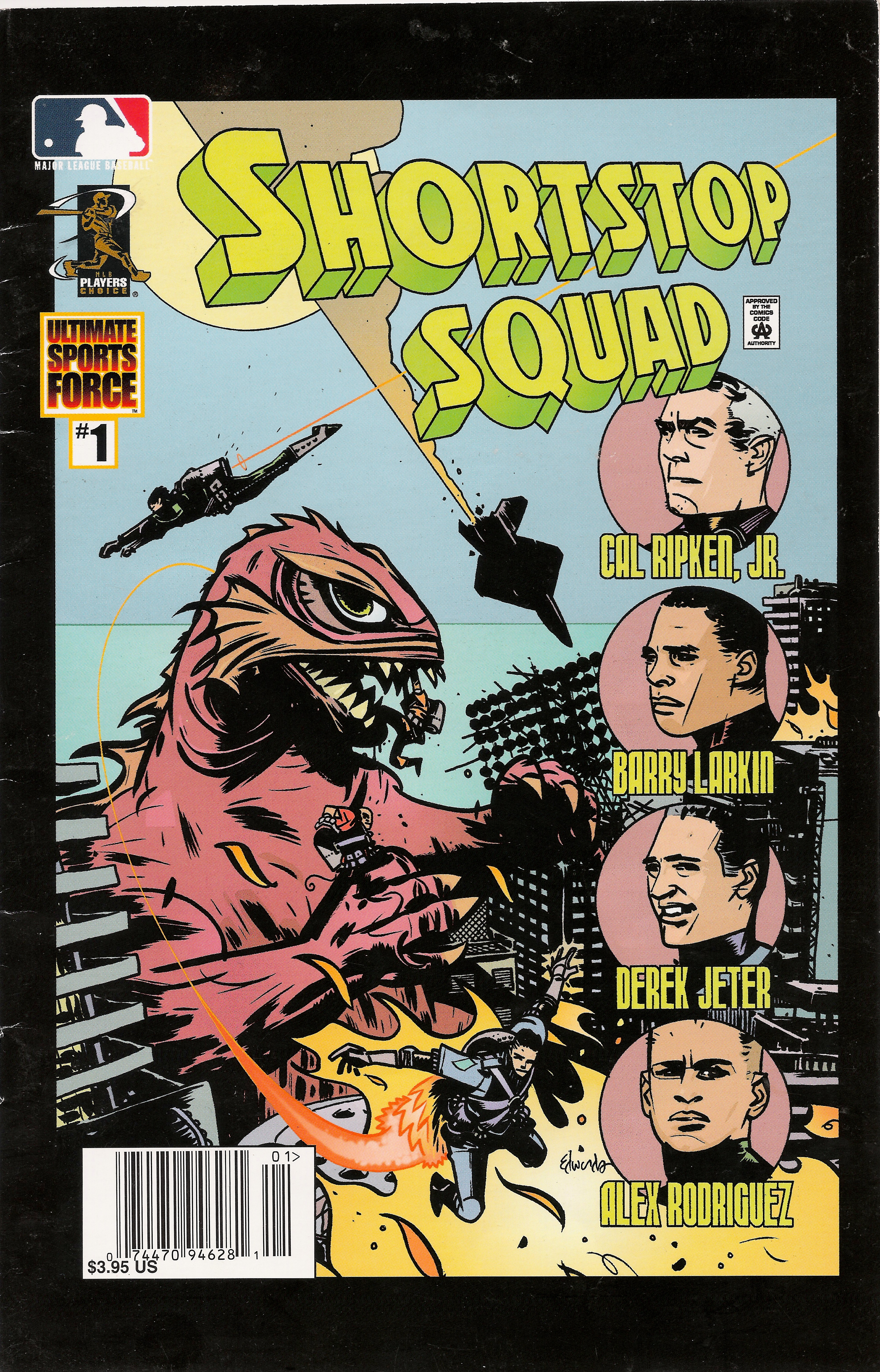
In the last years of the 20th century and the first years of the 21st, there existed a company called “Ultimate Sports Force”. It is gone now, existing only in old websites and undeleted news items, but in it’s day, it was a staple advertisement in things like Sports Illustrated for Kids.

What was “Ultimate Sports Force”, you ask?

Ultimate Sports Force was a comic company that made books in which professional athletes were superheroes, that’s what! They had licenses with MLB, NBA, NFL and others, and they made comics that involved them saving the world. And then, like a shooting star across the sky, they were gone.

But, oh, man, the stuff they left behind. I’ve come into possession of many of their great products, and while their quality varies from “surprisingly good” to “OH-DEAR-GOD-KILL-IT-WITH-FIRE”, they all represent a special point in our history, a time when we could think of our sports heroes as actual superheroes, and not individuals who got into arguments, used PEDs, had tumultuous love lives, politics we disagree with or other flaws. No, Ultimate Sports Force was the last Golden Age before we all became so jaded.

Perhaps the crown jewel of Ultimate Sports Force’s non-team-affiliated content was Shortstop Squad. Truly a marvel of the Bizarre Baseball Culture arts, it paid tribute to those that went before and followed in their traditions, as Cal Ripken led his team of Barry Larkin, Derek Jeter and Alex Rodriguez against a fish-monster that basically is meant to be fish-Godzilla.

You may think I’m being sarcastic, and you are probably right, but, well, this is SHORTSTOP SQUAD, so your logic is irrelevant.

After all, just LOOK at this cover:

SHORTSTOPSQUADcover

Your mind is now blown.

So, let’s get started with Shortstop Squad #1 from 1999… after the jump, of course:

Continue reading

(Blogathon ’16) Andrew Martin: A talk with Alex George

This guest-post is part of the 2016 Baseball Continuum Blogathon For Charity, benefiting the Roswell Park Alliance Foundation. The Roswell Park Alliance Foundation is the charitable arm of Roswell Park Cancer Institute and funds raised will be “put to immediate use to increase the pace from research trials into improved clinical care, to ensure state-of-the-art facilities, and to help improve the quality of life for patients and their families.” Please donate through the Blogathon’s GoFundMe page. Also, please note that the opinions and statements of the writer are not necessarily those of the Baseball Continuum or it’s webmaster.

What would be tougher? Being good enough to play major league baseball but to only get in to five games? Or having all of those five games come before your 17th birthday? Only one person knows that answer for sure, and it’s former shortstop Alex George, who reached the pinnacle of his baseball career as a teenager in the autumn of 1955.

Growing up in Kansas City, George was a multi-sport star and after graduating in 1955 at the age of 16, he enrolled at Kansas University with a dual scholarship in baseball and basketball. Upon reaching campus that fall he was introduced to his basketball team—including fellow newcomer, Wilt Chamberlain.

George had hardly cracked the books when he heard from his father that his hometown Kansas City Athletics wanted to sign him and have him join the team for the remainder of the season. That proved to be an offer too sweet to pass up, so he left campus and donned his glove and spikes.

The Athletics finished at 63-91 and were already well out of the pennant chase. This gave them the luxury at being able to look at prospects like George. The left-handed hitter got in five games, collecting a single and a walk in 10 official at bats. His seven strikeouts showed how overmatched he was, but he did pick up his lone hit on September 20th against fellow rookie Duke Maas and the Detroit Tigers, leading off what would be a 7-3 loss. He is still the sixth-youngest player to appear in the majors since World War I.

George spent the next seven seasons in the minors, experiencing modest levels of success (.254 batting average and 81 home runs) but never got back to the big leagues. By the time he was 24, he had been slowed by injuries to the point that it resulted in the end of his career.

He ended up returning to Kansas after his playing days were over and went on to have a successful career in radio and television sales. Now 77 and retired, he answered a few questions about his career when I contacted him (a few years back).

Who was your favorite coach or manager?: When I signed, Lou Boudreau was the manager. I had read a lot about him playing shortstop. Harry Craft was one of the coaches and was very nice to me. He had managed the Yankees Triple-A affiliate in Kansas City; the Kansas City Blues, so he was familiar with me and my family.

What was the strangest thing you ever saw as a player?: Probably the strangest play is when two or more infielders are all calling for a pop fly and then they all stop and look at one another and the ball drops between them. It’s not that unusual of a play, but it always struck me as odd and strange that they would just let the ball drop.

Who was the toughest pitcher you ever faced?: I didn’t faze too many major league pitchers, but I’ll always remember facing Billy Pierce in Chicago. He was a lefty and I just couldn’t catch up with his fastball.

If you could do anything differently about your career, what would that be?: I would probably wait until I was 18 to sign. At 16, I was really too young.

Andrew Martin writes The Baseball Historian blog. You can follow him on Facebook or Twitter @historianandrew

This guest-post has been part of the 2016 Baseball Continuum Blogathon For Charity, benefiting the Roswell Park Alliance Foundation. The Roswell Park Alliance Foundation is the charitable arm of Roswell Park Cancer Institute and funds raised will be “put to immediate use to increase the pace from research trials into improved clinical care, to ensure state-of-the-art facilities, and to help improve the quality of life for patients and their families.” Please donate through the Blogathon’s GoFundMe page. Also, please note that the opinions and statements of the writer were not necessarily those of the Baseball Continuum or it’s webmaster.

(Blogathon ’16) Mike Oz: The History of Baseball Players Rapping, Abridged

This guest-post is part of the 2016 Baseball Continuum Blogathon For Charity, benefiting the Roswell Park Alliance Foundation. The Roswell Park Alliance Foundation is the charitable arm of Roswell Park Cancer Institute and funds raised will be “put to immediate use to increase the pace from research trials into improved clinical care, to ensure state-of-the-art facilities, and to help improve the quality of life for patients and their families.” Please donate through the Blogathon’s GoFundMe page. Also, please note that the opinions and statements of the writer are not necessarily those of the Baseball Continuum or it’s webmaster.

As someone who loves both hip-hop and baseball, it’s a daily disappointment that these two lanes of my life don’t intersect more often.

It happened recently, when Toronto Blue Jays pitcher Marcus Stroman made his rhyming debut, dropping a verse on Mike Stud’s “These Days” remix from his new album of the same name. There’s more here than just the same ol’ story of an athlete thinking he can spit a few bars. Stud is the nom de rap of Mike Seander, who was a college teammate of Stroman’s at Duke University.

After Duke, Stroman went on to a successful MLB career and Stud became a notable figure in the Drake-influenced frat-rap scene. So more than baseball players trying to get into rap, this was two friends reuniting for fun. Nonetheless, Stroman was surprisingly good. Better, in fact, than you’d think.

Using Stroman as a jumping off point, this seems like a timely opportunity to talk about other baseball-rap crossovers. Please enjoy this Abridged Version of the History of Baseball Players Rapping.

1. DEION SANDERS
When Prime Time jumped into the rap game, no one took it all that serious. He was hanging with MC Hammer and had already established himself as a profession-juggler. So, rapping, why not? He released an entire album in 1994, aptly titled “Prime Time” that people will mostly remember for the somewhat popular song “Must Be the Money.” It wasn’t good, but it was at least ahead of its time in the sense that modern day hip-hop also values people who rap about being rich even if they have no actual talent.

Notable lyric: “Hey, my snakeskin shoes gonna change into gators / Hey, my library cards gonna change into credit cards
/ You know what I’m sayin?”

2. KEN GRIFFEY JR.
Somehow, The Kid’s foray into rap doesn’t get nearly enough attention. In 1992, Seattle rapper Kid Sensation got Griffey to jump on a track called “The Way I Swing.” How that happened? Emoji shrug. History doesn’t remember any of this too well, but you know what? The beat to the song isn’t bad. Griffey isn’t a Hall of Famer spitter, but this is at least somewhat respectable.

Notable lyric: “Ken Griffey is a swinger, not a singer / A def rhyme bringer / A home-run hitter but I’m not a dope slinger.”

3. COCO CRISP
As part of the 2005 album, “Oh Say, Can You Sing,” veteran outfielder Coco Crisp showed his flows on an original song called “We Got That Thing.” This might be baseball’s version of Cedric Ceballos rapping on that NBA rap CD where you’re like, “Huh? This guy is rapping and … he’s not bad.” It’s bouncy and interesting and actually sounds good more than 10 years later. Well done, Coco.

Notable lyric: “That chain you wear is dental floss to me.”

4. JOSE REYES
It’s a surprise we don’t hear more Spanish-language rap coming from Latin baseball players. We do get it from Jose Reyes, though. His history in rap is more prolific than most people here, as he’s appeared on a number of different songs, usually as an offseason hobby. It’s hard to judge his lyrics, as a non-Spanish speaker, but his flow doesn’t sound bad.

Notable lyric (translated): “There are no friends / A friend is a dollar in my pocket / As soon as you turn your back your friends want to stab you in the back.”

5. TREVOR BAUER
The now-Indians pitcher made headlines a few years ago for his hobby rap tracks. There was even one that was perceived as a diss to former D-backs teammate Miguel Montero. That would be a baseball first. Bauer isn’t very good. Even he admits that. And these days, he seems more focused on pitching than rapping, but he at least has proven he can be his team’s hip-hopping cheerleader.

Notable lyric: “So what do y’all know bout Swisher and his swag / Smokin pitchers like cigars / Are you picturing that?”

6. MARCUS STROMAN
This brings us back to Stroman who, compared to Bauer, is easily the best rapping pitcher in the game. He doesn’t plan to rap a bunch — he’d much rather lead the Jays back to the postseason — but Stroman did sound at ease on his Mike Stud cameo.

Notable lyric:“Yeah, my vision is to get it while I’m living / I’ll keep winning / Legendary comeback, ACL incision”

Mike Oz is the editor of Big League Stew on Yahoo Sports. You can find him on Twitter at and on Facebook. He lives in Central California and likes dope beats and tacos.

This guest-post has been part of the 2016 Baseball Continuum Blogathon For Charity, benefiting the Roswell Park Alliance Foundation. The Roswell Park Alliance Foundation is the charitable arm of Roswell Park Cancer Institute and funds raised will be “put to immediate use to increase the pace from research trials into improved clinical care, to ensure state-of-the-art facilities, and to help improve the quality of life for patients and their families.” Please donate through the Blogathon’s GoFundMe page. Also, please note that the opinions and statements of the writer were not necessarily those of the Baseball Continuum or it’s webmaster.

(Blogathon ’16) Eric Stephen: On Baseball and Brothers

This guest-post is part of the 2016 Baseball Continuum Blogathon For Charity, benefiting the Roswell Park Alliance Foundation. The Roswell Park Alliance Foundation is the charitable arm of Roswell Park Cancer Institute and funds raised will be “put to immediate use to increase the pace from research trials into improved clinical care, to ensure state-of-the-art facilities, and to help improve the quality of life for patients and their families.” Please donate through the Blogathon’s GoFundMe page. Also, please note that the opinions and statements of the writer are not necessarily those of the Baseball Continuum or it’s webmaster.

At the end of January, I am reaching the point of restlessness in the offseason, much too far removed from the end of the last baseball season and still too far away from the starting of spring training this season. With 2016 a bit of a milestone year for both me and one of my brothers, I thought I’d share one of my favorite baseball memories with him.

My two brothers are the reason I love baseball so much. Kelly is 15 years older than I am, and Greg is 10 years older than me, and were largely responsible for molding me into the person I am today. They loved baseball, so it had to be great. I had to find out about this thing my brothers loved so much, and I soon found I would love it too.

Given the age difference between us, Kelly and Greg were more than brothers and role models for me. They also had somewhat of a fatherly role, too, when I was younger. Our dad passed away from pancreatic cancer in January 1987, when I was 10, and they did their best to fill that void in my life when I needed it most.

The 1988 Dodgers will forever be the sports team I most identify with, one that captured my heart when I was 12. I grew up in Palm Springs and, being two-plus hours away from Dodger Stadium I didn’t go to too many games as a kid. I went to two games in 1988 – Game 2 of the 1988 World Series, with Kelly; and July 6 against the Cardinals, with Greg.

To date, Game 2 remains the only World Series game I have ever attended. But that July 6, 1988 game will always stick with me, too.

It was just Greg and I, which meant a lot of knowledge was getting passed down to me. Previous lessons included how to keep score, proper strategy, and even when to cheer. That last one was more important that you might think, especially for someone not familiar with depth perception at different sections of the ballpark.*

*In other words, not in this game but when I was much younger, I once stood up with arms raised upon bat hitting ball, not realizing this high fly ball wasn’t destined for the seats or even the outfield, but rather settled nicely into the waiting glove of the second baseman, much to the embarrassment and horror of my brothers.

Anyway, back to this July 6 game, there was nothing special about this relatively nondescript Wednesday night game. It did happen to fall on what would have been our dad’s 54th birthday, and was just his second birthday since his death.

The Dodgers were down 3-0 to the Cardinals after seven innings in this game, but as they did all year managed to rally to tie the game in the eighth inning. But the rally wasn’t over.

Even after tying the score, the Dodgers managed to load the bases against ace closer Todd Worrell, with first baseman Franklin Stubbs coming to the plate. Stubbs was a former first-round pick who never managed to live up to the advance billing, but on this night he came through.

Stubbs ran the count full and on the eighth pitch of his battle with Worrell launched a ball well into the right field pavilion, helping to give the Dodgers yet another improbable victory in a season full of them. What I remember most about the moment of the grand slam was the utter euphoria in Dodger Stadium, enhanced because I was there with my brother Greg.

I can still feel the goosebumps today when thinking about that game.

Greg lives in Baltimore now with his wife and three kids, so we don’t see each other as much as I would like. But this year he turns 50 in February, and I turn 40 in March, and with Kelly the three of us plan to celebrate these milestones with each other during a week in spring training in Arizona.

It is as perfect a combination that I can think of – me, baseball and my brothers. I’m getting goosebumps already, and I can’t wait.

Eric covers the Dodgers for True Blue LA and is an editor at SB Nation. You can follow him @truebluela.

This guest-post has been part of the 2016 Baseball Continuum Blogathon For Charity, benefiting the Roswell Park Alliance Foundation. The Roswell Park Alliance Foundation is the charitable arm of Roswell Park Cancer Institute and funds raised will be “put to immediate use to increase the pace from research trials into improved clinical care, to ensure state-of-the-art facilities, and to help improve the quality of life for patients and their families.” Please donate through the Blogathon’s GoFundMe page. Also, please note that the opinions and statements of the writer were not necessarily those of the Baseball Continuum or it’s webmaster.

(Blogathon ’16) Dan Hirsch: The Most Average Player in Baseball History

This guest-post is part of the 2016 Baseball Continuum Blogathon For Charity, benefiting the Roswell Park Alliance Foundation. The Roswell Park Alliance Foundation is the charitable arm of Roswell Park Cancer Institute and funds raised will be “put to immediate use to increase the pace from research trials into improved clinical care, to ensure state-of-the-art facilities, and to help improve the quality of life for patients and their families.” Please donate through the Blogathon’s GoFundMe page. Also, please note that the opinions and statements of the writer are not necessarily those of the Baseball Continuum or it’s webmaster.

In the baseball community, we are obsessed with comparing players to league average. The book Baseball Between the Numbers (which is a must-have for any baseball fan), the term “league average” appears 103 times. Wether it’s OPS+, ERA+, FIP-, wRC+ or DRS, we are constantly using it as a comparison. But what exactly is a league average player? Or maybe so we can understand it better, WHO is a league average player?

What I decided to look for was a player who performed closest to league average throughout their entire career. A quick way to do this would be to find which players total career Wins Above Average is closest to zero. This can easily be done using Baseball-Reference’s invaluable play index. I found each player with a career WAA between -0.1 and 0.1 and then sorted by plate appearances.

Rk Player PA WAA From To
1 Steve Sax 7632 0.1 1981 1994
2 Eddie Foster 6328 0.1 1910 1923
3 Melky Cabrera 5540 0.1 2005 2015
4 Gus Triandos 4424 0.0 1953 1965
5 Ivey Wingo 4376 0.1 1911 1929

The top spot belongs to Steve Sax. But while Sax’s overall career performance was almost exactly league average, his individual seasons don’t agree. He was a five time All-Star who posted multiple seasons with an OPS+ above 110 and multiple seasons below 75. Similarly, Melky Cabrera (who ranks third on the above list) has had a full-season WAA as low as -1.8 and as high as 3.2, so it’s obvious his performance has fluctuated greatly.

Clearly, this isn’t the best method in determining the most average player in Major League history. Instead of starting at the career level, I began by looking at each player’s individual seasons. The statistic I decided to use I was waaWL%, which can be found on the “Player Value” chart of each player’s Baseball-Reference page. This stat takes a hypothetical team of exactly league average players and estimates what their winning percentage would be if this player joined them. Obviously, a league average team would have a .500 winning percentage. Adding an above average player would increase the winning percentage while a below average player would decrease it.

For every season in a player’s career, I found the absolute value of the difference between their waaWL% and .500. Players closest to league average will have lower values than those who are farthest from league average. (Example: In 2015, Bryce Harper (.553 waaWL%) receives 53 points, since his waaWL% was 53 percentage points away from .500)

Finally, to give each player a career value, I found the average of each of their seasons, weighted by plate appearances.

I set the minimum career plate appearances at 5000, which will only include players with the equivalent of at least ten full seasons. Here are the qualifying players with the lowest career average point totals:

Rk Player PA WAA Pts From To
1 Jose Cruz 5448 1.2 3.8 1997 2008
2 Todd Zeile 8649 -7.7 4.7 1989 2004
3 Dan Driessen 6344 -0.7 4.7 1973 1987
4 Jack Graney 5584 -7.1 4.8 1910 1922
5 David DeJesus 5916 2.7 4.9 2003 2015
6 Ossie Bluege 7453 1.1 5.1 1922 1939
7 Bing Miller 6892 3.2 5.2 1921 1936
8 Joe Randa 6007 0.9 5.4 1995 2006
9 Bucky Harris 5559 -5.2 5.4 1919 1931
10 Steve Brodie 6342 -2.4 5.4 1890 1902
11 Chris Chambliss 8313 -1.5 5.4 1971 1988
12 Lyle Overbay 5802 -2.5 5.5 2001 2014
13 Al Lopez 6607 -5.3 5.5 1928 1947
14 Dick Hoblitzell 5368 1.3 5.5 1908 1918
15 Bruce Bochte 5994 -0.6 5.5 1974 1986

Jose Cruz Jr tops the list by a considerable margin. Over a twelve season career, Cruz had a waaWL% that was fewer than four percentage points away from .500. While his career total Wins Above Average (1.2) wasn’t exactly zero, he averaged just 0.1 WAA per 500 plate appearances. Cruz was also quite average with both the bat and the glove. When breaking it down even further, he averaged 0.08 offensive WAA and -0.15 defensive WAA per 500 PA.

How did the players in the first list fare using individual season waaWL%? Steve Sax’s average season (8.5 pts) was more than twice as far from league average than Jose Cruz Jr, while Melky Cabrera was almost 3x that of Cruz.

Rk Name Pts
1 Steve Sax 8.5
2 Eddie Foster 7.2
3 Melky Cabrera 10.9
4 Gus Triandos 7.8
5 Ivey Wingo 6.4

Pitchers
I ran the same process for pitchers, using innings pitched instead of plate appearances for the weighted career average and set the minimum at 200 games started. Here are the results:

Rk Name IP WAA Pts From To
1 Mudcat Grant 2442 -0.2 16.9 1958 1971
2 Harry Gumbert 2157 -0.3 17.3 1935 1950
3 Hooks Dauss 3389 1.0 21.4 1912 1926
4 Mike Flanagan 2770 0.3 21.6 1975 1992
5 Dummy Taylor 1916 0.4 21.7 1900 1908
6 Kirby Higbe 1952 0.6 21.7 1937 1950
7 Neal Heaton 1507 -1.7 22.8 1982 1993
8 Gary Bell 2015 -0.4 23.1 1958 1969
9 Tom Gordon 2108 4.5 24.3 1988 2009
10 Pat Dobson 2120 -0.2 24.6 1967 1977

Pitchers have more of an impact on the outcome of a particular game than an individual position player, leading to a greater variance in their waaWL%. This explains why their point totals are higher than those of the position players. Jim (Mudcat) Grant tops the list for pitchers, while Harry Gumbert is a close second.

So what kind of value does an average player provide over the course of a major league career? Jose Cruz Jr. racked up 19.5 WAR for his career while Mudcat Grant totaled 19.4. In fact, there were five players on the 2015 Hall of Fame ballot with lower career WAR than these two. To get a sense of present day value, Nori Aoki has a total of 0.1 WAA over last three seasons and just signed a contract for $5.5 million. League average has value. If a player like Nor Aoki is injured, their replacement will almost always be of below average ability.

So if you’re baseball obsessed friend asks you what exactly a league average player is, you can point them to Jose Cruz Jr and Mudcat Grant.

Dan Hirsch is the Creator of The Baseball Gauge. Baseball historian and SABR member for 10 years. Web designer for The Seamheads Negro Leagues Database and The Seamheads Ballparks Database.

This guest-post has been part of the 2016 Baseball Continuum Blogathon For Charity, benefiting the Roswell Park Alliance Foundation. The Roswell Park Alliance Foundation is the charitable arm of Roswell Park Cancer Institute and funds raised will be “put to immediate use to increase the pace from research trials into improved clinical care, to ensure state-of-the-art facilities, and to help improve the quality of life for patients and their families.” Please donate through the Blogathon’s GoFundMe page. Also, please note that the opinions and statements of the writer were not necessarily those of the Baseball Continuum or it’s webmaster.

(Blogathon ’16) CONTINUUM CLASSIC- The time I wrote an obituary for the 2012 Baltimore Orioles’ playoff hopes. Whoops.

This piece from the blog’s archives is part of the 2016 Baseball Continuum Blogathon For Charity, benefiting the Roswell Park Alliance Foundation. The Roswell Park Alliance Foundation is the charitable arm of Roswell Park Cancer Institute and funds raised will be “put to immediate use to increase the pace from research trials into improved clinical care, to ensure state-of-the-art facilities, and to help improve the quality of life for patients and their families.” Please donate through the Blogathon’s GoFundMe page.

The Playoff Hopes of the Baltimore Orioles passed away last night at the age of 89 games, dying shortly after a 19-7 trouncing at the hands of the Minnesota Twins, who sometimes don’t even seem to score 19 runs during a single month. Although Hopes, who had not been seen this late since 1997, is still technically alive, doctors confirm that the prognosis is extremely grim and that it is only a matter of time before it is overtaken and destroyed by the American League East and the tough competition for the AL Wild Card spots due to a lack of starting pitching.

The Orioles’ Playoff Hopes leaves behind it’s brother, fellow Baltimore native Michael Phelps Olympic Hopes, as well as it’s distant cousin, the Pittsburgh Pirates’ Playoff Hopes.

Services are the rest of the season. In lieu of flowers, send quality starting pitchers.

This piece from the blog’s archives has been part of the 2016 Baseball Continuum Blogathon For Charity, benefiting the Roswell Park Alliance Foundation. The Roswell Park Alliance Foundation is the charitable arm of Roswell Park Cancer Institute and funds raised will be “put to immediate use to increase the pace from research trials into improved clinical care, to ensure state-of-the-art facilities, and to help improve the quality of life for patients and their families.” Please donate through the Blogathon’s GoFundMe page.