(Blogathon ’16) Mike Oz: The History of Baseball Players Rapping, Abridged

This guest-post is part of the 2016 Baseball Continuum Blogathon For Charity, benefiting the Roswell Park Alliance Foundation. The Roswell Park Alliance Foundation is the charitable arm of Roswell Park Cancer Institute and funds raised will be “put to immediate use to increase the pace from research trials into improved clinical care, to ensure state-of-the-art facilities, and to help improve the quality of life for patients and their families.” Please donate through the Blogathon’s GoFundMe page. Also, please note that the opinions and statements of the writer are not necessarily those of the Baseball Continuum or it’s webmaster.

As someone who loves both hip-hop and baseball, it’s a daily disappointment that these two lanes of my life don’t intersect more often.

It happened recently, when Toronto Blue Jays pitcher Marcus Stroman made his rhyming debut, dropping a verse on Mike Stud’s “These Days” remix from his new album of the same name. There’s more here than just the same ol’ story of an athlete thinking he can spit a few bars. Stud is the nom de rap of Mike Seander, who was a college teammate of Stroman’s at Duke University.

After Duke, Stroman went on to a successful MLB career and Stud became a notable figure in the Drake-influenced frat-rap scene. So more than baseball players trying to get into rap, this was two friends reuniting for fun. Nonetheless, Stroman was surprisingly good. Better, in fact, than you’d think.

Using Stroman as a jumping off point, this seems like a timely opportunity to talk about other baseball-rap crossovers. Please enjoy this Abridged Version of the History of Baseball Players Rapping.

1. DEION SANDERS
When Prime Time jumped into the rap game, no one took it all that serious. He was hanging with MC Hammer and had already established himself as a profession-juggler. So, rapping, why not? He released an entire album in 1994, aptly titled “Prime Time” that people will mostly remember for the somewhat popular song “Must Be the Money.” It wasn’t good, but it was at least ahead of its time in the sense that modern day hip-hop also values people who rap about being rich even if they have no actual talent.

Notable lyric: “Hey, my snakeskin shoes gonna change into gators / Hey, my library cards gonna change into credit cards
/ You know what I’m sayin?”

2. KEN GRIFFEY JR.
Somehow, The Kid’s foray into rap doesn’t get nearly enough attention. In 1992, Seattle rapper Kid Sensation got Griffey to jump on a track called “The Way I Swing.” How that happened? Emoji shrug. History doesn’t remember any of this too well, but you know what? The beat to the song isn’t bad. Griffey isn’t a Hall of Famer spitter, but this is at least somewhat respectable.

Notable lyric: “Ken Griffey is a swinger, not a singer / A def rhyme bringer / A home-run hitter but I’m not a dope slinger.”

3. COCO CRISP
As part of the 2005 album, “Oh Say, Can You Sing,” veteran outfielder Coco Crisp showed his flows on an original song called “We Got That Thing.” This might be baseball’s version of Cedric Ceballos rapping on that NBA rap CD where you’re like, “Huh? This guy is rapping and … he’s not bad.” It’s bouncy and interesting and actually sounds good more than 10 years later. Well done, Coco.

Notable lyric: “That chain you wear is dental floss to me.”

4. JOSE REYES
It’s a surprise we don’t hear more Spanish-language rap coming from Latin baseball players. We do get it from Jose Reyes, though. His history in rap is more prolific than most people here, as he’s appeared on a number of different songs, usually as an offseason hobby. It’s hard to judge his lyrics, as a non-Spanish speaker, but his flow doesn’t sound bad.

Notable lyric (translated): “There are no friends / A friend is a dollar in my pocket / As soon as you turn your back your friends want to stab you in the back.”

5. TREVOR BAUER
The now-Indians pitcher made headlines a few years ago for his hobby rap tracks. There was even one that was perceived as a diss to former D-backs teammate Miguel Montero. That would be a baseball first. Bauer isn’t very good. Even he admits that. And these days, he seems more focused on pitching than rapping, but he at least has proven he can be his team’s hip-hopping cheerleader.

Notable lyric: “So what do y’all know bout Swisher and his swag / Smokin pitchers like cigars / Are you picturing that?”

6. MARCUS STROMAN
This brings us back to Stroman who, compared to Bauer, is easily the best rapping pitcher in the game. He doesn’t plan to rap a bunch — he’d much rather lead the Jays back to the postseason — but Stroman did sound at ease on his Mike Stud cameo.

Notable lyric:“Yeah, my vision is to get it while I’m living / I’ll keep winning / Legendary comeback, ACL incision”

Mike Oz is the editor of Big League Stew on Yahoo Sports. You can find him on Twitter at and on Facebook. He lives in Central California and likes dope beats and tacos.

This guest-post has been part of the 2016 Baseball Continuum Blogathon For Charity, benefiting the Roswell Park Alliance Foundation. The Roswell Park Alliance Foundation is the charitable arm of Roswell Park Cancer Institute and funds raised will be “put to immediate use to increase the pace from research trials into improved clinical care, to ensure state-of-the-art facilities, and to help improve the quality of life for patients and their families.” Please donate through the Blogathon’s GoFundMe page. Also, please note that the opinions and statements of the writer were not necessarily those of the Baseball Continuum or it’s webmaster.
(Blogathon ’16) Eric Stephen: On Baseball and Brothers

This guest-post is part of the 2016 Baseball Continuum Blogathon For Charity, benefiting the Roswell Park Alliance Foundation. The Roswell Park Alliance Foundation is the charitable arm of Roswell Park Cancer Institute and funds raised will be “put to immediate use to increase the pace from research trials into improved clinical care, to ensure state-of-the-art facilities, and to help improve the quality of life for patients and their families.” Please donate through the Blogathon’s GoFundMe page. Also, please note that the opinions and statements of the writer are not necessarily those of the Baseball Continuum or it’s webmaster.

At the end of January, I am reaching the point of restlessness in the offseason, much too far removed from the end of the last baseball season and still too far away from the starting of spring training this season. With 2016 a bit of a milestone year for both me and one of my brothers, I thought I’d share one of my favorite baseball memories with him.

My two brothers are the reason I love baseball so much. Kelly is 15 years older than I am, and Greg is 10 years older than me, and were largely responsible for molding me into the person I am today. They loved baseball, so it had to be great. I had to find out about this thing my brothers loved so much, and I soon found I would love it too.

Given the age difference between us, Kelly and Greg were more than brothers and role models for me. They also had somewhat of a fatherly role, too, when I was younger. Our dad passed away from pancreatic cancer in January 1987, when I was 10, and they did their best to fill that void in my life when I needed it most.

The 1988 Dodgers will forever be the sports team I most identify with, one that captured my heart when I was 12. I grew up in Palm Springs and, being two-plus hours away from Dodger Stadium I didn’t go to too many games as a kid. I went to two games in 1988 – Game 2 of the 1988 World Series, with Kelly; and July 6 against the Cardinals, with Greg.

To date, Game 2 remains the only World Series game I have ever attended. But that July 6, 1988 game will always stick with me, too.

It was just Greg and I, which meant a lot of knowledge was getting passed down to me. Previous lessons included how to keep score, proper strategy, and even when to cheer. That last one was more important that you might think, especially for someone not familiar with depth perception at different sections of the ballpark.*

*In other words, not in this game but when I was much younger, I once stood up with arms raised upon bat hitting ball, not realizing this high fly ball wasn’t destined for the seats or even the outfield, but rather settled nicely into the waiting glove of the second baseman, much to the embarrassment and horror of my brothers.

Anyway, back to this July 6 game, there was nothing special about this relatively nondescript Wednesday night game. It did happen to fall on what would have been our dad’s 54th birthday, and was just his second birthday since his death.

The Dodgers were down 3-0 to the Cardinals after seven innings in this game, but as they did all year managed to rally to tie the game in the eighth inning. But the rally wasn’t over.

Even after tying the score, the Dodgers managed to load the bases against ace closer Todd Worrell, with first baseman Franklin Stubbs coming to the plate. Stubbs was a former first-round pick who never managed to live up to the advance billing, but on this night he came through.

Stubbs ran the count full and on the eighth pitch of his battle with Worrell launched a ball well into the right field pavilion, helping to give the Dodgers yet another improbable victory in a season full of them. What I remember most about the moment of the grand slam was the utter euphoria in Dodger Stadium, enhanced because I was there with my brother Greg.

I can still feel the goosebumps today when thinking about that game.

Greg lives in Baltimore now with his wife and three kids, so we don’t see each other as much as I would like. But this year he turns 50 in February, and I turn 40 in March, and with Kelly the three of us plan to celebrate these milestones with each other during a week in spring training in Arizona.

It is as perfect a combination that I can think of – me, baseball and my brothers. I’m getting goosebumps already, and I can’t wait.

Eric covers the Dodgers for True Blue LA and is an editor at SB Nation. You can follow him @truebluela.

This guest-post has been part of the 2016 Baseball Continuum Blogathon For Charity, benefiting the Roswell Park Alliance Foundation. The Roswell Park Alliance Foundation is the charitable arm of Roswell Park Cancer Institute and funds raised will be “put to immediate use to increase the pace from research trials into improved clinical care, to ensure state-of-the-art facilities, and to help improve the quality of life for patients and their families.” Please donate through the Blogathon’s GoFundMe page. Also, please note that the opinions and statements of the writer were not necessarily those of the Baseball Continuum or it’s webmaster.
(Blogathon ’16) Dan Hirsch: The Most Average Player in Baseball History

This guest-post is part of the 2016 Baseball Continuum Blogathon For Charity, benefiting the Roswell Park Alliance Foundation. The Roswell Park Alliance Foundation is the charitable arm of Roswell Park Cancer Institute and funds raised will be “put to immediate use to increase the pace from research trials into improved clinical care, to ensure state-of-the-art facilities, and to help improve the quality of life for patients and their families.” Please donate through the Blogathon’s GoFundMe page. Also, please note that the opinions and statements of the writer are not necessarily those of the Baseball Continuum or it’s webmaster.

In the baseball community, we are obsessed with comparing players to league average. The book Baseball Between the Numbers (which is a must-have for any baseball fan), the term “league average” appears 103 times. Wether it’s OPS+, ERA+, FIP-, wRC+ or DRS, we are constantly using it as a comparison. But what exactly is a league average player? Or maybe so we can understand it better, WHO is a league average player?

What I decided to look for was a player who performed closest to league average throughout their entire career. A quick way to do this would be to find which players total career Wins Above Average is closest to zero. This can easily be done using Baseball-Reference’s invaluable play index. I found each player with a career WAA between -0.1 and 0.1 and then sorted by plate appearances.

Rk Player PA WAA From To
1 Steve Sax 7632 0.1 1981 1994
2 Eddie Foster 6328 0.1 1910 1923
3 Melky Cabrera 5540 0.1 2005 2015
4 Gus Triandos 4424 0.0 1953 1965
5 Ivey Wingo 4376 0.1 1911 1929

The top spot belongs to Steve Sax. But while Sax’s overall career performance was almost exactly league average, his individual seasons don’t agree. He was a five time All-Star who posted multiple seasons with an OPS+ above 110 and multiple seasons below 75. Similarly, Melky Cabrera (who ranks third on the above list) has had a full-season WAA as low as -1.8 and as high as 3.2, so it’s obvious his performance has fluctuated greatly.

Clearly, this isn’t the best method in determining the most average player in Major League history. Instead of starting at the career level, I began by looking at each player’s individual seasons. The statistic I decided to use I was waaWL%, which can be found on the “Player Value” chart of each player’s Baseball-Reference page. This stat takes a hypothetical team of exactly league average players and estimates what their winning percentage would be if this player joined them. Obviously, a league average team would have a .500 winning percentage. Adding an above average player would increase the winning percentage while a below average player would decrease it.

For every season in a player’s career, I found the absolute value of the difference between their waaWL% and .500. Players closest to league average will have lower values than those who are farthest from league average. (Example: In 2015, Bryce Harper (.553 waaWL%) receives 53 points, since his waaWL% was 53 percentage points away from .500)

Finally, to give each player a career value, I found the average of each of their seasons, weighted by plate appearances.

I set the minimum career plate appearances at 5000, which will only include players with the equivalent of at least ten full seasons. Here are the qualifying players with the lowest career average point totals:

Rk Player PA WAA Pts From To
1 Jose Cruz 5448 1.2 3.8 1997 2008
2 Todd Zeile 8649 -7.7 4.7 1989 2004
3 Dan Driessen 6344 -0.7 4.7 1973 1987
4 Jack Graney 5584 -7.1 4.8 1910 1922
5 David DeJesus 5916 2.7 4.9 2003 2015
6 Ossie Bluege 7453 1.1 5.1 1922 1939
7 Bing Miller 6892 3.2 5.2 1921 1936
8 Joe Randa 6007 0.9 5.4 1995 2006
9 Bucky Harris 5559 -5.2 5.4 1919 1931
10 Steve Brodie 6342 -2.4 5.4 1890 1902
11 Chris Chambliss 8313 -1.5 5.4 1971 1988
12 Lyle Overbay 5802 -2.5 5.5 2001 2014
13 Al Lopez 6607 -5.3 5.5 1928 1947
14 Dick Hoblitzell 5368 1.3 5.5 1908 1918
15 Bruce Bochte 5994 -0.6 5.5 1974 1986

Jose Cruz Jr tops the list by a considerable margin. Over a twelve season career, Cruz had a waaWL% that was fewer than four percentage points away from .500. While his career total Wins Above Average (1.2) wasn’t exactly zero, he averaged just 0.1 WAA per 500 plate appearances. Cruz was also quite average with both the bat and the glove. When breaking it down even further, he averaged 0.08 offensive WAA and -0.15 defensive WAA per 500 PA.

How did the players in the first list fare using individual season waaWL%? Steve Sax’s average season (8.5 pts) was more than twice as far from league average than Jose Cruz Jr, while Melky Cabrera was almost 3x that of Cruz.

Rk Name Pts
1 Steve Sax 8.5
2 Eddie Foster 7.2
3 Melky Cabrera 10.9
4 Gus Triandos 7.8
5 Ivey Wingo 6.4

Pitchers
I ran the same process for pitchers, using innings pitched instead of plate appearances for the weighted career average and set the minimum at 200 games started. Here are the results:

Rk Name IP WAA Pts From To
1 Mudcat Grant 2442 -0.2 16.9 1958 1971
2 Harry Gumbert 2157 -0.3 17.3 1935 1950
3 Hooks Dauss 3389 1.0 21.4 1912 1926
4 Mike Flanagan 2770 0.3 21.6 1975 1992
5 Dummy Taylor 1916 0.4 21.7 1900 1908
6 Kirby Higbe 1952 0.6 21.7 1937 1950
7 Neal Heaton 1507 -1.7 22.8 1982 1993
8 Gary Bell 2015 -0.4 23.1 1958 1969
9 Tom Gordon 2108 4.5 24.3 1988 2009
10 Pat Dobson 2120 -0.2 24.6 1967 1977

Pitchers have more of an impact on the outcome of a particular game than an individual position player, leading to a greater variance in their waaWL%. This explains why their point totals are higher than those of the position players. Jim (Mudcat) Grant tops the list for pitchers, while Harry Gumbert is a close second.

So what kind of value does an average player provide over the course of a major league career? Jose Cruz Jr. racked up 19.5 WAR for his career while Mudcat Grant totaled 19.4. In fact, there were five players on the 2015 Hall of Fame ballot with lower career WAR than these two. To get a sense of present day value, Nori Aoki has a total of 0.1 WAA over last three seasons and just signed a contract for $5.5 million. League average has value. If a player like Nor Aoki is injured, their replacement will almost always be of below average ability.

So if you’re baseball obsessed friend asks you what exactly a league average player is, you can point them to Jose Cruz Jr and Mudcat Grant.

Dan Hirsch is the Creator of The Baseball Gauge. Baseball historian and SABR member for 10 years. Web designer for The Seamheads Negro Leagues Database and The Seamheads Ballparks Database.

This guest-post has been part of the 2016 Baseball Continuum Blogathon For Charity, benefiting the Roswell Park Alliance Foundation. The Roswell Park Alliance Foundation is the charitable arm of Roswell Park Cancer Institute and funds raised will be “put to immediate use to increase the pace from research trials into improved clinical care, to ensure state-of-the-art facilities, and to help improve the quality of life for patients and their families.” Please donate through the Blogathon’s GoFundMe page. Also, please note that the opinions and statements of the writer were not necessarily those of the Baseball Continuum or it’s webmaster.

(Blogathon ’16) CONTINUUM CLASSIC- The time I wrote an obituary for the 2012 Baltimore Orioles’ playoff hopes. Whoops.

This piece from the blog’s archives is part of the 2016 Baseball Continuum Blogathon For Charity, benefiting the Roswell Park Alliance Foundation. The Roswell Park Alliance Foundation is the charitable arm of Roswell Park Cancer Institute and funds raised will be “put to immediate use to increase the pace from research trials into improved clinical care, to ensure state-of-the-art facilities, and to help improve the quality of life for patients and their families.” Please donate through the Blogathon’s GoFundMe page.

The Playoff Hopes of the Baltimore Orioles passed away last night at the age of 89 games, dying shortly after a 19-7 trouncing at the hands of the Minnesota Twins, who sometimes don’t even seem to score 19 runs during a single month. Although Hopes, who had not been seen this late since 1997, is still technically alive, doctors confirm that the prognosis is extremely grim and that it is only a matter of time before it is overtaken and destroyed by the American League East and the tough competition for the AL Wild Card spots due to a lack of starting pitching.

The Orioles’ Playoff Hopes leaves behind it’s brother, fellow Baltimore native Michael Phelps Olympic Hopes, as well as it’s distant cousin, the Pittsburgh Pirates’ Playoff Hopes.

Services are the rest of the season. In lieu of flowers, send quality starting pitchers.

This piece from the blog’s archives has been part of the 2016 Baseball Continuum Blogathon For Charity, benefiting the Roswell Park Alliance Foundation. The Roswell Park Alliance Foundation is the charitable arm of Roswell Park Cancer Institute and funds raised will be “put to immediate use to increase the pace from research trials into improved clinical care, to ensure state-of-the-art facilities, and to help improve the quality of life for patients and their families.” Please donate through the Blogathon’s GoFundMe page.

(Blogathon ’16) CONTINUUM CLASSIC: 2007 AAA BASEBALL HEROES

This piece from the blog’s archives is part of the 2016 Baseball Continuum Blogathon For Charity, benefiting the Roswell Park Alliance Foundation. The Roswell Park Alliance Foundation is the charitable arm of Roswell Park Cancer Institute and funds raised will be “put to immediate use to increase the pace from research trials into improved clinical care, to ensure state-of-the-art facilities, and to help improve the quality of life for patients and their families.” Please donate through the Blogathon’s GoFundMe page.

Originally published June 19, 2013.

In Bizarre Baseball Culture, I take a look at some of the more unusual places where baseball has reared it’s head in pop culture and fiction.

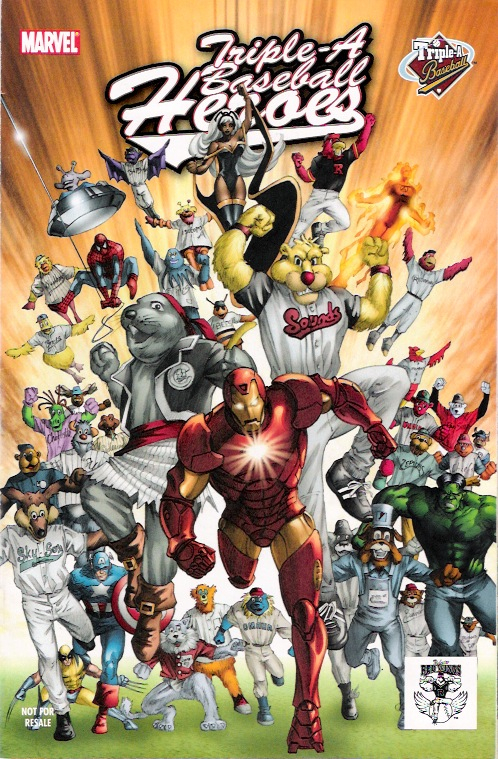
I warned you. I told you it was coming. You could have gone away, but, no, you had to go and actually come here and read this installment of Bizarre Baseball Culture. This is a very special Bizarre Baseball Culture, as, for the first time, it’s something that I actually have in my very small personal collection of comic books. You see, in 2007, each Triple-A baseball team had a day celebrating superheroes, and as a giveaway, there was this comic:

2007GiveawayComic copyAnd, as you can probably guess, I was at that game and got the giveaway. And so, it sat in a drawer for almost seven years, ignored. Until today. Yes, true believers, tremble and prepare yourself for the 2007 edition of Triple-A Baseball Heroes, featuring the superheroes of Marvel Comics.

Now, a few notes before we get going here:

  • All of the images in this post were scanned by yours truly, and any problems with the quality of the images are my fault.
  • All characters and logos in the comic are property of their respective owners (such as Marvel Comics or Minor League Baseball). The excerpts from this comic used in this post are being used under fair use doctrine and are meant merely to support and enhance the opinions and facts stated in said post.
  • Click on any of the images to make them bigger.
  • To the best of my knowledge, the only way to get this comic nowadays is to find it on eBay or have gone to the games that had them released.

Now, go below the jump for the rest of the post:

Continue reading

(Blogathon ’16) Jonathan Weeks: The Greatest Man I Have Known

This guest-post is part of the 2016 Baseball Continuum Blogathon For Charity, benefiting the Roswell Park Alliance Foundation. The Roswell Park Alliance Foundation is the charitable arm of Roswell Park Cancer Institute and funds raised will be “put to immediate use to increase the pace from research trials into improved clinical care, to ensure state-of-the-art facilities, and to help improve the quality of life for patients and their families.” Please donate through the Blogathon’s GoFundMe page. Also, please note that the opinions and statements of the writer are not necessarily those of the Baseball Continuum or it’s webmaster.

The Greatest Man I Have Known
by Jonathan Weeks

Don Weeks
(Nov. 23, 1938 – Mar. 11, 2015) 

When my father was born in 1938, the Yankees were finishing up a run of four consecutive world championships. He vividly remembered the teams of the late-’40s/ early-’50s and would regale me with stories of their on-field adventures. Though I began my formative years as a fan of Cincinnati’s “Big Red Machine,” I was officially converted in 1976 when my father took me to Yankee Stadium for the first time. I still remember the smell of hot dogs and beer, the shouts of refreshment vendors hawking their wares and the row of billboards lining the facade in center field (among them ads for Brut cologne and Marlboro cigarettes). Most of all, I remember my father’s passion as he told me about the exceptional men who had worn pinstripes over the years. Though I was only eleven at the time, I left the stadium with a vague notion that the game of baseball is a metaphor for life itself–how some men rise to the occasion while others wilt in the spotlight. Throughout my childhood and into my adult years, my father was one of the heroes. He taught me about courage, perseverance and fair play. He led by example–especially during his twilight months when he endured the unexpected loss of his beloved wife (my Mom) while fighting bravely through chemotherapy and radiation. Even as he lay dying, his body ravaged by an insidious disease known as Merkle Cell Cancer, he had a kind word for everyone who entered the room. When he eventually became incapable of speech, he offered smiles instead.

In honor of this great man, I would like to share the boxscore from the first game we attended together:

Screen Shot 2016-01-29 at 10.45.57 PMFor anyone interested, I (Jonathan Weeks) am the author of several baseball books—three nonfiction works and one novel. My latest nonfiction project is being released in the summer of 2016 by Rowman and Littlefield. It’s entitled “Baseball’s Dynasties and the Men Who Built Them”. (The title kind of says it all) You can access my blog at jonathanweeks.blogspot.com.

This guest-post has been part of the 2016 Baseball Continuum Blogathon For Charity, benefiting the Roswell Park Alliance Foundation. The Roswell Park Alliance Foundation is the charitable arm of Roswell Park Cancer Institute and funds raised will be “put to immediate use to increase the pace from research trials into improved clinical care, to ensure state-of-the-art facilities, and to help improve the quality of life for patients and their families.” Please donate through the Blogathon’s GoFundMe page. Also, please note that the opinions and statements of the writer were not necessarily those of the Baseball Continuum or it’s webmaster.

(Blogathon ’16!) The Sliding Scale of Fictional Baseball Realism

This post is part of the 2016 Baseball Continuum Blogathon For Charity, benefiting the Roswell Park Alliance Foundation. The Roswell Park Alliance Foundation is the charitable arm of Roswell Park Cancer Institute and funds raised will be “put to immediate use to increase the pace from research trials into improved clinical care, to ensure state-of-the-art facilities, and to help improve the quality of life for patients and their families.” Please donate through the Blogathon’s GoFundMe page.

Earlier today, in my look at Touch, I mentioned that you can make a 0-10 scale of baseball realism in works of fiction, with zero being baseball-in-name-only and ten being actual footage of a game.

Well, I’m going to expand upon that:

0: Baseball In Name Only

In this category, it’s not really baseball at all. They may call it baseball, but it certainly isn’t the actual sport that we know. The Moe Cronin version of baseball fits here.

1: Utterly Absurd

In this category, while it’s clearly meant to be baseball, the rules of the game and the laws of physics have clearly taken a vacation. Some classic cartoons fall into this category.

2: Very Absurd, but still with some realism

In this category, the work might have cartoonish physics and occurrences, but it still is grounded in reality enough to have the rules of baseball still be mostly the same. In theory, a baseball movie where the rules are not consistent or are wildly different but where everything else is played straight could also qualify here. Classic cartoons that aren’t “utterly absurd” usually fall in this category.

3: Absurd, but mostly consistent

Works in this category are clearly absurd and cartoonish, but are at least consistent: the laws of physics may not be what they are in the real world, but they don’t suddenly change mid-game, nor do the rules suddenly change simply because the story demands it. Most “cartoon” baseball video games, like Backyard Baseball and the Mario Baseball series, fit in this category.

4: Many absurd elements

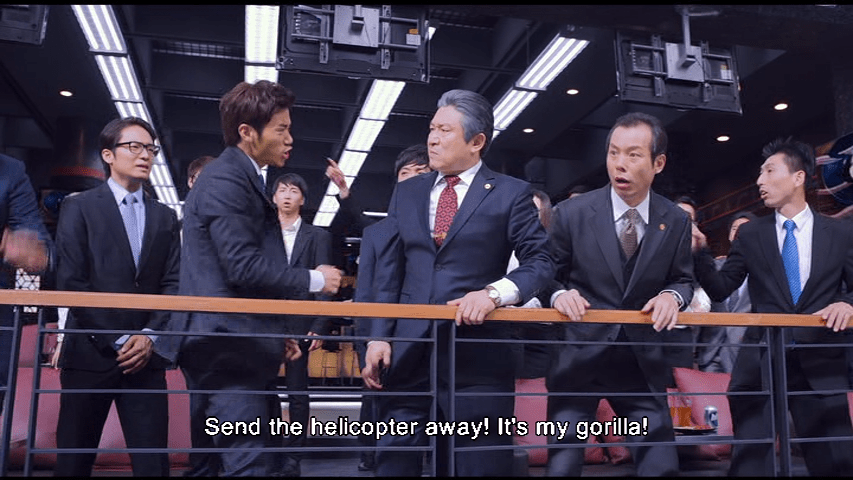
While clearly meant to be a realistic world that has our baseball’s rules and our laws of physics, the amount of absurd, cartoonish or unrealistic elements in the work make it more strange than realistic. Consider Mr. Go, for example, which has two baseball-playing gorillas, a little girl acting as a first-base coach and a finale that involves the baseball coming undone into a million pieces, which sort of overwhelms what would probably otherwise be a 6 if, say, it only had one gorilla.

5: Equal Mix of Realism and Fantasy

A work that sort of teeters between being realistic and being bizarre. This is more of a transitional spot on the scale, as it’s rare that anything ever stays at 5, inevitably going to 4 or 6 instead.

6: Realistic, but with one or two “big lies”

This is mostly realistic but it has one or two big elements (or the equivalent of one or two big elements made up of lots of smaller elements) that keep it from being something that you can honestly expect to ever happen in the real world. Sidd Finch could fit here, as could most of the movies in which a kid becomes a big league skipper or ballplayer.

7: Realistic, but highly unlikely

There’s nothing in this work that couldn’t happen, but it’s highly unlikely and any real event like this would probably instantly become one of the most notable things in baseball history. You could argue that Major League fits here, sort of.

8: Near total-realism

While some rules might be bent or not enforced on a strict basis, and some things might happen that are unlikely (although not nearly as unlikely as things that fall at seven on the scale), this is pretty realistic. Casey At The Bat, the classic poem, could be considered as this, with only the ability of everybody to seemingly hear everything keeping it from being a nine.

9: Utter realism

The only things that are not realistic in works of this category are omnipresent techniques like camerawork and editing for time, or stylish touches added in to indicate, say, that a player is angry. Bull Durham could, in theory, fit in this category, as could most (but not all) fairly true-to-history biopics and most realistic baseball video games.

10: Actual Baseball Footage used/Documentary

If you are watching an actual baseball game, or watching a documentary that uses baseball footage and does so without changing things for dramatic effect, you are watching a 10.


Feel free to consider where on the sliding scale your favorite piece of baseball fiction would fall!

6 PM: First References

This post has been part of the 2016 Baseball Continuum Blogathon For Charity, benefiting the Roswell Park Alliance Foundation. The Roswell Park Alliance Foundation is the charitable arm of Roswell Park Cancer Institute and funds raised will be “put to immediate use to increase the pace from research trials into improved clinical care, to ensure state-of-the-art facilities, and to help improve the quality of life for patients and their families.” Please donate through the Blogathon’s GoFundMe page.


(Blogathon ’16) Mr. Go, if adapted for American audiences

This post is part of the 2016 Baseball Continuum Blogathon For Charity, benefiting the Roswell Park Alliance Foundation. The Roswell Park Alliance Foundation is the charitable arm of Roswell Park Cancer Institute and funds raised will be “put to immediate use to increase the pace from research trials into improved clinical care, to ensure state-of-the-art facilities, and to help improve the quality of life for patients and their families.” Please donate through the Blogathon’s GoFundMe page.

Mr. Go. The classic tale of a girl, a gorilla, and the Korean Baseball Organization. Truly, one of the greatest Bizarre Baseball Culture entries of all time, and one you should totally consider purchasing if you are a fan of such things. But what if it was brought to American screens? How would it be adapted?

I have a few ideas:

The cute little Chinese girl, Weiwei, would stay, as would the backstory of her and her gorilla, Ling Ling. Similarly, the main antagonist of the film would be Liao Xiaogang, AKA “Tianjin Guy”, a corrupt nouveau-rich businessman/gangster.

This is a purely economic move. China is now one of the leading movie-going countries in the world, and the only way a baseball movie is going to get any attention there is if it has a Chinese person in it. Also, so much of what drives the plot is the fact that Weiwei is an outsider just trying to keep her friends and circus at home from being folded up.

The jerk-with-a-heart-of-gold scout, Sung Choong-Su, would instead be an American named Samuel “Sunny” Chance, played by James Franco.

For one thing, James Franco has experience with apes, and also he is able to do both comedy and drama, which this film would require. Also, I think civilization in general needs to see James Franco make drunken confessions to a baseball-playing gorilla who is also drunk.

Instead of going to the Doosan Bears, Ling Ling/Mr. Go would be a member of the San Diego Padres.

Don’t try to argue with me on this, you aren’t going to win.

The general manager of the Padres will have an expanded role and be played by John Goodman.

Because, really, imagine John Goodman delivering this line:

Jonah Hill would make a cameo as a sabermetrics expert who suggests how they can best use Mr. Go.

Both because he’s always in movies with James Franco, and as a reference to Moneyball.

There would be a subplot about how some people think Mr. Go isn’t playing the game the right way after he unleashes an epic bat-flip.

It’d provide realism to the affair.

After Mr. Go’s rampage, Weiwei and him would go on Jimmy Kimmel to prove he isn’t a monster.

Of course they would.

Instead of a bidding war between the Chunichi Dragons and Yomiuri Giants, it would be the Red Sox and Yankees.

Because of course it would be.

The veterinarian’s role would be expanded and made into a female love interest for Franco’s character, probably played by somebody quirky like Zooey Deschanel or wittily sarcastic like Anna Kendrick.

Because every goddamn movie, it seems, needs a love interest of some sort, and it sure as heck isn’t going to be Weiwei and Franco.

The NC Dinos, the main opponent of Doosan, would be replaced by the Dodgers. Also, the Division Series at the end of Mr. Go would be replaced with a final regular season series where the NL West title is on the line.

This both would better explain why every game is a home game for Mr. Go (in the Korean movie, they come up with an excuse about renovations at NC’s stadium) while still providing plenty of drama.

Leiting, the evil pitching gorilla who faces Mr. Go, will be renamed “Lightning” instead of “Zeros”.

Because Zeros was a dumb name.

The ending would be left more open to the “Football-playing Gorilla” sequel than the original movie was.

Every movie needs to have a opening for a sequel.

And, finally, it goes without saying that Andy Serkis would be playing Mr. Go.

Duh.

At 4 PM: AAA.

This post has been part of the 2016 Baseball Continuum Blogathon For Charity, benefiting the Roswell Park Alliance Foundation. The Roswell Park Alliance Foundation is the charitable arm of Roswell Park Cancer Institute and funds raised will be “put to immediate use to increase the pace from research trials into improved clinical care, to ensure state-of-the-art facilities, and to help improve the quality of life for patients and their families.” Please donate through the Blogathon’s GoFundMe page.


(Blogathon ’16!) Renaming Moved Teams

This post is part of the 2016 Baseball Continuum Blogathon For Charity, benefiting the Roswell Park Alliance Foundation. The Roswell Park Alliance Foundation is the charitable arm of Roswell Park Cancer Institute and funds raised will be “put to immediate use to increase the pace from research trials into improved clinical care, to ensure state-of-the-art facilities, and to help improve the quality of life for patients and their families.” Please donate through the Blogathon’s GoFundMe page.

There are four teams in MLB who have kept their names despite moving to different cities (or at least parts of a town where it’s enough where they change the first words of the team): The Angels, the Dodgers, the Athletics, and the Giants. What, however, if they had had to change their names? And, no, I’m not letting them just take their old Pacific Coast League team-names.

Let’s go place by place:

Los Angeles Angels of Anaheim, Orange County, California, USA, North America, Northwestern Quadrant, Planet Earth, Sol System, Milky Way, Local Group, The Universe

There was a very good reason why the Angels were originally called the Angels when they started playing: they were actually in Los Angeles, playing at Chavez Ravine. In addition, the LA Angels had been one of the flagship franchises of the Pacific Coast League, so the name had history. But as they moved to Anaheim and went by “California Angels” and then “Anaheim Angels” and now “Los Angeles Angels of Anaheim”, they have become more and more detached from the name. So what if they had abandoned the “Angels” moniker as soon as they left Chavez Ravine? Assuming that they had adopted California as their “first name” after leaving the ravine, perhaps they would be California related, perhaps the “California Bears” or the “California Trout” (ha). Or maybe they’d be more Anaheim-focused, with a name like “Oranges”. Personally, I think they would have to go with “Anaheim Mice”. In addition to the obvious Disneyland connection, there is the fact that mice are said to scare elephants, which would be a nice little poke at the Athletics. Well… it would be if…

The Oakland Athletics

Kept their Elephant logo despite changing to a new name. I think it’d be cool if they still had an old-timey sort of name. How about the “Oakland Eurekas”, after the California State Motto? (For the curious, the Pacific Coast League Oakland team was called the Oaks.)

Los Angeles Dodgers

If the Dodger brand hadn’t been so firmly established in Brooklyn, it feels likely they would have been renamed when they headed west. After all, “Dodgers” has basically nothing to do with Los Angeles. But what would they have been called? I personally think that they would take advantage of Hollywood and go with the name “Los Angeles Stars”. Oh, yeah, that was the name of Hollywood’s PCL team, but, guess what, it wasn’t LA’s, so it counts. So, “Los Angeles Stars” it is.

San Francisco Giants

The San Francisco Prospectors, or “Pros”. That was easy.

At 3 PM: MR. GO!

This post has been part of the 2016 Baseball Continuum Blogathon For Charity, benefiting the Roswell Park Alliance Foundation. The Roswell Park Alliance Foundation is the charitable arm of Roswell Park Cancer Institute and funds raised will be “put to immediate use to increase the pace from research trials into improved clinical care, to ensure state-of-the-art facilities, and to help improve the quality of life for patients and their families.” Please donate through the Blogathon’s GoFundMe page.


(Blogathon ’16) 2017 WBC Team Dominican Republic projections Version 0.1

This post is part of the 2016 Baseball Continuum Blogathon For Charity, benefiting the Roswell Park Alliance Foundation. The Roswell Park Alliance Foundation is the charitable arm of Roswell Park Cancer Institute and funds raised will be “put to immediate use to increase the pace from research trials into improved clinical care, to ensure state-of-the-art facilities, and to help improve the quality of life for patients and their families.” Please donate through the Blogathon’s GoFundMe page.

We are over a year from the 2017 World Baseball Classic, and the road will no doubt be filled with commitments, pull-outs, unusual nationality switches, injuries, trades, new contracts, personal decisions and god-knows-what-else still on the way. But, for now, let’s just imagine everybody is available: who’d be on Team Dominican in the 2017 World Baseball Classic?

Perhaps it would look something like this. Now, a reminder of the WBC roster rules:

  • Any player coming off a major injury or who has a history of injuries is unlikely to participate. This is especially true for the pitchers. (This “rule” is being ignored for version 0.1)
  • Players that will be on new teams are less likely to participate, but shouldn’t be completely ignored, with the exception of pitchers. (This “rule” is being ignored for version 0.1)
  • Teams are made up of 28 players, of which 13 of them must be pitchers and two of them catchers.
  • The pitch count rules make relievers extremely important.

Here we go:

Catchers (3): Wellington Castillo, Francisco Pena, Pedro Severino

First Baseman (3): Albert Pujols, Carlos Santana, Edwin Encarnacion

One of them would presumably also DH, obviously.

Second Baseman (1): Robinson Cano

Third Baseman (2): Adrian Beltre, Maikel Franco

Oh, Adrian Beltre will be in his late 30s in 2017, you say? That is true, but I wouldn’t bet against him.

Shortstop (2): Erick Aybar, Jhonny Peralta

Designated Hitter/3B/Who-The-Heck-Knows (1): Miguel Sano

Outfielders (4): Jose Bautista, Nelson Cruz, Carlos Gomez, Starling Marte

Starting Pitchers (4): Johnny Cueto, Carlos Martinez, Danny Salazar, Francisco Liriano

Relief Pitchers (8): Jeurys Familia, Kelvin Herrera, Arodys Vizcaino, Pedro Strop, Santiago Casilla, Luis Garcia, Antonio Bastardo, Alexi Ogando

And so, that’s Version 0.1 of my TeamDR projections. Version 1.0, which will include actual consideration as to whether I think somebody will actually take part or not, will come out sometime in the future. But until then…. feel free to imagine how the team would do if it looked like this.

At Noon: Mini-Book Reviews!

This post has been part of the 2016 Baseball Continuum Blogathon For Charity, benefiting the Roswell Park Alliance Foundation. The Roswell Park Alliance Foundation is the charitable arm of Roswell Park Cancer Institute and funds raised will be “put to immediate use to increase the pace from research trials into improved clinical care, to ensure state-of-the-art facilities, and to help improve the quality of life for patients and their families.” Please donate through the Blogathon’s GoFundMe page.