Random Video of the Undetermined Amount of Time: The Start of the 1983 World Series

On Youtube, you can find almost anything. For example, the start of the 1983 World Series between the Orioles and Phillies, Live (back then) from Memorial Stadium. ABC had the game, and had Al Michaels, Howard Cosell and Earl Weaver in the booth. It’s a little cut up (we only catch the end of a interview with a young Cal Ripken, and they don’t have the National Anthem), but it still is neat.

It’s interesting to me to see how this is different from how the World Series is broadcast these days, partially due to technology, as well as just some general differences and observations:

  • The graphics are extremely low tech, popping up very quickly in yellow and white to tell us that we are looking at “Claude Osteen, Pitching Coach”. Oh, but the managers? Their names flash in a strobe of technicolors, which no doubt gave some people seizures back in the day.
  • And we see the entire teams getting announced before pre-game, like it was the All-Star Game. I vaguely remember that this was done at least earlier in my lifetime, but I can’t remember FOX ever doing it.
  • All of the guys in the booth have bright gold-yellow jackets, as back then apparently network announcers had to have coordinated uniforms, much like the people on the field.
  • Oh, and one of the biggest differences between now and then: Nowadays, that players wouldn’t so clearly and openly be using chewing tobacco (check their cheeks). Oh, they are still using it, but not as many.
  • Orioles fans remembered Kiko Garcia.
  • I like how the Phillies brought the Phanatic along on the road. I don’t seem to recall them doing that during their more recent World Series appearances.
  • Joe Morgan, Pete Rose and Mike Schmidt were the first three in the starting lineup for the Phillies. They’d also make a good first three guy in the lineup for a 1970s National League All-Star Team. Sadly for the Phillies, it was 1983 and the two members of the Big Red Machine were on the downside of their careers. Also, apologies to Sixto Lezcano, but I honestly have to say I had to look that name up on Baseball Reference.
  • Trivia factoid: Jim Palmer is the only man to win a World Series game in three different decades.
  • Ballplayers in the 1980s had way more awesome hair. Behold the impressive Afro of Eddie Murray when he tips his hat to the crowd.
  • Notice how Scott McGregor is said to be in the “ninth position” of the lineup. This is because, from 1976 to 1985, the DH was in effect FOR ALL GAMES REGARDLESS OF VENUE in even years for the World Series, but not odd years. And that, in my opinion, is a weird and often forgotten fact.
Baseball’s children

In a bid to combine their powers and increase the chances of returning to the Olympics, baseball and softball’s international federations (the equivalent to soccer’s FIFA or basketball’s FIBA) recently decided to merge. How well this will or won’t work, as well as what effect this might have on things like women’s baseball or men’s softball, remains to be seen. However, it does give a good excuse to look at some of the “children” born from baseball. See after the jump.

Continue reading

The 1942 Service All-Star Team

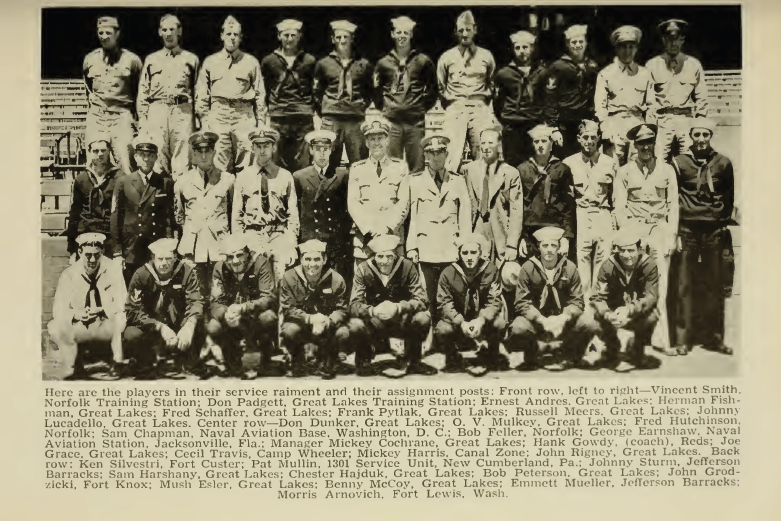
In 1942, the AL All-Stars played a team of players who had entered military service but who had yet to go to the Atlantic or Pacific Theatres. There is information on that game in the 1943 Baseball Guide by the Sporting News (available on archive.org), as well as this picture of the team (you can click the photo to see it bigger, so that the names are more visible):

Among the players you can find in this photo are Bob Feller, Mickey Cochrane (who managed), Hank Gowdy (who was a coach) and a variety of other major leaguers such as Cecil Travis, George Earnshaw, Mickey Harris, Sam Chapman, Pat Mullin, Benny McCoy, and others.

In the 1940s, you could actively stalk baseball players

Before the internet, or even The Baseball Encyclopedia, stats for previous seasons often were in the form of baseball guides, often from The Sporting News.

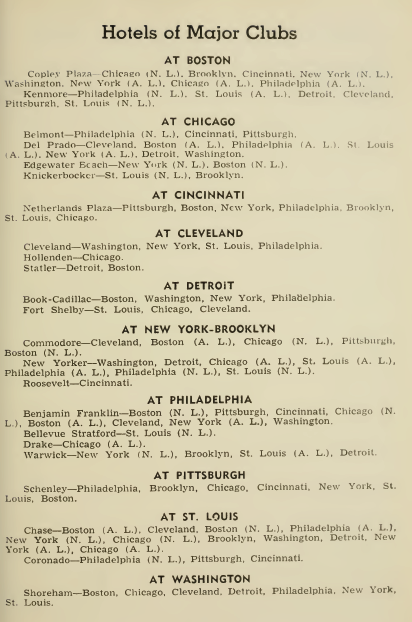
Also in there, however, were more strange things. Some of them, for example, had a listing of where the visiting teams stayed. Now, even today you can often figure out where visiting teams stay in town due to ads that might say “Official Hotel of the Boston Red Sox” or something similar, to the point where most baseball players have aliases that they check in with that don’t reveal their fame (although Rickey Henderson, ever the master of disguise, went by the alias of “Richard Pryor”)

Anyway, if you are caught in a time warp and find yourself in the early 40s and want to visit some players, you can find them here, from the 1943 edition of the Baseball Guide and Record Book (found for free on archive.org):

The 33rd Anniversary of Disco Demolition Night

It was July, 1979. Jimmy Carter was president, ESPN was still a few months away from it’s first broadcast and Laverne & Shirley was the most watched show on television. Against this backdrop, a DJ named Steve Dahl and fellow Chicagoland personality Garry Meier convinced Mike Veeck and his father Bill Veeck, owner of the Chicago White Sox, to hold an anti-Disco rally between games of a doubleheader.

After the Tigers beat the White Sox 3-1 in the first game… madness ensued, as can be seen in this compilation of news footage from Chicago that fateful night, 33 years ago. Keep an eye open for a young Greg Gumbel.

The second game, of course, ended up being cancelled, forfeited to the Tigers. It would be the last forfeit in American League history to this day and the second-to-last forfeit in MLB history (there was “ball day” on August 10, 1995 in Los Angeles).

Interestingly, despite claims that Disco Demolition Night ended disco forever, later that year the Pittsburgh Pirates won the World Series while playing Sister Sledge’s “We Are Family” as their theme song.

The Pittsburgh Pirates, it should be noted, have not been back to the World Series since.

Was that the worst (non-tie) ASG of all time?

So, the All-Star Game last night was a disappointment. It was a 8-0 drubbing of the AL, led by the NL’s Ryan Braun and the Giants contingent. It had it’s moments: the KC fans giving Chipper Jones a big round of applause, giving Billy Butler the largest applause he ever has and probably ever will be given, Trout and Harper making their debuts, the first bases-loaded triple in All-Star history. But in general, it was something of a bore, one of the least entertaining All-Star Games in memory.

But was it the worst All-Star Game? Well, no, at least it had a clear winner, and it wasn’t cut short by rain.  But what about of the non-ties? Well, looking at other blow-outs…

(jump)

Continue reading

July 4th: The Luckiest Man

It was July 4th, 1939. Lou Gehrig was a dying man. Earlier that year, he’d ended his 2,130 consecutive game streak, taking himself out before a game in Detroit for the good of the team (he was hitting .143 with an RBI). A visit to the Mayo Clinic in June confirmed the worst: he had Amyotrophic Lateral Sclerosis, the disease that now carries his name. Although his mind would remain intact, his body would slowly betray him. Although his wife had told the doctors to try and withhold some of the more horrible details of the diagnosis from him, there is evidence to suggest that Lou knew, somehow, that he was on his way out. He announced his retirement from the game he loved.

So it was on Independence Day that the Yankees held a day in his honor. They retired his number 4- the first in baseball to be so honored. Some of his most famous teammates, including Babe Ruth, joined delegates from across the country in Yankee Stadium.

Everybody knows how the speech began, and many know how it ends, as can be seen below:

However, that was because, as amazing as it sounds, no media outlets had recorded the whole thing. That is partly why Gary Cooper’s speech in Pride of the Yankees is occasionally played instead, although it moved the beginning of the speech to the end for artistic reasons and was more of a paraphrase of the actual words Gehrig gave on that day.

Since Gehrig’s death in 1941, he has remained an inspiration and a rallying-cry in the fight against ALS and similar diseases. What had been before Gehrig a little understood disease is now studied across the world.

Progress has been made. A few years back, a report came out that suggested that people who have a history of concussions may be more likely to develop an ALS-style disease (Gehrig, it should be noted, took plenty of beanballs during his career, and also had played football at Columbia), and there is also some evidence that genetics and mutations may also play a role. Despite this, however, there remains no cure.

Great Predictions in History: Umpires work both leagues

It seems surprising now, but until relatively recently the AL and NL had different sets of umpires, often trained by different people and using different equipment. It wasn’t until 2000 that the two leagues unified the umpiring crews.

That said, it’s not like people hadn’t thought about it before. Just look at this headline from a 1949 issue of Baseball Digest:

Great predictions in History: Interleague Play… in 1955

From Baseball Digest in January 1954:

Interleague in 1955? Well, apparently it was considered. Nate Dolin, the Cleveland Indians director of operations and AL schedule representative, wanted it to happen. He even got Walter O’Malley to agree with him. He proposed that the season would look like this:

  • 158 game schedule (instead of 154)
  • The 22 games-between-each-team-in-their-league balanced schedule would be cut to 18 games between each team in their league.
  • Each club would have two two-game series with each team of the opposing league.

Of course, it never happened. But it’s interesting to note that, starting next year, interleague won’t only just exist but will be expanded: there will be at least one interleague game every day, since both leagues will have 15 teams.

But it could have happened… even earlier!

Back Then: Red Sox Fans

The Library of Congress has lots of pictures from the earlier part of the 20th century available for free online. Take this picture of Red Sox “Royal Rooters” during the 1910s:

(Click the picture for a bigger view)

As you can see, everybody has a hat on, they are all white men, they are waving pennants, wearing suits, and generally looking old-timey. Although there is one guy on the right who seems to be making a finger-pistol at us.

I wonder what would happen if a group dressed like this showed up at Fenway today…