Baseball and Softball will probably be at the 2020 Olympics

Guess what, folks? If a proposal passes next month, baseball and softball will be back in the Olympics, at least occasionally. The proposal, called Agenda 2020, is meant to try and solve some of the big problems facing the IOC, such as the fact that the increasing cost of hosting has made many global cities scared of hosting. For example, the 2022 Winter Games have had all but two candidates more-or-less drop out of the running because of local backlash. And the two candidates that are left are Almaty, Kazakhstan and Beijing, who don’t have to care about public opinion and which are hardly the dropped-out winter wonderlands of Oslo or Stockholm that basically everybody outside of Kazakh and Chinese politicians would prefer.

The agenda includes, for example, allowing joint bids or at least allowing for certain events to be held elsewhere, perhaps even in other countries. But the big thing for baseball and softball in this is this part of the proposal, according to Reuters:

Sports will also not wait seven years from approval to their Olympic first appearance, and instead could be brought in for just one Olympics to maximize the Games’ reach and attraction.


In essence, it would allow sports to be added to the Olympics on a temporary basis if it would allow the Olympics to be more desirable in the host country. Now, presumably the sports added on temporary basis still would have to be pretty popular internationally (don’t go expecting to see NFL players marching in the opening ceremonies the next time the Olympics come to the USA, for example), but baseball and softball definitely fit the bill, and the Tokyo 2020 Olympic Committee has been heavily calling for them in 2020. So… expect baseball in the 2020 Olympics, and probably anytime in the future where the Olympics are in America, Japan, Korea, etc.


Looking at the Team MLB roster for the Japan All-Star Series

Above, you can see the roster for the Japan All-Star Series for Team MLB. As you can see, the term “All-Star” is sort of loose. Oh, yes, it’s a good team, and there are plenty of All-Stars on it. It’s definitely a team you’d be able to make the post-season with in a 162 game schedule. But on the other hand, the pitching staff isn’t exactly world-beating and the outfield is thin due to the pull-outs of Bryce Harper and Adam Jones, meaning a utility player like Ben Zobrist or Chris Carter will be playing a bit there. Another worry is that Evan Longoria might have to leave early because his fiancee is very pregnant, and, honestly, I’m surprised he’s going in the first place with something like that going on.

Anyway, here’s a bit of a run-down on the MLB roster… after the jump:

Continue reading

Will the MLB-Japan All-Star Series be on MLB Network? Yes! And I have a schedule

Good news everyone! It appears that, in the darkness of November, we will be seeing some MLB baseball after all. MLB is sending a team of players over to Japan to play some games against the Japanese National Team, “Samurai Japan” (in essence a NPB all-star team), and, guess what? We’ll be able to see it on television here in the states! Now, they haven’t released any sort of news release yet, but I did some of my own research, in that I looked at MLB Network’s website and looked at their schedule.

MLB’s team is going to be good, at least at the plate, with players like Robinson Cano, Adam Jones, Bryce Harper, Yasiel Puig, Jose Altuve and Justin Morneau having confirmed they are going (Albert Pujols was going to go too, but pulled out). Hisashi Iwakuma is the most notable pitcher going that we know of so far, and it should be fun seeing him pitch in front of (and against) his fellow countrymen.

As far as the Japanese team, it’s going to be very interesting to see how they do, as this will provide a WBC-esque look at Japanese players against MLB competition. Names to keep a close eye on include Kenta Maeda (a pitcher who might be be headed to MLB next year), Shohei Otani (who can both pitch AND play as a position player, and who considered heading to the USA out of high school but later changed his mind and stayed in Japan), Pacific League batting champ Yoshio Itoi, and 2014 Japanese hit champ Tetsuo Yamada.

Here’s the schedule in East Coast time, all games below will be on MLB Network and many of them will be shown again on tape delay at a more reasonable hour for Americans:

November 11, 4 AM: MLB vs. combined team of Hanshin Tigers and Yomiuri Giants (at Koshien Stadium in Nishinomiya, not far from Osaka)

November 12, 4 AM: MLB vs. Samurai Japan (at the Kyocera Dome in Osaka)

November 14, 4 AM: MLB vs. Samurai Japan (at the Tokyo Dome)

November 15, 4 AM: MLB vs. Samurai Japan (at the Tokyo Dome)

November 16, 4 AM: MLB vs. Samurai Japan (at the Tokyo Dome)

November 18, 5 AM: MLB vs. Samurai Japan (at the Sapporo Dome)

November 20, 4 AM: MLB vs. Samurai Japan (in Okinawa)

I’m particularly looking forward to the game at Koshien, as it’s the most historic of all Japanese ballparks and I think it’ll be neat to see MLB players play on the all-dirt infield there.

So, rest well knowing that we aren’t too far away from some more baseball.

Continuum Baseball Rankings Update (Oct. 20, 2014): Asian Games moves some stuff around, but nothing drastic

The Asian Games occurred late last month. Seven of the eight teams had a talent-level good enough to have it count for them in the Continuum Rankings (Korea, for example, sent KBO players, while Taipei sent players from the Affiliated Minors. The one team that didn’t qualify for Continuum Rankings was Japan, which sent amateurs and semi-pros, which isn’t enough to count). Korea won.

Now, despite all of this, there wasn’t too much movement. While Taipei lost a small amount of points and Korea gained over 19 points, those weren’t enough to cause any changes in the top 10. Instead, there were minor changes down the board, with China and Germany flip-flopping, South Africa and Hong Kong doing the same, and Finland and Mongolia switching places down near the bottom.

Anyway, look below the jump for the full rankings.


Continue reading

Plenty of Movement in Sept. 24’s post-European Championship Continuum Baseball Rankings

The European Baseball Championships are over, and were won by the Netherlands. So it’s time for a new round of the Continuum Baseball Rankings! Go to that link for an explanation about them.

This takes into account both the overall results of the tournament as well as head-to-head matchups during it.

Anyway, there was plenty of movement in the rankings because of the tournament. The Dutch, for example, are once again in fifth place, overtaking Taiwan/Taipei. The biggest jump was made by the Belgians, however, who as I predicted earlier have begun to move up the ladder, jumping from 55 to 50. The biggest drop came for Great Britain, which went from 24th to 27th as a result of their play at the European Championships.

It won’t be too long before yet another update of the Rankings, as the Asian Games baseball competition is going on right now- although it should be noted that that will only take into account results for teams that sent professional players or their closest national equivalent.


Go below the jump to see the rankings:

Continue reading

Some stuff at the bottom in the August 2, 2014 Continuum Baseball Rankings

It’s been awhile, but it’s time to update the Continuum Baseball Rankings! The C-Levels of the European Championships took place recently, and since it included previously-included Continuum Rankings teams like Israel, Ireland and Slovenia and involved senior teams (i.e. the best players they could round up given circumstances), it counts in the Rankings! Of course, the best players that these teams could get aren’t necessarily that great (the best rosters in this tournament would probably be beaten by fairly good D3 college teams)- Israel didn’t have Minor League ringers this time around like in the WBC Qualifiers, for example. But still, it counts, and Israel won it.

So, the movements in this installment (all at the bottom of the rankings, more or less):

  • Slovenia and Ireland swapped places, with Slovenia (which finished 2nd in the tournament) taking 47th while Ireland (4th) fell to 48.
  • Romania entered the rankings at 49, pushing Mongolia (inactive) back to 50.
  • Finland, Latvia, Hungary and Norway made their Rankings debut, being 51, 52, 53, and 54, respectively. Norway is now the lowest-rated team in the Rankings, and would, if they were to face a Senior USA team (which could mean anything from Indy Leaguers all the way up to MLB-filled WBC teams), lose over 99.39% of the time.


Lastly, a note about methodology: To make updates a bit more active, I am considering making it so that the Rankings cover everything 18 and over. This would bring in results by college teams and the like. Such a change won’t be made until 2015, but it’s something to note.


Anyway, current rankings are after the jump:

Continue reading

Future Possibilities for International Games

At the start of the season, regular season games were held in Sydney, Australia.* Whether you like it or not, it was not the first and won’t be the last time that MLB opened overseas. But, where will MLB go next? Here’s an overview of possibilities:


* This was partly written immediately following those games, but fell by the wayside until now, so here it is.

A Return to the Tokyo Dome

Used under Creative Commons license (http://creativecommons.org/licenses/by-sa/3.0/deed.en), taken by “DX Broadrec”.

Location: Tokyo, Japan

Baseball Pedigree: Has hosted baseball since it opened in 1988, home of the Yomiuri Giants, hosted WBC games in 2006, 2009 and 2013, hosted MLB season-opener games in 2000, 2004, 2008 and 2012. Japan is one of the preeminent baseball nations on Earth and host to the world’s 2nd most prominent baseball league.

Capacity: Between 42,000 and 55,000 (depending on configuration)

Pros: Japan is baseball-mad, has shown it can pack the stadium for MLB games, and the Tokyo Dome is highly-familiar to MLB officials and some players thanks to it’s many previous MLB-related events. Being a dome makes weather considerations non-existent, and Tokyo’s status as one of the world’s greatest cities allows for plenty for players to do when not playing.

Cons: It’s been done before several times, it’s a type of stadium that has been phased out of MLB, and, while this isn’t much of a factor that MLB cares about much, there is the time difference issue, with night games in Tokyo being early morning games in the Eastern USA and very, very, very early morning games in the western part of the USA.

Likelihood of return: It’s inevitable that MLB will return to Japan again sometime in the future, the question is whether the Tokyo Dome is the place it will happen. More-than-likely yes, but I’ll be looking at other possible Japanese sites later on.

(HIT THE JUMP FOR THE REST OF THIS ARTICLE)

Continue reading

So, where exactly was this picture taken? AKA: Where the heck would they play baseball in Dubai?

You may have seen this picture online a few days ago (click to enlarge):

As you can see, it’s a baseball game being played outside of Dubai, with the world’s tallest building, the Burj Khalifa (formerly known as the Burj Dubai) rising in the distance.

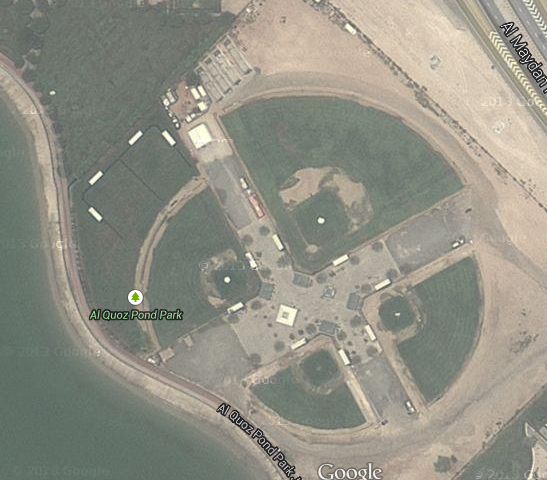
Of course, the United Arab Emirates isn’t exactly a baseball hot bed. So I was wondering where this picture was taken. So I did some research… and found it!

Screen Shot 2014-04-24 at 1.26.41 PMAt Al Quoz Pond Park south of Dubai’s downtown is the site of the Dubai Little League. To be more specific, the picture of the game with the Burj in the distance was taken at the large, adult-sized north field. As you can see below, this Little League facility is definitely close enough and in the right direction relative to Dubai’s downtown where the view in the top picture is what batters would see:

Screen Shot 2014-04-24 at 1.31.21 PMSo, there you have it: Not only are there baseball fields in Dubai, but at least one of them has a killer view.

Great Stuff from the B-Ref Japanese Data

With Baseball Reference adding Japanese stats, it’s time to look at some of the coolest stuff from it.

First off, of course, there is arguably the greatest Japanese player ever and one of the greatest hitters on any continent: Sadaharu Oh. You probably know about his 868 HRs, but you probably didn’t know about his impressive 2786 hits. Going on a tangent here, I remember reading somewhere that, after statistical conversions between the leagues, it’s thought that Oh would have had a career in MLB similar to Mel Ott.

Much like how Babe Ruth had Lou Gehrig behind him, Oh had Shigeo Nagashima, who formed the N in what was called the Yomiuri Giants’ “O-N Cannon”. Together, they helped the “Yankees of Japan” win nine straight titles.

However, had you looked hard enough, you probably could have found their statistics elsewhere, and the same probably goes for Americans and other westerners who spent time in Japan since the 1970s, like Charlie Manuel and Randy Bass and recent Japanese imports like Yu Darvish. What makes the Baseball Reference data awesome is that it goes beyond that to Japanese baseball’s earliest professional seasons.

For example, I can’t ever remember seeing the stats of Wally Yonamine, the first American to play in Japan post-WWII. Nor do I ever remember seeing statistics for Eiji Sawamura, the ace pitcher (Japan’s Cy Young Award equivalent is named for him) who once struck out Charlie Gehringer, Babe Ruth, Lou Gehrig and Jimmie Foxx in succession during one of Ruth’s famous tours of Japan, but whose career ended premature when he died during WWII.

As a third example of a early-years Japanese player who has interesting stats to look at: Victor Starfin (sometimes spelled Starffin). The first pitcher to win 300 games in Japan, Starfin was able to (mostly) avoid WWII’s effects on Japanese baseball. Well, until he was released in 1944 due to “security concerns” and thrown into a detention camp for being a foreign national. That, by the way, is like the fourth most interesting thing in his SABR biography. Seriously, it starts with his family fleeing the Russian Revolution and ends with him tragically dying in a drunk-driving accident in January, 1957- not long after his final season (1955).

Those just scratch the surface of the treasures in Baseball Reference’s new Japanese pages… go check them out.

Link

This is going to be good.

(The above link is to Japanese statistics just added to Baseball Reference.)