Your Offseason Baseball Viewing Listings for November 2, 2013

On internet and TV, here’s some games to keep the fire burning… all times are Eastern (note that they might bet screwed up by the daylight savings switch):

1:30 AM– JWBL “Japan Cup” Dione (JWBL) vs. Shobi University (College Team), will be streamed here.

Various Australian League Baseball Games, which can be accessed here. There are several doubleheaders and are on at various times from 1 AM all the way to 7:20 AM.

8 PM–  Arizona Fall League All-Star Game on MLB Network.

8 PM- JWBL “Japan Cup” Saitama Sakae (High School Team) vs. “The Lady Hornets”, will be streamed here.

10 PM– JWBL “Japan Cup” Participants TBD, will be streamed here.


(In addition, the Boston victory parade will be tomorrow starting at 9 and will no doubt receive coverage on MLB Network and ESPN)

Your Offseason Baseball Viewing Listings for November 1, 2013

With games in Korea, Australia and Women’s Games from Japan, it’s a fun and eclectic mix of baseball for anybody looking for a fix of baseball as the North American off-season begins… or, in some cases, simply suffering from insomnia.

Do you know of any legal (whether they be sponsored or endorsed by a league or run by the league itself) streams? Let me know!

(All times Eastern)

4 AM: Australian Baseball League, Melbourne Aces at Canberra Calvary, will be streamed here, and will have a radio broadcast here.

4:30 AM: Australian Baseball League, Adelaide Bite at Brisbane Bandits, will be streamed here.

5 AM: Korean Series Game 7. Doosan Bears (Yu-Hui Kwan) at Samsung Lions (Jang Won-Sam). Winner wins the series. Will be streamed here.

7:20 AM: Australian Baseball League, Sydney Blue Sox at Perth Heat. Will be streamed here.

9 PM: Japan Women’s Baseball League “Japan Cup”. Astraia (JWBL) vs. Heisei International University (College team). Will be streaming here.

11 PM: JWBL “Japan Cup” Flora (JWBL) vs. Asahi Trust (Corporate Club Team). Will be streaming here.

Wladimir Balentien ties Sadaharu Oh’s single-season record

Wladimir Balentien has tied Sadaharu Oh’s record for single-season HR in Japan with his 55th HR. Others have tied it in the past, but none have been able to break it, partly due to Japanese pitchers avoiding him in order to preserve Oh’s record from being broken by a Gaijin. That attitude may now be a thing of the past though, and even if it isn’t, Balentien still has 22 games left, and it seems doubtful that they’d be able to avoid him for all of it.

Great Stuff from the B-Ref Japanese Data

With Baseball Reference adding Japanese stats, it’s time to look at some of the coolest stuff from it.

First off, of course, there is arguably the greatest Japanese player ever and one of the greatest hitters on any continent: Sadaharu Oh. You probably know about his 868 HRs, but you probably didn’t know about his impressive 2786 hits. Going on a tangent here, I remember reading somewhere that, after statistical conversions between the leagues, it’s thought that Oh would have had a career in MLB similar to Mel Ott.

Much like how Babe Ruth had Lou Gehrig behind him, Oh had Shigeo Nagashima, who formed the N in what was called the Yomiuri Giants’ “O-N Cannon”. Together, they helped the “Yankees of Japan” win nine straight titles.

However, had you looked hard enough, you probably could have found their statistics elsewhere, and the same probably goes for Americans and other westerners who spent time in Japan since the 1970s, like Charlie Manuel and Randy Bass and recent Japanese imports like Yu Darvish. What makes the Baseball Reference data awesome is that it goes beyond that to Japanese baseball’s earliest professional seasons.

For example, I can’t ever remember seeing the stats of Wally Yonamine, the first American to play in Japan post-WWII. Nor do I ever remember seeing statistics for Eiji Sawamura, the ace pitcher (Japan’s Cy Young Award equivalent is named for him) who once struck out Charlie Gehringer, Babe Ruth, Lou Gehrig and Jimmie Foxx in succession during one of Ruth’s famous tours of Japan, but whose career ended premature when he died during WWII.

As a third example of a early-years Japanese player who has interesting stats to look at: Victor Starfin (sometimes spelled Starffin). The first pitcher to win 300 games in Japan, Starfin was able to (mostly) avoid WWII’s effects on Japanese baseball. Well, until he was released in 1944 due to “security concerns” and thrown into a detention camp for being a foreign national. That, by the way, is like the fourth most interesting thing in his SABR biography. Seriously, it starts with his family fleeing the Russian Revolution and ends with him tragically dying in a drunk-driving accident in January, 1957- not long after his final season (1955).

Those just scratch the surface of the treasures in Baseball Reference’s new Japanese pages… go check them out.

Link

This is going to be good.

(The above link is to Japanese statistics just added to Baseball Reference.)

Ichiro’s 4000 professional hits are impressive, regardless of the league some of them came in

Awhile back, Game 7 of the 1960 World Series was on MLB Network, having been found in an old wine cellar that had once belonged to Bing Crosby, who owned the Pirates at the time. And while, of course, it was one of the greatest games of all time in it’s own right, and had perhaps the greatest home run of all time in Bill Mazeroski‘s walk-off blast, what fascinated me was Roberto Clemente. I heard about how great Clemente was, I could see the old footage, but this was the first time I could see Clemente in a taped television broadcast since his death, as far as I knew.

And a weird thing happened: whenever he came up to the plate or a ball came towards him in the outfield, my eyes could not leave the television. Despite the fact the game had happened decades ago, despite the fact he only went one for four in the game… I could not take my eyes off the television. Because, well, I just knew there was a possibility he’d do something amazing (I hadn’t checked the box score before watching the broadcast, so I really only knew the broad strokes of the game).

To me, Ichiro Suzuki, the man who goes by only his first name, is the closest thing we have had in our lifetime to that sort of player. The player who’s talent is so great that you want to watch the TV not just when he’s at the plate, but when he’s about to make a fielding play as well, or on the basepaths. Oh, he’s left-handed (although naturally a righty, he bats lefty as a way of getting that slight head-start of running to first), and he’s Japanese and not Puerto Rican, but in most other ways the comparison fits: Ichiro, like Clemente, isn’t much of a power hitter (Ichiro averages about nine homers every 162 games while Clemente averaged about 16) but can definitely hit one when needed. Ichiro, like Clemente, has a cannon from the outfield that can stun even the fastest of runners. Ichiro, like Clemente, can make excellent catches in the outfield. And, finally, Ichiro, like Clemente, is a large case of “what if?”

For Clemente, it is a a tragic what-if of what may have happened had he not died that Christmas off the coast of Puerto Rico. For Ichiro, it is a bit more benign: what if he had played in Major League Baseball from the start?

As Ichiro got his 4000th combined hit yesterday, and in the run-up to it, some poo-poo’d him, saying that the 1,278 he had in Japan were meaningless, and that if we were to count them in any way we might as well count minor league statistics, or postseason statistics, or spring training statistics. This is ignorant of both the quality of the NPB (which, while not of MLB quality, is still better than even the best of AAA) and how dominant Ichiro was there (Jeff Passan notes that sabermetric wiz Clay Davenport found that Ichiro’s stats in Japan don’t translate downward that much when converted to MLB), as well as just how hard it is to get 4,000 hits in any league or combination of leagues.

In fact, as far as I can find, only seven players with good verifiable statistics have had 4,000 professional hits including every level: Pete Rose, Ty Cobb, Hank Aaron, Jigger Statz*, Minnie Minoso, Stan Musial and now Ichiro. Regardless of league, evel of competition or era, the fact that only seven players out of the thousands upon thousands of professional players in North America, Latin America, Asia, Australia and Europe have had 4,000 professional hits is proof of just how hard it is and how impressive it is that Ichiro has done so.

And, even if you want to totally ignore the Japanese hits, your forgetting the fact that with his hit yesterday, he passed Lou Gehrig (another player with a large “what-if”) on the all-time MLB hit list. And that, on it’s own, is impressive.

So, congratulations Ichiro.

*Statz got most of those in the minor leagues, where he was a constant presence for the Los Angeles Angels for years.
Continuum Global News (April 5, 2013)

Results and news from leagues around the world yesterday:

NPB (Japan) scores from April 5:

Hanshin Tigers 7, Hiroshima Carp 6 (in 12)

Tohoku Rakuten Golden Eagles 17, Chiba Lotte Marines 5

Yokohama Bay Stars 2, Tokyo Yakult Swallows 1

Orix Buffaloes 4, Seibu Lions 1

Fukuoka Softbank Hawks 6, Nippon Ham Fighters 1

Yomiuri Giants 7, Chunichi Dragons 2

KBO (Korea) scores from April 4 (via MyKBO):

Kia 12, Hanwha 4

Nexen 4, LG 3

Lotte 5, NC 1

SK 7, Doosan 5

Other bits of news:

Manny Ramirez mania is sweeping Taiwan, with attendance skyrocketing in games where he’s playing. The large amounts of interest, both because of Ramirez and Taiwan’s performance in the WBC, has led to speculation that the CPBL will be expanding.

Jeff Passan writes of the differences between America and Japanese views on pitch counts.

This is only tangentially related, but former big leaguer Luke Hughes has signed on to play with the Subiaco Lions of the Western Australian Football League, presumably bringing his baseball career to an end.

Continuum Global News (April 4, 2013)

The latest in International Baseball News:

In Japan’s “Spring Koshien”, Urawa Gakuin won the tournament. The “Spring Koshien”, unlike the “Summer Koshien”, is a invitational tournament and isn’t as prestigious, but is still shown on television and is a source of pride to the participants.

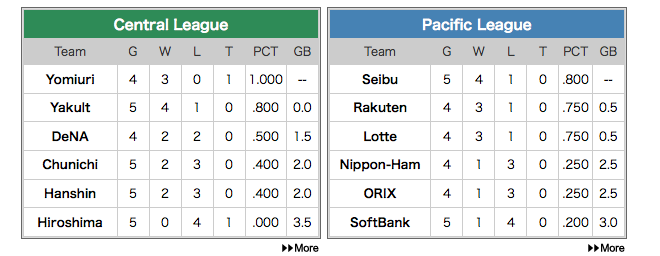
It’s still very early in the NPB season, but here’s how the standings there look right now:

Screen Shot 2013-04-04 at 12.29.02 PM

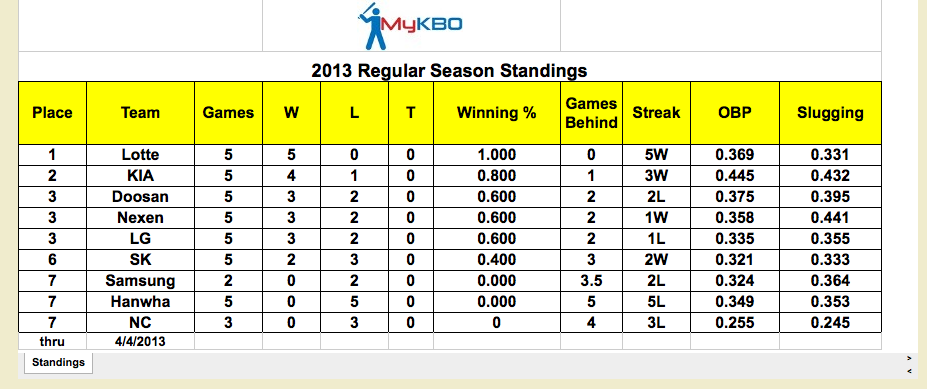
In Korea, the standings so far look like this (taken from MyKBO):

Screen Shot 2013-04-04 at 12.32.10 PM

I cannot find CPBL standings as of right now- if you know where I can find them, let me know.

Meanwhile, in Europe, Leon Boyd of the Dutch National Team (one of the very few “passport players” on the Kingdom of the Netherlands- his mother is Dutch) has signed with Correndon Kinheim.

And that will be it for today, but come back tomorrow for more Continuum Global News.

In the days and weeks ahead, this feature will be more fleshed-out and substantial, so please be patient as I work to make this one of the spots to go to for international baseball news.

WBC Semi-Final Preview: Japan vs. Puerto Rico

The game between Japan and Puerto Rico, on paper, should belong to the Japanese team, a seasoned squad that relatively breezed into the San Francisco round and which will be playing with far more rest than Puerto Rico, which will be playing it’s third game in as many days. But, as has been shown time and time again, in baseball weird and unexpected things can happen. Go below the jump for a more in-depth preview.

Continue reading

WBC Round 2 Preview: Pool 1 (Tokyo)

Well, Pool 1 of Round 2 of the World Baseball Classic is all set. Go below the jump for a preview of the pool, and also consider looking back at my predictions for Pool A and Pool B of the first round, which include a good amount of other information, such as the history and culture of the nations.

Continue reading