(Blogathon ’16) The Answer Key to Diane Firstman’s Crossword Puzzle

Yesterday, Diane Firstman kindly gave us all a crossword puzzle to try our hands at.

Well, it’s now been 24 hours, so here is the answer key:

Screen Shot 2016-01-31 at 12.48.46 AMSo, go and check to see how you did, then get ready because the Blogathon resumes in one hour! And don’t forget to donate!

(Blogathon ’16) Greg Gay: Victim of Circumstance

This guest-post is part of the 2016 Baseball Continuum Blogathon For Charity, benefiting the Roswell Park Alliance Foundation. The Roswell Park Alliance Foundation is the charitable arm of Roswell Park Cancer Institute and funds raised will be “put to immediate use to increase the pace from research trials into improved clinical care, to ensure state-of-the-art facilities, and to help improve the quality of life for patients and their families.” Please donate through the Blogathon’s GoFundMe page. Also, please note that the opinions and statements of the writer are not necessarily those of the Baseball Continuum or it’s webmaster.

Circumstances conspire to form our major league baseball alliances. Perhaps we live near a team and going to games forms an unbreakable bond with the franchise. Maybe our rooting interests were handed down, family member to family member, a continuous line of Cubs or Reds or Orioles fans.

My circumstance was my mother handing me a pack of baseball cards.

She had just returned from the grocery store. It was 1974 and it was the first time I had ever seen or even heard of baseball cards. It was a cello pack, which contained around 35 cards back in the mid-1970s. Don’t ask me how I remember this, but the first card I pulled from that pack featured someone on the brink of a career-threatening injury. They thought he’d never pitch again.

I didn’t know any of that as an 8-year-old. I just knew that I liked this Tommy John fellow, standing there on this piece of cardboard, with a glove held up in front of his chest, his mouth half-open as if he wanted to tell me something. Instantly, I pledged allegiance to the team featured on that card, the Los Angeles Dodgers.

The Dodgers were my team from that moment, even though I lived 3,000 miles from where they played their games. It was a tenuous relationship, which could have withered and died, if not for circumstance.

A few years later, during the first year that I actively watched baseball on TV — my interest in cards had blossomed into a full-fledged love for baseball — the Dodgers made the World Series. My Dodgers. The guys I collected on bubble gum cards.

I lived in Upstate New York, Yankees country. Almost all of my classmates were Yankees fans. They were relentless. I could never hold onto Yankees cards because everyone around me always wanted to trade for them. Gradually, I grew tired of their hounding, their superior attitude as they bragged about how good their teams’ players were. And now my Dodgers were playing their Yankees.

My Dodgers lost. Something about Reggie Jackson hitting three home runs in Game 6. The following year, my Dodgers played their Yankees again in the World Series. Something about Reggie Jackson sticking out his hip. I was deflated. Two years in a row of my team losing to the team everyone around me thought was so superior.

I resented them. But the experience strengthened my resolve. Circumstance saw to it that I remained a Dodgers fan.

In 1981, the Dodgers obtained their revenge, beating the Yankees in six games, just as L.A. had been beaten in six in ‘77 and ‘78. I saw that my team COULD beat their team in the ultimate series. I went to school the next day and announced to the Yankees lovers in the hallway, “How about those Dodgers?”

In 1986, I picked up a book called “The Boys Of Summer.” I was in college, a journalism student. Roger Kahn’s famed memories of the 1952 Brooklyn Dodgers appealed to me as a fan and a future writer. But I didn’t know how fascinated I would become with my team, thanks to that book.

Kahn’s very human stories of the very human Dodgers, and what became of them, sealed my allegiance forever. I was proud of the stories my team had to tell. Jackie, Pee Wee and the Duke. Campy, Billy Cox and Joe Black. The Dodgers’ history is as rich as any team in  professional sports. I wanted to follow a team like that.

Circumstance — an interest in stories and the human condition — drew me tighter to this team. Forever to this team.

Today, I appreciate every moment of my Dodgers’ history. My favorites — Kirk Gibson in the ‘88 World Series, of course — are both large and small. Ron Cey’s crazy RBI April in 1977. Reading about Fernandomania from afar on the floor of my dining room in 1981. Shawn Green’s four home runs against the Brewers in 2002. I could go on for pages. And the characters–so many. Tommy Lasorda. Mickey Hatcher, Nick Punto.

The Dodgers, in my lifetime, have experienced highs (the epic 4+1 home run comeback game against the Padres)  and lows (which franchise gave up both Hank Aaron’s and Barry Bonds’ record-breaking home runs?) . They illustrate the humanity of baseball as well as any team. Bob Welch’s and Steve Howe’s battles with substance abuse. Brett Butler’s battle with cancer.

Living so far from my team, I have watched them play in person only once (Eric Gagne’s blown save in his hometown of Montreal in 2002). But thanks to my third-shift job and night owl habits, I can keep careful track of my favorite team from a distance, far better than when there was just a newspaper and a Saturday Game Of The Week.

I am a victim of circumstance. A faithful fan following his team from the other side of the country, spurred on by a single baseball card and some well-placed moments in time.

And to think my mother — not a baseball fan in the least — started it all by handing me a pack of cards in 1974.

Thanks, Mom.

Gregory Gay is a editor and sportswriter for a newspaper in Upstate New York. He operates the popular baseball card blog “Night Owl Cards,” under his blog alias “night owl.” His twitter handle is: @nightowlcards.

This guest-post has been part of the 2016 Baseball Continuum Blogathon For Charity, benefiting the Roswell Park Alliance Foundation. The Roswell Park Alliance Foundation is the charitable arm of Roswell Park Cancer Institute and funds raised will be “put to immediate use to increase the pace from research trials into improved clinical care, to ensure state-of-the-art facilities, and to help improve the quality of life for patients and their families.” Please donate through the Blogathon’s GoFundMe page. Also, please note that the opinions and statements of the writer were not necessarily those of the Baseball Continuum or it’s webmaster.

(Blogathon ’16) Dan Szymborski: Doughy Nerd Gets A Job

This guest-post is part of the 2016 Baseball Continuum Blogathon For Charity, benefiting the Roswell Park Alliance Foundation. The Roswell Park Alliance Foundation is the charitable arm of Roswell Park Cancer Institute and funds raised will be “put to immediate use to increase the pace from research trials into improved clinical care, to ensure state-of-the-art facilities, and to help improve the quality of life for patients and their families.” Please donate through the Blogathon’s GoFundMe page. Also, please note that the opinions and statements of the writer are not necessarily those of the Baseball Continuum or it’s webmaster.

Tempora mutantur, nos et mutamur in illis

Latin is still taught in schools, though as an everyday language has been dead for more than a millennium. The above phrase, of obscure origin and even of obscure construction — some claim the source was Ovid but a direct quote is not to be found — can loosely be translated as “the times are changed and we are changed in the times.” We still encounter Latin in science and law, and the reflection of it in the Romance languages, stemming from the so-called vulgar Latin.

What does this have to do with baseball? In the last 20 years, the language of baseball has changed and as a result, the people involved in baseball have also been changed. The rise of sabermetrics in baseball as a mainstream “thing” has been the largest cultural sea change in baseball that we’ve seen this generation. And for me personally, it turned into a career, something I certainly didn’t expect at the start of this timeframe.

Like pretty much everyone who followed baseball closely at the time, I was not amused, bemused, or even cemused by baseball’s labor friction in the early 1990s that culminated in the 1994 players’ strike. At the time of the start of the strike was a 16-year-old kid at the time, I had just gotten my driver’s license (literally five days prior) and my first car, a 1988 Ford Tempo with this unbelievably weird automatic seatbelt and an alternator that would die a couple of times a year. A friend of mine’s family had season tickets to O’s games and I had the prospect of getting to spend a lot of time hanging out at the then relatively new Oriole Park at Camden Yards. That baseball suddenly went away was a blow to me and the other millions of baseball-mad fans and I was in search of an outlet.

In 1994, I had a subscription to Baseball Weekly and a dial-up internet connection and no real replacement for my lack of baseball. The internet at that time wasn’t overflowing with comparable baseball resources either. Those were the days we actually said the phrase “World Wide Web” non-ironically. For baseball on the internet, we had a sparse amount of resources, such as standings on Nando.net and the home pages linked to in John Skilton’s Baseball Links. Even ESPN’s website was just a shadow of its future self at this point, known simply as the rather prosaic ESPNet.SportsZone.com.

So I happened onto this thing called a “newsgroup” at the time and found something called “rec.sport.baseball.” Baseball might have been on strike, but there was a whole community of people still arguing about baseball as if the world hadn’t stopped. Passionate people too; only a few of my friends growing up really cared about the sport. I was overwhelmed at the time by the breadth of knowledge that these people had. So much so that I only read the newsgroup and the other alt.* baseball newsgroups for awhile before I had the courage to express my own opinions.

I had always been into the statistical side of baseball. Always fascinated with numbers, my grandfather had bought me the Elias Baseball Analysts and the Baseball Abstracts by Bill James every year. My own baseball career faded out quite quickly, I was a perfectly competent baseball player as a nine-year-old, but obviously was never going to play in the majors. From the time I was five to the time I was a teenager, my baseball highlight was having a pitch of mine getting crushed by future minor league outfielder Justin Singleton. I think. I didn’t even know his first name at the time, the other kids just called him “Ken Singleton’s son” and to this day, I’m not even sure that was Justin Singleton, though the ages and location match up, as I discovered much later.

So as a kid, I didn’t dream of becoming Cal Ripken or Eddie Murray, I dreamed of becoming Bill James or Peter Gammons, whose writing was the first thing I would jump to in Sports Illustrated every week.

So hanging out on usenet in the mid-to-late 90s (the newsgroup thing I’m referring to earlier), I developed my writing style and most importantly, my ability to make and defend an argument. Usenet was a brutal place, full of snark and sarcasm and all sorts of venom if you lost an argument. For one person I fought with, a fellow who insisted that Ed Sprague would always be a better player than Aramis Ramirez, I wrote insulting haiku in response to his insults. I became more active in the sabermetric community at that point and many of the participants are names that you likely still recognize today. Baseball Prospectus got its origin from usenet and writers like Keith Law and Christina Kahrl were already doing some Grade A wordslinging. Sean Forman from Baseball-Reference. Sean Lahman of the Lahman database. Voros McCracken of DIPS fame. Doug Pappas and Greg Spira, both writers that left us too early and too sadly. David Cameron of FanGraphs. Grant Brisbee of SBNation. Even some writers that you wouldn’t generally associate with baseball today, like Josh Kraushaar (National Journal), Jonathan Bernstein (Bloomberg), and Peter Spiegel (Financial Times).

It was a heady group and in baseball, we were all outsiders. We combined all the tactlessness of the internet with the surety that were absolutely right and everyone who disagreed with us was an idiot. We dripped with contempt for media, and the term “mediots” got thrown about fairly regularly.

As time went on and sabermetrics became a bigger thing in baseball and blogs starting coming into existence, usenet faded away and died. But by then, many of the ideas that we had espoused so fervently had made their way into baseball. Michael Lewis’s very popular Moneyball had become the first book really talking about sabermetrics that had truly reached the mainstream and the rate of adoption of sabermetrics in baseball had increased significantly. It may be weird to younger readers today that grew up seeing things like Wins Above Replacement and OPS+, but 20 years ago, the utility of even basic stats such as OBP and SLG was a controversial thing in baseball fan circles.

Sabermetricians changed baseball and baseball media, but the rest of the truth is that baseball and baseball media also changed sabermetrics. Some of the truths we so strongly believed in were more complex than we thought at the time. And as writers with a numbers background spread into baseball, we also came to be empathetic with the rest of media. We hadn’t appreciated the difficulty of suddenly telling stories about baseball in an entirely new way to an audience that didn’t necessarily want to hear baseball stories in an entirely new way. These journalists that, to us, were mostly simply bylines, became our acquaintances, or colleagues, and our friends. While I’m still quite snarky at times — and let’s not even get to the Murray Chass stuff — I know I have a greater appreciation for differing viewpoints than I used to. Now, I still always am sure I’m right, but hey, writers gonna writer.

I wrote my first piece for ESPN in 2010. Looking back on it, it wasn’t very good. I had no journalism background of note, mainly being known for my snippy two sentence quotes on Baseball Think Factory and my work in the sabermetrics community, both inside and outside of baseball. I’m honestly surprised they kept paying me money after the first one. But I got better.

Suddenly, I had a new challenge, becoming a real journalist, not just the numbers-dork who made jerkass one-liners. And doing so gave me additional respect for everyone else in journalism who had to sweat out a story. It was far harder in practice than at a distance. My ambition to be a sabermetrics guy who could write eventually became to be a writer who could do sabermetric work.

I would never have admitted it, but being a member of the Baseball Writers Association of America was actually quite important to me. While I could obtain media credentials when I needed them, one thing I’ve always craved, since starting the journey into journalism, was belonging. I desired that affirmation that I was an actual, real writer, not just some numbers-dork moonlighting until I could snag a front office job. This month, I was accepted as a member to the Cincinnati chapter.

Looking at the world of baseball analysis is very different in 2016 than it was in 1996. At one point, I knew practically everyone who worked in the field. Now baseball teams have entire analytics departments devoted to crunching baseball information, stocked with people who are younger than me, with a dizzying array of doctorates. I find myself in a curious situation in which at 37, I’ve become one of the elder statesmen of sabermetrics, a dinosaur in a field where most analytics guys can write R programs in their sleep. If I tell people that I’m using STATISTICA and even Excel (there are a lot of cool plugins!), they look at me as if I’m telling a story about the time I caught Spanish Flu in 1919. So is the way of the world.

I never grew up to be Bill James or Peter Gammons. Just Dan Szymborski, which isn’t really that bad.

Dan writes about baseball and eSports for ESPN.com and is the developer of the ZiPS projection system as seen on FanGraphs and in various other internet pipes. He can found at @DSzymborski on Twitter and you can email him at DSzymborskI@gmail.com.

This guest-post has been part of the 2016 Baseball Continuum Blogathon For Charity, benefiting the Roswell Park Alliance Foundation. The Roswell Park Alliance Foundation is the charitable arm of Roswell Park Cancer Institute and funds raised will be “put to immediate use to increase the pace from research trials into improved clinical care, to ensure state-of-the-art facilities, and to help improve the quality of life for patients and their families.” Please donate through the Blogathon’s GoFundMe page. Also, please note that the opinions and statements of the writer were not necessarily those of the Baseball Continuum or it’s webmaster.

The 50th BIZARRE BASEBALL CULTURE: DC’s greatest heroes and villains… PLAY BASEBALL? (BLOGATHON ’16)

This post is part of the 2016 Baseball Continuum Blogathon For Charity, benefiting the Roswell Park Alliance Foundation. The Roswell Park Alliance Foundation is the charitable arm of Roswell Park Cancer Institute and funds raised will be “put to immediate use to increase the pace from research trials into improved clinical care, to ensure state-of-the-art facilities, and to help improve the quality of life for patients and their families.” Please donate through the Blogathon’s GoFundMe page.

In Bizarre Baseball Culture, I take a look at some of the more unusual places where baseball has reared it’s head in pop culture and fiction.

What more can be said about DC Super-Stars #10 that has not already been said? Larry Granillo has looked at it, so did internet-based comics fan extraordinaire Chris Sims, a comic book blog ran a whole series on it, SI Kids actually pulled up WPA for the game, and probably plenty of others have also done a look at it.

But… if there is something better suited for the 50th installment of Bizarre Baseball Culture, this site’s signature series, I don’t know what it is. So buckle up, because here we go with DC Super-Stars #10 from 1976… “The Great Super-Star Game!”

superstargamecoverGO BELOW THE JUMP FOR MORE:

Continue reading

(Blogathon ’16) BREAKING OOTP, Ep. 5: The No-Homers Club

This post is part of the 2016 Baseball Continuum Blogathon For Charity, benefiting the Roswell Park Alliance Foundation. The Roswell Park Alliance Foundation is the charitable arm of Roswell Park Cancer Institute and funds raised will be “put to immediate use to increase the pace from research trials into improved clinical care, to ensure state-of-the-art facilities, and to help improve the quality of life for patients and their families.” Please donate through the Blogathon’s GoFundMe page.

In BREAKING OOTP, I push Out Of The Park Baseball to it’s limits in various scenarios. Some will answer questions, some will settle scores, and some will push Out Of The Park Baseball to it’s very limits, to see if I can literally cause the game engine to beg for mercy.

Do you remember the Arena Baseball League? Y’know, the league where only an infield existed, an MVP had 213 HRs and a Cy Young winner had a ERA over 7? Well, now we are going in the opposite direction.
BEHOLD THE GIGANTOFIELD!

Gigantofield_webcastYes, it’s a field so big it can’t even fit in the picture. 500 foot walls to all fields. And, what’s more, it has a domed roof, a wild grass field that probably was last mowed reliably three months ago, and enough foul space to qualify for statehood.

And now, the Arena Baseball League will play in this monstrosity. Let’s look at it’s OOTP park factors:

Screen Shot 2016-01-29 at 3.39.13 PMSo, let’s see, according to this, batting averages will be cut in half from a neutral environment, but doubles will be twice as frequent and triples one-and-a-half times as frequent. Also, outside the park HRs should not exist.

Mommy.

So, after the now-anachronistically named “Arena Baseball League” expanded by two at the end of last season, ten teams will struggle against the darkness. No hope for hitters.

OR IS THERE?!?!

Let’s get started by simulating the opening month of April and then looking at the leaderboards… hmmm…

YEAAARRRGGGH:

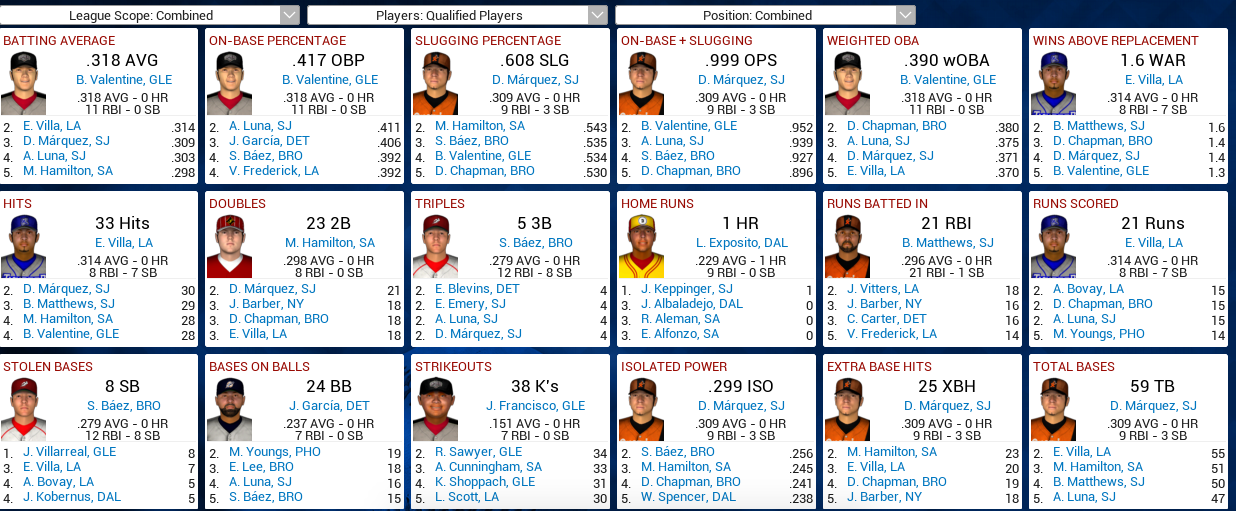
Screen Shot 2016-01-29 at 3.46.28 PMThere have been two HRs (both inside-the-park) hit in the entire league. The batting leader is hitting just .318. Mark Hamilton of the San Antonio Coyotes has 28 hits… 23 of them doubles.

Now, let’s look at the pitchers:

Screen Shot 2016-01-29 at 3.50.34 PM0.58 is leading the league in ERA amongst starters. Manny Lopez, by the way, had a 8.53 ERA back when the Arena Baseball League lived up to it’s name.

Okay, now let’s zoom to the All-Star Break…

Screen Shot 2016-01-29 at 3.56.45 PMOof. As you can see, the total number of Home Runs now stands at 3. The leading batting average is .312, and that’s the only BA over 300. The leader in doubles would already be tied for 30th all-time in a single season in the real world.

The pitching standings similarly continue to be a bit off-kilter:

Screen Shot 2016-01-29 at 4.05.39 PMAmazingly, despite how good all of these pitchers seems to be, there has only been one no-hitter in the first half of the season… and it was barely in the top ten best pitching performances of the half!

Screen Shot 2016-01-29 at 4.06.45 PMWowzers.

Now, let’s go to the end of the regular season and look at what has come:

Oh. Oh dear…

Screen Shot 2016-01-29 at 4.14.51 PMThe best batting average is a .304. .304. That is 1968 level of bad hitting (in 1968, Yastrzemski won the AL title with a .301). However, the doubles record of 67 has been demolished, and Arturo Luna had more triples than any MLB player has had since 1925.

Now, how about pitchers?

Screen Shot 2016-01-29 at 4.21.00 PMA 0.99 ERA in 208.2 IP is very impressive, needless to say, and 306 strikeouts is more in a season than any pitcher has had since Randy Johnson was in his prime. Amazingly, there was only one no-hitter: Ron Turner’s in the first half.

Now, let’s look at the league as whole, shall we?

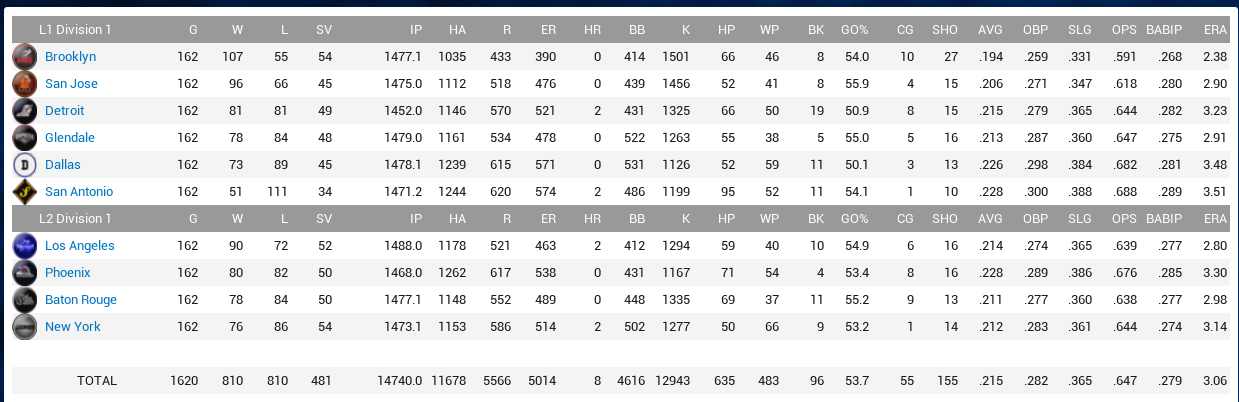
Screen Shot 2016-01-29 at 4.26.17 PM8 total home runs. 6998 total doubles. 564 total triples. The league as a total hit .215. Well, at least what hits did happen were usually exciting, right?

Screen Shot 2016-01-29 at 4.29.26 PMKind of surprised the league ERA was 3.06. I thought it’d be a little lower.

So… what did we learn? We learned that pushing the fences way back is bad for offense but will cause any balls that get past the outfielders to allow for extra bases. We learned that nothing particularly “game-breaking” occurs in OOTP if you do this. And, uhm, we learned that having deep outfield fences is nowhere near as fun to write about as arena-ball fences. I mean, yes, this is partly because I’m distracted by other blogathon concerns, but it was way more fun writing about insane scores statistics as opposed to what more-or-less was just a deadball era.

Next Time on Breaking OOTP: The most controversial Breaking OOTP yet

At 8 PM: BIZARRE BASEBALL CULTURE

This post has been part of the 2016 Baseball Continuum Blogathon For Charity, benefiting the Roswell Park Alliance Foundation. The Roswell Park Alliance Foundation is the charitable arm of Roswell Park Cancer Institute and funds raised will be “put to immediate use to increase the pace from research trials into improved clinical care, to ensure state-of-the-art facilities, and to help improve the quality of life for patients and their families.” Please donate through the Blogathon’s GoFundMe page.


(Blogathon ’16!) The Sliding Scale of Fictional Baseball Realism

This post is part of the 2016 Baseball Continuum Blogathon For Charity, benefiting the Roswell Park Alliance Foundation. The Roswell Park Alliance Foundation is the charitable arm of Roswell Park Cancer Institute and funds raised will be “put to immediate use to increase the pace from research trials into improved clinical care, to ensure state-of-the-art facilities, and to help improve the quality of life for patients and their families.” Please donate through the Blogathon’s GoFundMe page.

Earlier today, in my look at Touch, I mentioned that you can make a 0-10 scale of baseball realism in works of fiction, with zero being baseball-in-name-only and ten being actual footage of a game.

Well, I’m going to expand upon that:

0: Baseball In Name Only

In this category, it’s not really baseball at all. They may call it baseball, but it certainly isn’t the actual sport that we know. The Moe Cronin version of baseball fits here.

1: Utterly Absurd

In this category, while it’s clearly meant to be baseball, the rules of the game and the laws of physics have clearly taken a vacation. Some classic cartoons fall into this category.

2: Very Absurd, but still with some realism

In this category, the work might have cartoonish physics and occurrences, but it still is grounded in reality enough to have the rules of baseball still be mostly the same. In theory, a baseball movie where the rules are not consistent or are wildly different but where everything else is played straight could also qualify here. Classic cartoons that aren’t “utterly absurd” usually fall in this category.

3: Absurd, but mostly consistent

Works in this category are clearly absurd and cartoonish, but are at least consistent: the laws of physics may not be what they are in the real world, but they don’t suddenly change mid-game, nor do the rules suddenly change simply because the story demands it. Most “cartoon” baseball video games, like Backyard Baseball and the Mario Baseball series, fit in this category.

4: Many absurd elements

While clearly meant to be a realistic world that has our baseball’s rules and our laws of physics, the amount of absurd, cartoonish or unrealistic elements in the work make it more strange than realistic. Consider Mr. Go, for example, which has two baseball-playing gorillas, a little girl acting as a first-base coach and a finale that involves the baseball coming undone into a million pieces, which sort of overwhelms what would probably otherwise be a 6 if, say, it only had one gorilla.

5: Equal Mix of Realism and Fantasy

A work that sort of teeters between being realistic and being bizarre. This is more of a transitional spot on the scale, as it’s rare that anything ever stays at 5, inevitably going to 4 or 6 instead.

6: Realistic, but with one or two “big lies”

This is mostly realistic but it has one or two big elements (or the equivalent of one or two big elements made up of lots of smaller elements) that keep it from being something that you can honestly expect to ever happen in the real world. Sidd Finch could fit here, as could most of the movies in which a kid becomes a big league skipper or ballplayer.

7: Realistic, but highly unlikely

There’s nothing in this work that couldn’t happen, but it’s highly unlikely and any real event like this would probably instantly become one of the most notable things in baseball history. You could argue that Major League fits here, sort of.

8: Near total-realism

While some rules might be bent or not enforced on a strict basis, and some things might happen that are unlikely (although not nearly as unlikely as things that fall at seven on the scale), this is pretty realistic. Casey At The Bat, the classic poem, could be considered as this, with only the ability of everybody to seemingly hear everything keeping it from being a nine.

9: Utter realism

The only things that are not realistic in works of this category are omnipresent techniques like camerawork and editing for time, or stylish touches added in to indicate, say, that a player is angry. Bull Durham could, in theory, fit in this category, as could most (but not all) fairly true-to-history biopics and most realistic baseball video games.

10: Actual Baseball Footage used/Documentary

If you are watching an actual baseball game, or watching a documentary that uses baseball footage and does so without changing things for dramatic effect, you are watching a 10.


Feel free to consider where on the sliding scale your favorite piece of baseball fiction would fall!

6 PM: First References

This post has been part of the 2016 Baseball Continuum Blogathon For Charity, benefiting the Roswell Park Alliance Foundation. The Roswell Park Alliance Foundation is the charitable arm of Roswell Park Cancer Institute and funds raised will be “put to immediate use to increase the pace from research trials into improved clinical care, to ensure state-of-the-art facilities, and to help improve the quality of life for patients and their families.” Please donate through the Blogathon’s GoFundMe page.


(Blogathon ’16) Three Mini-Book Reviews

This post is part of the 2016 Baseball Continuum Blogathon For Charity, benefiting the Roswell Park Alliance Foundation. The Roswell Park Alliance Foundation is the charitable arm of Roswell Park Cancer Institute and funds raised will be “put to immediate use to increase the pace from research trials into improved clinical care, to ensure state-of-the-art facilities, and to help improve the quality of life for patients and their families.” Please donate through the Blogathon’s GoFundMe page.

And now, short reviews of three baseball-related books I’ve read somewhat recently:

Spalding’s World Tour: The Epic Adventure that Took Baseball Around the Globe – And Made It America’s Game, by Mark Lamster: Fun book on the Spalding world tour of 1888-89, set alongside the backdrop of the emergence of America as a world power, Spalding’s entrepreneurial and publicity-seeking abilities, and early labor tensions in baseball. Informative and entertaining about an interesting topic that isn’t wide known, and also provides several examples of Cap Anson being such an asshole you want to find a time machine in order to go back and throttle him. Seriously, Cap Anson was just the worst.

Yes, It’s Hot in Here: Adventures in the Weird, Wooly World of Sports Mascots, by AJ Mass: Written by a former Mr. Met turned ESPN fantasy sports writer, this book is a funny look at the world of mascots, and includes disputes with the Famous Chicken, the Mets’ front office being clueless, and looks at the many different people who don the mascot costumes. Not exactly hard-hitting and deep, but it doesn’t need to be.

Nuclear Powered Baseball: Articles inspired by The Simpsons episode “Homer at the Bat”, edited by Emily Hawks and Bill Nowlin: This e-book from SABR reprints biographies and articles about the classic “Homer at the Bat” episode, as well as a faux-“bioproject” entry for Homer Simpson himself, a listing of baseball players referenced on the show, and Joe Posnanski’s article on “MoneyBART”, the episode of The Simpsons about sabermetrics. Available free to SABR members (but available for sale to non-members), I don’t know if I’d pay money for it, but it’s definitely a fun tribute to one of the greatest baseball episodes in TV history.

At 1 PM: A short break to let you know what is available as giveaways if you donate to the Blogathon.

This post has been part of the 2016 Baseball Continuum Blogathon For Charity, benefiting the Roswell Park Alliance Foundation. The Roswell Park Alliance Foundation is the charitable arm of Roswell Park Cancer Institute and funds raised will be “put to immediate use to increase the pace from research trials into improved clinical care, to ensure state-of-the-art facilities, and to help improve the quality of life for patients and their families.” Please donate through the Blogathon’s GoFundMe page.

Announcing the First Annual Baseball Continuum Blogathon for Charity

Hello everyone, it’s Dan Glickman, your writer and host here at the Baseball Continuum. Today, I am writing to let all of you know of an exciting and hopefully helpful upcoming event, to begin on January 29, 2016: The First Annual Baseball Continuum Blogathon for Charity!

What, exactly, is the blogathon? Well, it’s simple and takes a page out of the blogathons of some previous years held by Michael Clair over at Old Time Family Baseball. In essence, it is a collection of baseball content put together by people from across the baseball internet, all to raise awareness and funds for charity. Some might be big long articles, others might be short jokes, and still others could be works of art or music. But for two to three days (depending on participation), the Baseball Continuum will (hopefully) be stuffed to the gills with baseball content, and, more importantly, will help raise money for a worthy cause.

That “worthy cause” is one that I know has affected seemingly everyone: cancer. It’s likely that all of us have known somebody who has suffered from it, and too many of us have personally lost somebody we love. Just last year, for example, I lost my grandfather- a devout baseball fan- to a form of the disease. I first heard of his death just as the Wild Card game between the Royals and Athletics began, and only hours before I had been talking to him about who was going to win. I’m sure many of you have similar stories.

And so, in this inaugural year, all money raised will go to the Roswell Park Alliance Foundation, which is the charitable arm of the Roswell Park Cancer Institute. Roswell Park, located in Buffalo but with affiliations across New York and the world, is America’s oldest cancer center, specializing in research and treatment. The RPAF is rated four stars by Charitynavigator.com, and donations will, according to their website, be “put to immediate use to increase the pace from research trials into improved clinical care, to ensure state-of-the-art facilities, and to help improve the quality of life for patients and their families.” Fittingly, Roswell Park has a close relationship with the State University of New York at Buffalo, where my late grandfather studied to become a pharmacist. 

So, here’s how the Blogathon will work:

  • On January 29, starting at midnight, I will be posting at least 24 new pieces of content on the Continuum. These will range from short stupid ditties to big long features.
  • Then, starting on January 30 and going until we run out of stuff to run, some of the best baseball fans, writers, bloggers, artists and analysts on the internet will take over, bringing a caboodle of content that will hopefully inform, amuse, and entertain readers from around the web. If you are interested in contributing a piece, please e-mail me at djgwriter@yahoo.com with the subject title of “Blogathon” (or something similar to that) and I can give you further details. In addition, I will be reaching out to many of you in the coming days and weeks to see if you may be interested in contributing, so if you are a noted personality of Baseball Twitter or the Internet Baseball Writers Association of America, check your in-box!
  • At the end of the campaign, anybody who donated at least one dollar will be eligible to win prizes, such as a copy of the 2007 installment of the immortal comic book, AAA Baseball Heroes. If you have something baseball-related that you would like to contribute, please let me know through my e-mail, djgwriter@yahoo.com.
  • Donations will open on a GoFundMe page about a week before the beginning of the blogathon and will close about a week after.


Thank you, and please look out in the coming weeks for more updates on the The First Annual Baseball Continuum Blogathon for Charity!


The Offseason at The Baseball Continuum: Bizarre Baseball Culture, Breaking OOTP, WBC, Features, Blogathon?

With the postseason over (ironically, the World Series MVP, Salvador Perez, didn’t actually win the Mr. October of any games in the World Series, he was just consistently good), it’s now time to go over what will be going on here at the Baseball Continuum during the offseason.  For the most part, it will be stuff I’ve been meaning to do, but which I have been unable to do so due to lack of time, other commitments, or simply because I forgot. In general, there might not be as many posts during the offseason, but the posts that will happen will on average be of a higher quality and longer length.

  • By the end of the week, you can expect a new Bizarre Baseball Culture, which will be a weird “Ultimate Sports Force” comic involving the early-aughts Cleveland Indians.
  • The new Breaking OOTP, long in development, will be Mario characters vs. Backyard Baseball characters. It should be out by the end of next week, unless I get so sucked into Fallout 4 that I just jump straight into doing a Bizarre Baseball Culture on it’s apparently surprisingly-high level of baseball elements.
  • Lookbacks at old Rochester Red Wings programs.
  • I’ll have my first World Baseball Classic roster projection for Team USA (and, later, Team Dominican). Of course, it’s a long while before the 2017 tournament so it likely will end up being vastly different, but that’s part of the fun, I guess. Expect these within the coming weeks, certainly before the end of November. You can also expect WBC News Updates when applicable.
  • There will be both Famous For Something Else installments (with one today!) and a new feature, Somebody Related To Somebody Famous For Something Else. Those features are basically what you’d think they are.
  • There will, of course, continue to be “Wisdom and Links” at Hall of Very Good.
  • You can expect some SABR-related stuff as well, such as “first references” in Sporting News and such.
  • During the Winter Meetings, if time allows, I’ll do the “Winter Meetings Tweets Of The Day” again.
  • And, of course, you never know what else might pop-up. I’m considering, for example, possibly doing a “Blogathon”, in the tradition of Michael Clair’s old “Old Time Family Baseball” blogathons that he did for charity. I’ll let you all know a bit about that later, maybe.

So stay tuned!

Coming in future weeks: Breaking OOTP, Red Wings programs, Bizarre Baseball Culture, etc.

As the postseason slowly starts to wind down, here’s a preview of what can be expected in the coming weeks:

  • The Return of “Breaking OOTP”, beginning with MARIO vs. BACKYARD BASEBALL.
  • The return of the lookback at Rochester Red Wings programs, including the early 90s, a program from the 1970s, and so on.
  • BIZARRE BASEBALL CULTURE finally returns, with one of the Ultimate Sports Force comics.
  • The long-awaited and oft-delayed return of the Baseball Continuum Continuucast
  • When Fallout 4 comes out, I’ll have a rundown of baseball elements in it, as post-apocalyptic Fenway will be a location in the game.
  • World Baseball Classic updates/projections.
  • And my votes for the IBWAA awards will be revealed.


So keep an eye out!