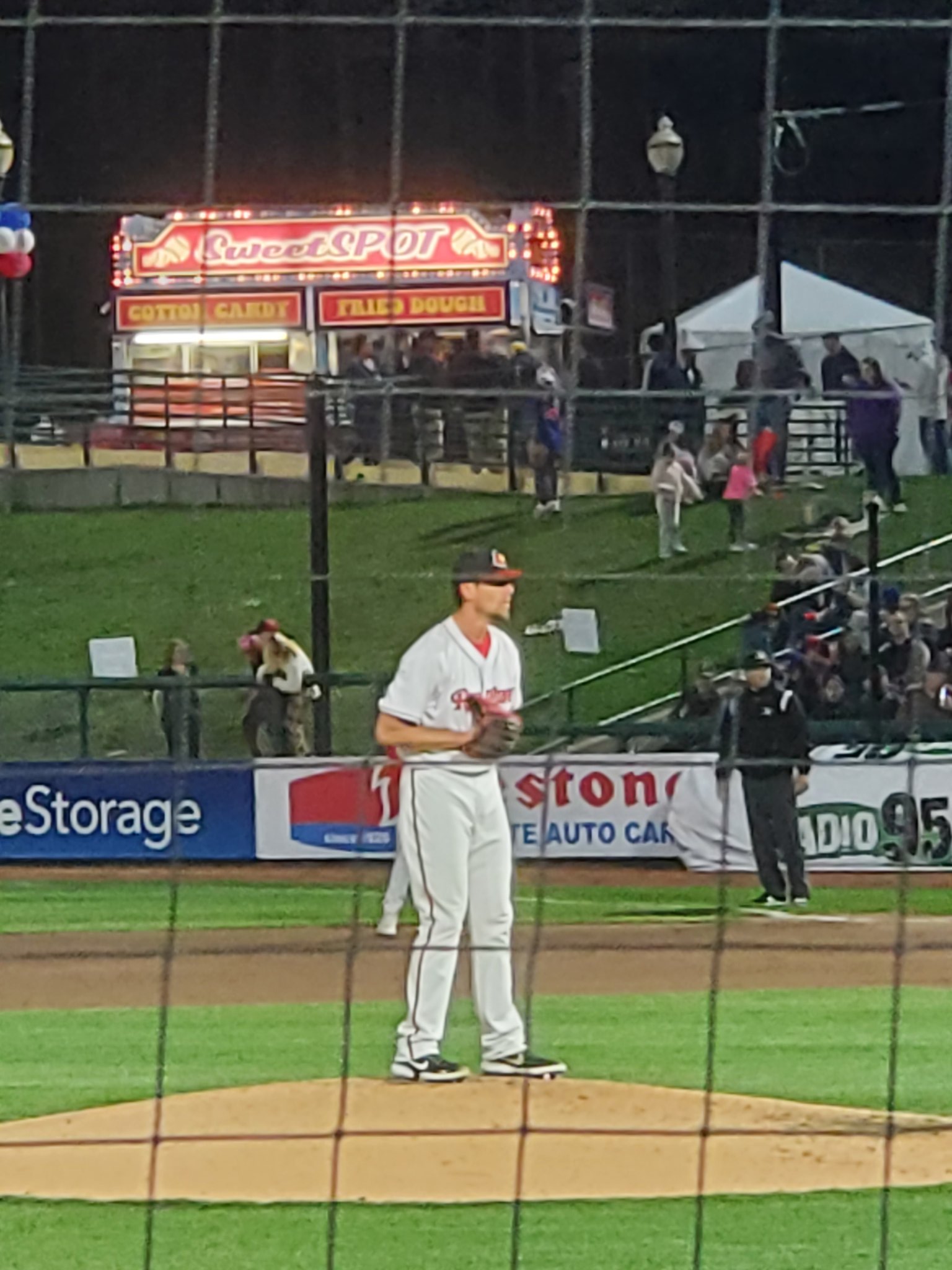
Rochester Red Wings Report: Past and future on a cold night

During the 2022 season, I’ll have occasional reports on games I’ve attended of the Rochester Red Wings, the AAA affiliate of the Washington Nationals.

It was a cold night on Tuesday as the Red Wings played the Syracuse Mets in front of a small but hardy crowd. That crowd grew thinner as the night went on and the temperature dipped ever-closer to 40, and it didn’t help matters that the Red Wings fell behind 8-1 in the first half of the game. Ultimately, though, those who stayed received a treat in the form of an epic comeback.

That, however, is not what this report is about. At least, not really. No, this is about how the past and future were both in Rochester on Tuesday.

To call Dee Strange-Gordon the past is perhaps not fair. He is still very much a present player. He’s no longer the All-Star he was in the mid-2010s, nor does he possess quite the quickness that makes him the active stolen-base leader. He’s moved into a more utility role at the age of 34, primarily playing in the outfield, unlike in the earlier parts of his career where he was mostly a middle infielder. Since leaving Miami after 2017, he’s hit .265/.292/.342 in 1094 plate appearances, a definite downgrade from the .293/.329/.367 of his career before. He spent 2021 entirely in the minors, and there was some thought that he’d start this season in the minors as well until he won a job in spring training.

Pity the poor equipment manager for the Rochester Red Wings, who had to fit his name on the back of the uniform.

Still, he’s Dee Strange-Gordon (the Strange added to his name in honor of his late mother). While never a superstar to the public (no doubt hurt by the fact he was traded to Miami from Los Angeles, as well as a suspension in 2016), most baseball fans know him, and for a few years he was one of the premier infielders in MLB. So when it was announced he’d begin a rehab from an undisclosed illness in Rochester just a few hours before game time, it was a pleasant surprise.

Wearing the number 1 once worn by his half-brother Nick Gordon during his time in Rochester as a Twins prospect, Dee was well-covered for the cold and wore his Nationals helmet to the plate for the game. Playing at shortstop for the first time this season (having been in the outfield and once in a garbage-time mound appearance in the big leagues), he was 0-2 with a strikeout and a walk at the plate, but still made an impact as he scored twice and reached base in the fifth on a fielders choice. He also made an impact in the field, taking part in a double-play.

It was clear that he wasn’t going to steal when he was no base (this was, after all, a minor league game to which he was essentially a special guest coming through on his way back to the show), but his speed still played a definite factor in keeping the fielders choice from becoming a possible double-play. He left the game in the 6th, but stuff like this is common for rehab appearances, particularly early on in the rehab stints. One game isn’t much to go on, but he seemed to be perfectly healthy and it is presumably only a matter of time before he joins the Nationals once again.

Strange-Gordon reaching base in the 5th, in hindsight, would prove very important, because the next batter was Luis Garcia, who was playing 2B on Tuesday. He’s the future in this tale. While he’s already played in parts of 110 MLB games, he’s still not even 22, and is almost certainly the top position player prospect on the Red Wings this year.

If his play on Tuesday was any indication, he probably shouldn’t be on the Red Wings much longer. Having already singled twice in the game, Garcia went deep in the fifth off Jake Reed, bringing home Strange-Gordon and himself to make it 8-3 in a much-needed sign of life for the Wings.

His next at-bat would come in the 7th, when he drew a walk. Little did we know at the time, but that would be start of the true comeback rally. A 2-out single by Joey Meneses moved him to third, and he then scored on a Josh Palacios hit right after. The next batter, Donovan Casey, then hit a home run to deep center (at first it was called a double, but that changed) to drive in three more and make it 8-7 Syracuse.

Finally, in the 8th, the culmination of the comeback and the culmination of Garcia’s jewel of a game came. Tres Barrera tied it with a solo shot to left with one out, leading to pandemonium among the small-but-hardy crowd. Then, after a fielding error allowed Alfredo Rodriguez (who had come in for Gordon) to reach, Garcia stepped to the plate again and hit his second home run of the night to make it 10-8. His totals for the night: 4-4, 2 HR, 4 RBI, 3 R, 10 total bases. His batting average now stands at .360, his OPS at 1.020.

The Wings would ultimately hold on to win 10-9, moving to 10-9 on the year in the process in what may forever be known as the Luis Garcia Game. The future is bright.
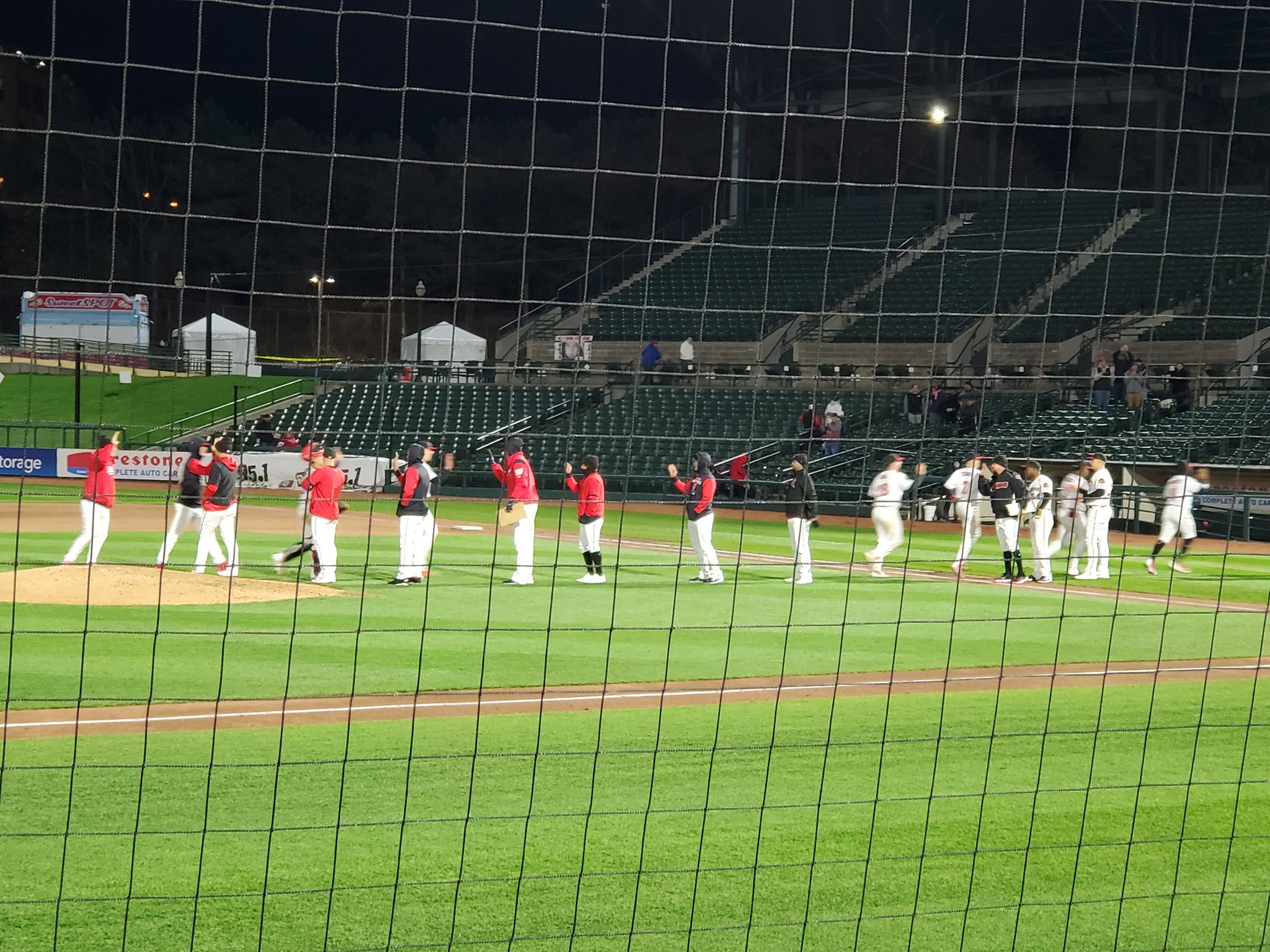
Someone Not to Forget

Although much of the attention no doubt goes to Garcia, Strange-Gordon, and the other hitters who got the Wings back into the game, I would be remiss if I didn’t mention Sterling Sharp. In four innings of relief, he gave up only two hits and two walks while striking out four. His shutout innings kept what was a Syracuse blowout from becoming even more out-of-hand, allowing the comeback to take place. He received no win for the performance, but in some ways it can be argued he is the one who deserved it.

The Red Wings continue their series against Syracuse throughout the week.
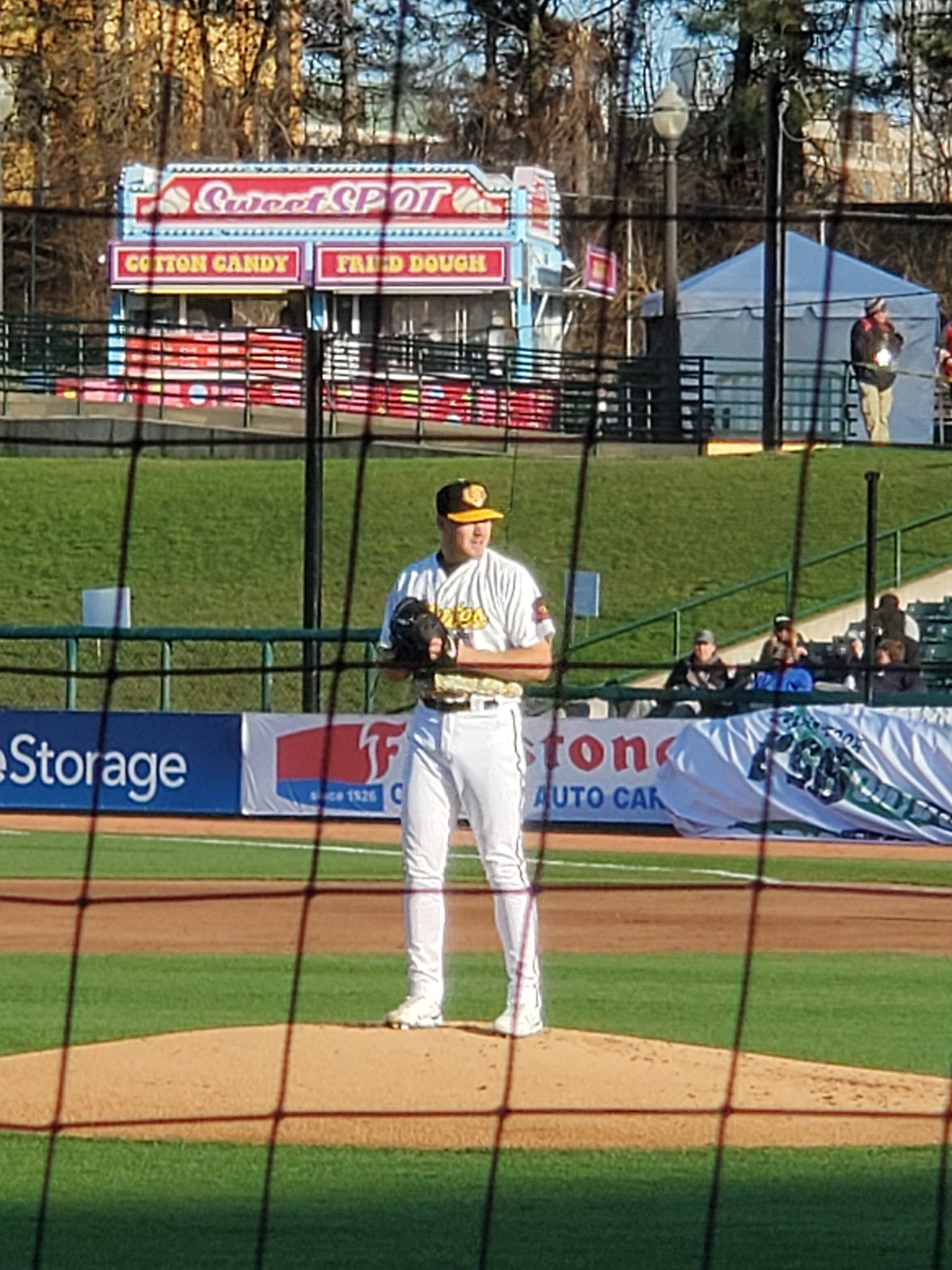
Rochester Red Wings Report: Four good innings of Cade Cavalli

During the 2022 season, I’ll have occasional reports on games I’ve attended of the Rochester Red Wings, the AAA affiliate of the Washington Nationals.

Cade Cavalli is the top pitching prospect of the Washington Nationals. Some lists have him as top prospect for the Nationals overall. For four innings on Thursday, he showed why. Working in the high 90s with off-speeds in the 80s, Cavalli struck out seven Buffalo Bisons while walking only one and giving up an earned run on four hits.

That Cavalli would rack up K’s (including three in the 3rd) isn’t surprising. He led the Minors in 2021 with 175 across three different levels while also being chosen for the Futures Game. However, he has struggled in AAA and didn’t have a good spring with the Nationals this year, including one game where he gave up 10 earned runs to the Cardinals.

The Cavalli of the first four innings on Thursday appeared to have put that behind him. The problem for Cavalli, though, is that he didn’t stop pitching in the 4th inning. He also came out in the 5th. There, the Bisons jumped on him for four straight hits. He was taken from the game after 82 pitches. A few batters later, Samad Taylor hit a grand slam off Jace Fry to put Buffalo up for good. Cavalli’s final line: 4+ IP, 8 H, 5 ER, 1 BB, 7 SO, season ERA after two starts: 9.00. The final score would ultimately be 10-1 Buffalo as the Wings fell to .500 on the year.

Despite how the game ended, however, Thursday spoke well of Cavalli and his future. He’s only had a small sample size of two starts this year, but his strikeout-to-walk ratio has improved (last season across three levels: 2.92 strikeouts for every walk, this season so far: 5.50 strikeouts for every walk). Plus, he certainly seemed more comfortable and less “raw” on the mound, although admittedly that is an intangible thing that is in the eye of the beholder. Doubtless he and the Nationals are hoping that he’ll be MLB-ready by mid-year. Until then, though, he’ll be in Rochester.

The Red Wings continue their series with Buffalo through the weekend.

Rochester Red Wings Report: It’s good to be back, shame about the ending

During the 2022 season, I’ll have occasional reports on games I’ve attended of the Rochester Red Wings, the AAA affiliate of the Washington Nationals.

The last few years have, frankly, stunk for Minor League Baseball. MLB was able to succeed in a plan (which some fear is not yet over) to decrease the minors, eliminate teams and entire leagues, forcibly shift surviving teams from long-held positions in the hierarchy, and impose certain scheduling restrictions that are a mixed bag for players, front offices, and fans. Add in COVID, which eliminated the 2020 season in its entirety and caused the 2021 season to have a hodgepodge of various restrictions and generally depressed attendance, and it has been a total bummer.

Which is part of the reason why last night in Rochester was so special. It still wasn’t as big of a crowd as it could have been (it was, after all, a school night), but the crowd of 8,170 was still larger than any crowd from 2021. And it was loud, into the game, and ready to cheer.

A good boy.

And the thing is, as an advertisement for Minor League Baseball, last night’s game was better than most. A back and forth game took place. The Bisons would pull ahead, the Red Wings would pull back even, and then it’d happen again. The promotions, as always, were on point, most notably an appearance by very good boy Milo the Bat Dog. He is, after all, a very good boy. I’m still waiting for an MLB team to have a bat dog. It needs to happen eventually, right? The dog would instantly go viral, would put butts in stands, and no doubt there’d be some great moments pre-game when players give the dog much-deserved head-pats. Make it happen, Major League Baseball.

Alas, the only thing that went wrong was the end of the game, as Buffalo took a 6-4 lead that the Red Wings couldn’t make up in the bottom of the 9th.

Other than that, though, it was perhaps the best night at the ballpark in Rochester since 2019.

Clippard not long for AAA

One highlight last night was the performance of Tyler Clippard. As I mentioned back in my one-line-look, the reason why the two-time All-Star with 803 MLB game appearances under his belt is in Rochester to begin with is largely because he signed late. He’s just in AAA for now to build up his arm.

If his performance last night was anything to go on, it won’t be too long. In the top of the 8th, Clippard sent down the Bisons with ease in order, including no-doubt strikeouts of Joshua Fuentes and Cullen Large.

So if you live in Rochester and want to see Tyler Clippard, make sure to head to Frontier Field soon, since he won’t be there long.

The Red Wings continue their long series against the Bisons through Sunday.

One line each on every member of the 2022 Rochester Red Wings opening day roster

One line (or at least a sentence- it could be longer than a line depending on your screen) on every member of the opening day roster of my hometown Rochester Red Wings. They range from statistics to trivia and everything in between. Of course, it’s possible that this roster will change drastically in just a few days once MLB begins its season.

  • Alberto Baldonado made his first MLB appearance late last season, striking out Bryce Harper during his debut.
  • Cade Cavalli is considered the Nationals’ top pitching prospect and should be the top man in the Rochester starting staff to begin the season.
  • Tyler Clippard was a two-time All-Star for the Nationals earlier in his career and will begin in Rochester primarily due to the fact he was signed late and needs more time to build his arm up.
  • Carl Edwards Jr. won a World Series title in 2016 with the Chicago Cubs.
  • Jace Fry played in the 2006 Little League World Series for Oregon.
  • Reed Garrett returns to North America after pitching two seasons in Japan for the Seibu Lions.
  • Hunter Harvey has pitched in 26 career games with the Orioles and joined the Nationals organization in late March.
  • Gabe Klobosits had a 2.45 ERA in 18.1 innings last season for the Wings while also spending time in Harrisburg and Washington.
  • Francisco Perez made his MLB debut last season for Cleveland.
  • Erasmo Ramirez has pitched in 216 career MLB games, primarily for Seattle and Tampa.
  • Luis Reyes was signed by the Nationals in Aug. 2012, when he was just 17.
  • Jefry Rodriguez split time between Rochester and Washington last season.
  • Seth Romero missed time this spring with a stiff back, hampering an attempt to start the season with the big club.
  • Aaron Sanchez was the 2016 AL ERA leader and made the All-Star Game that season for Toronto.
  • Curtis Taylor was acquired off waivers from the Toronto organization in December.
  • Lefty Carson Teel primarily played with Harrisburg in 2021 but did make five appearances for the Wings.
  • Jackson Tetreault threw all six innings in the Wings’ 4-0 rain-shortened loss to end the 2021 season.
  • Logan Verrett has pitched in 57 career games in MLB and has also had time in Korea and the independent leagues.
  • Jordan Weems split last season between the Oakland and Arizona organizations, including seven games in MLB.
  • Tres Barrera split time between Rochester and Washington last season, and actually hit better in MLB than he did in AAA!
  • Although he reportedly retired, longtime MLB catcher Welington Castillo is listed on the team’s roster, albeit not listed as not being with the team.
  • Chris Herrmann is no stranger to Rochester, having played here for parts of three seasons during the Twins era.
  • Wilmer Perez played some winter ball during the off-season in his native Venezuela.
  • Luis Garcia is once again the youngest member of the Red Wings (born: 5/16/00), and is considered one of the top prospects in the Nationals organization.
  • Bahamas-born Lucius Fox may be the fastest man on the team with 142 stolen bags during his minor league career so far.
  • Joey Meneses was the IL MVP in 2018 and played for Team Mexico in the Olympics last season.
  • Jake Noll was last season’s team MVP and was named to the league’s All-Star Team at the end of the season.
  • Adrian Sanchez hit well in Rochester last season while splitting time between here and Washington.
  • Richard Urena was with the Buffalo Bisons the last several years and so is likely familiar to many Red Wings fans.
  • Andrew Young played in 58 games for Arizona last season before being selected in the MiLB Rule 5 draft by the Nationals.
  • Nick Banks is from Chris Herrmann’s hometown of Tomball, Texas.
  • Donovan Casey was one of the player acquired in the Max Scherzer trade last season.
  • Matt Lipka hit .291/.352/.449 between AA and AAA in the Arizona and Milwaukee organizations in 2021.
  • Cole Freeman has twice been named to Washington’s organization All-Star Team by MiLB.com, but this will be his first season in AAA.
  • Andrew Stevenson has played 248 career MLB games, all with Washington.
  • Princeton grad Alec Keller is said to have retired according to MiLB.com, but is still listed on the team’s roster- albeit not with the team.
  • Manager Matt LeCroy returns for his second year as manager and third overall (he played for the 2007 team).
  • Hitting Coach Brian Daubach hit 20 or more HRs for four straight seasons in Boston from 1999 through 2002.
  • Pitching Coach Rafael Chaves has MLB pitching coach experience, as he held the Mariners job in 2006 and 2007.
  • Development Coach Billy McMillon was the skipper of the Worcester Red Sox last season

How to forfeit a game

Last night, the Rochester Red Wings were shellacked by the Buffalo Bisons, 20-3. As the game dragged on in its last innings and the Red Wings turned to a position player to pitch, Wings’ announcer Josh Whetzel wondered if maybe baseball should have a mercy rule or maybe a way to forfeit when things get too ugly.

Well, there is one way to forfeit. Sort of.

Take a look at the MLB rulebook. Now, head down to pages 85 and 86, the part on unsportsmanlike conduct. Make note of rule 6.04(a)(4), which says that no one can “Make intentional contact with the umpire in any manner.”

You’ve doubtless seen this rule in action before: a manager or player is arguing with an umpire after a bad call, and touches them. They are then usually immediately ejected.

So, in theory, you could have your players line up in a row and start touching the umpire until enough players are ejected that there aren’t enough to continue, thus ending the game.

Of course, there are other easier ways to forfeit (see rule 7.03). You can just refuse to come out and continue playing, for example. Or you could continually break rules. Or the thing that, if properly enforced, would probably lead to a wave of forfeits, rule 7.03(a)(2):

Employs tactics palpably designed to delay or shorten the
game;

Yeah, like that will ever be enforced…

The All-Time Home Run Derby

Imagine you have command of all time and space. And imagine you have been assigned to create the greatest Home Run Derby of all time… where do you hold it and who do you have in it?

I have ideas. Go below the jump to see them.

Continue reading

2020/2021 Tokyo Olympics Baseball Preview: Israel

Flag of Israel

With a team primarily of Jewish players from the USA who are eligible thanks to the infamously lax eligibility rules of international baseball, the Israeli baseball team will probably prove to be quite a curiosity to the world press. However, as the 2017 WBC showed, Team Israel is perfectly capable of pulling upsets and should not be underestimated. They are managed by Eric Holtz, the owner of a baseball training facility in Westchester County who played in Israel’s short-lived professional league and coached for college teams for decades. Israel’s 24-man roster can be found here.

About the Country: Sitting ever perilously at the center of both international politics and the world’s three largest monotheistic religions, the current state of Israel came into existence in 1947. Despite its decades of tumultuous history, Israel is also a leader in science and technology.

Baseball History: Although some may joke that Israeli baseball began “in the big inning” that can be found when the beginning of the Book of Genesis is read aloud (it’s a lame pun, think about it for a second), Israeli baseball didn’t really begin until some Americans who had moved to Israel played it a bit. However, that was about it until, in 2007, a small professional league was created in Israel by American businessmen. While it folded after one season, its level of play was apparently pretty good, although only a small handful of the players in the league were actually Israeli. In fact, it has been rare for actual Israelis to play for Team Israel. Thanks to lax eligibility rules as well as the fact that it is quite easy for those of Jewish descent to be eligible for Israeli citizenship, most of the Israeli national teams that have competed in large tournaments have been made up of Americans and Canadians.

Israel lost to Spain for a spot in the 2013 WBC before making the tournament in 2017, where they made it to the second round with a stream of upsets. Dean Kremer, a pitcher born to two Israeli parents and who has lived in Israel at times during summers where he hasn’t been pitching, became the first Israeli citizen drafted by MLB in 2015 and the first Israeli citizen to play in MLB when Kremer made his debut with the Orioles in 2020.

Olympic History: This is, of course, Israel’s first appearance in Olympic baseball. It isn’t the first time that there was an Olympic baseball team primarily made up of people from outside the country they were representing, however: the Greek national team in 2004 was made up primarily of Americans of Greek ancestry (most notably Nick Markakis).

For decades, Israel’s Olympic history had been (and continues to be) centered around 1972’s Munich massacre. It would not be until 1992 that an Israeli would win a medal, and to this day the country has won only one gold (windsurfer Gal Fridman in 2000). Every medal for Israel has come in either judo or a boating sport like sailing or canoe.

This year’s baseball team will be the first Israeli representation in a team sport since the Israeli soccer team made it to the quarter-finals of the 1976 Montreal games.

Road to Tokyo: Israel was actually the first team to qualify for the Olympics aside from the host nation of Japan. They came out on top of a 2019 qualifier in Italy for teams from Europe and Africa, winning the round robin thanks to holding a head-to-head tie-breaker against the Netherlands.

Notable Names: The former MLB players on Team Israel are, of course, Americans of Jewish heritage. The most notable is certainly Ian Kinsler, the four-time all-star second baseman and two-time Gold Glove winner. He was a member of Team USA’s WBC title team in 2017. He’s played a bit in the Atlantic League this year in preparation for the tournament.

Other players with MLB experience include Danny Valencia, who played third base for a variety of teams over a nine-year career and who is perhaps best known among degenerate baseballaholics like me for the fact that he always hit David Price exceptionally well (a career .600 BA) to the point where the Orioles, Red Sox and Blue Jays all made points of having him in the lineup for series against Tampa. Catcher Ryan Lavarnway played parts of 10 seasons in the big leagues and remains active in the affiliated minors on Cleveland’s AAA team in Columbus. Utilityman Ty Kelly played parts of three seasons between the Mets and Phillies and is a career .275 hitter in the minors. While less notable, the team also has MLB-experienced pitchers in Jeremy Bleich, Jon Moscot, Zack Weiss, and Josh Zeid.

Ones to Watch: First off, I want to the pay tribute to the actual people born in Israel that are on the team simply because on a team mostly of Americans they stand-out for… actually being from the country they are representing.

Shlomo Lipetz was born in Tel Aviv, fell in love with baseball during visits to New York, and later moved to the USA to pitch in college. He’s since played semi-pro ball and in the short-lived Israeli Baseball League while also working as a music booker at City Winery in New York City. Now 42, this is probably his last ride… but a ride it has been. Another Israeli-born pitcher on the team is Alon Leichman. Born in a kibbutz in the late 80s, Leichman fell in love with the game thanks to American relatives and moved to America to pitch in college. He’s since gone into coaching, where he is currently the pitching coach for Seattle’s AA Arkansas Travelers.

Among position players, there is catcher Tal Erel, born in Ramat Gan (near Tel Aviv). After playing in leagues in the Czech Republic and Netherlands, he moved to Florida where he played college ball on the JuCo and Division II levels. The final Israeli-born player is Assaf Lowengart, who now plays for DII Mansfield University.

Among the Americans on the team that haven’t played in the big leagues, names that stand out include LHP Jake Fishman (Miami’s AAA team in Jacksonville), LHP Alex Katz (Cubs organization), RHP Ben Wanger (University of Miami), SS Scott Burcham (AAA Colorado), utilityman Mitch Glasser (hitting .345 in independent Sioux Falls), and long-time minor league/indyball journeyman outfielder Blake Gailen.

Outlook: On paper, Israel is undoubtedly the worst team in the field. No other team in the tournament is rolling out college and semi-pro players to fill the back-end of their rosters, and most of their top professionals (such as Kinsler and Valencia) are in states of near-retirement. However, although it is unlikely that they can get to the medal stand they are still a good enough team where they may be able to pull an upset or two against stronger but potentially overconfident opponents.

You can find all the current Olympic Baseball previews here.

Major League Baseball in Buffalo a strange but fun experience

Last Sunday, I did something I never thought I’d do. Certainly never anytime soon.

I went to a Major League Baseball game in Buffalo, N.Y.

Head below the jump for thoughts from a day in Buffalo.

Continue reading

2020/2021 Tokyo Olympics Baseball Preview: Team USA

Flag of the United States of America

Managed by Mike Scioscia, Team USA comes to the Tokyo Games with an eclectic team that features former big leaguers looking for jobs and/or one last ride before retirement, prospects looking to make their name, and players who have gone overseas to ply their trade. Although among the tournament favorites, how Team USA does ultimately is anyone’s guess. You can see their roster here.

About the Country: …Seriously? Do I have to do an “about the country” for the USA? Look at your history books or something. Okay, fine: Declaring independence from Great Britain in 1776, the United States of America has grown from a 13-state experiment in Republican Democracy to a 50-state union that is a global power (in some cases the global power) in economics, politics, science, technology, military, sports and entertainment, amongst other areas.

Baseball History: The history of American baseball is, more or less, the history of baseball. While it is no longer the most popular sport as far as TV ratings or public-opinion polls go, its cultural impact in American history and its yearly attendance (more people attend MLB games than the other three major sports leagues combined, although admittedly MLB seasons are longer) remain unchallenged.

Olympic History: Team USA has played in every single Olympic baseball tournament save one (a meltdown during 2004 qualifiers prevented them from playing in Athens). After some sort of demonstration event at the 1904 Olympics that has been shrouded in mystery (and may not have even happened), America took part in every single demonstration game/tournament and won all of them save for 1984 (won by Japan). It proved harder once baseball officially joined the games, with Team USA winning only one gold (2000, when Ben Sheets threw a three-hit shutout against the Cubans in the final) and two bronze (1996 and 2008).

Outside of baseball, of course, Team USA is a giant of the Olympics, leading the all-time summer and overall (summer+winter) medal count in both golds and total medals overall even if you combine USSR and Russia. Of particular fame are Team USA’s track and swimming teams, whose dominance alone would probably be high up in the medal count most Olympiad.

Road to Tokyo: The road to the Olympics was a bit rougher than hoped for Team USA. Their initial shot came at the 2019 Premier12 tournament in Japan, which is sort of a World Cup-style contest between the top 12 teams in the WBSC’s world rankings. The top-finishing team from the Americas would be guaranteed a spot in the Olympics, but ultimately that would be Mexico after America’s bullpen blew the lead in the ninth and then fell in the 10th during the bronze-medal game. So, after a COVID delay of a year, Team USA played in the Americas Qualifier tournament. That went better, as Team USA went undefeated while outscoring their opponents 29-10 to clinch a spot in the games.

Notable Names: Like during the qualifiers, the roster contains some players who are MLB veterans who either have found themselves elsewhere (such as the minors or overseas) or out of a job (whether by choice or by simply being unable to get on a roster).

In all, 14 members of the team have MLB experience, including former all-stars in Scott Kazmir, Todd Frazier (who was impressive in qualifying), David Robertson (the lone player who was on the USA’s 2017 WBC title team), and Edwin Jackson. Other former MLB players who you might recognize on the roster include Anthony Gose, Tim Federowicz, and Bubba Starling. Eddy Alvarez, a primarily-defensive infielder who had a cup-of-coffee with Miami last season, already has an Olympic medal since he was part of a silver-winning relay speed-skating team in Sochi. Patrick Kivlehan can play both outfield and infield and has 137 career MLB games, mostly with Cincinnati in 2017.

There are also some players with MLB experience who now work internationally. Although he has now returned to the USA and is part of the Cardinals system, Brandon Dickson went to Japan after two cups of coffee in the bigs and became a regular with the Orix Buffaloes. Tyler Austin played parts of four seasons in the big leagues before going to Japan, where he is hitting .348 with 17 home runs this season for Yokohama. RHPs Nick Martinez and Scott McGough similarly had time in MLB but have found better luck in Japan.

Somewhat surprisingly, Adam Jones was not picked for the team despite the fact that he had expressed interest and would be by far one of the best historical resumes, possibly because he has been having a rough year in Japan where he’s only batting .233. It’ll be interesting to see if he is potentially added if there are any late injuries or pull-outs, since presumably he wouldn’t need to go through nearly as much COVID-related protocols going into or out-of Japan.

Ones to Watch: The Olympics have a long history of featuring prospects on Team USA, including players like Barry Larkin, Mark McGwire, Will Clark, Stephen Strasburg (the lone amateur on the 2008 team), Nomar Garciaparra, Roy Oswalt, and Jason Varitek. This year is no different. While the team’s inability to use any players on 40-man rosters keeps them from using much of the cream-of-the-cream, it’s likely that at least some of the prospects on this roster will end up big league regulars.

The three “ranked” prospects on the roster are 1B Triston Casas (Red Sox organization), RHP Simeon Woods Richardson (Blue Jays organization), and RHP Shane Baz (Rays organization). The other prospects on the squad, although not as well-regarded by scouts, are still hardly pushovers and will likely make it to the bigs. Middle-infielder Nick Allen is hitting .333 with an .882 OPS in AA for Oakland and was part of the qualifying team. OF/1B Eric Filia (Mariners organization) hit .313 with a HR and 5 RBIs during qualifiers. C Mark Kolozsary (Reds organization) showed good pop in the qualifiers with two home runs. Jamie Westbrook (Brewers organization) and Jack Lopez (Red Sox organization) will provide some defensive flexibility, which is important since these rosters only have 24 men on them.

There will also be a minor league “lifer” on the team in Anthony Carter. The 35-year-old RHP has been in pro ball since 2006 but has never appeared in an MLB game. He’s currently playing in the Mexican League.

Somewhat surprising omissions from the roster are Boston’s Jarren Duran and the Cardinals’ Matthew Liberatore, both well-regarded prospects who impressed in the qualifiers. It’s likely that they may now be on the verge of being called up to the big leagues, which of course would have meant that they would no longer be available. Luke Williams, who was so impressive during qualifiers that he was dubbed “Captain America” by some teammates and observers, is similarly ineligible since he has now been called up to the show (where he’s doing quite well!).

Outlook: While the prohibition on players on 40-man rosters means it doesn’t have the uniform excellence and up-down depth of Japan’s all-NPB team, Team USA needs to be considered one of the favorites for a gold thanks to its mix of experienced veterans and talented prospects. They are also aided by the fact that they are in a slightly-easier initial bracket (with Israel and South Korea instead of the other bracket, where Japan is with Dominican and Mexico). However, the randomness of baseball and the unforgiving format of the tournament leaves little room for error. One bad pitching performance or a ill-timed slump by some of the team’s players could be the difference between going for gold and not being on the medal stand at all.

You can find all the current Olympic Baseball previews here.

Neat Site: Digital Ballparks

Today’s neat site to check out is Digital Ballparks. It’s a site filled with slideshows of images of baseball stadiums past and present from around the country and even in some cases the world. It isn’t just limited to the pros, either: the Pastores (who run the site) also have plenty of amateur and semi-pro fields, as well as ballparks that once hosted professional baseball decades ago. In some cases where ballfields no longer have their traditional form (for example, abandoned fields or fields that may have been converted to another sport), they’ll even sometimes include Photoshop work to give an idea of what it may have looked like back in the day.

While it looks like they haven’t updated the site yet for the 2021 season, it remains a fascinating way to spend time for anyone interested in baseball stadiums.

Check it out.