Famous for Something Else: Charlie Powell, the minor-leaguer with 83 NFL games and a fight against Ali

Today’s “Famous for Something Else” is one who I honestly am surprised I hadn’t heard of until recently: Charlie Powell. After all, I doubt that there were any other former minor leaguers who had the honor of getting knocked out by Muhammad Ali. And even if there were (and if there were I will find out), I doubt any of them also played several seasons in the NFL.

Charlie (sometimes spelled Charley) Powell, however, did all of these things. Born in Dallas in 1932, he would grow up in San Diego. His was in an athletic family, and his brother Art would go on to be one of the lead receivers in the American Football League of the 1960s. According to the Los Angeles Times, Charlie’s time at San Diego High School was to that point perhaps the most decorated student-athlete career in the history of the city, as he lettered 12 times in four different sports (football, baseball, basketball, and track). The Harlem Globetrotters and major college football programs wanted to him to join up, but instead he decided to go into professional baseball.

It was a season that, as the Times obituary put it, left him “realizing his sporting riches would be elsewhere.” Looking at the admittedly bare-bones stats of that lone short season in Stockton that Baseball Reference has, it isn’t hard to see why:

Register Batting
Year Age AgeDif Tm Lg Lev Aff G PA AB R H 2B 3B HR RBI SB CS BB SO BA OBP SLG OPS TB GDP HBP SH SF IBB
1952 20 -2.6 Stockton CALL C SLB 10   30   5 0 0 0           .167   .167   5          
All Levels (1 Season)       10 30 30   5 0 0 0           .167   .167   5          
Provided by Baseball-Reference.com: View Original Table
Generated 6/24/2021.

And so, Powell instead went into football, joining the 49ers in time for the 1952 season at the age of 20, making him the youngest NFL player at that time. In 1953, he had his first boxing match, drawing with a fighter named Fred Taylor in Hollywood.

As evidenced by the fact he’s the subject of an installment of this series, it should be obvious he had far more luck on the gridiron and in the ring than he ever did on the diamond. Although his statistics from his time in the NFL are a bit hazy due to some less-than-stellar record-keeping during that era as well as the fact that some statistics (such as sacks) weren’t even officially recognized yet, anecdotally it is said that Powell once sacked Bobby Layne (himself someone you may see in a future installment of this series) ten times in one game. To put that into perspective, the most sacks in a single game from an era where NFL record-keeping existed well enough where we can be sure is seven.

Here are the NFL statistics for Powell that we do know:

Defense & Fumbles Table
          Game Game Def Def Def Def Fumb Fumb Fumb Fumb  
Year Age Tm Pos No. G GS Int Yds TD Lng Fmb FR Yds TD Sfty
1952 20 SFO RDE 87 7 7                 1
1953 21 SFO LDE 87 12 10         1 1 0 0  
1955 23 SFO RDE 87 12 7 0 7 0 7 0 1 0 0  
1956 24 SFO RDE 87 12 11                  
1957 25 SFO RLB 87 12 8         0 1 3 0  
1960 28 OAK RDE 87 14 14                  
1961 29 OAK RDE 87 14 14                  
Care Care       83 71 0 7 0 7 1 3 3 0 1
5 yr 5 yr SFO     55 43 0 7 0 7 1 3 3 0 1
2 yr 2 yr OAK     28 28                  
Provided by Pro-Football-Reference.com: View Original Table
Generated 6/24/2021.

Perhaps Charlie Powell’s most interesting athletic career, however, came in the ring. In 39 career bouts, Powell went 25-11-3, with 17 of his victories coming by knockout.

He was, according to my research, a legitimate heavyweight fighter, not some sideshow coasting on his achievement in football. According to his obituary, he once was rated the fourth-best in the world by The Ring magazine. His brother Art and a promoter named Don Chagrin both say that he could have been even more successful if he had had better management and had focused entirely on boxing. In fact, he himself admitted it later in life.

Still, he had some great success. In 1959, he defeated the Cuban Nino Valdes, who at the time looked like a possible challenger to then-champion Floyd Patterson. A few years later, he would step into the ring against a young hotshot with a big mouth but the talent to back it up, a man then called Cassius Clay but later known as Muhammad Ali.

The Jan. 24, 1963 match-up in Pittsburgh was over quick. Clay declared before the fight that he’d beat Powell in three rounds, and, of course, he did just that, winning by KO. According to a newspaper account from the time, Clay declared himself the “greatest” and then went to badmouthing future opponents, including then-champion Sonny Liston, who he said he hoped to unseat by the next November and who he categorized as being neither as fast or as rough as Powell, who he complimented in his own Ali-like way:

“Powell was rough. They couldn’t call him a push-over. I was concentrating on three. The man was strong for two. He’s the roughest fighter I’ve met yet for three rounds.”

That wouldn’t be the end of Charlie Powell’s boxing career, however, as he would fight six more times after that, perhaps most notably a six-round loss against Floyd Patterson in 1964 at Hiram Bithorn Stadium in Puerto Rico. Hiram Bithorn, of course, is most notably used for the sport that Powell began his professional sports career in: baseball.

Powell died on Sept. 1, 2014 after a years-long battle with dementia. He was 82. Although his brother believed that his dementia was the result of his years on the gridiron and in the ring, he had never joined any of the major lawsuits against the NFL.
Neat site to check out: “Threads of Our Game”

Some of you may be familiar with the Dressed to the Nines uniform database run by the Hall of Fame. On it, you can look up what each team wore uniform-wise from 1900 to today.

But what if you wanted to know what teams looked like before 1900? Enter Threads of Our Game, a website run by SABR member Craig Brown that focuses on the first few decades of baseball. To make up for the fact that photography of those days was not as common and essentially never in color, the site uses research of newspaper accounts, contemporary drawings, and other sources to get an idea of what the uniforms of the era looked like.

What’s more, the site doesn’t just have the Major Leagues. In fact, it doesn’t just stop at professional teams in general. They also have semi-pro and amateur teams of the era. No team, seemingly, is too small for inclusion. Nor is no team too vile: among the teams with a uniform on digital display is that of the 1874 baseball team run by the Klu Klux Klan chapter of Oneida, N.Y. Somewhat surprisingly, the uniforms does not contain any white.

Among the interesting highlights of the page are polka-dotted ballcaps, the first ballcap with a graphic on it (an Oriole wing), the year that some teams had a different-colored uniform for each position on the field, and also some of examples of 19th-century teams from the proto-Negro Leagues.

Check it out.

With Negro Leagues now officially major, it’s time for Rochester to honor its major leaguers

Late last year, Major League Baseball made it official: the Negro Leagues between 1920 and 1948 were and always have been major league level. Their exclusion from records before now had been the result of the very same racism that had forced their existence in the first place. The issue of incomplete statistics and other forms of record-keeping (for example, which games were official league games and which were one of the countless exhibitions that Negro League teams held) have been largely (although not completely) corrected through an extreme amount of research and fact-finding. MLB and most major baseball historians agree: there is no major reason to continue to exclude the Negro Leagues and the statistics of their players from the official history books of MLB.

For many baseball fans in the internet age, though, it can be argued that nothing is official until Baseball Reference says it is. Although not the official decision-maker of what baseball statistics are and are not valid, it might as well be, so when the folks there announced that the Negro League statistics would be integrated (for lack of a better word) with the site’s pre-existing statistics, it was a big deal.

Which brings me to my hometown of Rochester, N.Y. A good place to grow up depending on where you live in the area. Doesn’t deserve the reputation it has. For the purposes of this blog, what’s important though is that Rochester has one of the longest and most successful baseball histories in the country, outstripping even many major league cities. However, due to size and the proximity to other large cities it hadn’t had a Major League Baseball team since 1890’s American Association Broncos. The city had gone the entire 20th century without a MLB team.

Until now. Because, you see, in the waning days of the Negro Leagues, a member of the Negro National League played in Rochester. The New York Black Yankees were, of course, originally based in the New York City area. Founded in the early 30s and joining the NNL in 1936, they played in Paterson, N.J. or on Randalls Island when they weren’t barnstorming or playing away games. By 1948, with integration underway and finances taking a downward turn for many Negro League teams (especially in the New York City area), the Black Yankees headed upstate to Rochester, where they played the last year of their existence in Red Wing Stadium.

With MLB’s recent recognition of the Negro Leagues as major leagues, those 1948 New York Black Yankees are Rochester’s most recent Major League Baseball team. And it is time that Rochester also recognize them as such.

They were, admittedly, not very successful on the field, finishing 9-35 and coming in dead last in that year’s Negro National League standings. However, they still had some players who were considered good enough to represent the east in the Negro Leagues’ famed East-West All-Star Game. As the best players of Rochester’s last major league team, they deserve spots of honor at Frontier Field, perhaps on its Wall of Fame.

Those players are:

  • George Crowe, who hit .345 and led the team in HR and RBI. After integration, he would go on to spend time with three different franchises, playing over 700 games before finishing as a career .270 hitter. He was named to the 1958 All-Star Game when he was with the Cincinnati Reds. For a time, he held the MLB record for career pinch-hit home runs.
  • Robert Griffith was a two-way player. In his younger days, he’d often found himself in the top 10 of the pitching leaderboard for the NNL, but by 1948. he was 35-years-old and his best days were behind him. He was still the Black Yankees’ best pitcher, though, finishing with a 3-1 record and 4.33 ERA while throwing the team’s only shutout on the year. At the plate, he was less successful, although he still had a HR in his limited action.
  • Finally, there was Marvin Barker, an infielder who was also the team’s manager who occasionally would also fill in on the pitcher’s mound. Like Griffith, Barker’s best days were behind him, although he still hit a respectable .293 (third-best on the team) and had an OPS of .734 (second only to Crowe).

This coming Saturday, the Red Wings will hold their annual Negro Leagues tribute. They will be wearing the uniforms of the Rochester American Giants, a team that played in the minor leagues of the Negro Leagues. Perhaps, though, they should be playing in the uniforms of the 1948 Black Yankees. And perhaps, in years ahead, the best players of Rochester’s last Major League Baseball team can have a place of honor somewhere in the stadium.

Cancel (almost) Everything

On Tuesday, I said that Opening Day will not take place. At the time, it was mostly figurative, at least in America, and it seemed that while the big importance of Opening Day (capitalized) wouldn’t take place it seemed likely that the season would still start on time, albeit in a more depressing manner than usual thanks to the coronavirus.

Now, though, I think that we won’t even be seeing an opening day (not capitalized) as scheduled, much less an Opening Day. In fact, I think it would be malpractice to have it.

This realization came last night. I’m not sure when, but it was probably when a NBA game inexplicably postponed at the last second, a player tested positive for COVID19, and the entire season was suspended all in the space of what felt like a half-hour. Oh, and Tom Hanks announced he tested positive as well.

The average NBA arena holds between 15 and 20 thousand fans. Even the smallest MLB stadiums (Tropicana Field with tarps up, for example) holds thousands more people. Public Health experts in cities seem to differ on what level of crowd is too big, but even the largest estimates are around 1,000 people, or WAY WAY less than any major league stadium. Even a fan-less game may break the level of a safe gathering, given the amount of support staff, journalists, and security.

Yes, it is true that most COVID19 cases are minor, and even those in dangerous categories are more likely to live than not. But think of it this way: you are also more likely to get Christian Yelich out more often than not, but nobody would want to give him the opportunity to bat in the ninth against them.

So what I’m saying is: shut it down. Shut it all down. Unless it is either something  something essential or something that can be done entirely over television or the internet without any large amount of human interaction, it can wait.

It is said that baseball is life. That is true, but you also need life to have baseball, so there is no sense in putting anyone’s life at risk.

So shut it down. Cancel everything, and perhaps we can try again in a month or two.

Opening Day will not take place (Or: Baseball in the Time of Coronavirus)

Opening Day will not take place in 2020.

Oh, sure, an opening day (uncapitalized) will take place. The Major League Baseball season will take place, and there will be a day where the first games take place.

No, I’m talking about Opening Day (capitalized), the holiday where the long winter is finally truly banished on a joyous late-March-or-early-April day full of ace-on-ace pitching matchups, red-white-and-blue bunting, and a sense of hope for everyone. Yes, even the Orioles… at least for a couple of innings.

That Opening Day will not take place. You know the reason, if you’ve paid any attention to the news. I won’t say it here right now for at this point it would be redundant. The reason why Opening Day won’t take place, especially in places like Japan or Korea.

Opening Day might not happen in San Jose, depending on how long the crisis lasts. The A-ball Giants don’t have their home opener until April 17, but given the scary projections from epidemiologists, we have no idea what the world may be like on that day.

It is entirely possible that in the coming days and weeks Seattle, New York City, or other great cities may have the same rules then as San Jose has imposed now. Perhaps those may come before opening day, definitively cancelling Opening Day in those cities.

Ultimately, though, Opening Day has already been cancelled. For even if the gates are open and the people can come, the feelings of the day have been lost this year. For instead of hope, optimism, and rebirth from the long winter, there will instead be worry and fear.

Questions will race: Can I shake the hand of the person in the seat next to me, who I haven’t seen since last season? Did the person selling the hot dog wash their hands correctly? Should that old-timer who has been coming to games for as long as anyone can remember even be here?

Yes, Opening Day is cancelled, and we can only fathom when the long winter will truly end.

Continuum Classic: Jen Mac Ramos’ “Baseball Bonds”

As some of you active on Twitter may know, friend-of-the-Continuum Jen Mac Ramos’ family was involved in a horrific car accident this past weekend. A drunk driver struck their car, killing Jen’s husband Josh and leaving Jen with severe injuries. A GoFundMe site has been set up to help pay for Jen’s medical expenses and recovery, and anyone looking to donate is encouraged to head there as soon as possible.

I would not be able to claim that I know Jen, although I have often liked Jen’s Tweets and read Jen’s work, but In some way we can see a piece of Jen by reading the piece they contributed to the 2016 Baseball Continuum Blogathon. Entitled “Baseball Bonds,” it was one of my favorite pieces of that inaugural (and ultimately only, as my real job forced me to cut back) Blogathon. You can find it with only minimal edits (removing things about the Blogathon and updating Jen’s bio to note this was written in 2016) after the jump:


Continue reading

The greatest names of the upcoming 2019 MLB draft

The following are actual names of prospects who may be drafted in the 2019 MLB draft, which begins Monday. Some of them were chosen because they sound cool, others because they sound funny, others because they just look fun to say.

So without any further ado, the best names in MLB Draft Tracker for 2019:

  • Josh Jung
  • Brett Baty
  • Quinn Priester
  • Gunnar Henderson
  • Cameron Cannon
  • John Rave
  • Hudson Head
  • Jaxx Groshans
  • Matthew Barefoot
  • Justin Fall
  • Quinn Cotton
  • Andy Archer
  • Bryce Ball
  • Dallas Beaver
  • Bear Bellomy
  • Cuba Bess
  • Hunter Bigge
  • Blake Buckle
  • Cade Cabbiness
  • Jax Cash
  • Steele Chambers
  • Cutter Clawson
  • Jack Dashwood
  • Gunner Halter
  • Maverick Handley
  • Jett Jackson
  • Dutch Landis
  • Skyler Loverink
  • Cole McDonald
  • Takoda Metoxen
  • Cam Opp
  • Al Pesto
  • Nico Popa
  • Major Posey
  • DJ Poteet
  • Paxton Rigby
  • Kipp Rollings
  • Rudy Rott
  • Jason Ruffcorn
  • Danny Sinatro
  • Ryan Sleeper
  • Bruce Steel
  • Trevor Tinder
  • Parker Towns
  • Benny Wanger
  • Hunter Wolfe
  • Zane Zurbrugg

Best of luck to all the awesomely-named prospects during the draft!

Random question: Will we soon have a MLB player with a last name starting with X?

In 1949, writer Ogden Nash wrote “Line-Up for Yesterday”, a poem that paid tribute to some of the greatest ballplayers in history up to that point by going through the alphabet. Three letters did not have representation:

  • I, which was used as a joking reference to himself writing the poem.
  • Z, for zenith, as a way of saying that these players were the top of the game.
  • And, of course… X, because there weren’t any ballplayers with a last name starting in  X. To make up for it, he just paid tribute to Jimmie Foxx.

Time has gone on, and, well, there still isn’t an MLB ballplayer with an X starting their last name. But, I was wondering- are there any candidates for it? After all, there are a lot of baseball players, and those players come from an increasing number of countries, some of which have different languages where having an X at the start of your name is more common.

So let’s go through the history of X-named ballplayers and see who has come closest so far, and see if there is anyone who may have a shot in the near-future.

The closest so far: Joe Xavier.

The closest baseball has ever come to having a Major Leaguer with an X at the start of their last name came in the late 1980s and the 1990 season, when Joe Xavier reached AAA. An infielder with the Oakland, Milwaukee and Atlanta organizations, Xavier later told “The Greatest 21 Days” blog that he may have had a shot at the big leagues if not for being traded to Milwaukee, which had a glut of infield prospects at that time. Alas, the fact that he never was able to crack the big league roster meant that the X portion of MLB reference material would remain empty.

The most recent one: Gui Yuan Xu.

Technically, Xu is his first name, but under western naming convention his family name of Xu comes last and therefore if he were to make the big league that is where he would be found in the index of baseball history.

Putting aside that, though, Gui Yuan Xu is the most recent minor leaguer who would have broken the “X” barrier if he made the bigs. A rare pro ballplayer signed from mainland China, Gui Yuan played three years in the Orioles organization before being released this past spring.

Anyone coming up in the college ranks?

The outlook for X-named ballplayers right now is not looking good. A look at the Baseball Cube (which is better than even Baseball Reference when it comes to college ballplayers) shows no current or recent prospect-level college ballplayers with names starting with X, at least at the Division I level. While there surely must be some high school players with surnames that begin with X, I am not a big enough expert on the prospects at that level to say if any of them may have a shot of one day breaking the “X” barrier.

Chinese Dreams

Ultimately, the best hope of one day having a ballplayer with a X at the start of their surname may lie in mainland China. While many ballplayers in Taiwan transliterate names with the “shoo” or “choo” sound into English with “Ch” instead of “X”, on the mainland the X seems far more common.

To see how that is, you need only look at the Baseball Reference page for players who have had their surname begin with “Xi”. Most of them are Chinese players who were on the Texas AirHogs of the independent American Association either last year or this year. The AirHogs entered an agreement before the 2018 season to more-or-less give most of their roster over to China’s national team, as China prepares for the return of baseball to the Olympics in 2020 and likely then 2028. Six of those Chinese players on the 2018 AirHogs had names starting with “Xi”, and at least one of them has returned in 2019.

Now, the stats for them don’t exactly impress, with only one of the “Xi” (reliever Qi Xin) having statistics that I’d call “good”, but who knows? Perhaps one day a Chinese player with a surname that starts with X will catch somebody’s eye, just as Gui Yuan Xu once briefly caught the Orioles’ eye. And perhaps one day they will make the big leagues, breaking the “X” barrier once and for all.

So will we have a MLB player with a last name starting in X anytime soon? Probably not, but you never know…

Why the Rochester Red Wings Should Stay a Twins Affiliate

The Rochester Red Wings’ affiliation agreement with the Minnesota Twins ends this year. And while it’s entirely possible that it will be renewed, it’s also entirely possible it will not, as there is some discussion that, with the future of the Twins’ front office uncertain after the firing of Terry Ryan, now may be the time to again switch. This speculation is especially occurring because the New York Mets, one of the most popular MLB teams in the area, will also likely be available in the affiliation shuffle after this year, and the Mets are desperate to get a new affiliate closer to home, as opposed to distant Vegas.

However, I’m here to argue that the Red Wings should stick with the Twins, at least for another two years. Here’s why:

1. Don’t mess with success.

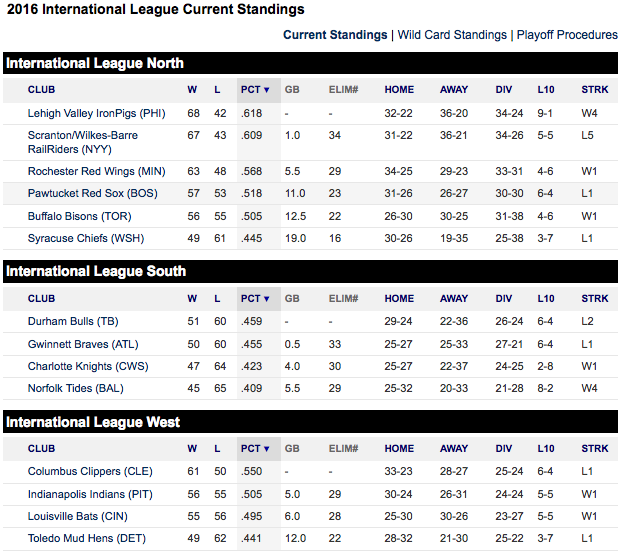
While it is true that the Red Wings have not had much postseason success during the Twins’ years, with only two appearances and no titles. However, this forgets that the Wings have been competitive for most of the Twins era and probably would have reached more postseasons if not for the tough IL North division and some bad luck. In 2014, for example, they were not eliminated until the final weekend of the year. 2015 saw something similar, and had the Red Wings finish with the same record as the previous two seasons, including the 2013 year where they made the playoffs. This season may see the Red Wings miss the playoffs despite currently having the third best record in the league.

It’s not the Twins fault that Rochester geographically lies in the International League’s toughest division, nor is it their fault that the IL doesn’t have a rule that kicks any team under .500 out of the playoffs, to be replaced by the Wild Card runner-up:

#ContractTheILSouth

#ContractTheILSouth

2. The Twins are a Better Farm System, from a winning perspective.

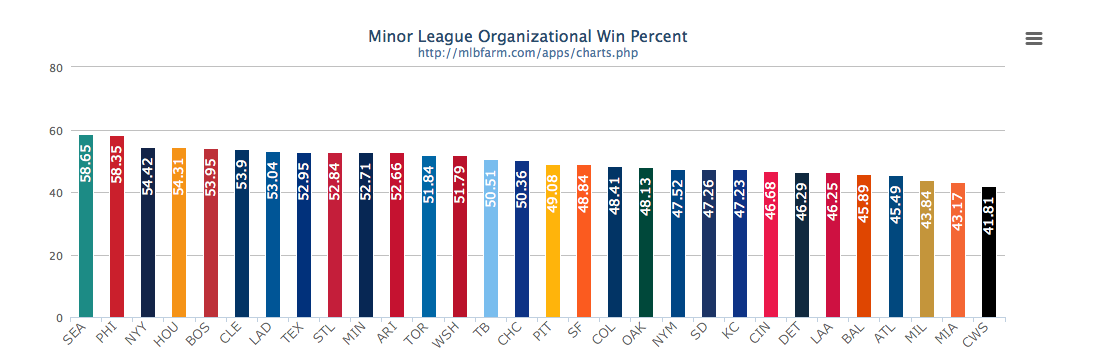
Here’s a look at the winning percentages of farm systems, as of August 3:

Screen Shot 2016-08-03 at 5.12.40 PMAs you can see, the Twins are a respectable 10th place. This is the entire organization, from AAA all the way down to the lowest of Rookie leagues. The Mets, meanwhile, are sub-.500 and are at 19th. And if you go level by level, the Twins have a better team in most of them: The AAA Twins (the Red Wings) have a better record than the AAA Mets (Las Vegas). The AA Twins (Chattanooga) have a better record than the AA Mets (Binghamton). The low-A Twins (Cedar Rapids) have a better record than the low-A Mets (Columbia). The rookie-ball Twins (Elizabethton) have a better record than the rookie-ball Mets (Kingsport). The Twins even have a better record in the Gulf Coast League! The only minor-league level where both organizations have teams and the Mets have a better record than the Twins affiliate is the High-A Florida league.

It’s been said that the two biggest determinants of minor league team attendance are also the two things the local GM (in the minors, the GM is more of a business position, not like the position in MLB) has the least control over: how the team is doing, and how the weather is. Except that isn’t really true, as the Minor League team CAN decide who it affiliates with. And when you look at the success on the field up and down the minors, the Twins clearly are the better choice when it comes to wins than the the Mets.

3. The Twins have better prospects overall than the Mets.

One of the neatest things about Minor League Baseball is that you can see the stars of tomorrow. And in this case, the Twins have a better case than the Mets. At the beginning of the year, MLB.com listed the Twins as the fifth best farm system in baseball. While obviously this has likely changed as players like Max Kepler and Byron Buxton have headed to the big leagues, it should be noted that the Mets were nowhere to be found in the top ten this year, and another site (which ranked the Twins 8th) put the Mets all the way down at number 20.

4. The Mets probably wouldn’t cause the big attendance boost some people think.

My fellow Rochester seamheads will remember the Empire State Yankees. In 2012, as their stadium was being renovated, the Scranton Wilkes-Barre Yankees (now the Scranton RailRiders) played their home games on the road, mostly in Rochester. Before the season, some Yankee fans were declaring that the people of Rochester would love them and support them even more than they did the Wings, that it was a dream come true, etc. etc.

Well, here’s the secret: The Empire State Yankees were a bust. Look at this news report from back then:

Yes, the Baby Bronx Bombers were in town and, with the exception of a Andy Pettitte rehab assignment, they drew flies, despite the fact they had a very good team. And the Yankees are definitely far more popular in Rochester than the Mets.

Now, admittedly, the fact that they were the “Empire State Yankees” and not the “Rochester Red Wings, AAA Affiliate of the New York Yankees” probably had a lot to do with it. But when you consider that attendance wasn’t particularly skyrockety for the Buffalo Bisons when they had the Mets affiliation (although to be fair, the Mets system was even worse back then), I think it’s safe to say that in general the affiliation doesn’t drive attendance all that much- winning and weather does. And as I showed with number two and number three, the Twins are a better choice for that.

5. The Mets have horrible owners.

Red Wings fans still speak in hushed tones about Orioles owner Peter Angelos. Why, the only people who hate Peter Angelos more than Red Wings fans are Orioles’ fans! GET IN LINE, NATS FANS, THIS SPOT IS TAKEN! Peter Angelos’ interference with minor league operations, general incompetence, breaking of traditions, and favoritism (intentional or not) to other teams in the Orioles’ system (especially the AA Bowie Baysox) led to the end of one of the longest affiliations in baseball. Well, say what you will about Angelos, but to the best of my knowledge he never ended up drowning in debt after being caught up in a massive Ponzi scheme and as a result been unspeakably cheap for his team that was in the World Series last season and plays in New York City. Nor, to the best of my knowledge, has Peter Angelos been sued for firing somebody because she had a baby out of wedlock and then resolved it before it reached trial. And while I’m sure he (like, sadly, seemingly every single MLB owner) would sign somebody who was suspended for domestic abuse, he hasn’t as far as I know. Yet.

But you know who has done all of this? The owners of the New York Mets! Now, full disclosure, I own a very small (essentially symbolic) portion of the Rochester Red Wings (I covered this before). Not enough to make a difference, but I do own some. But let’s say I did own enough. Would I want to do business with the Wilpons?

No. No I would not.

6. The Red Wings shouldn’t be like other Minor League teams

Many minor league teams change affiliation with relative regularity. The Red Wings don’t- they were Cardinals affiliates from the late 20s to 1960, and then spent the rest of the 20th century and the first two years of the 21st with the Orioles. That means that it should still be another decade or two left with the Twins. Perhaps I’m just being a romantic, ignoring the business nature of modern baseball. And, to be sure, if everything was bad and the Red Wings were doing horrible with no good hope in the lower minors, I’d agree that perhaps it’s time to move on. But the Wings have been one of the most successful minor league franchises in history by not changing course at the first sign of trouble, and I see no reason to start swapping every decade or so now.

So… I say: stick with the Twins and nix the Mets. The reasons to stay with Minnesota lay in the evidence, and the reasons to go to the Mets are nowhere near as high as they seem.

And, besides, if the Mets want to be in Rochester so damn bad, maybe they can call back in two-to-four years. By that point, maybe whoever has replaced Terry Ryan will have shown how he will treat the minor leagues. And maybe they won’t be owned by the Wilpons either.


Death To Copy-Pasted Minor League Team Names

There is something that annoys me in Minor League baseball. And that thing is minor league teams that just copy what their parent club’s name is. It is, in a way, almost insulting to the city that hosts the team plays in, making it impossible for that team to truly build a unique identity. To be sure, there are exceptions- the Pawtucket Red Sox have been around since the 70s and it seems inconceivable to think of them as anything else- but in general, they are generic names that make it impossible for the team to truly represent the town it plays out of.

So, today, I declare war on most of the Copy-Pasted Minor League Team Names…. after the jump:

Continue reading