Bizarre Baseball Culture: Dash Dartwell’s PED use for justice

In Bizarre Baseball Culture, I take a look at some of the more unusual places where baseball has reared it’s head in pop culture and fiction.

Steroids and other performance-enhancers are, to sports, a plague. They provide some players an unfair advantage, threaten the integrity of records, and could also endanger the long-term health of the user. The great struggle of 21st century sports has, in many ways, been the struggle against PEDs.

But, as today’s installment of Bizarre Baseball Culture shows, the the view that PEDs are bad goes against human nature and human fantasy. The human experience, the human dream, has always been about becoming better. It is one reason why, for example, that larger-than-life heroes have been popular since ancient times.

So it is perhaps not surprising that fictional superhumans (who by their nature are better than human) have often gone hand-in-hand with PEDs (which by their very nature make the user better than the average human). Steve Rogers, for example, became Captain America after being given a Super-Soldier Serum by the American government. Bane, the villain who once broke Batman’s back and appeared in less-steroidy form in The Dark Knight Rises, got his great strength from a drug known simply as “Venom”. Even Popeye, with his spinach, could be said to be using some type of performance enhancers.

But few stories actually have an athlete using a PED… but I have found at least one, featuring the obscure hero Dash Dartwell (sometimes called “The Human Meteor”), a college athlete who has gotten “Metabo-tablets” from a biochemistry professor that make him superhuman until the pill’s effect wears off.

Amazing Man Comics #22, the issue from May 1941 which contains this story (it starts on page 41), can be found here. Go below the jump for the rest of this installment of Bizarre Baseball Culture.

Continue reading

Bizarre Baseball Culture: The Little Wise Guys and the Absent-Minded Natural

In Bizarre Baseball Culture, I take a look at some of the more unusual places where baseball has reared it’s head in pop culture and fiction.

There is nothing new under the sun. That is one way to sum up the tale of “The Trick Baseball Bat” by Charles Biro (story) and Norman Maurer (art). It stars the comic sidekicks of a superhero named Daredevil (who’s name was later taken up by a Marvel character), it involves a magic bat (you know, like The Natural, only in this case it’s actually magic) and said magic bat is made out of a special type of wood that is incredibly bouncy (like Flubber in The Absent-Minded Professor). Oh, and that wood? It got it’s amazing powers from being nuked.

And the thing is, this story was from 1951. That was a year before Malamud’s The Natural hit bookshelves, a decade before The Absent-Minded Professor was in theaters and at the start of the 1950s, where every B-Movie ended up having some sort of monster mutated by atomic radiation, although to the best of my knowledge none of them were bouncing wood. It is a stretch to say that this story (in the public domain, originally printed in Daredevil Comics #77, found here) is the inspiration for those works (it has a significantly different ending), but it is a interesting coincidence. Too interesting to have been ignored up until now.

(more after jump)

Continue reading

Now available for purchase: Joe Connor’s “World in a Ballpark”

The Baseball Continuum is proud to offer for purchase the World Baseball Classic guide, World in a Ballpark: Baseball Goes Global, written by published international baseball writer Joe Connor. Connor is a world-traveling freelance writer who has written about baseball in more than 30 countries. His work has appeared on ESPN.com, NBCSports.com, MLB.com and other respected outlets. Connor has, since 2001, written a series of travel guides about baseball on many topics, including international baseball such as the World Baseball Classic and the Caribbean Series. World in a Ballpark focuses on baseball in countries all around the world, including all 16 participants in the 2013 WBC. It is available for purchase below.

World in a Ballpark: Baseball Goes Global

A 275-page guide detailing what’s happening on the ground across the globe, with scouting reports on the growth of baseball across six continents and in more than 100 countries. $24.99, PDF file will be e-mailed to you.

BuynowCC_LG

The guide is also available for purchase on the “Joe Connor’s WBC Guide” tab at the top of the page.

BOOK REVIEW: “Baseball Is Just Baseball: The Understated Ichiro” by David Shields

The most famous baseball player since 2001 is almost certainly Derek Jeter. But perhaps the most interesting player of the time period is Ichiro Suzuki. Or, rather, Ichiro… no last name needed. The first and greatest Asian everyday-player in MLB, Ichiro has dazzled with his quick baserunning, excellent defense, and the hitting that will lead him to be the first Japanese player to make it to Cooperstown.

And along the way, he’s amused and inspired baseball fans with his wit and wisdom. Perhaps it is because of his unique perspective on our culture, perhaps it is because of the way his translator interprets what he says in his native tongue, or maybe he just has a good way with words. But no matter what, through the years, Ichiro has been giving the world some great quotes. They have ranged from profound life-mottoes like “Failure is the mother of success,” to insults, such as “If I ever saw myself saying I’m excited going to Cleveland, I’d punch myself in the face, because I’m lying.” {sic}

(Ouch!)

For that reason, Baseball Is Just Baseball: The Understated Ichiro, by David Shields, is a book that, had it not existed, somebody would have had to create it. Originally published in 2001- Ichiro’s debut year on our shores- this new edition from Blue Rider Press (part of the Penguin Group) adds more quotes (bringing it up to his arrival with the Yankees) and a introduction by the author.

And, overall, it is a great read, providing the reader with bite-sized amounts of Ichiro wisdom. Starting with Shields’ introduction, which talks about how he first came to love watching Ichiro play, Baseball Is Just Baseball is a non-stop love letter to the outfielder, almost entirely made out of quotes by him, with some anecdotes here and there to provide context.

If the quotes had been simply placed in a random order, or even in some type of chronological order, the book may have seemed disjointed. Thankfully, however, Shields instead collects the quotations in a somewhat flowing style, where each quote is connected to those around them. The quote about Cleveland, for example, comes immediately after a quote about a time he missed a fly ball in Cleveland. This gives it something of a “plot” to follow, watching many of the quotes merge into each other and connect, showing how Ichiro’s opinions have shifted or have remained the same and also providing some humor to the proceedings (such as the aforementioned Cleveland quote).

However, it isn’t perfect. For one thing, it is heavily weighted towards quotes from Ichiro’s early years, likely a result of how this book was originally written in 2001. In addition, those who expect it to be a biography would end up being greatly disappointed- although Baseball Is Just Baseball makes no claim to being such a book.

However, all-and-all, I would recommend this book, especially for fans of Ichiro or of good baseball quotes.

FULL DISCLOSURE: THE COPY OF THIS BOOK USED FOR THIS REVIEW WAS PROVIDED TO ME BY THE PUBLISHER.

“Moneyball” is a book that has shaped America. No, seriously.

The Library of Congress recently released a list of 88 Books that Shaped America, which are part of a current exhibit at the Library. It’s a pretty good list of books (which had to either be written by an American or by somebody who became an American), and it’s hard to argue with most of them. However, it’s missing something big: sports. America is the most diverse and sports-loving country on Earth. Most countries focus on only one sport (usually soccer), but America has many sports, and it affects our language and culture. We ask for ballpark figures and play Monday morning quarterback. Something that is a certainty is a slam dunk. It’s one of the last few universal experiences: at a sporting event, nobody cares (or at least 99.9% of people don’t care) what party you vote for or what you do for a living.

That the LoC would so ignore this aspect of American life is disappointing, especially because there are plenty of good sports books out there that have shaped America. Jim Bouton’s Ball Four was one of the first books to openly tell things like they were and show the public’s heroes with all of their flaws. Buzz Bissinger’s Friday Night Lights highlighted the importance of football in small-town Texas, and later was made into a movie and TV series. Juiced was hardly a triumph of literary genius, but it can’t be denied that Canseco shaped not only baseball but America, leading to the government hearings and efforts by all sports (although people only cared about what baseball did) in trying to fight it.

However, if I could add in one sports book to the Library of Congress list, it would be Michael Lewis’ Moneyball.

(jump)

Continue reading

Mini-Bizarre Baseball Culture- Tony Stark: Baseball Fan

In Bizarre Baseball Culture, I take a look at some of the more unusual places where baseball has reared it’s head in pop culture and fiction. This is a smaller installment of that.

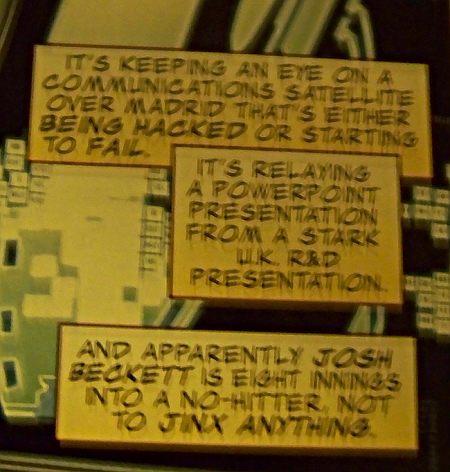
In the trade paperback entitled The Five Nightmares (by Matt Fraction), Tony Stark AKA Iron Man has traveled to the Congo to investigate a genocidal supervillain organization that may have replicated his technology.

He also is tracking a few other things. Y’know, R&D meetings, messed up satellites….

… and Josh Beckett throwing a no-hitter.

Iron Man = Baseball Fan.

(The use of this low-quality photo of a very small portion of a larger storyline qualifies as Fair Use under US copyright law.)

Want more Bizarre Baseball Culture? Check out after the jump.

Continue reading

Bizarre Baseball Culture: Doll Man fights the Baseball Bandits

It’s time for another installment of Bizarre Baseball Culture, where we look at some of the weirdest uses of the National Pastime in the history of pop culture (no matter how low or high-brow). This time, continuing the series of unusual old comic book adventures that featured baseball, we have the story of Doll Man and the “Baseball Bandits.”

Read more after the jump.

Continue reading

Bizarre Baseball Culture: Amazing Mystery Funnies #22 has exploding baseballs

There is a story that, during one of their several hundred attempts to assassinate or overthrow Fidel Castro during the 1960s, the CIA considered sending him baseballs that would, after a time, explode in his face.

With that in mind, perhaps the story featuring the “Fantom of the Fair” in Amazing Mystery Funnies #22 has more truth to it than it appears.

(more after the jump)

Continue reading

Bizarre Baseball Culture: Captain Marvel teaches baseball… to Martians

Baseball has an unusual relationship with the rest of popular culture. There are more baseball movies than basically any other kind of sports movie (with the exception of boxing, which is very easy to stage), Charlie Brown’s ineptness on the mound lasted fifty years, and almost every TV series ends up having at least one casual mention of the game at point or another.

But with this, sometimes popular culture about baseball can get, well… weird. Bizarre!

This is part of a series about those times. Sometimes it’ll be short stories (like that old tale about 2044 baseball), other times comic books, occasionally a movie clip or advertisement. No matter what, it’ll be weird, it probably won’t be very good, and I’ll give it far more attention than it really deserves.

So, for the first edition of BIZARRE BASEBALL CULTURE (I’ll consider the 2044 baseball story as something of a prologue), I bring to you this:

Captain Marvel. Playing baseball. On the planet Mars. In a story that is about how Captain Marvel taught the Martians baseball. Fittingly, this has been set to go up on a Saturday morning. More underneath the jump.

Continue reading

Rockets Rigby’s baseball career was only the beginning…

Okay, so out of curiosity, I did some googling as to whether anybody else had written about the bad-but-interesting tale of Rockets Rigby and baseball in the year 2044. They hadn’t. At least, not as of this morning.

I did, however, find a bibliography for Mr. Jim Moore, and listed is a story entitled “The Good New Days” from Super Sports in March 1953. The site notes that it is a Rockets Rigby story about “21st century football”.

Wait, there were more Rockets Rigby stories, and he was a multi-sport athlete? My far-overdone analysis of “Rockets on the Mound” is already the most popular post in the Continuum’s admittedly young history, so obviously there is some interest in it. So, to paraphrase Andy Samberg as Nicholas Cage: “HOW AM I NOT BLOGGING ABOUT THESE STORIES!?!?”

The reason, of course, is that they aren’t available online like “Rockets on the Mound” is. Or are they? If you know where more of Jim Moore’s sci-fi sports stories can be found, let me know.