Rockets Rigby’s baseball career was only the beginning…

Okay, so out of curiosity, I did some googling as to whether anybody else had written about the bad-but-interesting tale of Rockets Rigby and baseball in the year 2044. They hadn’t. At least, not as of this morning.

I did, however, find a bibliography for Mr. Jim Moore, and listed is a story entitled “The Good New Days” from Super Sports in March 1953. The site notes that it is a Rockets Rigby story about “21st century football”.

Wait, there were more Rockets Rigby stories, and he was a multi-sport athlete? My far-overdone analysis of “Rockets on the Mound” is already the most popular post in the Continuum’s admittedly young history, so obviously there is some interest in it. So, to paraphrase Andy Samberg as Nicholas Cage: “HOW AM I NOT BLOGGING ABOUT THESE STORIES!?!?”

The reason, of course, is that they aren’t available online like “Rockets on the Mound” is. Or are they? If you know where more of Jim Moore’s sci-fi sports stories can be found, let me know.
Great Bats in History

Josh Hamilton’s bat is dead.

No, I don’t mean his hitting ability, I mean his bat. Literally. It cracked a bit over the weekend. But this was no ordinary bat. It will go down in history as one of the great bats of baseball lore. It hit eight home runs, including four in a game, during one of the greatest weeks in hitting history. Such was it’s reputation that, before being sent to Cooperstown, the Rangers let people pay $5 (to charity) to pose with it on Monday. 

A few things about the bat:

-It’s a H359 Louisville Slugger. It was made to Hamilton’s specifications after he signed an exclusive deal to use the company’s bats. It’s made of M9 maple and is 35 inches long.

-Befitting Hamilton, who credits his religion with helping him defeat the substance abuse that nearly killed him, he has a Bible notation emblazoned upon his bats: Jeremiah 29:11. I looked that up, and here it is-

“For I know the thoughts that I think toward you, saith the LORD, thoughts of peace, and not of evil, to give you an expected end.”

So now that we know of this great baseball bat, what about some of the other great baseball bats in history? Read on to find out about some of them.

Continue reading

Baseball in the Year 2044: A look at “Rockets on the Mound”

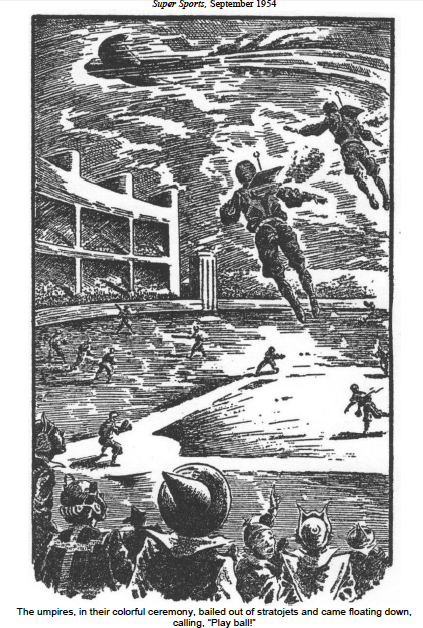
The internet is a great place. Really, it is. And one of the reasons it is great is that you can find practically anything on it. Take, for example, short stories. There are countless stories that are in the public domain, either because they are really old, or because nobody bothered to renew the copyrights on things from cheap pulp publications. It’s from one of those that “Rockets on the Mound” comes from. First printed in 1954 in Super Sports magazine, and written by one Jim Moore, it is the tale of a baseball team in 2044 and it’s star, Rockets Rigby, who is in a horrible hit-and-run flying car accident. Seriously.

But before all of that, check out this picture that goes with it:

First, let’s note the field itself. It has a lot of space, almost circular in appearance. I mean, look at all of those players practicing to the left of the diamond, where they are conducting warmups as the umpires descend with their jet-packs from the stratojet. As this huge amount of foul territory can show, Moore was foreseeing the rise of multi-use facilities, and the Oakland Coliseum in particular. Either that, or whoever was hired to do this image hadn’t seen a baseball field in their lives. Also notice how the fans are dressed. Apparently, in the 2040s, women will all wear pointed witches’ hats and gigantic collars, while all of the men will wear space-cadet helmets. Nobody wears plain-old baseball caps, nor even the hats men wore in public before President Kennedy made them go out of style. Also, the “stratojet” used to bring the umpires in seems to be powered by a rocket and has swept wings. An F-16 flyover it isn’t…

Anyway, a few things to keep in mind before we start:

Continue reading

The Art (and Question) of the Farewell Tour

It is a given these days that future Hall of Famers announce their retirements in advance, so that they can receive their applause from the rest of league. It is a good tradition, allowing even every city and fanbase to show their appreciation to a transcendent talent.

It is an old tradition. During his famous “Luckiest Man” speech, for example, Lou Gehrig noted that the New York Giants had sent him a gift, despite the fact he would, he admitted, have been willing to cut his arm off to beat them.

The tradition continues to this day. Take this tidbit about what the Cardinals have given Chipper Jones:

It’s hardly surprising that the Cardinals would giving gifts to Chipper. Heck, a few days ago the Cardinal fans gave him a big round of applause during his first at-bat. Chipper will probably be getting a good reception most everywhere- in Wrigley Field, for example, he was given the Braves pennant that was used to indicate their place in the division standings.

But this leads to a interesting question: what is the proper etiquette for the teams? Do they look bad if they don’t give the retiring HoFer a gift? Like, if the Mets decide that Chipper Jones had inflicted too much pain on them during the 1990s and decide not to honor him, is that breaking one of the unwritten rules?

I think too much about some of this stuff.

East Coast Bias and ESPN Sunday Night Baseball Part 4: The Blue Jays

(Part 1, Part 2 and Part 3)

As part of my study of ESPN’s scheduling patterns for Sunday Night Baseball, I was somewhat surprised to see that the  team with the biggest discrepancy between performance and appearances on SNB were the Toronto Blue Jays.

Seriously. The Blue Jays had the 15th best record in baseball from 2007 to 2011, but were tied for 30th (dead last), with no appearances. They’ve had two of the best players in the game to knowledgeable baseball fans: Roy Halladay and then Jose Bautista have been in Toronto. But, guess what, they haven’t shown up on Sunday Night Baseball in recent years. At all. In fact, it was a bit of a surprise when I saw them on Monday Night Baseball earlier this season. Apparently, Tim Kurkjian had to appeal straight to the State Department to get some passport problems fixed, which is probably a good indication of how rarely ESPN gets up there.

But why, exactly, are the Blue Jays so ignored by ESPN, despite the fact they usually have a winning team? Well, there are two reasons, read on to see them.

Continue reading

A little thing about Sexism, Racism, Anti-Semitism and Bigotry in general

A few days ago, there was a news story that Our Lady of Sorrows, an Arizona high school run by a breakaway sect of the Catholic Church, had forfeited a game against Mesa Prep due to the fact that Mesa’s second baseman is female, citing religious beliefs. This is, of course, something that goes against every bone in my and most Americans’ bodies. It also is shameful in how it echoes past prejudices held in sports. Continue reading to see what I mean:

Continue reading

East Coast Bias and ESPN Sunday Night Baseball Part 3: Who gets ignored

As noted yesterday and the day before, ESPN does indeed have East Coast teams on Sunday Night Baseball more than many teams from other areas. However, it isn’t because ESPN wants teams closer to Bristol, it’s just that teams on the East Coast tend to do well both on the field and in the ratings, so it makes sense to schedule them more.

That said, there are some teams that end up getting the short end of the stick because of this. These are some of those teams.

Continue reading

East Coast Bias and ESPN Sunday Night Baseball, Part 2

As we saw yesterday, ESPN’s Sunday Night Baseball does, in general, feature more eastern teams than teams in other parts of the country.

But, as I said yesterday, that isn’t telling the whole story. Yes, there is an East Coast Bias in appearances, but that bias is not necessarily geographical so much as it is based on two factors: finding the best stories (which are usually the best teams), and getting the most eyeballs watching the games. In fact, at one point a VP of Programming and Acquisitions at ESPN even said as much.

Continue reading

Texas + Baltimore= Wackiness

On May 10, 1972, the Texas Rangers (formerly the Washington Senators) faced the Baltimore Orioles for the first time. The game was a tight pitching duel between Dave McNally and Pete Broberg, who both went the distance. In a strange circumstance, the Orioles would win when, in the bottom of the ninth, Merv Rettenmund would score on a error by Rangers’ catcher Ken Suarez. In other words, not a single earned run was scored in the 1-0 Orioles victory.

This set the tone for the future of the two most bizarrely matched teams in baseball. When the Red Sox and Yankees face off, the games go forever. When the Orioles and Rangers face each other, games go to the Twilight Zone. So after that first game, where no earned runs were scored, here are some notable occurrences since then:

Interestingly enough, the weirdness magnet that is Texas-Baltimore did not start when the Rangers moved their from DC. On Sept. 12, 1962, Senators pitcher Tom Cheney went 16 innings and had a record 21 strikeouts.

Know of any other weird Texas-Baltimore games? Let me know.

Great Predictions in History: Kiko Garcia will be the Orioles’ shortstop of the future (in 1980)

Google Books has lots of old Baseball Digest issues available. It is interesting to see how previous generations thought. And, so often, it is fun to see how wrong they were. Take this headline from March, 1980.

Kiko Garcia had an okay career and was able to stick around baseball for parts of 10 seasons, but ultimately he ended his career with a middling .239 BA, .286 OBP and .323 SLG. He had a total of 12 career home runs.

Funnily enough, at the time this was published in Baseball Digest, there was a third baseman in Orioles camp who, just the year before had hit a respectable .286 between Miami and Charlotte. He was headed towards a breakout 1980 season, where he’d hit .276/.367/.492 and hit 25 home runs. The year after that, he was in Rochester. And the year after that, he was Rookie of the Year in Baltimore… as a shortstop. Perhaps you’ve heard of him. He was Cal Ripken Jr.

Kiko Garcia, by the way, was sent to Houston in 1981 and never played in more than 100 games again.