WBC Update for 4-25-16: Rule changes, Team USA, Puerto Rico, and what Asian Countries will get WBC Pools?

It’s been awhile, but it’s time for a World Baseball Classic update!

General News:

A possible change in the WBC rules will be introduced in order to entice more pitchers to play. It would allow teams to add extra players the further they advance, so it could be possible, for example, for Clayton Kershaw or David Price (who both have passed on the tournament in the past because they didn’t want to rush their throwing schedule) to join later in the tournament.

At least two pools will take place in Asia during the 2017 Classic, with one in Japan and one in either Korea or Taiwan.

Connected to that: earlier this year, Twins broadcaster, Hall of Famer, and occasional Netherlands pitching coach Bert Blyleven said that the Dutch were expected to start their WBC campaign in Korea. Apparently that isn’t official yet, but definitely possible. This is mainly because Korea has a domed stadium and Taiwan does not.

While I can’t find the exact tweet/article about it, apparently the locations of the first round of the “main” World Baseball Classic will be revealed on May 10, so presumably all these questions will be put to rest then.

Pakistani coaches have attended a clinic in China in preparation for their qualifying pool.

Players on possibility of WBC play:

Mike Trout says it’s too early to say whether he’ll play in the WBC, although it sounds like he does want to do it, it’ll depend on how he feels.

Staying on Team USA, the dream of a Team USA Madison BumgarnerBuster Posey battery apparently isn’t a pipe-dream. Although neither of them have said definitively, both of them said they were open to it.

Sonny Gray, meanwhile, thinks it’d be “awesome” to be on Team USA.

Francisco Lindor is excited to play for the Puerto Rican national team.

Look later this week as I make another projection for Team USA! And if you see any WBC news I missed, let me know by tweeting me at @DanJGlickman or e-mailing me at Djgwriter@yahoo.com!

BIZARRE BASEBALL CULTURE: The Kool-Aid Man Cometh (W/bonus Kool-Aid Commercial)

In Bizarre Baseball Culture, I take a look at some of the more unusual places where baseball has reared it’s head in pop culture and fiction.

There is a man. A man unlike any other other. He’s not really a man, he’s more like a anthropomorphic water-pitcher filled with Kool-Aid. He is the Kool-Aid Man, and he is the subject of this installment of Bizarre Baseball Culture:

KAMcoverOH, YEAAHH! It’s time for The Adventures of Kool-Aid Man #1 from Marvel Comics in 1983. Go below the jump for more:

Continue reading

Chris Colabello: Too Real For Hollywood

So, there is this guy. He’s a ballplayer. Not a particularly great or notable one, but still a ballplayer. He’s so desperate to keep playing that after college he moves to the land of his ancestors: Italy. He plays baseball there, is pretty good. Falls in love with a local. Marries her, they spend their days split between Massachusetts and Italy. They have a son.

That son follows in his father’s footsteps, growing up and playing baseball on two continents. Trials and tribulations- of his own making and of fate’s- seem to keep him from reaching his true potential, and after college he, like his father, finds his baseball career seemingly at an end. Except instead of across the sea, the son stays near home: Independent Ball. The last hope or only shot of the truly baseball-desperate. Pitiful salaries, long bus rides, no fame… only dreams.

He spends seven years there, occasionally leaving to represent Italia, the land where he grew up and where his mother was born. Most would quit, or at least consider other options. This guy doesn’t. He keeps going, and finally, when he’s in his late 20s, he’s doing so well he cannot be ignored. A major league organization signs him, and at age 28 he begins his first Minor League season, nearly four years older than his average teammate.

And he is a revelation, as he becomes one of the best hitters on a team with some of the farm system’s best prospects. The next year, in AAA, he does it again and is named MVP in the league, becoming a fan favorite in a Upstate New York town in a season that began with him pacing his ancestral home to it’s best showing in the history of the World Baseball Classic.

Except…. it’s not the end. He was called up. He doesn’t do all that well in his first stint in the show, but it’s a dream that he had scraped and clawed for so long, finally achieved. That offseason, with no guarantees of a roster spot the next season, he is offered a big money deal from a team in Korea. He could make more money than he ever has. He refuses, as it would mean shutting the door, perhaps permanently, on his Major League dreams.

At first, it seems he made the right decision. He gets a roster spot and starts the year on a historic tear, breaking the team RBI record for April that had been set by a legendary man. He hits a home run in front of his parents as they are interviewed on television, a birthday gift to his mother.

But then… it falls apart. April proves the exception, and in late May he is sent down to AAA… even as the program-covers that greet fans at the Major League ballpark bear his face. He goes back and forth like a yo-yo, but ultimately he spends more time in AAA than he does in the show.

For some, this would be the end. Those gasps of major league greatness would be all there would be. Not for him. The next year, after a good start in AAA, he goes to a third country: Canada. He never recaptures that April, and he doesn’t play every game… but he doesn’t need to. He’s another bat in a lineup of big bats. He has a career year, and he is a mainstay in the starting lineup during the postseason, where he hits two home runs.

It seems, perhaps, that he has finally arrived. But then, the next season, he starts on a slump. Some wonder if he might again get sent down. And then, late in April, the slump becomes the least of his worries.

He’s suspended for 80 games for using a Performance Enhancing Drug. An old one. East German. And suddenly, a story that seemed too extraordinary for Hollywood becomes one that is too real for Hollywood.

It’s the story of Chris Colabello, son of Lou Colabello. His has been a story of near-biblical persistence and long odds. A story that brought him from Italy and Massachusetts, through New Britain and Rochester and Minneapolis and Buffalo, and finally to Toronto. That he suddenly is caught using a Cold War-era PED in some ways casts a shroud of doubt on all of it.

There is, of course, no way of knowing if that is the case. It seems unlikely that he would have been using such a obvious and classic steroid for so long without getting caught. After all, this is a player who would have been subject not just to the MLB tests of the past few years, but also tests in the minors and in overseas competitions.

Perhaps he was using something else this whole time.

Perhaps it was just a mistake. It could have been a accident or (for the more conspiracy-prone) an act of malice by a trainer or pharmacist.

Or maybe, having finally truly tasted the highest heights of his profession, Chris Colabello thought he needed to do anything and everything he could to stay there, or perhaps even go higher. And perhaps, like Icarus, he got too close to the sun.

I don’t know. Nobody, aside perhaps from Colabello himself, knows.

And perhaps that is why his suspension is so unsettling to myself and many other baseball fans, particularly fans of the Twins and Blue Jays. An icon of hard work and perseverance, suddenly found to have been taking the easy way out. Over a decade of work, seemingly thrown away.

What this means… I’m not sure I’ll ever know. I’m not sure if we’ll ever know.

Perhaps it just means that Chris Colabello, like all of us… is human.

Who’d be on MLB Money?

After reading about the addition of Harriet Tubman to the 20 dollar bill, I got to thinking: If Major League Baseball had it’s own currency, who’d be on it?

It’s not entirely outlandish. After all, there are Disney Dollars and up in Canada they have Canadian Tire money, it’s not that much out of the realm of possibility that baseball could have it’s own currency that could only be used at ballparks, team stores, and the like. Maybe they could call them “Baseball Bucks”, or something like that.

So… who’d be on these… Baseball Bucks?

$1: Henry Chadwick. The one-dollar Baseball Buck would have to, like George Washington on the US $1, be that of a founding father. While Chadwick can’t be considered as one of baseball’s many possible inventors, he was one of the men who helped promote it and made it a widely-played sport.. He also developed many of the game’s mainstay statistics, such as batting average and ERA. It’s not surprising, really, that some have called him the “Father of Baseball”. So, it feels right that he’d be on the $1 Baseball Buck. On the other side of the $1 Baseball Buck would be a image of the Elysian Fields in New Jersey as it was during the early days of baseball.

$2: Ty Cobb. Thomas Jefferson is a guy who was so great, important, and brilliant that he kind of has to be on money, but who’s life was so full of personal failings and hypocrisy that at times you kind of wish you didn’t have to put him on money. So in some ways it’s good that he’s on the two-dollar-bill, the rarest of all currently-printed banknotes. I’d imagine that a similar arrangement would exist for Baseball Bucks. Ty Cobb was too good and too important of a player to be ignored, but, well, he was Ty Cobb, possibly the meanest son-of-a-gun to ever play the game. He possibly once killed a drifter, he once beat up a crippled man, and his racism is so well-known that it’s entirely possible he was less racist than many people think he was (he was still pretty racist, he just wasn’t as racist as Cap Anson, who was certifiably The Worst). But he also was unquestionably the greatest baseball player of all time before Babe Ruth showed up and still stands as one of the greatest hitters who ever lived, so…. he’s going to be the Baseball Bucks version of Thomas Jefferson. The reverse of the $2 Baseball Buck would be the late Tiger Stadium.

$5: Jackie Robinson. The $1 dollar bill belongs to the father, but $5 dollar bill belongs to the emancipator. Perhaps that is giving Jackie Robinson too much credit- after all, the integration of baseball was ultimately a result of many men (and women!), both black and white- but the fact remains that Jackie Robinson, more than anybody else in baseball history, belongs on money. And I’m talking about real money here, not fake hypothetical baseball money. So, not surprisingly, he’s a shoo-in for being on a Baseball Buck. The reverse of the $5 Baseball Buck would be Jackie Robinson sliding in as he steals home against Yogi Berra and the Yankees during the 1955 World Series.

$10: Ted Williams. I can’t really make any deep connection between Alexander Hamilton and Ted Williams (outside of the fact that they were both workaholic veterans who didn’t have the most stable of family lives growing up and made a bunch of enemies), but… c’mon, he’s Ted Williams. He’d have to be on a Baseball Buck. The reverse of the $10 Baseball Buck would be Fenway Park.

$20: Satchel Paige. There needs to be a pitcher amongst these legends, and while Walter Johnson, Cy Young, Sandy Koufax or Greg Maddux (amongst others) would all have fine claims, none of them were as colorful and legendary as Satchel Paige, who would also provide a nice nod to the great Negro Leaguers. The reverse of the $20 Baseball Buck would be the Negro Leagues Museum in Kansas City.

$50: John McGraw. There needs to be a manager. John McGraw is the greatest manager of all time (anybody who disagrees is also disagreeing with Connie Mack, who once declared that McGraw was the only true manager in baseball), so he’s it. It would make sense to have him be the $50 Baseball Buck, since the real fifty-dollar-bill has Ulysses Grant- a general- on it. The reverse of the $50 Baseball Buck would be Comiskey Park during the first All-Star Game, which McGraw managed in.

$100: Babe Ruth. It’s all about the Babe. And, just as Ben Franklin excelled in multiple areas and had a infamous appetite for food and women, so did the Bambino… although admittedly pitching and hitting is a bit different than politics and science (and writing, and philosophy, and… you get the idea.) And, much like how Ben Franklin was the first grand American celebrity, Ruth was baseball’s first megastar. Who else could be on the biggest denomination? The reverse of the $100 Baseball Buck would be the Baseball Hall of Fame in Cooperstown.

You may be wondering who’d be on the coins. Well, there wouldn’t be any coins, probably. I mean, Disney doesn’t have any coins in their Disney Dollars, so I don’t think MLB would, either. Maybe I can do that in another post….

MVP of Yesterday (April 19, 2016): Drew Smyly

Drew Smyly went 8 innings of one hit shutout ball, walked only two, and struck out 11…. but the Rays didn’t score until the 11th inning, so he didn’t get the win. Proving, once again, that the win stat is severely flawed.

But, hey, at least he got MVP of Yesterday.

Standings after the jump:

Continue reading

MVP of Yesterday (April 14, 2016): Vince Velasquez

Vince Velasquez had the best game of his young career yesterday, dominating the Padres while  striking out 16 in a three-hit shutout win for the Phillies.

Needless to say, he’s the MVP.

Standings after the jump:

Continue reading

A Short Book Review: “Breaking Ground: How Jackie Robinson Changed Brooklyn”, by Alan Lelchuk

Note: I was provided a review copy of this book by it’s publisher.

In “Breaking Ground: How Jackie Robinson Changed Brooklyn”, author and teacher Alan Lelchuk tells the familiar story of Jackie Robinson from a different perspective: that of the people of Brooklyn, especially his family, including his parents, Jewish immigrants from Russia. It’s a short book, more of an extended essay of 117 pages, and it’s an overall mixed bag.

First, the good. It is a unique look at Jackie’s time in Brooklyn told by somebody who was growing up there as it happened. While obviously colored by nostalgia and the passage of time, Lelchuk’s stories of how the diverse people of Brooklyn identified with Robinson are poignant. After all, many of them had suffered discrimination and persecution, and now their team had a similar outsider who was suffering from discrimination. There are also good stories about the effect Robinson had elsewhere in America, but it’s mainly about Brooklyn. You can really tell how much Jackie meant to them and Lelchuk.

However, this is far from a perfect book. At times, Lelchuk turns on the schmaltz a little too high or enters into “back in my day” ramblings, and still other times the English scholar kicks in a bit too much as he enters into comparisons of Robinson to fictional characters and other notable figures. It’s a bit too thick, given the subject matter, but thankfully they aren’t too numerous. Still, at times, it feels as if he is just filling space to make it long enough to justify being a book instead of an unusual long article.

Those cons are enough to keep this from being far from a must-purchase. Instead, it’s likely just for the Jackie Robinson completists out there. It’s not a bad book, but it most definitely isn’t for everyone.

OOTP Baseball 2017 Review

Note: I was provided a early review copy of the game.

First, let’s cut to the chase: Out of the Park Baseball is back in it’s 2017-titled installment, and it has maintained it’s strengths, improved in it’s weaker areas, licenses from both MLB and the MLBPA, and more data and options than ever. If you are wondering if it’s worth getting now over previous versions, the answer is: yes, yes it is. And if you are wondering if it’s a good OOTP to start with, I say: yes, yes it is. It’s not perfect, but nothing is.

Now, this review mostly focuses on what’s new. What I said in my three previous reviews still, for the most part, holds up.

But, man, what is added is substantial. Previous years may have added a bit here and there, or introduced features that, while good in theory, were somewhat unfinished in practice. And while that “never finished” feeling still is in effect in some areas of OOTP 17, this year’s installment is one of the most polished leap forwards in the series.

Take, for example, the 3D view. In previous years, the 3D view was sometimes more trouble than it was worth, and sometimes would wonk up the system. But now…

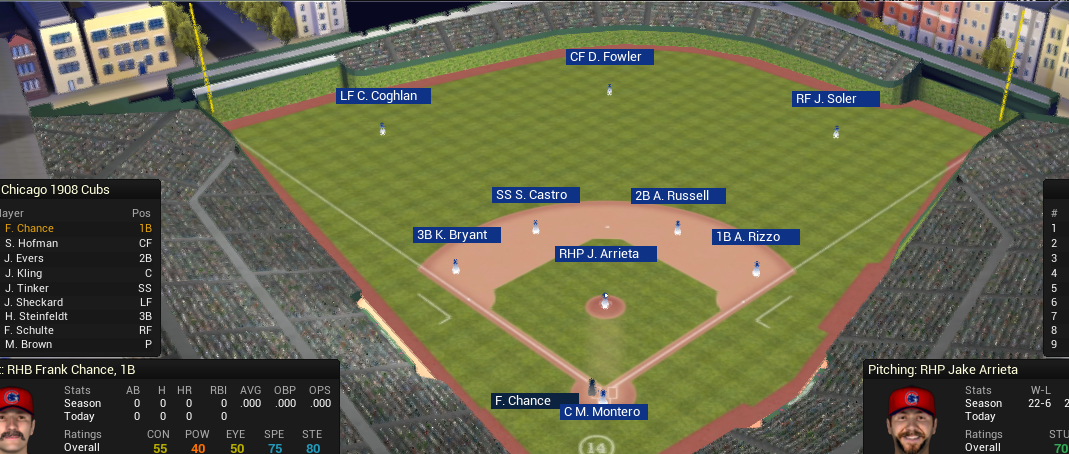
Screen Shot 2016-04-11 at 11.39.23 AMAs you can see, you can now see little peg-people representing the players. And they will move to represent the plays that happen. For example, if a batter walks, you’ll see their little peg move down to first, and if there’s a ball hit to left, you’ll see a little ball go to left and see the left-fielder chase it down. It’s not exactly high-technology, but it gets the point across. Even better, it doesn’t seem to affect how smoothly the game runs, although of course that will depend a bit on your computer. I love this, it adds a bit of “as it’s happening” flare to games that wasn’t there before, and turns what to me was something of a boondoggle way of viewing the field into something I’ll probably use regularly.

Also in that picture, you can see a bit of another great new feature: historical exhibition play! I covered this a bit during one of my “30 Teams, 30 Posts” installments, but I’ll cover it again a bit here. Basically, you can have any MLB team in history play any other MLB team in history. You could do this before, but it was very time-intensive. Now, it’s as simple as selecting a team and choosing your wanted setting and/or rosters. It’s both a good way to see interesting match-ups and also a good introduction to OOTP for people who haven’t played it before and don’t want to jump straight into the longer modes.

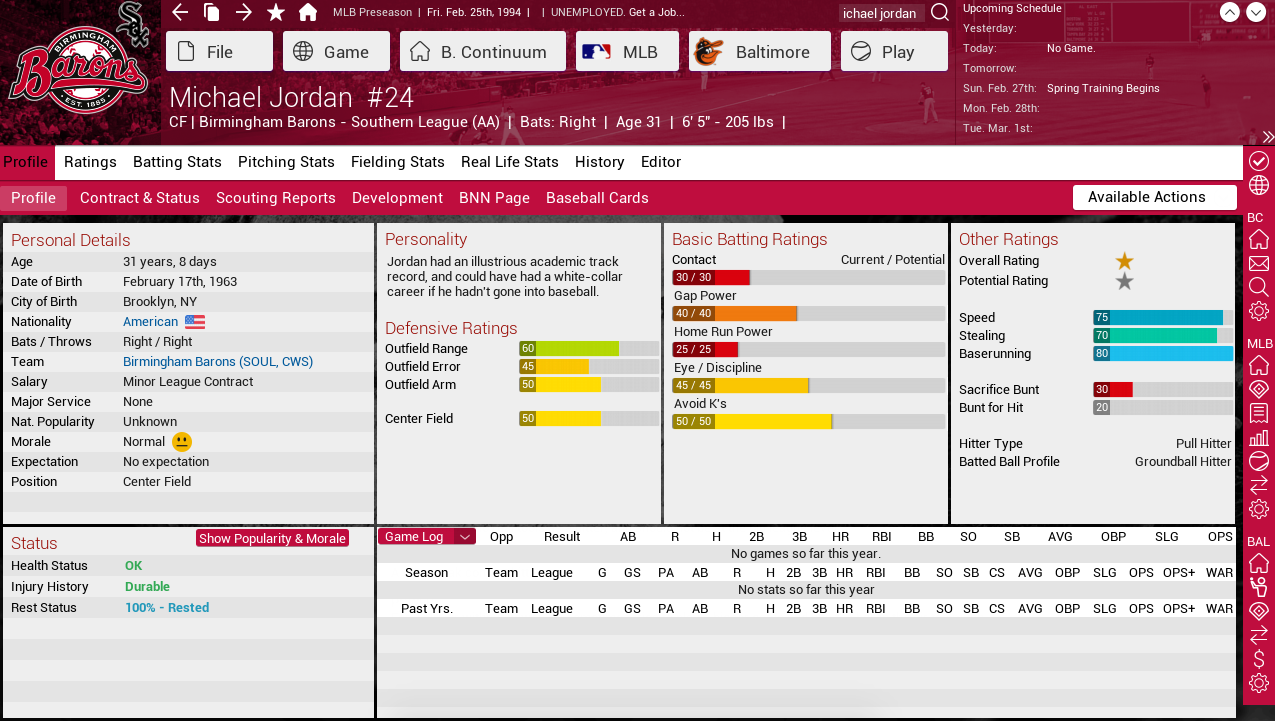
That doesn’t mean that the longer modes haven’t received updates. They have. In addition to the usual upgrading of rosters to their current state, is also the addition of historical minor leagues! Want to see what might have happened if Michael Jordan had continued his baseball career? You can!

Screen Shot 2016-03-24 at 10.06.07 PMWhile those are the big changes, there are also some small changes that, together, add a lot. For example, there are now computer-written recaps for games you play and/or simulate. Is it something that completely changes the game? No. But they are nice to have.

Really, if I have any issues with this year’s installment, it’s how the Steam version of it only supports the workshop for mods. In previous years, you could use a in-game system to download new logos and rosters from the internet easily, this time it only can connect to the Steam Workshop. While OOTP Developments has said that most if not all mods will eventually come to the Workshop, right now only two are there, meaning to get some mods you have to go poking around the internet for the files and install them manually. Annoying, but not a deal-breaker by any means. Hopefully it improves soon, though, as OOTP and Steam’s Workshop would seem to be made for each other.

But, really, other than that and maybe the occasional bug that will always rear up in a game of this scale and complexity, Out of the Park Baseball 2017 is quite possibly the greatest baseball simulator of all time. At least… until next year, when those mad geniuses will probably top it again!


MVPs of the Weekend and also Monday (April 8, 9, 10 and 11)

The MVP of Friday was Ross Stripling, who threw 7.1 no-hit innings IN HIS MLB DEBUT and all he got was this meaningless blog MVP award.

Saturday’s MVP was Matt Kemp, who had two HRs and six RBIs.

Sunday’s MVP was Felix Hernandez, who pitched great but didn’t get enough run support, ending up getting a no-decision.

On Monday, the MVP was Chris Davis, who hit a shocking 9th-inning HR off of Craig Kimbrel to help keep the Orioles undefeated.

Standings after the jump:

Continue reading

MVP of Yesterday (Apr. 6, 2016): Steven Souza

4-for-4 with two home runs, Steven Souza of the Rays is the MVP of Yesterday.

Standings:

Francisco Liriano: 1

Clayton Kershaw: 1

Noah Syndergaard: 1

Steven Souza: 1