BIZARRE BASEBALL CULTURE: Marvel Adventures Spider-Man 34 brings steroid accusations, hallucinations, and a angry father

In Bizarre Baseball Culture, I take a look at some of the more unusual places where baseball has reared it’s head in pop culture and fiction.

Sports have many problems. There are performance enhancing drugs, exploitative agents, a culture that honors people and asks their opinions for no other reason than that they are strong, and stupid adults who ruin everything.

And in Marvel Adventures Spider-Man #34, we get a hard-hitting glimpse at how this affects high school baseball in a Marvel Universe. BECAUSE SOMEBODY HAD TO TELL US!

Screen Shot 2015-05-29 at 1.39.53 PMPublished in 2007, this issue was part of the Marvel Adventures/Marvel Age imprint, a set of ongoing series that were meant for all-ages of readers. To make it more readable for younger folks, these series cut down on more complicated backstories, featured characters (like Spider-Man) that most kids would have been familiar with from TV or movies, featured younger versions of some characters (this Spider-Man is still in High School, for example), didn’t have as much violence, and eliminated bad language and sexual innuendo.

But… that doesn’t stop it from having steroid accusations, a angry father, sports agents, and other fun stuff! It also has a baseball uniform with a Koala Bear on it, which is cool.

Go below the jump for more!

Continue reading

OOTP International Baseball Competition Part 9: Week 8 brings lots of runs, a near-no-hitter, etc.

Throughout the year, I’ll be posting updates of a simulated league from Out Of The Park Baseball 2016 made up of national “dream teams” to determine what the greatest baseball country on Earth is… or something like that. Previous installments can be found here. This is a long post, so there is a JUMP after the first day. A glossary of storyline characters can be looked at here. Also, hit any picture to make it bigger and more readable.

May 18

Week 8 of the IBC began in Australia between the Dutch and the Australians. The Dutch would end up winning 9-6, not long before a Takayuki Kajitani 3-run home run in the 7th in Japan put the home team up 3-0 against Venezuela, a lead they wouldn’t give up. Not long after that, the Taiwanese finished off the Puerto Ricans, 5-4.

And then… everybody waited until night-time on the East Coast of the USA.

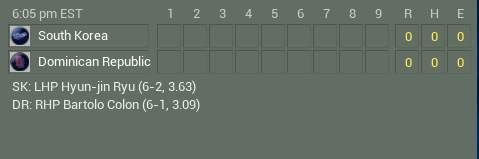
The first game of the night, at 6 PM, was South Korea vs. Dominican Republic. It was a nice pitching match-up:

Screen Shot 2015-05-26 at 7.25.02 PM(A reminder that injuries and such are, other than opening day injuries, entirely separate from actual reality, hence why Hyun-Jin Ryu is still playing despite being injured in the real world)

Bartolo Colon would prove to be the winner of the game, as the Dominican would be the first to get on the board, thanks to a Starling Marte double in the second. Robinson Cano and Adrian Beltre would add two more RBIs later in the game. Colon and the relievers (including Antonio Bastardo, who had to fill in after Joaquin got injured with two outs in the 9th) would hold the Koreans scoreless. Colon would strike out nine and give up six hits in the victory.

In Boston, Team USA once again demolished Italy, but “only” by the score of 13-1, as Trout, Stanton, Kemp and McCutchen all homered and Jon Lester went 8.2 IP allowing only 3 hits and striking out 15. However, the Ghost of the Bambino was not happy: “Only won by 12, Joe?”, he whispered in Joe Maddon’s ear. And, worse, Matt Kemp, who was hitting .373, hurt himself running the bases and would be out for 2 weeks.

In Havana, the biggest upset of the day took place, as Team Rest-Of-The-World defeated Cuba, 4-3, surviving a late 9th-inning rally. However, the Rest-Of-Worlders did not get out unscathed, as 1st baseman Rene Leveret, one of their few sort-of-kind-of-semi-power threats, was injured making a spectacular dive to record an out in the 9th, straining an oblique and being knocked out for three weeks.

Justin Morneau, Joey Votto and George Kottaras all homered as Canada beat Panama, 12-6.

Finally, Enrique Osorio went 5-5 with 2 doubles and 4 RBIs as Mexico steamrolled Colombia, 15-5.

GO BELOW THE JUMP FOR MORE:

Continue reading

For Memorial Day: Baseball Players Who Gave Everything

(Portions of this have previously been in a post from May 2012.)

Throughout history, there have been baseball players who have been willing to put their careers aside in service of their countries. It even continues today, as Mitch Harris of the Cardinals, a Naval Academy graduate, worked his way up through the minors after spending five years serving in the Navy.

And there have been some who have given their lives while serving. Some died in the heat of combat, others died in accidents, still others died of illness or other causes. Regardless, today we remember them:

  • Bill Stearns pitched part of five seasons in the National Association (the predecessor to the National League that is sometimes considered a Major League, sometimes not). A drummer as a young teenager in the Civil War, years after his baseball career ended he volunteered to fight in the Spanish-American War. He served in Puerto Rico, where he caught some sort of tropical disease that would ultimately kill him upon his return to the mainland. He is the earliest known Major Leaguer to die while serving his country.
  • Eddie Grant was a Harvard-educated infielder who spent time with Cleveland, Philly, Cincinnati and the Giants. On October 15, 1918, he died after being wounded by a artillery shell in the Argonne Forest of France. His unit had been fighting to rescue the “Lost Battalion” that had been pinned down by German forces. He was 35. A memorial to him was placed in the Polo Grounds (it is one of the plaques that can be seen in the expanded version of the Willie Mays catch photo), and a replica of it is now apparently in San Francisco.
  • Larry Chappell was a light-hitting outfielder in the 1910s who was at one point part of a trade for Shoeless Joe Jackson. In 1918, he died while in Army service only a few days before the armistice from the Spanish Flu pandemic that killed tens of millions of people. He was 28.
  • Ralph Sharman was a young outfielder who did well in a September stint with the Phillies in 1917. After the ’17 season, however, he was inducted into the army. He died in May, 1918 when he drowned while in Alabama, where he was undergoing training. He was only 23.
  • Tom Burr appeared in one game with the Yankees in 1914. He retired from baseball after 1914 and would find himself as one of the first fighter pilots in the history of the United States. He died in a training accident in France in 1918 at the age of 24.
  • Harry Chapman played parts of five seasons in the majors before he entered military service in 1917. He never would see action, dying from influenza in Nevada in October of 1918.
  • Harry Glenn played six games with the Cardinals in 1915 and was a mainstay of the St. Paul Saints minor league team. While serving as a army aviation mechanic on the homefront, Glenn died of pneumonia.
  • Newt Halliday would play only one game and have only one AB with the Pirates in 1916 before entering military service, where he died of tuberculosis and pneumonia while undergoing naval training. He was only 20.
  • Robert “Bun” Troy was born in Germany but moved to America at a very young age. He appeared in one game with Detroit as a pitcher in 1912, and his professional baseball career would end after 1914. He died of wounds sustained while serving as a member of the 80th Infantry Division in the Meuse-Argonne during October of 1918.
  • Christy Mathewson had retired from pitching by the beginning of America’s involvement in WWI, and was manager of the Cincinnati Reds. He left the club in the middle of the 1918 season, going to France, where he served in the Army’s chemical division. While there, he suffered the effects of poison gas, which left him with various respiratory ailments, including the tuberculosis that took his life in 1925.
  • Marv Goodwin, who played portions of seven seasons in the majors, died on October 18,1925 in a training exercise for the Army Air Service Reserves, mere weeks after his last professional game.
  • Elmer Gedeon, who had had a cup of coffee with Washington in 1939, died while piloting a B-26 Marauder over France on April 20, 1944. He was 27.  He was one of only two people with Major League experience who died in WWII. The other being…
  • Harry O’Neill, who was a catcher in one game (with no plate appearances) for the Athletics in 1939. He was killed by a sniper on Iwo Jima on March 6, 1945.
  • Bob Neighbors, who had a cup of coffee with the Browns in 1939. In 1941, his baseball career came to an end when he had a poor season and, perhaps more importantly, lost his wife of only six months in a car accident while he was away on a road trip. He signed up for the United States Army Air Force after Pearl Harbor, and became a career military man from that point on. He went Missing In Action (and presumed dead) in 1952 when his B-26 went down over North Korea. He was both the only MLB-experienced man to die during the Korean War, and the last to have died in active service, period.

Of course, there were plenty of players who never made it to the big leagues who died in the line of duty, some of whom may have one day become Major Leaguers if not for the cruelty of war:


To them and all who have given the ultimate sacrifice, and to those who made it home, we salute you.


MVP of Yesterday (May 20, 2015): Mike Trout

Trout was 2-5 yesterday, but one of them was a HR, he walked twice, and scored three times. So, he’s the MVP of Yesterday. It was surprisingly a bit of a down day, generally.

Standings, as always, after the jump:

Continue reading

MVP of Yesterday (May 18, 2015): Corey Kluber

Corey Kluber is more than making up for a bad April, going 9 innings of 5-hit ball and striking out 12 in a no-decision.

It’s his second of the year.

Standings, as always, after the jump:

Continue reading

BIZARRE BASEBALL CULTURE- The Time That Bullseye had a 2-issue Baseball Miniseries

In Bizarre Baseball Culture, I take a look at some of the more unusual places where baseball has reared it’s head in pop culture and fiction.

One of the things you realize when you think about superhero fiction too hard is that a lot of the criminals could probably become rich using their technology or skills in more legal pursuits. For example, find the right quiz show for the Riddler, and he’s rolling in dough. Captain Cold or Mister Freeze could easily make a mint if they applied their freeze-weapons toward something like refrigeration. Heck, even the people who write the comics know this, and in the 1980s they turned Lex Luthor from a supergenius with lots of high-tech inventions into a corrupt supergenius billionaire superexecutive who had made his money from his many high-tech inventions.

Which leads me to Bullseye. Bullseye’s a Daredevil villain, created by Marv Wolfman and John Romita Sr. in the 1976 and perfected by Frank Miller in his run on Daredevil’s comic book. Bullseye’s entire shtick is that he basically has perfect killer accuracy with basically everything, even harmless stuff like playing cards. He’s arguably Daredevil’s second-greatest foe (after the Kingpin), and is directly or indirectly responsible for the death of at least two of Daredevil’s girlfriends (only one of whom got better).

But, still, that shtick with the accuracy, wouldn’t you think he could make a great pitcher?

Well, there was a 2-part miniseries at the turn of this decade that basically grabbed a hold of that idea and ran with it… Bullseye: Perfect Game.

It’s a surprisingly good short look at obsession and perfection, with some nice easter eggs for fans of baseball and of comics and a great ending that I’m sort of bummed out I’ll spoil in my summary…. BELOW THE JUMP:

Continue reading

OOTP International Baseball Competition Part 8: Week 7 includes more USA-DR action!

Throughout the year, I’ll be posting updates of a simulated league from Out Of The Park Baseball 2016 made up of national “dream teams” to determine what the greatest baseball country on Earth is… or something like that. Previous installments can be found here. This is a long post, so there is a JUMP after the first day. A glossary of storyline characters can be looked at here. Also, hit any picture to make it bigger and more readable.

May 11

Week 7 of the IBC began in Taiwan, where Venezuela was playing the Taiwanese. Taiwan had won the opening game of the series, and they’d win the second game too, 4-2. The two teams now had identical 23-15 records.

Later, the Dutch were able to tie their series with Japan with a 4-2 victory. However, veteran outfielder Andruw Jones was injured during the game, and the Dutch could only hold their breath waiting for a diagnosis.

And then… in the Western Hemisphere, there was another showdown between the baseball superpowers: USA at Dominican. It’d be Matt Harvey (4-1, 3.38) vs. Francisco Liriano (5-0, 3.05). And everyone was hyped.

At least, that was the hope. Some bad weather was going through the Caribbean, and the game in Puerto Rico between them and the South Koreans had already been delayed:

Screen Shot 2015-05-14 at 1.14.34 PMCoincidentally, Joe Maddon ran into Pedro Martinez during workouts that day under cloudy skies.

“Hey, Joe, think the game will happen?” asked Pedro.

Joe Maddon then entered into a sprawling explanation of weather systems, how rain forms, wind patterns and the differences between various forecasting models… before basically saying he had no idea.

So, go figure, by the time the game started, it was clear skies and a nice 80 degrees Fahrenheit, just in time for Matt Carpenter, Giancarlo Stanton and Andrew McCutchen to go down 1-2-3 against Liriano. Harvey was able to work around a lead-off walk to Carlos Gomez to similarly put down the Dominican in the bottom half.

That was a omen of things to come, as neither pitcher would let a run across, although both teams would threaten at one point or another. It wasn’t helping that the wind was blowing in: a would-be dinger from Stanton instead fell into the waiting glove of Carlos Gomez in the top of the 6th, for example.

That could possibly prove costly, as a Adrian Beltre single in the bottom of the 6th- made possible because of a Buster Posey passed ball on what should have been a inning-ending strikeout of Nelson Cruz- put the Dominican up 1-0. And then Edwin Encarnacion was able to bust it open with a 3-run home run, making it 4-0.

And Liriano continued to dominate, ending up going 7.1 IP with 3 hits allowed and 12 strikeouts. Harvey, meanwhile, was replaced after the 7th inning… he’d given up 8 hits, had struck out six, and given up 4 runs… none of them earned due to Buster Posey’s passed ball allowing the Dominican to open the flood gates.

Perhaps to put an exclamation point on how big that one passed ball proved to be, it was Posey who would be the last out, as the Dominican won 4-0.

In other action:

  • Jorge Cortes homered for Panama in a 2-0 victory over Italy.
  • Alfredo Despaigne and Yulieski Gourriel both homered in Cuba’s 5-2 win over Colombia.
  • Mexico steamrolled Australia, 12-1.
  • A late Canadian rally was way too little, way too late, as Team Rest-Of-World beat them 9-5.

(GO BELOW THE JUMP FOR MORE)

Continue reading

100 Years Ago Today: Babe Ruth’s First HR… it was, needless to say, a different time.

It’s says something about how old baseball is that we can hold centennials for home runs. As in, individual home runs. Such as the case of today, where we celebrate the 100th anniversary of the first of Babe Ruth‘s 714 home runs, which he hit May 6, 1915 at the Polo Grounds against the Yankees. He also made his first error that day, but that presumably won’t be commemorated. It wasn’t much noticed at the time- a cursory look at SABR’s online Sporting News doesn’t bring up anything (although certainly that doesn’t mean it isn’t there).

Perhaps that was because Ruth was, of course, a pitcher at the time. And on that day, he went all 12.1 innings of the game before finally he gave up the game-winning run in the 4-3 loss in 13 innings. He went 3-5 at the plate that day, though, moving his batting average to .417 on the season- he would end up hitting .315 on the year in 92 ABs.

It was, needless to say, a different time:

  • The career HR leader was Roger Connor, with 138.
  • The single-season HR leader was Ned Williamson, who had hit 27 for Chicago in 1884. Gavvy Cravath would give chase to that in 1915 with 24 HRs.
  • The active HR leader was Honus Wagner, who had 94 at the time.
  • Ruth’s 4 HRs in 1915 were good enough for being tied for 9th in the AL.
  • Shoeless Joe Jackson would take the career and active leads in slugging percentage in 1915 and finish the season with a career total of .527- his career would end with it at .517. By comparison, Babe Ruth’s final career slugging percentage would be .690, a record he still holds to this day.
  • The highest career WAR at the time- and this was long, long, LONG before WAR was a statistic- was 168.4, held by Cy Young. Babe Ruth’s career WAR, still a record, ended up being 183.6.
  • The highest career position player WAR at the end of 1915 was Wagner, with 128.5. Ruth would end his career with 163.1, still a record (Barry Bonds is second at 162.4).
  • Ruth would win 18 games in 1915, good enough for being tied for 9th in the AL that season. It would have tied him for the most wins in the AL in 2014.
  • Ruth ended up throwing 217.2 IP in 1915, which wasn’t anywhere good enough for a top 10 finish in the AL that season (the 10th place man that year, Jean Dubuc, had thrown 258 innings) … but it would have been good for 8th in 2014!
  • On the flip-side, his 4.631 SO/9, which was good for 8th in the AL in 1915, would be nowhere near the top 10 in 2014, where, for comparison, the 8th best (Drew Hutchison) had 8.968 SO/9.
  • The man who Ruth hit his first HR (and, coincidentally, his second) off of was Jack Warhop, who would give up seven that year- tied for the most in the AL. By comparison, the player gave up the most HRs in the AL in 2014 was Hector Noesi, with 28.
  • The consecutive games played streak was held by George Pinkney, at 577. Ruth’s teammate that day, Everett Scott, would on June 20, 1916 begin a streak of 1,307 games. Wally Pipp, who Ruth would hold to 1-6 with a strikeout on this day 100 years ago, would later go on to have a fairly long consecutive game streak of his own, only to be replaced one day by a man named Lou Gehrig, who would break Scott’s record.
  • The Yankees had won a grand total of zero World Series titles.
  • The team with the most World Series titles at the time was the Athletics, with three. The Red Sox would tie that when they won the World Series that year.
  • Hank Aaron had not yet been born. Josh Gibson was three. Lou Gehrig was 11. Guy Bush, who would give up Ruth’s 714th HR (and his 713th, by the way), was 13.
  • The Cubs had won two World Series. That, as we know, is still their number. The more things change, the more things stay the same.


OOTP International Baseball Competition Part 7

Throughout the year, I’ll be posting updates of a simulated league from Out Of The Park Baseball 2016 made up of national “dream teams” to determine what the greatest baseball country on Earth is… or something like that. Previous installments can be found here. This is a long post, so there is a JUMP after the first day. A glossary of storyline characters can be looked at here. Also, hit any picture to make it bigger and more readable.

May 4th

Week 6 would begin in Asia with a game between Taiwan and the visiting Korean team. And the home crowd went home happy, as the Taiwanese won 8-4. Cheng-Ming Peng homered in the win.

Later, Japan hosted Mexico. Both Chihiro Kaneko and Jaime Garcia pitched well in the starts, but Japan was able to get to Garcia and the Mexican bullpen for three runs in the 8th to pull out a 5-2 win.

In San Juan, Joe Maddon awoke. He had not been visited by Babe Ruth’s ghost the previous night, but he was still wary. However, it was Star Wars Day (“May The Fourth Be With You”), so he instead decided he’d get his mind off of the spectral slugger by having a team-bonding activity by having everybody dress up in Jedi robes. It’d be hilarious.

In the earlier games in the hemisphere, though, things were hilariously crazy. Colombia, for example, at one point led Canada 10-1 after 4-and-a-half innings, only to ultimately lose 12-11:

Screen Shot 2015-04-26 at 2.45.15 PMAnd the Dominican utterly destroyed Panama, 23-3:

Screen Shot 2015-04-26 at 2.47.45 PMBy the time of first pitch in Puerto Rico, the internet had seen the viral sensation of seeing Team USA in Jedi Robes, and, in fact, the force proved strong for the Americans, as Team USA beat Puerto Rico 10-1 in 8 innings, with the game being called in the 9th due to bad weather that mercifully ended the slaughter. Mike Trout hit two HRs, and Giancarlo Stanton, Matt Kemp, and Jimmy Rollins also homered.

The Venezuelans beat the Netherlands 4-2, as the Dutch- once one of the last teams to be defeated during the season- fell to 14-18.

In Cuba, Yasiel Puig homered twice and Yulieski Gourriel also homered, and Raisel Iglesias had 12 Ks in a 8-hit shutout, as Cuba defeated Australia 11-0. Ned Kelly O’Shaughessy drank a lot of rum in response to this.

Finally, Yan Gomes hit his second HR of the season as Team Rest-Of-World beat Italy, 9-3.

MORE BELOW THE JUMP.

Continue reading

OFF-TOPIC THURSDAY: There’s no wrong way to do the Joker

In the irregular “Off-Topic Thursday” feature, I do stuff that is totally off-topic from the usual baseball stuff…

You probably saw the apparent first image of Jared Leto as the Joker for Warner Brother’s upcoming Suicide Squad movie, as well as other future films where he presumably will fight Ben Affleck’s Caped Crusader:

Just as with everything having to do with comic book movies, it has proven controversial. A Joker with tattoos? A Joker with a lot of tattoos? This is radically different from previous live-action Jokers, and also pretty different from most incarnations in comics and animation.

However, that doesn’t mean it will be bad. Because, here’s the thing: the Joker is a chameleon, a character that has been done in countless ways and in countless tones.

Originally, in the 1930s, the Joker was a exotic take off of a silent horror movie called The Man Who Laughs. He was shown to be a ruthless serial killer completely without morals who murdered dozens.

After Batman became more popular with kids, the Joker became a bit less of a horrific killer and slowly became a more comedic figure. This was further increased during the late 40s and the 1950s, as a wave of censorship and moral panic neutered most comics. By the time Cesar Romero (with his mustache still on) was the Joker in the 1966 TV series, there was barely a shred of the killer that he originally was.

And then, in the 1970s and 1980s, a combination of the two emerged, at least in the comics: the Joker was a ruthless criminal mastermind and murderer, but he would do so for reasons (which could change whenever he felt like it) or in ways that would seem to have come from a “soft R” (or at least PG-13) version of Cesar Romero, all while thinking, in his own twisted way, that he was the only sane man in Gotham. One particular favorite of mine was the time he went on a killing spree of bureaucrats because they wouldn’t give him a copyright to Gotham Bay’s fish population after he poisoned the fish with a mild version of his venom so that they’d all all his evil grin.

That version of the Joker- the homicidal maniac with an insane sense of humor- is perhaps the default version of the Joker now and in my opinion is the one that works the best. Jack Nicholson’s 1989 Joker was a lot like that, as was Mark Hamill’s Joker (regarded by most Batman fans as being the greatest Joker of all) in the cartoons and video games. Even Heath Ledger, who owed more to the 1930s serial killer Joker, still had that randomness about him- go back and watch The Dark Knight and see how many times he changes the story of how he got his scars, or how he goes from wanting to kill Batman to wanting to have fights with him forever (a possibility that, sadly, ended with Ledger’s death).

But, regardless of how the Joker has been portrayed, he’s always proved popular. Cesar Romero was one of the most popular villains of the 1960s TV series. Jack Nicholson’s Joker was the most popular of the pre-Nolan Batman villains. Heath Ledger, despite initially being the subject of a controversy once cast (not that different from Ben Affleck being cast as Batman), ended up winning an Oscar for it.

So why should we assume that a tattooed Joker will be bad? The character hasn’t disappointed anyone yet, and with a Oscar-winner behind him, it feels foolish to assume.

I guess time will tell.