(Blogathon ’16) CONTINUUM CLASSIC: 2007 AAA BASEBALL HEROES

This piece from the blog’s archives is part of the 2016 Baseball Continuum Blogathon For Charity, benefiting the Roswell Park Alliance Foundation. The Roswell Park Alliance Foundation is the charitable arm of Roswell Park Cancer Institute and funds raised will be “put to immediate use to increase the pace from research trials into improved clinical care, to ensure state-of-the-art facilities, and to help improve the quality of life for patients and their families.” Please donate through the Blogathon’s GoFundMe page.
Originally published June 19, 2013.

In Bizarre Baseball Culture, I take a look at some of the more unusual places where baseball has reared it’s head in pop culture and fiction.

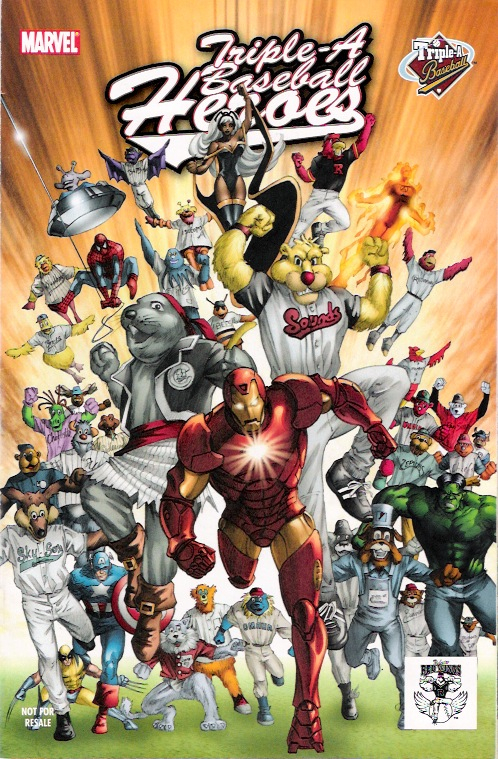
I warned you. I told you it was coming. You could have gone away, but, no, you had to go and actually come here and read this installment of Bizarre Baseball Culture. This is a very special Bizarre Baseball Culture, as, for the first time, it’s something that I actually have in my very small personal collection of comic books. You see, in 2007, each Triple-A baseball team had a day celebrating superheroes, and as a giveaway, there was this comic:

2007GiveawayComic copyAnd, as you can probably guess, I was at that game and got the giveaway. And so, it sat in a drawer for almost seven years, ignored. Until today. Yes, true believers, tremble and prepare yourself for the 2007 edition of Triple-A Baseball Heroes, featuring the superheroes of Marvel Comics.
Now, a few notes before we get going here:

  • All of the images in this post were scanned by yours truly, and any problems with the quality of the images are my fault.
  • All characters and logos in the comic are property of their respective owners (such as Marvel Comics or Minor League Baseball). The excerpts from this comic used in this post are being used under fair use doctrine and are meant merely to support and enhance the opinions and facts stated in said post.
  • Click on any of the images to make them bigger.
  • To the best of my knowledge, the only way to get this comic nowadays is to find it on eBay or have gone to the games that had them released.

Now, go below the jump for the rest of the post:

Continue reading

(Blogathon ’16) Jonathan Weeks: The Greatest Man I Have Known

This guest-post is part of the 2016 Baseball Continuum Blogathon For Charity, benefiting the Roswell Park Alliance Foundation. The Roswell Park Alliance Foundation is the charitable arm of Roswell Park Cancer Institute and funds raised will be “put to immediate use to increase the pace from research trials into improved clinical care, to ensure state-of-the-art facilities, and to help improve the quality of life for patients and their families.” Please donate through the Blogathon’s GoFundMe page. Also, please note that the opinions and statements of the writer are not necessarily those of the Baseball Continuum or it’s webmaster.

The Greatest Man I Have Known
by Jonathan Weeks

Don Weeks
(Nov. 23, 1938 – Mar. 11, 2015) 

When my father was born in 1938, the Yankees were finishing up a run of four consecutive world championships. He vividly remembered the teams of the late-’40s/ early-’50s and would regale me with stories of their on-field adventures. Though I began my formative years as a fan of Cincinnati’s “Big Red Machine,” I was officially converted in 1976 when my father took me to Yankee Stadium for the first time. I still remember the smell of hot dogs and beer, the shouts of refreshment vendors hawking their wares and the row of billboards lining the facade in center field (among them ads for Brut cologne and Marlboro cigarettes). Most of all, I remember my father’s passion as he told me about the exceptional men who had worn pinstripes over the years. Though I was only eleven at the time, I left the stadium with a vague notion that the game of baseball is a metaphor for life itself–how some men rise to the occasion while others wilt in the spotlight. Throughout my childhood and into my adult years, my father was one of the heroes. He taught me about courage, perseverance and fair play. He led by example–especially during his twilight months when he endured the unexpected loss of his beloved wife (my Mom) while fighting bravely through chemotherapy and radiation. Even as he lay dying, his body ravaged by an insidious disease known as Merkle Cell Cancer, he had a kind word for everyone who entered the room. When he eventually became incapable of speech, he offered smiles instead.

In honor of this great man, I would like to share the boxscore from the first game we attended together:

Screen Shot 2016-01-29 at 10.45.57 PMFor anyone interested, I (Jonathan Weeks) am the author of several baseball books—three nonfiction works and one novel. My latest nonfiction project is being released in the summer of 2016 by Rowman and Littlefield. It’s entitled “Baseball’s Dynasties and the Men Who Built Them”. (The title kind of says it all) You can access my blog at jonathanweeks.blogspot.com.

This guest-post has been part of the 2016 Baseball Continuum Blogathon For Charity, benefiting the Roswell Park Alliance Foundation. The Roswell Park Alliance Foundation is the charitable arm of Roswell Park Cancer Institute and funds raised will be “put to immediate use to increase the pace from research trials into improved clinical care, to ensure state-of-the-art facilities, and to help improve the quality of life for patients and their families.” Please donate through the Blogathon’s GoFundMe page. Also, please note that the opinions and statements of the writer were not necessarily those of the Baseball Continuum or it’s webmaster.

(Blogathon ’16!) The Sliding Scale of Fictional Baseball Realism

This post is part of the 2016 Baseball Continuum Blogathon For Charity, benefiting the Roswell Park Alliance Foundation. The Roswell Park Alliance Foundation is the charitable arm of Roswell Park Cancer Institute and funds raised will be “put to immediate use to increase the pace from research trials into improved clinical care, to ensure state-of-the-art facilities, and to help improve the quality of life for patients and their families.” Please donate through the Blogathon’s GoFundMe page.

Earlier today, in my look at Touch, I mentioned that you can make a 0-10 scale of baseball realism in works of fiction, with zero being baseball-in-name-only and ten being actual footage of a game.

Well, I’m going to expand upon that:

0: Baseball In Name Only

In this category, it’s not really baseball at all. They may call it baseball, but it certainly isn’t the actual sport that we know. The Moe Cronin version of baseball fits here.

1: Utterly Absurd

In this category, while it’s clearly meant to be baseball, the rules of the game and the laws of physics have clearly taken a vacation. Some classic cartoons fall into this category.

2: Very Absurd, but still with some realism

In this category, the work might have cartoonish physics and occurrences, but it still is grounded in reality enough to have the rules of baseball still be mostly the same. In theory, a baseball movie where the rules are not consistent or are wildly different but where everything else is played straight could also qualify here. Classic cartoons that aren’t “utterly absurd” usually fall in this category.

3: Absurd, but mostly consistent

Works in this category are clearly absurd and cartoonish, but are at least consistent: the laws of physics may not be what they are in the real world, but they don’t suddenly change mid-game, nor do the rules suddenly change simply because the story demands it. Most “cartoon” baseball video games, like Backyard Baseball and the Mario Baseball series, fit in this category.

4: Many absurd elements

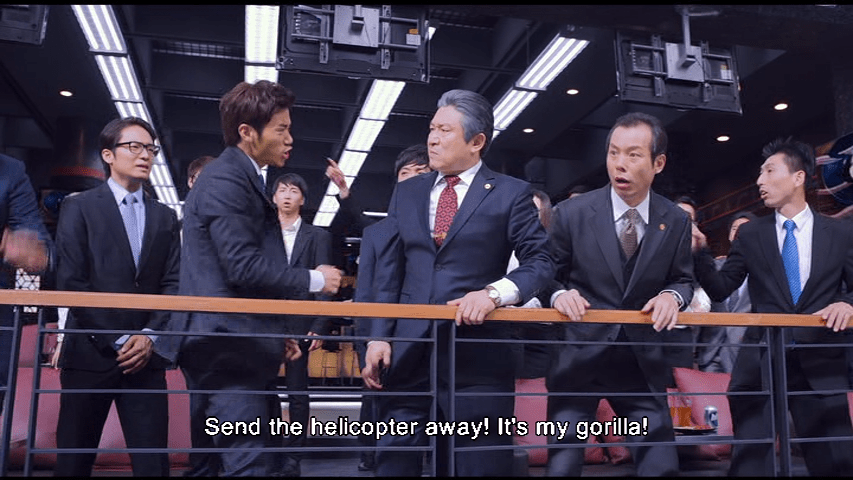
While clearly meant to be a realistic world that has our baseball’s rules and our laws of physics, the amount of absurd, cartoonish or unrealistic elements in the work make it more strange than realistic. Consider Mr. Go, for example, which has two baseball-playing gorillas, a little girl acting as a first-base coach and a finale that involves the baseball coming undone into a million pieces, which sort of overwhelms what would probably otherwise be a 6 if, say, it only had one gorilla.

5: Equal Mix of Realism and Fantasy

A work that sort of teeters between being realistic and being bizarre. This is more of a transitional spot on the scale, as it’s rare that anything ever stays at 5, inevitably going to 4 or 6 instead.

6: Realistic, but with one or two “big lies”

This is mostly realistic but it has one or two big elements (or the equivalent of one or two big elements made up of lots of smaller elements) that keep it from being something that you can honestly expect to ever happen in the real world. Sidd Finch could fit here, as could most of the movies in which a kid becomes a big league skipper or ballplayer.

7: Realistic, but highly unlikely

There’s nothing in this work that couldn’t happen, but it’s highly unlikely and any real event like this would probably instantly become one of the most notable things in baseball history. You could argue that Major League fits here, sort of.

8: Near total-realism

While some rules might be bent or not enforced on a strict basis, and some things might happen that are unlikely (although not nearly as unlikely as things that fall at seven on the scale), this is pretty realistic. Casey At The Bat, the classic poem, could be considered as this, with only the ability of everybody to seemingly hear everything keeping it from being a nine.

9: Utter realism

The only things that are not realistic in works of this category are omnipresent techniques like camerawork and editing for time, or stylish touches added in to indicate, say, that a player is angry. Bull Durham could, in theory, fit in this category, as could most (but not all) fairly true-to-history biopics and most realistic baseball video games.

10: Actual Baseball Footage used/Documentary

If you are watching an actual baseball game, or watching a documentary that uses baseball footage and does so without changing things for dramatic effect, you are watching a 10.


Feel free to consider where on the sliding scale your favorite piece of baseball fiction would fall!

6 PM: First References

This post has been part of the 2016 Baseball Continuum Blogathon For Charity, benefiting the Roswell Park Alliance Foundation. The Roswell Park Alliance Foundation is the charitable arm of Roswell Park Cancer Institute and funds raised will be “put to immediate use to increase the pace from research trials into improved clinical care, to ensure state-of-the-art facilities, and to help improve the quality of life for patients and their families.” Please donate through the Blogathon’s GoFundMe page.


(Blogathon ’16) Mr. Go, if adapted for American audiences

This post is part of the 2016 Baseball Continuum Blogathon For Charity, benefiting the Roswell Park Alliance Foundation. The Roswell Park Alliance Foundation is the charitable arm of Roswell Park Cancer Institute and funds raised will be “put to immediate use to increase the pace from research trials into improved clinical care, to ensure state-of-the-art facilities, and to help improve the quality of life for patients and their families.” Please donate through the Blogathon’s GoFundMe page.

Mr. Go. The classic tale of a girl, a gorilla, and the Korean Baseball Organization. Truly, one of the greatest Bizarre Baseball Culture entries of all time, and one you should totally consider purchasing if you are a fan of such things. But what if it was brought to American screens? How would it be adapted?

I have a few ideas:

The cute little Chinese girl, Weiwei, would stay, as would the backstory of her and her gorilla, Ling Ling. Similarly, the main antagonist of the film would be Liao Xiaogang, AKA “Tianjin Guy”, a corrupt nouveau-rich businessman/gangster.

This is a purely economic move. China is now one of the leading movie-going countries in the world, and the only way a baseball movie is going to get any attention there is if it has a Chinese person in it. Also, so much of what drives the plot is the fact that Weiwei is an outsider just trying to keep her friends and circus at home from being folded up.

The jerk-with-a-heart-of-gold scout, Sung Choong-Su, would instead be an American named Samuel “Sunny” Chance, played by James Franco.

For one thing, James Franco has experience with apes, and also he is able to do both comedy and drama, which this film would require. Also, I think civilization in general needs to see James Franco make drunken confessions to a baseball-playing gorilla who is also drunk.

Instead of going to the Doosan Bears, Ling Ling/Mr. Go would be a member of the San Diego Padres.

Don’t try to argue with me on this, you aren’t going to win.

The general manager of the Padres will have an expanded role and be played by John Goodman.

Because, really, imagine John Goodman delivering this line:

Jonah Hill would make a cameo as a sabermetrics expert who suggests how they can best use Mr. Go.

Both because he’s always in movies with James Franco, and as a reference to Moneyball.

There would be a subplot about how some people think Mr. Go isn’t playing the game the right way after he unleashes an epic bat-flip.

It’d provide realism to the affair.

After Mr. Go’s rampage, Weiwei and him would go on Jimmy Kimmel to prove he isn’t a monster.

Of course they would.

Instead of a bidding war between the Chunichi Dragons and Yomiuri Giants, it would be the Red Sox and Yankees.

Because of course it would be.

The veterinarian’s role would be expanded and made into a female love interest for Franco’s character, probably played by somebody quirky like Zooey Deschanel or wittily sarcastic like Anna Kendrick.

Because every goddamn movie, it seems, needs a love interest of some sort, and it sure as heck isn’t going to be Weiwei and Franco.

The NC Dinos, the main opponent of Doosan, would be replaced by the Dodgers. Also, the Division Series at the end of Mr. Go would be replaced with a final regular season series where the NL West title is on the line.

This both would better explain why every game is a home game for Mr. Go (in the Korean movie, they come up with an excuse about renovations at NC’s stadium) while still providing plenty of drama.

Leiting, the evil pitching gorilla who faces Mr. Go, will be renamed “Lightning” instead of “Zeros”.

Because Zeros was a dumb name.

The ending would be left more open to the “Football-playing Gorilla” sequel than the original movie was.

Every movie needs to have a opening for a sequel.

And, finally, it goes without saying that Andy Serkis would be playing Mr. Go.

Duh.

At 4 PM: AAA.

This post has been part of the 2016 Baseball Continuum Blogathon For Charity, benefiting the Roswell Park Alliance Foundation. The Roswell Park Alliance Foundation is the charitable arm of Roswell Park Cancer Institute and funds raised will be “put to immediate use to increase the pace from research trials into improved clinical care, to ensure state-of-the-art facilities, and to help improve the quality of life for patients and their families.” Please donate through the Blogathon’s GoFundMe page.


(Blogathon ’16!) Renaming Moved Teams

This post is part of the 2016 Baseball Continuum Blogathon For Charity, benefiting the Roswell Park Alliance Foundation. The Roswell Park Alliance Foundation is the charitable arm of Roswell Park Cancer Institute and funds raised will be “put to immediate use to increase the pace from research trials into improved clinical care, to ensure state-of-the-art facilities, and to help improve the quality of life for patients and their families.” Please donate through the Blogathon’s GoFundMe page.

There are four teams in MLB who have kept their names despite moving to different cities (or at least parts of a town where it’s enough where they change the first words of the team): The Angels, the Dodgers, the Athletics, and the Giants. What, however, if they had had to change their names? And, no, I’m not letting them just take their old Pacific Coast League team-names.

Let’s go place by place:

Los Angeles Angels of Anaheim, Orange County, California, USA, North America, Northwestern Quadrant, Planet Earth, Sol System, Milky Way, Local Group, The Universe

There was a very good reason why the Angels were originally called the Angels when they started playing: they were actually in Los Angeles, playing at Chavez Ravine. In addition, the LA Angels had been one of the flagship franchises of the Pacific Coast League, so the name had history. But as they moved to Anaheim and went by “California Angels” and then “Anaheim Angels” and now “Los Angeles Angels of Anaheim”, they have become more and more detached from the name. So what if they had abandoned the “Angels” moniker as soon as they left Chavez Ravine? Assuming that they had adopted California as their “first name” after leaving the ravine, perhaps they would be California related, perhaps the “California Bears” or the “California Trout” (ha). Or maybe they’d be more Anaheim-focused, with a name like “Oranges”. Personally, I think they would have to go with “Anaheim Mice”. In addition to the obvious Disneyland connection, there is the fact that mice are said to scare elephants, which would be a nice little poke at the Athletics. Well… it would be if…

The Oakland Athletics

Kept their Elephant logo despite changing to a new name. I think it’d be cool if they still had an old-timey sort of name. How about the “Oakland Eurekas”, after the California State Motto? (For the curious, the Pacific Coast League Oakland team was called the Oaks.)

Los Angeles Dodgers

If the Dodger brand hadn’t been so firmly established in Brooklyn, it feels likely they would have been renamed when they headed west. After all, “Dodgers” has basically nothing to do with Los Angeles. But what would they have been called? I personally think that they would take advantage of Hollywood and go with the name “Los Angeles Stars”. Oh, yeah, that was the name of Hollywood’s PCL team, but, guess what, it wasn’t LA’s, so it counts. So, “Los Angeles Stars” it is.

San Francisco Giants

The San Francisco Prospectors, or “Pros”. That was easy.

At 3 PM: MR. GO!

This post has been part of the 2016 Baseball Continuum Blogathon For Charity, benefiting the Roswell Park Alliance Foundation. The Roswell Park Alliance Foundation is the charitable arm of Roswell Park Cancer Institute and funds raised will be “put to immediate use to increase the pace from research trials into improved clinical care, to ensure state-of-the-art facilities, and to help improve the quality of life for patients and their families.” Please donate through the Blogathon’s GoFundMe page.


(Blogathon ’16) 2017 WBC Team Dominican Republic projections Version 0.1

This post is part of the 2016 Baseball Continuum Blogathon For Charity, benefiting the Roswell Park Alliance Foundation. The Roswell Park Alliance Foundation is the charitable arm of Roswell Park Cancer Institute and funds raised will be “put to immediate use to increase the pace from research trials into improved clinical care, to ensure state-of-the-art facilities, and to help improve the quality of life for patients and their families.” Please donate through the Blogathon’s GoFundMe page.

We are over a year from the 2017 World Baseball Classic, and the road will no doubt be filled with commitments, pull-outs, unusual nationality switches, injuries, trades, new contracts, personal decisions and god-knows-what-else still on the way. But, for now, let’s just imagine everybody is available: who’d be on Team Dominican in the 2017 World Baseball Classic?

Perhaps it would look something like this. Now, a reminder of the WBC roster rules:

  • Any player coming off a major injury or who has a history of injuries is unlikely to participate. This is especially true for the pitchers. (This “rule” is being ignored for version 0.1)
  • Players that will be on new teams are less likely to participate, but shouldn’t be completely ignored, with the exception of pitchers. (This “rule” is being ignored for version 0.1)
  • Teams are made up of 28 players, of which 13 of them must be pitchers and two of them catchers.
  • The pitch count rules make relievers extremely important.

Here we go:

Catchers (3): Wellington Castillo, Francisco Pena, Pedro Severino

First Baseman (3): Albert Pujols, Carlos Santana, Edwin Encarnacion

One of them would presumably also DH, obviously.

Second Baseman (1): Robinson Cano

Third Baseman (2): Adrian Beltre, Maikel Franco

Oh, Adrian Beltre will be in his late 30s in 2017, you say? That is true, but I wouldn’t bet against him.

Shortstop (2): Erick Aybar, Jhonny Peralta

Designated Hitter/3B/Who-The-Heck-Knows (1): Miguel Sano

Outfielders (4): Jose Bautista, Nelson Cruz, Carlos Gomez, Starling Marte

Starting Pitchers (4): Johnny Cueto, Carlos Martinez, Danny Salazar, Francisco Liriano

Relief Pitchers (8): Jeurys Familia, Kelvin Herrera, Arodys Vizcaino, Pedro Strop, Santiago Casilla, Luis Garcia, Antonio Bastardo, Alexi Ogando

And so, that’s Version 0.1 of my TeamDR projections. Version 1.0, which will include actual consideration as to whether I think somebody will actually take part or not, will come out sometime in the future. But until then…. feel free to imagine how the team would do if it looked like this.

At Noon: Mini-Book Reviews!

This post has been part of the 2016 Baseball Continuum Blogathon For Charity, benefiting the Roswell Park Alliance Foundation. The Roswell Park Alliance Foundation is the charitable arm of Roswell Park Cancer Institute and funds raised will be “put to immediate use to increase the pace from research trials into improved clinical care, to ensure state-of-the-art facilities, and to help improve the quality of life for patients and their families.” Please donate through the Blogathon’s GoFundMe page.


(BLOGATHON ’16!) International Baseball Culture: Mitsuru Adachi’s “Touch”, Part 1, which ironically doesn’t have much baseball in it

This post is part of the 2016 Baseball Continuum Blogathon For Charity, benefiting the Roswell Park Alliance Foundation. The Roswell Park Alliance Foundation is the charitable arm of Roswell Park Cancer Institute and funds raised will be “put to immediate use to increase the pace from research trials into improved clinical care, to ensure state-of-the-art facilities, and to help improve the quality of life for patients and their families.” Please donate through the Blogathon’s GoFundMe page.

In International Baseball Culture, I look at baseball-related entertainment from outside the USA that isn’t bizarre, but is interesting, perhaps learning some new things along the way!

In 2005, the Japanese television station TV Asahi held a special on the 100 most popular anime (animation) in history, as voted on by Japanese viewers. While many of the most popular programs were fantasy, adventure or science fiction, such as the Gundam series of giant robot programs (at number two) or Dragon Ball (at number three), the top ten also had a baseball anime: Touch, which was seventh.

What is Touch? Well, to put it in simple terms, it’s a tale of two stories: the baseball one and the off-the-field one. It’s about three teenagers (twin boys and their girl-next-door neighbor) who navigate high-school, relationships and their pitfalls while trying to bring their school glory on the diamond as they try to reach Koshien, Japan’s national high school baseball tournament, which is like March Madness and a Friday night in Texas combined.

Needless to say, it struck a nerve with Japanese audiences, and the 2005 program’s polling was not that out of the ordinary: A follow-up list that included votes from after the TV Asahi special was aired also had Touch in the top ten, at number nine. Nor was this a recent phenomena, either: during it’s original run in the 1980s, it was, according to some sources, the most watched anime in the history of Japan. Ever.

The series was, in itself, adapted from a manga (comic) of the same name, written and illustrated by Mitsuru Adachi, that saw it’s volumes sell over an estimated 100 million copies. Just to put that in perspective, in 2010 the population of Japan was around 128 million. Of course, that doesn’t mean over three out of four Japanese people owned at least one copy of a volume of Touch… but it does mean that those who did liked it very much, buying every volume.

From what I’ve read about the series, it’s not hard to see why it would have such broad appeal, as it apparently has something for everyone. It has baseball action (and also some detours into boxing and other sports) for the boys, romance for the girls, and drama and comedy for everyone. And apparently all of those things are done well enough where even people who normally can’t stand stuff like that seem to like it- I’ve come across several reviews that include lines like “I don’t even like baseball but I was enthralled by the game episodes” or “the romance plot is actually realistic and well-handled.”

And yet, despite the fact that Touch is one of the most successful anime and manga in the history of Japan, it has never seen official release in the United States, and it’s unlikely that it will anytime soon, either (the anime and manga import market is mainly focused on recent releases, and what old ones that do happen are usually Sci-Fi or Fantasy). However, there is apparently a unspoken agreement between the Japanese entertainment industry and it’s English-speaking fans that they won’t sue anybody who translates and distributes translated versions of the show/book, so long as they stop doing it if an actual agreement to distribute them in the USA is made, so I was able to find copies of both the anime and manga online.

But anyway: a baseball-centric story that is one of the most popular and well-regarded anime/manga in Japanese history, and it’s almost completely unknown to American audiences? What better way to start International Baseball Culture? (after the jump)

Continue reading

(Blogathon ’16) WBC News for January 29, 2016

This post is part of the 2016 Baseball Continuum Blogathon For Charity, benefiting the Roswell Park Alliance Foundation. The Roswell Park Alliance Foundation is the charitable arm of Roswell Park Cancer Institute and funds raised will be “put to immediate use to increase the pace from research trials into improved clinical care, to ensure state-of-the-art facilities, and to help improve the quality of life for patients and their families.” Please donate through the Blogathon’s GoFundMe page.

It’s time for a World Baseball Classic update! With the first qualifiers coming up, more news has started to come out. Let’s take a look at some of the news:

Sydney Qualifying Pool Rosters and Schedules released:

On Wednesday, the rosters and schedules for the Sydney qualifying pool came out. They can be found over here on Baseball America. I’ll have a more thorough preview as we get closer to the event, but it’s definitely a case where Australia should be considered the heavy favorite, full of players with experience in MLB or the Minors. After Australia, it’s a fight for the second spot to face them in a winner-take-all game to get to the main tournament. Clay Rapada is probably the most notable player outside of the Australians, as he will be playing for the Philippines, the country of his father’s birth, before retiring. Former All-Star Jason Bartlett, also of Filipino descent, was also expected to play, but I don’t see him on the roster.

News from other qualifying pools:

As I mentioned last time, the qualifiers, unlike the main tournament, are not events where MLB teams are required to allow 40-man roster players to take part if there’s an overlap with official team acitivites. This will most hurt a team like Mexico, where the Blue Jays are unlikely to allow their three Mexican players from taking part in the March qualifier in Mexicali.

Jon Morosi, one of the best people to follow for WBC news, had information on his Twitter feed on the German team, who will be managed by Garth Iorg (yes, that Garth Iorg). Depending on what difficulties Mexico has, they could be a threat in Mexicali, even with Max Kepler likely skipping as he tries to win a spot on the Twins, they will have Donald Lutz, one of the few Germans with MLB experience.

Bruce Chen, who retired last season, is apparently willing to pitch for Panama.

Other WBC News:

Ozzie Guillen is totally up for managing Team Venezuela in 2017.


And that’s it… for now.

Keep an eye out for more WBC news on the Baseball Continuum as it occurs.

At 9 AM: International Baseball Culture

This post has been part of the 2016 Baseball Continuum Blogathon For Charity, benefiting the Roswell Park Alliance Foundation. The Roswell Park Alliance Foundation is the charitable arm of Roswell Park Cancer Institute and funds raised will be “put to immediate use to increase the pace from research trials into improved clinical care, to ensure state-of-the-art facilities, and to help improve the quality of life for patients and their families.” Please donate through the Blogathon’s GoFundMe page.

(Blogathon ’16) Songs of October (Post-2015 update)

This post is part of the 2016 Baseball Continuum Blogathon For Charity, benefiting the Roswell Park Alliance Foundation. The Roswell Park Alliance Foundation is the charitable arm of Roswell Park Cancer Institute and funds raised will be “put to immediate use to increase the pace from research trials into improved clinical care, to ensure state-of-the-art facilities, and to help improve the quality of life for patients and their families.” Please donate through the Blogathon’s GoFundMe page.

For the far-too-late update on what happened in 2015, go to the bottom of the post after the jump.

In 2013, there was a sensation that spread across the nation: Mups. Their spread was unstoppable, to the point where some like the “Cespedes Family BBQ” and Jesse Spector had begun to engage in a “#Mupwatch”. But some wondered: What was a Mup? Were they some sort of Muppet? Were they dangerous? And why were they being lit on fire?

Well, the answer lay in the commercials that had been playing in the lead-up to and during the post-season, featuring Fall Out Boy’s “My Songs Know What You Did In The Dark”. Here is an example of such a commercial. While officially they were saying “Light ’em up”, it sounded, especially during the echoing segments, like they were actually talking about things called “mups”.

And thus continued a long tradition of October songs that have graced our televisions and infected our ears, whether we liked them or not. And, usually, if we DID like them at the start of the postseason, we ended up being sick of them by the end just from hearing them so many times.

And, what’s more, these songs and how they have become memes aren’t from a universal source. Most of them, for example, have been part of TBS’ coverage, but others, including the Fall Out Boy song, have actually been of MLB’s doing. In 2013, for example, TBS was using a different song*, and MLB Network itself also had a different song for the commercials for it’s two games**. Rarely if ever have they been actually about baseball, usually selected more for their choruses or imagery.

*Using Google searches of the lyrics I was able to decipher, I’ve figured out it’s 30 Seconds to Mars’ “Do or Die”.

**Again using Google, I’ve found that the commercials use the chorus from Papa Roach’s “Still Swingin’“.

Still, with that out of the way, here’s a history (after the jump) of the Songs of October:

Continue reading

Hall of Fame Day: What To Watch For

It’s Hall of Fame Day. This year, Ken Griffey will almost certainly get in, and Mike Piazza is pretty likely. Jeff Bagwell and Tim Raines also have shots, although it will be close.

Some other things though to watch for:

1) How does Trevor Hoffman do?

The greatest closer in the history of the National League is unlikely to get in on the first ballot, but does seem likely to eventually get on. Held back by the fact he played on some crummy teams and never gaining the postseason glory of his AL opposite number (Mariano Rivera), Hoffman is perhaps not as highly-regarded as he should be. How he does in this, his first year on the ballot, will probably be a good

2) With the balloting list purged, do the PED users and Sabermetric darlings gain?

Many voters- mainly ones who are old or have not covered baseball in a long while- had their votes taken away starting this year. Normally I’m against disenfranchising people, but it was always ridiculous that a person who hadn’t covered baseball in the slightest since 1992 could vote in the Hall of Fame. These voters tended to be older, more traditional, more hostile towards statistics, and more draconian in dealing with the PED era. With them gone, will we see PED users and favorites of the statistical community gain? I feel like we will, but by how much is a big question.

3) What player is most going to get screwed over by the fact that voters can still only vote for 10 people, and then likely fall off the ballot?

Jim Edmonds. I don’t know if he’s a Hall of Famer, but he certainly shouldn’t be falling off the ballot in his first year.

4) Will some idiot not vote for Ken Griffey Jr.?

Yes. There’s always somebody.

5) Will they be brave enough to come forward?

If they do, then they are both brave and foolish at the same time, especially if they have some sort of stupid reason and it isn’t a case of “I knew he was being inducted so I voted for Jim Edmonds to try and keep him on the ballot”. Actually, that’s a stupid reason too, but that more has to do with the Hall of Fame’s continued denial of the BBWAA’s requests to be able to vote for more than 10 people.


So, keep an eye open for the answers to these questions.