(Blogathon ’16) Graveyard Baseball- Your guide to adopting an NPB team Part 12: Saitama Seibu Lions (埼玉西武ライオンズ)

This guest-post is part of the 2016 Baseball Continuum Blogathon For Charity, benefiting the Roswell Park Alliance Foundation. The Roswell Park Alliance Foundation is the charitable arm of Roswell Park Cancer Institute and funds raised will be “put to immediate use to increase the pace from research trials into improved clinical care, to ensure state-of-the-art facilities, and to help improve the quality of life for patients and their families.” Please donate through the Blogathon’s GoFundMe page. Also, please note that the opinions and statements of the writer are not necessarily those of the Baseball Continuum or it’s webmaster.

Who are we?: We are an English blog writing about one of 12 teams in the Japanese professional baseball league known as Nippon Professional Baseball (NPB). While the Saitama Seibu Lions are the primary team we cover, we will write anything that connects MLB and NPB, such as the recent signing of Kenta Maeda to the Los Angeles Dodgers. You can follow us on Twitter @GraveyardBall for any instant updates.

Part 12?  What?: This is the final piece in a 12-part series on a guide with who to adopt as your NPB team. We connected with some history, trivia and showing who played on each team with MLB on their resume.  You can see all posts at the bottom which covers each team.

Saitama Seibu Lions (埼玉西武ライオンズ)

The Saitama Seibu (西武) Lions were originally in Fukuoka (Kyushu island) as the Nishitetsu Clippers in 1950 for one season. Nishitetsu is an electric railway in Fukuoka which still operates today. After a merger with another team, they became Nishitetsu Lions one year later in 1951.

There would be a Black Mist scandal involving players fixing games from 1969-1971, similar to the Black Sox scandal from 1919. Nishitetsu would sell the team and they would be Taiheiyo Club Lions from 1973-1976, which is named after a golf course and resort developer. They would then be sold to Crown Lighter Gas, to be called the Crown Lighter Lions from 1977-1978.

Eventually, they were sold to Seibu Group and they moved to Tokorozawa in 1979, a place they still hold today. Their title would be Seibu Lions until 2008, where they added the prefecture name “Saitama” to the front.

===

Ownership: Seibu Holdings

Seibu is a conglomerate which owns several businesses. The most well-known one is the Seibu Railway as it operates in greater Tokyo. The trains are one of the best ways to get to a game in Tokorozawa. Seibu also owns hotels, real estate, resorts and more.

Train stations in the area will often be decorated with Lions related colors. The name “Seibu” (西武) derives as an abbreviation from it’s kanji title of west Musashi, which was the old title of where present day Saitama prefecture was located. 西 (Nishi) means West in Japanese.

===

League: Pacific

===

Payroll rank in 2015: 9

The Lions are a team with a tight budget as they won’t spend a lot. However, they will pay players who prove their worth and this ranking can go up with multiple pay raises happening. Usually they are in the “pack”.

Location/Stadium: Seibu Dome in Tokorozawa, Saitama prefecture
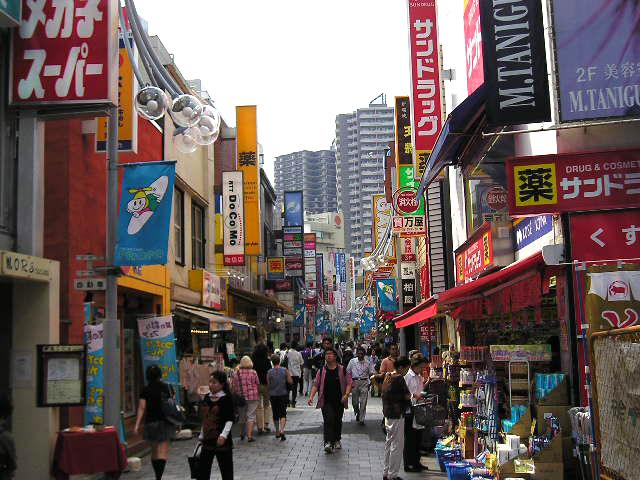
Tokorozawa is a suburb in greater Tokyo. It’s quite a distance from the capital itself, but the Lions represent Saitama prefecture, which is in the North. Saitama prefecture is known for some mountains in their scenery, with plenty of room to go hiking.

The most famous spot in the area, would be Hachikokuyama, which is a park right on the border of Saitama and Tokyo prefectures.  The park was used as an inspiration as the scenery for the movie My Neighbor Totoro


Side note: I recommend everyone sees this short movie, which is nearly 30 years old now.

ixOSAy2u

Seibu Dome was originally an outdoor stadium when the Lions moved there in 1979. It was then known as Seibu Stadium. While there is a roof, you can see that in the outfield and all around the building that it can be exposed to wind and hot temperatures with the open face.  The domed roof was added in 1998. Due to one player being sold, the place underwent renovations after 2007.

===


Mascots: Leo (right) and Lyna (left)

Leo is based off the character Kimba the White Lion in the Japanese Anime known as “Jungle Emperor Leo.” The Lions used to have this as their main logo and still use it for flags (such as what’s in centerfield near the country’s flag. That flag is also seen during the NPB Draft.

===

Uniforms: The Lions have switched to Majestic in 2016, and had a ceremonial “kick-off” for them last Friday morning:

QnvleipjNote: The Lions used to wear a bright blue design with the Kimba logo since their move to Tokorozawa. However, a scandal in the 00s by then-owner Yoshiaki Tsutsumi made them want to move on from it and rebranded to a dark blue design beginning in 2009.

===


Cheer song:  Hoero Lions (吠えろライオンズ) “Roar Lions”

Instead of a 7th inning stretch of “Take me out to the ballgame”, Fans pull out balloons in 9 out of 12 stadiums and sing a cheer song as an alternative.  A video of this can be found here.

===


Ōendan (Cheerleading) Songs: 2015 Player songs at 00:00, Hoero Lions at 7:03, Special Chance themes at 8:27, [ソリャセ] (Soryase, an equivalent of “Let’s Go”) at 10:42, Regular chance themes at 11:18, Scoring song at 15:08

Notes:

Every player has their own “song” to hear when they’re batting. Whether home or away, a portion of the crowd will always be singing. A Chance song is a special song when usually runners are in scoring position, hence drawing a “Chance” opportunity.

The regular chance songs for the Lions have similar tunes to “Cotton Eye Joe”, “Do you know the Muffin man?”, but notice how Chance #4 near the end has women and men singing separate lines. You can hear a cleaner version here. (Scoring song featured too)

The Lions are the only Oendan in Japan to wave flags as a group. They do this when scoring and well as during the [ソリャセ], which is almost like saying “We want more runs”.

The scoring song title translates into “I saw a Lion running on the Horizon”.  An up close version of the song can be heard in the video below starting at 2:41. They also sing “Happy Birthday” to players on their birthday, which you can see in the video as well.

Here is a link to a full version of the song as sung by a person. Lastly, here’s an instrumental version from a commemorative 1986 Nippon Series Champions box.


===


MLB Comparison: Oakland Athletics

The Lions have found ways to be competitive with a low payroll more times than not. Since their move to Tokorozawa in 1979, the Lions have finished in the Bottom 3 of the Pacific League only three times.

Only difference is, the Lions have won a crucial elimination game multiple times in the 21st Century, including a Game 7 of the Japan Series. They’ve been competitive and avoided the cellar for the most part, which is good for a team that hasn’t been a high spender in recent years. Playing in what is viewed as the “ugliest” stadium in NPB also draws this comparison to the Oakland A’s, who play in the Oakland Coliseum.

===

Notable former MiLB and MLB players to play for the Lions:


Ryan Spilborghs, Esmerling Vasquez, Matty Alou, Terry Whitfield, George Vukovich, Kazuhisa Ishii

===

Notable players who played in MLB: 

Daisuke Matsuzaka, Kazuo Matsui

Note: The Lions used a portion of the $51.1 million they acquired for Matsuzaka on renovations to the Seibu Dome. You can see the original look of the Dome prior to renovations here. Matsuzaka paid for restroom upgrades, an HD scoreboard, renovated field turf as well as adding bullpen box seats on the side.

===

Verdict


Why you root for them: 


Because you’re used to being in a big market, but rooting for a team with less fans in numbers. The Lions are far from the city, which is a long train ride away to get to the Seibu Dome. Yes, they’re in greater Tokyo, but forgotten due to teams like the Yomiuri Giants controlling the market.

It could also be that you’re an Oakland A’s fan know what it’s like to compete on a lower budget. The Lions have benefited from their ballpark and developed pitching over the years. Like the A’s, they have a strong amount of success in their team’s history with 13 Japan Series championships overall when combining their time in Fukuoka with the Seibu era.

The Lions had a “Golden Age” where they won 11 pennants from 1982-1994 and took eight Japan Series titles in that timeframe. This dynasty gets overlooked, similar to how the A’s had a three-peat from 1972-1974, due to being in the Pacific League.

Here at Graveyard Baseball, we can provide exclusive coverage of the team and insight in English for anyone. As of the time of this writing, we’re the only blog to write about the Lions in the English language.

===

Why you don’t root for them:


Like the A’s, the Lions have had their share of disappointing postseason exits. They were a strong team in both 2012 and 2013, but lost in the opening round when they were favored. You also dislike ugly stadiums if not teams from a suburb away from the city.

Crowds are also half empty on week nights due to the proximity from the heart of Tokyo. The average person who works in the city would not be able to attend a game on a week night at first pitch. Assuming the game begins at 6:00 PM local time, it takes 90 minutes by train to arrive at the Seibu Dome from Tokyo, meaning it wouldn’t be worth it for a worker (known as salarymen in Japan) to attend a game late.

===

Other NPB Teams in the series: 

Yomiuri Giants (巨人)

Hiroshima Toyo Carp (広島)

Hokkaido Nippon-Ham Fighters (日本) 

Orix Buffaloes (オリックス)

Hanshin Tigers (阪神) 

Chunichi Dragons (中日)

Tohoku Rakuten Golden Eagles (楽天)

Softbank Hawks (ソフトバンク) 

Yokohama (DeNA) Baystars

Chiba Lotte Marines (ロッテ)

Tokyo Yakult Swallows (ヤクルトス)

===

Follow us on Twitter @GraveyardBall

This guest-post has been part of the 2016 Baseball Continuum Blogathon For Charity, benefiting the Roswell Park Alliance Foundation. The Roswell Park Alliance Foundation is the charitable arm of Roswell Park Cancer Institute and funds raised will be “put to immediate use to increase the pace from research trials into improved clinical care, to ensure state-of-the-art facilities, and to help improve the quality of life for patients and their families.” Please donate through the Blogathon’s GoFundMe page. Also, please note that the opinions and statements of the writer were not necessarily those of the Baseball Continuum or it’s webmaster.

(Blogathon ’16) Mike Oz: The History of Baseball Players Rapping, Abridged

This guest-post is part of the 2016 Baseball Continuum Blogathon For Charity, benefiting the Roswell Park Alliance Foundation. The Roswell Park Alliance Foundation is the charitable arm of Roswell Park Cancer Institute and funds raised will be “put to immediate use to increase the pace from research trials into improved clinical care, to ensure state-of-the-art facilities, and to help improve the quality of life for patients and their families.” Please donate through the Blogathon’s GoFundMe page. Also, please note that the opinions and statements of the writer are not necessarily those of the Baseball Continuum or it’s webmaster.

As someone who loves both hip-hop and baseball, it’s a daily disappointment that these two lanes of my life don’t intersect more often.

It happened recently, when Toronto Blue Jays pitcher Marcus Stroman made his rhyming debut, dropping a verse on Mike Stud’s “These Days” remix from his new album of the same name. There’s more here than just the same ol’ story of an athlete thinking he can spit a few bars. Stud is the nom de rap of Mike Seander, who was a college teammate of Stroman’s at Duke University.

After Duke, Stroman went on to a successful MLB career and Stud became a notable figure in the Drake-influenced frat-rap scene. So more than baseball players trying to get into rap, this was two friends reuniting for fun. Nonetheless, Stroman was surprisingly good. Better, in fact, than you’d think.

Using Stroman as a jumping off point, this seems like a timely opportunity to talk about other baseball-rap crossovers. Please enjoy this Abridged Version of the History of Baseball Players Rapping.

1. DEION SANDERS
When Prime Time jumped into the rap game, no one took it all that serious. He was hanging with MC Hammer and had already established himself as a profession-juggler. So, rapping, why not? He released an entire album in 1994, aptly titled “Prime Time” that people will mostly remember for the somewhat popular song “Must Be the Money.” It wasn’t good, but it was at least ahead of its time in the sense that modern day hip-hop also values people who rap about being rich even if they have no actual talent.

https://www.youtube.com/watch?v=AEEPVGtwsO8

Notable lyric: “Hey, my snakeskin shoes gonna change into gators / Hey, my library cards gonna change into credit cards
/ You know what I’m sayin?”

2. KEN GRIFFEY JR.
Somehow, The Kid’s foray into rap doesn’t get nearly enough attention. In 1992, Seattle rapper Kid Sensation got Griffey to jump on a track called “The Way I Swing.” How that happened? Emoji shrug. History doesn’t remember any of this too well, but you know what? The beat to the song isn’t bad. Griffey isn’t a Hall of Famer spitter, but this is at least somewhat respectable.

http://www.youtube.com/watch?v=rETID1lEykE

Notable lyric: “Ken Griffey is a swinger, not a singer / A def rhyme bringer / A home-run hitter but I’m not a dope slinger.”

3. COCO CRISP
As part of the 2005 album, “Oh Say, Can You Sing,” veteran outfielder Coco Crisp showed his flows on an original song called “We Got That Thing.” This might be baseball’s version of Cedric Ceballos rapping on that NBA rap CD where you’re like, “Huh? This guy is rapping and … he’s not bad.” It’s bouncy and interesting and actually sounds good more than 10 years later. Well done, Coco.

Notable lyric: “That chain you wear is dental floss to me.”

4. JOSE REYES
It’s a surprise we don’t hear more Spanish-language rap coming from Latin baseball players. We do get it from Jose Reyes, though. His history in rap is more prolific than most people here, as he’s appeared on a number of different songs, usually as an offseason hobby. It’s hard to judge his lyrics, as a non-Spanish speaker, but his flow doesn’t sound bad.

https://www.youtube.com/watch?v=Bm02uAboP74

Notable lyric (translated): “There are no friends / A friend is a dollar in my pocket / As soon as you turn your back your friends want to stab you in the back.”

5. TREVOR BAUER
The now-Indians pitcher made headlines a few years ago for his hobby rap tracks. There was even one that was perceived as a diss to former D-backs teammate Miguel Montero. That would be a baseball first. Bauer isn’t very good. Even he admits that. And these days, he seems more focused on pitching than rapping, but he at least has proven he can be his team’s hip-hopping cheerleader.

Notable lyric: “So what do y’all know bout Swisher and his swag / Smokin pitchers like cigars / Are you picturing that?”

6. MARCUS STROMAN
This brings us back to Stroman who, compared to Bauer, is easily the best rapping pitcher in the game. He doesn’t plan to rap a bunch — he’d much rather lead the Jays back to the postseason — but Stroman did sound at ease on his Mike Stud cameo.

https://www.youtube.com/watch?v=uGBCHnFkkRg

Notable lyric:“Yeah, my vision is to get it while I’m living / I’ll keep winning / Legendary comeback, ACL incision”

Mike Oz is the editor of Big League Stew on Yahoo Sports. You can find him on Twitter at and on Facebook. He lives in Central California and likes dope beats and tacos.

This guest-post has been part of the 2016 Baseball Continuum Blogathon For Charity, benefiting the Roswell Park Alliance Foundation. The Roswell Park Alliance Foundation is the charitable arm of Roswell Park Cancer Institute and funds raised will be “put to immediate use to increase the pace from research trials into improved clinical care, to ensure state-of-the-art facilities, and to help improve the quality of life for patients and their families.” Please donate through the Blogathon’s GoFundMe page. Also, please note that the opinions and statements of the writer were not necessarily those of the Baseball Continuum or it’s webmaster.

(Blogathon ’16) Matthew Kory: “My Friend Bud”

This guest-post is part of the 2016 Baseball Continuum Blogathon For Charity, benefiting the Roswell Park Alliance Foundation. The Roswell Park Alliance Foundation is the charitable arm of Roswell Park Cancer Institute and funds raised will be “put to immediate use to increase the pace from research trials into improved clinical care, to ensure state-of-the-art facilities, and to help improve the quality of life for patients and their families.” Please donate through the Blogathon’s GoFundMe page. Also, please note that the opinions and statements of the writer are not necessarily those of the Baseball Continuum or it’s webmaster.

*phone rings*

“Ahoy-hoy.”

“Mr Selig?”

“Speaking.”

“Hi! It’s Rob.”

“Oh, you again, Mr. Frost. Stop calling me from beyond the grave!”

“No, no…”

“And while I’ve got you here, you can’t take a road not taken. Taking a road not taken means the road not taken is taken and then it’s a road taken so your poem is stupid and it’s garbage! Go back to the land of the dead, sir, and leave me be!”

“Manfred.”

“Who?”

“Rob Manfred. I took over for you?”

“Look, I don’t know who you think you are, but nobody takes over for Bud Selig!”

“As Commissioner, sir. Commissioner of baseball.”

“Oh! Ah ha! Yes! Rob Manfred. I remember now. I thought you were noted poet Robert Frost calling from beyond the grave. It was an honest mistake. So, what kind of pickle have you got yourself into, Rob Manfred, that you need to call Old Budrick Selig?”

“Budrick?”

“You can just call me Bud.”

“Thank you, Bud.”

“Mr. Selig.”

“Right, sorry. Mr. Selig.”

“So, what kind of pickle have you got yourself into?”

“Well, you see there’s this whole DH thing…”
“DH thing? Well I have to ask right off the bat, why are you shouting when you say DH?”

“I’m not shouting, DH is capitalized because it stands for Designated Hitter.”

“DESIGNATED HITTER?”

“Yes, but again, no need to yell.”

“Well, Manfred, the way I see it is one designated hitter (quiet enough for you?) is enough. Copying the NFL is a great way to go in almost all instances, but maybe this is one where we don’t want to go quite all the way.”

“Sir, I’m talking about adding the DH to the N… uh, national league.”

“Adding it, eh? Well. That’s quite a suggestion. Baseball is a game of history, Manfred. A game of history. And you just don’t go monkeying around with history.”

“Sir, you monkeyed with history quite a bit during your time.”

“Well right. That’s me though. I’m infallible.”

“In any case, do you think I should give the DH to the National League?”

“That’s a toughie, Manfred. A real toughie.”

“Sure is.”

“zzzzzzz”

“Mr. Selig?

“zzzzzzz”

“Mr. Selig!!”

“Dammit Lincoln this isn’t the theater.”

“Mr. Selig, I’d like an answer.”

“What, oh, sure. Fine. The answer, Manfred, is that the job is yours now. The decisions are yours as well. Also it’s baseball. It’s a game. So what if you change the rules a little bit now and again. Keeps it fresh. Keeps it current. Sometimes change is the best medicine. Though you shouldn’t eat pennies. Seriously. I know from experience.”

“But what about the National League owners? What about the fans?”

“Are you seriously telling me people want to watch pitchers hit? Of course they don’t. Paying money to watch pitchers hitting is like paying money to watch ants screw. Very little happens and then it’s over and you’re like, wait what?”

“That’s quite an analogy.”

“Nobody likes pitchers hitting. And they’re terrible at it. We have genuine issues facing baseball, Manfred. Cutting out one of the few bad parts shouldn’t be one of them.”

“Thanks, Bud.”

“Budrick.”

“Budrick.”

“Right. But you can call me Mr. Selig. In any case I’ve got to go. There’s a special on PBS about ants screwing right now that I don’t want to miss.”

Matthew Kory is a writer at many different venues, most recently FanGraphs, Baseball Prospectus, and Vice Sports. He’s written about lots of different stuff and googling his name will lead you to either him or a podcast called the Matthew and Kory Show. Litigation is ongoing. You can follow him at @mattymatty2000. He lives in Portland, Oregon with his wife, two kids, cat, and broken dreams.

This guest-post has been part of the 2016 Baseball Continuum Blogathon For Charity, benefiting the Roswell Park Alliance Foundation. The Roswell Park Alliance Foundation is the charitable arm of Roswell Park Cancer Institute and funds raised will be “put to immediate use to increase the pace from research trials into improved clinical care, to ensure state-of-the-art facilities, and to help improve the quality of life for patients and their families.” Please donate through the Blogathon’s GoFundMe page. Also, please note that the opinions and statements of the writer were not necessarily those of the Baseball Continuum or it’s webmaster.
(Blogathon ’16) Jeff Katz: Anniversaries and World Series

This guest-post is part of the 2016 Baseball Continuum Blogathon For Charity, benefiting the Roswell Park Alliance Foundation. The Roswell Park Alliance Foundation is the charitable arm of Roswell Park Cancer Institute and funds raised will be “put to immediate use to increase the pace from research trials into improved clinical care, to ensure state-of-the-art facilities, and to help improve the quality of life for patients and their families.” Please donate through the Blogathon’s GoFundMe page. Also, please note that the opinions and statements of the writer are not necessarily those of the Baseball Continuum or it’s webmaster.

Karen and I met on New Year’s Eve, December 31, 1985. By May, we were engaged. When Karen started looking for a place to get married near her hometown of Niskayuna, New York, I had one request.

“I just don’t want to get married during the World Series.”

It seemed a simple enough request to me. Sure, I wasn’t destined to play in the World Series, but I always watched it and it was very important to me. What I didn’t understand, the flaw in my plan, was that Karen had no idea when the World Series occurred. We were to be married the same day as Game 2 of what would turn out to be the Red Sox – Mets series.

“Wait,” she said with surprise. “Isn’t it ‘The Boys of September?’” What can you do?

The day before the wedding, my in-laws had a big spread, not a rehearsal dinner per se, but a nice gathering at their house. Everyone huddled around the TV to watch the opener, Bruce Hurst v. Ron Darling at Shea.

“Why are they all watching TV?” my mother-in-law wondered, in disbelief.

They were doing what was the only normal thing to do, watch the World Series. I left before the game was over, heading back to my hotel with my parents. My mother was ticked off at my in-laws because they didn’t have enough food. Why? My mother told them no one would come from New York City to upstate the night before the wedding. My mother-in-law ordered an appropriate amount of food and then, of course, a horde of New Yorkers came. A nice trap was set by my mother. What did I care? I just wanted to get back to watch the rest of the game, which Boston won 1-0 on a Tim Teufel error.

The next day, October 19, was beautiful and sunny, the last pretty day before fall gave way to winter. We had an outdoor wedding, well-attended, and well-remembered. As the afternoon went on, some guests had to leave. They had tickets to Game 2. I couldn’t blame them for the leaving early.

Karen and I didn’t leave the wedding together; we didn’t give it any thought. A worker at the hall said to Karen, “I’ve never seen the bride and groom leave separately.” It was no big deal and I had to get my stuff from the hotel. Our honeymoon wasn’t until December. We reconvened at her parents’ house and went to the Desmond Americana Hotel in Albany for the night.

At the hotel, in a nice two level room, we opened all our gifts on the first floor and ordered lots of appetizers from room service. Then, like all newlywed couples, we went upstairs to bed.

I watched Game 2, a Red Sox blow out.

Our anniversary has always revolved around the World Series, though now, with the extra layer of playoffs, the Series is usually the week later. We watch all the post-season games together, I tell Karen about the players, we snack, we drink and we have a blast. Not even the “Boys of September” have a better time.

Jeff Katz, author, Split Season 1981: Fernandomania, The Bronx Zoo and The Strike That Saved Baseball (Thomas Dunne Books) is also the Mayor of Cooperstown. You can find him at http://Jeff-Katz.com  and @splitseason1981.

This guest-post has been part of the 2016 Baseball Continuum Blogathon For Charity, benefiting the Roswell Park Alliance Foundation. The Roswell Park Alliance Foundation is the charitable arm of Roswell Park Cancer Institute and funds raised will be “put to immediate use to increase the pace from research trials into improved clinical care, to ensure state-of-the-art facilities, and to help improve the quality of life for patients and their families.” Please donate through the Blogathon’s GoFundMe page. Also, please note that the opinions and statements of the writer were not necessarily those of the Baseball Continuum or it’s webmaster.
(Blogathon ’16) Howard Cole: Thoughts on Retiring Roberto Clemente’s Number 21

This guest-post is part of the 2016 Baseball Continuum Blogathon For Charity, benefiting the Roswell Park Alliance Foundation. The Roswell Park Alliance Foundation is the charitable arm of Roswell Park Cancer Institute and funds raised will be “put to immediate use to increase the pace from research trials into improved clinical care, to ensure state-of-the-art facilities, and to help improve the quality of life for patients and their families.” Please donate through the Blogathon’s GoFundMe page. Also, please note that the opinions and statements of the writer are not necessarily those of the Baseball Continuum or it’s webmaster.

First a shout-out to ESPN.com, if I may. There is no online publication as dedicated to baseball as ESPN.com, with more writers penning thoughtful pieces on a daily basis than most of their major competitors combined. Employing baseball writers, and lots of them, is a good thing.

There are almost too many scribes to commend without leaving someone out, but here are my favorites: Jim Caple, Jerry Crasnick, Buster Olney, Mark Saxon, David Schoenfield, Mark Simon and Jayson Stark.

ESPN.com is in the midst of a fun series called “MLB 2.0 – Reimagining Baseball,” with topics such as the overuse of replay, international expansion, robot umpires (good grief!) and the DH in the National League #Sacrilege. Whether baseball needs reimagining is a fine question, but one for another day.

Although not part of the 2.0 series, Buster has an interesting piece titled “MLB should retire Roberto Clemente’s number.” ESPN Insider is required, but here’s the key phrase: “This is why the time has come for Major League Baseball to honor Clemente in the way that it did Jackie Robinson, and retire Clemente’s No. 21, for all teams and for all time.”

I get the sentiment and it’s a beautiful thought, but if I were commish for a day – and it happened to be decision day on this one – I’d pass on the idea.

There’s no need to compare Jackie’s contributions to Roberto’s. This isn’t about that. While I would have had loved to have seen Robinson play, I was lucky enough to experience Clemente a bit. On NBC’s Game of the Week, with Curt Gowdy and Tony Kubek, in All-Star Games and in the World Series, primarily. And I loved him.

If I saw him as a child in Los Angeles I don’t recall, and that bothers me no end. I remember that awful New Year’s Day in 1973 like it was yesterday. I’ve also learned to take note of Roberto’s birth-day more so than, well, that other day.

Clemente is worthy of having his number retired. I just don’t think it serves the purpose intended.

From my perspective as a life-long Dodger fan, there was something about Jackie Robinson’s number being retired throughout the sport that bugged me. Made me jealous, actually. I mean, it was cool and all, but I couldn’t help thinking, “Why do the Giants get to celebrate Jack in this way? What did they do?” More importantly, I thought, “why the Boston Red Sox – the last team to integrate in 1959 – of all teams?”

And what about teams like the Rockies and Marlins, who might stick the glorious number 42 on a façade someplace 450 feet from home plate?

Pittsburgh is a great baseball town, and Clemente is such an important part of everything the organization does there. Why not allow the Bucs and their fans to have Clemente to themselves? To hold him close.

Similarly, while retiring a number does serve as a fine reminder of a Hall of Fame player who has come and gone, so to does keeping the number in use, with players from Clemente’s native Puerto Rico especially in mind. Ruben Sierra wore Clemente’s number 21 at several stops during his career, including at Texas, Oakland, Detroit and Seattle, for example, and I believe with distinction.

Houston Astros star shortstop Carlos Correa has said just last week while accepting the 2015 Rookie of the Year Award that he would like to wear his idol’s number 21, and can you think of a better player to carry the banner?

Let’s keep the spirit of Roberto Clemente alive in as many ways as we possibly can, shall will. With a little deference to the Pirates, and to the young men from Puerto Rico too, while we’re at it.

And remember, glove conquers all.

Howard Cole has been blogging about baseball since Y2K. Follow him on Twitter.

This guest-post has been part of the 2016 Baseball Continuum Blogathon For Charity, benefiting the Roswell Park Alliance Foundation. The Roswell Park Alliance Foundation is the charitable arm of Roswell Park Cancer Institute and funds raised will be “put to immediate use to increase the pace from research trials into improved clinical care, to ensure state-of-the-art facilities, and to help improve the quality of life for patients and their families.” Please donate through the Blogathon’s GoFundMe page. Also, please note that the opinions and statements of the writer were not necessarily those of the Baseball Continuum or it’s webmaster.
(Blogathon ’16) Sean Lahman: How Soon is Now? Reds Fans React to Rebuild Plan

This guest-post is part of the 2016 Baseball Continuum Blogathon For Charity, benefiting the Roswell Park Alliance Foundation. The Roswell Park Alliance Foundation is the charitable arm of Roswell Park Cancer Institute and funds raised will be “put to immediate use to increase the pace from research trials into improved clinical care, to ensure state-of-the-art facilities, and to help improve the quality of life for patients and their families.” Please donate through the Blogathon’s GoFundMe page. Also, please note that the opinions and statements of the writer are not necessarily those of the Baseball Continuum or it’s webmaster.

Has the Internet given us shorter attention spans?

Tl;dr yes it has.

As a lifelong Reds fan, I can’t help but be amused by the howls of outrage that have greeted the team’s current rebuilding plan. After three playoff appearances in four seasons, the Reds faced a problem that most teams eventually face after such a run of success: Their core players were all headed to free agency at roughly the same time, and they couldn’t afford to resign them all.

Two strategies exist for dealing with the problem. One — let’s call it the Steinbrenner method — calls for doubling down on your aging veterans, signing them to pricey contract extensions and filling whatever gaps remain with new free agent signings.

The other is rebuilding, making the painful admission that this particular team’s window for winning pennants had closed, and setting about the task of assembling a group of players who could propel the team towards its next string of pennants.

The Reds, under GM Walt Jocketty, opted for the accelerated rebuilding plan, one executed most recently by the Astros and the Cubs. It combines a painful house cleaning of veterans with a rapid accumulation of young talent, through trades, high draft picks, and an increased emphasis on player development.

In a span of about 12 months, the Reds traded four All-Stars — Johnny Cueto, Todd Frazier, Aroldis Chapman, and Alfredo Simon– and two solid starting pitchers — Mat Latos and Mike Leake.

In return, the Reds received an assortment of sixteen minor league players. Most were playing at AA or higher, and Jocketty said he’d focused on acquiring players who were close to the majors with a focus on getting the team back to contention by 2018.

The reaction from most Reds fans has been outrage, with many calling it an unnecessary dismantling, blasting Jocketty for getting rid of popular and talented players, and some even going so far as to renounce their allegiance with the Reds.

On Twitter, one fan wrote:

//platform.twitter.com/widgets.js

Another:

//platform.twitter.com/widgets.js

Time will tell whether the trades work out, of course. The rapid rebuild only works if some of those prospects develop into stars.

But what strikes me is the level of impatience with what’s billed as a three- year rebuilding process. That’s practically light speed in the baseball world.

I moved to Cincinnati as a 9-year old in 1977. By the time I turned 40, I’d only seen the Reds make the playoffs three times. Before their run of three playoff appearances from 2010 to 2013, they had gone 14 straight years without reaching the postseason.

And that’s not unusual. The Seattle Mariners haven’t been to the playoffs for 14 years. The Miami Marlins haven’t reached the postseason since 2003. Neither team seems likely to break those streaks anytime soon.

We’ve watched teams like the Royals and the Pirates reach the playoffs after decades of futility. The Blue Jays went last year for the first time since 1993. The Rangers and Nationals recently ended streaks of more than 30 years.

Of course, none of those teams planned to struggle for so long. Nobody unveiled a 20-year plan to become competitive.

As a fan, you root for your team to reach the playoffs every year. But if you’re honest, you know it’s not reasonable to expect success one hundred percent of the time.

When your team loses year after year, and there’s no sign of improvement on the horizon, then by all means air your complaints and call for the GM to be run out of town on a rail.

But when a GM says “give me three years and we’ll be back on top,” I for one am intrigued. I can’t wait to see how it unfolds.

Sean Lahman is a reporter for the Rochester Democrat & Chronicle and the Database Guru for the Society for American Baseball Research. He can be reached at SeanLahman@Gmail.com

This guest-post has been part of the 2016 Baseball Continuum Blogathon For Charity, benefiting the Roswell Park Alliance Foundation. The Roswell Park Alliance Foundation is the charitable arm of Roswell Park Cancer Institute and funds raised will be “put to immediate use to increase the pace from research trials into improved clinical care, to ensure state-of-the-art facilities, and to help improve the quality of life for patients and their families.” Please donate through the Blogathon’s GoFundMe page. Also, please note that the opinions and statements of the writer were not necessarily those of the Baseball Continuum or it’s webmaster.
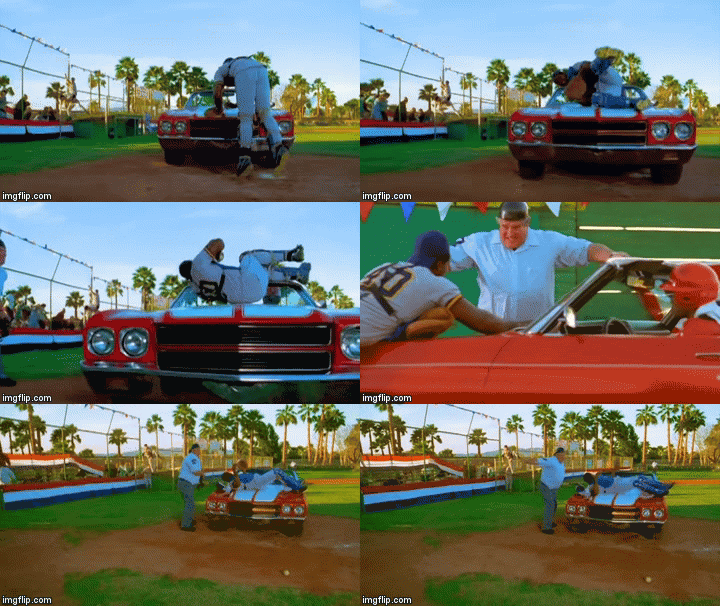
(Blogathon ’16) Jake Mintz and Jordan Shusterman: Nelly’s “Batter Up”

This guest-post is part of the 2016 Baseball Continuum Blogathon For Charity, benefiting the Roswell Park Alliance Foundation. The Roswell Park Alliance Foundation is the charitable arm of Roswell Park Cancer Institute and funds raised will be “put to immediate use to increase the pace from research trials into improved clinical care, to ensure state-of-the-art facilities, and to help improve the quality of life for patients and their families.” Please donate through the Blogathon’s GoFundMe page. Also, please note that the opinions and statements of the writer are not necessarily those of the Baseball Continuum or it’s webmaster.

Throughout the baseball community, St. Louis baseball fans have a bad reputation. The “Best-Fans-In-Baseball” moniker is frequently used to ridicule Cardinals fans for their own brand of self-righteous blind homer-ism (to be fair, this is a phenomenon every single fan base exhibits to some extent). We’re not here today to discuss whether or not St. Louis has the best fans in baseball, we’re here to show you that St. Louis has THE best fan in baseball. His name is Cornell Iral Haynes Jr. — but you probably know him as Nelly.

Nelly is easily St. Louis’ most well known and successful rapper. His songs ‘Ride Wit Me’, ‘Hot in Herre’, ‘Dilemma’, and ‘Shake Ya Tailfeather’ have been certified platinum. But Nelly’s most important song — and thus his most important music video — is ‘Batter Up’, which combines a hook based on the theme song from The Jeffersons with Nelly’s love for baseball to form an undisputed artistic masterpiece.

Released in 2001, the music video for Batter Up is 4 minutes and 41 seconds of pure baseball delight. It’s got barbecue, bunt home runs, scantily clad women, and George Jefferson himself. So sit back, relax, and let us take you on a journey through the brilliant baseball mind of Cornell Haynes Jr.

0:03-0:14

Right off the bat we meet our announcers, two old balding white guys in ugly suits that are quite obviously not being portrayed by old balding white guys. Not trying to start a controversy here, but the one on the right bears a suspicious resemblance to Nelly.

nelly1

0:17

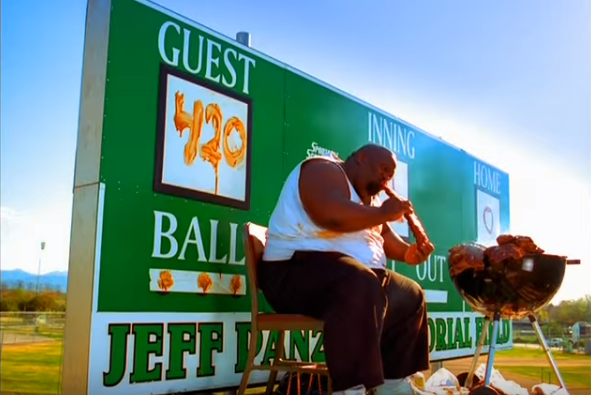
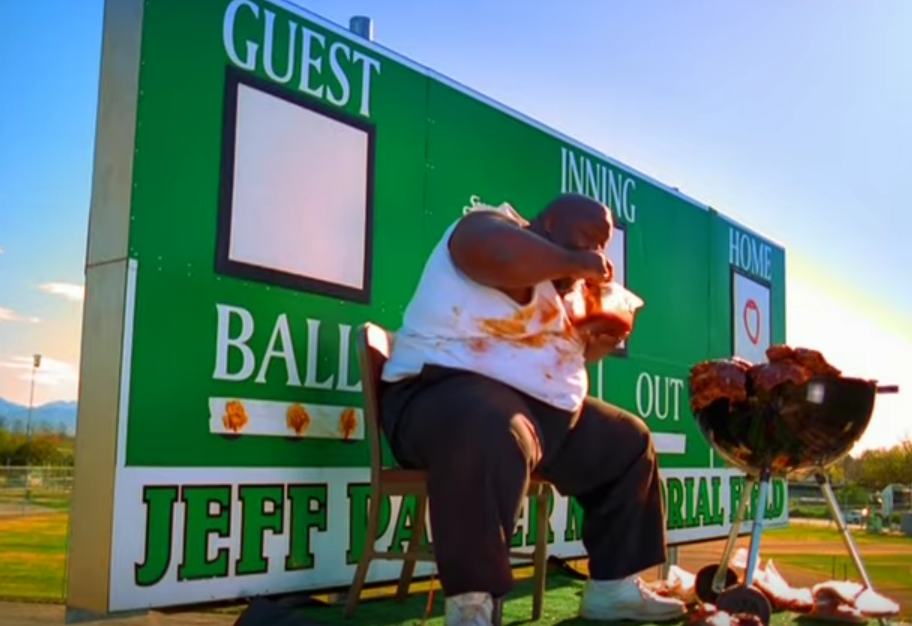
We are introduced to the scoreboard operator: a heavyset man in a white tank top that is absolutely doused in BBQ sauce. This gentleman seems to be using the ribs as a paintbrush in order to carry out changes to the scoreboard. Notice how not a single pitch has been thrown, yet there are already three balls.

nelly2

0:20

Sherman Hemsley!

nelly3

“And now, please rise for the singing of our National Anthem!” Hemsley proclaims. Was this a legitimate attempt to get Batter Up to be our new National Anthem? Nelly knows no bounds.

0:29

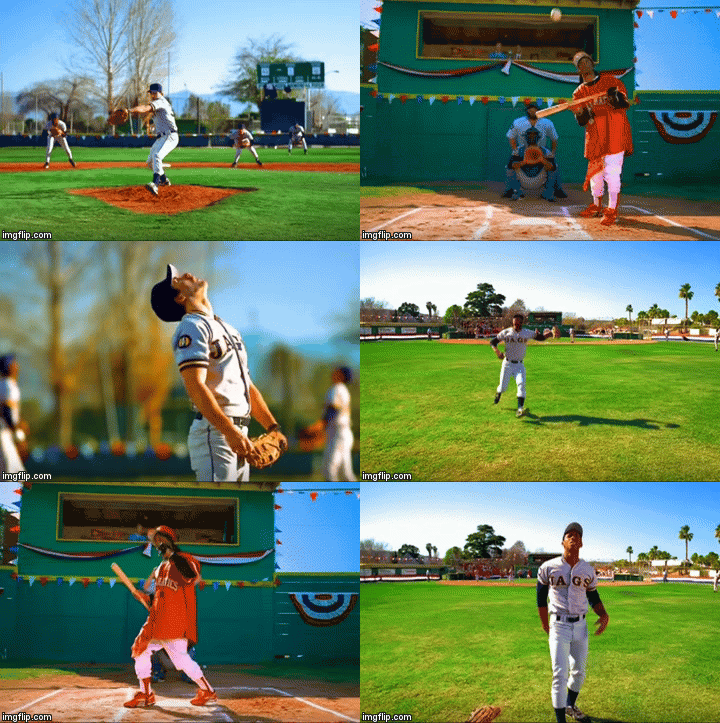
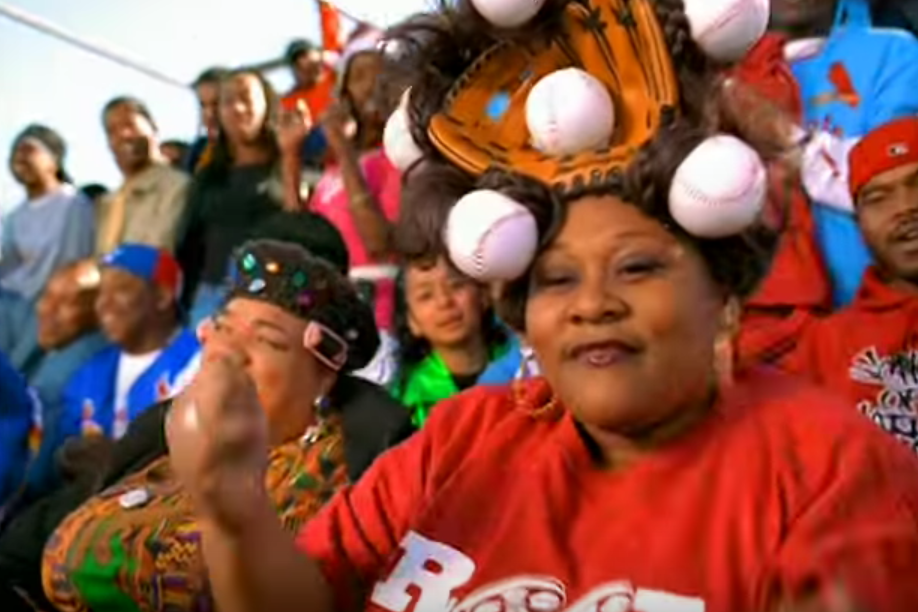
So many questions about this hat/hair combination. Is the glove embedded into the woman’s hairdo? Is it simply one enormous hair piece? Does Lids have any available in a 7 3/8?

nelly4

0:39

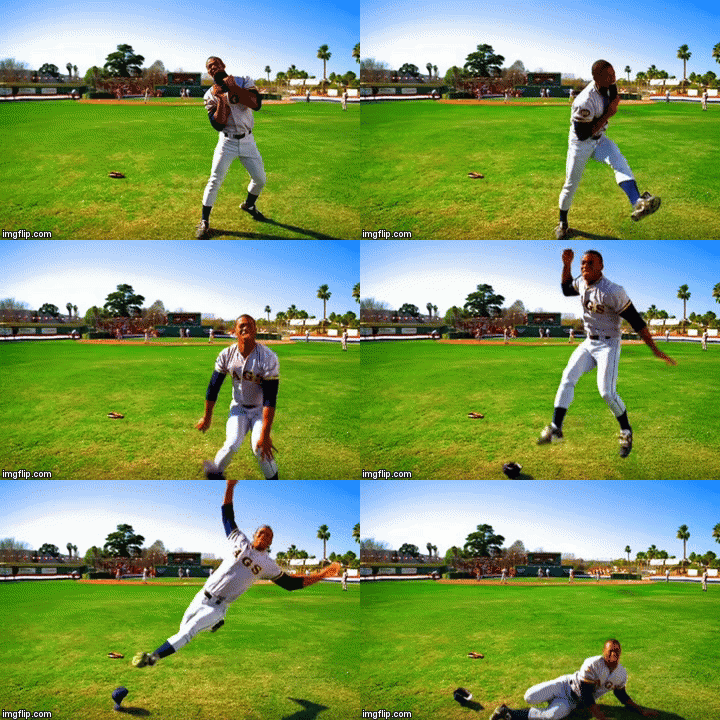
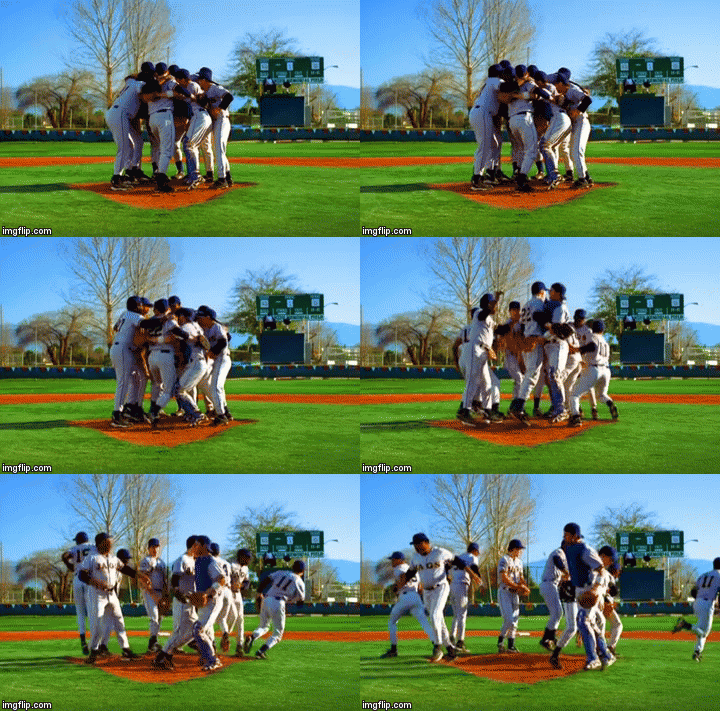
Here we see something unprecedented in the baseball world: an entire team pre-inning huddle on the mound. Did the outfielders come into the infield after the catcher threw down to second? It looks like the coach is in there too. Maybe they’re drawing up some type of trick play.

nelly5

Let’s take a look at the scoreboard in centerfield. Under it we see our old friend, the heavy set barbecuin’ chef. And oh, the score is somehow 62-0 in the top of the 1st inning. 62-0! The first pitch of the game hasn’t even been thrown yet. Could it be that Nelly and his St. Lunatics were at such a disadvantage that the other, seemingly more put-together outfit, spotted them 62 runs? Just some food for thought. Perhaps more importantly, what is even the circumstance of this game? Is it just a men’s league? Independent ball? Are the St. Lunatics barnstorming around the country challenging any semi-pro team that thinks they can take down Nelly & Co.? It’s just a peculiar match-up by all accounts.

0:42

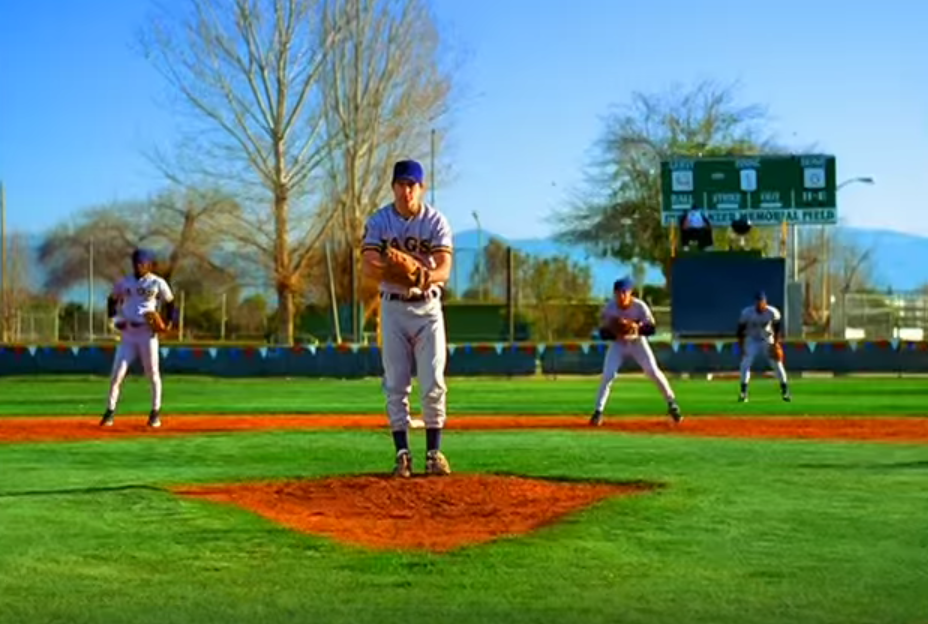
What kinda shift is this? There’s supposedly no one on base yet (as evidenced by the ridiculous team huddle) but the middle infielders are in double play depth. And even if there was a dude on first, this would be extreme.

nelly6

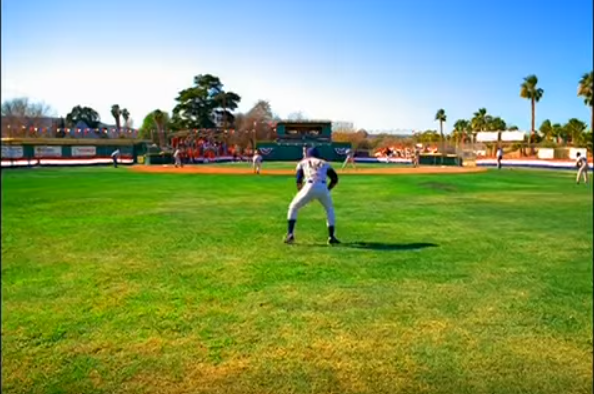
The bizarro double play shift looks even more absurd because this game is clearly being played on a field with Little League/softball dimensions. Making grown men play on a Little League size field has to be some sort of safety risk.

0:44

nelly7

Yeah, that’s not a baseball field.

0:48

nelly8

Posture – 40

Balance – 55

Torque – 30

Hat Content – 20

Early 2000’s Reebok Cleats – 80

0:55

Up first for the St. Lunatics is Ali. Let’s see what kind of swing he has… oh, that’s a pitbull.

nelly9

If this game is being played in a baseball universe that permits batters to bring pitbulls up to the plate with them, the pitbulls should at the very least have to be in the batter’s box.

Despite the potential advantage intimidation-wise — is the pitcher even going to throw the ball if the catcher is too afraid to crouch? — you’d have to think that having a pitbull with you in the batter’s box would probably have a negative effect on offensive production. Not only does it force you to swing with only one hand, but you become significantly more susceptible pitches low in the zone.

1:00

Maybe because both the umpire and the opposing team are so intimidated by the presence of his pitbull, Ali bypasses the traditional rules of baseball and is awarded a single run without having to even swing the bat.

All you, barbecue scoreboard guy.

nelly10

YOU CAN PUT IT ON THE BOOOOOOOARD, YESSSS.


1:22

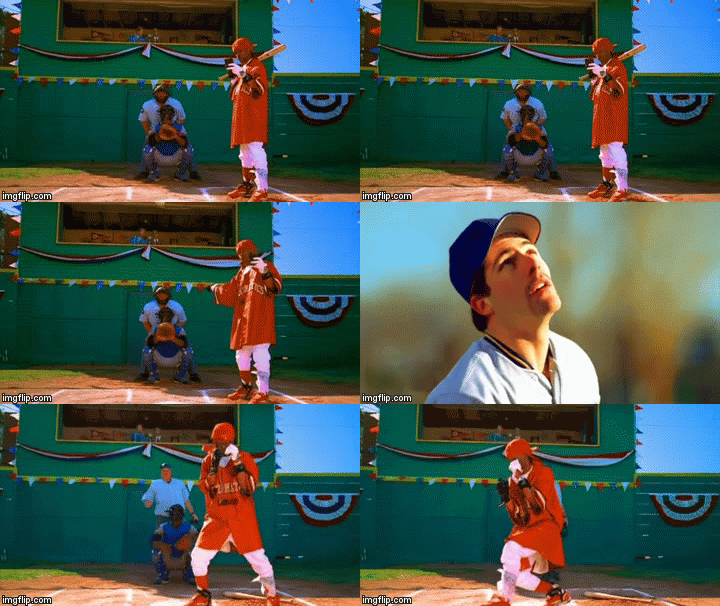
Kyjuan steps up to the plate with, as far as we know, no one one base. Looks like he’s gonna try and bunt for a hit. Odd strategy at this point in the game, and considering his stolen base totals in recent years, but he must know something we don’t.

nelly11

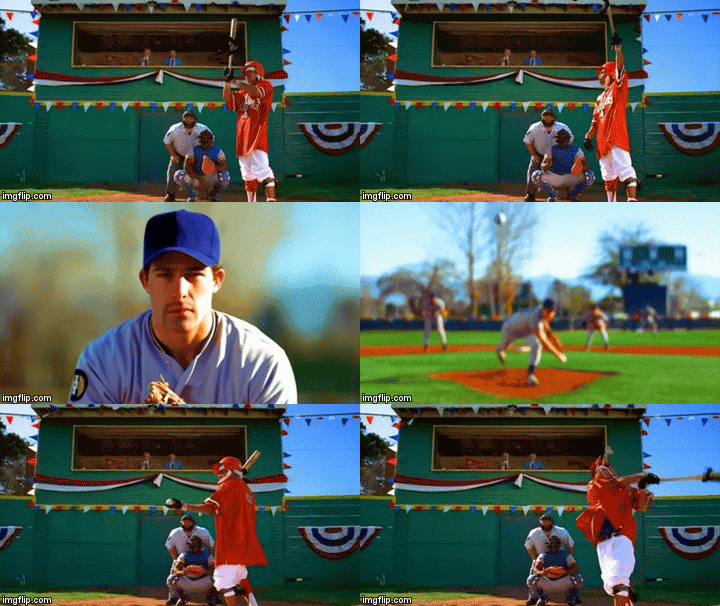
WELL THEN. The pitcher thought he could go up and in but Kyjuan brings his hands in and launches the ball over the centerfield wall…while bunting. He saunters down to first with pride. It’s basically Super Bunt from MLB 2K6.

2:17

nelly12

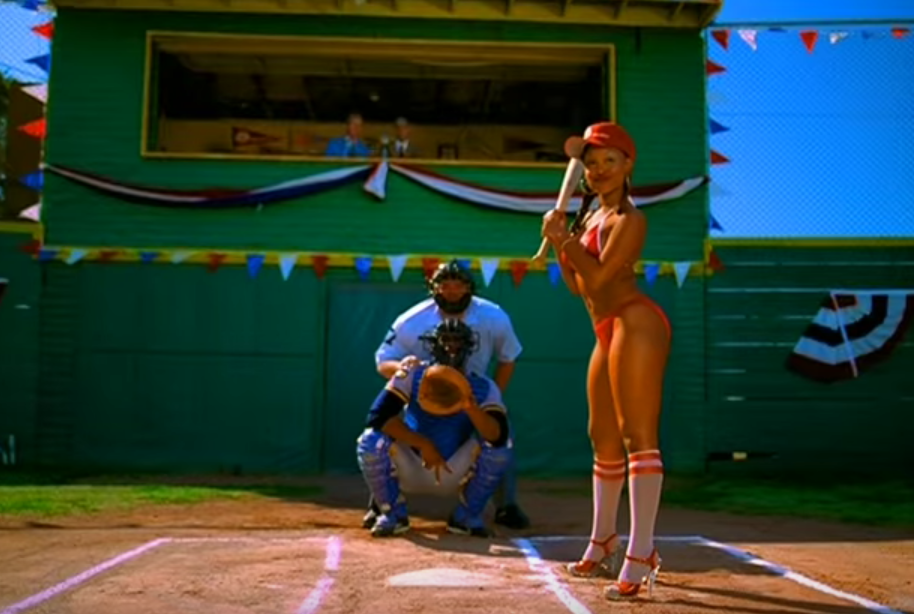
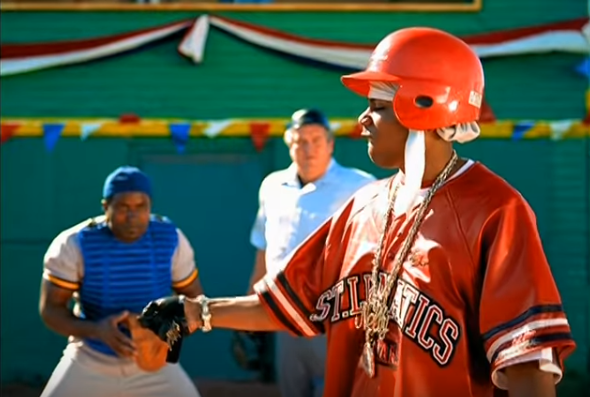
We’re usually all for unique uniforms, but this one just seems impractical. Can you imagine sliding headfirst on dirt in that thing? THE HIGH HEELS! Also, WHY ARE YOU CALLING A CURVEBALL! At least the pitcher is smart enough to shake him off.

2:28
And even after calling off the curveball, the pitcher manages to airmail it into the press box. The umpire rules that the runner go to first, which makes zero sense unless that was ball four. More confusing is the outrage expressed by the catcher, the opposing manager, as well as the announcers. Who are they mad at? The umpire for calling ball four? The pitcher for throwing ball four? The batter for not wearing any clothes? What we do know for sure is our scorekeeper is still very much enjoying his barbecue:

nelly13

3:17

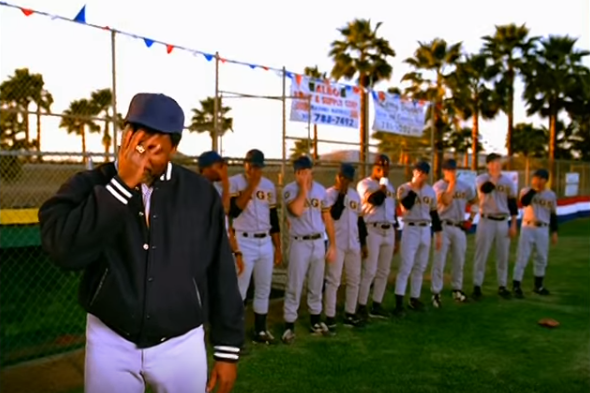
This is a confusing shot for a few reasons. While we acknowledged that this is clearly not a professional sized field, and the dugouts most likely aren’t very big, it’s still rather odd to see the entire team out of the dugout standing in a line, expressing their discontent simultaneously. Also…is the manager wearing a World Series ring? Is this team supposed to be good??!?!

nelly14


3:28

nelly15

Our clean-up hitter for today’s game is Murphy Lee, who struts up to the plate with what appears to be his cell phone in one hand and his bat in the other. Without taking his eyes off his game of Tetris, he squares the first pitch up and launches it to right-center.

3:41

Murphy Lee apparently hit a 358-run dinger and now the score is 420-0. Starting to wonder why they needed to be spotted 62 runs from the start.

nelly16

3:43

nelly17

At least this ball actually went over the fence. Looking at you, Nyjer Morgan.

3:53

nelly18

Our final batter of the day is Nelly, who promptly calls his shot. And the pitch…

nelly19

BOOM. Absolutely crushed. Time to trot…

nelly20

Oh?

Nelly21

OH.

Nelly is now going to drive his car around the bases.

nelly22

Based on previous at-bats, it’d be safe to assume that this monstrous hit was indeed a home run, and thus, no defense was in need of being played. But apparently not! As Nelly Tokyo drifts around third, we see him heading towards the catcher who is prepared to field the ball.

nelly23

And you thought Chase Utley was reckless.

4:41

nelly24

The St. Lunatics. The Best Fans in Baseball.

Jake Mintz and Jordan Shusterman are the guys behind “Cespedes Family BBQ” and co-host the “Cespedes Family Barbecast“. They can be followed at @CespedesBBQ.

This guest-post has been part of the 2016 Baseball Continuum Blogathon For Charity, benefiting the Roswell Park Alliance Foundation. The Roswell Park Alliance Foundation is the charitable arm of Roswell Park Cancer Institute and funds raised will be “put to immediate use to increase the pace from research trials into improved clinical care, to ensure state-of-the-art facilities, and to help improve the quality of life for patients and their families.” Please donate through the Blogathon’s GoFundMe page. Also, please note that the opinions and statements of the writer are not necessarily those of the Baseball Continuum or it’s webmaster.

(Blogathon ’16) Eric Stephen: On Baseball and Brothers

This guest-post is part of the 2016 Baseball Continuum Blogathon For Charity, benefiting the Roswell Park Alliance Foundation. The Roswell Park Alliance Foundation is the charitable arm of Roswell Park Cancer Institute and funds raised will be “put to immediate use to increase the pace from research trials into improved clinical care, to ensure state-of-the-art facilities, and to help improve the quality of life for patients and their families.” Please donate through the Blogathon’s GoFundMe page. Also, please note that the opinions and statements of the writer are not necessarily those of the Baseball Continuum or it’s webmaster.

At the end of January, I am reaching the point of restlessness in the offseason, much too far removed from the end of the last baseball season and still too far away from the starting of spring training this season. With 2016 a bit of a milestone year for both me and one of my brothers, I thought I’d share one of my favorite baseball memories with him.

My two brothers are the reason I love baseball so much. Kelly is 15 years older than I am, and Greg is 10 years older than me, and were largely responsible for molding me into the person I am today. They loved baseball, so it had to be great. I had to find out about this thing my brothers loved so much, and I soon found I would love it too.

Given the age difference between us, Kelly and Greg were more than brothers and role models for me. They also had somewhat of a fatherly role, too, when I was younger. Our dad passed away from pancreatic cancer in January 1987, when I was 10, and they did their best to fill that void in my life when I needed it most.

The 1988 Dodgers will forever be the sports team I most identify with, one that captured my heart when I was 12. I grew up in Palm Springs and, being two-plus hours away from Dodger Stadium I didn’t go to too many games as a kid. I went to two games in 1988 – Game 2 of the 1988 World Series, with Kelly; and July 6 against the Cardinals, with Greg.

To date, Game 2 remains the only World Series game I have ever attended. But that July 6, 1988 game will always stick with me, too.

It was just Greg and I, which meant a lot of knowledge was getting passed down to me. Previous lessons included how to keep score, proper strategy, and even when to cheer. That last one was more important that you might think, especially for someone not familiar with depth perception at different sections of the ballpark.*

*In other words, not in this game but when I was much younger, I once stood up with arms raised upon bat hitting ball, not realizing this high fly ball wasn’t destined for the seats or even the outfield, but rather settled nicely into the waiting glove of the second baseman, much to the embarrassment and horror of my brothers.

Anyway, back to this July 6 game, there was nothing special about this relatively nondescript Wednesday night game. It did happen to fall on what would have been our dad’s 54th birthday, and was just his second birthday since his death.

The Dodgers were down 3-0 to the Cardinals after seven innings in this game, but as they did all year managed to rally to tie the game in the eighth inning. But the rally wasn’t over.

Even after tying the score, the Dodgers managed to load the bases against ace closer Todd Worrell, with first baseman Franklin Stubbs coming to the plate. Stubbs was a former first-round pick who never managed to live up to the advance billing, but on this night he came through.

Stubbs ran the count full and on the eighth pitch of his battle with Worrell launched a ball well into the right field pavilion, helping to give the Dodgers yet another improbable victory in a season full of them. What I remember most about the moment of the grand slam was the utter euphoria in Dodger Stadium, enhanced because I was there with my brother Greg.

I can still feel the goosebumps today when thinking about that game.

Greg lives in Baltimore now with his wife and three kids, so we don’t see each other as much as I would like. But this year he turns 50 in February, and I turn 40 in March, and with Kelly the three of us plan to celebrate these milestones with each other during a week in spring training in Arizona.

It is as perfect a combination that I can think of – me, baseball and my brothers. I’m getting goosebumps already, and I can’t wait.

Eric covers the Dodgers for True Blue LA and is an editor at SB Nation. You can follow him @truebluela.

This guest-post has been part of the 2016 Baseball Continuum Blogathon For Charity, benefiting the Roswell Park Alliance Foundation. The Roswell Park Alliance Foundation is the charitable arm of Roswell Park Cancer Institute and funds raised will be “put to immediate use to increase the pace from research trials into improved clinical care, to ensure state-of-the-art facilities, and to help improve the quality of life for patients and their families.” Please donate through the Blogathon’s GoFundMe page. Also, please note that the opinions and statements of the writer were not necessarily those of the Baseball Continuum or it’s webmaster.

(Blogathon ’16) Jason Cohen: Reminiscing about Chien-Ming Wang and What Could Have Been

This guest-post is part of the 2016 Baseball Continuum Blogathon For Charity, benefiting the Roswell Park Alliance Foundation. The Roswell Park Alliance Foundation is the charitable arm of Roswell Park Cancer Institute and funds raised will be “put to immediate use to increase the pace from research trials into improved clinical care, to ensure state-of-the-art facilities, and to help improve the quality of life for patients and their families.” Please donate through the Blogathon’s GoFundMe page. Also, please note that the opinions and statements of the writer are not necessarily those of the Baseball Continuum or it’s webmaster.

Former Yankees pitcher Chien-Ming Wang signed a minor league deal with the Royals, making that the eighth organization (ninth if you count a short stint in indy ball) the right-hander has been a part of since returning to pitching in 2011. After tearing his shoulder capsule during the 2009 season, Wang missed all of 2010 to recover and the Washington Nationals picked him up in hopes of getting the pitcher he once was for such a short amount of time. He last pitched in the big leagues during the 2013 season for the Toronto Blue Jays and it was a disaster, but it wasn’t always that way.

Signed as an amateur free agent by the Yankees in 2000, he made his professional debut at the age of 20. After missing the 2001 season to injury, it took him another four seasons to reach the majors. He wasn’t expected to be a star, but somehow he managed to turn into one, albeit not a very famous one. In 2005, he managed to pitch at an above-average level while the rotation fell apart around him. That year, Carl Pavano, Jared Wright, Kevin Brown, all broke down during the course of the season. Wang was hurt too, but he returned late in the second half and was even able to pitch in a playoff game. His first year was solid, but maybe not much to remember.

What followed, though, were probably two of the most important seasons for the Yankees in that decade. Between 2006 and 2007, Wang pitched to a 3.67 ERA and a 3.85 FIP over 417.1 innings, averaging somewhere between six and seven innings per start–something the current Yankees would love to dream on. He led the league with 19 wins in 2006, was the runner-up in the Cy Young vote to Johan Santana, and placed 24th in the AL MVP vote. His numbers weren’t the most dominating–a 3.9 K/9 rate over that time would attest to that–but his power sinker made him a real threat to hitters with a ground ball rate over 60%.

Some of his best games in 2006 include his two-hit, two-walk, complete game shutout of the Tampa Bay Devil Rays. There was also a game where he produced a total of 20 ground balls outs in a single game against the Atlanta Braves. He even struck out 10 batters in 2007 on his way to complete game while allowing just two runs against the New York Mets. It seemed like he was always going into the seventh, eighth, or ninth inning with less than 100 pitches. Everyone was so focused on the strikeout that they never realized that contact could be such an effective means to utterly dominate your opponent. It’s a pity he had the literal worst defense in baseball playing behind him from 2005-2007, because who knows what things would have been like if they had even a league-average group then.

He ended up being worth 7.5 WAR over those two years, ranking right next to Mussina and Andy Pettitte during that period. He was top-20 in innings pitched, ranked third in ground ball percentage behind only Derek Lowe and Brandon Webb, and his 2.40 BB/9 was just outside of top 20 in baseball at the time. Wang was never the best, but when the Yankees needed him most, he was at least one of them. At a time when the Yankees were paying Carl Pavano not to pitch and had a disappointing two years with Randy Johnson, Wang filled in at the league minimum. He was invaluable.

The most exciting thing about it was that he arrived on the brink of a new day. He came up at a time where the Yankees were still filled with bloated contracts for underperforming veterans and his presence was a breath of fresh air. He made his debut just as Robinson Cano was entering the league and Melky Cabrera was getting a chance. Joe Torre was finally on his way out after a decade in the dugout. Pretty soon there would be Phil Hughes and Joba Chamberlain, and though we have the benefit of hindsight to know how terrible that all worked out in the end, Wang was there before it was cool to be young and he was great.

Unfortunately not everything worked out as expected. As much promise as the 2007 season brought, 2008 proved to be the cruel reality check that none of us wanted. Hughes and Joba got hurt, and Wang, while rounding the bases in Houston, tore a ligament in his foot and a muscle in his leg to end his season in June. All these injuries and disappointing seasons likely led the Yankees to go heavy on that year’s free agent class, coming away with CC Sabathia and AJ Burnett to nail down their weakened and underperforming rotation. Many believe that Wang’s injury threw him off and he struggled in his return during the 2009 season before ultimately tearing his shoulder capsule and destroying the Wang we all knew.

I’ve written about Wang before, I even asked him to retire and put an end to the ghost that he has become because it was just too painful to watch. He’s a member of the Pinstripe Alley Top 100 Yankees and he has a legacy in the Bronx that won’t go away with time. It’s just incredibly weird to think that you’ve peaked doing your life’s work before the age of 30 and it’s not really anyone’s fault. You can’t even say he just didn’t work out–he got hurt. Situations like this ruin–even end–people’s lives. I’m a few years away from 30 and would like to think that I haven’t come close to my peak, but if I knew it had already come and gone, I have no idea how I’d be able to keep doing what I was doing.

Then you look at what Wang has been doing and maybe it isn’t sad to see a 35-year-old man–already gone from the man he once was–continue to plug along. He made it once, he could make it again, but even if he doesn’t maybe there is something to look at, maybe even emulate, in Wang’s determination to do the only thing he very well might be good at. There’s no shame in that and if he pitches another 10 years, even if it’s at the Triple-A level, we should all be so lucky. In the meantime, I’ll remember who Wang was, but never ignore who he has become.

Jason Cohen is an editor at SB Nation’s Pinstripe Alley where he holds the world record for most articles written and it isn’t even close. He is an unapologetic Yankees fan who loves bat flips, calling people out when they say something offensive, and isn’t quite comfortable talking about himself in the third person. You can normally see his writing at Pinstripealley.com and his tweets at @Jason00Cohen.

This guest-post has been part of the 2016 Baseball Continuum Blogathon For Charity, benefiting the Roswell Park Alliance Foundation. The Roswell Park Alliance Foundation is the charitable arm of Roswell Park Cancer Institute and funds raised will be “put to immediate use to increase the pace from research trials into improved clinical care, to ensure state-of-the-art facilities, and to help improve the quality of life for patients and their families.” Please donate through the Blogathon’s GoFundMe page. Also, please note that the opinions and statements of the writer were not necessarily those of the Baseball Continuum or it’s webmaster.

Pieces of the Blogathon you may have missed

Hello, a quick interruption here to tell you about the early-morning Blogathon pieces you may have missed today. While I try to get everybody into a spot where people will be reading, obviously due to the vast number of pieces it’s not possible to totally avoid having some people fall into times where most people are asleep.

So, please, take a look at these Blogathon pieces you may have missed, and don’t forget to donate!

Jonathan Weeks’ “The Greatest Man I Have Known”

Mets Daddy’s “Highs and Lows of 1986”

Seth Poho’s “2016 Nuclear Plant Team”

Yakyu Night Owl’s “Dreams of Kenji-Kun”

Matt Wojciak’s “Middle Relief Report”

Matt Taylor on Adam Jones

Thank you, and we now return to the Blogathon.