Unknown's avatar

About danglickman

2012 Graduate of St. John Fisher College. Journalist, writer and sponge for information.

Glick on Gaming: Xenoblade Chronicles is the most unique series at Nintendo

In Glick on Gaming, Dan Glickman leaves baseball (mostly) behind to talk video gaming. This time: Xenoblade Chronicles: Definitive Edition and Xenoblade Chronicles 2 for the Nintendo Switch.

The Xenoblade Chronicles by Monolith Soft series that can be found on Nintendo consoles is an odd one, one of the most unique of Nintendo’s stable. Given that this is a company that has a mushroom-eating plumber as its mascot, that may be saying something. However, it is odd even compared to other Nintendo series. Here are a few reasons why:

IT IS BRITISH

Well, not really. It, like most games published by Nintendo, was created in Japan. It’s done in an anime style that is full of big-eyed people, scantily-clad women, and wild hair. In fact, an argument could be made that it is one of Nintendo’s most Japanese series. Its genre is even JRPG (Japanese Role-Playing Game). However, the vast majority of Nintendo games when they are localized (translated) into English are done by Nintendo’s American branch. The voice actors that redub any Japanese dialogue are almost always American, the spellings used are the American spellings, and so is the slang.

In Xenoblade, that isn’t the case. A quirk of history meant that Nintendo’s branch in the UK did it. It all stems from Nintendo of America’s initial refusal to bring the original game to the USA until a fan campaign convinced them to do otherwise. Since Nintendo’s UK branch had already localized the game, Nintendo of America simply decided to use their work.

As a result, almost all of the characters in the Xenoblade games speak in British accents, generally by actual British people. This leads to some glorious subversions of what you’d expect, giving the series a unique character that isn’t really found anywhere else in Nintendo’s repertoire. For example, take this character from Xenoblade Chronicles 2, Nia:
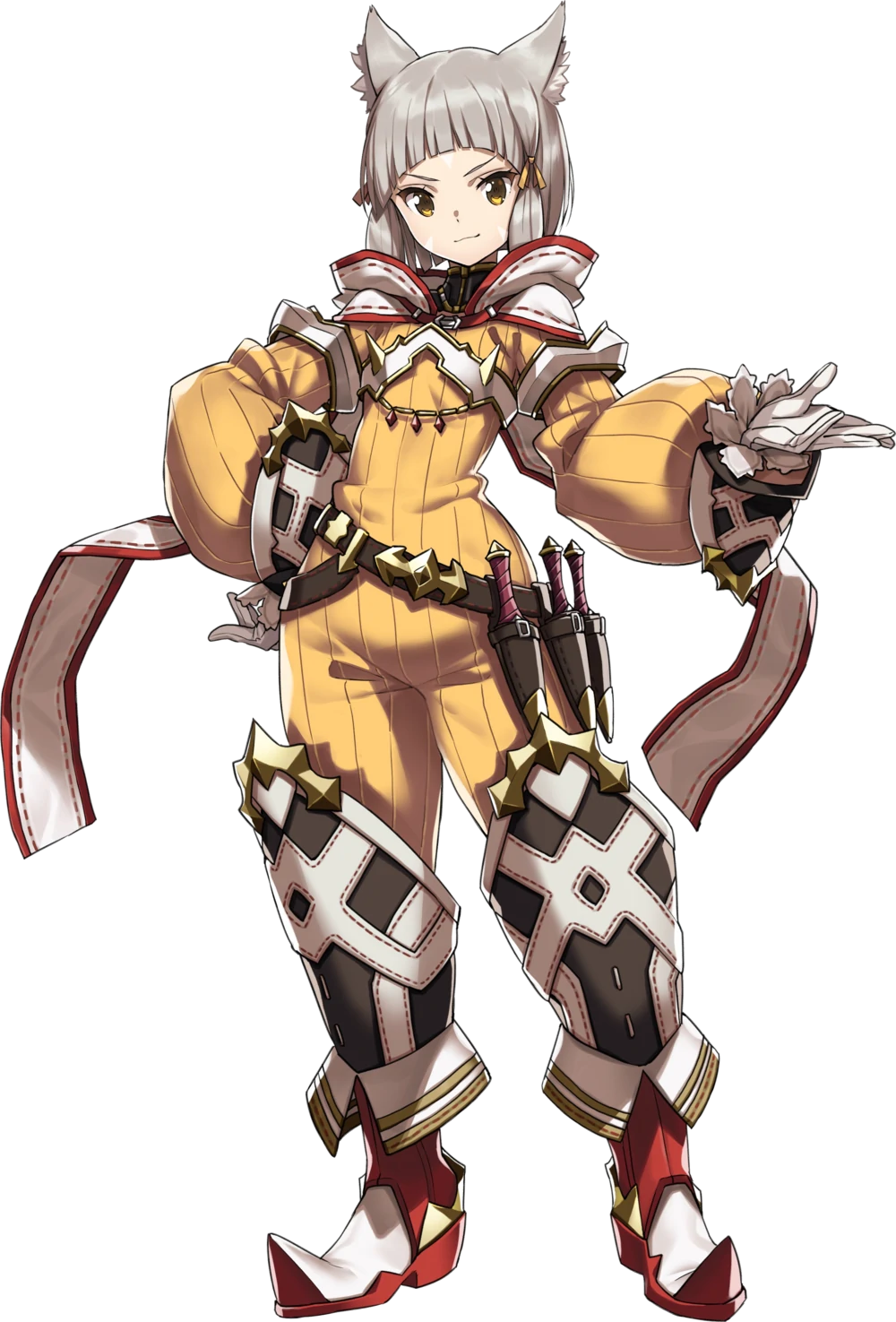
Credit to the Xenoblade Wiki for this.

Now, looking at her, you’ll notice a few things. The most notable is that she is a cute cat-person with big fuzzy ears. You’d think that this character would have some sort of cutesy kiddy voice.

You would be wrong. Nia is an angry and often sarcastic catwoman with a Welsh accent:

This leads to the next thing that makes Xenoblade a unique series at Nintendo…

THE NOPON AREN’T WHAT THEY SEEM

Nintendo games are often quite straight-forward. Really, the number of Nintendo series that truly have stories that go beyond the standard “good versus evil” can probably fit on one hand. It ultimately goes to the Nintendo philosophy that puts the gameplay before anything else. Monolith Soft, the production house behind Xenoblade, is not as beholden to this, as they actually had been independent until being bought out by Nintendo. As a result, no Nintendo series has more twists and turns. And few Nintendo series have a more surprising setting filled with interesting races of beings.

Take, for example, the Nopon. The Nopon are small egg-shaped balls of fur with prehensile ears. Here is Riki from Xenoblade Chronicles 1, for example:

And just in case that doesn’t truly show Riki’s essence, here’s the official art for him:

Credit again to the series’ wiki page.

You look at him and you doubtless think: this is clearly the kid-friendly cutesy character only there to serve as comic relief. And in that, you are right. Except here’s the thing:

Riki there? He’s a man, he’s 40! He’s got 11 kids! He’s deeply in debt to basically everyone in his village! In fact, he’s so in debt that he’s basically forced to go on a suicide mission and join the heroes!

Not what you were expecting, huh? Well, the thing is that the entire Nopon race is like that. In a medium that often paints other sci-fi or fantasy species with a broad brush, the Nopon have layers. The Nopon character in Xenoblade Chronicles 2 is a borderline-perverted engineer who clearly has a crush on his robot creation, The Nopon characters in the Xenoblade Chronicles 1 pseudo-sequel Future Connected are a brother and sister where the sister is the big physical basher (usually a role reserved for a giant muscular man, not a cute pink bunny-ball) and the brother is the healer (usually the role reserved for a woman in games such as these). Still others in that same game are a group of explorers with various different personalities, wants, needs, and quirks.

Other Nopon you meet during the series have as varied of personalities as the humans as well. Many of them are back-stabbing businessmen every bit as cruel and cunning as the worst people you know, and they will use their cuteness to their advantage in doing so. Other Nopon are as varied as humans. There are loving mothers, deadbeat fathers, salesmen, thieves, orphans, scientists, and every other type of thing. This may seem obvious to those not familiar with Nintendo’s games, but this wide variety is rare. In the Zelda series, for example, the non-human species are often pigeonholed into specific roles. The Gorons are almost always miners and explosive experts, for example. Not so for the Nopon.

IT’S ADULT

I don’t mean it in the “there are scantily-clad cartoon women in this” (although there are) sense. Nor do I mean it in the violence sense (although there is violence). No, it is adult in theme. It covers, either directly or indirectly, some of the following topics:

  • The existence or non-existence of a higher power, and what value that being does or does not bring.
  • Whether we are in charge of our fates or destined to go on a predetermined course.
  • Racism, discrimination, and the difficulties of overcoming hatred.
  • War and the scars left by it.
  • The question of whether the nature of mankind means it will repeat its mistakes forever.
  • The need to overcome nihilism.
  • Generational trauma.
  • The relationship between man and nature.
  • Gnosticism.
  • Eugenics.
  • The burden of responsibility.
  • Friendship.
  • Whether memory is a blessing or a curse.

This isn’t to say there aren’t other video games that deal with topics like this. There are. But in Nintendo’s stable, Xenoblade is one of the few that do, and perhaps the only one that does so many.

And now, it is only a month until the third official game of the series (a side-game was released for the Wii U) comes out. The third installment of Nintendo’s most unique series.
Later this week…

Aside

Later this week, there will be a “Glick on Gaming.” Stay tuned!

2023 WBC Team Dominican Republic: The “ideal” roster

Here’s a fun fact: one of my most popular posts ever was an early projection of what Team Dominican Republic’s roster would look like for the 2017 World Baseball Classic. So now that I have finished my June update for Team USA, it is time to look at another tournament favorite: the Dominican Republic. It’s a topic that others have already brought up: reporter Hector Gomez tweeted out one possible lineup, while no less than Vladimir Guerrero Jr. gave his opinion back in April. Now, it’s my turn.

Much like the Team USA rosters, at this point this is a “pie-in-the-sky” roster. It assumes, probably wrongly, that every player I mention would be willing and able to play. That, needless to say, is highly unlikely. There are always injuries, spring training superstitions, or transaction considerations that cause players to back out. While this has not been as big of a problem in the past for the Dominican as it has been for some other countries, it still happens. So keep that in mind while reading this: it’s highly unlikely that the final roster will look like this.

That said, even with this being a pie-in-the-sky exercise, there are two rules I have in place while making this:

  • Teams are made up of 28 players, of which 13 of them must be pitchers and two of them catchers.
  • The pitch count rules make relievers extremely important.

Go below the jump for more:

Continue reading

The “ideal” 2023 Team USA WBC roster 2.0

THIS ARTICLE IS NOW OUT-OF-DATE! MY LATEST PROJECTIONS CAN BE FOUND HERE!

Last month, I speculated as to who would be on the Team USA World Baseball Classic roster next year. We’re now over a month later, so based on how the season is going, how much has changed?

Again, this is not the most likely (that will happen when I begin doing projections). Instead, it is what the best possible team would be if I could wave a magic wand and ensure that every player we’d want would be playing regardless of any injuries, off-season concerns, or spring training routine.

In other words, think of this as a sort-of rough draft or best-case-scenario. It will likely provide a bit of a skeleton for more-serious projections, but it’s unlikely to come to pass as it currently exists.

That said, even with this being a pie-in-the-sky exercise, there are two rules I have in place while making this:

  • Teams are made up of 28 players, of which 13 of them must be pitchers and two of them catchers.
  • The pitch count rules make relievers extremely important.

Go below the jump for more:

Continue reading

Coming up…

Aside

Coming up on the Baseball Continuum:

  • My early WBC roster for Team USA has been getting a lot of attention but in some ways is already a bit out-of-date so I’ll give it an update.
  • I may also be creating a Dominican Republic early roster.
  • Something for the MLB draft next month
  • A “Glick on Gaming”

Thanks for reading!

Fictional Fields: Parks Department Field No. 2

An often-underappreciated part of fiction is setting and set design. We focus on the characters and special effects flying around, all of that is meaningless without a sense of place. What would Captain Kirk be without the bridge of the USS Enterprise? Would The Shawshank Redemption have worked as well if we could not see the prison walls that Andy Dufresne chips his way through? What would Mario be able to do if there weren’t blocks, castles, hills, and tubes around for him to jump on and explore? The places where our fiction takes place help dictate how that fiction occurs.

The same can be said for baseball. Alone among the major sports, massive differences exist between ball fields. They can be anything from an open field with no boundaries to a gigantic stadium with walls of various heights. How that ball field is laid out affects how the game is played: what will and won’t be a home run, how deep the outfielders will play, and how likely it is that a long hit becomes a double, triple, or out.

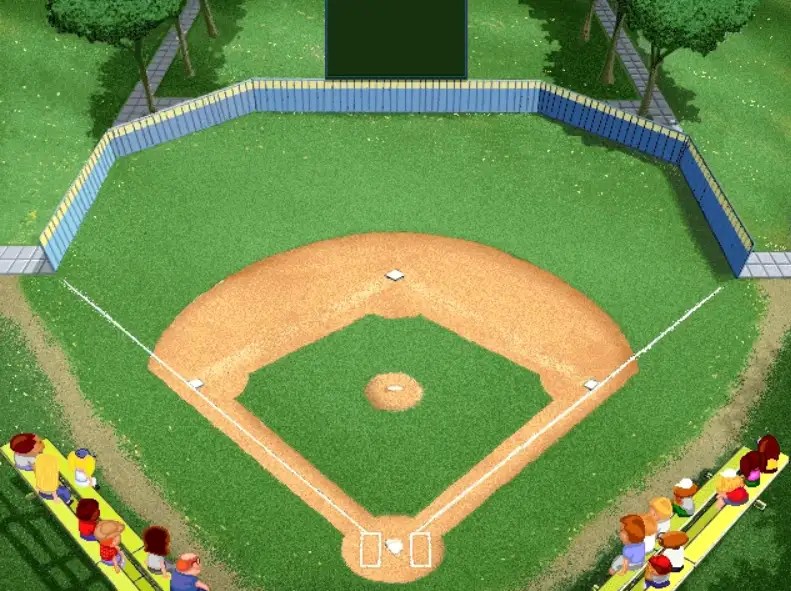
Now, I combine the two to look at FICTIONAL FIELDS- baseball fields from the land of fiction. We begin with Parks Department Field No. 2 from the classic Backyard Baseball.

About The Field: Debuting in the classic Backyard Baseball of 1997, Parks Department Field No. 2 (PDFN2) was in some ways the most ubiquitous and least-wacky stadium in the series. Initially only available if you played in season mode, it became available for single games in later installments. Sadly, after the 2003 installment, PDFN2 disappeared from the series.

As mentioned above, it was the least-wacky stadium of the series. While other fields in the games are generally in actual backyards, back alleys, or playgrounds, this one has a more official feeling. The fact that it was what was used in season mode suggests that it was (and perhaps still is) the home facility of the local sports organization.

Great Players: The field was used by almost every team in season mode, from the Melonheads to the Taters and everyone in-between. There were also pint-sized versions of MLB teams. The only teams that couldn’t be encountered there were those that could only be found in post-season tournament play. As a result, PDFN2 saw many of the greats: Pablo Sanchez, Pete Wheeler, Stephanie Morgan, Achmed Khan, the works! Add in the kid versions of MLB stars from the sequels, and it’s possible that PDFN2 has seen the greatest assemblage of baseball talent in video game history.

Dimensions:

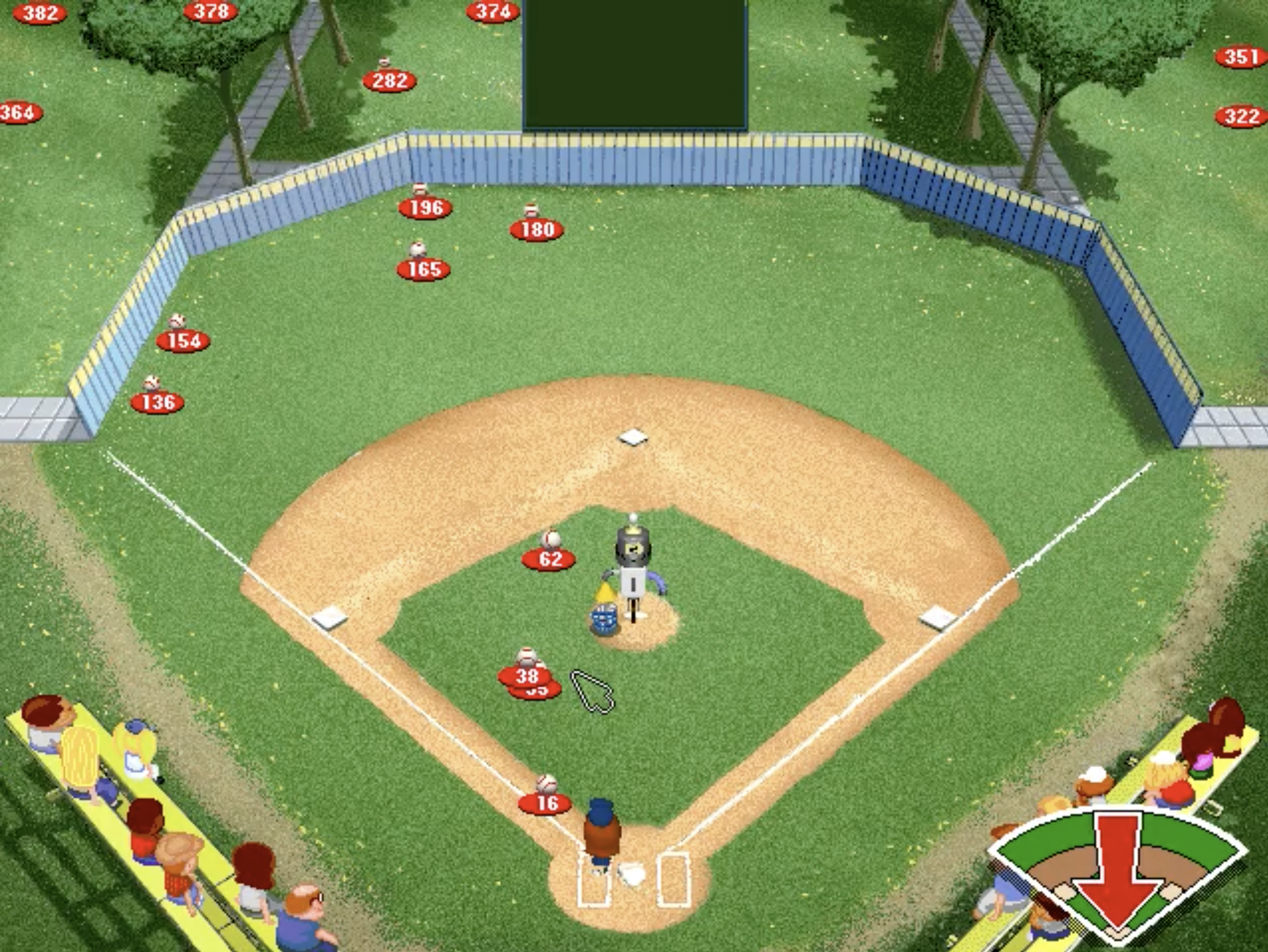
So, before we figure out the field’s dimensions, there is a need first to get an idea of what type of field this is. There is reason to believe it is a Little League-size field. Why? When you see the length of home runs in Backyard batting practices, you see that the balls that die at the left-center wall are only going 196 feet (note that in BB they count the rolls and bounces for distance). Dead grounders ahead of the pitcher’s mound are in the 30s as far as distance, and a ball clearly past the pitcher’s mound is 62 feet. Look below at a screenshot of Eauxps I. Fourgott’s video:

This would suggest that this is a little league field. So about 46 feet from the mound to home and 60 feet between the bases. This is not surprising, of course, given that the Backyard Baseballers are children, but it’s still important to know as we figure out the lengths.

So, looking over various videos of home run derbies, I’ve come to the conclusion that the following distances are definitely true:

Left Field: 175 ft

Left-Center: 196 ft

Right-Center: 196 ft

Right Field: 175 ft

So, we still need to figure out how long it is down the lines and to straightaway center. To do that, we’ll need to do the highly-unscientific-but-the-best-we’ve-got method of pixel measurement. In this case, we measure something on the computer in pixels and then use that to get an idea of the scale. Since it isn’t a “straight-on” view but rather at an angle and further distorted by it cartooniness, we’ll have to use the balls closest to the area we’re aiming at to set a scale.

So, for example, it appears that the hit towards center that went 180 feet was 1274.5 pixels. This suggests that 7.080555555 (repeating) pixels is equal to one foot. Since straightaway center is about 1306 pixels, that suggests that it’s about 184.4 feet to center. This means, of course, that the right-center and left-center alleys are actually deeper than straightaway center.

Now, time to figure out the lines. The ball hit closest to the line is the 136 hit to left. So to get something close to that scale, we find 1299.1 pixels equals 136 feet. That suggests that down the lines we should assume one foot is represented by just over 9.5522 pixels. It looks like the lines are 1310.5 pixels, so that equals out to about 137.19 feet down the lines. So, the final dimensions of PDFN2 are:

Left Field line: 137 ft

Left Field: 175 ft

Left-Center: 196 ft

Dead Center: 184 ft

Right-Center: 196 ft

Right Field: 175 ft

Right Field line: 137 ft

Now, this was highly unscientific, and no doubt the “real” lengths are rounded up or down. Still, it gives a “ballpark” figure. And, yes, that wordplay is intended.

Just for fun, given that Little League fields are 2/3rds the size of adult fields, we can figure out what the MLB equivalent of PDFN2 is with a little math. That comes out to…

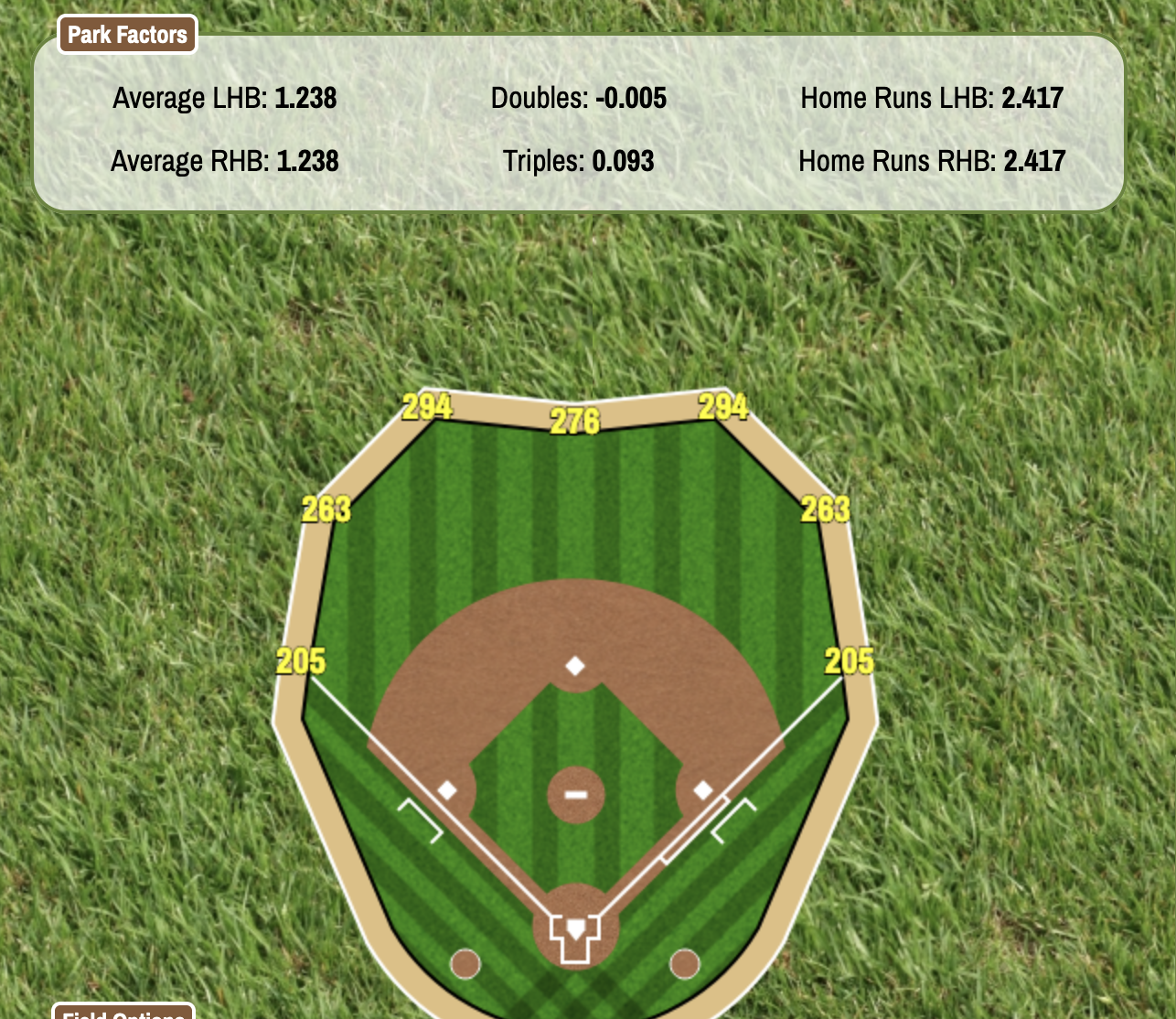
Left Field line: 205.5 ft

Left Field: 262.5 ft

Left-Center: 294 ft

Dead Center: 276 ft

Right-Center: 294 ft

Right Field: 262.5

Right Field line: 205.5 ft

You’ll notice that this is still hilariously small (and also that the shape would become more exaggerated). Doing some work with the OOTP Parkgen website suggests it’d be the ultimate hitter’s park:

Yes, if you are reading that right, it should literally be impossible to hit a double in play on that field. So this leads to the question: why was it so small? Even going by the Little League standards (where the deepest parts are 196), the deepest parts of PDFN2 are far closer to the plate than the walls at Lamade Stadium in Williamsport. Given that Pablo Sanchez can smack it over 700 feet, it becomes even more absurd.

Alas, we have no way of knowing. Still, we now know the dimensions for PDFN2, so use this knowledge only for good.

Capacity and Amenities: By default, 16 people are seen in the stands when seen from overhead in Backyard Baseball. Based on the empty spots, it looks like another 16 probably could fit on those stands for a total capacity of 32. It’s possible that additional stands existed outside of camera view, but those were never seen, at least in the classic games. And, of course, there probably is room for blankets and other standing-room options.

As far as amenities, PDFN2 is and was top-of-the-line. Perhaps even over-the-top. It possesses a large scoreboard in dead center for replays and statistics, as well as a blimp that flew over to celebrate home runs. It also had an awesome sound system to blast out the theme songs of all the players. Some sort of broadcast facilities are/were also present since Sunny Day and Vinny the Gooch were able to cover all games.

For fans, less is known. However, given the Gooch’s chili dog, we must assume that some concession stands are/were present.

Other Notes: PDFN2 is part of a series of fields run by the Parks Department. Parks Department Field No. 3 is used for (American) football, while Parks Department Field No. 7 and Parks Department Field No. 8 are used for soccer (although PDFN8 lacks grass and is instead a sandy field).

Final Thoughts: The Parks Department Field No. 2 is a classic of Backyard Baseball, but lacks much of the charm that other fields in the series have. This is, admittedly, by design. While other playing fields are odd and quirky, PDFN2 is fair, without giving an advantage to left-handed or right-handed hitters. It also had a more professional look, like an actual youth stadium on steroids. This made it the perfect stadium for the season mode that Backyard Baseball had. It may not have been the place you’d want to play with your friends, but it was definitely the place you’d want to play against your opponents.

Rochester Red Wings Report: The Ghosts of Strasmas Past and Present

During the 2022 season, I’ll have occasional reports on games I’ve attended of the Rochester Red Wings, the AAA affiliate of the Washington Nationals.

It is May 19, 2010. The second game of a day-night doubleheader. Over 12.5 thousand people pack Frontier Field to watch the best prospect in baseball face the Red Wings. His name is Stephen Strasburg. He is young, but already accomplished. He won awards at San Diego State, a bronze medal in Beijing, and a $15 million dollar contract with the help of Scott Boras. The world is seemingly watching, with national media in the stands and seemingly every camera in the photo city aimed at the clean-shaven kid. Among those cameras in mine. It’s a clear view from behind the visitor dugout, and I see it all as he dismantles the likes of Trevor Plouffe, Matt Tolbert, and Danny Valencia to the tune of nine strikeouts. He leaves the game to a round of applause from the fans of the team he held to three hits. Admittedly, the 2010 Red Wings end up not being anything particularly special, finishing 49-95. As he enters the dugout, some boo him for not tipping his hat. It’s a silly controversy which fades quickly, the Ghost of Strasmas Past.

Within a few weeks, Strasburg is striking out 14 Pittsburgh Pirates. Within a few years, he’s an all-star. Within a decade, he’s the World Series MVP.

It is June 3, 2022. Over a dozen years have passed. Now, the great Stephen Strasburg returns to Rochester. He’s no longer the wonderboy of 2010. Time and injuries have forced him to go from the high heat to more finesse. Where once he could seemingly send it at 95 on demand, now his most dangerous pitch is likely the curve. Regardless, he is Stephen Strasburg, hero of the 2019 World Series. Over 10.5 thousand people pack Frontier Field to see the now-bearded veteran. While the eyes of the world have turned elsewhere, there are still plenty of cameras. One of those cameras is mine, shooting around the protective netting that slightly obstructs the view behind the visitors dugout. The Buffalo team Strasburg faces is a far better opponent than the Wings team he faced in 2010. The Red Wings he’s rehabbing with are better, too. The two Western New York teams are in a fight for the lead of the International League East. When he leaves the game after six innings, the Wings are leading 1-0 thanks to a Donovan Casey solo shot off a nearly-as-dominant Max Castillo. Strasburg has thrown 83 pitches, 50 of them for strikes. He has struck out four, walked one, and given up just a single hit. Early on, he humiliates the Blue Jays’ top prospect, Gabriel Moreno. Outside of a few at-bats that saw deep counts and a few possible would-be hits that are prevented by Rochester gloves, he never really struggles. The Bison eventually tie the game, but the Red Wings win it in the bottom of the ninth as Joey Meneses gets a bases-loaded single that just falls out of the third baseman’s glove. The win extends Rochester’s lead in the division to 2.5 games. By then, I imagine, Strasburg is already on a flight back to join the Nationals. After all, when he leaves the game after the sixth to applause he does some fist-bumps, talks to coaches quickly, and then disappears into the clubhouse. Gone. The Ghost of Strasmas Present.

And so now, he is gone, likely to never see Frontier Field again barring any future injuries. What the future holds for him is anyone’s guess, but in the near-term, it almost certainly sees him stepping on the mound in Washington once again. It will be a far cry from that night he struck out 14 Pirates as the world watched. Still, he is Stephen Strasburg. The best pitcher on a team having a horrific year. The greatest pitcher to spend the vast majority of his career in Washington since Walter Johnson. Beyond that, who knows? Perhaps this is the twilight of his career. Perhaps he’s just one more injury away from hanging it up. Or perhaps this is still just the end of the beginning or middle stage. Perhaps he has many years left in him. Perhaps it even leads to Cooperstown. Right now that feels iffy, but who knows how the career of Stephen Strasburg will end? Nobody knows, save perhaps the Ghost of Strasmas Future.

The Red Wings (without Stephen Strasburg) finish up their series with Buffalo over the weekend.

BIZARRE BASEBALL CULTURE 2.0: “Mr. Go” is about a GORILLA PLAYING BASEBALL IN KOREA

In Bizarre Baseball Culture, I take a look at some of the more unusual places where baseball In Bizarre Baseball Culture 2.0, I take an updated look at some of the more unusual places that I previously covered where baseball has reared its head in pop culture and fiction. In the process, I clean up some mistakes of mine and add some more perspective.

NOTE: The original form of this post ran here. It has some grammatical mistakes and out-of-date information that has been corrected in this post but remains up for posterity. In addition, I have added some extra stuff.

In 2019, the Bong Joon-ho film Parasite took the world by storm. The tale of a poor Korean family that integrates its way into the life of a wealthy family, it became the first film not in the English language to win the Academy Award for Best Picture. It spurred a greater appreciation and interest in Korean cinema amongst cinephiles and even general audiences.

This post is not about that film. No, this is about the exact opposite of the award-winning works of Bong Joon-Ho. This is a post about the 2013 film Mr. Go, a Korean-Chinese co-production (more on that later) about a gorilla trained to play baseball.

This was a film much beloved by people throughout the baseball internet at one point for the sheer curiosity factor of its existence. Places like the now-defunct Big League Stew did posts about it, but few actually saw it. I, however, was able to procure a copy of the film in 2014. It was in the form of a DVD from Hong Kong, acquired from a Canadian seller on eBay. All for you, the readership of the Baseball Continuum (and anybody who found this link). Times have changed since 2014, though. Now, you can watch it streaming for free (with advertisements) on the Amazon FreeVee service and on Tubi.

So, buckle up. Below the jump, we dive deep into Mr. Go. Prepare yourself, because gorilla baseball, MLB cameos, banana-shaped thunderstix, pizza commercials, a bullpen-cart chase, and other madness awaits you:

Continue reading

Later this week and looking ahead

Aside

Later this week, there will be a new Bizarre Baseball Culture 2.0, bringing you an updated version of a previous post with things corrected, upgraded, and added-on!

Next week, expect more Rochester Red Wings reports as well as the first installment of a new feature I’m calling “Fictional Fields.”

Rochester Red Wings Report: Can’t Win Them All

During the 2022 season, I’ll have occasional reports on games I’ve attended of the Rochester Red Wings, the AAA affiliate of the Washington Nationals.

For two batters on Tuesday night, it appeared that the Rochester Red Wings were going to win their 10th straight game and further solidify their place at the top of the IL East and one of the bright spots for the Washington Nationals organization. For two batters on Tuesday night, Cade Cavalli was the best pitcher in the minors.

Alas, the game did not end after two batters. After striking out Matt Vierling and Austin Wynns in quick succession to begin the game, it all fell apart. While Cavalli maintained the high speeds that have made him the Nationals’ best pitching prospect, the control left him and the Lehigh Valley IronPigs (Phillies) found themselves able to sit on the pitches he was able to get in the zone. Four hits, two walks, and eventually five earned runs later, and the Wings found themselves down 5-0 after the first inning, with Cavalli only going 0.2 on the day as his ERA increased to 7.62.

It was undoubtedly a disheartening display for prospect-watchers. Cavalli has yo-yo’d a bit in quality this season. At times, such as a 5.1 IP no-hit performance in late April, he has been every bit the future MLB fireballer that Nationals fans are hoping for. On other nights, such as Tuesday, he has been a messy pitcher who calls to mind Nuke Laloosh early in Bull Durham, with plenty of pure talent but none of the refinement needed to make it to the show. Whether he settles into one or the other as far as results is one of the things that Nationals fans and Red Wings fans most want to know.

While the Wings lineup was able to make it something of a game again later, the deficit was just far too great to truly make it competitive, as they fell 11-5. Outside of two good two-inning stints by Jace Fry and Andres Machado, the pitching just couldn’t hold off the IronPigs enough to allow for another comeback.

Luis Garcia, who remains by far the position player on the Wings most likely to become a mainstay in Washington, also had a rough game, going 0-3 and leaving four on base before being pulled later in the game. While the hitless game wasn’t entirely his fault (Lehigh’s Vierling made a nice diving catch to rob him in the first), the same couldn’t be said for his fielding. Often mentioned as his weakest tool and one reason why he hasn’t become a permanent fixture in the bigs yet, Garcia sadly lived down to that complaint on Tuesday, committing his fifth error of the season while also showing a lack of range at shortstop. On a few occasions, there were balls hit up the middle that a top-level shortstop may have been able to make a play on, but Garcia wasn’t able to. Some (but not all) of these may have been because of shifts in play, but it was still concerning. Shifts or no shifts, though, it is pretty concerning. While hardly something that justifies him staying in the minors (after all, Derek Jeter was infamous for his inability to get to balls hit to his left), it does show some of why the Nationals are concerned about his play in the field.

In some ways, the loss on Tuesday was inevitable. The Wings had been soaring this month, but there had been some big caveats. As I mentioned in my previous article, they’d been playing teams under .500 (with Tuesday’s loss they actually have a losing record against teams with winning records). What’s more, some of those wins during their now-ended nine-game winning streak were perilous, involving comebacks and at times shaky play that forced the Wings to win narrowly. It also felt a bit too good to be true for Rochester sports. Last week, the weather was beautiful (so, of course, the Wings were on the road) and the local hockey team, the Amerks, were storming to wins in the playoffs. Between the Wings win streak and the Amerks’ success on the rink, good vibes were at a high for Rochester sports. On Tuesday, though, the weather was cold and bitter, so perhaps it wasn’t surprising that the Wings lost and the Amerks lost on the same night.

However, the ultimate reason is the probably the simplest. The thing you say after any loss:

“You can’t win them all.”

The Red Wings continue their series with Lehigh Valley for the rest of the week.