Why the Rochester Red Wings Should Stay a Twins Affiliate

The Rochester Red Wings’ affiliation agreement with the Minnesota Twins ends this year. And while it’s entirely possible that it will be renewed, it’s also entirely possible it will not, as there is some discussion that, with the future of the Twins’ front office uncertain after the firing of Terry Ryan, now may be the time to again switch. This speculation is especially occurring because the New York Mets, one of the most popular MLB teams in the area, will also likely be available in the affiliation shuffle after this year, and the Mets are desperate to get a new affiliate closer to home, as opposed to distant Vegas.

However, I’m here to argue that the Red Wings should stick with the Twins, at least for another two years. Here’s why:

1. Don’t mess with success.

While it is true that the Red Wings have not had much postseason success during the Twins’ years, with only two appearances and no titles. However, this forgets that the Wings have been competitive for most of the Twins era and probably would have reached more postseasons if not for the tough IL North division and some bad luck. In 2014, for example, they were not eliminated until the final weekend of the year. 2015 saw something similar, and had the Red Wings finish with the same record as the previous two seasons, including the 2013 year where they made the playoffs. This season may see the Red Wings miss the playoffs despite currently having the third best record in the league.

It’s not the Twins fault that Rochester geographically lies in the International League’s toughest division, nor is it their fault that the IL doesn’t have a rule that kicks any team under .500 out of the playoffs, to be replaced by the Wild Card runner-up:
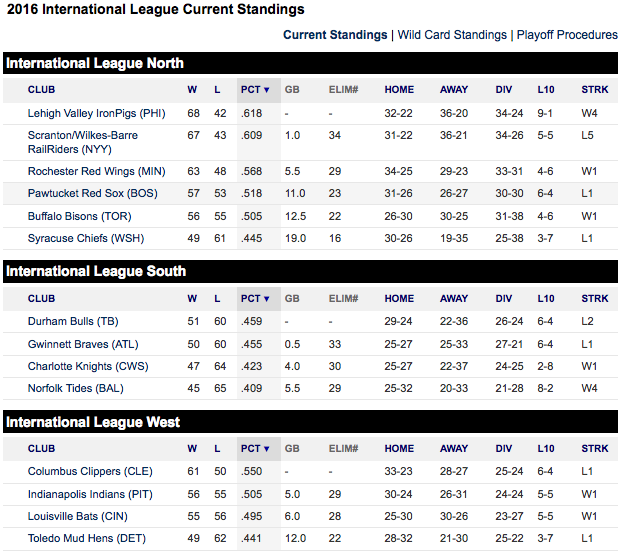
#ContractTheILSouth

#ContractTheILSouth

2. The Twins are a Better Farm System, from a winning perspective.

Here’s a look at the winning percentages of farm systems, as of August 3:
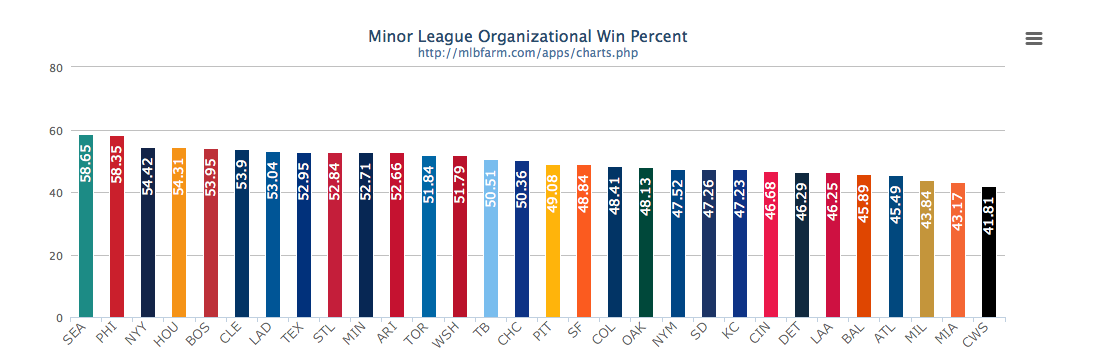
Screen Shot 2016-08-03 at 5.12.40 PMAs you can see, the Twins are a respectable 10th place. This is the entire organization, from AAA all the way down to the lowest of Rookie leagues. The Mets, meanwhile, are sub-.500 and are at 19th. And if you go level by level, the Twins have a better team in most of them: The AAA Twins (the Red Wings) have a better record than the AAA Mets (Las Vegas). The AA Twins (Chattanooga) have a better record than the AA Mets (Binghamton). The low-A Twins (Cedar Rapids) have a better record than the low-A Mets (Columbia). The rookie-ball Twins (Elizabethton) have a better record than the rookie-ball Mets (Kingsport). The Twins even have a better record in the Gulf Coast League! The only minor-league level where both organizations have teams and the Mets have a better record than the Twins affiliate is the High-A Florida league.

It’s been said that the two biggest determinants of minor league team attendance are also the two things the local GM (in the minors, the GM is more of a business position, not like the position in MLB) has the least control over: how the team is doing, and how the weather is. Except that isn’t really true, as the Minor League team CAN decide who it affiliates with. And when you look at the success on the field up and down the minors, the Twins clearly are the better choice when it comes to wins than the the Mets.

3. The Twins have better prospects overall than the Mets.

One of the neatest things about Minor League Baseball is that you can see the stars of tomorrow. And in this case, the Twins have a better case than the Mets. At the beginning of the year, MLB.com listed the Twins as the fifth best farm system in baseball. While obviously this has likely changed as players like Max Kepler and Byron Buxton have headed to the big leagues, it should be noted that the Mets were nowhere to be found in the top ten this year, and another site (which ranked the Twins 8th) put the Mets all the way down at number 20.

4. The Mets probably wouldn’t cause the big attendance boost some people think.

My fellow Rochester seamheads will remember the Empire State Yankees. In 2012, as their stadium was being renovated, the Scranton Wilkes-Barre Yankees (now the Scranton RailRiders) played their home games on the road, mostly in Rochester. Before the season, some Yankee fans were declaring that the people of Rochester would love them and support them even more than they did the Wings, that it was a dream come true, etc. etc.

Well, here’s the secret: The Empire State Yankees were a bust. Look at this news report from back then:

Yes, the Baby Bronx Bombers were in town and, with the exception of a Andy Pettitte rehab assignment, they drew flies, despite the fact they had a very good team. And the Yankees are definitely far more popular in Rochester than the Mets.

Now, admittedly, the fact that they were the “Empire State Yankees” and not the “Rochester Red Wings, AAA Affiliate of the New York Yankees” probably had a lot to do with it. But when you consider that attendance wasn’t particularly skyrockety for the Buffalo Bisons when they had the Mets affiliation (although to be fair, the Mets system was even worse back then), I think it’s safe to say that in general the affiliation doesn’t drive attendance all that much- winning and weather does. And as I showed with number two and number three, the Twins are a better choice for that.

5. The Mets have horrible owners.

Red Wings fans still speak in hushed tones about Orioles owner Peter Angelos. Why, the only people who hate Peter Angelos more than Red Wings fans are Orioles’ fans! GET IN LINE, NATS FANS, THIS SPOT IS TAKEN! Peter Angelos’ interference with minor league operations, general incompetence, breaking of traditions, and favoritism (intentional or not) to other teams in the Orioles’ system (especially the AA Bowie Baysox) led to the end of one of the longest affiliations in baseball. Well, say what you will about Angelos, but to the best of my knowledge he never ended up drowning in debt after being caught up in a massive Ponzi scheme and as a result been unspeakably cheap for his team that was in the World Series last season and plays in New York City. Nor, to the best of my knowledge, has Peter Angelos been sued for firing somebody because she had a baby out of wedlock and then resolved it before it reached trial. And while I’m sure he (like, sadly, seemingly every single MLB owner) would sign somebody who was suspended for domestic abuse, he hasn’t as far as I know. Yet.

But you know who has done all of this? The owners of the New York Mets! Now, full disclosure, I own a very small (essentially symbolic) portion of the Rochester Red Wings (I covered this before). Not enough to make a difference, but I do own some. But let’s say I did own enough. Would I want to do business with the Wilpons?

No. No I would not.

6. The Red Wings shouldn’t be like other Minor League teams

Many minor league teams change affiliation with relative regularity. The Red Wings don’t- they were Cardinals affiliates from the late 20s to 1960, and then spent the rest of the 20th century and the first two years of the 21st with the Orioles. That means that it should still be another decade or two left with the Twins. Perhaps I’m just being a romantic, ignoring the business nature of modern baseball. And, to be sure, if everything was bad and the Red Wings were doing horrible with no good hope in the lower minors, I’d agree that perhaps it’s time to move on. But the Wings have been one of the most successful minor league franchises in history by not changing course at the first sign of trouble, and I see no reason to start swapping every decade or so now.

So… I say: stick with the Twins and nix the Mets. The reasons to stay with Minnesota lay in the evidence, and the reasons to go to the Mets are nowhere near as high as they seem.

And, besides, if the Mets want to be in Rochester so damn bad, maybe they can call back in two-to-four years. By that point, maybe whoever has replaced Terry Ryan will have shown how he will treat the minor leagues. And maybe they won’t be owned by the Wilpons either.


MVPs of the Last Few Days (July 28-August 1)

July 28: David Price

July 29: Jason Kipnis

July 30: Christian Yelich

July 31: Neil Walker

August 1: Danny Duffy (apologies to Max Kepler)

Standings, as always, after the jump:

Continue reading

MVPs of July 19 to July 26, 2016

Apologies for the hiatus, everyone!

Anyway…

July 19: Blake Snell

July 20: Hanley Ramirez

July 21: Steven Wright

July 22: Zach Eflin

July 23: Trevor Story

July 24: Jose Altuve

July 25: Adrian Beltre

July 26: Yunel Escobar

Standings, as always, after the jump:

Continue reading

So… who’d be in the 2016 “In Memoriam” montage?

Like in previous years, here’s who would be in this season’s hypothetical “In Memoriam” segment of the All-Star Game. It’s in a semi-random order, and a * means that they’d get an extra emphasis, such as a highlight or interview clip about them- they all died after last year’s ASG (July 14):

Joe Garagiola Sr., Player and famed announcer*

Milt Pappas, 2-time All-Star

Mike Sandlock, played portions of five seasons

Dick McAuliffe, 3-time All-Star

John Young, creator of the RBI program

Paul Carey, Announcer

Sammy Ellis, 1965 All-Star

Monte Irvin, HoF outfielder*

Luis Arroyo, 2-time All-Star

Eddie Milner, Reds OF in 1980s

Jim Hickman, 1970 All-Star

Walt Williams, 10 seasons in MLB

Eddie Einhorn, White Sox Vice Chairman

Joaquin Andujar, 4-time All-Star*

Tommy Hanson, MLB pitcher for Braves and Angels

Phil Pepe, Noted NYC baseball writer

Rueben Quevedo, MLB pitcher from 2000 to 2003

Jim Davenport, All-Star and Gold Glove winner

Walter Young, 1B for Orioles in 2005

Frank Sullivan, 2-time All-Star

Dave Henderson, 1991 All-Star and hitter of famed home run off of Donnie Moore*

John Tsitouris, played parts of 11 seasons

Spec Richardson, General Manager for Astros and Giants

Betty Francis, AAGPBL player

Bobby Smith, OF with five teams from 1957-1965

Masayoshi Higashida, 2-time NPB All-Star

Billy Pierce, 7-time All-Star

Gene Elston, long-time Houston Announcer and Ford C. Frick winner *

Jim Ray Hart, 1966 All-Star

Marilyn Jones, AAGPBL star

Barney Schultz, Cardinals relief ace

Trent Baker, member of the Brisbane Bandits

Harry Perkowski, played parts of 8 seasons

Dean Chance, 2-time All-Star and 1964 Cy Young Award winner

Buzz Bowers, Baseball Scout Hall of Famer

Frank Malzone, 3-time Gold Glove, multiple ASG appearances, member of BOS HoF*

Jim O’Toole, Reds Hall of Famer and 1963 All-Star

Chico Fernandez, MLB 1956-1963

Erma Bergmann, AAGPBL Star

Joe Durham, Negro Leaguer and longtime member of the Orioles organization

June Peppas, AAGPBL Star

Kiyohiro Miura, 19-years in NPB

Milo Hamilton, Announcer and Ford C. Frick winner *

Ken Johnson, Pitcher for seven teams between 1958 and 1970

Norm Siebern, 3-time All-Star

Alice Pollitt, AAGPBL star

Hal Brown, Knuckleballer in 1950s and 60s

James Moore, Negro League All-Star

Tony Phillips, Utilityman Extraordinaire*

Garry Hancock, OF during portions of 6 season

Tom Kelley, Reliever in 60s and 70s

Donny Everett, college player for Vanderbilt

Cal Neeman, SS in Majors 1957-1963

Jimmy Williams, Player, coach and member of Canadian Baseball HoF

Yogi Berra, HoF Catcher and 18-time All-Star *


MVPs of My Vacation and the days after (June 22-July 7)

Well, I was on vacation. So here are all the MVPs I missed while I was gone:

June 22: Trevor Bauer

June 23: Wei-Yin Chen

June 24: Yasmany Tomas

June 25: Carlos Carrasco (apologies to Jose Altuve)

June 26: Jose Fernandez

June 27: Kris Bryant

June 28: Brian Dozier

June 29: Brian McCann

June 30: Danny Espinosa

July 1: Trevor Bauer

July 2: C.J. Cron (Apologies to Rajai Davis)

July 3: Wilmer Flores (Apologies to Stephen Strasburg)

July 4: Junior Guerra

July 5: Josh Donaldson

July 6: Chase Utley

July 7: Nick Markakis

Standings, as always, after the jump:

Continue reading

Vacation Over!

Aside

Okay, my vacation is over and I’ve gotten some freelance stuff done, so it’s time to get back to work. So come back tomorrow for the MVPs of Yesterday I’ve missed for awhile.

BOOK REVIEW: “Ahead of the Curve: Inside the Baseball Revolution”, by Brian Kenny

Note: I was provided an early review copy of the book by the publisher.

Anybody who has watched MLB Network (or ESPN before that) is likely familiar with Brian Kenny. And if you are familiar with Brian Kenny or any of the shows he hosts on MLB Network, you know that he is one of the biggest champions of new-school thinking at the network, often butting heads (in a friendly way) not only with ex-players and old-school writers, but sometimes even other new-school sabermetricians and thinkers who just aren’t as radical as he is.

His crusades and pet peeves are familiar to anyone who has seen his shows on MLB Network: the win needs to be killed as a statistic, the Triple Crown and batting title are overrated, the way that pitchers are used makes no sense for the modern game, and, of course, the sacrifice bunt is used way too damn much and statistically hurts your team’s chance of victory (he has the probability charts to prove it!). His book, Ahead of the Curve: Inside the Baseball Revolution, is about those… and more. It’s part history, part autobiography, part manifesto, and part behind-the-scenes peek, and it’s a good book that I’d recommend to people regardless of where they lie on the spectrum of baseball analysis.

The reason for this is because the book is not so much about the nitty-gritty parts of sabermetrics and new-school thinking, so much as it is about the why (both as to why the status quo has survived so long and why a change may be in order) and the how (as in, how sabermetric analysis has grown over the years). In essence, it’s a mixture of inertia, tradition, and the fear of failure (and, attached to that, the need to pass failure to others if something does go wrong). Tradition and inertia have slowed new ways of baseball analysis and strategy almost since the start of the game. For example, things like the win and error are relics of when pitchers went the entire game and gloves were either non-existent or bare-bones. However, since they were important in those early days, they stayed important as time has gone on. Even though everyone today knows that the win is a deeply flawed stat (at one point in the book Kenny recalls Clayton Kershaw saying it should be de-emphasized) and that the best fielder isn’t necessarily the one with the most errors but instead the one who gets to balls that others wouldn’t, baseball as we know it continues to emphasize them.

While such a topic could easily have tumbled into the written equivalent of rambling, Kenny keeps everything very organized and with a good flow. Each chapter covers one or two topics. One, for example, focuses entirely on the quest to “kill” the win. Another is about the flaws of the Save stat. Still others focus on things like the Hall of Fame, various MVP votes, bullpen usage, the Astros “Decision Sciences” division, and the like. Along the way, he weaves in pieces of his own history and experience. The usual suspects such as Billy Beane and Bill James all put in appearances, but so do some unexpected sources of baseball unorthodoxy… like Tommy Lasorda of all people, who agrees with Kenny’s assertion that many managers are afraid to try new things so that they can protect their jobs if something goes wrong, and points to his many Rookie of the Year winners as proof that success can come by not being afraid to go against the herd.

While I will admit I do not agree with all of his conclusions and assertions (the idea of having a closer serve as a starter to avoid the first inning jitters makes sense on paper given that the first inning is when the most runs are scored, but it makes me wonder if it would merely delay the first-inning runs into the second or third inning), it definitely provides a good look into the revolution that has hit baseball this century. So, I recommend that you pick up a copy of Brian Kenny’s Ahead of the Curve at your nearest bookstore, e-book store, or library.

REVIEW: Strat-O-Matic Baseball Daily a great idea with room for improvement

The Baseball Continuum is on vacation, but here’s a bit to help hold you over.

The idea behind Strat-O-Matic Baseball Daily is simple: it’s a computer simulation of the famed Strat-O-Matic tabletop game, but the cards change day-by-day to reflect what’s going on in the real world. For example, if a player is on a hot streak, his card will change to make it more likely (for example) that he will hit a home run and less likely that he will strike out. Similarly, if the team’s ace has been getting shelled, his card will be changed to increase the odds that he’ll be having a bad day.

It’s a good idea, and it definitely has some good points and will no doubt get better in the future, but as it stands right now, it is not as good as it could be. The main reason for this lies in the interface and ease of use- it just isn’t quite up to the standards of the current generations of other baseball simulators that exist right now like Out Of The Park Baseball.

For one thing, it takes awhile to set up. You need to get online to download everything, which isn’t a problem, but you the thing is that everything is separate from each other. There’s the main game, but the Baseball Daily portion is separate from that. And other parts are also separate. There are a lot of games that do similar things to this these days, but it just felt clunky for some reason here. Perhaps it is all in the presentation.

For another, the controls and menus in the game feel like they are 10 to 20 years out of date. Again, it’s hard to really describe this, it’s more a case of feel, but compared to other games in the genre it feels like you need to click through more screens, fiddle with more settings, and the like.

However… once you do get it up and running to your satisfaction, it does exactly what it goes out to do and changes the roster day by day as you move forward and does the same with the player cards. Oh, yes, I’ve seen some complaints on their message boards and elsewhere that sometimes the updates aren’t correct, but for the most part, it definitely changes correctly. Players enter and exit your roster during the season as they did in the real world, and their cards also change accordingly. If you want to see if you could do better in the season than your favorite team’s actual manager, this is where you can do it with the exact same rosters available to them.

And, really, how cool is that?

So, while I can’t suggest it to everyone right now, I can say to keep an eye on it in future years as the game no doubt is refined and improved further.

Note: I was provided a free copy of the game.

MVP of Yesterday (6-15-16): Noah Syndergaard

An easy selection for yesterday’s MVP: Noah Syndergaard, who went 8.1 innings while striking out 11, giving up just five hits, and only one earned run. He also walked at the plate.

Standings, as always, after the jump:

Continue reading

This summer, I’m writing a column on the Perfect Game Collegiate Baseball League.

You may have noticed that there haven’t been as many things here lately. Well, part of that is because I’ve been pretty busy with some freelance stuff. While it is now a bit calm again and I’ll hopefully be able to put more time onto the blog, I wanted to share one thing that is going to be near-constant during the next two months: a weekly notebook for the Messenger-Post papers on the Perfect Game Collegiate Baseball League. The PGCBL is a wooden-bat college summer league, and while it is fairly new (it started in 2011) and isn’t on the level of the Cape Cod League, it still has seen a lot of players drafted in the last few years and has a good level of play. So, here’s my first notebook on the league, which went up a few days ago.