(Blogathon ’16) Sean Lahman: How Soon is Now? Reds Fans React to Rebuild Plan

This guest-post is part of the 2016 Baseball Continuum Blogathon For Charity, benefiting the Roswell Park Alliance Foundation. The Roswell Park Alliance Foundation is the charitable arm of Roswell Park Cancer Institute and funds raised will be “put to immediate use to increase the pace from research trials into improved clinical care, to ensure state-of-the-art facilities, and to help improve the quality of life for patients and their families.” Please donate through the Blogathon’s GoFundMe page. Also, please note that the opinions and statements of the writer are not necessarily those of the Baseball Continuum or it’s webmaster.

Has the Internet given us shorter attention spans?

Tl;dr yes it has.

As a lifelong Reds fan, I can’t help but be amused by the howls of outrage that have greeted the team’s current rebuilding plan. After three playoff appearances in four seasons, the Reds faced a problem that most teams eventually face after such a run of success: Their core players were all headed to free agency at roughly the same time, and they couldn’t afford to resign them all.

Two strategies exist for dealing with the problem. One — let’s call it the Steinbrenner method — calls for doubling down on your aging veterans, signing them to pricey contract extensions and filling whatever gaps remain with new free agent signings.

The other is rebuilding, making the painful admission that this particular team’s window for winning pennants had closed, and setting about the task of assembling a group of players who could propel the team towards its next string of pennants.

The Reds, under GM Walt Jocketty, opted for the accelerated rebuilding plan, one executed most recently by the Astros and the Cubs. It combines a painful house cleaning of veterans with a rapid accumulation of young talent, through trades, high draft picks, and an increased emphasis on player development.

In a span of about 12 months, the Reds traded four All-Stars — Johnny Cueto, Todd Frazier, Aroldis Chapman, and Alfredo Simon– and two solid starting pitchers — Mat Latos and Mike Leake.

In return, the Reds received an assortment of sixteen minor league players. Most were playing at AA or higher, and Jocketty said he’d focused on acquiring players who were close to the majors with a focus on getting the team back to contention by 2018.

The reaction from most Reds fans has been outrage, with many calling it an unnecessary dismantling, blasting Jocketty for getting rid of popular and talented players, and some even going so far as to renounce their allegiance with the Reds.

On Twitter, one fan wrote:

//platform.twitter.com/widgets.js

Another:

//platform.twitter.com/widgets.js

Time will tell whether the trades work out, of course. The rapid rebuild only works if some of those prospects develop into stars.

But what strikes me is the level of impatience with what’s billed as a three- year rebuilding process. That’s practically light speed in the baseball world.

I moved to Cincinnati as a 9-year old in 1977. By the time I turned 40, I’d only seen the Reds make the playoffs three times. Before their run of three playoff appearances from 2010 to 2013, they had gone 14 straight years without reaching the postseason.

And that’s not unusual. The Seattle Mariners haven’t been to the playoffs for 14 years. The Miami Marlins haven’t reached the postseason since 2003. Neither team seems likely to break those streaks anytime soon.

We’ve watched teams like the Royals and the Pirates reach the playoffs after decades of futility. The Blue Jays went last year for the first time since 1993. The Rangers and Nationals recently ended streaks of more than 30 years.

Of course, none of those teams planned to struggle for so long. Nobody unveiled a 20-year plan to become competitive.

As a fan, you root for your team to reach the playoffs every year. But if you’re honest, you know it’s not reasonable to expect success one hundred percent of the time.

When your team loses year after year, and there’s no sign of improvement on the horizon, then by all means air your complaints and call for the GM to be run out of town on a rail.

But when a GM says “give me three years and we’ll be back on top,” I for one am intrigued. I can’t wait to see how it unfolds.

Sean Lahman is a reporter for the Rochester Democrat & Chronicle and the Database Guru for the Society for American Baseball Research. He can be reached at SeanLahman@Gmail.com

This guest-post has been part of the 2016 Baseball Continuum Blogathon For Charity, benefiting the Roswell Park Alliance Foundation. The Roswell Park Alliance Foundation is the charitable arm of Roswell Park Cancer Institute and funds raised will be “put to immediate use to increase the pace from research trials into improved clinical care, to ensure state-of-the-art facilities, and to help improve the quality of life for patients and their families.” Please donate through the Blogathon’s GoFundMe page. Also, please note that the opinions and statements of the writer were not necessarily those of the Baseball Continuum or it’s webmaster.

(Blogathon ’16) Jake Mintz and Jordan Shusterman: Nelly’s “Batter Up”

This guest-post is part of the 2016 Baseball Continuum Blogathon For Charity, benefiting the Roswell Park Alliance Foundation. The Roswell Park Alliance Foundation is the charitable arm of Roswell Park Cancer Institute and funds raised will be “put to immediate use to increase the pace from research trials into improved clinical care, to ensure state-of-the-art facilities, and to help improve the quality of life for patients and their families.” Please donate through the Blogathon’s GoFundMe page. Also, please note that the opinions and statements of the writer are not necessarily those of the Baseball Continuum or it’s webmaster.

Throughout the baseball community, St. Louis baseball fans have a bad reputation. The “Best-Fans-In-Baseball” moniker is frequently used to ridicule Cardinals fans for their own brand of self-righteous blind homer-ism (to be fair, this is a phenomenon every single fan base exhibits to some extent). We’re not here today to discuss whether or not St. Louis has the best fans in baseball, we’re here to show you that St. Louis has THE best fan in baseball. His name is Cornell Iral Haynes Jr. — but you probably know him as Nelly.

Nelly is easily St. Louis’ most well known and successful rapper. His songs ‘Ride Wit Me’, ‘Hot in Herre’, ‘Dilemma’, and ‘Shake Ya Tailfeather’ have been certified platinum. But Nelly’s most important song — and thus his most important music video — is ‘Batter Up’, which combines a hook based on the theme song from The Jeffersons with Nelly’s love for baseball to form an undisputed artistic masterpiece.

Released in 2001, the music video for Batter Up is 4 minutes and 41 seconds of pure baseball delight. It’s got barbecue, bunt home runs, scantily clad women, and George Jefferson himself. So sit back, relax, and let us take you on a journey through the brilliant baseball mind of Cornell Haynes Jr.

0:03-0:14

Right off the bat we meet our announcers, two old balding white guys in ugly suits that are quite obviously not being portrayed by old balding white guys. Not trying to start a controversy here, but the one on the right bears a suspicious resemblance to Nelly.

nelly1

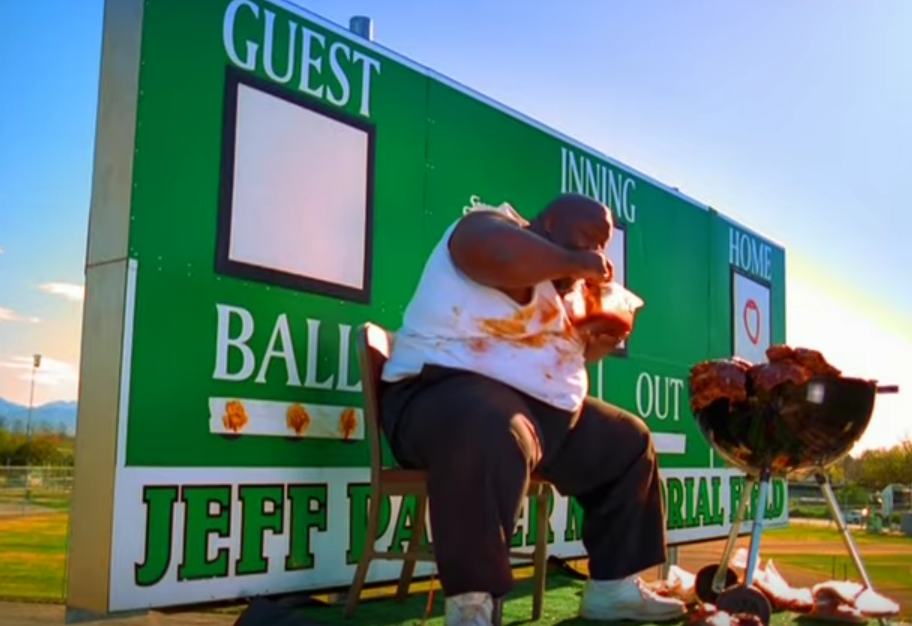
0:17

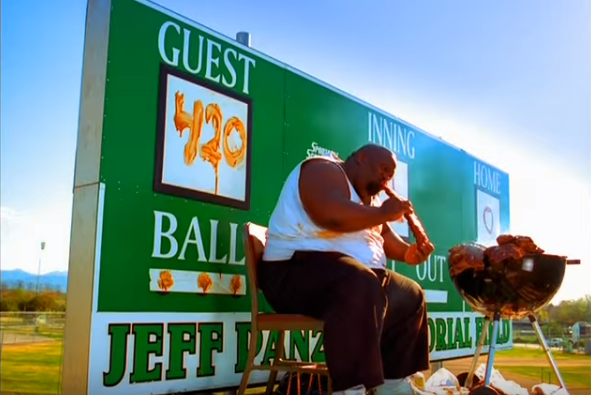
We are introduced to the scoreboard operator: a heavyset man in a white tank top that is absolutely doused in BBQ sauce. This gentleman seems to be using the ribs as a paintbrush in order to carry out changes to the scoreboard. Notice how not a single pitch has been thrown, yet there are already three balls.

nelly2

0:20

Sherman Hemsley!

nelly3

“And now, please rise for the singing of our National Anthem!” Hemsley proclaims. Was this a legitimate attempt to get Batter Up to be our new National Anthem? Nelly knows no bounds.

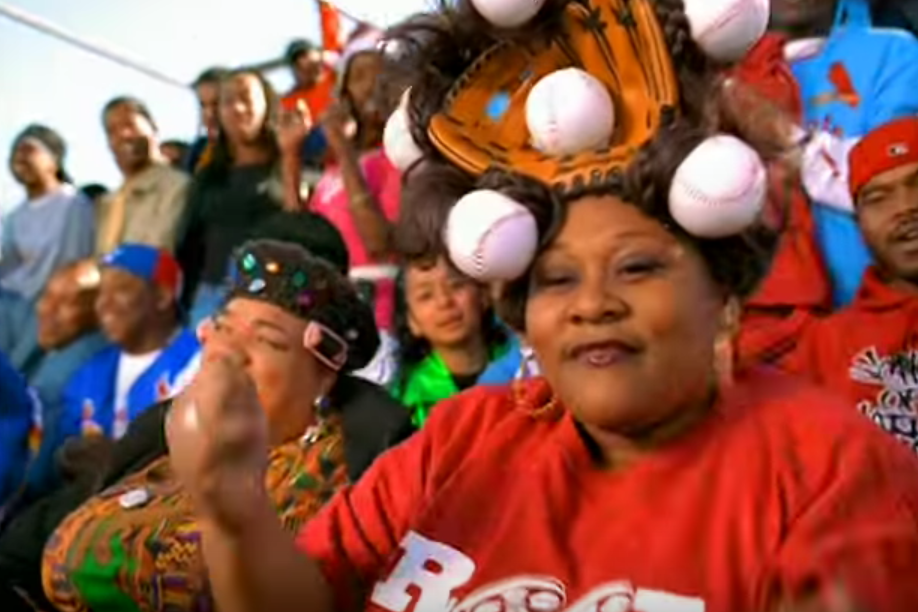
0:29

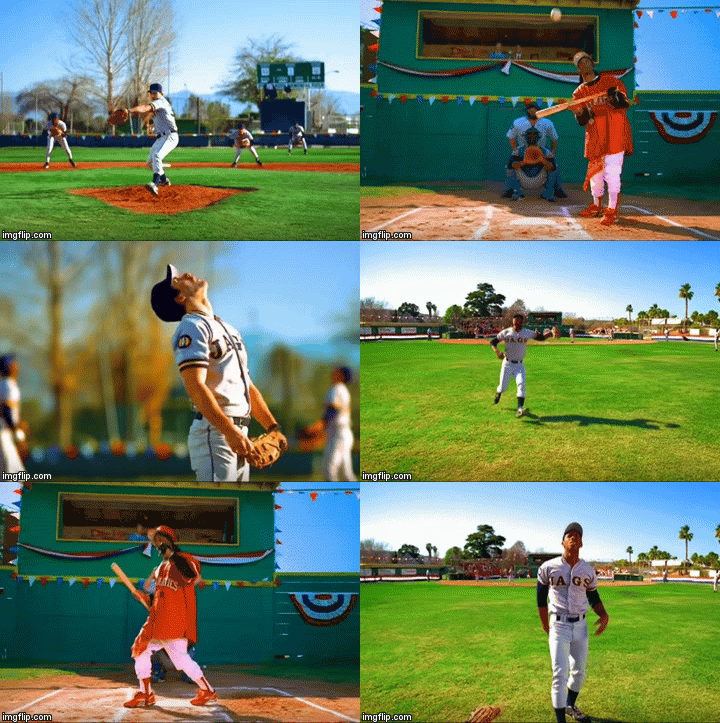
So many questions about this hat/hair combination. Is the glove embedded into the woman’s hairdo? Is it simply one enormous hair piece? Does Lids have any available in a 7 3/8?

nelly4

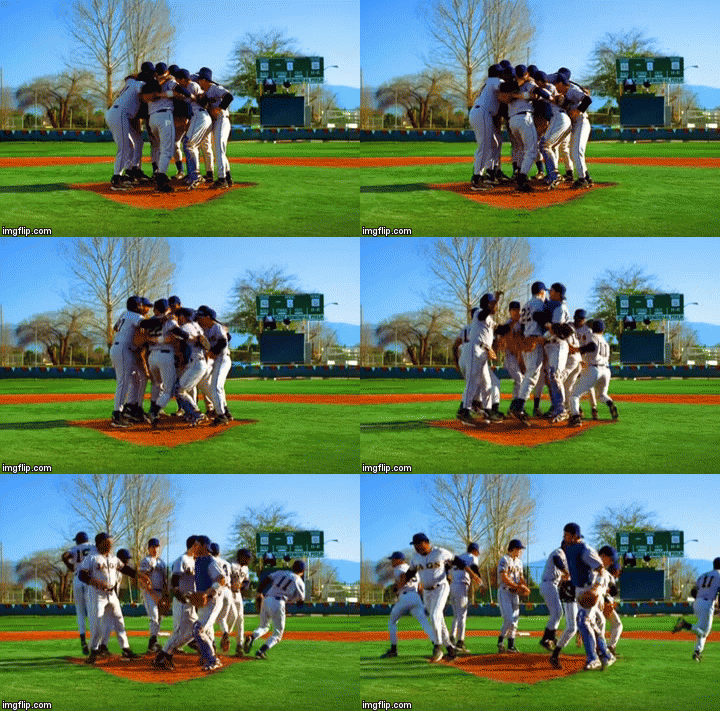
0:39

Here we see something unprecedented in the baseball world: an entire team pre-inning huddle on the mound. Did the outfielders come into the infield after the catcher threw down to second? It looks like the coach is in there too. Maybe they’re drawing up some type of trick play.

nelly5

Let’s take a look at the scoreboard in centerfield. Under it we see our old friend, the heavy set barbecuin’ chef. And oh, the score is somehow 62-0 in the top of the 1st inning. 62-0! The first pitch of the game hasn’t even been thrown yet. Could it be that Nelly and his St. Lunatics were at such a disadvantage that the other, seemingly more put-together outfit, spotted them 62 runs? Just some food for thought. Perhaps more importantly, what is even the circumstance of this game? Is it just a men’s league? Independent ball? Are the St. Lunatics barnstorming around the country challenging any semi-pro team that thinks they can take down Nelly & Co.? It’s just a peculiar match-up by all accounts.

0:42

What kinda shift is this? There’s supposedly no one on base yet (as evidenced by the ridiculous team huddle) but the middle infielders are in double play depth. And even if there was a dude on first, this would be extreme.

nelly6

The bizarro double play shift looks even more absurd because this game is clearly being played on a field with Little League/softball dimensions. Making grown men play on a Little League size field has to be some sort of safety risk.

0:44

nelly7

Yeah, that’s not a baseball field.

0:48

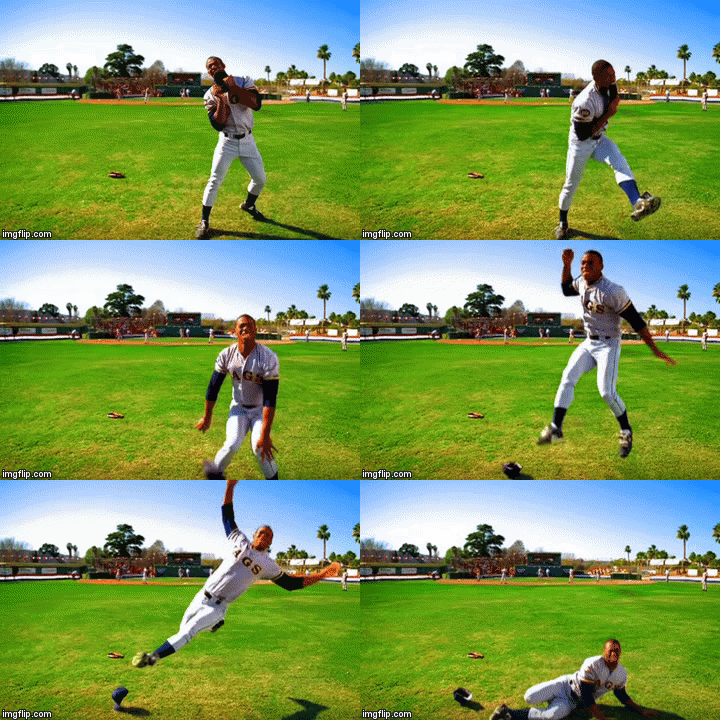
nelly8

Posture – 40

Balance – 55

Torque – 30

Hat Content – 20

Early 2000’s Reebok Cleats – 80

0:55

Up first for the St. Lunatics is Ali. Let’s see what kind of swing he has… oh, that’s a pitbull.

nelly9

If this game is being played in a baseball universe that permits batters to bring pitbulls up to the plate with them, the pitbulls should at the very least have to be in the batter’s box.

Despite the potential advantage intimidation-wise — is the pitcher even going to throw the ball if the catcher is too afraid to crouch? — you’d have to think that having a pitbull with you in the batter’s box would probably have a negative effect on offensive production. Not only does it force you to swing with only one hand, but you become significantly more susceptible pitches low in the zone.

1:00

Maybe because both the umpire and the opposing team are so intimidated by the presence of his pitbull, Ali bypasses the traditional rules of baseball and is awarded a single run without having to even swing the bat.

All you, barbecue scoreboard guy.

nelly10

YOU CAN PUT IT ON THE BOOOOOOOARD, YESSSS.


1:22

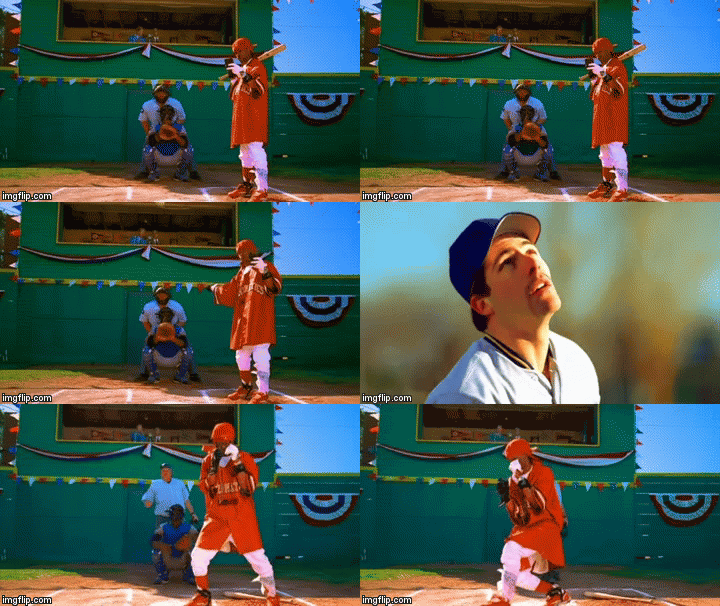
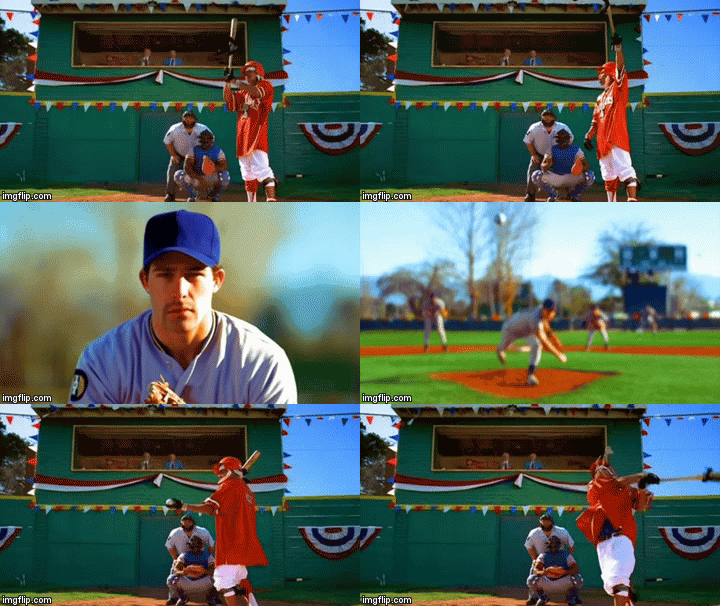
Kyjuan steps up to the plate with, as far as we know, no one one base. Looks like he’s gonna try and bunt for a hit. Odd strategy at this point in the game, and considering his stolen base totals in recent years, but he must know something we don’t.

nelly11

WELL THEN. The pitcher thought he could go up and in but Kyjuan brings his hands in and launches the ball over the centerfield wall…while bunting. He saunters down to first with pride. It’s basically Super Bunt from MLB 2K6.

2:17

nelly12

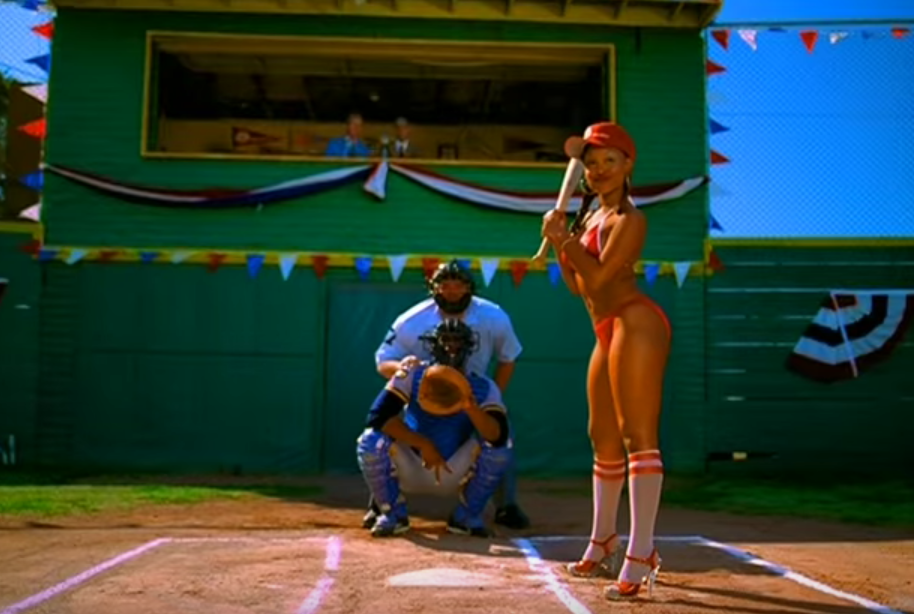
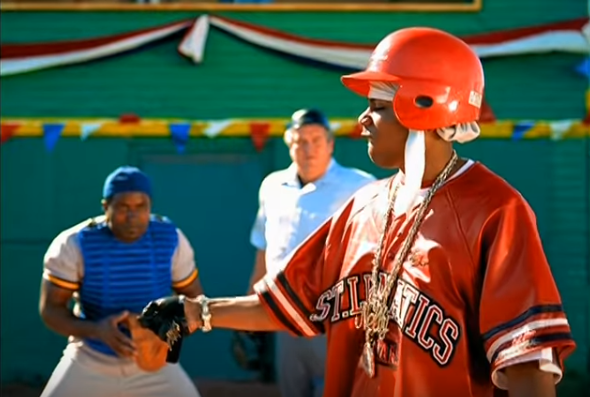
We’re usually all for unique uniforms, but this one just seems impractical. Can you imagine sliding headfirst on dirt in that thing? THE HIGH HEELS! Also, WHY ARE YOU CALLING A CURVEBALL! At least the pitcher is smart enough to shake him off.

2:28
And even after calling off the curveball, the pitcher manages to airmail it into the press box. The umpire rules that the runner go to first, which makes zero sense unless that was ball four. More confusing is the outrage expressed by the catcher, the opposing manager, as well as the announcers. Who are they mad at? The umpire for calling ball four? The pitcher for throwing ball four? The batter for not wearing any clothes? What we do know for sure is our scorekeeper is still very much enjoying his barbecue:

nelly13

3:17

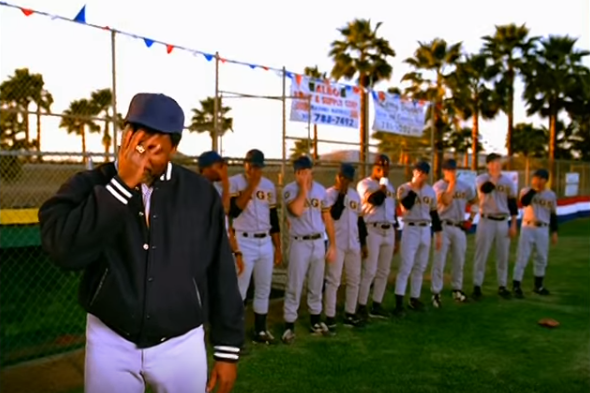
This is a confusing shot for a few reasons. While we acknowledged that this is clearly not a professional sized field, and the dugouts most likely aren’t very big, it’s still rather odd to see the entire team out of the dugout standing in a line, expressing their discontent simultaneously. Also…is the manager wearing a World Series ring? Is this team supposed to be good??!?!

nelly14


3:28

nelly15

Our clean-up hitter for today’s game is Murphy Lee, who struts up to the plate with what appears to be his cell phone in one hand and his bat in the other. Without taking his eyes off his game of Tetris, he squares the first pitch up and launches it to right-center.

3:41

Murphy Lee apparently hit a 358-run dinger and now the score is 420-0. Starting to wonder why they needed to be spotted 62 runs from the start.

nelly16

3:43

nelly17

At least this ball actually went over the fence. Looking at you, Nyjer Morgan.

3:53

nelly18

Our final batter of the day is Nelly, who promptly calls his shot. And the pitch…

nelly19

BOOM. Absolutely crushed. Time to trot…

nelly20

Oh?

Nelly21

OH.

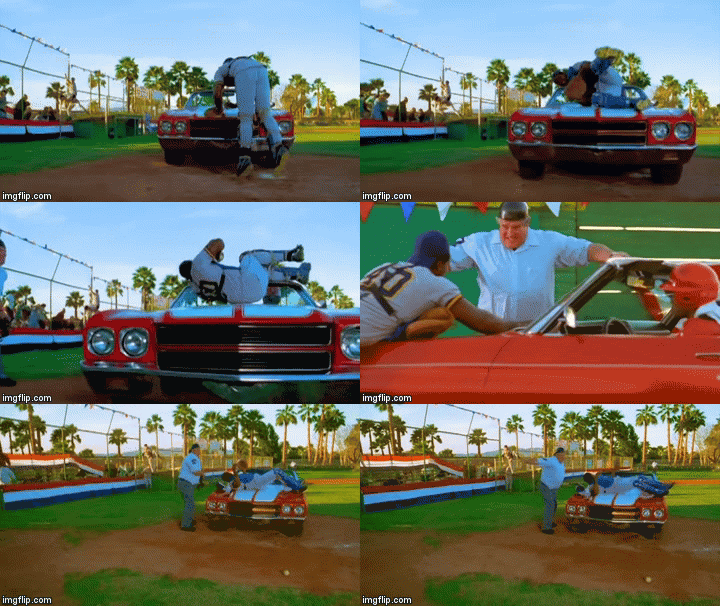
Nelly is now going to drive his car around the bases.

nelly22

Based on previous at-bats, it’d be safe to assume that this monstrous hit was indeed a home run, and thus, no defense was in need of being played. But apparently not! As Nelly Tokyo drifts around third, we see him heading towards the catcher who is prepared to field the ball.

nelly23

And you thought Chase Utley was reckless.

4:41

nelly24

The St. Lunatics. The Best Fans in Baseball.

Jake Mintz and Jordan Shusterman are the guys behind “Cespedes Family BBQ” and co-host the “Cespedes Family Barbecast“. They can be followed at @CespedesBBQ.

This guest-post has been part of the 2016 Baseball Continuum Blogathon For Charity, benefiting the Roswell Park Alliance Foundation. The Roswell Park Alliance Foundation is the charitable arm of Roswell Park Cancer Institute and funds raised will be “put to immediate use to increase the pace from research trials into improved clinical care, to ensure state-of-the-art facilities, and to help improve the quality of life for patients and their families.” Please donate through the Blogathon’s GoFundMe page. Also, please note that the opinions and statements of the writer are not necessarily those of the Baseball Continuum or it’s webmaster.

(Blogathon ’16) Eric Stephen: On Baseball and Brothers

This guest-post is part of the 2016 Baseball Continuum Blogathon For Charity, benefiting the Roswell Park Alliance Foundation. The Roswell Park Alliance Foundation is the charitable arm of Roswell Park Cancer Institute and funds raised will be “put to immediate use to increase the pace from research trials into improved clinical care, to ensure state-of-the-art facilities, and to help improve the quality of life for patients and their families.” Please donate through the Blogathon’s GoFundMe page. Also, please note that the opinions and statements of the writer are not necessarily those of the Baseball Continuum or it’s webmaster.

At the end of January, I am reaching the point of restlessness in the offseason, much too far removed from the end of the last baseball season and still too far away from the starting of spring training this season. With 2016 a bit of a milestone year for both me and one of my brothers, I thought I’d share one of my favorite baseball memories with him.

My two brothers are the reason I love baseball so much. Kelly is 15 years older than I am, and Greg is 10 years older than me, and were largely responsible for molding me into the person I am today. They loved baseball, so it had to be great. I had to find out about this thing my brothers loved so much, and I soon found I would love it too.

Given the age difference between us, Kelly and Greg were more than brothers and role models for me. They also had somewhat of a fatherly role, too, when I was younger. Our dad passed away from pancreatic cancer in January 1987, when I was 10, and they did their best to fill that void in my life when I needed it most.

The 1988 Dodgers will forever be the sports team I most identify with, one that captured my heart when I was 12. I grew up in Palm Springs and, being two-plus hours away from Dodger Stadium I didn’t go to too many games as a kid. I went to two games in 1988 – Game 2 of the 1988 World Series, with Kelly; and July 6 against the Cardinals, with Greg.

To date, Game 2 remains the only World Series game I have ever attended. But that July 6, 1988 game will always stick with me, too.

It was just Greg and I, which meant a lot of knowledge was getting passed down to me. Previous lessons included how to keep score, proper strategy, and even when to cheer. That last one was more important that you might think, especially for someone not familiar with depth perception at different sections of the ballpark.*

*In other words, not in this game but when I was much younger, I once stood up with arms raised upon bat hitting ball, not realizing this high fly ball wasn’t destined for the seats or even the outfield, but rather settled nicely into the waiting glove of the second baseman, much to the embarrassment and horror of my brothers.

Anyway, back to this July 6 game, there was nothing special about this relatively nondescript Wednesday night game. It did happen to fall on what would have been our dad’s 54th birthday, and was just his second birthday since his death.

The Dodgers were down 3-0 to the Cardinals after seven innings in this game, but as they did all year managed to rally to tie the game in the eighth inning. But the rally wasn’t over.

Even after tying the score, the Dodgers managed to load the bases against ace closer Todd Worrell, with first baseman Franklin Stubbs coming to the plate. Stubbs was a former first-round pick who never managed to live up to the advance billing, but on this night he came through.

Stubbs ran the count full and on the eighth pitch of his battle with Worrell launched a ball well into the right field pavilion, helping to give the Dodgers yet another improbable victory in a season full of them. What I remember most about the moment of the grand slam was the utter euphoria in Dodger Stadium, enhanced because I was there with my brother Greg.

I can still feel the goosebumps today when thinking about that game.

Greg lives in Baltimore now with his wife and three kids, so we don’t see each other as much as I would like. But this year he turns 50 in February, and I turn 40 in March, and with Kelly the three of us plan to celebrate these milestones with each other during a week in spring training in Arizona.

It is as perfect a combination that I can think of – me, baseball and my brothers. I’m getting goosebumps already, and I can’t wait.

Eric covers the Dodgers for True Blue LA and is an editor at SB Nation. You can follow him @truebluela.

This guest-post has been part of the 2016 Baseball Continuum Blogathon For Charity, benefiting the Roswell Park Alliance Foundation. The Roswell Park Alliance Foundation is the charitable arm of Roswell Park Cancer Institute and funds raised will be “put to immediate use to increase the pace from research trials into improved clinical care, to ensure state-of-the-art facilities, and to help improve the quality of life for patients and their families.” Please donate through the Blogathon’s GoFundMe page. Also, please note that the opinions and statements of the writer were not necessarily those of the Baseball Continuum or it’s webmaster.

(Blogathon ’16) Jason Cohen: Reminiscing about Chien-Ming Wang and What Could Have Been

This guest-post is part of the 2016 Baseball Continuum Blogathon For Charity, benefiting the Roswell Park Alliance Foundation. The Roswell Park Alliance Foundation is the charitable arm of Roswell Park Cancer Institute and funds raised will be “put to immediate use to increase the pace from research trials into improved clinical care, to ensure state-of-the-art facilities, and to help improve the quality of life for patients and their families.” Please donate through the Blogathon’s GoFundMe page. Also, please note that the opinions and statements of the writer are not necessarily those of the Baseball Continuum or it’s webmaster.

Former Yankees pitcher Chien-Ming Wang signed a minor league deal with the Royals, making that the eighth organization (ninth if you count a short stint in indy ball) the right-hander has been a part of since returning to pitching in 2011. After tearing his shoulder capsule during the 2009 season, Wang missed all of 2010 to recover and the Washington Nationals picked him up in hopes of getting the pitcher he once was for such a short amount of time. He last pitched in the big leagues during the 2013 season for the Toronto Blue Jays and it was a disaster, but it wasn’t always that way.

Signed as an amateur free agent by the Yankees in 2000, he made his professional debut at the age of 20. After missing the 2001 season to injury, it took him another four seasons to reach the majors. He wasn’t expected to be a star, but somehow he managed to turn into one, albeit not a very famous one. In 2005, he managed to pitch at an above-average level while the rotation fell apart around him. That year, Carl Pavano, Jared Wright, Kevin Brown, all broke down during the course of the season. Wang was hurt too, but he returned late in the second half and was even able to pitch in a playoff game. His first year was solid, but maybe not much to remember.

What followed, though, were probably two of the most important seasons for the Yankees in that decade. Between 2006 and 2007, Wang pitched to a 3.67 ERA and a 3.85 FIP over 417.1 innings, averaging somewhere between six and seven innings per start–something the current Yankees would love to dream on. He led the league with 19 wins in 2006, was the runner-up in the Cy Young vote to Johan Santana, and placed 24th in the AL MVP vote. His numbers weren’t the most dominating–a 3.9 K/9 rate over that time would attest to that–but his power sinker made him a real threat to hitters with a ground ball rate over 60%.

Some of his best games in 2006 include his two-hit, two-walk, complete game shutout of the Tampa Bay Devil Rays. There was also a game where he produced a total of 20 ground balls outs in a single game against the Atlanta Braves. He even struck out 10 batters in 2007 on his way to complete game while allowing just two runs against the New York Mets. It seemed like he was always going into the seventh, eighth, or ninth inning with less than 100 pitches. Everyone was so focused on the strikeout that they never realized that contact could be such an effective means to utterly dominate your opponent. It’s a pity he had the literal worst defense in baseball playing behind him from 2005-2007, because who knows what things would have been like if they had even a league-average group then.

He ended up being worth 7.5 WAR over those two years, ranking right next to Mussina and Andy Pettitte during that period. He was top-20 in innings pitched, ranked third in ground ball percentage behind only Derek Lowe and Brandon Webb, and his 2.40 BB/9 was just outside of top 20 in baseball at the time. Wang was never the best, but when the Yankees needed him most, he was at least one of them. At a time when the Yankees were paying Carl Pavano not to pitch and had a disappointing two years with Randy Johnson, Wang filled in at the league minimum. He was invaluable.

The most exciting thing about it was that he arrived on the brink of a new day. He came up at a time where the Yankees were still filled with bloated contracts for underperforming veterans and his presence was a breath of fresh air. He made his debut just as Robinson Cano was entering the league and Melky Cabrera was getting a chance. Joe Torre was finally on his way out after a decade in the dugout. Pretty soon there would be Phil Hughes and Joba Chamberlain, and though we have the benefit of hindsight to know how terrible that all worked out in the end, Wang was there before it was cool to be young and he was great.

Unfortunately not everything worked out as expected. As much promise as the 2007 season brought, 2008 proved to be the cruel reality check that none of us wanted. Hughes and Joba got hurt, and Wang, while rounding the bases in Houston, tore a ligament in his foot and a muscle in his leg to end his season in June. All these injuries and disappointing seasons likely led the Yankees to go heavy on that year’s free agent class, coming away with CC Sabathia and AJ Burnett to nail down their weakened and underperforming rotation. Many believe that Wang’s injury threw him off and he struggled in his return during the 2009 season before ultimately tearing his shoulder capsule and destroying the Wang we all knew.

I’ve written about Wang before, I even asked him to retire and put an end to the ghost that he has become because it was just too painful to watch. He’s a member of the Pinstripe Alley Top 100 Yankees and he has a legacy in the Bronx that won’t go away with time. It’s just incredibly weird to think that you’ve peaked doing your life’s work before the age of 30 and it’s not really anyone’s fault. You can’t even say he just didn’t work out–he got hurt. Situations like this ruin–even end–people’s lives. I’m a few years away from 30 and would like to think that I haven’t come close to my peak, but if I knew it had already come and gone, I have no idea how I’d be able to keep doing what I was doing.

Then you look at what Wang has been doing and maybe it isn’t sad to see a 35-year-old man–already gone from the man he once was–continue to plug along. He made it once, he could make it again, but even if he doesn’t maybe there is something to look at, maybe even emulate, in Wang’s determination to do the only thing he very well might be good at. There’s no shame in that and if he pitches another 10 years, even if it’s at the Triple-A level, we should all be so lucky. In the meantime, I’ll remember who Wang was, but never ignore who he has become.

Jason Cohen is an editor at SB Nation’s Pinstripe Alley where he holds the world record for most articles written and it isn’t even close. He is an unapologetic Yankees fan who loves bat flips, calling people out when they say something offensive, and isn’t quite comfortable talking about himself in the third person. You can normally see his writing at Pinstripealley.com and his tweets at @Jason00Cohen.

This guest-post has been part of the 2016 Baseball Continuum Blogathon For Charity, benefiting the Roswell Park Alliance Foundation. The Roswell Park Alliance Foundation is the charitable arm of Roswell Park Cancer Institute and funds raised will be “put to immediate use to increase the pace from research trials into improved clinical care, to ensure state-of-the-art facilities, and to help improve the quality of life for patients and their families.” Please donate through the Blogathon’s GoFundMe page. Also, please note that the opinions and statements of the writer were not necessarily those of the Baseball Continuum or it’s webmaster.
Pieces of the Blogathon you may have missed

Hello, a quick interruption here to tell you about the early-morning Blogathon pieces you may have missed today. While I try to get everybody into a spot where people will be reading, obviously due to the vast number of pieces it’s not possible to totally avoid having some people fall into times where most people are asleep.

So, please, take a look at these Blogathon pieces you may have missed, and don’t forget to donate!

Jonathan Weeks’ “The Greatest Man I Have Known”

Mets Daddy’s “Highs and Lows of 1986”

Seth Poho’s “2016 Nuclear Plant Team”

Yakyu Night Owl’s “Dreams of Kenji-Kun”

Matt Wojciak’s “Middle Relief Report”

Matt Taylor on Adam Jones

Thank you, and we now return to the Blogathon.

(Blogathon ’16) Stacey Gotsulias: Sonnet 13

This guest-post is part of the 2016 Baseball Continuum Blogathon For Charity, benefiting the Roswell Park Alliance Foundation. The Roswell Park Alliance Foundation is the charitable arm of Roswell Park Cancer Institute and funds raised will be “put to immediate use to increase the pace from research trials into improved clinical care, to ensure state-of-the-art facilities, and to help improve the quality of life for patients and their families.” Please donate through the Blogathon’s GoFundMe page. Also, please note that the opinions and statements of the writer are not necessarily those of the Baseball Continuum or it’s webmaster.

With my heartfelt apologies to Elizabeth Barrett Browning and her fans…

“Sonnet 13”

How do I love A-Rod? Let me count the ways.
I love A-Rod to the beauty of his swing and length of his home runs and pace of his trot around the bases
Even when I’m not at the Stadium or watching on TV
My feelings are big as Doug Eddings’ strike zone.
I love A-Rod during every single day game and at night, even if he goes 0-6 with four strikeouts
I love A-Rod freely, as others boo him vociferously
I love A-Rod purely, as others write vigorously, articles of his demise
I love A-Rod with the passion most have for their spouses or children
In my older, more wise age, and with the same faith as my 10 year old self.
I love A-Rod with a love I didn’t even know I had
With my lost family, friends and lovers. I love A-Rod with every breath,
every smile, every cry for his entire career even after his eventual retirement
I shall but love A-Rod better after baseball, when he’s broadcasting alongside Joe Buck on Fox.


Stacey Gotsulias is a freelance sportswriter whose work has appeared both online and in print. She currently writes for It’s About The Money, which is the Yankees’ blog on ESPN’s SweetSpot Network and for The Hardball Times.

This guest-post has been part of the 2016 Baseball Continuum Blogathon For Charity, benefiting the Roswell Park Alliance Foundation. The Roswell Park Alliance Foundation is the charitable arm of Roswell Park Cancer Institute and funds raised will be “put to immediate use to increase the pace from research trials into improved clinical care, to ensure state-of-the-art facilities, and to help improve the quality of life for patients and their families.” Please donate through the Blogathon’s GoFundMe page. Also, please note that the opinions and statements of the writer were not necessarily those of the Baseball Continuum or it’s webmaster.
(Blogathon ’16) Dan Szymborski: Doughy Nerd Gets A Job

This guest-post is part of the 2016 Baseball Continuum Blogathon For Charity, benefiting the Roswell Park Alliance Foundation. The Roswell Park Alliance Foundation is the charitable arm of Roswell Park Cancer Institute and funds raised will be “put to immediate use to increase the pace from research trials into improved clinical care, to ensure state-of-the-art facilities, and to help improve the quality of life for patients and their families.” Please donate through the Blogathon’s GoFundMe page. Also, please note that the opinions and statements of the writer are not necessarily those of the Baseball Continuum or it’s webmaster.

Tempora mutantur, nos et mutamur in illis

Latin is still taught in schools, though as an everyday language has been dead for more than a millennium. The above phrase, of obscure origin and even of obscure construction — some claim the source was Ovid but a direct quote is not to be found — can loosely be translated as “the times are changed and we are changed in the times.” We still encounter Latin in science and law, and the reflection of it in the Romance languages, stemming from the so-called vulgar Latin.

What does this have to do with baseball? In the last 20 years, the language of baseball has changed and as a result, the people involved in baseball have also been changed. The rise of sabermetrics in baseball as a mainstream “thing” has been the largest cultural sea change in baseball that we’ve seen this generation. And for me personally, it turned into a career, something I certainly didn’t expect at the start of this timeframe.

Like pretty much everyone who followed baseball closely at the time, I was not amused, bemused, or even cemused by baseball’s labor friction in the early 1990s that culminated in the 1994 players’ strike. At the time of the start of the strike was a 16-year-old kid at the time, I had just gotten my driver’s license (literally five days prior) and my first car, a 1988 Ford Tempo with this unbelievably weird automatic seatbelt and an alternator that would die a couple of times a year. A friend of mine’s family had season tickets to O’s games and I had the prospect of getting to spend a lot of time hanging out at the then relatively new Oriole Park at Camden Yards. That baseball suddenly went away was a blow to me and the other millions of baseball-mad fans and I was in search of an outlet.

In 1994, I had a subscription to Baseball Weekly and a dial-up internet connection and no real replacement for my lack of baseball. The internet at that time wasn’t overflowing with comparable baseball resources either. Those were the days we actually said the phrase “World Wide Web” non-ironically. For baseball on the internet, we had a sparse amount of resources, such as standings on Nando.net and the home pages linked to in John Skilton’s Baseball Links. Even ESPN’s website was just a shadow of its future self at this point, known simply as the rather prosaic ESPNet.SportsZone.com.

So I happened onto this thing called a “newsgroup” at the time and found something called “rec.sport.baseball.” Baseball might have been on strike, but there was a whole community of people still arguing about baseball as if the world hadn’t stopped. Passionate people too; only a few of my friends growing up really cared about the sport. I was overwhelmed at the time by the breadth of knowledge that these people had. So much so that I only read the newsgroup and the other alt.* baseball newsgroups for awhile before I had the courage to express my own opinions.

I had always been into the statistical side of baseball. Always fascinated with numbers, my grandfather had bought me the Elias Baseball Analysts and the Baseball Abstracts by Bill James every year. My own baseball career faded out quite quickly, I was a perfectly competent baseball player as a nine-year-old, but obviously was never going to play in the majors. From the time I was five to the time I was a teenager, my baseball highlight was having a pitch of mine getting crushed by future minor league outfielder Justin Singleton. I think. I didn’t even know his first name at the time, the other kids just called him “Ken Singleton’s son” and to this day, I’m not even sure that was Justin Singleton, though the ages and location match up, as I discovered much later.

So as a kid, I didn’t dream of becoming Cal Ripken or Eddie Murray, I dreamed of becoming Bill James or Peter Gammons, whose writing was the first thing I would jump to in Sports Illustrated every week.

So hanging out on usenet in the mid-to-late 90s (the newsgroup thing I’m referring to earlier), I developed my writing style and most importantly, my ability to make and defend an argument. Usenet was a brutal place, full of snark and sarcasm and all sorts of venom if you lost an argument. For one person I fought with, a fellow who insisted that Ed Sprague would always be a better player than Aramis Ramirez, I wrote insulting haiku in response to his insults. I became more active in the sabermetric community at that point and many of the participants are names that you likely still recognize today. Baseball Prospectus got its origin from usenet and writers like Keith Law and Christina Kahrl were already doing some Grade A wordslinging. Sean Forman from Baseball-Reference. Sean Lahman of the Lahman database. Voros McCracken of DIPS fame. Doug Pappas and Greg Spira, both writers that left us too early and too sadly. David Cameron of FanGraphs. Grant Brisbee of SBNation. Even some writers that you wouldn’t generally associate with baseball today, like Josh Kraushaar (National Journal), Jonathan Bernstein (Bloomberg), and Peter Spiegel (Financial Times).

It was a heady group and in baseball, we were all outsiders. We combined all the tactlessness of the internet with the surety that were absolutely right and everyone who disagreed with us was an idiot. We dripped with contempt for media, and the term “mediots” got thrown about fairly regularly.

As time went on and sabermetrics became a bigger thing in baseball and blogs starting coming into existence, usenet faded away and died. But by then, many of the ideas that we had espoused so fervently had made their way into baseball. Michael Lewis’s very popular Moneyball had become the first book really talking about sabermetrics that had truly reached the mainstream and the rate of adoption of sabermetrics in baseball had increased significantly. It may be weird to younger readers today that grew up seeing things like Wins Above Replacement and OPS+, but 20 years ago, the utility of even basic stats such as OBP and SLG was a controversial thing in baseball fan circles.

Sabermetricians changed baseball and baseball media, but the rest of the truth is that baseball and baseball media also changed sabermetrics. Some of the truths we so strongly believed in were more complex than we thought at the time. And as writers with a numbers background spread into baseball, we also came to be empathetic with the rest of media. We hadn’t appreciated the difficulty of suddenly telling stories about baseball in an entirely new way to an audience that didn’t necessarily want to hear baseball stories in an entirely new way. These journalists that, to us, were mostly simply bylines, became our acquaintances, or colleagues, and our friends. While I’m still quite snarky at times — and let’s not even get to the Murray Chass stuff — I know I have a greater appreciation for differing viewpoints than I used to. Now, I still always am sure I’m right, but hey, writers gonna writer.

I wrote my first piece for ESPN in 2010. Looking back on it, it wasn’t very good. I had no journalism background of note, mainly being known for my snippy two sentence quotes on Baseball Think Factory and my work in the sabermetrics community, both inside and outside of baseball. I’m honestly surprised they kept paying me money after the first one. But I got better.

Suddenly, I had a new challenge, becoming a real journalist, not just the numbers-dork who made jerkass one-liners. And doing so gave me additional respect for everyone else in journalism who had to sweat out a story. It was far harder in practice than at a distance. My ambition to be a sabermetrics guy who could write eventually became to be a writer who could do sabermetric work.

I would never have admitted it, but being a member of the Baseball Writers Association of America was actually quite important to me. While I could obtain media credentials when I needed them, one thing I’ve always craved, since starting the journey into journalism, was belonging. I desired that affirmation that I was an actual, real writer, not just some numbers-dork moonlighting until I could snag a front office job. This month, I was accepted as a member to the Cincinnati chapter.

Looking at the world of baseball analysis is very different in 2016 than it was in 1996. At one point, I knew practically everyone who worked in the field. Now baseball teams have entire analytics departments devoted to crunching baseball information, stocked with people who are younger than me, with a dizzying array of doctorates. I find myself in a curious situation in which at 37, I’ve become one of the elder statesmen of sabermetrics, a dinosaur in a field where most analytics guys can write R programs in their sleep. If I tell people that I’m using STATISTICA and even Excel (there are a lot of cool plugins!), they look at me as if I’m telling a story about the time I caught Spanish Flu in 1919. So is the way of the world.

I never grew up to be Bill James or Peter Gammons. Just Dan Szymborski, which isn’t really that bad.

Dan writes about baseball and eSports for ESPN.com and is the developer of the ZiPS projection system as seen on FanGraphs and in various other internet pipes. He can found at @DSzymborski on Twitter and you can email him at DSzymborskI@gmail.com.

This guest-post has been part of the 2016 Baseball Continuum Blogathon For Charity, benefiting the Roswell Park Alliance Foundation. The Roswell Park Alliance Foundation is the charitable arm of Roswell Park Cancer Institute and funds raised will be “put to immediate use to increase the pace from research trials into improved clinical care, to ensure state-of-the-art facilities, and to help improve the quality of life for patients and their families.” Please donate through the Blogathon’s GoFundMe page. Also, please note that the opinions and statements of the writer were not necessarily those of the Baseball Continuum or it’s webmaster.
(Blogathon ’16) Dan Hirsch: The Most Average Player in Baseball History

This guest-post is part of the 2016 Baseball Continuum Blogathon For Charity, benefiting the Roswell Park Alliance Foundation. The Roswell Park Alliance Foundation is the charitable arm of Roswell Park Cancer Institute and funds raised will be “put to immediate use to increase the pace from research trials into improved clinical care, to ensure state-of-the-art facilities, and to help improve the quality of life for patients and their families.” Please donate through the Blogathon’s GoFundMe page. Also, please note that the opinions and statements of the writer are not necessarily those of the Baseball Continuum or it’s webmaster.

In the baseball community, we are obsessed with comparing players to league average. The book Baseball Between the Numbers (which is a must-have for any baseball fan), the term “league average” appears 103 times. Wether it’s OPS+, ERA+, FIP-, wRC+ or DRS, we are constantly using it as a comparison. But what exactly is a league average player? Or maybe so we can understand it better, WHO is a league average player?

What I decided to look for was a player who performed closest to league average throughout their entire career. A quick way to do this would be to find which players total career Wins Above Average is closest to zero. This can easily be done using Baseball-Reference’s invaluable play index. I found each player with a career WAA between -0.1 and 0.1 and then sorted by plate appearances.

Rk Player PA WAA From To
1 Steve Sax 7632 0.1 1981 1994
2 Eddie Foster 6328 0.1 1910 1923
3 Melky Cabrera 5540 0.1 2005 2015
4 Gus Triandos 4424 0.0 1953 1965
5 Ivey Wingo 4376 0.1 1911 1929

The top spot belongs to Steve Sax. But while Sax’s overall career performance was almost exactly league average, his individual seasons don’t agree. He was a five time All-Star who posted multiple seasons with an OPS+ above 110 and multiple seasons below 75. Similarly, Melky Cabrera (who ranks third on the above list) has had a full-season WAA as low as -1.8 and as high as 3.2, so it’s obvious his performance has fluctuated greatly.

Clearly, this isn’t the best method in determining the most average player in Major League history. Instead of starting at the career level, I began by looking at each player’s individual seasons. The statistic I decided to use I was waaWL%, which can be found on the “Player Value” chart of each player’s Baseball-Reference page. This stat takes a hypothetical team of exactly league average players and estimates what their winning percentage would be if this player joined them. Obviously, a league average team would have a .500 winning percentage. Adding an above average player would increase the winning percentage while a below average player would decrease it.

For every season in a player’s career, I found the absolute value of the difference between their waaWL% and .500. Players closest to league average will have lower values than those who are farthest from league average. (Example: In 2015, Bryce Harper (.553 waaWL%) receives 53 points, since his waaWL% was 53 percentage points away from .500)

Finally, to give each player a career value, I found the average of each of their seasons, weighted by plate appearances.

I set the minimum career plate appearances at 5000, which will only include players with the equivalent of at least ten full seasons. Here are the qualifying players with the lowest career average point totals:

Rk Player PA WAA Pts From To
1 Jose Cruz 5448 1.2 3.8 1997 2008
2 Todd Zeile 8649 -7.7 4.7 1989 2004
3 Dan Driessen 6344 -0.7 4.7 1973 1987
4 Jack Graney 5584 -7.1 4.8 1910 1922
5 David DeJesus 5916 2.7 4.9 2003 2015
6 Ossie Bluege 7453 1.1 5.1 1922 1939
7 Bing Miller 6892 3.2 5.2 1921 1936
8 Joe Randa 6007 0.9 5.4 1995 2006
9 Bucky Harris 5559 -5.2 5.4 1919 1931
10 Steve Brodie 6342 -2.4 5.4 1890 1902
11 Chris Chambliss 8313 -1.5 5.4 1971 1988
12 Lyle Overbay 5802 -2.5 5.5 2001 2014
13 Al Lopez 6607 -5.3 5.5 1928 1947
14 Dick Hoblitzell 5368 1.3 5.5 1908 1918
15 Bruce Bochte 5994 -0.6 5.5 1974 1986

Jose Cruz Jr tops the list by a considerable margin. Over a twelve season career, Cruz had a waaWL% that was fewer than four percentage points away from .500. While his career total Wins Above Average (1.2) wasn’t exactly zero, he averaged just 0.1 WAA per 500 plate appearances. Cruz was also quite average with both the bat and the glove. When breaking it down even further, he averaged 0.08 offensive WAA and -0.15 defensive WAA per 500 PA.

How did the players in the first list fare using individual season waaWL%? Steve Sax’s average season (8.5 pts) was more than twice as far from league average than Jose Cruz Jr, while Melky Cabrera was almost 3x that of Cruz.

Rk Name Pts
1 Steve Sax 8.5
2 Eddie Foster 7.2
3 Melky Cabrera 10.9
4 Gus Triandos 7.8
5 Ivey Wingo 6.4

Pitchers
I ran the same process for pitchers, using innings pitched instead of plate appearances for the weighted career average and set the minimum at 200 games started. Here are the results:

Rk Name IP WAA Pts From To
1 Mudcat Grant 2442 -0.2 16.9 1958 1971
2 Harry Gumbert 2157 -0.3 17.3 1935 1950
3 Hooks Dauss 3389 1.0 21.4 1912 1926
4 Mike Flanagan 2770 0.3 21.6 1975 1992
5 Dummy Taylor 1916 0.4 21.7 1900 1908
6 Kirby Higbe 1952 0.6 21.7 1937 1950
7 Neal Heaton 1507 -1.7 22.8 1982 1993
8 Gary Bell 2015 -0.4 23.1 1958 1969
9 Tom Gordon 2108 4.5 24.3 1988 2009
10 Pat Dobson 2120 -0.2 24.6 1967 1977

Pitchers have more of an impact on the outcome of a particular game than an individual position player, leading to a greater variance in their waaWL%. This explains why their point totals are higher than those of the position players. Jim (Mudcat) Grant tops the list for pitchers, while Harry Gumbert is a close second.

So what kind of value does an average player provide over the course of a major league career? Jose Cruz Jr. racked up 19.5 WAR for his career while Mudcat Grant totaled 19.4. In fact, there were five players on the 2015 Hall of Fame ballot with lower career WAR than these two. To get a sense of present day value, Nori Aoki has a total of 0.1 WAA over last three seasons and just signed a contract for $5.5 million. League average has value. If a player like Nor Aoki is injured, their replacement will almost always be of below average ability.

So if you’re baseball obsessed friend asks you what exactly a league average player is, you can point them to Jose Cruz Jr and Mudcat Grant.

Dan Hirsch is the Creator of The Baseball Gauge. Baseball historian and SABR member for 10 years. Web designer for The Seamheads Negro Leagues Database and The Seamheads Ballparks Database.

This guest-post has been part of the 2016 Baseball Continuum Blogathon For Charity, benefiting the Roswell Park Alliance Foundation. The Roswell Park Alliance Foundation is the charitable arm of Roswell Park Cancer Institute and funds raised will be “put to immediate use to increase the pace from research trials into improved clinical care, to ensure state-of-the-art facilities, and to help improve the quality of life for patients and their families.” Please donate through the Blogathon’s GoFundMe page. Also, please note that the opinions and statements of the writer were not necessarily those of the Baseball Continuum or it’s webmaster.
(Blogathon ’16) Kayla Thompson: “Wild And Outside” Review

This guest-post is part of the 2016 Baseball Continuum Blogathon For Charity, benefiting the Roswell Park Alliance Foundation. The Roswell Park Alliance Foundation is the charitable arm of Roswell Park Cancer Institute and funds raised will be “put to immediate use to increase the pace from research trials into improved clinical care, to ensure state-of-the-art facilities, and to help improve the quality of life for patients and their families.” Please donate through the Blogathon’s GoFundMe page. Also, please note that the opinions and statements of the writer are not necessarily those of the Baseball Continuum or it’s webmaster.

Book Review – Wild and Outside: How a Renegade Minor League Revived the Spirit of Baseball in America’s Heartland, by Stefan Fatsis

As a writer about independent baseball (Indy Ball Island), I am always curious to read more about the history surrounding the indy leagues. I was given a recommendation to check out Wild and Outside, a book that covers the independent Northern League during their second season. While major league baseball came to a halt in the summer of 1994, the Northern League was flourishing and bringing hope back to baseball.

This book, much like independent baseball itself, is a little all over the place. It bounces back and forth from teams to players frequently, but always in a way that keeps you following along all season long. Their second season of existence didn’t happen without some bumps in the road, but the league stayed strong and survived. Through all the ups and downs, readers are given an inside look at everything that went on behind the scenes with the league, in every city, and in each locker room.

The book’s introduction says it best:

“This is the story of how a game of rebels – from the purist Miles Wolff to the chip-off-the-block son of showman Bill Veeck to a happy-go-lucky career minor leaguer named Ed Nottle – battled the big leagues, and some times each other. It is about players who, despite being told they aren’t good enough, refuse to loosen their grip on a dream born in childhood. It is about communities that rally around something as innocent and traditional as a baseball team. And it is about a place where baseball can still be fun.”

Wild and Outside follows league owner Miles Wolff as he explains just why he wanted to bring baseball to cities in the northern mid-west. Readers get a chance to see how the six towns (Duluth, Minnesota; St. Paul, Minnesota; Sioux Falls, South Dakota; Sioux City, Iowa; Thunder Bay, Ontario and Winnipeg, Manitoba) bonded with a group of misfits and brought the spirit of baseball back when it was going through its roughest patch. Meet the owners and managers who have to deal with the trials and tribulations that come with independent baseball. And finally, read about the players who are just trying to keep their dreams alive anyway they can.

While the book does cover all six teams to some extent, some teams and players are covered in much more detail than others. The Duluth-Superior Dukes with their owner Ted Cushmore is one story that really gets to the essence of independent baseball. Readers will find themselves growing sympathetic to their issues and begin rooting for the real underdogs in a league that is filled with them. Cushmore is thrust into owning the struggling Dukes, and with little help from others around him, including a manager who rarely communicated with him, faces many challenges that are a part of independent baseball teams everywhere.

In addition, hard working players such as Stephen Bishop, Vince Castaldo, Pedro Guerrero and many others have their stories weaved into the book effortlessly. The reader can follow their journeys throughout the season as they try to rekindle their love for baseball through indy ball all while still trying to reach their ultimate goal of making it (back) to affiliated ball.

Although the book is over two decades old, and the Northern League is no longer in existence (the league folded after the 2010 season), it is still a great read for baseball fans especially those that are a fan of minor league baseball and the true love of the game. This book could really be a number of stories around the country right now… the heart, the passion, the drive and determination are still in small towns all across America every summer. Get away from the big MLB contracts and fall in love with baseball again.

4 out of 5 stars

A copy of Wild and Outside will be a giveaway to a lucky person who donates through the Blogathon’s GoFundMe page. A special thanks to Kayla for contributing a copy!

This guest-post has been part of the 2016 Baseball Continuum Blogathon For Charity, benefiting the Roswell Park Alliance Foundation. The Roswell Park Alliance Foundation is the charitable arm of Roswell Park Cancer Institute and funds raised will be “put to immediate use to increase the pace from research trials into improved clinical care, to ensure state-of-the-art facilities, and to help improve the quality of life for patients and their families.” Please donate through the Blogathon’s GoFundMe page. Also, please note that the opinions and statements of the writer were not necessarily those of the Baseball Continuum or it’s webmaster.


(Blogathon ’16!) Diane Firstman: Baseball Crossword Puzzle

This guest-post is part of the 2016 Baseball Continuum Blogathon For Charity, benefiting the Roswell Park Alliance Foundation. The Roswell Park Alliance Foundation is the charitable arm of Roswell Park Cancer Institute and funds raised will be “put to immediate use to increase the pace from research trials into improved clinical care, to ensure state-of-the-art facilities, and to help improve the quality of life for patients and their families.” Please donate through the Blogathon’s GoFundMe page. Also, please note that the opinions and statements of the writer are not necessarily those of the Baseball Continuum or it’s webmaster.

One of the regular features at “Value Over Replacement Grit” is a baseball-themed crossword puzzle. I’ve created one especially for the blogathon, and hope you enjoy it! The answer key will be put up tomorrow at 9 AM.

Screen Shot 2016-01-30 at 1.09.11 AM
Across

1. “Planet of the ___”

5. Literally, “king”

9. Fergie, formally

14. Em, to Dorothy

15. Outfielder Nori ___

16. Ancient assembly area

17. Web gem, often

20. “Dallas” matriarch Miss ___

21. Annul

22. Beaned Astros shortstop Dickie ____

23. LAD/NYM, CHC/STL met in these in 2015 (abbr)

25. “___ Like It Hot”

27. Storyteller

30. Yankee shortstop Gregorius

31. Software program, briefly

34. Fishing, perhaps

35. All excited

37. Walker or Dierker

39. 1906 World Series champions

42. Uni number of Andy Etchebarren

43. “I’m ___ you!”

44. After-bath wear

45. Result of game one of 1907 World Series

46. Cutlass, e.g.

48. Stole 504 bases between 1981-1987

50. Like a stuffed shirt

51. Chad ___, Indians swingman 1994-1998

52. Middle name of Joe Tinker

55. “Mi chiamano Mimi,” e.g.

57. Gregg ___, saved 160 games for Orioles from 1989-1993

61. Weak-hitting reserve middle infielder for Rockies 2005-2009

64. Exquisite curio

65. “Our Time in ___” (10,000 Maniacs album)

66. Won 65 games for Boston Braves 1946-1948

67. Phi ___ Jama, nickname of Houston’s NCAA basketball team in 1983

68. Times or Century

69. Catchers on scorecards


Down

1. After Aardsma and the Aarons in Baseball Encyclopedia

2. Terry ___, lone Astros All-Star in 1978

3. Carbon compound

4. Terry ___, A’s catcher 1986-1996

5. Was idle

6. Falcon-headed Egyptian god

7. Like, with “to”

8. Its said to be 20-20

9. Pitcher’s plate appearance result with runners on, often

10. Banded stone

11. Middle name of Ken Forsch

12. With the bow, in music

13. Jesse ___, former Padre who became A’s starting pitcher in 2015

18. Aaron ___, threw 844 innings and won 69 games 1998-2001

19. Through the uprights

24. Downer

26. ___ Wilcox, Tigers hurler of late ’70s-early ’80s

27. Aspect

28. Kazuhisa ___, won 36 games for Dodgers from 2002-2004

29. Ecru

30. Scott ___, led AL in games pitched (81) in 2007

31. Flaming felony

32. Investigate

33. Eucharist vessels

36. Exclamation uttered in “Peanuts”

38. Trapeze whiz

40. Bit

41. Dane or Garth

47. Hilo feast

49. Long, long time

50. Late Sen. Thurmond

51. Like Cheerios

52. Walk and Moose

53. Middle name of Brandon Phillips

54. Big Indian

56. ___-European

58. Cole ___

59. Assortment

60. Indian breads

62. In the capacity of

63. Tidbit for an aardvark

Diane Firstman wanted to be the first female general manager in the Majors, but a degree in Athletic Administration and an internship with the Elias Sports Bureau didn’t bear fruit. So, she toils by day as a data analyst for the City of New York, crunching large data sets and using SPSS and Excel.  She was the first “fan” to start a blog over at MLB.COM in 2005, and her “Diamonds are for Humor” was voted “Best Comedic Blog” that year. More recently, she contributed quirky stories and analysis to the “Humbug Journal” blog at Baseball Toaster, had an essay included in the “Lasting Yankee Stadium Memories” anthology, and offered game recaps and offbeat statistical analysis at the “Bronx Banter” site. Her “Value Over Replacement Grit” has been going strong since April 2011, and is part of ESPN’s “Sweet Spot” network of baseball blogs. She has also written for ESPN.com and the Village Voice.

This guest-post has been part of the 2016 Baseball Continuum Blogathon For Charity, benefiting the Roswell Park Alliance Foundation. The Roswell Park Alliance Foundation is the charitable arm of Roswell Park Cancer Institute and funds raised will be “put to immediate use to increase the pace from research trials into improved clinical care, to ensure state-of-the-art facilities, and to help improve the quality of life for patients and their families.” Please donate through the Blogathon’s GoFundMe page. Also, please note that the opinions and statements of the writer are not necessarily those of the Baseball Continuum or it’s webmaster.