I have a new Rochester Red Wings Report over at Nats Report. Check it out here.
Tomorrow on this blog: A World Baseball Classic update!
I have a new Rochester Red Wings Report over at Nats Report. Check it out here.
Tomorrow on this blog: A World Baseball Classic update!
You may know about Mr. Irrelevant, the last pick of the NFL Draft. The idea being that he is the equivalent of the last person picked on the playground, doomed to be an afterthought. Of course, even the last person picked in a professional draft is still far more talented than you, me, or almost anyone else on the planet. And, indeed, some Mr. Irrelevant picks have gone on to have good careers.
But what of baseball? After all, until very recently the MLB Draft was hilariously long. In fact, at one point there was no set ending. Even once more structure was added, it could still last 40 rounds. Only recently has it truly been downsized, going all the way down to five rounds in 2020 for COVID/labor reasoning before being increased again somewhat to 20 in 2021.
That, as well as the fact that all but the very best of prospects must spend at least some time in the minors, mean many baseball Mr. Irrelevants never even played professionally. But of those who did, who did the best? Given that this year’s draft is currently in full swing, I have a rundown under the jump:
Continue readingOn June 22, I made the following post on Twitter:
At the time, it seemed absurd, but as we enter Wednesday, the Baltimore Orioles are now at .500 and are just two games back of a wild card spot. While still considered quite unlikely, it is now not out of the realm of possibility that they will, indeed, make the playoffs.
When I made the declaration above, I did not believe the Orioles would even come remotely close at any point in the season. This is not because I dislike the Orioles. In fact, I quite like the Orioles. I have family in Maryland, watched their minor leaguers when they were the Red Wings’ parent club, and Cal Ripken Jr. was my favorite player growing up. In fact, I even attended one of their playoff games against the Yankees in 2012 and have the “BUCKle Up” rally towel to prove it.
However, I didn’t think they’d possibly be this good. I wouldn’t have been surprised if they continued to do a lot better than myself and many others thought they would, but I didn’t think they’d get to .500, much less be in the conversation for a wild card at any point. That’s especially true since I figured they’d trade away every player not on a long-term contract, which now looks unlikely save for perhaps Trey Mancini (since his contract ends after this season and they’ll want something for him). So, when I wrote that I’d get into composting if they made the playoffs, I meant it.
So, since I’m a man of my word, I’m going to stick with it: If the 2022 Baltimore Orioles make the postseason, I will get into composting. I will buy a compost bin, I will put biodegradable waste like dead leaves, rotten fruits/vegetables, and cut grass into it. I will turn it every week or two to ensure it gets all mixed up. Maybe I’ll even put some worms in it. Eventually, assuming it actually works, I’ll probably give the resulting compost to family to use for gardening, or something.
Now, you’re probably wondering: why composting? It stems from a stupid inside joke where somebody said I must have been a farmer since I was helping with something outside. I quipped that I was doing composting, and it ran far too long from there. For another, composting doesn’t hurt anything and is good environmentally, so it’s not like I’m going to do some dangerous stunt
So, yeah, if the Orioles make the playoffs, I’m going to do composting.
Seriously.
My first game story for Pickin’ Splinters is now up. Be sure to check it out and read about the Wings’ loss last night as well as manager Matthew LeCroy’s thoughts on the game.
I’m sharing some personal news today. Beginning on Friday, I’ll be occasionally covering the Rochester Red Wings and other Rochester-area sports on Pickin’ Splinters.
I will continue, of course, to post on this blog. My Rochester Red Wings Reports will also continue, but will only cover games that I go to as a fan. I will, however, make sure to provide links here to any baseball-related stories I do for Splinters.
Thanks for reading!
During the 2022 season, I’ll have occasional reports on games I’ve attended of the Rochester Red Wings, the AAA affiliate of the Washington Nationals.
Last night’s 3-2 loss to Syracuse was, for such a close game, a rather nondescript one, as the Wings were foiled by a lack of clutch hitting and a would-be tying run being thrown out at the plate.
So, instead, I’m updating my opening day look at the team by having one line on every member of the Red Wings who was not on the opening day roster. I am not including Alcides Escobar, who is on a rehab assignment.
Here we go:
The Red Wings continue their series against Syracuse through Sunday.
Here’s a fun fact: one of my most popular posts ever was an early projection of what Team Dominican Republic’s roster would look like for the 2017 World Baseball Classic. So now that I have finished my June update for Team USA, it is time to look at another tournament favorite: the Dominican Republic. It’s a topic that others have already brought up: reporter Hector Gomez tweeted out one possible lineup, while no less than Vladimir Guerrero Jr. gave his opinion back in April. Now, it’s my turn.
Much like the Team USA rosters, at this point this is a “pie-in-the-sky” roster. It assumes, probably wrongly, that every player I mention would be willing and able to play. That, needless to say, is highly unlikely. There are always injuries, spring training superstitions, or transaction considerations that cause players to back out. While this has not been as big of a problem in the past for the Dominican as it has been for some other countries, it still happens. So keep that in mind while reading this: it’s highly unlikely that the final roster will look like this.
That said, even with this being a pie-in-the-sky exercise, there are two rules I have in place while making this:
Go below the jump for more:
Continue readingTHIS ARTICLE IS NOW OUT-OF-DATE! MY LATEST PROJECTIONS CAN BE FOUND HERE!
Last month, I speculated as to who would be on the Team USA World Baseball Classic roster next year. We’re now over a month later, so based on how the season is going, how much has changed?
Again, this is not the most likely (that will happen when I begin doing projections). Instead, it is what the best possible team would be if I could wave a magic wand and ensure that every player we’d want would be playing regardless of any injuries, off-season concerns, or spring training routine.
In other words, think of this as a sort-of rough draft or best-case-scenario. It will likely provide a bit of a skeleton for more-serious projections, but it’s unlikely to come to pass as it currently exists.
That said, even with this being a pie-in-the-sky exercise, there are two rules I have in place while making this:
Go below the jump for more:
Continue readingAn often-underappreciated part of fiction is setting and set design. We focus on the characters and special effects flying around, all of that is meaningless without a sense of place. What would Captain Kirk be without the bridge of the USS Enterprise? Would The Shawshank Redemption have worked as well if we could not see the prison walls that Andy Dufresne chips his way through? What would Mario be able to do if there weren’t blocks, castles, hills, and tubes around for him to jump on and explore? The places where our fiction takes place help dictate how that fiction occurs.
The same can be said for baseball. Alone among the major sports, massive differences exist between ball fields. They can be anything from an open field with no boundaries to a gigantic stadium with walls of various heights. How that ball field is laid out affects how the game is played: what will and won’t be a home run, how deep the outfielders will play, and how likely it is that a long hit becomes a double, triple, or out.
Now, I combine the two to look at FICTIONAL FIELDS- baseball fields from the land of fiction. We begin with Parks Department Field No. 2 from the classic Backyard Baseball.
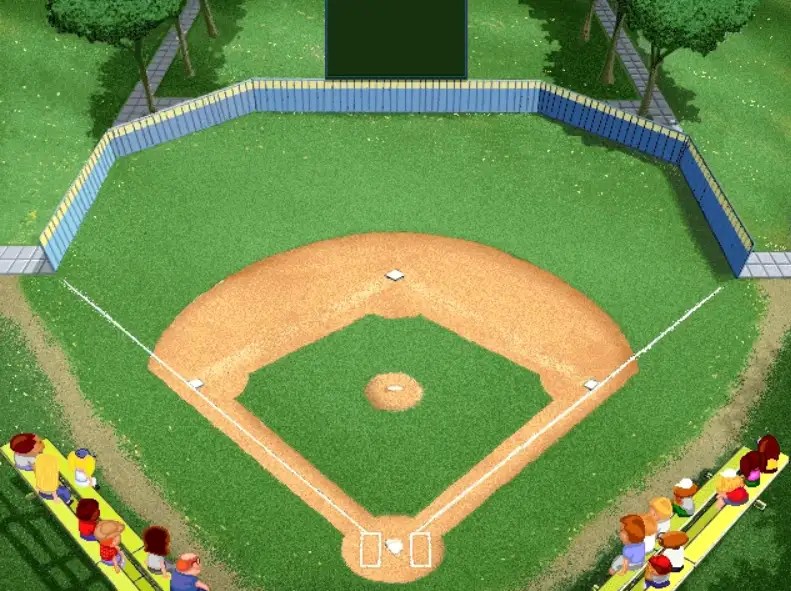
About The Field: Debuting in the classic Backyard Baseball of 1997, Parks Department Field No. 2 (PDFN2) was in some ways the most ubiquitous and least-wacky stadium in the series. Initially only available if you played in season mode, it became available for single games in later installments. Sadly, after the 2003 installment, PDFN2 disappeared from the series.
As mentioned above, it was the least-wacky stadium of the series. While other fields in the games are generally in actual backyards, back alleys, or playgrounds, this one has a more official feeling. The fact that it was what was used in season mode suggests that it was (and perhaps still is) the home facility of the local sports organization.
Great Players: The field was used by almost every team in season mode, from the Melonheads to the Taters and everyone in-between. There were also pint-sized versions of MLB teams. The only teams that couldn’t be encountered there were those that could only be found in post-season tournament play. As a result, PDFN2 saw many of the greats: Pablo Sanchez, Pete Wheeler, Stephanie Morgan, Achmed Khan, the works! Add in the kid versions of MLB stars from the sequels, and it’s possible that PDFN2 has seen the greatest assemblage of baseball talent in video game history.
Dimensions:
So, before we figure out the field’s dimensions, there is a need first to get an idea of what type of field this is. There is reason to believe it is a Little League-size field. Why? When you see the length of home runs in Backyard batting practices, you see that the balls that die at the left-center wall are only going 196 feet (note that in BB they count the rolls and bounces for distance). Dead grounders ahead of the pitcher’s mound are in the 30s as far as distance, and a ball clearly past the pitcher’s mound is 62 feet. Look below at a screenshot of Eauxps I. Fourgott’s video:
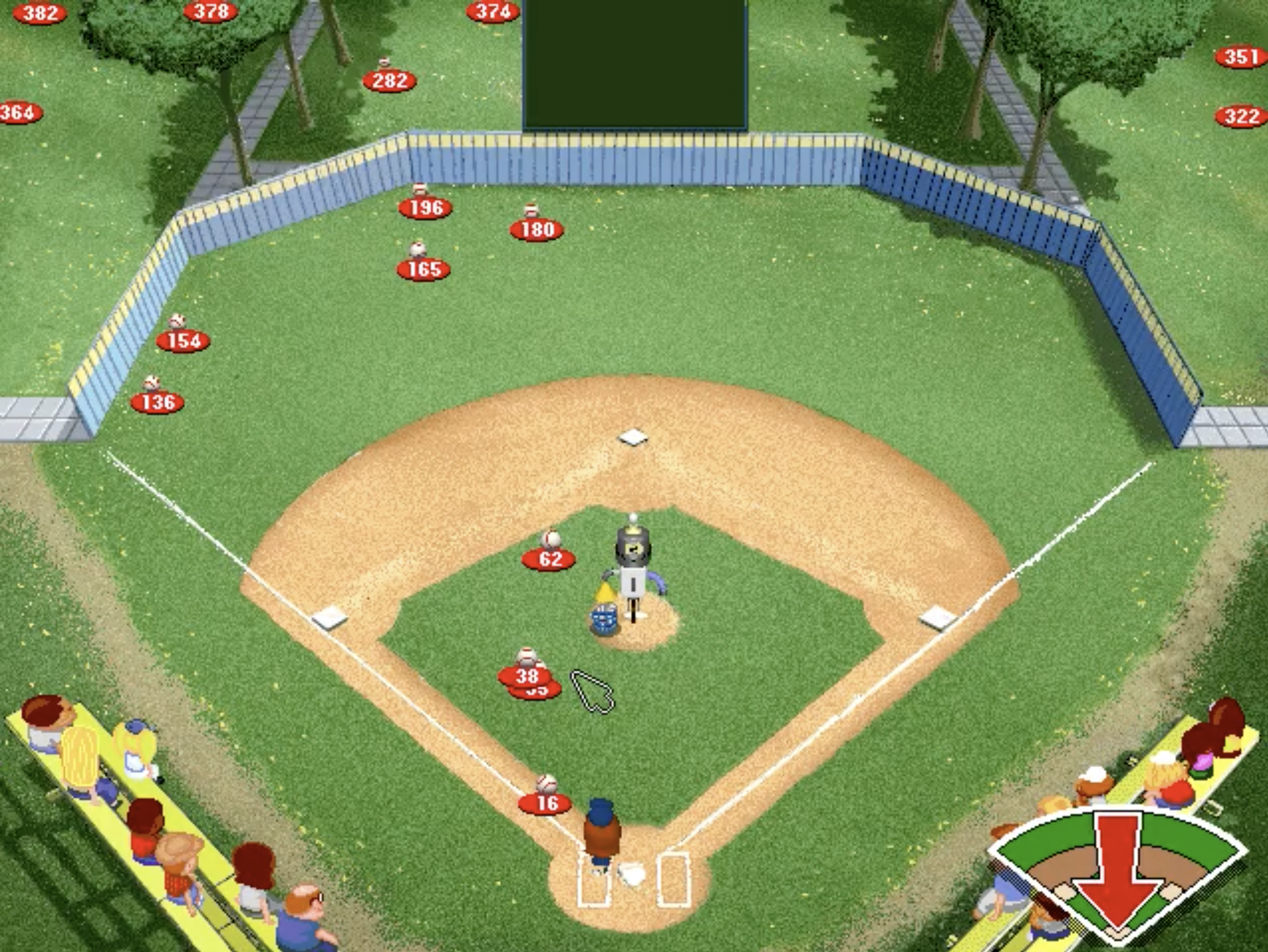
This would suggest that this is a little league field. So about 46 feet from the mound to home and 60 feet between the bases. This is not surprising, of course, given that the Backyard Baseballers are children, but it’s still important to know as we figure out the lengths.
So, looking over various videos of home run derbies, I’ve come to the conclusion that the following distances are definitely true:
Left Field: 175 ft
Left-Center: 196 ft
Right-Center: 196 ft
Right Field: 175 ft
So, we still need to figure out how long it is down the lines and to straightaway center. To do that, we’ll need to do the highly-unscientific-but-the-best-we’ve-got method of pixel measurement. In this case, we measure something on the computer in pixels and then use that to get an idea of the scale. Since it isn’t a “straight-on” view but rather at an angle and further distorted by it cartooniness, we’ll have to use the balls closest to the area we’re aiming at to set a scale.
So, for example, it appears that the hit towards center that went 180 feet was 1274.5 pixels. This suggests that 7.080555555 (repeating) pixels is equal to one foot. Since straightaway center is about 1306 pixels, that suggests that it’s about 184.4 feet to center. This means, of course, that the right-center and left-center alleys are actually deeper than straightaway center.
Now, time to figure out the lines. The ball hit closest to the line is the 136 hit to left. So to get something close to that scale, we find 1299.1 pixels equals 136 feet. That suggests that down the lines we should assume one foot is represented by just over 9.5522 pixels. It looks like the lines are 1310.5 pixels, so that equals out to about 137.19 feet down the lines. So, the final dimensions of PDFN2 are:
Left Field line: 137 ft
Left Field: 175 ft
Left-Center: 196 ft
Dead Center: 184 ft
Right-Center: 196 ft
Right Field: 175 ft
Right Field line: 137 ft
Now, this was highly unscientific, and no doubt the “real” lengths are rounded up or down. Still, it gives a “ballpark” figure. And, yes, that wordplay is intended.
Just for fun, given that Little League fields are 2/3rds the size of adult fields, we can figure out what the MLB equivalent of PDFN2 is with a little math. That comes out to…
Left Field line: 205.5 ft
Left Field: 262.5 ft
Left-Center: 294 ft
Dead Center: 276 ft
Right-Center: 294 ft
Right Field: 262.5
Right Field line: 205.5 ft
You’ll notice that this is still hilariously small (and also that the shape would become more exaggerated). Doing some work with the OOTP Parkgen website suggests it’d be the ultimate hitter’s park:
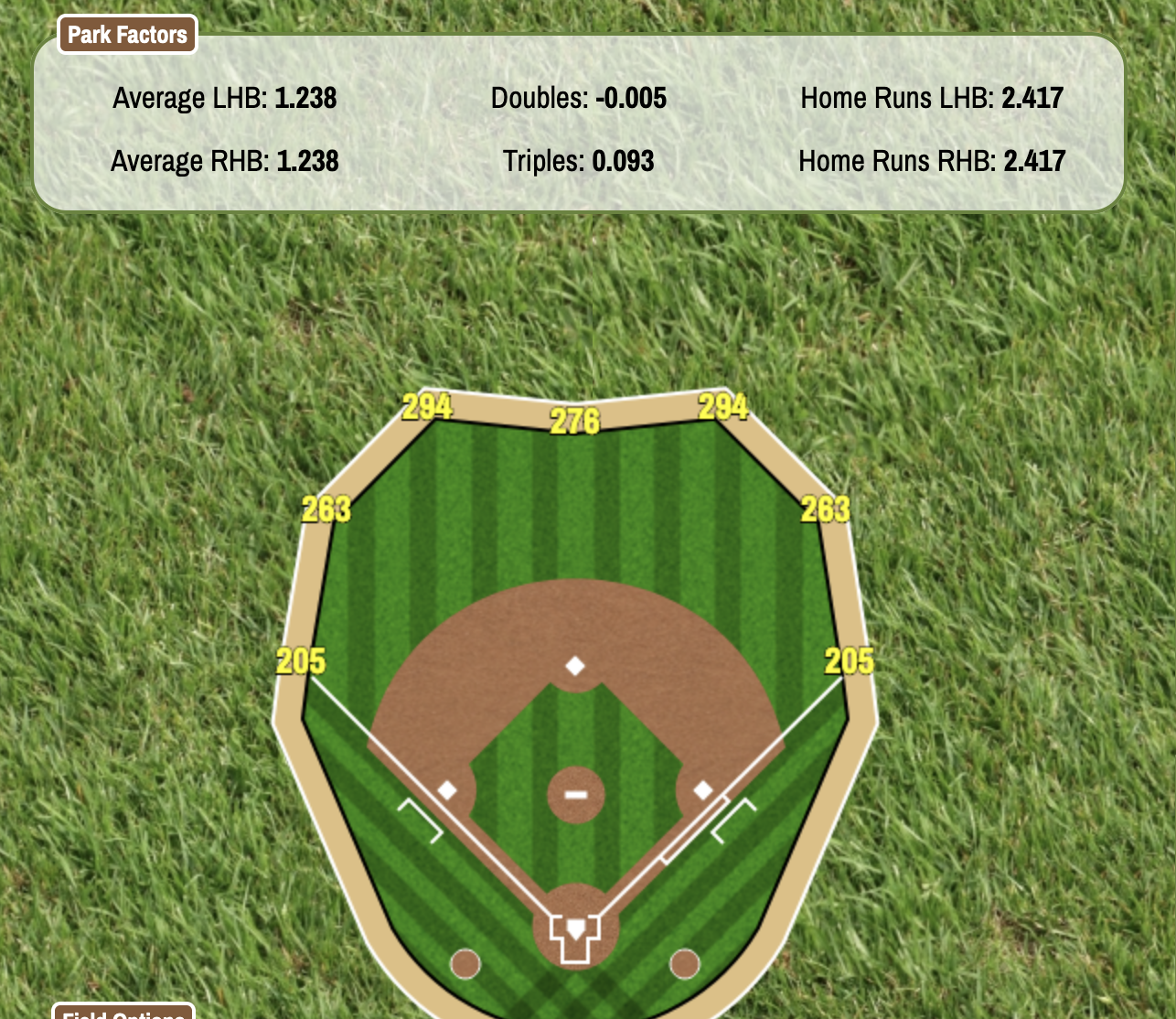
Yes, if you are reading that right, it should literally be impossible to hit a double in play on that field. So this leads to the question: why was it so small? Even going by the Little League standards (where the deepest parts are 196), the deepest parts of PDFN2 are far closer to the plate than the walls at Lamade Stadium in Williamsport. Given that Pablo Sanchez can smack it over 700 feet, it becomes even more absurd.
Alas, we have no way of knowing. Still, we now know the dimensions for PDFN2, so use this knowledge only for good.
Capacity and Amenities: By default, 16 people are seen in the stands when seen from overhead in Backyard Baseball. Based on the empty spots, it looks like another 16 probably could fit on those stands for a total capacity of 32. It’s possible that additional stands existed outside of camera view, but those were never seen, at least in the classic games. And, of course, there probably is room for blankets and other standing-room options.
As far as amenities, PDFN2 is and was top-of-the-line. Perhaps even over-the-top. It possesses a large scoreboard in dead center for replays and statistics, as well as a blimp that flew over to celebrate home runs. It also had an awesome sound system to blast out the theme songs of all the players. Some sort of broadcast facilities are/were also present since Sunny Day and Vinny the Gooch were able to cover all games.
For fans, less is known. However, given the Gooch’s chili dog, we must assume that some concession stands are/were present.
Other Notes: PDFN2 is part of a series of fields run by the Parks Department. Parks Department Field No. 3 is used for (American) football, while Parks Department Field No. 7 and Parks Department Field No. 8 are used for soccer (although PDFN8 lacks grass and is instead a sandy field).
Final Thoughts: The Parks Department Field No. 2 is a classic of Backyard Baseball, but lacks much of the charm that other fields in the series have. This is, admittedly, by design. While other playing fields are odd and quirky, PDFN2 is fair, without giving an advantage to left-handed or right-handed hitters. It also had a more professional look, like an actual youth stadium on steroids. This made it the perfect stadium for the season mode that Backyard Baseball had. It may not have been the place you’d want to play with your friends, but it was definitely the place you’d want to play against your opponents.
During the 2022 season, I’ll have occasional reports on games I’ve attended of the Rochester Red Wings, the AAA affiliate of the Washington Nationals.

It is May 19, 2010. The second game of a day-night doubleheader. Over 12.5 thousand people pack Frontier Field to watch the best prospect in baseball face the Red Wings. His name is Stephen Strasburg. He is young, but already accomplished. He won awards at San Diego State, a bronze medal in Beijing, and a $15 million dollar contract with the help of Scott Boras. The world is seemingly watching, with national media in the stands and seemingly every camera in the photo city aimed at the clean-shaven kid. Among those cameras in mine. It’s a clear view from behind the visitor dugout, and I see it all as he dismantles the likes of Trevor Plouffe, Matt Tolbert, and Danny Valencia to the tune of nine strikeouts. He leaves the game to a round of applause from the fans of the team he held to three hits. Admittedly, the 2010 Red Wings end up not being anything particularly special, finishing 49-95. As he enters the dugout, some boo him for not tipping his hat. It’s a silly controversy which fades quickly, the Ghost of Strasmas Past.
Within a few weeks, Strasburg is striking out 14 Pittsburgh Pirates. Within a few years, he’s an all-star. Within a decade, he’s the World Series MVP.

It is June 3, 2022. Over a dozen years have passed. Now, the great Stephen Strasburg returns to Rochester. He’s no longer the wonderboy of 2010. Time and injuries have forced him to go from the high heat to more finesse. Where once he could seemingly send it at 95 on demand, now his most dangerous pitch is likely the curve. Regardless, he is Stephen Strasburg, hero of the 2019 World Series. Over 10.5 thousand people pack Frontier Field to see the now-bearded veteran. While the eyes of the world have turned elsewhere, there are still plenty of cameras. One of those cameras is mine, shooting around the protective netting that slightly obstructs the view behind the visitors dugout. The Buffalo team Strasburg faces is a far better opponent than the Wings team he faced in 2010. The Red Wings he’s rehabbing with are better, too. The two Western New York teams are in a fight for the lead of the International League East. When he leaves the game after six innings, the Wings are leading 1-0 thanks to a Donovan Casey solo shot off a nearly-as-dominant Max Castillo. Strasburg has thrown 83 pitches, 50 of them for strikes. He has struck out four, walked one, and given up just a single hit. Early on, he humiliates the Blue Jays’ top prospect, Gabriel Moreno. Outside of a few at-bats that saw deep counts and a few possible would-be hits that are prevented by Rochester gloves, he never really struggles. The Bison eventually tie the game, but the Red Wings win it in the bottom of the ninth as Joey Meneses gets a bases-loaded single that just falls out of the third baseman’s glove. The win extends Rochester’s lead in the division to 2.5 games. By then, I imagine, Strasburg is already on a flight back to join the Nationals. After all, when he leaves the game after the sixth to applause he does some fist-bumps, talks to coaches quickly, and then disappears into the clubhouse. Gone. The Ghost of Strasmas Present.

And so now, he is gone, likely to never see Frontier Field again barring any future injuries. What the future holds for him is anyone’s guess, but in the near-term, it almost certainly sees him stepping on the mound in Washington once again. It will be a far cry from that night he struck out 14 Pirates as the world watched. Still, he is Stephen Strasburg. The best pitcher on a team having a horrific year. The greatest pitcher to spend the vast majority of his career in Washington since Walter Johnson. Beyond that, who knows? Perhaps this is the twilight of his career. Perhaps he’s just one more injury away from hanging it up. Or perhaps this is still just the end of the beginning or middle stage. Perhaps he has many years left in him. Perhaps it even leads to Cooperstown. Right now that feels iffy, but who knows how the career of Stephen Strasburg will end? Nobody knows, save perhaps the Ghost of Strasmas Future.
The Red Wings (without Stephen Strasburg) finish up their series with Buffalo over the weekend.
 The Baseball Continuum