GREAT MOMENTS OF 2013: The clever baseball reference in the “Parks and Recreation” book

As 2013 comes to a close, I’ll remember the good times we had by reposting some of the most popular things from the Continuum in the past year. Today, from September 19, a look at the clever David Aardsma reference in the Parks and Recreation book:
In 2009, Parks and Recreation first aired. A spiritual spin-off (but not an actual spin-off) of The Office, it follows the life of the Leslie Knope (Amy Poehler) and the rest of the staff of the Parks and Recreation Department in the fictional, Springfield-like city of Pawnee, Indiana.

In 2011, Knope released a book on Pawnee in the show, entitled Pawnee: The Greatest Town in America. NBC released the book in the real world.

In 2013, as part of a Netflix/Hulu binge to get caught up on Parks and Recreation before the next season starts, I also read Pawnee: The Greatest Town in America. I got it from the library (thankfully, my local library is not run by Ron Swanson’s second ex-wife Tammi). In doing so, I was able to catch a clever baseball reference in it during a section on Pawnee’s school board- which is filled with people who have lots of A’s at the start of their names in order to be at the top of the ballot, helping them win simply through the laziness of the voters of Pawnee. I’ve put the page up below the jump*, can you spot it?

*(Please don’t sue me, NBC!)

Continue reading

Random Video: Wade Boggs throws a scoreless inning

In 1997, Wade Boggs threw a scoreless inning against the Angels:

Bizarre Baseball Culture: Mariners Mojo, in which a baseball team fights a Sasquatch Invasion

Robinson Cano is now a Mariner. I did NOT see that coming. And they paid a ridiculous 240 million dollars for him, which is absurd, especially given the long length of the deal and the fact Cano is already in his thirties.

However, that, along with the fact that the Mariners are apparently not going in hard to get David Price (amongst others), means there is perhaps no better time than now to be remembering how back in 2002 the Mariners saved humanity from a grand Sasquatch Invasion, which is easily one of the ten worst types of invasions to deal with. And they did it in TWO issues! Yeah, some teams would stop with just one issue, but the Mariners released TWO in 2002. That is true devotion to giving the fans what they…. want? And, what’s more, They were available outside of the stadium too, available at local McDonald’s! That way, you wouldn’t even have had to go to the park to get your hands on these comics!

Oh, and yes, it was done by Ultimate Sports Entertainment/Ultimate Sports Force, why do you ask?

Both comics were written by David B. Schwartz, who’s Twitter account calls him a “entertainment lawyer by day, comic book writer by night.” He’s recently been doing things for independent comic companies like Aspen, where he most recently wrote a title called Idolized, if my research is correct. Since he’s a lawyer, I’m going to be extra-careful not to say anything that might cause him to sue me. Thankfully, he does a pretty good job with these comics, given the circumstances that surround comics like this.

Doing the art for the first issue- and the covers of both issues- was Brian Kong. Kong has done a ton of stuff over the years, from comics to cards to recently illustrating a children’s book about how baseball teams got their names. In part two, the art was done by Dennis Calero, a prolific artist who co-created Cowboys and Aliens, which was later very-loosely adapted into a movie, as well as work with DC and Marvel. Like with Schwartz, they do okay given the circumstances.

Anyway….

Go below the jump and let’s get started on the stories themselves:

Continue reading

Roy Halladay retires, the three great managers inducted, I feel old

I swear I’m going to get up the latest Bizarre Baseball Culture soon, but today has brought two major news stories:

A) Joe Torre, Tony La Russa and Bobby Cox have been inducted into the Baseball Hall of Fame by the Veterans’ Committee. Marvin Miller wasn’t, but that’s another story.

B) Roy Halladay, the Doctor, has announced his retirement, signing a one-day deal with Toronto to end his career as a Blue Jay.

So, for those keeping score, that means perhaps the three greatest managers of the past 30 years are now in the Hall of Fame, and perhaps the best pitcher of the last 10 or 11 years has retired.

It’s an interesting contrast when you look at it, because while almost everyone expected the three managers to get in the Hall of Fame, it’s unlikely many people expected Roy Halladay would have gone out with such a whimper. Injuries and the cruelty that comes with growing old led to his sharp decline in 2012 and 2013, while the Phillies lack of hitting and the sheer randomness of October left him without a World Series ring.

It’s a stretch to compare Halladay to Sandy Koufax, but there are some similarities, as both came to the big leagues young, with their first few years being rocky as their raw talent was often unable to make up for inexperience. But then, something clicked, and for a span (five or so years for Koufax, ten or so years for Halladay, albeit with a blip in 2004 when he was hurt) they became the best pitchers of their generations. Then, however, injuries forced them into premature retirements (Koufax at only 30, while Halladay at 36 after two years of decline that Koufax never had).

Another thing they will have in common? The Hall of Fame. Matthew Pouliot over at HardballTalk has a good summing up of why, but it essentially comes down to how good he was over that 10-year span, as well as the fact that, for his era, he was an exceptional pitcher, for example throwing almost double the amount of complete games as the next pitcher who remains active.

Yesterday was nuts

Well, that escalated quickly.

You know how I made that post about how crazy it could get in the winter meetings? Y’know, with the name of the Mystery Team, the free agents and traded players all redacted? Well, as yesterday went on, it became a lot less likely and a lot less intentionally funny.

So, for those of you who missed it, this happened yesterday:

  • The Orioles traded the ever hot-and-cold Jim Johnson to the Athletics for Jemile Weeks, a prospect, and perhaps some magic beans. This was late Monday, but I really didn’t hear about it until I woke up on Tuesday.
  • The Red Sox signed AJ Pierzynski.
  • The Tigers signed Joe Nathan.
  • The Rays, Reds and Diamondbacks had a three-way trade that ended with Tampa getting Ryan Hanigan and Heath Bell.
  • It came out that that Mariners apparently are in on Robinson Cano.
  • The Padres traded Luke Gregerson to the A’s for Seth Smith.
  • The Astros got Dexter Fowler from the Rockies.
  • The Marlins signed Jarrod Saltalamacchia to a three-year deal.
  • The Yankees signed Jacoby Ellsbury to a seven-year deal, $153 million dollar deal that is absolutely absurd given his injury history and the fact that he’s 30 years old.
  • The Rockies signed Justin Morneau to a two-year deal.
  • Oh, and we found out this morning that Paul Konerko will return for the White Sox this year, after speculation he would retire, and that Brandon Phillips will likely be back with the Reds, after speculation he would be traded.

Got all of that?

The Phil Hughes deal isn’t as crazy as you think

As you no doubt have found out by now, Phil Hughes has signed with the Minnesota Twins. On one hand, you likely thought this was a crazy and reckless move by the Twins, throwing 24 million dollars at a pitcher who has been wildly inconsistent and who was 4-14 last year with an abominable 5.19 ERA. At least Ricky Nolasco, the other big signing for the Twins in their attempt to make their rotation better, was good last season, after all.

But, get this: this could actually end up being a good move. Maybe.

For one, keep in mind the type of pitcher Hughes is. He’s a fly ball pitcher. Last year, 46.5% of balls hit off Hughes ended up as fly balls, according to FanGraphs. That’s a lot, and it is especially dangerous in stadiums like the new Yankee Stadium, which is a hitters park that at times seems to turn routine fly balls into unexpected home runs. Compare that to Target Field, however, where the opposite seems to happen: if I had a quarter for every time it looked like Joe Mauer had just hit one over the wall only for it to fall short (either turning into a double or a fly-out, depending on the outfielder and the part of the stadium he hit it to), I’d have many quarters.

It’s entirely possible that, with more of his games in a more spacious stadium, Hughes will be able to cut down on the gopher-balls and deflate his ERA quite a bit. Although it’s admittedly a small sample size (and he was facing Twins hitters), Hughes’ regular-season numbers in his three games and 21.1 innings at Target Field seem to back this assessment up. He is a career 2.53 ERA pitcher in those three games, and gave up just one HR (That’s one HR every 21.1 innings, compared to one HR every 5.015 innings in the current Yankee Stadium). If Hughes can replicate anything close to that performance when he pitches in Minnesota wearing a Twins’ jersey, he could prove to be a reliable two or three starter for the Twins, and certainly an improvement over the revolving door they had last season.

And, what’s more, there is also the fact that at times, Phil Hughes’ roller-coaster career has climbed very high. Back in 2010, for example, he was an All-Star who went 18-8 (more on that next sentence). As recently as 2012, he won 16 games, although, as Brian Kenny would tell you, that more-or-less tells you nothing (and, what’s more, he also lost 13 games). Could Hughes be heading for another upward trend? Well, that has yet to be seen, and the answer may well make the Twins look like geniuses (or fools).

Bizarre Baseball Culture THANKSGIVING WEEKEND DOUBLEHEADER (Starring Dick Blaze and Franklin Richards)

In Bizarre Baseball Culture, I take a look at some of the more unusual places where baseball has reared it’s head in pop culture and fiction.

So, for the first time ever, we have a very special DOUBLEHEADER in Bizarre Baseball Culture, as we belatedly celebrate Thanksgiving with TWO comics. The reason behind this is because both of them are kind of short- one of them is only 3 pages! We’ll open up with the aforementioned 3 page story, a public-domain tale starring “Dick Blaze” (seriously, that’s the name), and then move on to celebrating the family time we have at Thanksgiving with a look at a short comic starring Franklin Richard, son of the Fantastic Four’s Reed Richards (AKA Mr. Fantastic) and Susan Storm Richards (AKA The Invisible Woman).

So, let’s get started:

First off, the 3-page story of “Dick Blaze, Four Letter Man at Yardley” can be found in Whirlwind Comics #2, viewable here on page 45. I can find basically nothing about this character, at least partially because I’m not going to be putting “Dick Blaze” into Google because I’m afraid of what might come up (shivers). The GCD doesn’t know a thing either. However, this came out in July 1940, published by Nita Publishing, which would later become part of Holyoke Publishing. Holyoke was one of the various comic companies that existed back during the “Golden Age” and then disappeared.

Anyway… the story.

Screen Shot 2013-11-30 at 3.55.08 PMWe begin near the end, which isn’t a surprise, given that this story is just three freaking pages. As the little info-box on the page says, it’s the final game of what seems to be the College World Series, and Dick Blaze’s (STOP LAUGHING, YOU JUVENILE) Yardley team is down by one but with two men on. Also, Yardley has very, very blue uniforms. It’s obvious, based on the situation, that Dick (STOP IT) is the best hitter, something that the Wentworth battery confirms as they deviously scheme:

Screen Shot 2013-11-30 at 4.03.36 PMThis is a rather suspect strategy. I mean, for one, it’s mean and unsportsmanlike, unless Dick has broken some unwritten rules earlier in the game. And for another, it’s dumb. There are two men on. You are going to load the bases to send a message, and, what’s more, your going to do it with a intentional HBP that could well go to the backstop if you miss the guy’s head?

On the other hand, Old Hoss Radbourn (or at least his Twitter incarnation)  would be pleased.

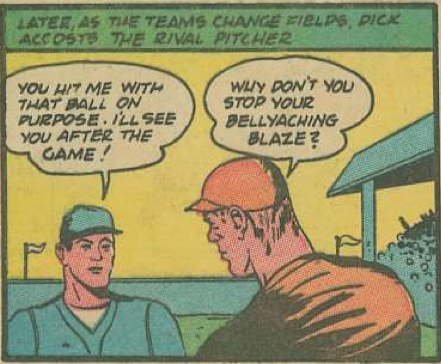
The first attempt to bean Dick in the head (you’re probably the same type of people who laugh when you read “Uranus”, aren’t you?) fails. But the second one succeeds, and he’s shaken up. Everyone is trying to tell him to get out of the game, but Dick doesn’t care, he says he’s FINE:

Screen Shot 2013-11-30 at 4.09.51 PMDick succeeds in convincing his coach and teammates that he can stay in the game, which isn’t really a surprise, since this is the Golden Age: When Men were Men and concussions weren’t considered a major threat to an athlete’s future physical well-being and mental health. After all, nobody who suffered from concussions back then became erratic and violent…. right?

Screen Shot 2013-11-30 at 4.13.26 PM(Jeez, this is up there with Dash Dartwell in ironically-uncomfortable-in-retrospect comics)

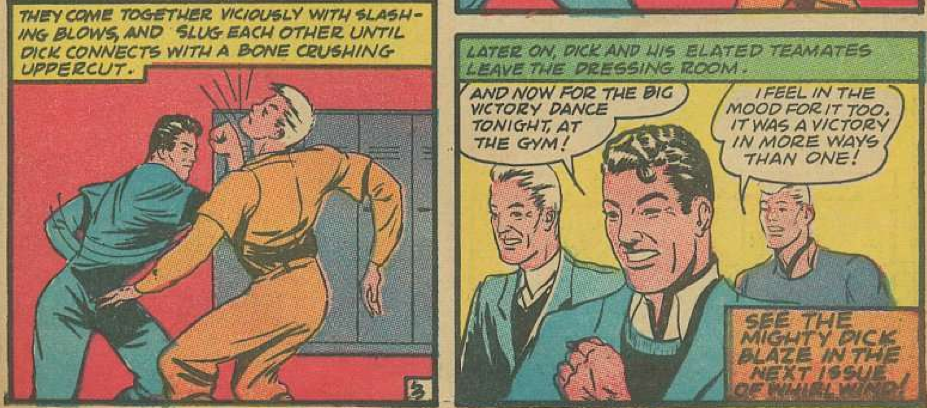
Anyway, you can probably guess how the rest of this comic (which has about… a page and a line left in it) goes: Dick comes up in the 9th inning despite still being dizzy and socks a walk-off homer….

and then goes to the opponent locker room and beats up the pitcher:

Screen Shot 2013-11-30 at 4.22.31 PMSo, remember kids: if you get a serious injury from having a fastball hit you in the head, ignore the pleas of your teammates and stay in the game no matter how dizzy you are. And then, make sure to take revenge against the pitcher who hit you by storming into his locker room and knocking him out.

Man, that’s dark. Let’s go to something a bit more happy: Franklin Richards. A look at his story can be FOUND UNDER THE JUMP:

Continue reading

Extreme Baseball Fields (Geographically, at least)

…and we’re back! And today, we’re doing a little bit of a geography lesson, finding the most extreme baseball fields in the United States! No, I don’t mean that they are “extreme” as in “radical”, I’m talking extreme as in geographical: the highest, lowest, northernmost, etc.

Northernmost Baseball Field in the USA:

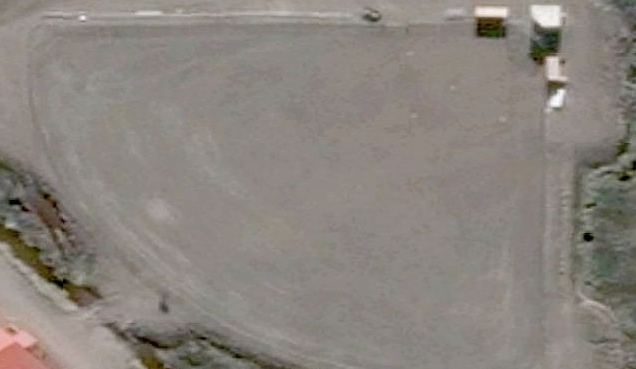
By definition, this has to be in Alaska. Presumably, it would be in Barrow, Alaska. Barrow is the northernmost town in America, and, guess what? They have a diamond! Oh, it’s all dirt and gravel (it’s hard growing grass in the arctic circle) and looks like it’s also used for softball as well, or perhaps Little league, but I’ll count it. It’s not far from Barrow’s schools, which makes me think it’s for their use. It can be found at 71.290189,-156.75865.

Here’s how it looks on Google Maps:

And here’s a “bird’s eye” image of it from Bing:

Screen Shot 2013-11-26 at 3.18.21 PMNorthernmost Baseball Field in the Lower 48:

Due to a quirk of history and a mapmaking error, the northernmost part of the Lower 48 is the Northwest Angle in Minnesota. However, not many people live there, and based on looking using Bing and Google Maps, I couldn’t find any baseball fields. This doesn’t mean that there definitely aren’t any, of course, merely that I couldn’t find any sort of permanent structures. If you live there or have visited there and are willing to correct me, let me know.

Instead, it’s likely that the Northernmost Baseball Field in the Lower 48 is in one of the border towns of Washington State. For example, there is this group of diamonds in Sumas, Washington (Bing calls these “Howard Bowen Memorial Park”):

The northernmost of these is at about 48.989888 degrees north. On the other hand, though, Blaine, WA has these High School fields ever so slightly more to the North, at around 48.992121 degrees north:

There are no doubt plenty of other fields in border areas that are ever so slightly north, and it would likely take awhile to find where, exactly, the northernmost ballfield in the lower 48 is. Still, you now have two good candidates.

Southernmost Ballfield in the USA:

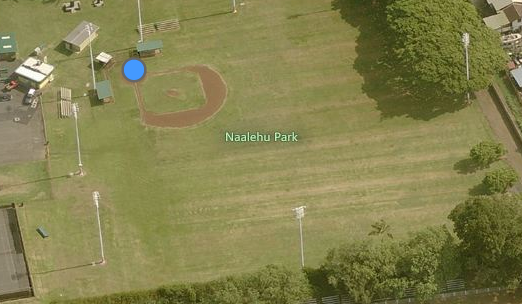
Hawaii is by far the southernmost of the United States, with Naalehu being the southernmost town, located on the Big Island and being home to about 919 people. And guess what you can find there, at about 19.06045 degrees north?

A baseball diamond! Bing calls it “Naalehu Park” and it looks like this from the air:
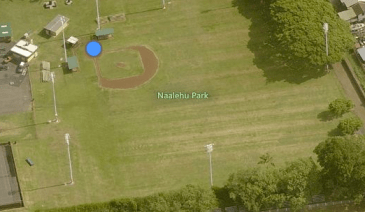
Screen Shot 2013-11-26 at 3.53.19 PMGiven that basically everything south of Naalehu is fields, farms, parks and scientific facilities (radio antennae, etc.) this is almost certainly the southernmost ballfield in America.

Southernmost Baseball Field in the Lower 48:

While there are some small softball fields (as in, so small there’s no way they can be used for baseball) more to the south of it, I’m going to say it’s this field in Key West:

Easternmost Baseball Field in the USA:

None of the Aleutian Islands that jut past the 180th meridian have ballfields, or even much as far as inhabitants, so far as I can tell. So the easternmost field is in Maine.

One possibility are these all-dirt fields (seen here in the dead of winter, so you have to look closely for them):

These are near an Elementary School, so it’s likely that, in addition to being softball fields, they serve as baseball fields for kids.

Westernmost Baseball Field in the USA:

The westernmost parts of the USA are in Alaska, in the Aleutians. There is a small field near Adak, Alaska, not far from an airport and a school, meaning it likely is used by school kids for baseball and softball. Another possibility is this field in Unalaska.

Westernmost Baseball Field in the Lower 48:

Probably this diamond in Port Orford, Oregon:

Highest Baseball Field in the USA:

Probably one of the fields in Leadville, Colorado. I don’t know how to check altitudes on them in a quick and accurate manner.

Lowest Baseball Field in the USA:

Calipatria, California is the lowest city in the Western Hemisphere, 180 feet below sea level. And, guess what? It’s local High School is the site of what is likely the lowest baseball field in America, unless there’s some place in Death Valley I don’t know about:

Have any corrections? Let me know. Also let me know if you live at or near those places- I’ll put up any pictures you send me.

Bizarre Baseball Culture: McGwire, Sosa and Friends fight Tree Monsters in “Cosmic Slam”

In Bizarre Baseball Culture, I take a look at some of the more unusual places where baseball has reared it’s head in pop culture and fiction.

I’m coming to you from the Auxiliary Headquarters of the Continuum… AKA a Living Room instead of my usual Family Room or Bedroom writing area, due to the great Wi-Fi Crisis of 2013. The reason I have braved such perils is simple: Cosmic Slam. The sequel to Shortstop Squad, and another great epic from the folks at Ultimate Sports Entertainment (AKA “Ultimate Sports Force”). Just as Shortstop Squad brought us late-90s shortstops fighting monsters and aliens, Cosmic Slam does the same with late 1990s sluggers. Jeff Bagwell, Sammy Sosa, David Justice and Mark McGwire all grace the cover, and Gary Sheffield, Bobby Bonilla and Frank Thomas all show up in the story as well.

It also involves Bagwell complaining about missing a fishing trip, Sosa making a corked bat joke, Greg Maddux‘s fastball being insulted, and of course, the making of a baseball bat out of the body of your defeated foes.

No, I’m not joking about the last one. Seriously, that really happens.

So, place your tongue firmly in cheek and go below the jump for Cosmic Slam.

Continue reading

The only post about the Braves’ move to reference “Back to the Future”, Doctor Who and Joe Mauer in the first two paragraphs

I need a time machine. Now. Or, well, I guess later would work as well. That’s the thing with time machines, after all. Still, I need a time machine. And when I have it, I intend on going back to Las Vegas in 2010, and tell them that I wanted to place a bet that by Opening Day of 2014 the Atlanta Braves would have announced plans to move from Turner Field and Joe Mauer would become a full-time first baseman.

I then would have hopped into my DeLorean and/or TARDIS, travel to today, and cash in enough money where I could buy a small nation, because that’s what happening. And, while many could read the tea leaves about Mauer, nobody saw the death of Turner Field coming, and for a very good reason:

It goes against almost every single thing we know about stadium movement. Most teams move towards the center of their cities, the Braves are moving away from it. Most teams flee old stadiums, and while Turner Field isn’t young anymore, it’s less than two decades old. Most teams don’t keep their moving plans total secrets… but the Braves did.

Now, to be fair, the Braves do have some good points: most of their season-ticket base is from the suburbs, and their new Cobb County facility will be closer to them. That, in turn, would likely increase in-stadium attendance, a  And, yes, they are getting a good deal from Cobb County, essentially letting them get a whole new stadium for the same price (as far as the team’s own funds) as what they would have spent if they renovated Turner Field entirely out of their own fund. And, at least in theory, the new stadium would be better located logistically, near two major interstate highways.

But, well, it still goes against most conventional wisdom, especially when one takes into account various caveats about the Braves’ good points. For example, the traffic in the areas north of Atlanta is infamously bad, and I myself remember being stuck in traffic during a family trip down there back in 2008. There is no mass-transit to Cobb County, for various reasons (some of them ugly), which would presumably have helped alleviate that traffic problem.

But, most of all, there is the general bad taste that is left in people’s mouths as a post-Camden Yards stadium is replaced for the first time, even as the Athletics and Rays are stuck in fields from a bygone era. And, perhaps even more worrying: virtually every stadium opened since Camden Yards changed the landscape of baseball stadium design was built with platitudes about them being able to carry their franchises “well into the 21st century”.

And yet, come 2017, not even a fifth of the way through the century, one of them will be replaced.

While Turner Field has always been something of an oddball amongst the post-Camden Yards boom (more brought about by the 1996 Olympics than any type of real plan), one worries about what sort of precedent that might set.