Addendum to today’s earlier post: The Green Light Letter

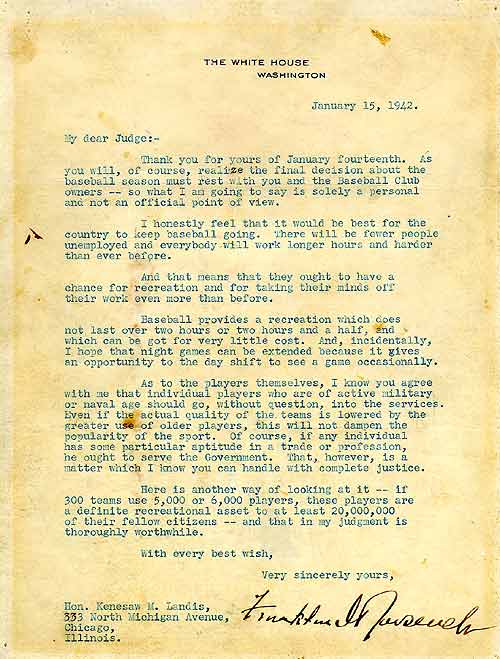
As I noted earlier today, many ballplayers have answered the call of duty, especially during the World Wars. What I didn’t note was that, especially in WWII, there were so many players that either volunteered or were drafted into the service that there was some discussion of whether baseball could even continue, especially as those who would be left to play would generally be old or unfit physically for military service (and thus probably not fit physically for Major League Baseball either). Commissioner Kennesaw Mountain Landis wrote President Franklin Delano Roosevelt asking his opinion. He received back what has been called the “Green Light Letter”.

(A full transcription is available here)

And thus, baseball continued through WWII. It led to some strange things. For example, in 1943 rubber rations led to a brief time where balls were used that had balata (a substance more similar to the golf balls of the time) in them, which wouldn’t have been a problem except for the fact that it created one of the deadest baseballs in history. There was the rise of the All-American Girls Professional League in areas of the Midwest that had had their minor league teams fold due to lack of players (although, unlike in League Of Their Own, it was, during the war years, more of a modified form of softball). And, in perhaps the biggest indication of how strange baseball had become while the players were in the service, the St. Louis Browns made the World Series. I seem to recall reading somewhere that a joke at the time was that it was because the Army didn’t want them. By the next season, the Browns then, in 1945, had Pete Gray play the outfield. Who was Pete Gray? Well, he’s the only ballplayer in history who only had one arm.

But, as FDR wrote would happen, baseball continued to provide much-needed recreation to a war-weary nation. Even if it was a bit less Major League than usual.

Ballplayers who gave everything

On this Memorial Day, it is as good a time as any to mention some of the ballplayers who gave their lives serving in America’s armed forces. The DeadBallEra site has a list of those who died while serving America, and there is also a good site entirely about Baseball in Wartime (primarily focused on WWII), but here are some notables (although, in the end, everyone who gives the ultimate sacrifice is notable). Not all of them died in combat, but all of them died while in military service or (in the case of people like Christy Mathewson) as a result of those actions:

  • Eddie Grant was a Harvard-educated infielder who spent time with Cleveland, Philly, Cincinnati and the Giants. On October 15, 1918, he died after being wounded by a artillery shell in the Argonne Forest of France. His unit had been fighting to rescue the “Lost Battalion” that had been pinned down by German forces. He was 35. A memorial to him was placed in the Polo Grounds (it is one of the plaques that can be seen in the expanded version of the Willie Mays catch photo), and a replica of it is now apparently in San Francisco.
  • Larry Chappell was a light-hitting outfielder in the 1910s who was at one point part of a trade for Shoeless Joe Jackson. In 1918, he died while in Army service only a few days before the armistice from the Spanish Flu pandemic that killed tens of millions of people. He was 28.
  • Ralph Sharman was a young outfielder who did well in a September stint with the Phillies in 1917. After the ’17 season, however, he was inducted into the army. He died in May, 1918 when he drowned while in Alabama, where he was undergoing training. He was only 23.
  • Christy Mathewson had retired from pitching by the beginning of America’s involvement in WWI, and was manager of the Cincinnati Reds. He left the club in the middle of the 1918 season, going to France, where he served in the Army’s chemical division. While there, he suffered the effects of poison gas, which left him with various respiratory ailments, including the tuberculosis that took his life in 1925.
  • Elmer Gedeon, who had had a cup of coffee with Washington in 1939, died while piloting a B-26 Marauder over France on April 20, 1944. He was 27.  He was one of only two people with Major League experience who died in WWII. The other being…
  • Harry O’Neill, who was a catcher in one game (with no plate appearances) for the Athletics in 1939. He was killed by a sniper on Iwo Jima on March 6, 1945.
  • Bob Neighbors, who had a cup of coffee with the Browns in 1939. In 1941, his baseball career came to an end when he had a poor season and, perhaps more importantly, lost his wife of only six months in a car accident while he was away on a road trip. He signed up for the United States Army Air Force after Pearl Harbor, and became a career military man from that point on. He went Missing In Action (and presumed dead) in 1952 when his B-26 went down over North Korea. He was both the only MLB-experienced man to die during the Korean War, and the last to have died in active service, period.

Of course, there were plenty of players who never made it to the big leagues who died in the line of duty, some of whom may have one day become Major Leaguers if not for the cruelty of war:


To them and all who have given the ultimate sacrifice, and to those who made it home, we salute you.

Red Sox, Rays, and a Friday Night Fight

So, during the 9th inning of Friday’s game, the Red Sox and Rays had basically the most heated bench-clearing in the history of baseball that did not feature a single ejection.

It all started when longtime Boston enemy Luke Scott, noted by many for his good career splits against the Red Sox (he’d been with the Orioles before this season) and calling Fenway a dump a month or so ago, was clearly targeted during the 9th inning Friday night. The first pitch from Franklin Morales was 97 MPH and behind his back, the next two were inside, and the final pitch finally hit him. This was, as an ESPN article points out, the third time in three games that Scott was hit by a Boston pitcher.

(more after jump)

Continue reading

Bizarre Baseball Culture: Captain Marvel teaches baseball… to Martians

Baseball has an unusual relationship with the rest of popular culture. There are more baseball movies than basically any other kind of sports movie (with the exception of boxing, which is very easy to stage), Charlie Brown’s ineptness on the mound lasted fifty years, and almost every TV series ends up having at least one casual mention of the game at point or another.

But with this, sometimes popular culture about baseball can get, well… weird. Bizarre!

This is part of a series about those times. Sometimes it’ll be short stories (like that old tale about 2044 baseball), other times comic books, occasionally a movie clip or advertisement. No matter what, it’ll be weird, it probably won’t be very good, and I’ll give it far more attention than it really deserves.

So, for the first edition of BIZARRE BASEBALL CULTURE (I’ll consider the 2044 baseball story as something of a prologue), I bring to you this:

Captain Marvel. Playing baseball. On the planet Mars. In a story that is about how Captain Marvel taught the Martians baseball. Fittingly, this has been set to go up on a Saturday morning. More underneath the jump.

Continue reading

Why the IOC should add baseball (and softball) back to the Olympics

The London games are coming up later this summer, but for the first time in years, baseball won’t be a part of it. When baseball, along with it’s sister sport* softball, were kicked out (to later be replaced by golf and rugby), the most often cited reasons by the International Olympic Committee were (in no particular order):

  1. A lack of popularity outside of the Americas and certain parts of Asia
  2. A steroid problem
  3. Not having the highest level (i.e. MLBers) play like the NHL and NBA do.

All of these reasons are, to put it some way or another, total crap, and also full of hypocrisy. The real reason for the ejection of the ballgames can be summed up as: “The European dominance in the IOC”, “disputes with the USA over money” and “overzealous cost-cutting”. You see, until recently, the United States Olympic Committee had been in a dispute with the International Olympic Committee over how revenue from the mega sponsorship deals that the USOC has would be distributed. This dispute, more so than any other factor, is believed to have been one of the main reasons that the Olympic bids by New York and Chicago failed. At the same time, the IOC has over the past decade or so been focusing on keeping the costs down on the Olympics, with the admittedly-noble goal of having future games be economically sensible enough that previously priced-out countries could host games. So, when it came time to cut the fat in 2005, it’s hardly surprising that baseball and softball- two sports that often require new facilities, and that are most identified with the USA (who, remember the IOC was in a money dispute with at the time), were cut, and that Golf (which could utilize pre-existing courses) and Rugby (which could use soccer stadiums) were added.

That, according to most observers, were the real reasons. Because the reasons that IOC generally cited were, for the most part, full of crap and hypocrisy.

A lack of popularity outside of the Americas and areas of Asia.

This is relatively true. I say “relatively” true because baseball is, indeed, not as popular as soccer, basketball, etc. in most countries in Europe, Africa, South America, etc. However, there’s a difference between “not being as popular” and “not being popular at all”. There are baseball fans outside of the traditional “baseball countries”, and there are players. Heck, there are full-fledged leagues in the Netherlands, Italy, Germany and Australia, and amateur leagues in almost every country that is larger than Rhode Island. Being popular does not mean “unknown” or “not played”.

In addition, the Olympics have several sports that are far less popular globally than baseball and softball. Team Handball, for example, is hardly practiced outside of Europe (especially Eastern Europe, although France does well too) and portions of the Middle East and Asia. And even where it is played, it is a secondary sport, having nowhere near the impact baseball has on the countries where it is popular. I also highly doubt it has ever had as many participants or spectators as baseball/softball has. I also recall reading somewhere that rhythmic gymnastics is rarely practiced outside of the former USSR, to the extent that I can only count three individual medalists from outside of Eastern Europe who have ever won a medal in the sport, and two of those are from 1984, where most of the Soviet Bloc wasn’t even participating!

A steroid problem

If you show me a Olympic sport that doesn’t have problems with performance enhancing drugs, I’ll show you a sport that is delusional. Every sport is going to have drug scandals. It’s just that we make a bigger deal out of baseball drug scandals due to the long history and importance of statistics.

The highest level league doesn’t stop the season and let the best players play.

This is true. But it’s also true for with plenty of other sports. Boxing only lets amateurs box (which is probably for the best, given all the shadiness that surrounds pro-boxing sometimes), and soccer (you know, the most popular sport on the planet?) actively has tried to make Men’s Olympic soccer as irrelevant as possible. This apparently all stems back to how, years and years ago, the Olympics wouldn’t let soccer teams use professionals, so FIFA decided to create the World Cup. Once professionals were allowed, FIFA didn’t want to dilute the shine of the World Cup and didn’t want to delay or interrupt any previously scheduled tournaments such as Europe’s continental championships. So it has made it so that men’s soccer teams in the Olympics have a limit of three players above the age of 23, the rest have to be 23 or under. In essence, every Men’s team in the Olympics is a mashup of prospects with the occasional guy who is over-the-hill.

This is essentially the same setup that baseball had: with MLB going on, the players who were in the Olympics were prospects and over-the-hill guys who had found themselves in the minors. However, the Japanese, Koreans and Cubans were sending teams with players from their top-flight leagues, so, if anything, it could be argued that baseball actually was having better players go to the Olympics than soccer had.


I know, I know, soccer is a sport that is so popular across the world that perhaps it should be allowed to be exempt from the requirement that the best player compete in the Olympics, but it remains hypocrisy, especially as one of the reasons that major soccer players aren’t in the Olympics (Europe has competitions going at the same time) is much the same as why major baseball players couldn’t go (MLB is going at the same time).


But what if they could go? Is there any way that MLB could have at least some presence in the Olympics? I’ll have such a posting sometime in the future.

*Technically, softball isn’t so much a sister sport as it is a child of baseball. It was originally formed as a way of playing baseball indoors during the winter, with a heavier ball so that it would be less likely to be hit far enough to break things.

Great Mysteries in Baseball

Baseball is a sport where there are a lot of thing that are unexplained or unknown. For example…

  • Where, exactly, does Lena Blackburne’s Rubbing Mud come from?
  • How and why did Big Ed Delahanty fall over Niagara Falls in 1903? Was it suicide? An accident? Murder?
  • What happened to the ball Bobby Thomson hit in the “Shot Heard ‘Round the World”? I seem to remember reading somewhere that a nun caught it, and I think there might be a book out there about the quest for it, but I don’t think anybody really knows for sure.
  • Did John Smoltz really get injured while trying to iron his shirt while still wearing it?
  • Did Babe Ruth really have a piano of his fall into a pond in Massachusetts? And if so, is it still down there? (It’s a long story.)
  • Did Wade Boggs really drink over 50 (possibly as many as 64) cans of Miller Light during one cross-country flight?
  • Does, as the result of an agreement in the early 1880s, the National League (and, as the result of the merging of the AL and NL into one legal entity in the late 1990s, MLB) owe the cities of Troy, NY and Worcester, MA hundreds of exhibition games? (Essentially, the agreement was that Troy and Worcester would lose their NL teams, but as compensation would get at least two exhibition games against NL teams each year… I don’t think that’s happened anytime in at least a hundred years, and I have to figure it’s a lawsuit or publicity stunt waiting to happen.)
  • Was William White, and not Fleetwood Walker or Jackie Robinson, the first African-American ballplayer in the bigs?
  • Who put the obscenity on the bat in Bill Ripken’s infamous baseball card? Was it him trying to pull one on the card company? Was it a bat-boy? His brother Cal? Someone else?
  • Did Babe Ruth call his shot? It’s obvious from video and stills from that day that he was pointing at something, but we probably will never know what, exactly, he was pointing at.

And there are no doubt many more as well….

Twins. Red Wings. It’s a revolving door.

Quick, ignore the logos and team names, what team is this?:

Well, it’s the Rochester Red Wings. But it’s filled with players who have been a part of the Twins over the rather disastrous past season-and-a-half. Revere is now back up with the Twins (saving Rochestarians from having to hear him sing), but plenty of once-and-possibly-future Twins remain. So when, and who, is most likely to rejoin Revere in Minneapolis? Let’s take a look (more below the break):

Continue reading

The Return of Costas to Postseason Baseball?

News item: TBS will air the two Wild Card play-in games. In addition, MLB Network will air two games of the Division Series.

Comment: Besides the fact that this makes MLB Network even more important (it already was getting close to eating and breathing), this also could mean that Bob Costas, one of the signature voices of sports broadcasting, will once again be calling October baseball, if only for two games. Costas has done select games on MLB Network since the station started, as well as hosting various shows and calling in to give analysis whenever a extremely major story happens. Sadly, due to the stupid MLB TV blackout map, I haven’t been able to see that many of them, as the games he’s covered usually have the Yankees or Mets (after all, Costas still needs to be close to 30 Rockefeller Center once football season starts). But with MLB Network now having some post-season play, not only will Costas possibly be calling baseball for the entire nation (blackout be damned), but he’d be calling postseason baseball. I only have the vaguest recollections of his postseason work, with the exception of the occasional MLB Network classic game, but I’m sure most would agree that the possibility of him calling postseason baseball can only be a good thing for all parties involved.

ADDED LATER: The NY Times confirms that Costas will do one of MLB Network’s games. Matt Vasgersian will do the other.

Blast from the past: How my predictions look so far

Back in April, I wrote my predictions of what would happen in the 2012 season as part of my column for the Cardinal Courier. I’m going to return to those predictions now and in the future to see how I’m doing. Predictions are in BOLD, followed by how I’m doing so far.

Albert Pujols and Prince Fielder will do fine in their new cities (Anaheim and Detroit, respectively).

Well, Prince is doing fine. So chalk that up this prediction as being half-right as of right now.

Justin Verlander will win the AL Cy Young again, but won’t win the MVP again. Instead, Albert Pujols will. He tends to do that.

Too early to tell if Verlander will win the Cy Young again, but I think it’s safe to say that, barring an utterly unbelievable season from here on out, Pujols isn’t winning MVP. Again, half-right as of right now.

The new addition of a extra wild card will make the post-season race more entertaining most years, but this year it will feel underwhelming, since last season’s playoff race was so historic.

Too early to tell.

The Marlins will be the most entertaining ballclub in years, and the second season of The Franchise will be one of the most hilarious documentary series ever created, if only because it will have raw, uncensored, Ozzie Guillen rants.

The first episode (a preview episode, really) of The Franchise was, indeed, quite hilarious with it’s uncensored Ozzie. Problem is, the situation that Ozzie got himself in (the Castro comments) wasn’t. So I guess it is too early to tell.

The Nationals and Royals will be the “surprise” teams of 2012.

Nationals are doing well on this so far. Royals… not so much.

The Mets will stink.

They’ve done surprisingly well so far, but there is still a lot of season left.

This will be the last season for Chipper Jones (who’s confirmed as much), Mariano Rivera (who has hinted as much), Jim Thome, Todd Helton, Roy Oswalt (if he even signs anywhere), Johnny Damon (if he even signs anywhere) and Arthur Rhodes (did you even know he was still in the league?)

Chipper is a yes. Mariano apparently will try to come back from his injury. Oswalt still hasn’t signed. Damon is now with the Indians. Arthur Rhodes has yet to say.

If Twins first-baseman Justin Morneau suffers concussion symptoms again, he will retire for medical reasons. He will go down as one of the great “what might have beens” in sports history.

Hasn’t had concussion symptoms. Thankfully.

Yu Darvish and Yoennis Cespedes, the two big imported players this season (Darvish from Japan, Cespedes defected from Cuba), will do fine, although Darvish is the one more likely to win AL “Rookie” of the Year.

More or less correct.

Bryce Harper will arrive by mid-summer and will become one of the most polarizing athletes this side of Tim Tebow.

Arrived earlier than expected, and has really only served to make Cole Hamels polarizing.

Matt Kemp will win NL MVP, but won’t have a 50-50 season, like he said he is aiming for.

Doubtful on the 50-50. Depends on how well he returns from the DL for the MVP.

Roy “Doc” Halladay will be the NL Cy Young winner. This is, of course, hardly a bold prediction.

He hasn’t been having the best of seasons, by his standards.

Alex Rodriguez will tie Lou Gehrig’s record for career grand slams.

Not yet.

Bryan Stow, the Giants fan who was savagely beaten outside of Dodger Stadium last opening day, will be throwing a ceremonial first pitch out at AT&T Park by the end of the season. And everyone will cry.

He appeared in a video message on opening day but isn’t yet healthy enough to do a first pitch.

Young Royals slugger Eric Hosmer will win the Home Run Derby, fittingly held in Kansas City.

Hosmer has been having a sophomore slump, so it’s unlikely that he will be an all-star.

The NL will win the All-Star Game.

Too early to tell, and a crapshoot to predict anyway.

At least one Cy Young candidate will have his season ended early when he requires Tommy John Surgery.

Depends on if you count Brian Wilson. I don’t think he was a Cy Young contender.

Every home run hit by Ryan Braun will be scrutinized.

Not so much.

The Astros will spend their last year in the National League by being so irrelevant everybody will forget they are in any league.

Actually, they are doing relatively well so far.

Joe Mauer will drop his good manners for a few minutes and ask that the walls at Target Field be moved in.

Not yet, but you know he’s thought about it.

The Cubs and White Sox will both stink, to the point where fans will be chanting for the Bears by late June.

The Cubs do stink, and the White Sox are under .500 so far.

Andy Pettitte’s comeback won’t go as well as he and the Yankees are hoping.

Too early to tell.

Giancarlo Stanton will be referred to as Mike Stanton many times, which isn’t surprising, as he was going by Mike Stanton until this offseason before beginning to use his real first name.

He has.

Buster Posey will be back and will be an All-Star.

He probably will be.

Ichiro will continue his downward slide, but still will probably be the best hitter on the Mariners.

As of this morning, he was hitting a hideous-for-him .288. That’s the highest BA, but not the highest OPS, on the Seattle roster.

The Cardinals and Reds will have a bench-clearing brawl.

Not yet, thankfully.

The Reds will, shockingly, have the best record in the National League, as their pitchers return from their injury-prone 2011 season and they’ve added the better-than-his-win-loss-record-suggests Mat Latos. Oh, and they are in the same division as the Cubs, Pirates and Astros, a great way to inflate a win total.

They aren’t doing bad, but they aren’t the best record in the NL. They merely are at a 19-17 record.

The Orioles will remain three-to-five years away from a return to glory, just like they have been every year since 1997.

I’ll let you know in a few months.

AL Division winners: Yankees, Tigers and Angels (best record).

NL Division winners: Phillies, Reds (the surprise best record in the NL) and Diamondbacks.

The AL Wild Cards will be the Rays and the Rangers. The Rays will win the game.

The NL Wild Cards will be the Giants and the Marlins. The Giants will win the game.

The ALDSes will see the Angels beat the Rays and the Tigers beat the Yankees.

The NLDSes will see the Phillies beat the Diamondbacks and the Giants defeat the Reds.

The Tigers will beat the Angels in the ALCS

The Phillies will outlast the Giants in the NLCS.

The Phillies will defeat the Tigers in the World Series.

Still early, but I’m starting to think my predictions are going to be off…

But, hey, you never know.