Joe Garagiola sums it all up:
Baseball is drama with an endless run and an ever-changing cast.

Joe Garagiola sums it all up:
Baseball is drama with an endless run and an ever-changing cast.
Well, it turns out that I didn’t get to all of my ideas for the First Anniversary Spectacular (and, honestly, I didn’t want to overflow the inboxes of people who subscribe to this via e-mail THAT much), so in the coming days there will be some overflow, including my favorite baseball memory (to go with those from yesterday), a look at the best/worst of Bizarre Baseball Culture, some follow-ups on some previous stories, and one or two other feature stories.
So… keep an eye open!
Smithsonian Magazine‘s website has an article up on the history of ballpark nachos. This is important, people.
As you can see, Adam Rosales’ hit struck the railing above the yellow line, meaning it should have been a game-tying HR.

Angel Hernandez, Umpire, was instrumental in Cleveland’s victory over Oakland yesterday, somehow missing a call even with the help of replay that would have shown that Oakland’s Adam Rosales had hit a game-tying HR in the 9th inning.
But, instead, he declared that it was not a home run, and the Athletics ended up losing the game. And, what’s more, the Indians won thanks to Angel Hernandez!
(Note: The above is a joke, the actual MVP of Yesterday is Evan Longoria, who went 3-4 with a HR and 3 RBIs in a win against Toronto.)
MVP Standings (as always) are under the jump:
Take it, YogI:
Little League baseball is a very good thing because it keeps the parents off the streets.
It’s sometimes said that Jim Thorpe, for all his great talent, couldn’t hit a curveball, and that baseball was his worst sport.
Well, maybe, but then you look at his statistics. Take a look:
| Year | Age | Tm | Lg | G | PA | AB | R | H | 2B | 3B | HR | RBI | SB | BB | SO | Pos | |||||
|---|---|---|---|---|---|---|---|---|---|---|---|---|---|---|---|---|---|---|---|---|---|
| 1913 | 26 | NYG | NL | 19 | 36 | 35 | 6 | 5 | 0 | 0 | 1 | 2 | 2 | 1 | 9 | .143 | .167 | .229 | .395 | 12 | /O |
| 1914 | 27 | NYG | NL | 30 | 31 | 31 | 5 | 6 | 1 | 0 | 0 | 2 | 1 | 0 | 4 | .194 | .194 | .226 | .419 | 27 | /O |
| 1915 | 28 | NYG | NL | 17 | 54 | 52 | 8 | 12 | 3 | 1 | 0 | 1 | 4 | 2 | 16 | .231 | .259 | .327 | .586 | 81 | O |
| 1917 | 30 | TOT | NL | 103 | 404 | 308 | 41 | 73 | 5 | 10 | 4 | 40 | 12 | 14 | 45 | .237 | .275 | .357 | .632 | 96 | O97/8 |
| 1917 | 30 | NYG | NL | 4 | 69 | 2 | 2 | 1 | 0 | 0 | 0 | 0 | 0 | 0 | 0 | .500 | .500 | .500 | 1.000 | 211 | 9/78 |
| 1917 | 30 | CIN | NL | 77 | 269 | 251 | 29 | 62 | 2 | 8 | 4 | 36 | 11 | 6 | 35 | .247 | .267 | .367 | .634 | 97 | O97 |
| 1917 | 30 | NYG | NL | 22 | 66 | 55 | 10 | 10 | 3 | 2 | 0 | 4 | 1 | 8 | 10 | .182 | .297 | .309 | .606 | 88 | O |
| 1918 | 31 | NYG | NL | 58 | 119 | 113 | 15 | 28 | 4 | 4 | 1 | 11 | 3 | 4 | 18 | .248 | .286 | .381 | .666 | 103 | O7/98 |
| 1919 | 32 | TOT | NL | 62 | 172 | 159 | 16 | 52 | 7 | 3 | 1 | 26 | 7 | 6 | 30 | .327 | .359 | .428 | .787 | 142 | O78/93 |
| 1919 | 32 | NYG | NL | 2 | 4 | 3 | 0 | 1 | 0 | 0 | 0 | 1 | 0 | 0 | 0 | .333 | .333 | .333 | .667 | 101 | /O87 |
| 1919 | 32 | BSN | NL | 60 | 168 | 156 | 16 | 51 | 7 | 3 | 1 | 25 | 7 | 6 | 30 | .327 | .360 | .429 | .789 | 143 | O78/93 |
| 6 Yrs | 289 | 816 | 698 | 91 | 176 | 20 | 18 | 7 | 82 | 29 | 27 | 122 | .252 | .286 | .362 | .648 | 99 | ||||
| 162 Game Avg. | 162 | 457 | 391 | 51 | 99 | 11 | 10 | 4 | 46 | 16 | 15 | 68 | .252 | .286 | .362 | .648 | 99 | ||||
| NYG (6 yrs) | 152 | 379 | 291 | 46 | 63 | 11 | 7 | 2 | 21 | 11 | 15 | 57 | .216 | .262 | .323 | .585 | 78 | ||||
| BSN (1 yr) | 60 | 168 | 156 | 16 | 51 | 7 | 3 | 1 | 25 | 7 | 6 | 30 | .327 | .360 | .429 | .789 | 143 | ||||
| CIN (1 yr) | 77 | 269 | 251 | 29 | 62 | 2 | 8 | 4 | 36 | 11 | 6 | 35 | .247 | .267 | .367 | .634 | 97 | ||||
As you can see, early in his career, Thorpe was dreadful in his limited time playing baseball. But as time went on, he got better. By his final season in the big leagues, 1919, he was hitting a good .327/.359/.428 and his OPS was .787, which is above average. Hardly a world-beater, but definitely not the failure many make his baseball career out to be.
But, wait, what did he do in the minor leagues?
| Year | Age | Tm | Lg | Lev | G | AB | H | 2B | 3B | HR | TB | ||
|---|---|---|---|---|---|---|---|---|---|---|---|---|---|
| 1909 | 22 | Rocky Mount | ECAR | D | 44 | 138 | 35 | 4 | 0 | 1 | .254 | .304 | 42 |
| 1910 | 23 | 2 Teams | 1 Lg | D | 45 | 128 | 31 | 2 | 2 | 0 | .242 | .289 | 37 |
| 1910 | 23 | Rocky Mount,Fayetteville | ECAR | D | 45 | 128 | 31 | 2 | 2 | 0 | .242 | .289 | 37 |
| 1910 | 23 | Rocky Mount | ECAR | D | 29 | 76 | 18 | 2 | 1 | 0 | .237 | .289 | 22 |
| 1910 | 23 | Fayetteville | ECAR | D | 16 | 52 | 13 | 0 | 1 | 0 | .250 | .288 | 15 |
| 1915 | 28 | 2 Teams | 1 Lg | AA | 96 | 370 | 112 | 13 | 7 | 2 | .303 | .392 | 145 |
| 1915 | 28 | Newark/Harrisburg,Jersey City | IL | AA | 96 | 370 | 112 | 13 | 7 | 2 | .303 | .392 | 145 |
| 1915 | 28 | Jersey City | IL | AA | |||||||||
| 1915 | 28 | Newark/Harrisburg | IL | AA | |||||||||
| 1916 | 29 | Milwaukee | AA | AA | 143 | 573 | 157 | 25 | 14 | 10 | .274 | .419 | 240 |
| 1920 | 33 | Akron | IL | AA | 128 | 522 | 188 | 28 | 15 | 16 | .360 | .563 | 294 |
| 1921 | 34 | Toledo | AA | AA | 133 | 505 | 181 | 36 | 13 | 9 | .358 | .535 | 270 |
| 1922 | 35 | 3 Teams | 2 Lgs | AA-A | 131 | 501 | 168 | 26 | 15 | 10 | .335 | .507 | 254 |
| 1922 | 35 | Portland | PCL | AA | 35 | 120 | 37 | 3 | 2 | 1 | .308 | .392 | 47 |
| 1922 | 35 | Hartford | EL | A | |||||||||
| 1922 | 35 | Hartford,Fitchburg/Worcester | EL | A | 96 | 381 | 131 | 23 | 13 | 9 | .344 | .543 | 207 |
| 1922 | 35 | Fitchburg/Worcester | EL | A | |||||||||
| 7 Seasons | 720 | 2737 | 872 | 134 | 66 | 48 | .319 | .468 | 1282 | ||||
| AA (5 seasons) | AA | 535 | 2090 | 675 | 105 | 51 | 38 | .323 | .477 | 996 | |||
| D (2 seasons) | D | 89 | 266 | 66 | 6 | 2 | 1 | .248 | .297 | 79 | |||
| A (1 season) | A | 96 | 381 | 131 | 23 | 13 | 9 | .344 | .543 | 207 | |||
These minor league stats, as incomplete as they are, seem to suggest that Thorpe definitely had a talent at baseball- perhaps not against MLB pitching, but certainly good enough to wreck havoc upon lower levels. But, take a look at those years after his 1919 season- the one season where he hit pretty well in MLB. He kept hitting above .300- at times well above it, and in pretty good leagues like the International League and American Association.
So, what happened? Why didn’t he return to the big leagues after 1919? SABR’s BioProject suggests it was because he started to focus more on professional football- he was the first commissioner of what would one day become the NFL, for example. We’ll never know what he might have accomplished in any one sport if he had focused solely on it- but Thorpe was too great an athlete to be held to just one. Or two. Or three…
And that is and was a good thing.
For this first anniversary, I decided to write. Not just articles, though. I decided to write people– as many of the baseball writers, analysts and bloggers I could think of. I asked what seemed to be a simple question: what is your favorite baseball memory?
My reasoning for this little project was all over the place. Partly, it was because it seemed like something that would be interesting. Partly, it was because I was curious to see who would answer. And, of course, partly it was because I thought perhaps it could tell me, and all of us, a bit about baseball fans.
For that reason, it was a rather eclectic group I sent the question to, ranging from big names that everyone has probably heard of, to the proprietors of smaller or more specialized pieces of the web. I also tried to ask the fans, bloggers or writers of a variety of teams, since the fans of one team would, of course, probably have a different favorite memory than fans of another.
In the end, I received responses from less than half of the people I sent the question to. But, hey, hitting in the upper .300s is nothing to sneeze at.
So what did I learn?
First off, as probably could be expected, a lot of the memories involve fathers. Pirates blogger Pat Lackey, for example, remembered going to a doubleheader with his father and seeing new-dad Rob Mackowiak have the day of his life. Others treasure memories of playing baseball with their children or going to their first game with them.
Secondly, the favorite memories in many (but certainly not all) cases involve actually going to games. And, again, I’m not surprised by this. Baseball, perhaps more than any other sport, is one that is best when seen in person, where you can get a true feel for the crowd, take in all of the unique sights, sounds and smells, and see the shifts and strategies at work. On TV, it just isn’t the same.
Third, and connected to the second thing, a surprising amount of favorite memories had nothing to do with a team winning a championship. Oh, sure, there are some, but for many, it was comparatively small things like scrambling to get tickets to see Rick Ankiel make his position-player debut, like Daniel Moore of Viva El Birdos did, or hearing that your their favorite childhood player had just hit their first (and only) big league home run, as Joe Posnanski remembered.
But lastly, what’s great is that everybody’s favorite baseball memory is unique and personal. It’s not like a bunch of people all had the same memory (although there were a few that were close), no, everybody had something unique, with a special meaning to them. For some cases, it was because it made them fall in love with the game. For others, it was seeing or experiencing something they never had before. And still for others, it was just something special, something that can’t be duplicated and will forever stick in their minds.
In other words… they were all reasons why we love to watch baseball.
So, after all of that, want to see the responses I got? Go below the jump:
In Bizarre Baseball Culture, I take a look at some of the more unusual places where baseball has reared it’s head in pop culture and fiction.
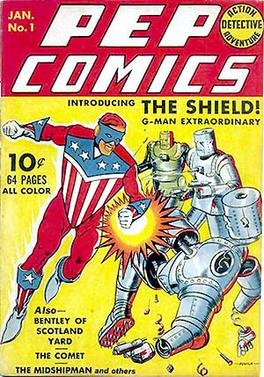
One of the main types of Superhero is the patriotic hero, wrapped in the flag, fighting crime and evil not just to protect a city, but to protect a country. The quintessential patriotic hero, of course, is Captain America. But, contrary to popular belief, he was not the first. No, that honor goes to The Shield, “G-Man Extraordinary”, who first showed up in Pep Comic #1 in January 1940. By contrast, Captain America didn’t appear until March 1941. The Shield- created by MLJ Comics (which eventually became Archie Comics)- is actually Joe Higgins, who gained his rather generic superpowers (strength, invulnerability, etc) from a chemical formula (much like, yes, Captain America eventually did).
Anyway, given his patriotic get-up, it was probably inevitable that the Shield would one day crossover with the National Pastime. And, in fact, it happened rather quickly in Pep Comics #7, which came out later in 1940. It can be found here, written by Harry Shorten and drawn by Irv Novick.
Anyway, onto the story:

We begin with the standard organized crime villains (these ones belonging to “Al Moroni”), not unlike the ones we’ve seen in plenty of previous installments of Bizarre Baseball Culture. It’s sort of weird that we don’t really ever seem to run into actual supervillains in these things, especially considering that the vast majority of these Bizarre Baseball Culture stories involve superheroes.
(JUMP for the rest of the story)
The biggest complaint about baseball is that it can go very, very long, and is more-or-less getting longer as batters are encouraged to work the count. But what can be done? You can’t just tell players they can’t try to work the count, for example. And to try to put a type of “shot-clock” on hitters or pitchers would never be able to get past the rules committee.
Oh, wait, in a way, they already have. The problem is that they never are enforced.
Rule 6.02 deals with hitters and states, essentially, that a batter must take their position at the plate in a prompt manner. Subrule C says that if they don’t, then… well…
(c) If the batter refuses to take his position in the batters box during his time at bat, the umpire shall call a strike on the batter. The ball is dead, and no runners may advance. After the penalty, the batter may take his proper position and the regular ball and strike count shall continue. If the batter does not take his proper position before three strikes have been called, the batter shall be declared out.
So, in theory, if a batter is taking too long to go into the box, he should be getting strikes called against him.
To the best of my knowledge, I have never, ever seen this called. Ever. On any level. No matter how much of a human rain delay is up.
If enforced, it would certainly make the game move faster, but the hitter is but one part of the equation. What of the pitchers? That’s where rule 8.04 comes in.
Rule 8.04 reads:
When the bases are unoccupied, the pitcher shall deliver the ball to the batter within 12 seconds after he receives the ball. Each time the pitcher delays the game by violating this rule, the umpire shall call Ball. The 12-second timing starts when the pitcher is in possession of the ball and the batter is in the box, alert to the pitcher. The timing stops when the pitcher releases the ball.
The intent of this rule is to avoid unnecessary delays. The umpire shall insist that the catcher return the ball promptly to the pitcher, and that the pitcher take his position on the rubber promptly. Obvious delay by the pitcher should instantly be penalized by the umpire.
In other words, by rule, if there are no men on, the pitcher has 12 seconds from getting the ball and the batter entering the box to throw a pitch. Otherwise, it’s a ball. Like Rule 6.02 section C, I don’t think I’ve ever seen this enforced. If I have, it must have only been once or twice.
So, why aren’t these rules ever enforced, especially since their enforcement would probably shorten the game at least a little?
The answer, more than likely, is a mix of tradition and habit. For one thing, for years baseball games moved along fine without these rules being enforced. It was only once required television breaks, working the count, and more pitching changes came around that they started to become longer and longer. For another, the fact that these haven’t been enforced means that the players don’t expect them to be- and to suddenly start enforcing them, it may be thought, could be more annoying than it is worth for the umpires.
But that doesn’t mean they shouldn’t try. Test out having those rules heavily enforced in a place like the Arizona Fall League or one of the rookie-level leagues. See if they make a difference. Because, if they could be put into force, baseball could speed itself up without having to change anything in the rules.
 The Baseball Continuum