(Blogathon ’16) Graveyard Baseball- Your guide to adopting an NPB team Part 12: Saitama Seibu Lions (埼玉西武ライオンズ)

This guest-post is part of the 2016 Baseball Continuum Blogathon For Charity, benefiting the Roswell Park Alliance Foundation. The Roswell Park Alliance Foundation is the charitable arm of Roswell Park Cancer Institute and funds raised will be “put to immediate use to increase the pace from research trials into improved clinical care, to ensure state-of-the-art facilities, and to help improve the quality of life for patients and their families.” Please donate through the Blogathon’s GoFundMe page. Also, please note that the opinions and statements of the writer are not necessarily those of the Baseball Continuum or it’s webmaster.

Who are we?: We are an English blog writing about one of 12 teams in the Japanese professional baseball league known as Nippon Professional Baseball (NPB). While the Saitama Seibu Lions are the primary team we cover, we will write anything that connects MLB and NPB, such as the recent signing of Kenta Maeda to the Los Angeles Dodgers. You can follow us on Twitter @GraveyardBall for any instant updates.

Part 12?  What?: This is the final piece in a 12-part series on a guide with who to adopt as your NPB team. We connected with some history, trivia and showing who played on each team with MLB on their resume.  You can see all posts at the bottom which covers each team.

Saitama Seibu Lions (埼玉西武ライオンズ)

The Saitama Seibu (西武) Lions were originally in Fukuoka (Kyushu island) as the Nishitetsu Clippers in 1950 for one season. Nishitetsu is an electric railway in Fukuoka which still operates today. After a merger with another team, they became Nishitetsu Lions one year later in 1951.

There would be a Black Mist scandal involving players fixing games from 1969-1971, similar to the Black Sox scandal from 1919. Nishitetsu would sell the team and they would be Taiheiyo Club Lions from 1973-1976, which is named after a golf course and resort developer. They would then be sold to Crown Lighter Gas, to be called the Crown Lighter Lions from 1977-1978.

Eventually, they were sold to Seibu Group and they moved to Tokorozawa in 1979, a place they still hold today. Their title would be Seibu Lions until 2008, where they added the prefecture name “Saitama” to the front.

===

Ownership: Seibu Holdings

Seibu is a conglomerate which owns several businesses. The most well-known one is the Seibu Railway as it operates in greater Tokyo. The trains are one of the best ways to get to a game in Tokorozawa. Seibu also owns hotels, real estate, resorts and more.

Train stations in the area will often be decorated with Lions related colors. The name “Seibu” (西武) derives as an abbreviation from it’s kanji title of west Musashi, which was the old title of where present day Saitama prefecture was located. 西 (Nishi) means West in Japanese.

===

League: Pacific

===

Payroll rank in 2015: 9

The Lions are a team with a tight budget as they won’t spend a lot. However, they will pay players who prove their worth and this ranking can go up with multiple pay raises happening. Usually they are in the “pack”.

Location/Stadium: Seibu Dome in Tokorozawa, Saitama prefecture
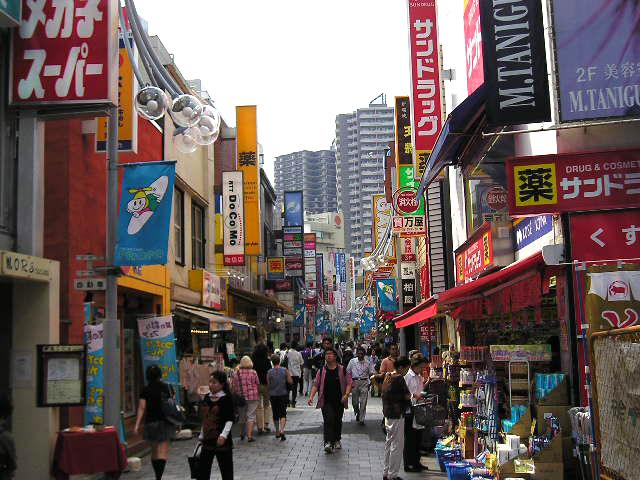
Tokorozawa is a suburb in greater Tokyo. It’s quite a distance from the capital itself, but the Lions represent Saitama prefecture, which is in the North. Saitama prefecture is known for some mountains in their scenery, with plenty of room to go hiking.

The most famous spot in the area, would be Hachikokuyama, which is a park right on the border of Saitama and Tokyo prefectures.  The park was used as an inspiration as the scenery for the movie My Neighbor Totoro


Side note: I recommend everyone sees this short movie, which is nearly 30 years old now.

ixOSAy2u

Seibu Dome was originally an outdoor stadium when the Lions moved there in 1979. It was then known as Seibu Stadium. While there is a roof, you can see that in the outfield and all around the building that it can be exposed to wind and hot temperatures with the open face.  The domed roof was added in 1998. Due to one player being sold, the place underwent renovations after 2007.

===


Mascots: Leo (right) and Lyna (left)

Leo is based off the character Kimba the White Lion in the Japanese Anime known as “Jungle Emperor Leo.” The Lions used to have this as their main logo and still use it for flags (such as what’s in centerfield near the country’s flag. That flag is also seen during the NPB Draft.

===

Uniforms: The Lions have switched to Majestic in 2016, and had a ceremonial “kick-off” for them last Friday morning:

QnvleipjNote: The Lions used to wear a bright blue design with the Kimba logo since their move to Tokorozawa. However, a scandal in the 00s by then-owner Yoshiaki Tsutsumi made them want to move on from it and rebranded to a dark blue design beginning in 2009.

===


Cheer song:  Hoero Lions (吠えろライオンズ) “Roar Lions”

Instead of a 7th inning stretch of “Take me out to the ballgame”, Fans pull out balloons in 9 out of 12 stadiums and sing a cheer song as an alternative.  A video of this can be found here.

===


Ōendan (Cheerleading) Songs: 2015 Player songs at 00:00, Hoero Lions at 7:03, Special Chance themes at 8:27, [ソリャセ] (Soryase, an equivalent of “Let’s Go”) at 10:42, Regular chance themes at 11:18, Scoring song at 15:08

Notes:

Every player has their own “song” to hear when they’re batting. Whether home or away, a portion of the crowd will always be singing. A Chance song is a special song when usually runners are in scoring position, hence drawing a “Chance” opportunity.

The regular chance songs for the Lions have similar tunes to “Cotton Eye Joe”, “Do you know the Muffin man?”, but notice how Chance #4 near the end has women and men singing separate lines. You can hear a cleaner version here. (Scoring song featured too)

The Lions are the only Oendan in Japan to wave flags as a group. They do this when scoring and well as during the [ソリャセ], which is almost like saying “We want more runs”.

The scoring song title translates into “I saw a Lion running on the Horizon”.  An up close version of the song can be heard in the video below starting at 2:41. They also sing “Happy Birthday” to players on their birthday, which you can see in the video as well.

Here is a link to a full version of the song as sung by a person. Lastly, here’s an instrumental version from a commemorative 1986 Nippon Series Champions box.


===


MLB Comparison: Oakland Athletics

The Lions have found ways to be competitive with a low payroll more times than not. Since their move to Tokorozawa in 1979, the Lions have finished in the Bottom 3 of the Pacific League only three times.

Only difference is, the Lions have won a crucial elimination game multiple times in the 21st Century, including a Game 7 of the Japan Series. They’ve been competitive and avoided the cellar for the most part, which is good for a team that hasn’t been a high spender in recent years. Playing in what is viewed as the “ugliest” stadium in NPB also draws this comparison to the Oakland A’s, who play in the Oakland Coliseum.

===

Notable former MiLB and MLB players to play for the Lions:


Ryan Spilborghs, Esmerling Vasquez, Matty Alou, Terry Whitfield, George Vukovich, Kazuhisa Ishii

===

Notable players who played in MLB: 

Daisuke Matsuzaka, Kazuo Matsui

Note: The Lions used a portion of the $51.1 million they acquired for Matsuzaka on renovations to the Seibu Dome. You can see the original look of the Dome prior to renovations here. Matsuzaka paid for restroom upgrades, an HD scoreboard, renovated field turf as well as adding bullpen box seats on the side.

===

Verdict


Why you root for them: 


Because you’re used to being in a big market, but rooting for a team with less fans in numbers. The Lions are far from the city, which is a long train ride away to get to the Seibu Dome. Yes, they’re in greater Tokyo, but forgotten due to teams like the Yomiuri Giants controlling the market.

It could also be that you’re an Oakland A’s fan know what it’s like to compete on a lower budget. The Lions have benefited from their ballpark and developed pitching over the years. Like the A’s, they have a strong amount of success in their team’s history with 13 Japan Series championships overall when combining their time in Fukuoka with the Seibu era.

The Lions had a “Golden Age” where they won 11 pennants from 1982-1994 and took eight Japan Series titles in that timeframe. This dynasty gets overlooked, similar to how the A’s had a three-peat from 1972-1974, due to being in the Pacific League.

Here at Graveyard Baseball, we can provide exclusive coverage of the team and insight in English for anyone. As of the time of this writing, we’re the only blog to write about the Lions in the English language.

===

Why you don’t root for them:


Like the A’s, the Lions have had their share of disappointing postseason exits. They were a strong team in both 2012 and 2013, but lost in the opening round when they were favored. You also dislike ugly stadiums if not teams from a suburb away from the city.

Crowds are also half empty on week nights due to the proximity from the heart of Tokyo. The average person who works in the city would not be able to attend a game on a week night at first pitch. Assuming the game begins at 6:00 PM local time, it takes 90 minutes by train to arrive at the Seibu Dome from Tokyo, meaning it wouldn’t be worth it for a worker (known as salarymen in Japan) to attend a game late.

===

Other NPB Teams in the series: 

Yomiuri Giants (巨人)

Hiroshima Toyo Carp (広島)

Hokkaido Nippon-Ham Fighters (日本) 

Orix Buffaloes (オリックス)

Hanshin Tigers (阪神) 

Chunichi Dragons (中日)

Tohoku Rakuten Golden Eagles (楽天)

Softbank Hawks (ソフトバンク) 

Yokohama (DeNA) Baystars

Chiba Lotte Marines (ロッテ)

Tokyo Yakult Swallows (ヤクルトス)

===

Follow us on Twitter @GraveyardBall

This guest-post has been part of the 2016 Baseball Continuum Blogathon For Charity, benefiting the Roswell Park Alliance Foundation. The Roswell Park Alliance Foundation is the charitable arm of Roswell Park Cancer Institute and funds raised will be “put to immediate use to increase the pace from research trials into improved clinical care, to ensure state-of-the-art facilities, and to help improve the quality of life for patients and their families.” Please donate through the Blogathon’s GoFundMe page. Also, please note that the opinions and statements of the writer were not necessarily those of the Baseball Continuum or it’s webmaster.
(Blogathon ’16) Yakyu Night Owl: Dreams of Kenji-kun

Kenji-Alexander Ramírez was born last spring. His proud father, Alex Ramírez, will pilot the Yokohama DeNA BayStars this coming season. Rami-chan was a legend. His career was tremendous, and the accolades deserved, but there was also a certain poetry in moments big and small. Of course, his 2,000 hit in NPB was a home run. Why celebrate at first base?

When a great ballplayer adds to the family, it’s natural to be excited and think about what may happen in the future. After all, he isn’t just the newest part of a family at home. Kenji-kun has hundreds of older brothers, uncles, and aunts in his immediate baseball family, and thousands more around the world.

We can easily imagine the little fella growing into bigger and bigger uniforms and caps. If daddy keeps managing for a living, perhaps the clubhouse will be a second home. He could share enthusiastic high fives with the team after an exciting win, or a simple kind word to someone after a tough loss. In time, he may be carefully crafting rosin bags, or hanging fresh uniforms in long row of lockers. It’s fun to trace the steps along the road of a potential baseball lifer.

//platform.twitter.com/widgets.js

For every Casey Candaele born to a Helen Callaghan, or David born to a Diego Seguí, there are a million children of ballplayers who never play baseball for a living. Like so many kids, Kenji-kun will probably not grow up to have 400 foot power, but his impact could still reach far beyond the upper deck.

Yes, it’s unfair to have expectations. He is just a little kid. At the same time, he is the youngest son of a global ambassador for the game. Imagine a generation of ballplayers learning from Kenji. By being himself, he can inspire others to be themselves. By being part of a winning clubhouse, he could show without a doubt that everyone has something to offer. He might open more eyes. He may change more hearts.

It’s a lot of pressure to put on an adorable little sprout, but this kid has immense potential, and an 80 grade grin.

Yakyu Night Owl is a writer from the Pacific Northwest who enjoys baseball across a big ocean.

(Blogathon ’16) Mr. Go, if adapted for American audiences

This post is part of the 2016 Baseball Continuum Blogathon For Charity, benefiting the Roswell Park Alliance Foundation. The Roswell Park Alliance Foundation is the charitable arm of Roswell Park Cancer Institute and funds raised will be “put to immediate use to increase the pace from research trials into improved clinical care, to ensure state-of-the-art facilities, and to help improve the quality of life for patients and their families.” Please donate through the Blogathon’s GoFundMe page.

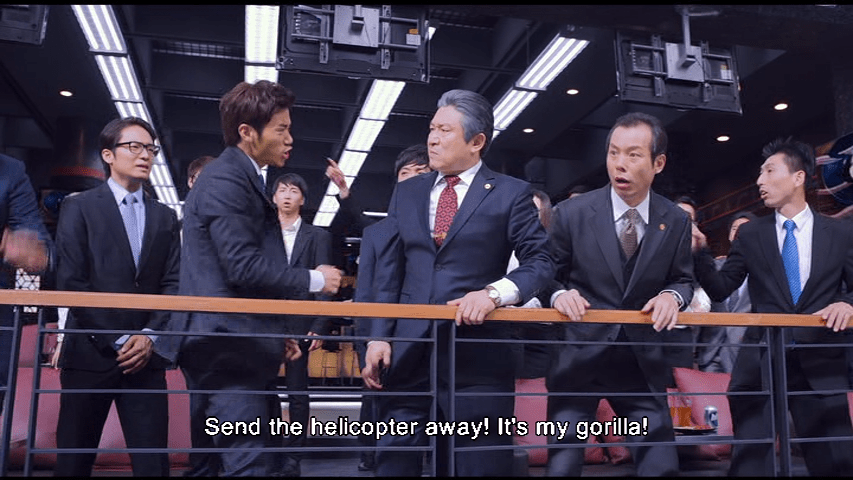
Mr. Go. The classic tale of a girl, a gorilla, and the Korean Baseball Organization. Truly, one of the greatest Bizarre Baseball Culture entries of all time, and one you should totally consider purchasing if you are a fan of such things. But what if it was brought to American screens? How would it be adapted?

I have a few ideas:

The cute little Chinese girl, Weiwei, would stay, as would the backstory of her and her gorilla, Ling Ling. Similarly, the main antagonist of the film would be Liao Xiaogang, AKA “Tianjin Guy”, a corrupt nouveau-rich businessman/gangster.

This is a purely economic move. China is now one of the leading movie-going countries in the world, and the only way a baseball movie is going to get any attention there is if it has a Chinese person in it. Also, so much of what drives the plot is the fact that Weiwei is an outsider just trying to keep her friends and circus at home from being folded up.

The jerk-with-a-heart-of-gold scout, Sung Choong-Su, would instead be an American named Samuel “Sunny” Chance, played by James Franco.

For one thing, James Franco has experience with apes, and also he is able to do both comedy and drama, which this film would require. Also, I think civilization in general needs to see James Franco make drunken confessions to a baseball-playing gorilla who is also drunk.

Instead of going to the Doosan Bears, Ling Ling/Mr. Go would be a member of the San Diego Padres.

Don’t try to argue with me on this, you aren’t going to win.

The general manager of the Padres will have an expanded role and be played by John Goodman.

Because, really, imagine John Goodman delivering this line:

Jonah Hill would make a cameo as a sabermetrics expert who suggests how they can best use Mr. Go.

Both because he’s always in movies with James Franco, and as a reference to Moneyball.

There would be a subplot about how some people think Mr. Go isn’t playing the game the right way after he unleashes an epic bat-flip.

It’d provide realism to the affair.

After Mr. Go’s rampage, Weiwei and him would go on Jimmy Kimmel to prove he isn’t a monster.

Of course they would.

Instead of a bidding war between the Chunichi Dragons and Yomiuri Giants, it would be the Red Sox and Yankees.

Because of course it would be.

The veterinarian’s role would be expanded and made into a female love interest for Franco’s character, probably played by somebody quirky like Zooey Deschanel or wittily sarcastic like Anna Kendrick.

Because every goddamn movie, it seems, needs a love interest of some sort, and it sure as heck isn’t going to be Weiwei and Franco.

The NC Dinos, the main opponent of Doosan, would be replaced by the Dodgers. Also, the Division Series at the end of Mr. Go would be replaced with a final regular season series where the NL West title is on the line.

This both would better explain why every game is a home game for Mr. Go (in the Korean movie, they come up with an excuse about renovations at NC’s stadium) while still providing plenty of drama.

Leiting, the evil pitching gorilla who faces Mr. Go, will be renamed “Lightning” instead of “Zeros”.

Because Zeros was a dumb name.

The ending would be left more open to the “Football-playing Gorilla” sequel than the original movie was.

Every movie needs to have a opening for a sequel.

And, finally, it goes without saying that Andy Serkis would be playing Mr. Go.

Duh.

At 4 PM: AAA.

This post has been part of the 2016 Baseball Continuum Blogathon For Charity, benefiting the Roswell Park Alliance Foundation. The Roswell Park Alliance Foundation is the charitable arm of Roswell Park Cancer Institute and funds raised will be “put to immediate use to increase the pace from research trials into improved clinical care, to ensure state-of-the-art facilities, and to help improve the quality of life for patients and their families.” Please donate through the Blogathon’s GoFundMe page.


(Blogathon ’16) 2017 WBC Team Dominican Republic projections Version 0.1

This post is part of the 2016 Baseball Continuum Blogathon For Charity, benefiting the Roswell Park Alliance Foundation. The Roswell Park Alliance Foundation is the charitable arm of Roswell Park Cancer Institute and funds raised will be “put to immediate use to increase the pace from research trials into improved clinical care, to ensure state-of-the-art facilities, and to help improve the quality of life for patients and their families.” Please donate through the Blogathon’s GoFundMe page.

We are over a year from the 2017 World Baseball Classic, and the road will no doubt be filled with commitments, pull-outs, unusual nationality switches, injuries, trades, new contracts, personal decisions and god-knows-what-else still on the way. But, for now, let’s just imagine everybody is available: who’d be on Team Dominican in the 2017 World Baseball Classic?

Perhaps it would look something like this. Now, a reminder of the WBC roster rules:

  • Any player coming off a major injury or who has a history of injuries is unlikely to participate. This is especially true for the pitchers. (This “rule” is being ignored for version 0.1)
  • Players that will be on new teams are less likely to participate, but shouldn’t be completely ignored, with the exception of pitchers. (This “rule” is being ignored for version 0.1)
  • Teams are made up of 28 players, of which 13 of them must be pitchers and two of them catchers.
  • The pitch count rules make relievers extremely important.

Here we go:

Catchers (3): Wellington Castillo, Francisco Pena, Pedro Severino

First Baseman (3): Albert Pujols, Carlos Santana, Edwin Encarnacion

One of them would presumably also DH, obviously.

Second Baseman (1): Robinson Cano

Third Baseman (2): Adrian Beltre, Maikel Franco

Oh, Adrian Beltre will be in his late 30s in 2017, you say? That is true, but I wouldn’t bet against him.

Shortstop (2): Erick Aybar, Jhonny Peralta

Designated Hitter/3B/Who-The-Heck-Knows (1): Miguel Sano

Outfielders (4): Jose Bautista, Nelson Cruz, Carlos Gomez, Starling Marte

Starting Pitchers (4): Johnny Cueto, Carlos Martinez, Danny Salazar, Francisco Liriano

Relief Pitchers (8): Jeurys Familia, Kelvin Herrera, Arodys Vizcaino, Pedro Strop, Santiago Casilla, Luis Garcia, Antonio Bastardo, Alexi Ogando

And so, that’s Version 0.1 of my TeamDR projections. Version 1.0, which will include actual consideration as to whether I think somebody will actually take part or not, will come out sometime in the future. But until then…. feel free to imagine how the team would do if it looked like this.

At Noon: Mini-Book Reviews!

This post has been part of the 2016 Baseball Continuum Blogathon For Charity, benefiting the Roswell Park Alliance Foundation. The Roswell Park Alliance Foundation is the charitable arm of Roswell Park Cancer Institute and funds raised will be “put to immediate use to increase the pace from research trials into improved clinical care, to ensure state-of-the-art facilities, and to help improve the quality of life for patients and their families.” Please donate through the Blogathon’s GoFundMe page.


(Blogathon ’16) 2017 WBC Team USA Projections Version 0.1

This post is part of the 2016 Baseball Continuum Blogathon For Charity, benefiting the Roswell Park Alliance Foundation. The Roswell Park Alliance Foundation is the charitable arm of Roswell Park Cancer Institute and funds raised will be “put to immediate use to increase the pace from research trials into improved clinical care, to ensure state-of-the-art facilities, and to help improve the quality of life for patients and their families.” Please donate through the Blogathon’s GoFundMe page.

We are over a year from the 2017 World Baseball Classic, and the road will no doubt be filled with commitments, pull-outs, unusual nationality switches, injuries, trades, new contracts, personal decisions and god-knows-what-else still on the way. But, for now, let’s just imagine everybody is available: who’d be on Team USA in the 2017 World Baseball Classic?

Perhaps it would look something like this. Now, a reminder of the WBC roster rules:

  • Any player coming off a major injury or who has a history of injuries is unlikely to participate. This is especially true for the pitchers. (This “rule” is being ignored for version 0.1)
  • Players that will be on new teams are less likely to participate, but shouldn’t be completely ignored, with the exception of pitchers. (This “rule” is being ignored for version 0.1)
  • Teams are made up of 28 players, of which 13 of them must be pitchers and two of them catchers.
  • The pitch count rules make relievers extremely important.

Catchers (3): Buster Posey, Stephen Vogt, Derek Morris

First Baseman (2): Paul Goldschmidt, Anthony Rizzo

Second Basemen (1): Dee Gordon

Third Basemen (2): David Wright, Josh Donaldson

David Wright is basically the closest thing that Team USA has to a given and after his performances in 2009 and 2013 he’s probably in if he has any sort of good season in 2016. If we were going strictly by performance, it’d be Donaldson and Manny Machado (who might play for the Dominican), with Kris Bryant also being a very real possibility.

Shortstop (2): Troy Tulowitzki, Brandon Crawford

Utility (1): Ben Zobrist

The greatest utility player of his generation.

Outfield (4): Bryce Harper, Mike Trout, Giancarlo Stanton, Kevin Kiermaier

Or maybe Adam Jones. Or maybe Lorenzo Cain. Or maybe A.J. Pollock. Or maybe Jason Heyward. Or maybe…. really, even ALL FOUR of the guys I have in this pie-in-the-sky version 0.1 were to pull out (doubtful, as I seem to remember Harper and/or Trout saying they wanted in for 2017 shortly after they said he wasn’t in for 2013), it’s likely that Team USA will have one of the best outfields in the event.

Starting Pitchers (4): Zack Greinke, Clayton Kershaw, Jake Arrieta, Max Scherzer

Like outfield, the sheer depth of American pitching means that it’s likely they will, on paper, have one of the best staffs in the WBC even if there are plenty of pull-outs. And, given that this is the WBC and the starting pitchers are the hardest players to have participate, there will be plenty of pull-outs. Madison Bumgarner, Dallas Keuchel, the various Mets, Sonny Gray, etc. are all possibilities.

Relief Pitchers (9): Wade Davis, Darren O’Day, Dellin Betances, Trevor Rosenthal, Tony Watson, Zach Britton, Carson Smith, Ken Giles, Will Harris


And so, that’s Version 0.1 of my Team USA projections. Version 1.0, which will include actual consideration as to whether I think somebody will actually take part or not (for example, I doubt Zack Greinke would play), will come out sometime in the future. But until then…. feel free to imagine how the team would do if it looked like this.


At 11 AM: Dominican Republic WBC Projections 0.1

This post has been part of the 2016 Baseball Continuum Blogathon For Charity, benefiting the Roswell Park Alliance Foundation. The Roswell Park Alliance Foundation is the charitable arm of Roswell Park Cancer Institute and funds raised will be “put to immediate use to increase the pace from research trials into improved clinical care, to ensure state-of-the-art facilities, and to help improve the quality of life for patients and their families.” Please donate through the Blogathon’s GoFundMe page.

(BLOGATHON ’16!) International Baseball Culture: Mitsuru Adachi’s “Touch”, Part 1, which ironically doesn’t have much baseball in it

This post is part of the 2016 Baseball Continuum Blogathon For Charity, benefiting the Roswell Park Alliance Foundation. The Roswell Park Alliance Foundation is the charitable arm of Roswell Park Cancer Institute and funds raised will be “put to immediate use to increase the pace from research trials into improved clinical care, to ensure state-of-the-art facilities, and to help improve the quality of life for patients and their families.” Please donate through the Blogathon’s GoFundMe page.

In International Baseball Culture, I look at baseball-related entertainment from outside the USA that isn’t bizarre, but is interesting, perhaps learning some new things along the way!

In 2005, the Japanese television station TV Asahi held a special on the 100 most popular anime (animation) in history, as voted on by Japanese viewers. While many of the most popular programs were fantasy, adventure or science fiction, such as the Gundam series of giant robot programs (at number two) or Dragon Ball (at number three), the top ten also had a baseball anime: Touch, which was seventh.

What is Touch? Well, to put it in simple terms, it’s a tale of two stories: the baseball one and the off-the-field one. It’s about three teenagers (twin boys and their girl-next-door neighbor) who navigate high-school, relationships and their pitfalls while trying to bring their school glory on the diamond as they try to reach Koshien, Japan’s national high school baseball tournament, which is like March Madness and a Friday night in Texas combined.

Needless to say, it struck a nerve with Japanese audiences, and the 2005 program’s polling was not that out of the ordinary: A follow-up list that included votes from after the TV Asahi special was aired also had Touch in the top ten, at number nine. Nor was this a recent phenomena, either: during it’s original run in the 1980s, it was, according to some sources, the most watched anime in the history of Japan. Ever.

The series was, in itself, adapted from a manga (comic) of the same name, written and illustrated by Mitsuru Adachi, that saw it’s volumes sell over an estimated 100 million copies. Just to put that in perspective, in 2010 the population of Japan was around 128 million. Of course, that doesn’t mean over three out of four Japanese people owned at least one copy of a volume of Touch… but it does mean that those who did liked it very much, buying every volume.

From what I’ve read about the series, it’s not hard to see why it would have such broad appeal, as it apparently has something for everyone. It has baseball action (and also some detours into boxing and other sports) for the boys, romance for the girls, and drama and comedy for everyone. And apparently all of those things are done well enough where even people who normally can’t stand stuff like that seem to like it- I’ve come across several reviews that include lines like “I don’t even like baseball but I was enthralled by the game episodes” or “the romance plot is actually realistic and well-handled.”

And yet, despite the fact that Touch is one of the most successful anime and manga in the history of Japan, it has never seen official release in the United States, and it’s unlikely that it will anytime soon, either (the anime and manga import market is mainly focused on recent releases, and what old ones that do happen are usually Sci-Fi or Fantasy). However, there is apparently a unspoken agreement between the Japanese entertainment industry and it’s English-speaking fans that they won’t sue anybody who translates and distributes translated versions of the show/book, so long as they stop doing it if an actual agreement to distribute them in the USA is made, so I was able to find copies of both the anime and manga online.

But anyway: a baseball-centric story that is one of the most popular and well-regarded anime/manga in Japanese history, and it’s almost completely unknown to American audiences? What better way to start International Baseball Culture? (after the jump)

Continue reading

(Blogathon ’16) WBC News for January 29, 2016

This post is part of the 2016 Baseball Continuum Blogathon For Charity, benefiting the Roswell Park Alliance Foundation. The Roswell Park Alliance Foundation is the charitable arm of Roswell Park Cancer Institute and funds raised will be “put to immediate use to increase the pace from research trials into improved clinical care, to ensure state-of-the-art facilities, and to help improve the quality of life for patients and their families.” Please donate through the Blogathon’s GoFundMe page.

It’s time for a World Baseball Classic update! With the first qualifiers coming up, more news has started to come out. Let’s take a look at some of the news:

Sydney Qualifying Pool Rosters and Schedules released:

On Wednesday, the rosters and schedules for the Sydney qualifying pool came out. They can be found over here on Baseball America. I’ll have a more thorough preview as we get closer to the event, but it’s definitely a case where Australia should be considered the heavy favorite, full of players with experience in MLB or the Minors. After Australia, it’s a fight for the second spot to face them in a winner-take-all game to get to the main tournament. Clay Rapada is probably the most notable player outside of the Australians, as he will be playing for the Philippines, the country of his father’s birth, before retiring. Former All-Star Jason Bartlett, also of Filipino descent, was also expected to play, but I don’t see him on the roster.

News from other qualifying pools:

As I mentioned last time, the qualifiers, unlike the main tournament, are not events where MLB teams are required to allow 40-man roster players to take part if there’s an overlap with official team acitivites. This will most hurt a team like Mexico, where the Blue Jays are unlikely to allow their three Mexican players from taking part in the March qualifier in Mexicali.

Jon Morosi, one of the best people to follow for WBC news, had information on his Twitter feed on the German team, who will be managed by Garth Iorg (yes, that Garth Iorg). Depending on what difficulties Mexico has, they could be a threat in Mexicali, even with Max Kepler likely skipping as he tries to win a spot on the Twins, they will have Donald Lutz, one of the few Germans with MLB experience.

Bruce Chen, who retired last season, is apparently willing to pitch for Panama.

Other WBC News:

Ozzie Guillen is totally up for managing Team Venezuela in 2017.


And that’s it… for now.

Keep an eye out for more WBC news on the Baseball Continuum as it occurs.

At 9 AM: International Baseball Culture

This post has been part of the 2016 Baseball Continuum Blogathon For Charity, benefiting the Roswell Park Alliance Foundation. The Roswell Park Alliance Foundation is the charitable arm of Roswell Park Cancer Institute and funds raised will be “put to immediate use to increase the pace from research trials into improved clinical care, to ensure state-of-the-art facilities, and to help improve the quality of life for patients and their families.” Please donate through the Blogathon’s GoFundMe page.

Coming later this month: “International Baseball Culture”

Bizarre Baseball Culture is perhaps my most popular segment on the Baseball Continuum. In it, I, as I say: “…take a look at some of the more unusual places where baseball has reared it’s head in pop culture and fiction.” It’s seen comic books, video games, novels, TV episodes, animated shorts, a radio drama, and even a full-length movie. They’ve ranged from the well-known to the hyper-obscure, leading Michael Claire to dub me the “Indiana Jones of baseball comics“, which I guess isn’t the worst thing to be put on a tombstone.

Anyway, in search of good material, I have recently began to look overseas. Some of my favorite Bizarre Baseball Culture posts have been from elsewhere in the world. The Pokémon episode, for example, was pretty popular. Mr. Go might have been the most fun I’ve ever had doing Bizarre Baseball Culture (well, until you see what the 50th installment is). My most recent installment was, of all things, an episode of an Ultraman TV series.

However, here’s the thing: it is stupid to assume that everything foreign is bizarre. Oh, to be sure, plenty of it is, just like how the American-made works of fiction I’ve covered here on the Continuum have been bizarre (intentionally or not). I mean, no matter what country it was made in, a movie about a gorilla playing baseball would have been bizarre.

But to say it is all bizarre, simply because it is foreign, would be highly ignorant and also disrespectful. These are places with their own traditions, not only in baseball but in their popular culture. To immediately dub a fairly mundane (i.e. no baseball-playing gorillas or evil glove monsters) baseball comic from Japan or a baseball film from Korea “bizarre” would be like being the baseball entertainment equivalent of the crotchety old columnist who claims that Latin American players aren’t playing the game the “right way” despite the fact that that’s the way they’ve played all their lives. And, guess what, I am not a crotchety old columnist, although I wish I was being paid like one.

So, with that out of the way, I am proud to announce that, starting with a piece in this year’s blogathon, there will be a new recurring feature on the Baseball Continuum: International Baseball Culture. It will cover baseball entertainment from outside the United States and sometimes Canada* that isn’t “bizarre”. Now, there will continue to be foreign-sourced baseball works in Bizarre Baseball Culture, but they will only be those that would qualify for the series due to their content. If it turns out that there’s a Mexican movie in which luchadores play baseball against mermen from Atlantis, that’s still going into Bizarre Baseball Culture. But if it’s a serious drama about a baseball team called the “Luchadores” who are playing a team called the “Mermen”, that would be International Baseball Culture.

So, please join me during the Blogathon when I begin my International Baseball Culture travels with the beginning of a series of articles on Mitsuru Adachi’s Touch, a baseball dramedy/romance manga and anime that won awards, set viewership records in the 1980s, and was in 2005 named one of the ten greatest anime ever… and yet has never seen an official release in North America.

*I’ll be taking Canada on a case-by-case basis. For example, you could argue that the works of W.P. Kinsella are Canadian because Kinsella is from Canada, but you’d be ignoring the fact that most of his baseball stories are set in America and deal pretty specifically with American baseball. But if somebody were to make a French-language drama about a man and a woman who fall in love over their shared longing for the return of the Montreal Expos, that would probably fall under International Baseball Culture.

Bizarre Baseball Culture: Ultraman 80 vs. An Evil Baseball-Glove Monster

In Bizarre Baseball Culture, I take a look at some of the more unusual places where baseball has reared it’s head in pop culture and fiction.

(Note: The following is different from what I previewed last time, because, well, I couldn’t just ignore such great material as this.)

Baseball is a hard game. A game of failure. A game where even the slightest mistake can have horrible consequences for your team.

It is also a game of much superstition. What a player eats or what rituals they perform may affect their performance. And they may even believe their equipment- their bats and gloves- may be what decides victory and defeat. It is not that uncommon to see somebody slam a glove or a bat if they fail or have just been ejected from a game.

But, perhaps you should consider that maybe those seemingly inanimate-objects have feelings too, and that all of that negative energy (mixed with pollution) will cause them to become GIANT EVIL BASEBALL GLOVE MONSTERS, as happened in the 47th episode (“The Evil Glove. Be Careful What You Throw Out!”) of the Japanese documentary science fiction show, Ultraman 80!

Screen Shot 2015-12-28 at 11.02.00 AM

Yes, buckle up, everyone, because I may have finally found something weirder than Mr. Go!

(Go below the jump for more)

Continue reading

And now, a random picture of people playing baseball dressed as astronauts

Image

baseballspacemenSometimes, you come across random things online. I’m not sure where, exactly, I found this picture- I think it was on a blog about Godzilla (as happens sometimes), especially given the fact that the pitcher in this picture appears to be Japanese.

Anyway, consider this picture a nice dose of whimsy into your dreary Boxing Day.