2014 Rochester Red Wings in Review, Part 2: Five Things We Learned

Apologies for being late, but here are five things we learned from the 2014 Rochester Red Wings season:

1. It is possible to throw a No-Hitter in two different states and two different months

2. Geography is Destiny

3. As always, the fate of a Minor League Team is in large part outside of it’s control

Make no mistake, the purpose of AAA baseball teams is, and always will be, to provide a place for future MLB players to get ready for The Show. Winning is of only secondary importance, and, with rare exception, no AAA team will go the season with all of their key pieces untouched. What’s more, there are still the other hazards that haunt every baseball club: injuries, slumps, players that just don’t work out or underperform.

This year’s Red Wings were a perfect example of that. The Red Wings played 144 games this season. Only six position players were in at least 100 of them, only four were in at least 120 of them, and only two (Eric Farris, who’s “get to know your Wings” scoreboard segment was by far the best, and Aussie infielder James Beresford) were in at least 130 of them. Danny Santana, who many thought would be in Rochester for a good chunk of the season, ended up only playing 24 games, while Darin Mastroianni was lost to first the Majors and then to the Blue Jays through waivers after just four games. Chris Parmelee, the leading power threat through the first month of the season, was also gone early. The vaunted opening-day rotation of Alex Meyer, Trevor May, Yohan Pino, Logan Darnell and Kris Johnson saw all but Meyer spend at least some time in Minnesota, and the loss of May and Pino down the stretch especially hurt. If Rochester had all five of them all season, I see almost no way that they miss the playoffs, but, again, those are the breaks that come with being a AAA franchise.

And, of course, there were injuries, both in the majors (which led to certain players getting called up to replace the injured Twins) and down in the minors. The loss of Meyer to injury early in the third-to-last game of the season may well have doomed the Red Wings, as it forced them to burn Mark Hamburger, who was expected to pitch a must-win game against Pawtuckett the next day. Instead, the Red Wings had to have Jose Berrios, a 20-year-old (albeit one of the top prospects in the system) pitch that game, where he was beaten up on in a loss that ended the Wings’ playoff chances.

Health problems below AAA also put a wrench in the Wings’ season. At the start of the year, it was considered possible that top prospects Miguel Sano and (although more of a longshot) Byron Buxton could join by the end of the year. Sano got hurt and missed the whole season, and Buxton got a concussion in his first game in AA (although by that point it was clear he was probably not going to end up in Rochester by the end of the year).

Speaking of prospects, I think it’s becoming increasingly unlikely that Rochester will ever see Kennys Vargas, who has gone .314 in 140 AB for the Twins since getting the call-up from AA. Prospects jumping from AA to MLB is less frequent in Minnesota’s system than it is in some others, but it does happen: Joe Mauer would never have played in Rochester if not for a injury so early in his rookie season in MLB, for example.

4. Of course, the above thing also can go the other way.

After the first month of the season, I don’t think anybody expected that Chris Colabello would be back in Rochester. He’d done great early in the year, after all, even winning AL Player of the Week at one point. Then he crashed back to earth and ended up spending more games in Rochester this season (61) than he would in Minneapolis (59). He did not receive a call-up at the end of the year and it’s almost certain that his time with Minnesota- and maybe even affiliated baseball in general- is at an end. But what must have been a horrible disappointment for Colabello was good news for the Red Wings, as he ended up leading the team in HRs. In his two seasons with the Red Wings, Colabello ended up batting .319 in 551 ABs, with 34 HRs and 114 RBIs. His OPS of .966 was spectacular. He will be missed, but hopefully he gets another shot at a permanent place in the Majors.

Similarly, Chris Herrmann was originally with the Twins to start the year, but ended up playing sizable time in Rochester, where he became one of the Wings’ best hitters. He’s now in Minnesota again as a September call-up.

The same sort of thing will no doubt happen next year, just as it happens every year.

5. The Mario-Coin Sound Is An Excellent Sound Effect For Scoring A Run

This season, when the Red Wings scored a run, the sound from Super Mario Brothers when you got a coin would play. They aren’t the only team that does it- I believe the Cleveland Indians do the same, and the Twins use the 1-Up Sound from SMB. It’s great, funny, and is also a good reminder that ultimately baseball is a game.

In fact, it even inspired me to try my hand at some artwork:

marioredwingsThat’s Mario in a Rochester Red Wings jersey. I’m not entirely sure why I made it, but I find it funny and I’m glad I made it. Let’s just hope they don’t change the sound effect next year, otherwise this will just be ridiculous.


So, the 2014 season is over in Rochester. It’s far too early to guess what the 2015 season may bring: Will Gene Glynn return as manager? Will some players be lost to free agency or by making the jump to the big leagues? Will next year by the year that Sano and/or Buxton make the jump to AAA?

Only time will tell.


2014 Rochester Red Wings in Review, Part 1, AKA “The IL North is Tough”

If there is one lesson to be learned from the 2014 Rochester Red Wings, it is that minor league baseball is perhaps even more cruel than Major League Baseball, and perhaps even more unforgiving, at least to teams.

If you want to know what I mean, take a look at the standings of the International League this year. You’ll see on them a horrible unbalanced league, where one division clearly was better than the other two. That division was the IL North. Take a look at the near-final (there were one or two games still going on when I posted this) standings here:

Screen Shot 2014-09-01 at 4.04.16 PMNow, as you can see, the North simply owned the other divisions. The four teams with the best records in the league were in it (meaning the playoffs will consist of the first, second, fifth, and sixth best teams), and it’s two worst teams (Scranton and Lehigh Valley) would have been in a three-way fight with Gwinnett for second in another division (the South).

Sadly for the Red Wings, they were in the North. And, sadly, they were unable to win the Wild Card. To be sure, there were times this season where it could be said they blew their chance at the postseason: a horrible 0-for-Ohio road trip, a few blown games by the bullpen here and there, and some games where they got plenty of men on base but never got enough of them home. But, ultimately, the Red Wings were just unlucky victims of geography, stuck in what may have been the best division in all of baseball (relative to the rest of it’s league).

That said, despite the disappointing ending, it was a ton of fun, so on Wednesday, I’ll have a second part, a retrospective on the 2014 Red Wings season, complete with photos!


The Red Wings had one of the weirdest no-hitters ever

It’s late so I can’t write too much, but, anyway, I was at the ballpark tonight. However, this story starts on July 24, when I was sitting on my couch watching the Rochester Red Wings play in Durham. Trevor May, who I discussed a few days ago, was pitching, and he was on that day, having given up no hits in the first three frames…. until the skies opened up and washed it away after three innings.

Cut to today (August 11), because Rochester wouldn’t be back to Durham, they were playing it here. Durham would still technically be the home team, and it would still be a nine-inning game, but it would be played in Rochester. Of course, Trevor May is now with Minnesota, so taking the mound instead was Logan Darnell…

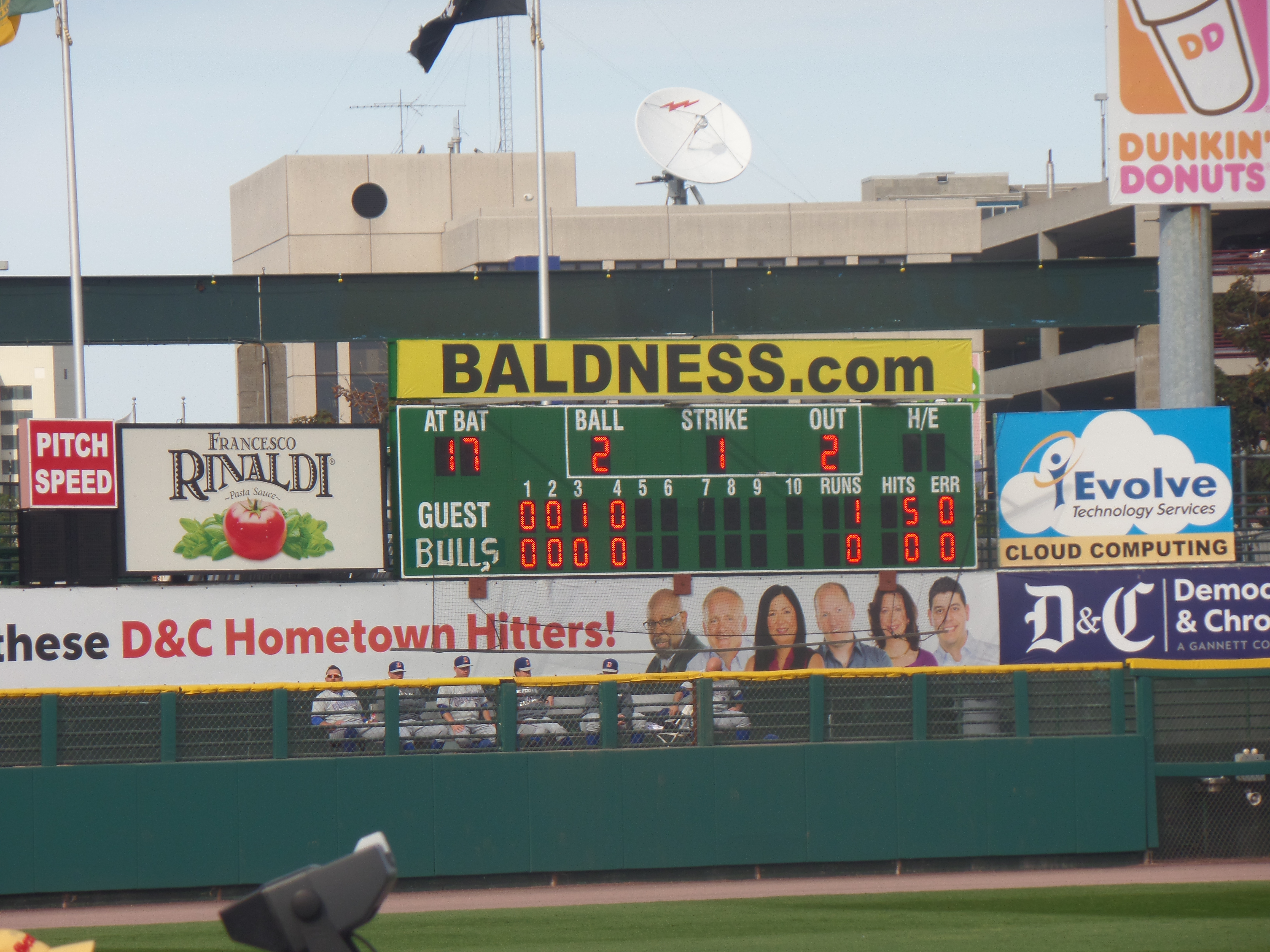
It was still early, but here's how the scoreboard looked, complete with makeshift "Bulls" sign.

It was still early, but here’s how the scoreboard looked, complete with makeshift “Bulls” sign.

And a funny thing happened: Darnell was unhittable. Literally. He struck out five and got the final hitter, Justin Christian, to ground into a double play to seal the 3-0 no-hitter.

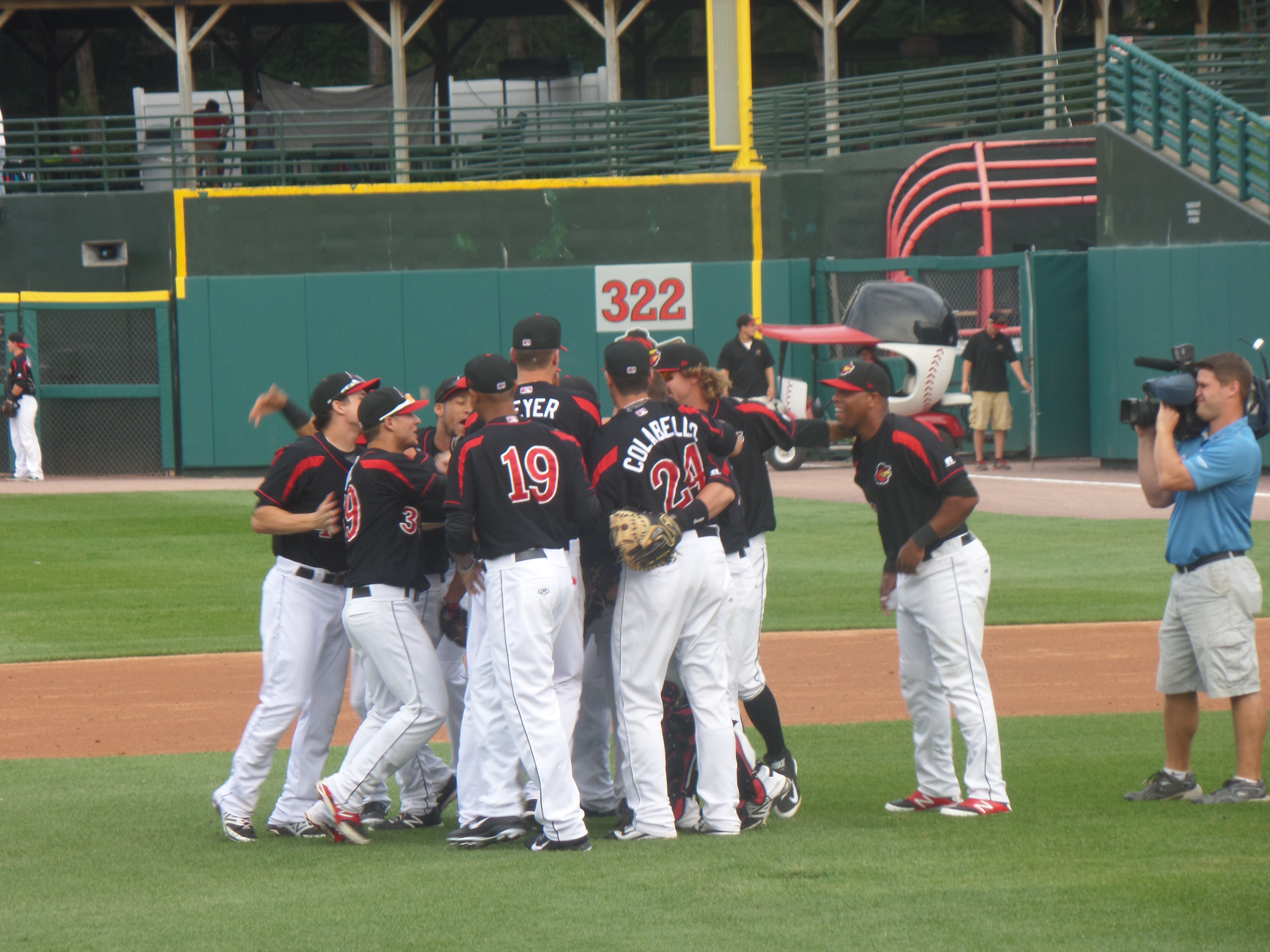
And then, of course, everybody went crazy:

Group hug!This was the third no-hitter I’ve ever seen in person (or, as somebody else pointed out to me, the second and two-thirds no-hitter, since I technically only saw just six of the nine innings). It also, however, is the weirdest. Consider how this technically was a road win for Rochester, despite being at home, where they have excelled all year. Consider how the person who started the no-hitter (May) is now in Minnesota, and the person who threw the final six innings (Darnell) had been called up AND sent down by Minnesota since the game began. Chris Colabello, who had an RBI single during the game, was also in Minnesota. The losing pitcher for Durham, Alex Colome, had been the winning pitcher in Durham’s win yesterday against Buffalo. Jayson Nix, who was the starting 2B for Durham when the game started, isn’t even in the Tampa Bay organization anymore.

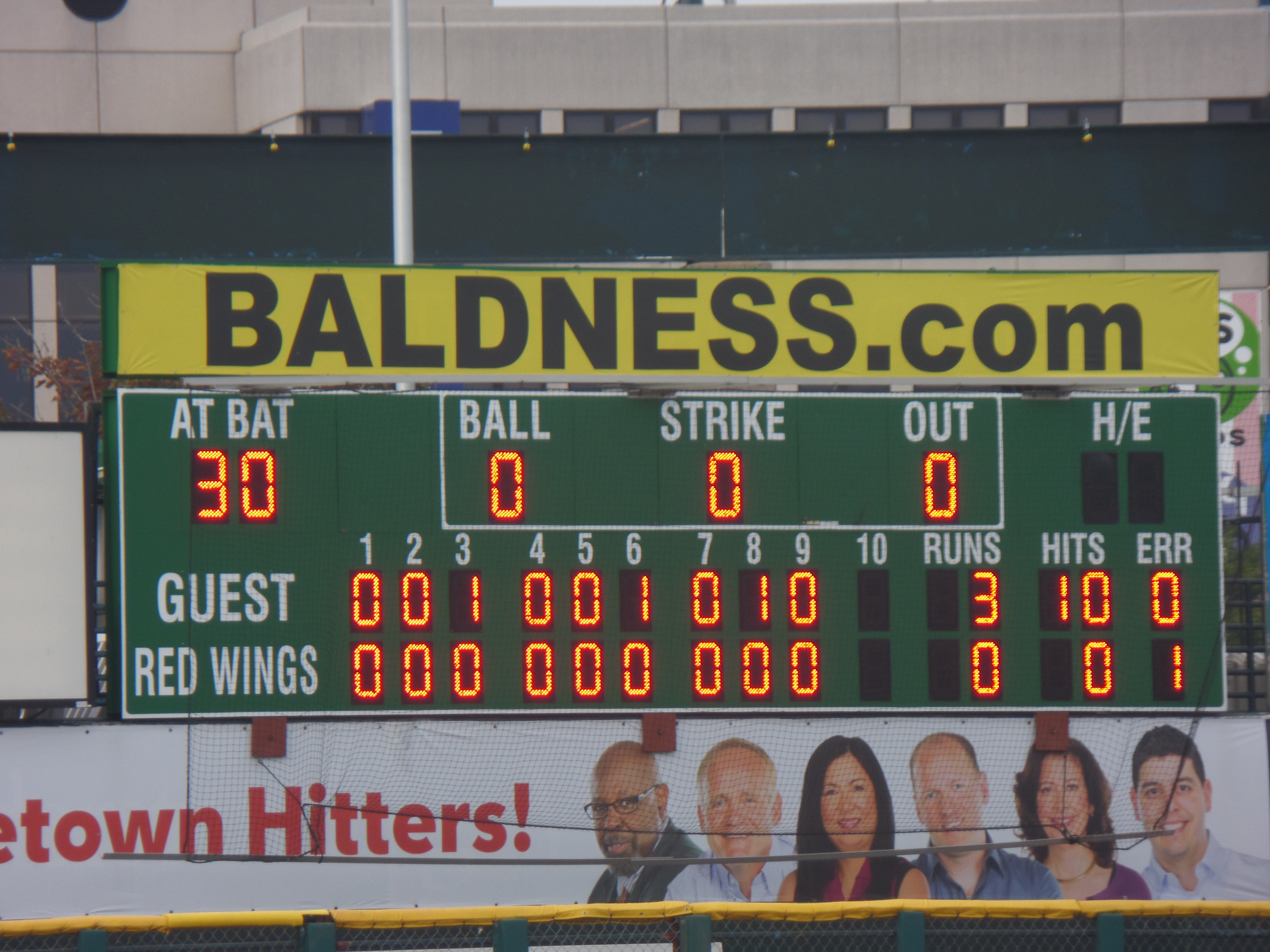
(They'd removed the "Bulls" from the bottom, but hadn't wiped the board yet.)

(They’d removed the “Bulls” from the bottom, but hadn’t wiped the board yet.)

And, then, of course, there is the final strangeness that there was a whole other game to play. That was a interesting game, too, with the Wings squeaking out a 5-4 victory despite the rehabbing Wil Myers hitting a Grand Slam for Durham (leading to a hilarious Twitter exchange between Durham and their parent club), but… well… it was coming after a no-hitter that spanned weeks and states… so… well… better luck next time, game two of a double-header.

For the Minnesota Twins, Saturday is May Day

Trevor May deals during a game in May in Rochester. Photo by Dan Glickman.

Trevor May deals during a game in May in Rochester. Photo by Dan Glickman.

For Minnesota Twins fans, it probably has been a question of “when”, not “if”, and it’s been a question they have been asking since April (probably earlier).

That question, of course, is: “When the hell will Trevor May get called up?” With every great start by him or his higher-ceiling-but-not-as-polished comrade, Alex Meyer, the cries would go louder and louder. Twinkie Town, perhaps the best (or at least most popular) Minnesota Twins blog on the web, wrote not one, but two facetious articles that implied that otherworldly powers beyond our understanding

The answer, at least for now, is “Saturday, August 9th.”

Yes, the day has come: Trevor May is going to pitch in the Major Leagues.

Having seen May all year this year (I’ve made a point of trying to get to as many of his starts as possible), May was acquired in the Ben Revere trade a few years back. In the past, apparently, he’s had control problems, and they still come up now and then, but in general he’s proven himself more than ready to try in the big leagues, posting a 2.93 ERA (4th best in the IL) and striking out 91 in a little over 95 innings. As I said earlier, he’s generally regarded as the lesser of the two pitching prospects who’ve helmed the Red Wings rotation (Alex Meyer, who has felt streaky at times this year), but he still could be something special, or at the very least be a good part of a rotation, especially one like the Twins’, which needs all the help it can get.

Then again, you never know with pitchers. Only time can tell.

Famous For Something Else: Frank Borghi, the washed-up catcher who helped Team USA pull off one of the greatest upsets in the history of Soccer

The World Cup is going on now in Brazil, so perhaps there is no better time than now to talk about Frank Borghi.

Who is Frank Borghi?

Well, let’s go back to 1950. It was a World Cup year, with the tournament in Brazil then, as it is now. And Team USA was in it then, as it is now. However, this was decades before the United States was even semi-competitive in international competitions, and the team was made up entirely of amateurs or semi-pros, many of them from St. Louis, a hotbed of soccer much like it is a hotbed of baseball.

It was from St. Louis that Frank Borghi came into the picture. Borghi was the team’s goalkeeper, primarily because he lacked much leg strength to actually kick the ball well. Of course, that wasn’t his main profession- he made his living in the funeral home business, and at the time was driving a hearse as his day-job.

Not surprisingly, his relative inexperience showed early on, as he had given up 3 goals to Spain in a 3-1 loss. It wasn’t looking any easier, with England coming up and with a team made entirely of their top professional players, having already beaten Chile 2-0.

But a funny thing happened: the United States won, 1-0, on the strength of a goal in the 38th minute by Joe Gaetjen, a Haitian cook (others say he was a dishwasher or student, or possibly all three) who lived in New York and was only on the team due to the lax FIFA citizenship regulations of the time. The win wouldn’t have been possible without Borghi, who constantly stopped the English onslaught, holding them scoreless despite 20 shots on goal.

The end result was a shocker. It is said (possibly inaccurately) that many newspapers around the world, not believing the result, printed it as a 10-0 win for England, having thought there was a mistake. It probably looked even more shocking a few days later, when the USA was trounced by Chile, 5-0.

Which brings us back to Borghi. After all, he was a goalie mainly because he didn’t have much leg strength, which begs the question of how he got into soccer in the first place?

The answer is that originally he didn’t. No, his true love was baseball- soccer was initially just a hobby to stay fit during the off-season. In fact, Borghi was a good enough player that he was briefly a professional, playing catcher in the very low minors of the Cardinals system in 1946:

Year Age AgeDif Tm Lg Lev Aff G PA AB R H 2B 3B HR RBI SB CS BB SO BA OBP SLG OPS TB
1946 21 -1.4 Carthage KOML D STL 103 272 71 9 6 0 .261 .338 92
1 Season 103 272 272 71 9 6 0 .261 .261 .338 .599 92
Provided by Baseball-Reference.com: View Original Table
Generated 6/23/2014.

While in Carthage, Borghi would have likely caught for future MLB pitchers Cloyd Boyer and Bob Habenicht. Borghi, however, would never reach anywhere close to the bigs as a baseball player- according to Baseball Reference, 1946 would be his only year professionally (other sources say that he played more than that year, but it’s possible that those were in non-affiliated leagues or simply have been lost due to the haphazard score-keeping and coverage of the minors at the time). After his professional baseball career ended, he spent more of his time on soccer… which is how a washed-up catcher helped Team USA pull off one of the biggest upsets in soccer history.

Borghi still lives in St. Louis and is a member of the St. Louis Sports Hall of Fame and the National Soccer Hall of Fame.


Coming Soon: First Impressions of OOTP Baseball ’15!

Sometime soon, my first impressions of OOTP Baseball ’15, which is due out later this month:

Screen Shot 2014-04-09 at 10.09.25 PM

TwitchplaysPokemon, Fan Managing, and the wisdom (?) of the crowd

Over the past few days-okay, almost a week now- I have been (stupidly) riveted to the tale of “TwitchPlaysPokemon”. It is a social-experiment/massive-game in which tens of thousands and sometimes over a hundred of thousands all trying to control the main character of Pokemon Red. In theory, you would think this would mean good things: thousands of players, most of them having beaten the game at least once, joining forces to send commands to Red, the game’s player character.

In practice, however, it’s a mess. You see, usually it isn’t a democracy, it’s an anarchic mess of random button pushes, with the game more-or-less randomly selecting what ones it’s listening too. So while having the majority of people saying that the character should go right makes it more likely that he’ll go right, sometimes all it takes is one jerk or confused person pressing down to make Red jump off a ledge and forcing you to walk all the way back and start again. Even the “democracy” mode than occasionally kicks in is screwed up, since lag between you and the server means you are at times voting not for what to do but rather what to do next.

As a result, what an average player might be able to finish rather quickly has taken, at last count, at least 12 days…. playing every single second.

So what does this have to do with baseball? Well, as amazing as it sounds, stuff like this has been tried in baseball. With… mixed results.

The first, and most famous, example of the fans doing the manager’s job was “Grandstand Manager’s Day”, held on August 24, 1951 by Bill Veeck and his hapless St. Louis Browns. The Browns won, defeating the Philadelphia Athletics 5-3. At various points in the game, a question was flashed to the fans, who could then determine (through the use of signs) what they should do: should the infield play in double-play depth, should a runner go, etc.

The rest of the American League was less than happy with the stunt, which probably explains why we’ve never seen it again on the major league level.

So, fast-forward to August of 2004. The Brockton Rox, then of the indy Canadian-American League and with Mike Veeck (Bill’s son, perhaps best known for his role in Disco-Demolition Night) as a consultant, recreated the stunt. It was less successful, as the Rox lost 8-2.

But two years later, a team went even farther. You see, in the second half of 2006, the independent Schaumburg Flyers let the internet dictate parts of their team for a web-based reality show. While the show, “Fan Club: Reality Baseball”, has long disappeared from the web, a Los Angeles Times article from that glorious era and a USA TODAY article from the same time gives us a view of the madness that ensued:

  • The team, which had won their division the first half of the split-season, was in last for the second half.
  • One lineup dictated to the manager had the usual 9-hole hitter leading off, a slow catcher batting second, and the clean-up man hitting sixth.
  • Another lineup- the second one ever handed in- had the team’s best hitter riding the bench, the center-fielder at first, and the backup catcher at third base.
  • The longest losing streak in the team’s history happened.

Ouch.

Of course, there are several key differences between a video game and baseball. And there is the biggest one: You can’t control real people. You can’t tell a baserunner to slide a certain way, for example. And even if you can…. they might not listen.

Still, it’s an interesting thought, and, especially considering the rise of Twitter, it is likely only a matter of time until somebody, presumably in the Indy leagues, tries it again. After all, you can’t keep a crazy idea down.

Famous For Something Else: Russell Wilson

As amazing as it seems, I have never had Russell Wilson of the Seahawks as a “Famous For Something Else” entry. Oh, I had a post in which I put up his minor league numbers, but it wasn’t a “Famous for Something Else”. So, without further ado, Russell Wilson’s minor league statistics:

Year Age Tm Lg Lev Aff G PA AB R H 2B 3B HR RBI SB CS BB SO BA OBP SLG OPS TB GDP HBP SH SF IBB
2010 21 Tri-City NORW A- COL 32 143 122 18 28 4 4 2 11 4 6 16 36 .230 .336 .377 .713 46 4 4 0 1 0
2011 22 Asheville SALL A COL 61 236 193 40 44 5 4 3 15 15 2 35 82 .228 .366 .342 .708 66 2 7 1 0 0
2 Seasons 93 379 315 58 72 9 8 5 26 19 8 51 118 .229 .354 .356 .710 112 6 11 1 1 0
Provided by Baseball-Reference.com: View Original Table
Generated 1/13/2013.

It should be noted that Wilson has not officially retired from baseball. Oh, sure, he probably won’t ever play again (although he has said he might be interested in hanging out with the Rangers next Spring Training to take BP, after they had picked him up in the Rule 5 draft as a publicity stunt), but he still appears on a Major League organization’s depth chart, if only as a “just-in-case” possibility.

Of course, even if he did want to be a two-sport athlete, it’s highly unlikely that he’d be able to pull it off, and not just because of his career .229 BA. The fact is, it’s more-or-less impossible to imagine an NFL quarterback also playing another sport, given both his importance to his team and how involved the QB is to football’s strategies and tactics. Bo Jackson was a running back- important, but not the type of person who needs to know every play in the book. Same goes for Deion Sanders (who, admittedly, always had the NFL as his higher priority except for when his MLB team was in the playoffs), who while an important part of every defense he was in, was hardly as indispensable as a quarterback is to a NFL team.

The only way I could maybe see it happen would be if the QB was a starting pitcher who only worked early in the week. But even that is a bit of a stretch.

Greg Maddux as a Minor Leaguer… VIDEOS

Thanks Youtube! While looking up “Greg Maddux“, I found video of him as a 19-year-old in 1985 with the Peoria Chiefs. THREE VIDEOS OF IT, to be exact.

So, while I haven’t watched these yet, here are all three, for your viewing pleasure:

Part 1:

Part 2:

Part 3:

Catching up on what happened to some players after some previous posts…

What happened to some of the people in previous posts? Well….

…And now you know!