Crazy Question: Should Surgeons be in the Hall of Fame? (AKA: The Importance of Tommy John Surgery)

A man who had a major impact in baseball passed today, someone who helped teams win championships and aided some of the biggest names in the sport.

That man was Lewis Yocum, and he was a orthopedic surgeon specializing in sports surgeries like Tommy John Surgery, in addition to serving as the team physician for the Angels. His passing has been commented upon by many in the baseball community, with some declaring that they owed him their careers.

Which leads to this: should surgeons and doctors be considered for the Hall of Fame?

Well, the answer is probably no. After all, they aren’t in this for fame, and to try and say what makes a “Hall of Fame Surgeon” is fraught with questions I don’t think can be answered.

But, let’s just consider for a second the impact that some of these surgeons have had on baseball.

Imagine what the world of baseball pitching looked like before Frank Jobe. Who’s Frank Jobe? He’s the guy who first performed ulnar collateral ligament (UCL) reconstruction surgery, where a UCL is replaced by a tendon from elsewhere. You probably know it as Tommy John Surgery.

Before TJ Surgery, to have a dead arm was a death sentence for a career. Let that sink in and then remember the full implications of that statement:

  • Without TJS, Stephen Strasburg‘s career would be done.
  • Without TJS, Jim Morris would never have been portrayed by Dennis Quaid in a movie.
  • Without TJS, Hyun-Jin Ryu never gets out of high school, much less comes to America and becomes one of the few bright spots of the 2013 Dodgers season.
  • Without TJS, Chris Carpenter‘s career probably would have ended on Opening Day, 2007. Adam Wainwright‘s career would have ended in 2011.
  • Without TJS, Eric Gagne‘s career probably have ended in the minors. Same goes for Kenny Rogers, C.J. Wilson and David Wells.
  • Without TJS, Tim Hudson wouldn’t have won the 55 games he’s won since 2009.
  • Without TJS, Phil Humber never has his perfect game. Francisco Liriano doesn’t have his no-hitter. Neither does Anibal Sanchez.
  • Without TJS, Kerry Wood‘s career would have been an even bigger “what might have been” than it ended up being.
  • Without TJS, John Smoltz‘s career ended in 2000, with 56 wins and 154 saves never happening.
  • Without TJS, we MAYBE might never have even heard of Mariano Rivera. (There is some confusion over whether or not Rivera had a TJS in the minors, or if it was a different type of surgery).

Hmm… maybe surgeons should be in the Hall of Fame. At least Jobe should.
Classic Continuum: Ballplayers who gave everything

This article was initially published on Memorial Day, 2012.

On this Memorial Day, it is as good a time as any to mention some of the ballplayers who gave their lives serving in America’s armed forces. The DeadBallEra site has a list of those who died while serving America, and there is also a good site entirely about Baseball in Wartime (primarily focused on WWII), but here are some notables (although, in the end, everyone who gives the ultimate sacrifice is notable). Not all of them died in combat, but all of them died while in military service or (in the case of people like Christy Mathewson) as a result of those actions:

  • Eddie Grant was a Harvard-educated infielder who spent time with Cleveland, Philly, Cincinnati and the Giants. On October 15, 1918, he died after being wounded by a artillery shell in the Argonne Forest of France. His unit had been fighting to rescue the “Lost Battalion” that had been pinned down by German forces. He was 35. A memorial to him was placed in the Polo Grounds (it is one of the plaques that can be seen in the expanded version of the Willie Mays catch photo), and a replica of it is now apparently in San Francisco.
  • Larry Chappell was a light-hitting outfielder in the 1910s who was at one point part of a trade for Shoeless Joe Jackson. In 1918, he died while in Army service only a few days before the armistice from the Spanish Flu pandemic that killed tens of millions of people. He was 28.
  • Ralph Sharman was a young outfielder who did well in a September stint with the Phillies in 1917. After the ’17 season, however, he was inducted into the army. He died in May, 1918 when he drowned while in Alabama, where he was undergoing training. He was only 23.
  • Christy Mathewson had retired from pitching by the beginning of America’s involvement in WWI, and was manager of the Cincinnati Reds. He left the club in the middle of the 1918 season, going to France, where he served in the Army’s chemical division. While there, he suffered the effects of poison gas, which left him with various respiratory ailments, including the tuberculosis that took his life in 1925.
  • Elmer Gedeon, who had had a cup of coffee with Washington in 1939, died while piloting a B-26 Marauder over France on April 20, 1944. He was 27.  He was one of only two people with Major League experience who died in WWII. The other being…
  • Harry O’Neill, who was a catcher in one game (with no plate appearances) for the Athletics in 1939. He was killed by a sniper on Iwo Jima on March 6, 1945.
  • Bob Neighbors, who had a cup of coffee with the Browns in 1939. In 1941, his baseball career came to an end when he had a poor season and, perhaps more importantly, lost his wife of only six months in a car accident while he was away on a road trip. He signed up for the United States Army Air Force after Pearl Harbor, and became a career military man from that point on. He went Missing In Action (and presumed dead) in 1952 when his B-26 went down over North Korea. He was both the only MLB-experienced man to die during the Korean War, and the last to have died in active service, period.

Of course, there were plenty of players who never made it to the big leagues who died in the line of duty, some of whom may have one day become Major Leaguers if not for the cruelty of war:


To them and all who have given the ultimate sacrifice, and to those who made it home, we salute you.

Prospect Service Announcement: Kevin Gausman

THIS IS A PROSPECT SERVICE ANNOUNCEMENT.

KEVIN GAUSMAN, RIGHT-HANDED PITCHER OUT OF LOUISIANA STATE UNIVERSITY, WILL MAKE HIS MAJOR LEAGUE BASEBALL DEBUT TOMORROW FOR THE BALTIMORE ORIOLES.

IN THIRTEEN STARTS IN 2012 AND 2013 IN THE ORIOLES ORGANIZATION, GAUSMAN HAS A 3.23 ERA IN 61.1 IP, WITH 62 TOTAL STRIKEOUTS AND ONLY SIX WALKS. SERIOUSLY, THAT IS NOT A TYPO, HE’S ONLY WALKED SIX BATTERS.

THIS YEAR IN AA BOWIE, GAUSMAN HAS STRUCK OUT 49 IN 46.1 IP WHILE WALKING ONLY FIVE. AGAIN, ONLY FIVE.

APOLOGIES FOR THE ALL CAPITAL LETTERS, I’M TRYING TO MAKE IT LOOK LIKE ONE OF THOSE IMPORTANT WEATHER BULLETINS OR SOMETHING LIKE THAT.

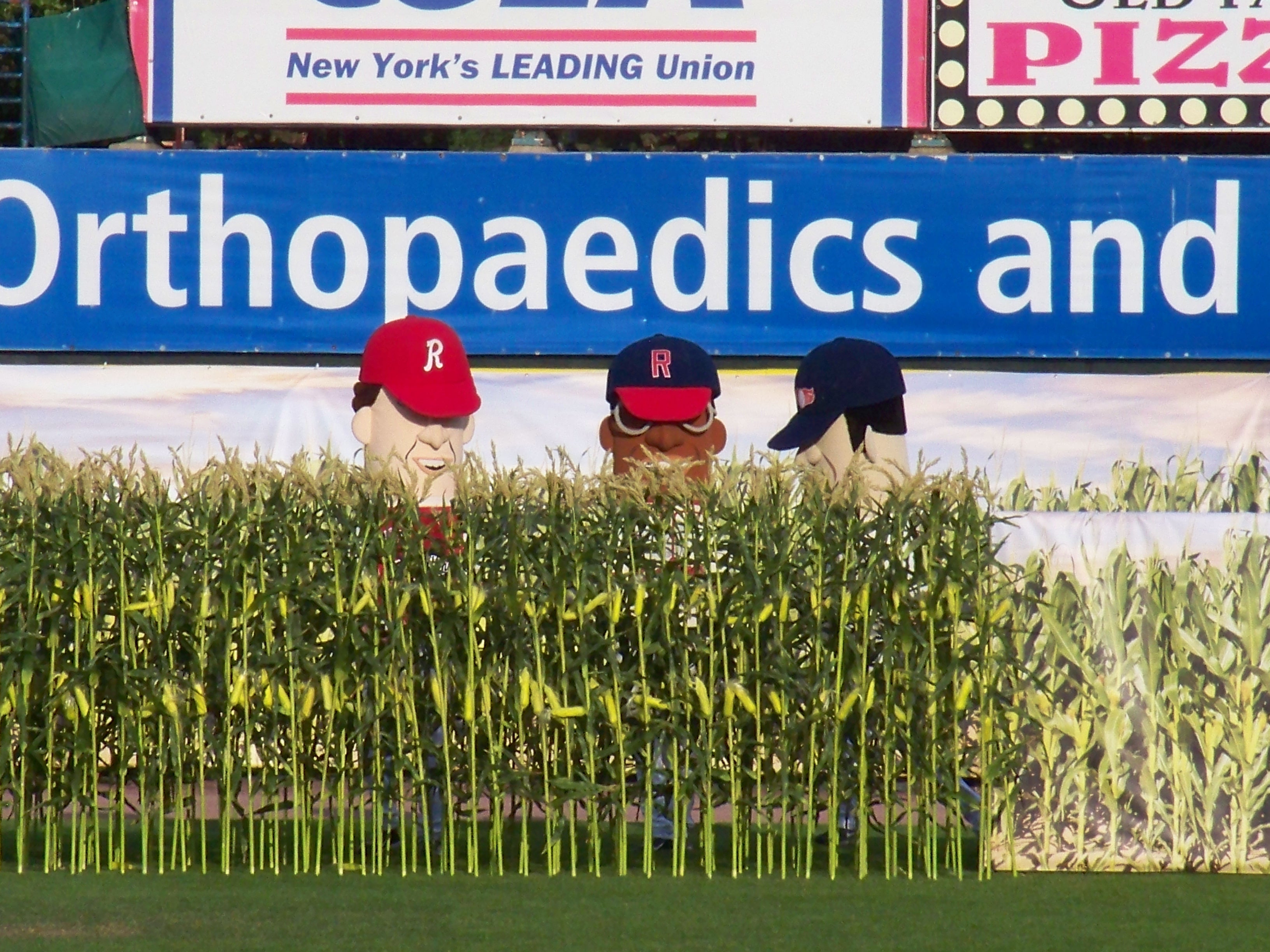
Picture of the day: Somebody’s watching you…

Image

Wait, wait... what's that in the corn?

A Day With Legends: The 2013 Pepsi Max Field of Dreams Game

You may have heard of the Pepsi Max Field of Dreams game, probably semi-heard during commercial breaks of MLB Network. Well, basically, it’s part old-timers game, and part fantasy camp. Two teams play a 6-inning game… with the catch being that each team is half made up of former MLB stars (almost all of them either Hall of Famers and ones that one day will be) and the other half is made up of ordinary Joes who won a contest. There are also some ringers (mainly guys who either play or coach locally and had professional careers) thrown in to fill spots in later innings. This year, it was was in my home town of Rochester, New York, and myself and 13,715 of my closest friends were there to see it.

(By the way, any picture you see in this was taken by me, and can be enlarged if you click it.)

Go below the jump for more, this is a photo-heavy post.

Continue reading

The Unwritten Rules of Watching Baseball

There are unwritten rules of playing baseball, but what are the unwritten rules of watching baseball? Or at least rules of thumbs or something…

Well….

  1. Veeck’s Law: The knowledge of baseball at a major league game is usually inverse the price of tickets.
  2. Don’t mention a no-hitter in progress, unless you do.
  3. Don’t mention a perfect game in progress, unless you do.
  4. If you mention how quickly a game is moving, it will grind to a halt.
  5. The players coming in from the field after a half-inning will throw a ball to either the cutest kid or the sexiest girl.
  6. If you catch a foul ball, and you are near a cute kid, you had better give him or her the ball.
  7. Every stadium should have at least one “regular” who’s voice can carry into the neighboring county.
  8. The official attendance of the game is always higher than the actual attendance.
  9. When a pitcher turns and fakes a pickoff towards second, at least one person will claim it’s a balk. It isn’t.
  10. The scrappier the player, the more liked he will be, no matter what his batting average.
  11. When there is a stadium trivia question and three of the choices are Hall of Famers and the fourth is somebody like Rusty Staub or Mike Timlin, then the answer is probably Rusty Staub or Mike Timlin.
  12. The temperature of the in-stadium thermometer is always at least four degrees higher or lower than it actually is.
  13. Any close call that goes against the home team is to be considered an insult by a blind umpire, even if it was relatively obvious it was the right call.
  14. After a few drinks, the person a few seats away from you will suddenly become an expert in when to send a runner, when not to send the runner, how to cover home plate, when to pull the pitcher and whether to swing, bunt or take a pitch.
  15. The batboy won’t give anyone a ball, but everyone will try and ask him for one anyway.


And that’s just the first 15!

The Famous For Something Else Index (as of April 24, 2013)

Want to see all of the “Famous For Something Else” features so far? Go through the links below:

Mario Cuomo (Governor of New York State from 1983-1994)

Randy “Macho Man” Savage (Wrestler)

Ricky Williams (NFL Running Back)

John Elway (NFL Hall Of Fame QB)

John Lynch (9-Time Pro Bowl Safety)

Kurt Russell (Actor)

Michael Jordan (His Airness)

George Halas (HOF Football coach and player)

Danny Ainge (NBA player and executive)

Scott Patterson (Actor)


Famous For Something Else: Scott Patterson

I’m starting to scrape the bottom of the barrel of baseball players who became famous for doing something else, to the point where I’m now doing TV actors I had to look up on IMDB. So, anyway, here are the statistics for Scott Patterson (IMDB link). After his pitching career ended, he became an actor who has had roles in Gilmore Girls, some of the Saw films, Aliens in America and The Event.


(Go below the jump to see them.)

Continue reading

Neat Website of the Undetermined Amount of Time: Bleacher Weather

After seeing what Target Field looks like today, I thought I’d share a link with you: Bleacher Weather, which superimposes the location of stadiums onto a weather map and gives you forecasts when you click on the stadium locations.

Famous for Something Else: Danny Ainge

Danny Ainge was an All-Star with the Boston Celtics, and later would become an award-winning executive for them after he hung up the uniform. But before he started his professional basketball career, the BYU grad had a short career with the Blue Jays. Go below the jump to see his major league and minor league stats:

Continue reading