Projecting a possible 2013 USA WBC team

(EDITED IN ON DEC. 31: As of this writing, the most recent projection for the United States can be found here.)

Joe Torre will be managing the 2013 WBC team. As I mentioned during my musings on what a baseball dream team in 1992 would have been like, I guess now is as good a time as any to try to predict who will be on the 2013 WBC team. Unlike my pie-in-the-sky 1992 team though, these predictions will be based more in the cold reality about WBC teams that emerges due to the fact that the tournament takes place during Spring Training:

  • Any player coming off a major injury or who has a history of injuries is unlikely to participate. This is especially true for the pitchers.
  • Players that will be on new teams are less likely to participate, but shouldn’t be completely ignored, with the exception of pitchers.
  • Teams are made up of 28 players, of which 13 of them must be pitchers and two of them catchers.
  • The pitch count rules make relievers extremely important.

So, with this in mind, and after much looking over of statistics and histories, here are my projections (after the jump):
Continue reading

An Alternate History: What if there was a baseball dream team?

I previously talked about how the IOC should put baseball and softball back into the Olympics. But it got me to thinking: what if MLB had been on board with the Olympics and had sent dream teams overseas? I’m not even talking about the World Baseball Classic teams, which often are missing some key players (primarily pitchers) due to the fact that spring training is at the same time and they are worried that going all-out so early could get them injured. I’m talking about no-holds-barred dream teams that would have taken part in the Olympics during an extended All-Star Break. Who would have gone?

Well, with there being a lot of talk about the 20th anniversary of the original Basketball Dream Team, it got me to thinking of what sort of team the USA would have sent to Barcelona had they A) been allowed (technically, no professionals were allowed to play baseball in the Olympics until the 2000 games) and B) had MLB done a extended All-Star Break to allow the players to go without missing any games.

Drawing inspiration from how the basketball Dream Team was picked, it would be made up not just of the best players available, but also the most marketable. In order to make sure everyone was ready in advance, they presumably would have picked the players based on their performance in 1991. While in 1992 the Olympic teams were limited at 20 players, by the time professionals were in the Olympics the roster had been increased to 24 or 25 players, so I’ll go with that.

So, presenting the alternate universe 1992 Team USA Olympic Baseball Team:

(more after jump)

Continue reading

Perfect Perfection

Matt Cain did not just throw a perfect game last night. No, he threw one of the most perfect perfect games. One of the greatest games in history, in fact. It had everything: drama, close plays, a legendary catch and the final out, where, as always, there is that one second of worry that somebody is going to screw it up.

Oh, sure, Don Larsen’s perfect game came on the sport’s greatest stage, against a team of future Hall-of-Famers, but statistically, the greatest perfect game has long been Sandy Koufax’s brilliant game in 1965. It’s game score was 101 (out of a possible 114), second only to Kerry Wood’s 20-K one-hitter (105).

Cain has tied Koufax. Let that sink in: Matt Cain’s game was, statistically speaking, as good as Koufax’s magnum opus.

In other words, Giants and Dodgers fans now have another thing to argue about.

In short, there have been perfect games, and no-hitters. But of the many recent ones, this one is perhaps the one that is the most… perfect.

Baseball needs a better trophy

On Monday, the Stanley Cup was handed out. It is a a nearly 120-year-old trophy that is more revered than the actual event that is played for the right to have it. People have drunk out of it, had their kids baptized in it, it’s been thrown in rivers and pools and knocked off tables. There are names on it that are misspelled or put on as gags. Wherever it goes, it has at least one concierge with it. Every year, it produces a instant image that would become etched in the mind of that team’s fans: the captain hoisting it above his head, parading it around the ice.

In October, the winner of the World Series will receive the Commissioner’s Trophy (did you even know it had a name?), a rather uniconic statuette that has a new copy made every year for the champion, unlike the Cup, which goes from team to team. It only dates back to 1967. There are no iconic images of the Commissioner’s Trophy: no hoistings by the team leader, no images of a unflappable star weeping as they hold it and certainly no thrustings into the air as confetti falls. Why, the default pose with the Commissioner’s Trophy is just kind of holding it, like Lance Berkman did. Although Pedro used it as a hat, which is kind of cool.

(more after jump)

Continue reading

Somebody get Harper and Trout into the All-Star Game

The two great young stars of baseball right now, I mean the really young stars, are the Angels’ Mike Trout (20) and Washington’s Bryce Harper (19). They are in opposite leagues, hit from opposite sides of the plate, play on opposite coasts and have received the opposite amounts of hype (Harper was hailed as the second coming, Trout’s emergence in the bigs has been far more subdued), but they both have been playing like they’ve been in the Majors for years, instead of months.

To pick which one is “better” is a fool’s errand, it is too early to really project the (hopefully long) careers of the two, and although Trout is having the better season (.354 BA/.412 OBP/.565 SLG compared to Harper’s .295/.381/.527), who knows what the future may hold for them?

I personally hope the future involves the 2012 All-Star Game in Kansas City.

(more after jump)

Continue reading

Stony Brook: The North will rise again

Stony Brook made it to the College World Series yesterday, defeating perennial power LSU, on LSU’s home turf, and in near-dominating fashion too. The super-regional series went to the full three games, but Stony Brook easily could have swept, having blown leads several times in game 1 before LSU won it.

This is, even in the relatively-niche college sport of baseball, a big deal. The Seawolves (previously best known for having been the college team of Joe Nathan) were a number 4 seed in regionals, and, as ESPN constantly pointed out, that makes them the equivalent of a number 13 or lower/higher (it’s hard to keep your directions straight with seeds sometimes) making it to the Elite Eight during March Madness. In 2008, Fresno State became the first and only regional 4-seed to win the entire tournament, but Fresno, unlike Stony Brook, had been to the CWS before, and had in fact ended up coming in second on three previous occasions. Stony Brook… hasn’t. In fact, they hadn’t even made it to the Super Regionals before this year.

(more after jump)

Continue reading

The War for the (AL and NL) East

The greatest division races are already shaping up to be in the (AL and NL East). Teams that had been afterthoughts are now in the mix, perennial powers have found themselves in the cellar. Things are changing quickly, so by the time this goes up on the afternoon of June 10, it may already by obsolete: teams that were in first may have fallen to second or even third. A team who was in it could not be out of it. A team that was out of it could be in it. It is just that volatile.

(more after jump)

Continue reading

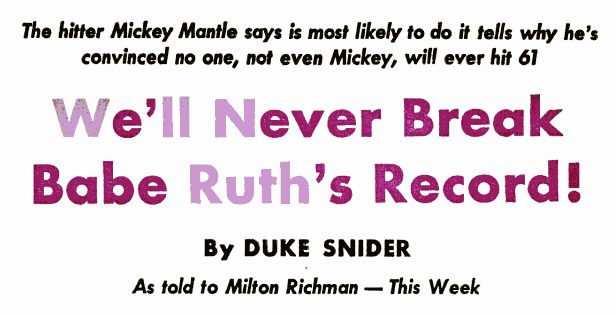
Great Predictions in History: Nobody will break Ruth’s Record (says Duke Snider in 1957)

From Baseball Digest in October, 1957:

The record he speaks of is his 60 HR in 1927. Among the reasons that the record won’t be broken are the fact that Ruth didn’t have to deal with the media pressure as he headed down the stretch that anyone going for 60+ has to, the fact there are fewer off days, the fact that there are now day and night games that could mess with a player’s rest schedule, and that most of the parks aren’t as easy to hit home runs out of as Yankee Stadium had been during Ruth’s day.

He implies that Ted Williams could if he wanted to, but that he doesn’t focus on home runs, instead focusing on being an all-around hitter.

Interestingly, Duke Snider and his ghostwriter Milton Richman also predict that if anybody did they’d be headed to Cooperstown for sure.

Roger Maris is not in the Hall of Fame…. but he did hit 61 HRs in 1961.

They call the AAA team the Norfolk Tides (but the All-Stars don’t wear blue)

Miguel Tejada (left) chats with Brian Roberts before a ballgame in Rochester. Photo by Dan Glickman.

Brian Roberts. Miguel Tejada. Nate McLouth. Jamie Moyer. Between those four players, there are 10 All-Star Game selections. And yet, all four of them are currently at Baltimore’s AAA affiliate in Norfolk. There are several other ex-MLBers on the Norfolk roster as well, such as Bill Hall.  I recently saw three games involving the Tides. Here are some impressions of this unusual group of players who all have found their way to the International League, whether due to injury, poor play, bad luck or an attempt to make a comeback.

Continue reading

No-Hit Fever!

After six Mariners combined to no-hit the Dodgers last night, it is now official: America has no-hit fever. And the only solution is… I have no idea. It was enough when no-hitters were getting thrown against bad teams like the Twins and Mariners, but now we’re having no-hitters thrown against the defending champion Cardinals and the Dodgers, who have the best record in the league. Even the Rangers were almost no-hit by Jarrod Parker not that long ago. In other words, this is getting close to ridiculous.

Not bad, really, just ridiculous. We have come to the point where, every night, we feel as if a no-hitter could happen. This is one of baseball’s great strengths: anything could happen at any time, in the most unexpected places.

Still, this made me curious as to what season saw the most no-nos. The fact is, the four we have seen so far in 2012 actually aren’t that many, historically. The pre-modern 1884 season had eight no-nos, while 1990 and 1991 both saw seven no-nos. In fact, June 29, 1990 saw two no-hitters thrown (one by Dave Stewart, one by Fernando Valenzuela), which brings up the question of what ESPN led off with that night.

So, when will the next no-hitter happen, and is there a chance we could see seven or eight of them? I don’t know, but that’s the beauty of it: we could see another no-hitter tomorrow, or there might not be another one for a few years. They just… happen.