BIZARRE BASEBALL CULTURE: Marvel Adventures Spider-Man 34 brings steroid accusations, hallucinations, and a angry father

In Bizarre Baseball Culture, I take a look at some of the more unusual places where baseball has reared it’s head in pop culture and fiction.

Sports have many problems. There are performance enhancing drugs, exploitative agents, a culture that honors people and asks their opinions for no other reason than that they are strong, and stupid adults who ruin everything.

And in Marvel Adventures Spider-Man #34, we get a hard-hitting glimpse at how this affects high school baseball in a Marvel Universe. BECAUSE SOMEBODY HAD TO TELL US!

Screen Shot 2015-05-29 at 1.39.53 PMPublished in 2007, this issue was part of the Marvel Adventures/Marvel Age imprint, a set of ongoing series that were meant for all-ages of readers. To make it more readable for younger folks, these series cut down on more complicated backstories, featured characters (like Spider-Man) that most kids would have been familiar with from TV or movies, featured younger versions of some characters (this Spider-Man is still in High School, for example), didn’t have as much violence, and eliminated bad language and sexual innuendo.

But… that doesn’t stop it from having steroid accusations, a angry father, sports agents, and other fun stuff! It also has a baseball uniform with a Koala Bear on it, which is cool.

Go below the jump for more!

Continue reading

BIZARRE BASEBALL CULTURE- The Time That Bullseye had a 2-issue Baseball Miniseries

In Bizarre Baseball Culture, I take a look at some of the more unusual places where baseball has reared it’s head in pop culture and fiction.

One of the things you realize when you think about superhero fiction too hard is that a lot of the criminals could probably become rich using their technology or skills in more legal pursuits. For example, find the right quiz show for the Riddler, and he’s rolling in dough. Captain Cold or Mister Freeze could easily make a mint if they applied their freeze-weapons toward something like refrigeration. Heck, even the people who write the comics know this, and in the 1980s they turned Lex Luthor from a supergenius with lots of high-tech inventions into a corrupt supergenius billionaire superexecutive who had made his money from his many high-tech inventions.

Which leads me to Bullseye. Bullseye’s a Daredevil villain, created by Marv Wolfman and John Romita Sr. in the 1976 and perfected by Frank Miller in his run on Daredevil’s comic book. Bullseye’s entire shtick is that he basically has perfect killer accuracy with basically everything, even harmless stuff like playing cards. He’s arguably Daredevil’s second-greatest foe (after the Kingpin), and is directly or indirectly responsible for the death of at least two of Daredevil’s girlfriends (only one of whom got better).

But, still, that shtick with the accuracy, wouldn’t you think he could make a great pitcher?

Well, there was a 2-part miniseries at the turn of this decade that basically grabbed a hold of that idea and ran with it… Bullseye: Perfect Game.

It’s a surprisingly good short look at obsession and perfection, with some nice easter eggs for fans of baseball and of comics and a great ending that I’m sort of bummed out I’ll spoil in my summary…. BELOW THE JUMP:

Continue reading

OFF-TOPIC THURSDAY: There’s no wrong way to do the Joker

In the irregular “Off-Topic Thursday” feature, I do stuff that is totally off-topic from the usual baseball stuff…

You probably saw the apparent first image of Jared Leto as the Joker for Warner Brother’s upcoming Suicide Squad movie, as well as other future films where he presumably will fight Ben Affleck’s Caped Crusader:

Just as with everything having to do with comic book movies, it has proven controversial. A Joker with tattoos? A Joker with a lot of tattoos? This is radically different from previous live-action Jokers, and also pretty different from most incarnations in comics and animation.

However, that doesn’t mean it will be bad. Because, here’s the thing: the Joker is a chameleon, a character that has been done in countless ways and in countless tones.

Originally, in the 1930s, the Joker was a exotic take off of a silent horror movie called The Man Who Laughs. He was shown to be a ruthless serial killer completely without morals who murdered dozens.

After Batman became more popular with kids, the Joker became a bit less of a horrific killer and slowly became a more comedic figure. This was further increased during the late 40s and the 1950s, as a wave of censorship and moral panic neutered most comics. By the time Cesar Romero (with his mustache still on) was the Joker in the 1966 TV series, there was barely a shred of the killer that he originally was.

And then, in the 1970s and 1980s, a combination of the two emerged, at least in the comics: the Joker was a ruthless criminal mastermind and murderer, but he would do so for reasons (which could change whenever he felt like it) or in ways that would seem to have come from a “soft R” (or at least PG-13) version of Cesar Romero, all while thinking, in his own twisted way, that he was the only sane man in Gotham. One particular favorite of mine was the time he went on a killing spree of bureaucrats because they wouldn’t give him a copyright to Gotham Bay’s fish population after he poisoned the fish with a mild version of his venom so that they’d all all his evil grin.

That version of the Joker- the homicidal maniac with an insane sense of humor- is perhaps the default version of the Joker now and in my opinion is the one that works the best. Jack Nicholson’s 1989 Joker was a lot like that, as was Mark Hamill’s Joker (regarded by most Batman fans as being the greatest Joker of all) in the cartoons and video games. Even Heath Ledger, who owed more to the 1930s serial killer Joker, still had that randomness about him- go back and watch The Dark Knight and see how many times he changes the story of how he got his scars, or how he goes from wanting to kill Batman to wanting to have fights with him forever (a possibility that, sadly, ended with Ledger’s death).

But, regardless of how the Joker has been portrayed, he’s always proved popular. Cesar Romero was one of the most popular villains of the 1960s TV series. Jack Nicholson’s Joker was the most popular of the pre-Nolan Batman villains. Heath Ledger, despite initially being the subject of a controversy once cast (not that different from Ben Affleck being cast as Batman), ended up winning an Oscar for it.

So why should we assume that a tattooed Joker will be bad? The character hasn’t disappointed anyone yet, and with a Oscar-winner behind him, it feels foolish to assume.

I guess time will tell.

Book Review: The Essential W.P. Kinsella

W.P. Kinsella is best known as the writer of Shoeless Joe, the book that Field of Dreams was based on. However, that just scratches the surface of the many short stories and novels he has written over the years, not just on baseball, but also on others subjects, such as those related to the “First Nations” of his homeland of Canada.

And for Kinsella’s 80th birthday and the 25th anniversary of the release of Field of Dreams, many of his short stories have been put together in Tachyon Press’ The Essential W.P. Kinsella.

While I, of course, was most interested in the baseball stories within and only skimmed some of the other works, rest assured that this is a big and comprehensive collection of many of Kinsella’s works, and while some are better than others, you cannot deny that this is a big and diverse assortment of stories that Kinsella clearly put a lot of care into.

So, without further ado, here are some thoughts and reviews on some (not all- I’ll admit two or three of the stories just sort of failed to stick with me) of the baseball stories within Essential W.P. Kinsella:

The first baseball story in the collection is “How I Got My Nickname”, a strange fantasy tale where a dream-version of W.P. Kinsella talks about playing with the 1951 Giants, who all share his family’s love of books and languages. A weird story, but kind of cute when you think of it as a childhood fantasy.

In “The Night Manny Mota Tied The Record”, a writer (again likely a thinly-veiled Kinsella) is given the opportunity by some sort of cosmic arbiter to die in Thurman Munson’s place, and that such a opportunity is given to people anytime a well-known figure dies a premature death. An interesting concept, and in some cases it feels like something that would be better suited for a individual bigger than Thurman Munson (they off-handedly remark on presidents and civil rights leaders that had been spared or condemned due to how their cosmic substitutes decided). I wasn’t sure what to think about this story, and the ending was pretty corny. Still, a neat concept.

“Searching for January”-which runs with the fact that no trace of Roberto Clemente was ever found- is about a man in the late 1980s who discovers a time-lost Clemente drifting onto a Latin American beach, having apparently not aged a day since his fateful flight and thinking it’s now January 1973. This set-up actually ends up being much better than it sounds, and this is arguably my favorite baseball story in the collection, although the ending is just like an episode of The Twilight Zone I remember seeing. Despite that, it’s a great little gem of a story, and I’m somewhat surprised it hasn’t been made into a short film or anything.

Oh, and if anybody wants to make this into a short film, call me, I’ll write the screenplay.

“Distances” is about a old pitcher with the uncanny ability to remember the distances between major city who convinces a Iowa high school team to let him pitch for them in a game against a company team. It’s alright, I guess, but is a bit plodding at times.

“How Manny Embarquadero Overcame” is a twist on the the tale of a Latin American player lying about his age or identity, except it also involves voodoo, Detroit, and an ugly dog. It has a great first line that pulls you right in, but sadly the story doesn’t quite pay off the good lede.

Whether “K Mart” is a story about baseball or merely a story that involves baseball is a question the story itself asks. It’s more about the growing up and regrets of a guy who returns to the town where he played pick-up ball for the funeral of his first crush, if you ask me.

The final story of the collection is “Shoeless Joe Jackson Comes To Iowa”, the story that was later expanded into Shoeless Joe and then adapted into Field of Dreams. It is roughly (if I remember Shoeless Joe correctly) the first chapter of that book, in which Ray Kinsella builds the field and then Joe Jackson shows up, eventually asking if he was in heaven (“No, it’s Iowa.”). It’s a good read and you definitely could see why it was ultimately made into a full book and then the movie, although you can’t help but look at some of the parts that are dated or different from the movie that eventually was made from it (for example, in the story, it’s mentioned that Wrigley Field doesn’t have lights, but in the movie, it’s specifically mentioned that even Wrigley Field now has lights).

Speaking of which, at the end of the collection, there is a short piece by W.P. Kinsella about that story, the book, and the movie adaptation, and I learned some things from it. For example, his working title was The Kidnapping of J.D. Salinger (Salinger would become the Terrance Mann character played by James Earl Jones in the film), and the voice in the film that speaks to Ray was Ed Harris.

Overall, I found The Essential W.P. Kinsella something of a mixed bag. Kinsella’s writing is great when it’s on, but can be a bit grating and hokey when it isn’t, and while there are a lot of good ideas in his stories, not all of them are always followed upon. Still, I’d recommend this book, especially if you liked Field of Dreams and the semi-magical properties it ascribes baseball.

Note: I was provided a review copy of this book.

Spider-Man’s appearances in BIZARRE BASEBALL CULTURE

As you would know unless if you’ve been living under a rock the last day or two, Spider-Man is coming to the Marvel Cinematic Universe. In honor of this, here are the web-slinger’s appearances in BIZARRE BASEBALL CULTURE:

2007’s TRIPLE-A BASEBALL HEROES

The crossover between Marvel Comics and AAA baseball that you never knew you needed, Spidey is one of the main characters in this comic. There is also a serious error, however, as Peter Parker is portrayed wearing Yankee regalia, which goes against the well-established fact (to Spider-fans) that Pete is a Mets fan.

2008’s TRIPLE-A BASEBALL HEROES

Spider-Man has a much smaller role in the second AAA/Marvel crossover, but does still appear, so it counts.

BILLY THE MARLIN

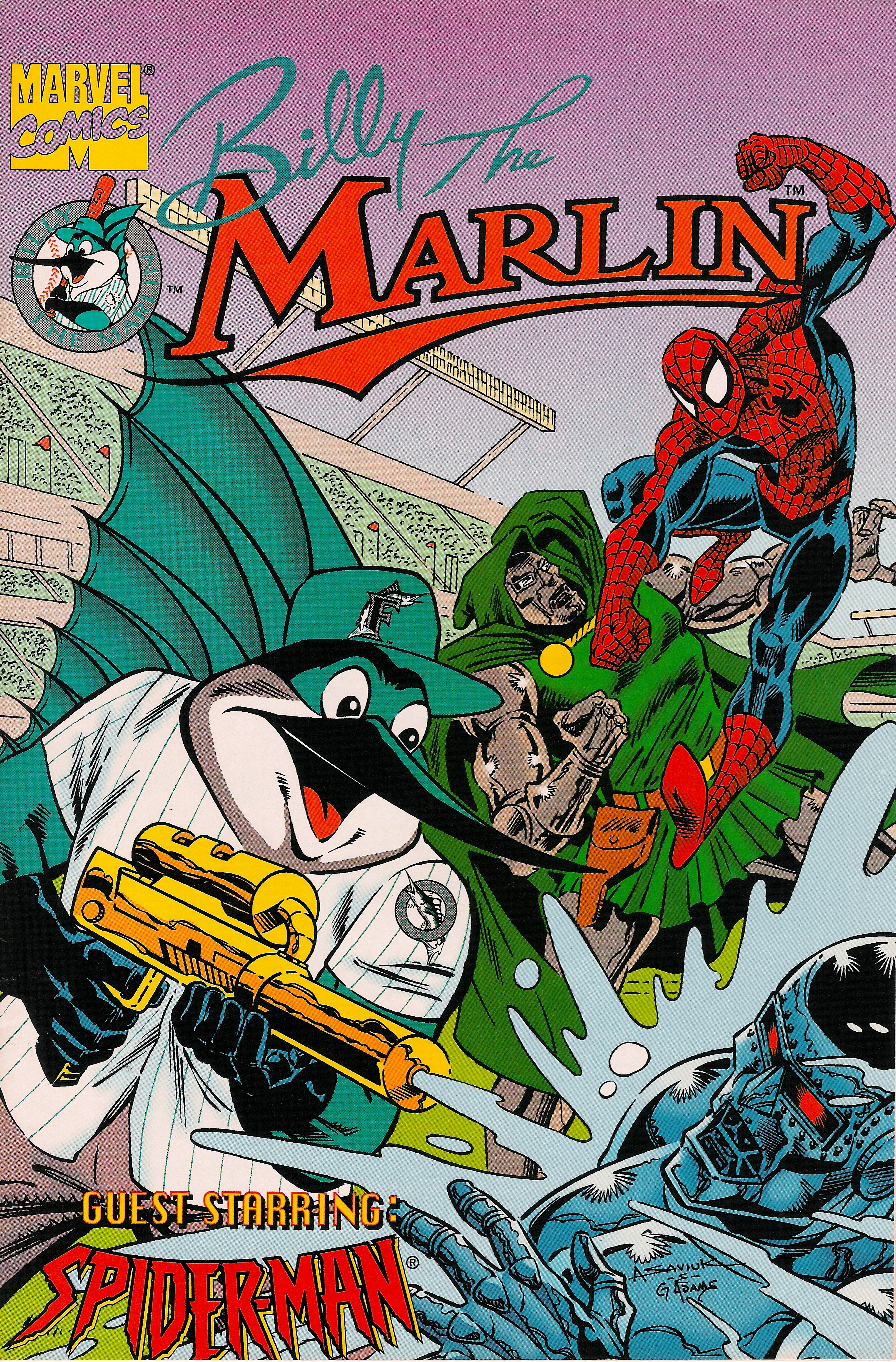
One of the greatest achievements in human history, right up there with fire, the wheel, the polio vaccine and Mario Kart. I mean, just look at this:

MarlinsSpideyCoverIn this comic, Spider-Man aids Billy the Marlin in stopping Doctor Doom, who has arrived in Miami to kidnap Jeff Conine in order to force him to join the Latverian National Baseball Team, or something like that. It’s amazing. I did not make that up.

Peter Parker Spider-Man (Vol. 2) #33

The last (for now) Bizarre Baseball Culture featuring Spidey, this issue is entirely about Peter Parker’s love of the New York Mets and how it was a bond between him and his Uncle Ben. Features an appearance of an off-brand and talking Mr. Met.

So, there you go! Spider-Man’s appearances in BIZARRE BASEBALL CULTURE! Enjoy!


BIZARRE BASEBALL CULTURE: Strange Sports Stories #1… “TO BEAT THE DEVIL!”

In Bizarre Baseball Culture, I take a look at some of the more unusual places where baseball has reared it’s head in pop culture and fiction.

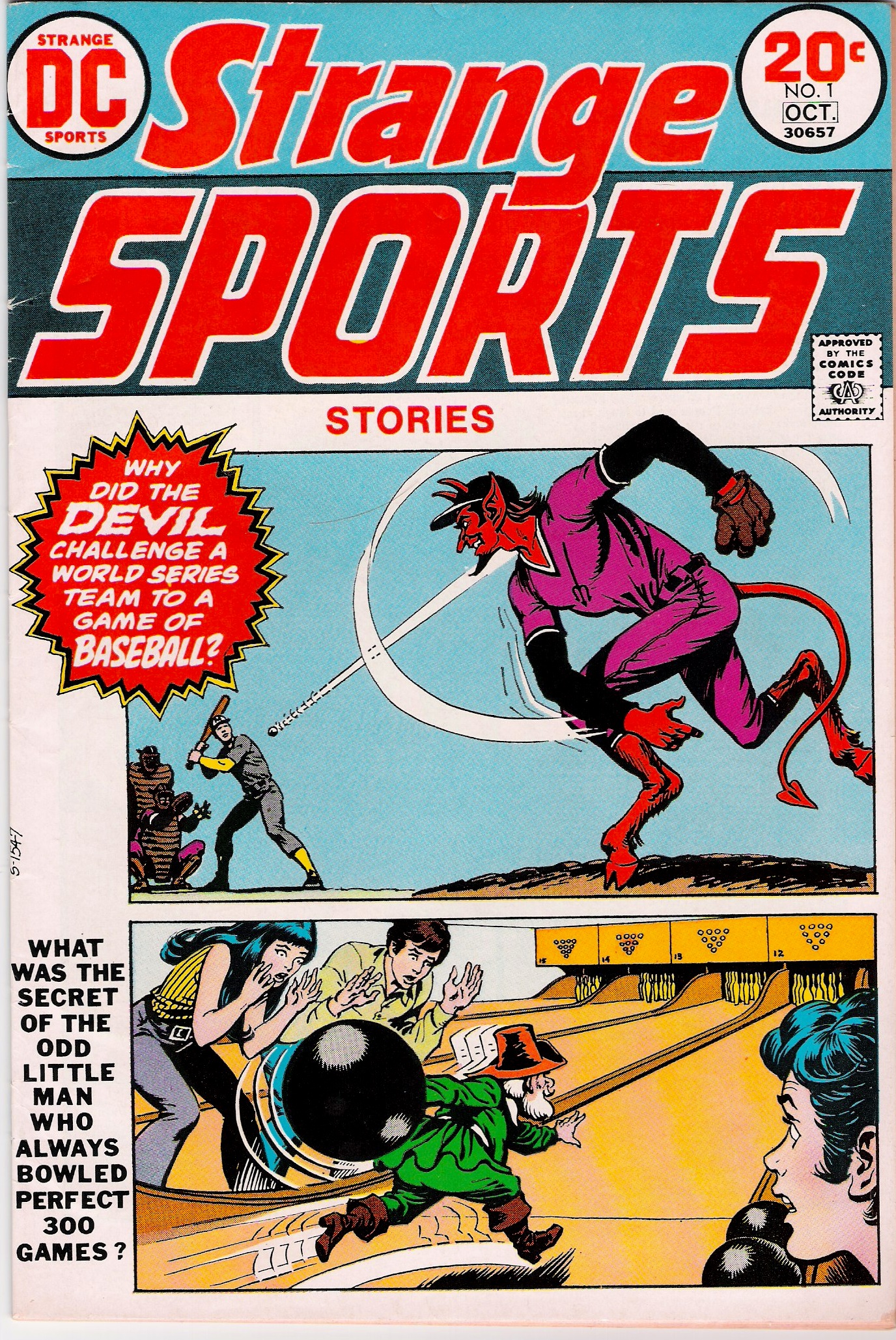
Last time, I introduced you to “Strange Sports Stories”, the on-and-off anthology of DC Comics’ Science-Fiction and/or Fantasy tales involving sports. That past installment was from the 1960s Brave and The Bold run of SSS, but this time, we’re looking at the Strange Sports Stories stand-alone series, from 1973. It only lasted six issues, but it’s first issue prominently featured baseball (amazingly, it wasn’t in any of the other five issues, and as far as I can tell no sport was featured more than once) in a tale called “To Beat The Devil!”

DevilBallcover

Written by Frank Robbins (who was primarily an artist, most notable for having helped create the character of the Man-Bat for DC Comics), penciled by Curt Swan (who is best known for his work on Superman comics) and inked by Dick Giordano (best known for his partnership with artist Neal Adams on Batman and the socially-conscious Green Lantern/Green Arrow book), this tale, as the cover (done by Nick Cardy, who according to Wikipedia is best known for his work with Aquaman and the Teen Titans) indicates, is about a face-off between a baseball team and the devil himself. The Devil, of course, is no stranger to baseball, primarily known for his involvement in baseball-themed musicals, but this is the first appearance by Satan in Bizarre Baseball Culture. Well, unless you count this weird guy from the second AAA Baseball/Marvel comic. I don’t.

Anyway, go below the jump for more:

Continue reading

Bizarre Baseball Culture: “CHALLENGE OF THE HEADLESS BASEBALL TEAM!”

In Bizarre Baseball Culture, I take a look at some of the more unusual places where baseball has reared it’s head in pop culture and fiction.

This is gonna be fun. Today, I take my first look at a quintessential part of Bizarre Baseball Culture: “Strange Sports Stories”. A short-lived DC Comics anthology banner that popped up a few times during the 1960s and 1970s- at one point even having it’s own book for six issues- it’s title told you everything you have to know about them: they were sports stories that were strange. Sometimes they would be sports mixed with magic. Other times it would be sports mixed with science fiction. No matter what, though, they were most definitely bizarre. And, so, by definition, all baseball installments of “Strange Sports Stories” are going to be Bizarre Baseball Culture.

And we’ll begin with the very first “Strange Sports Stories” story, from waaaay back in December 1962 or January 1963 (it’s cover date was January, but comics often come out before the cover date, so it likely was already out in December- if not even earlier, as the GCD says it was on stands in late October), in The Brave and The Bold #45, the first “Strange Sports Stories” installment ever: “CHALLENGE OF THE HEADLESS BASEBALL TEAM!”

Note that this isn't an actual picture of my cover- my cover is in sort of crummy shape- the book is over 50 years old, after all.

Note that this isn’t an actual picture of my cover- my cover is in sort of crummy shape- the book is over 50 years old, after all.

Let’s go below the jump for more.

Continue reading

Coming Up: A New “Bizarre Baseball Culture”

By the end of the week (perhaps as early as tonight), you’ll be seeing a new “Bizarre Baseball Culture”. Originally the plan was for it to be tonight, but it’s a bit longer of a story than I thought it was, so to ensure it is a good quality article, it’ll be a bit delayed.

Thank you!

Bizarre Baseball Culture: True Comics #78 has a Stan Musial Biography

In Bizarre Baseball Culture, I take a look at some of the more unusual places where baseball has reared it’s head in pop culture and fiction.

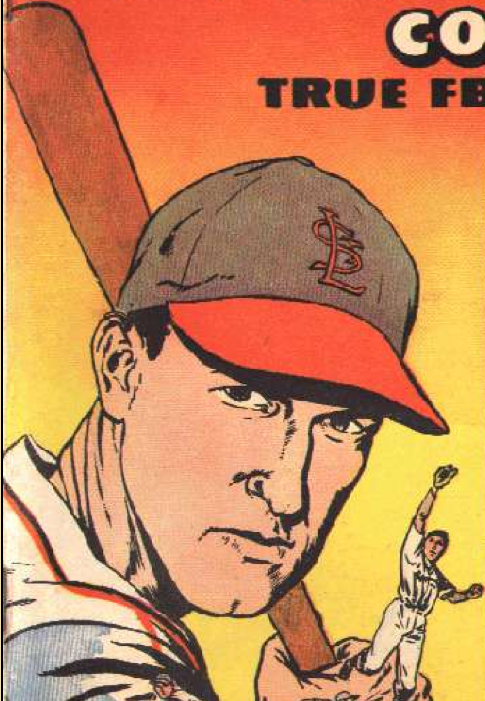
A shorter one today, as we go back to bio-comics, this time looking at Stan Musial. Now, I’ve done a bio-comic before, but this one is different because it’s from a different era- the Golden Age of Comics! To be more specific, it’s from True Comics #78, in August 1949, from “Parents Magazine”. This is from the late Golden Age, a time where super-hero comics were in a low period and were being replaced by crime, horror and romance comics, no doubt leading to good wholesome fun like this to held up as being the last bastions of innocent virtue in comics.

But I digress. Here’s the part of the comic with Stan on it:

Screen Shot 2014-11-16 at 12.01.23 PM

You can see it here, as it is in the Public Domain. Go below the jump for more:

Continue reading

Bizarre Baseball Culture: Post-Schulz Peanuts go to Japan in “It’s Tokyo, Charlie Brown!”

In Bizarre Baseball Culture, I take a look at some of the more unusual places where baseball has reared it’s head in pop culture and fiction.

Today, we look at an odd duck: a Peanuts story. Only it’s not from the classic comics by Charles Schulz, it’s instead a long-form post-Schulz comic book in which Charlie Brown and friends go to Japan after being selected to represent America as Little League ambassadors. Hilarity ensues.

Released in 2012 by KaBOOM! Press (part of BOOM! Studios) and authorized by the Schulz estate (which provided the actual creative team), It’s Tokyo, Charlie Brown! was written and penciled by Vicki Scott and had colored by Paige Braddock. Both had worked as assistants at Schulz’s studio before his death, which famously occurred the day his final Peanuts strip came out. In fact, Braddock apparently did the inking of the comic using a pen nib that “Chuck” had given her.

Still, I don’t know, despite that pedigree, I’m not so sure about this. I mean, I’m still weary about the the upcoming Peanuts CGI film, despite the fact that it’s teaser trailer was actually pretty good.

Well, we’ll have to see…. after the jump:

It only says "Charles M. Schulz" because they are his characters and he did the original drawing of them in baseball garb.

It only says “Charles M. Schulz” because they are his characters and he did the original drawing of them in baseball garb.

Continue reading