(Blogathon ’16) BREAKING OOTP, Ep. 5: The No-Homers Club

This post is part of the 2016 Baseball Continuum Blogathon For Charity, benefiting the Roswell Park Alliance Foundation. The Roswell Park Alliance Foundation is the charitable arm of Roswell Park Cancer Institute and funds raised will be “put to immediate use to increase the pace from research trials into improved clinical care, to ensure state-of-the-art facilities, and to help improve the quality of life for patients and their families.” Please donate through the Blogathon’s GoFundMe page.

In BREAKING OOTP, I push Out Of The Park Baseball to it’s limits in various scenarios. Some will answer questions, some will settle scores, and some will push Out Of The Park Baseball to it’s very limits, to see if I can literally cause the game engine to beg for mercy.

Do you remember the Arena Baseball League? Y’know, the league where only an infield existed, an MVP had 213 HRs and a Cy Young winner had a ERA over 7? Well, now we are going in the opposite direction.
BEHOLD THE GIGANTOFIELD!

Gigantofield_webcastYes, it’s a field so big it can’t even fit in the picture. 500 foot walls to all fields. And, what’s more, it has a domed roof, a wild grass field that probably was last mowed reliably three months ago, and enough foul space to qualify for statehood.

And now, the Arena Baseball League will play in this monstrosity. Let’s look at it’s OOTP park factors:

Screen Shot 2016-01-29 at 3.39.13 PMSo, let’s see, according to this, batting averages will be cut in half from a neutral environment, but doubles will be twice as frequent and triples one-and-a-half times as frequent. Also, outside the park HRs should not exist.

Mommy.

So, after the now-anachronistically named “Arena Baseball League” expanded by two at the end of last season, ten teams will struggle against the darkness. No hope for hitters.

OR IS THERE?!?!

Let’s get started by simulating the opening month of April and then looking at the leaderboards… hmmm…

YEAAARRRGGGH:
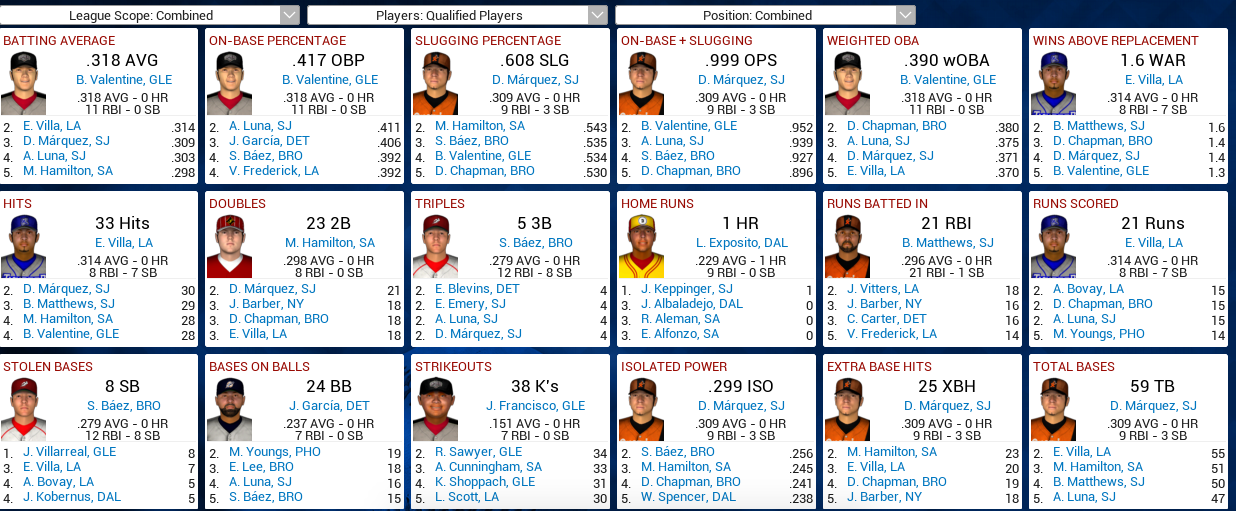
Screen Shot 2016-01-29 at 3.46.28 PMThere have been two HRs (both inside-the-park) hit in the entire league. The batting leader is hitting just .318. Mark Hamilton of the San Antonio Coyotes has 28 hits… 23 of them doubles.

Now, let’s look at the pitchers:

Screen Shot 2016-01-29 at 3.50.34 PM0.58 is leading the league in ERA amongst starters. Manny Lopez, by the way, had a 8.53 ERA back when the Arena Baseball League lived up to it’s name.

Okay, now let’s zoom to the All-Star Break…

Screen Shot 2016-01-29 at 3.56.45 PMOof. As you can see, the total number of Home Runs now stands at 3. The leading batting average is .312, and that’s the only BA over 300. The leader in doubles would already be tied for 30th all-time in a single season in the real world.

The pitching standings similarly continue to be a bit off-kilter:

Screen Shot 2016-01-29 at 4.05.39 PMAmazingly, despite how good all of these pitchers seems to be, there has only been one no-hitter in the first half of the season… and it was barely in the top ten best pitching performances of the half!

Screen Shot 2016-01-29 at 4.06.45 PMWowzers.

Now, let’s go to the end of the regular season and look at what has come:

Oh. Oh dear…

Screen Shot 2016-01-29 at 4.14.51 PMThe best batting average is a .304. .304. That is 1968 level of bad hitting (in 1968, Yastrzemski won the AL title with a .301). However, the doubles record of 67 has been demolished, and Arturo Luna had more triples than any MLB player has had since 1925.

Now, how about pitchers?

Screen Shot 2016-01-29 at 4.21.00 PMA 0.99 ERA in 208.2 IP is very impressive, needless to say, and 306 strikeouts is more in a season than any pitcher has had since Randy Johnson was in his prime. Amazingly, there was only one no-hitter: Ron Turner’s in the first half.

Now, let’s look at the league as whole, shall we?

Screen Shot 2016-01-29 at 4.26.17 PM8 total home runs. 6998 total doubles. 564 total triples. The league as a total hit .215. Well, at least what hits did happen were usually exciting, right?
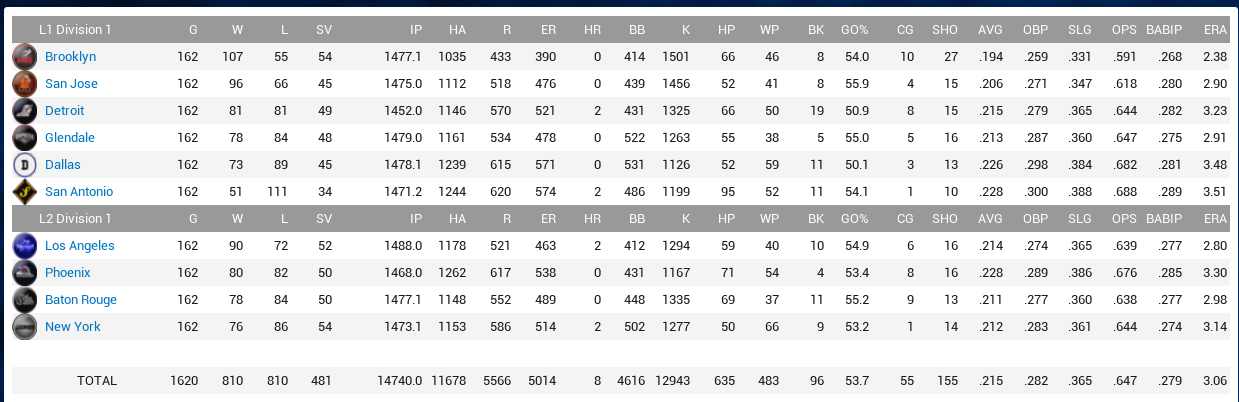
Screen Shot 2016-01-29 at 4.29.26 PMKind of surprised the league ERA was 3.06. I thought it’d be a little lower.

So… what did we learn? We learned that pushing the fences way back is bad for offense but will cause any balls that get past the outfielders to allow for extra bases. We learned that nothing particularly “game-breaking” occurs in OOTP if you do this. And, uhm, we learned that having deep outfield fences is nowhere near as fun to write about as arena-ball fences. I mean, yes, this is partly because I’m distracted by other blogathon concerns, but it was way more fun writing about insane scores statistics as opposed to what more-or-less was just a deadball era.

Next Time on Breaking OOTP: The most controversial Breaking OOTP yet

At 8 PM: BIZARRE BASEBALL CULTURE

This post has been part of the 2016 Baseball Continuum Blogathon For Charity, benefiting the Roswell Park Alliance Foundation. The Roswell Park Alliance Foundation is the charitable arm of Roswell Park Cancer Institute and funds raised will be “put to immediate use to increase the pace from research trials into improved clinical care, to ensure state-of-the-art facilities, and to help improve the quality of life for patients and their families.” Please donate through the Blogathon’s GoFundMe page.
 

(Blogathon ’16!) The Sliding Scale of Fictional Baseball Realism

This post is part of the 2016 Baseball Continuum Blogathon For Charity, benefiting the Roswell Park Alliance Foundation. The Roswell Park Alliance Foundation is the charitable arm of Roswell Park Cancer Institute and funds raised will be “put to immediate use to increase the pace from research trials into improved clinical care, to ensure state-of-the-art facilities, and to help improve the quality of life for patients and their families.” Please donate through the Blogathon’s GoFundMe page.

Earlier today, in my look at Touch, I mentioned that you can make a 0-10 scale of baseball realism in works of fiction, with zero being baseball-in-name-only and ten being actual footage of a game.

Well, I’m going to expand upon that:

0: Baseball In Name Only

In this category, it’s not really baseball at all. They may call it baseball, but it certainly isn’t the actual sport that we know. The Moe Cronin version of baseball fits here.

1: Utterly Absurd

In this category, while it’s clearly meant to be baseball, the rules of the game and the laws of physics have clearly taken a vacation. Some classic cartoons fall into this category.

2: Very Absurd, but still with some realism

In this category, the work might have cartoonish physics and occurrences, but it still is grounded in reality enough to have the rules of baseball still be mostly the same. In theory, a baseball movie where the rules are not consistent or are wildly different but where everything else is played straight could also qualify here. Classic cartoons that aren’t “utterly absurd” usually fall in this category.

3: Absurd, but mostly consistent

Works in this category are clearly absurd and cartoonish, but are at least consistent: the laws of physics may not be what they are in the real world, but they don’t suddenly change mid-game, nor do the rules suddenly change simply because the story demands it. Most “cartoon” baseball video games, like Backyard Baseball and the Mario Baseball series, fit in this category.

4: Many absurd elements

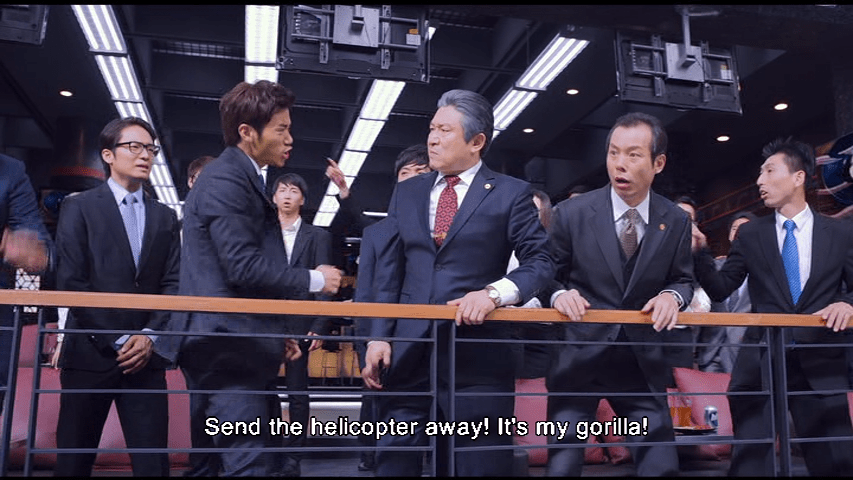
While clearly meant to be a realistic world that has our baseball’s rules and our laws of physics, the amount of absurd, cartoonish or unrealistic elements in the work make it more strange than realistic. Consider Mr. Go, for example, which has two baseball-playing gorillas, a little girl acting as a first-base coach and a finale that involves the baseball coming undone into a million pieces, which sort of overwhelms what would probably otherwise be a 6 if, say, it only had one gorilla.

5: Equal Mix of Realism and Fantasy

A work that sort of teeters between being realistic and being bizarre. This is more of a transitional spot on the scale, as it’s rare that anything ever stays at 5, inevitably going to 4 or 6 instead.

6: Realistic, but with one or two “big lies”

This is mostly realistic but it has one or two big elements (or the equivalent of one or two big elements made up of lots of smaller elements) that keep it from being something that you can honestly expect to ever happen in the real world. Sidd Finch could fit here, as could most of the movies in which a kid becomes a big league skipper or ballplayer.

7: Realistic, but highly unlikely

There’s nothing in this work that couldn’t happen, but it’s highly unlikely and any real event like this would probably instantly become one of the most notable things in baseball history. You could argue that Major League fits here, sort of.

8: Near total-realism

While some rules might be bent or not enforced on a strict basis, and some things might happen that are unlikely (although not nearly as unlikely as things that fall at seven on the scale), this is pretty realistic. Casey At The Bat, the classic poem, could be considered as this, with only the ability of everybody to seemingly hear everything keeping it from being a nine.

9: Utter realism

The only things that are not realistic in works of this category are omnipresent techniques like camerawork and editing for time, or stylish touches added in to indicate, say, that a player is angry. Bull Durham could, in theory, fit in this category, as could most (but not all) fairly true-to-history biopics and most realistic baseball video games.

10: Actual Baseball Footage used/Documentary

If you are watching an actual baseball game, or watching a documentary that uses baseball footage and does so without changing things for dramatic effect, you are watching a 10.


Feel free to consider where on the sliding scale your favorite piece of baseball fiction would fall!

6 PM: First References

This post has been part of the 2016 Baseball Continuum Blogathon For Charity, benefiting the Roswell Park Alliance Foundation. The Roswell Park Alliance Foundation is the charitable arm of Roswell Park Cancer Institute and funds raised will be “put to immediate use to increase the pace from research trials into improved clinical care, to ensure state-of-the-art facilities, and to help improve the quality of life for patients and their families.” Please donate through the Blogathon’s GoFundMe page.
 

(Blogathon ’16) Mr. Go, if adapted for American audiences

This post is part of the 2016 Baseball Continuum Blogathon For Charity, benefiting the Roswell Park Alliance Foundation. The Roswell Park Alliance Foundation is the charitable arm of Roswell Park Cancer Institute and funds raised will be “put to immediate use to increase the pace from research trials into improved clinical care, to ensure state-of-the-art facilities, and to help improve the quality of life for patients and their families.” Please donate through the Blogathon’s GoFundMe page.
Mr. Go. The classic tale of a girl, a gorilla, and the Korean Baseball Organization. Truly, one of the greatest Bizarre Baseball Culture entries of all time, and one you should totally consider purchasing if you are a fan of such things. But what if it was brought to American screens? How would it be adapted?

I have a few ideas:

The cute little Chinese girl, Weiwei, would stay, as would the backstory of her and her gorilla, Ling Ling. Similarly, the main antagonist of the film would be Liao Xiaogang, AKA “Tianjin Guy”, a corrupt nouveau-rich businessman/gangster.

This is a purely economic move. China is now one of the leading movie-going countries in the world, and the only way a baseball movie is going to get any attention there is if it has a Chinese person in it. Also, so much of what drives the plot is the fact that Weiwei is an outsider just trying to keep her friends and circus at home from being folded up.

The jerk-with-a-heart-of-gold scout, Sung Choong-Su, would instead be an American named Samuel “Sunny” Chance, played by James Franco.

For one thing, James Franco has experience with apes, and also he is able to do both comedy and drama, which this film would require. Also, I think civilization in general needs to see James Franco make drunken confessions to a baseball-playing gorilla who is also drunk.

Instead of going to the Doosan Bears, Ling Ling/Mr. Go would be a member of the San Diego Padres.

Don’t try to argue with me on this, you aren’t going to win.

The general manager of the Padres will have an expanded role and be played by John Goodman.

Because, really, imagine John Goodman delivering this line:

Jonah Hill would make a cameo as a sabermetrics expert who suggests how they can best use Mr. Go.

Both because he’s always in movies with James Franco, and as a reference to Moneyball.

There would be a subplot about how some people think Mr. Go isn’t playing the game the right way after he unleashes an epic bat-flip.

It’d provide realism to the affair.

After Mr. Go’s rampage, Weiwei and him would go on Jimmy Kimmel to prove he isn’t a monster.

Of course they would.

Instead of a bidding war between the Chunichi Dragons and Yomiuri Giants, it would be the Red Sox and Yankees.

Because of course it would be.

The veterinarian’s role would be expanded and made into a female love interest for Franco’s character, probably played by somebody quirky like Zooey Deschanel or wittily sarcastic like Anna Kendrick.

Because every goddamn movie, it seems, needs a love interest of some sort, and it sure as heck isn’t going to be Weiwei and Franco.

The NC Dinos, the main opponent of Doosan, would be replaced by the Dodgers. Also, the Division Series at the end of Mr. Go would be replaced with a final regular season series where the NL West title is on the line.

This both would better explain why every game is a home game for Mr. Go (in the Korean movie, they come up with an excuse about renovations at NC’s stadium) while still providing plenty of drama.

Leiting, the evil pitching gorilla who faces Mr. Go, will be renamed “Lightning” instead of “Zeros”.

Because Zeros was a dumb name.

The ending would be left more open to the “Football-playing Gorilla” sequel than the original movie was.

Every movie needs to have a opening for a sequel.

And, finally, it goes without saying that Andy Serkis would be playing Mr. Go.

Duh.

At 4 PM: AAA.

This post has been part of the 2016 Baseball Continuum Blogathon For Charity, benefiting the Roswell Park Alliance Foundation. The Roswell Park Alliance Foundation is the charitable arm of Roswell Park Cancer Institute and funds raised will be “put to immediate use to increase the pace from research trials into improved clinical care, to ensure state-of-the-art facilities, and to help improve the quality of life for patients and their families.” Please donate through the Blogathon’s GoFundMe page.


(Blogathon ’16) Three Mini-Book Reviews

This post is part of the 2016 Baseball Continuum Blogathon For Charity, benefiting the Roswell Park Alliance Foundation. The Roswell Park Alliance Foundation is the charitable arm of Roswell Park Cancer Institute and funds raised will be “put to immediate use to increase the pace from research trials into improved clinical care, to ensure state-of-the-art facilities, and to help improve the quality of life for patients and their families.” Please donate through the Blogathon’s GoFundMe page.

And now, short reviews of three baseball-related books I’ve read somewhat recently:

Spalding’s World Tour: The Epic Adventure that Took Baseball Around the Globe – And Made It America’s Game, by Mark Lamster: Fun book on the Spalding world tour of 1888-89, set alongside the backdrop of the emergence of America as a world power, Spalding’s entrepreneurial and publicity-seeking abilities, and early labor tensions in baseball. Informative and entertaining about an interesting topic that isn’t wide known, and also provides several examples of Cap Anson being such an asshole you want to find a time machine in order to go back and throttle him. Seriously, Cap Anson was just the worst.

Yes, It’s Hot in Here: Adventures in the Weird, Wooly World of Sports Mascots, by AJ Mass: Written by a former Mr. Met turned ESPN fantasy sports writer, this book is a funny look at the world of mascots, and includes disputes with the Famous Chicken, the Mets’ front office being clueless, and looks at the many different people who don the mascot costumes. Not exactly hard-hitting and deep, but it doesn’t need to be.

Nuclear Powered Baseball: Articles inspired by The Simpsons episode “Homer at the Bat”, edited by Emily Hawks and Bill Nowlin: This e-book from SABR reprints biographies and articles about the classic “Homer at the Bat” episode, as well as a faux-“bioproject” entry for Homer Simpson himself, a listing of baseball players referenced on the show, and Joe Posnanski’s article on “MoneyBART”, the episode of The Simpsons about sabermetrics. Available free to SABR members (but available for sale to non-members), I don’t know if I’d pay money for it, but it’s definitely a fun tribute to one of the greatest baseball episodes in TV history.

At 1 PM: A short break to let you know what is available as giveaways if you donate to the Blogathon.

This post has been part of the 2016 Baseball Continuum Blogathon For Charity, benefiting the Roswell Park Alliance Foundation. The Roswell Park Alliance Foundation is the charitable arm of Roswell Park Cancer Institute and funds raised will be “put to immediate use to increase the pace from research trials into improved clinical care, to ensure state-of-the-art facilities, and to help improve the quality of life for patients and their families.” Please donate through the Blogathon’s GoFundMe page.

(Blogathon ’16) Songs of October (Post-2015 update)

This post is part of the 2016 Baseball Continuum Blogathon For Charity, benefiting the Roswell Park Alliance Foundation. The Roswell Park Alliance Foundation is the charitable arm of Roswell Park Cancer Institute and funds raised will be “put to immediate use to increase the pace from research trials into improved clinical care, to ensure state-of-the-art facilities, and to help improve the quality of life for patients and their families.” Please donate through the Blogathon’s GoFundMe page.

For the far-too-late update on what happened in 2015, go to the bottom of the post after the jump.

In 2013, there was a sensation that spread across the nation: Mups. Their spread was unstoppable, to the point where some like the “Cespedes Family BBQ” and Jesse Spector had begun to engage in a “#Mupwatch”. But some wondered: What was a Mup? Were they some sort of Muppet? Were they dangerous? And why were they being lit on fire?

Well, the answer lay in the commercials that had been playing in the lead-up to and during the post-season, featuring Fall Out Boy’s “My Songs Know What You Did In The Dark”. Here is an example of such a commercial. While officially they were saying “Light ’em up”, it sounded, especially during the echoing segments, like they were actually talking about things called “mups”.

And thus continued a long tradition of October songs that have graced our televisions and infected our ears, whether we liked them or not. And, usually, if we DID like them at the start of the postseason, we ended up being sick of them by the end just from hearing them so many times.

And, what’s more, these songs and how they have become memes aren’t from a universal source. Most of them, for example, have been part of TBS’ coverage, but others, including the Fall Out Boy song, have actually been of MLB’s doing. In 2013, for example, TBS was using a different song*, and MLB Network itself also had a different song for the commercials for it’s two games**. Rarely if ever have they been actually about baseball, usually selected more for their choruses or imagery.

*Using Google searches of the lyrics I was able to decipher, I’ve figured out it’s 30 Seconds to Mars’ “Do or Die”.

**Again using Google, I’ve found that the commercials use the chorus from Papa Roach’s “Still Swingin’“.

Still, with that out of the way, here’s a history (after the jump) of the Songs of October:

Continue reading

My super-duper-short prediction for NFL Conference Championship Weekend, 2016.

Aside

The Patriots and Panthers will win.

Super-short prediction for the 2016 NFL Divisional Round

Aside

As I said on Twitter, I predict that the Chiefs, Cardinals, Seahawks and Broncos will win this weekend.

Short Predictions for the NFL Wild Card Round (2016)

Some short predictions for this week’s NFL playoff games:


The Chiefs are hot, and have been hot ever since they got out of a very poor start to the season. So much of the NFL playoffs is who is hot at the right time, so I think the Chiefs will beat the Texans.

The Bengals would have been my pick to win against the Steelers… but then Andy Dalton got hurt a few weeks ago. So, I’m picking the Steelers.

Seattle beat up on the Vikings earlier in the year, and even with Marshawn Lynch not available (again) I think they will win again in the freezing cold of Minnesota.

The Packers have been stumbling a ton the later part of the season, but I feel like Aaron Rodgers is ultimately going to wake up (and hopefully be protected long enough) to beat Washington.


So… I picked…. all road teams.

Weird.


Coming later this month: “International Baseball Culture”

Bizarre Baseball Culture is perhaps my most popular segment on the Baseball Continuum. In it, I, as I say: “…take a look at some of the more unusual places where baseball has reared it’s head in pop culture and fiction.” It’s seen comic books, video games, novels, TV episodes, animated shorts, a radio drama, and even a full-length movie. They’ve ranged from the well-known to the hyper-obscure, leading Michael Claire to dub me the “Indiana Jones of baseball comics“, which I guess isn’t the worst thing to be put on a tombstone.

Anyway, in search of good material, I have recently began to look overseas. Some of my favorite Bizarre Baseball Culture posts have been from elsewhere in the world. The Pokémon episode, for example, was pretty popular. Mr. Go might have been the most fun I’ve ever had doing Bizarre Baseball Culture (well, until you see what the 50th installment is). My most recent installment was, of all things, an episode of an Ultraman TV series.

However, here’s the thing: it is stupid to assume that everything foreign is bizarre. Oh, to be sure, plenty of it is, just like how the American-made works of fiction I’ve covered here on the Continuum have been bizarre (intentionally or not). I mean, no matter what country it was made in, a movie about a gorilla playing baseball would have been bizarre.

But to say it is all bizarre, simply because it is foreign, would be highly ignorant and also disrespectful. These are places with their own traditions, not only in baseball but in their popular culture. To immediately dub a fairly mundane (i.e. no baseball-playing gorillas or evil glove monsters) baseball comic from Japan or a baseball film from Korea “bizarre” would be like being the baseball entertainment equivalent of the crotchety old columnist who claims that Latin American players aren’t playing the game the “right way” despite the fact that that’s the way they’ve played all their lives. And, guess what, I am not a crotchety old columnist, although I wish I was being paid like one.

So, with that out of the way, I am proud to announce that, starting with a piece in this year’s blogathon, there will be a new recurring feature on the Baseball Continuum: International Baseball Culture. It will cover baseball entertainment from outside the United States and sometimes Canada* that isn’t “bizarre”. Now, there will continue to be foreign-sourced baseball works in Bizarre Baseball Culture, but they will only be those that would qualify for the series due to their content. If it turns out that there’s a Mexican movie in which luchadores play baseball against mermen from Atlantis, that’s still going into Bizarre Baseball Culture. But if it’s a serious drama about a baseball team called the “Luchadores” who are playing a team called the “Mermen”, that would be International Baseball Culture.

So, please join me during the Blogathon when I begin my International Baseball Culture travels with the beginning of a series of articles on Mitsuru Adachi’s Touch, a baseball dramedy/romance manga and anime that won awards, set viewership records in the 1980s, and was in 2005 named one of the ten greatest anime ever… and yet has never seen an official release in North America.

*I’ll be taking Canada on a case-by-case basis. For example, you could argue that the works of W.P. Kinsella are Canadian because Kinsella is from Canada, but you’d be ignoring the fact that most of his baseball stories are set in America and deal pretty specifically with American baseball. But if somebody were to make a French-language drama about a man and a woman who fall in love over their shared longing for the return of the Montreal Expos, that would probably fall under International Baseball Culture.

Best of 2015- Bizarre Baseball Culture: Fallout 4’s surprisingly-high level of Baseball

Originally published November 24, 2015.

In Bizarre Baseball Culture, I take a look at some of the more unusual places where baseball has reared it’s head in pop culture and fiction.

(Note: The following contains spoilers for Fallout 4. Click on each picture to make it larger if you are having trouble reading text or seeing something.)

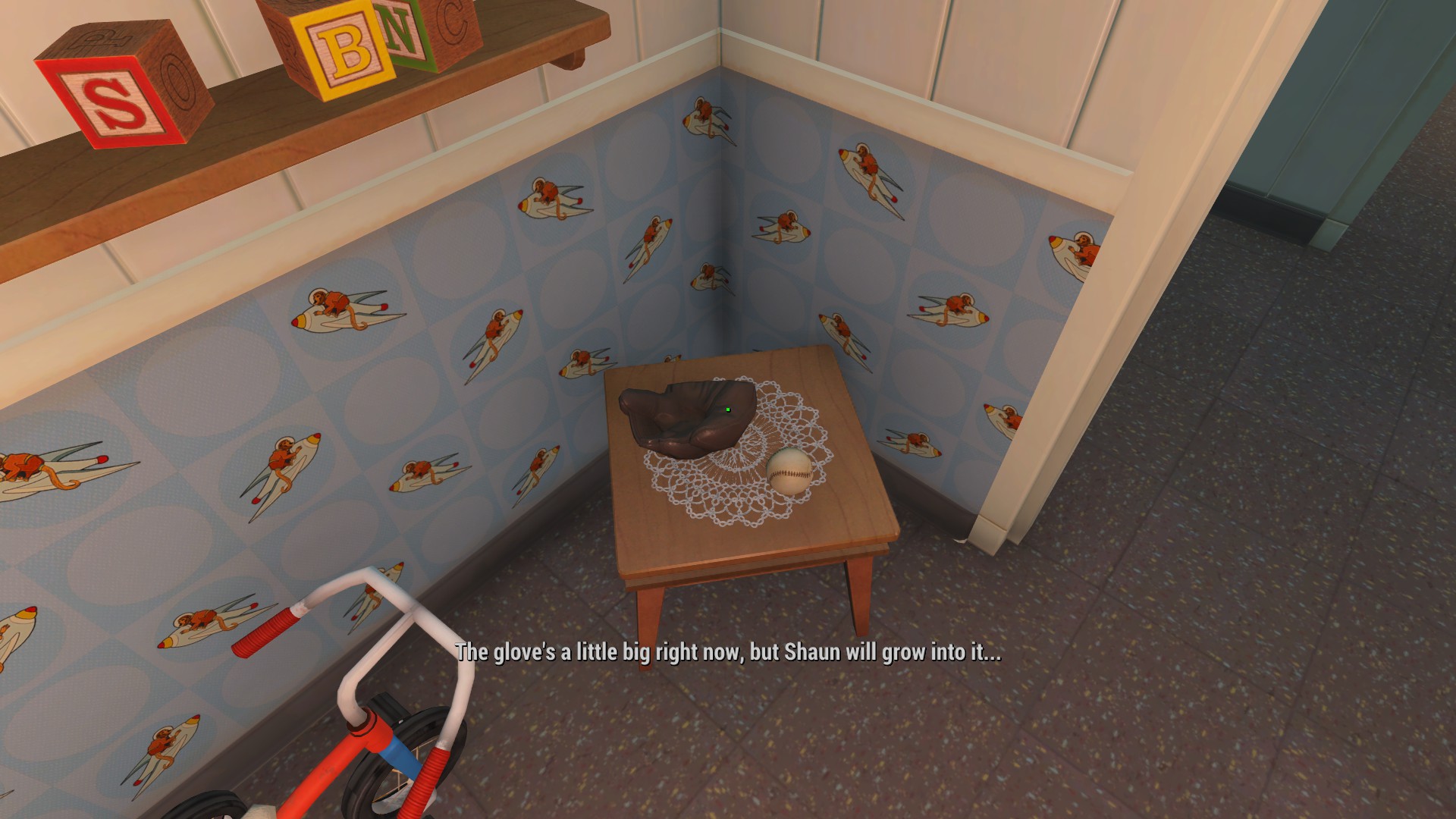
It is October 23, 2077. The world is at war, and fear of nuclear annihilation is high. However, for you, it is just another day in a Boston suburb with your spouse and your young son. And, obviously, your son, Shaun, is a baseball fan in the making, as you can see a small glove and ball that you can comment on:

ShaunGlove

shaunball

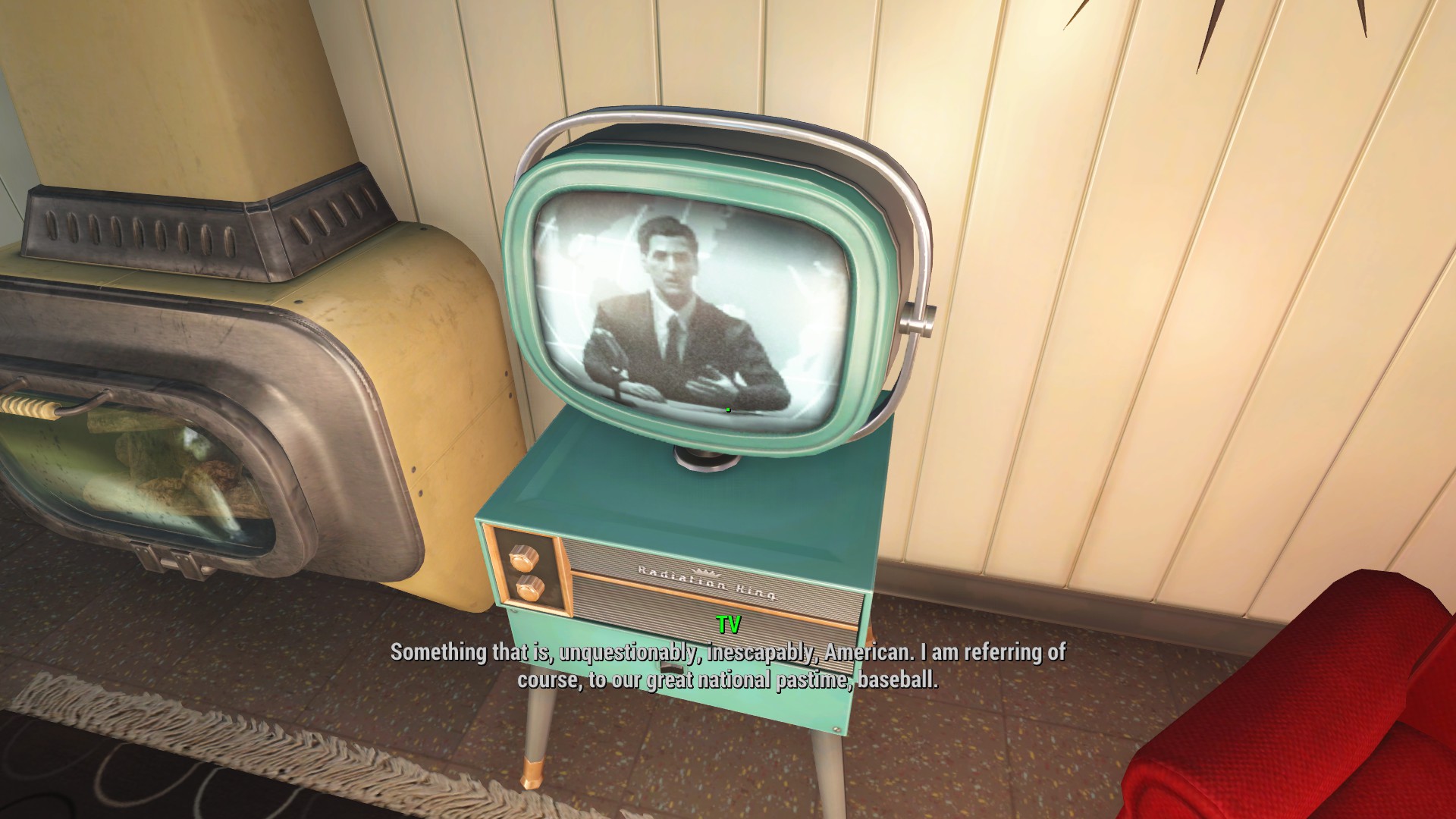
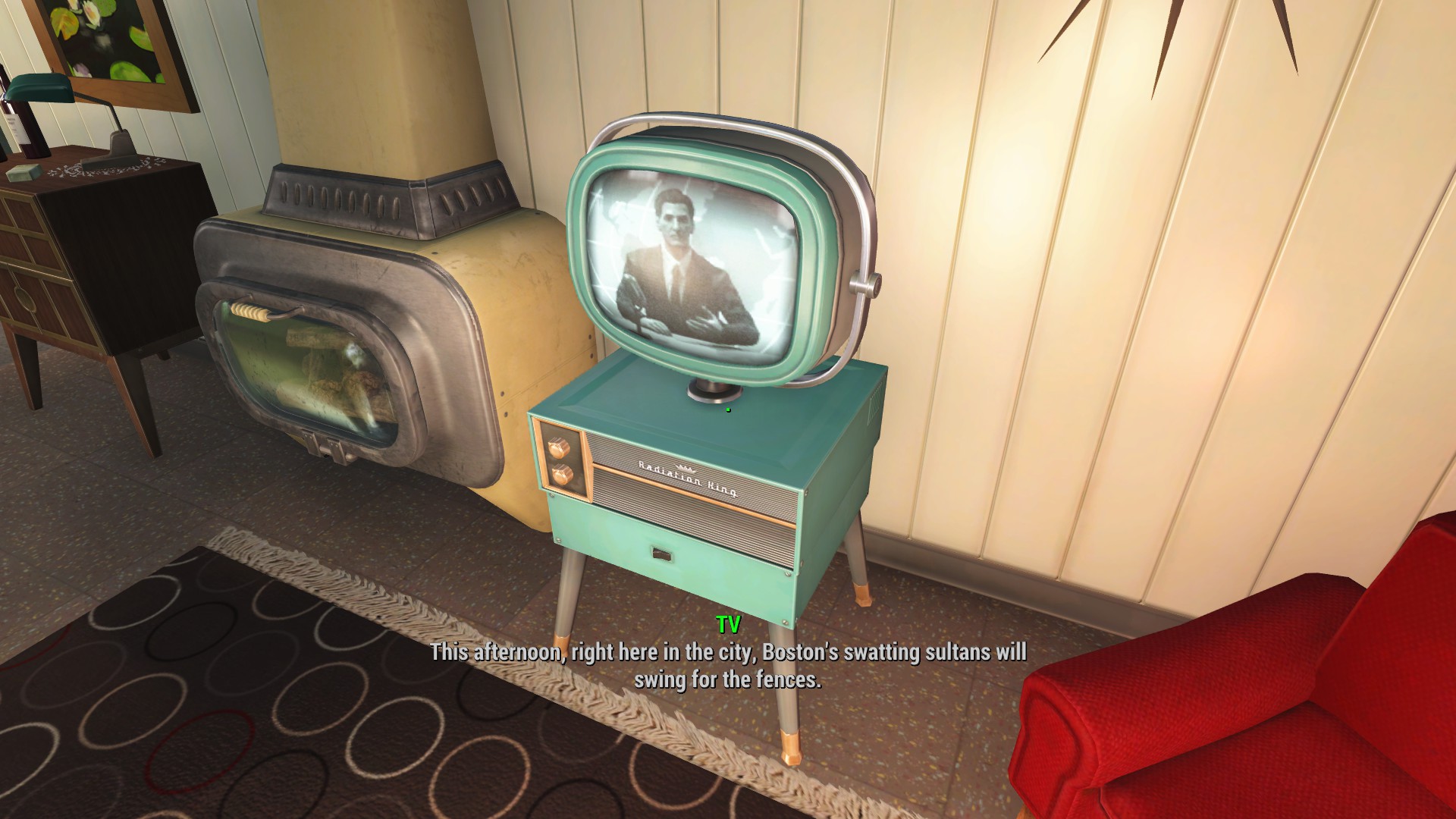
As you receive your coffee and paper from your robotic butler, Codsworth, you hear something in the corner of your living room. On a black-and-white TV, a newsman with the voice of Ron Perlman (who has a role in every Fallout game, usually as a narrator of some kind) updates you on the day’s events and weather before going to sports:

perlman1

perlman2

perlman3

Yes, it’s World Series time in Boston, as the Red Sox are looking to win their first title in over a century and a half!

You are then interrupted by a salesman selling a spot in a underground fallout shelter, called a Vault. After that’s done, you go check on your son and talk to your wife. She thinks maybe everyone should go for a walk in the park this afternoon. Pffft, you say:

misstheworldseries

Of course, you do end up missing the World Series. After this conversation, you get news that atomic missiles are incoming. You rush to the nearest vault. Stuff happens, and you wake up 210 years later with your wife gone and your son missing.

(More below the jump!)

Continue reading