Great Baseball Lies: “Keep your eye on the ball!”

Baseball is full of lies. One of them is pounded into every Little Leaguer in America: you need to keep your eye on the ball from as soon as it leaves the pitcher’s hand until you are ready to swing the bat.

I was told it. You were told it. Everybody was told it. It also doesn’t help whatsoever. Mainly because, if the ball is going any faster than a beer league softball, you aren’t going to be able to see it for any long span of time, and certainly not all the way to the plate. The ball is just going too fast. This has been known for over half of a century.

So what, exactly, do baseball players who are successful actually do? Well, they basically guess and anticipate where the ball is going based on those split-seconds they have to see the ball. This is why a good change-up so fools a hitter if they’ve been getting lots of fastballs: they are expecting a 90+ MPH pitch, so time their swing based on that assumption.
So, remember kids: don’t keep your eye on the ball. Instead, take a quick glance and then guess where it’s going. I mean, I always kept my eye on the ball, and look at me: I washed out of baseball by the age of 11.

Lost history: A US-Cuba Series was “likely” in the late 70s

According to a December 22, 1977 article from the AP in the Youngstown Vindicator, there were discussions of a series between an MLB All-Star Team and the Cuban National Team:

It, of course, never happened. It wasn’t until the late 90s that MLB players (the Baltimore Orioles) played the Cuban National Team. The two teams split a home-and-home series.

For those wondering, Cuba’s record against teams in the World Baseball Classic that have had large numbers of MLB players is mixed: they had a 3-2 record in 2006 against teams with large numbers of MLB players (Puerto Rico, Venezuela and the Dominican Republic) and had a 2-0 record against Mexico in the 2009 WBC (the rest of their games were against teams that were either made up of predominantly foreign league players, or against mainly minor leaguers).

The Yankees are just trying to play their role now

The Yankees have traded for Ichiro. A few years ago, this would have been earth-shattering news that would have caused large amounts of hair to be pulled out, rioting would have engulfed the Northwest (it still might- they still are justifiably angry about losing the Sonics) and every person with a keyboard would have declared this another sign of the inequity of baseball’s markets.

Now though, it seems almost as if the Yankees are doing this just to remind everyone that, yes, they are the Yankees, and, yes, they are willing to get well-known players who are past their prime in order to aid in the yearly quest for a world title.

This isn’t to say this is a bad deal: Ichiro still definitely has his moments, and has enough talent that he could easily go on a tear for the rest of the season. In addition, the two pitchers they gave up (D.J. Mitchell and Danny Farquhar) don’t seem to be anything special- it’s not like they are trading Jay Buhner for Ken Phelps. It’s just that I don’t this is the big deal that some may make it out to be. Ichiro is a legend, a future HOFer, and still one of the best quotes and most exciting players in baseball on his best day, but this is hardly the deal that will win the Yankees the pennant.

The 1942 Service All-Star Team

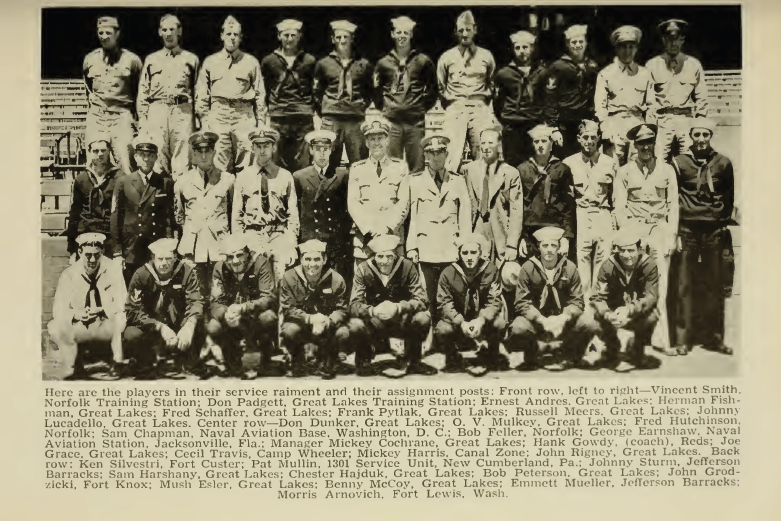
In 1942, the AL All-Stars played a team of players who had entered military service but who had yet to go to the Atlantic or Pacific Theatres. There is information on that game in the 1943 Baseball Guide by the Sporting News (available on archive.org), as well as this picture of the team (you can click the photo to see it bigger, so that the names are more visible):

Among the players you can find in this photo are Bob Feller, Mickey Cochrane (who managed), Hank Gowdy (who was a coach) and a variety of other major leaguers such as Cecil Travis, George Earnshaw, Mickey Harris, Sam Chapman, Pat Mullin, Benny McCoy, and others.

Party like an Aught-Star: Ben Sheets and the Oakland Athletics

Ben Sheets is now 2-0. The Athletics have beat the Yankees three straight to open their series. Although I can’t be sure, I’m going to have to guess that I’ll be playing a Nintendo Gamecube tomorrow, as soon as I finish the last chapter of the latest Harry Potter book.

Yes, it is true, we have seemingly done a time-warp into the first decade of the 21st century. The Aughts, as they are sometimes called, since saying “The 2000s” is kind of unclear as to whether you are talking about the decade or the century.

The Aughts were good to the Oakland Athletics and to Ben Sheets, but they had fallen on hard times by the 2010s. Now, however, they seem to be turning things around.

Continue reading

In the 1940s, you could actively stalk baseball players

Before the internet, or even The Baseball Encyclopedia, stats for previous seasons often were in the form of baseball guides, often from The Sporting News.

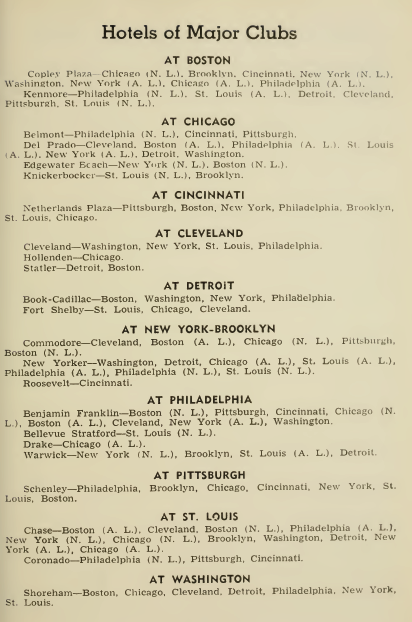
Also in there, however, were more strange things. Some of them, for example, had a listing of where the visiting teams stayed. Now, even today you can often figure out where visiting teams stay in town due to ads that might say “Official Hotel of the Boston Red Sox” or something similar, to the point where most baseball players have aliases that they check in with that don’t reveal their fame (although Rickey Henderson, ever the master of disguise, went by the alias of “Richard Pryor”)

Anyway, if you are caught in a time warp and find yourself in the early 40s and want to visit some players, you can find them here, from the 1943 edition of the Baseball Guide and Record Book (found for free on archive.org):

Taking a day off

I was going to write a off-topic story about what I was looking forward to with the release of The Dark Knight Rises. But after hearing the tragic news from Colorado this morning, I feel as if it would be in some ways insensitive to do so.
My thoughts are with the victims and their families.

The Second Episode of 2012’s “The Franchise” saw Ozzie Guillen say the F-Word about 18 times, and other observations

The second episode of this season of The Franchise wasn’t as long or as good as the first, but it still entertained while providing a unique look at the Miami Marlins, focusing primarily on Giancarlo Stanton’s surgery, Logan Morrison’s trip back to his hometown of Kansas City, and the unexpected rise of Justin Ruggiano, but still getting in some good Ozzie Guillen sounds before the end, as he chewed out the team immediately following the All-Star Break. Thoughts and the “Ozzie Guillen ‘Carlin Words’ Counter” after the jump:

Continue reading

“Moneyball” is a book that has shaped America. No, seriously.

The Library of Congress recently released a list of 88 Books that Shaped America, which are part of a current exhibit at the Library. It’s a pretty good list of books (which had to either be written by an American or by somebody who became an American), and it’s hard to argue with most of them. However, it’s missing something big: sports. America is the most diverse and sports-loving country on Earth. Most countries focus on only one sport (usually soccer), but America has many sports, and it affects our language and culture. We ask for ballpark figures and play Monday morning quarterback. Something that is a certainty is a slam dunk. It’s one of the last few universal experiences: at a sporting event, nobody cares (or at least 99.9% of people don’t care) what party you vote for or what you do for a living.

That the LoC would so ignore this aspect of American life is disappointing, especially because there are plenty of good sports books out there that have shaped America. Jim Bouton’s Ball Four was one of the first books to openly tell things like they were and show the public’s heroes with all of their flaws. Buzz Bissinger’s Friday Night Lights highlighted the importance of football in small-town Texas, and later was made into a movie and TV series. Juiced was hardly a triumph of literary genius, but it can’t be denied that Canseco shaped not only baseball but America, leading to the government hearings and efforts by all sports (although people only cared about what baseball did) in trying to fight it.

However, if I could add in one sports book to the Library of Congress list, it would be Michael Lewis’ Moneyball.

(jump)

Continue reading

Billy Hamilton is the fastest man alive

Watching the Futures Game out of the corner of my eye a few weeks ago, a guy named Billy Hamilton (Reds Organization) hit a triple. A very, very, fast triple. A triple that, if the outfielders had been slower or the outfield walls has been deeper, he could easily have attempted to make into an inside-the-park home run.

A few days ago, he did hit a inside-the-park home run. Not only that, but he did it in 13.8 seconds… while not even going full-speed near the end. Oh, and he has 109 stolen bases between A and AA this season. The all-time pro record for a season is 145, which Vince Coleman pulled off in A-ball during the 1983 season.

(more after jump)

And Hamilton isn’t exactly a one-trick pony, he hit .323 in a half-season of A-Ball. Barring injury, he could end up as a runner-off-the-bench for the Reds come September. After all, he’s way too fast to just be left in the minors once crunch-time comes, especially for a National League team.

By the way, Hamilton’s dash around the bases in 13.8 seconds- roughly 360 feet- is in itself a impressive athletic feat. It means he was averaging about 17.79 MPH during the run. If Hamilton were to hold that speed for just 100 meters, he’d finish in about 12.57 seconds. That isn’t exactly Usain Bolt, but then again it wasn’t exactly a straight sprint and Hamilton was running on dirt and grass instead of smooth pavement, so the comparison doesn’t really work… does it?

Interestingly, Billy Hamilton was also the name of a Hall of Famer from the late 19th century. “Sliding Billy” Hamilton also was quite the base stealer: he had 914 in his career, which was the most of all time until Lou Brock broke his record in 1978. He still is third overall.

So keep an eye out for Sliding Billy 2.0, he’s running his way through the minors, and it is probably only a matter of time before he is testing the arms of MLB catchers.