Headlines from around the Continuum: November 30, 2012

Headlines from around the world, courtesy of the Newseum’s website.

Story: Denard Span traded to Nationals for prospect Alex Meyer

Star Tribune (Minneapolis): SPAN DEALT TO NATS (Subhead: “Twins get pitching prospect Meyer in trade”)

Washington Times (Washington Post didn’t have any big headlines about it): Nationals fill need, acquire center fielder Denard Span.

Denard Span himself:


Sadly, my original plan to include reactions to David Wright’s new deal was foiled by the fact it happened after press time for most papers. Perhaps tomorrow.

A detailed look at the BBWAA HoF ballot, Part 1: The Unquestionable and the guys who may have been HoF before alleged drug use and so may make it anyway

In a world without steroids, where all of the magic numbers of the 1990s and early 2000s were just because of superhuman ability and extremely hard work, this is how this article would start:

“Bonds, Clemens, Piazza, Sosa, Biggio, and perhaps Schilling. That’s five, maybe six sure-fire HoFers coming onto the ballot this year, and Kenny Lofton, while not a Hall of Famer in my opinion, should certainly be expected to stick around the ballot for awhile. Not to mention this could be the year Jack Morris gets in. The biggest worry, really, is whether it’s possible to get more than three or four of them in this year and whether the Cooperstown Chamber of Commerce can handle the pilgrimage that will besiege the village, likely the largest group since Cal Ripken, Tony Gwynn and Mark McGwire were inducted in 2007…”

Of course, steroids did and do exist, so instead of having five or six sure-fire Hall of Famers on the ballot, it’s a picture that is far less clear. Oh, and Mark McGwire? He wasn’t inducted in 2007. In fact, he’s still on the ballot right now, and likely will remain. Same goes for Rafael Palmeiro, who has even less of a chance than McGwire of one day having a plaque up in Cooperstown’s halls. Both of them would have already been inducted, probably in their first year, had it not been for steroids.

So, instead, we have many categories and shades of grey. Over the next few days, I’ll take a look at those categories.

Unquestionably Hall of Fame, Probably First Ballot:

Craig Biggio: Only three men have had 3000+ hits, 200+ home runs, and 400+ stolen bases. Two of them are Paul Molitor and Rickey Henderson. The third is Craig Biggio. Add in his defensive flexibility (he played 2B, C and OF during his career) and the fact that there isn’t a whiff of steroid scandal around him, and he’s a shoo-in for the Hall of Fame.

Mike Piazza: Piazza has had some steroid stuff around him, but it’s generally been hearsay (he had back acne, according to some people) and general innuendo about the fact that he played during the steroid era. That’s not enough for me, and I don’t think it’ll be enough for the voters. Piazza was, quite simply, the best power-hitting catcher in history. He had more home runs than any other catcher, had a career .308 BA, and made 12 all-star teams.

(Alleged) Steroid-users that may make the Hall of Fame anyway:

Barry Bonds: Without the steroid allegations, Bonds would be so much a slam dunk first-ballot Hall of Famer that the only question would be whether his prickly reputation with the media would keep him from getting 97% or more of the vote. In fact, had he retired after the 1998 season (he allegedly began taking steroids shortly after 1998, partially because of his envy of the attention that Mark McGwire and Sammy Sosa were getting), he would have been a first-ballot Hall of Famer. After all, he’d have retired with 411 HRs, 1216 RBIs, eight All-Star wins, three MVPs, eight Gold Gloves, seven Silver Sluggers, and an OPS of .966 that would be 15th all-time today, ahead of such immortals as Willie Mays, Frank Robinson, Ty Cobb and Duke Snider. Had he kept going after 1998 without (alleged) steroid-use, he still likely would have gotten to 500 HRs, possibly even 600.

Of course, he did end up (allegedly) using steroids, and as a result he grew from being “merely” the best baseball player since Frank Robinson to being the best baseball player since Ted Williams or Babe Ruth. The question is: does the fact he would have been a HoF before his alleged use of PEDs make up for the fact that, well, he allegedly used PEDs? And… I don’t know.

Roger Clemens: Much like Bonds, the question of Clemens will depend on whether voters consider him as having been good enough of a player before his (alleged) drug use. Clemens (allegedly) began using during his time in Toronto, so let’s just question what would have happened if he had had a career-ending injury in a freak accident shortly after the 1996 season ended in. He would have ended his career with a 192-111 record, a 3.06 ERA, 2590 strikeouts and 100 complete games. He also would have three Cy Youngs to his name, as well as an MVP and five All-Star Games. He almost certainly would be elected to the Hall of Fame.

But, once again, his career didn’t stop there. He went on, and (allegedly) made some bad decisions. So the question is far more difficult.


Come back tomorrow for more.

Cheat Sheet: (Almost) All of the Most Recent Champions (as of Nov. 29, 2012)

(Note: Not included are leagues still in session)

So, who’s the defending champion in the….

The Top Leagues:

…MLB? San Francisco Giants

…NPB? Yomiuri Giants

…KBO? Samsung Lions

…CPBL? Lamigo Monkeys

…Mexican League? Rojos del Aguila de Veracruz

The Affiliated Minors:

…International League? Pawtucket Red Sox

…Pacific Coast League? Reno Aces

…Eastern League? Akron Aeros

…Southern League? Mobile BayBears

…Texas League? San Antonio Missions

…California League? Lancaster JetHawks

…Carolina League? Lynchburg Hillcats

…Florida State League? Lakeland Flying Tigers

…Midwest League? Wisconsin Timber Rattlers

…South Atlantic League? Asheville Tourists

…NY-Penn League? Hudson Valley Renegades

…Northwest League? Vancouver Canadians

…Appalachian League? Elizabethton Twins

…Pioneer League? Missoula Osprey

…Gulf Coast League? Gulf Coast Pirates

…Arizona League? Arizona Rangers

…Dominican Summer League? DSL Pirates Team 1

…Venezuelan Summer League? VSL Pirates

(Want more? Go below the jump!)

Continue reading

Random video of the undetermined amount of time: Ichiro is awesome, sells wine doing so

Is this real or fake? Does it matter? Click the link below if it doesn’t show up correctly for you.

#sato #yunker #ichiro suzuki #health and beauty… by JPCMHD

A few statistics that show Marvin Miller’s impact on baseball

Marvin Miller, the man behind the Major League Baseball Players Association’s rise from an ineffective organization to the most powerful labor organization in the history of the country, has passed away at the age of 95. There are many people who have written big in-depth looks at Miller’s impact, and you should check those out. Here, however, I’ll just let the numbers speak for themselves:

$6,000: The minimum salary of a MLB player when Marvin Miller took over the union in 1966.

$19,000: The average salary of a MLB player when Marvin Miller took over the union in 1966.

$241,000: The average salary of a MLB player when Marvin Miller retired in the early 1980s.

$480,000: The minimum salary of an MLB player in 2012.

$3.4 million: The average salary of an MLB player at the beginning of the 2012 season.

Whatever your opinion of Miller, the union or money in baseball, you cannot deny that he, and the union he built, has left a permanent mark upon the way the business of baseball is operated.

Long-Term Deals: The Way to the Future

Two things caught my eye this morning, and while on first glance you would think they aren’t related, in fact they may be tied together.

The first is an article by Jeff Passan on how the money involved with regional sports network deals, such as the one the Dodgers are expected to take that will be between $6 and $7 billion dollars, are going to widen the gap between the rich and poor in baseball.

The second is the news that Evan Longoria has signed a $100 million dollar extension with Tampa that will keep him with the team until as late as 2023, depending on options.
How are these connected? Well, in a word, the events of the first article will probably lead to us seeing more deals like the Longoria deal of the second article.

Consider: the bubble of money that Regional Sports Networks will bring the big market teams- amounts of money that not even revenue sharing will dent all of that much- will make it extremely hard for teams to keep top free agents from leaving. A team like Tampa will just simply be unable to outbid, even on a good day, one of the top markets. While of course there will be some exceptions such as “hometown discounts” and big markets botching negotiations, the fact is that the best way for a smaller market to keep talent will be to make sure that they never leave in the first place. The way to do that? Sign them up early, and sign them up often.

Longoria, for example, had already been signed to a contract extension early in his career, before he became his MVP self. That was a deal extremely kind to the Rays. This second deal is more in line with Longoria’s value, but is also good for the Rays (at least in the short-term), since it means that he won’t be leaving.

Longoria’s deal is just the latest in what has become a trend… but expect it to become the norm as time goes on.

If Indiana Jones looked for baseball things…

If Indiana Jones looked for baseball things, what would he be looking for? I have a few ideas. This is similar to my post in May about the great mysteries of baseball, but is a bit more in-depth.

The Bobby Thomson Ball

Possibly the Holy Grail of Baseball Artifacts, the ball from the 1951 “Shot Heard Round the World” would be potentially worth millions of dollars. However, back then very few people would have thought of that, unlike today, where the ball would have likely been immediately been authenticated and then be handed to either Thomson, the Hall of Fame, or sold at auction.

However, there’s no way of knowing what could have happened to it now. Right? Well, some people have tried. There is a book out there about one man’s search for it, which I should really get out of the library one of these days. But given the fact that there were no big news items about how the ball had been found, I’m guessing the search turned out without the ball in hand.

The Source of Lena Blackburne’s Mud

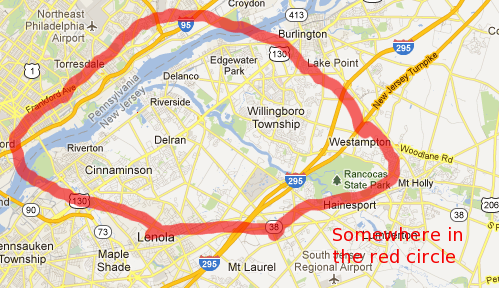
The mud that is put on baseballs to remove the weird new-ball sheen all comes from a single source somewhere in New Jersey. The source of the mud is a closely guarded secret, hidden through the years.

I, for one, once tried to figure out where it was located, at which point I would reveal the location here on this blog, solving the mystery and bringing me miniscule amounts of fame and even less amount of fortune.

I decided against it, however, for three reasons:

A) I felt that revealing a trade secret held by a single family for generations would be in poor taste.

B) If I somehow was right I might’ve gotten sued, or led to some type of strange tourism that would have messed with the ecology of New Jersey’s creeks and rivers, or something.

C) I wasn’t able to narrow it down very much anyway. Seriously, here’s what I was able to extrapolate from the various news articles and other writings about the source of the Rubbing Mud:

That’s a big area, and I wasn’t able to narrow it down any more than that (although I will admit I drew that circle too big). I quit trying when I realized points A and B.

Babe Ruth’s Piano

Tommy Holmes, a sportswriter in New York from the 1920s to 1950s, once said that he had to stop telling Babe Ruth stories because eventually nobody believed him. Such a man was Babe Ruth.

One of the legends around him is that, during a drunken 1918 party, Ruth somehow had a piano fall into a pond in Sudbury, Massachusetts. For years, some people wondered if perhaps this was the true cause of the Curse of the Bambino (it wasn’t). Still, the piano has never been found, and most doubted it even existed in the first place… but then a piece of piano veneer was found in 2010. So could Babe Ruth’s piano still be in Willis Pond? Maybe.

The Earliest TV Recordings

In the earliest days of television, things usually weren’t saved, instead being taped over. As a result, some of the earliest treasures in television either don’t exist anymore or only exist in incomplete forms. While occasionally a recording is found in a private collection (Game 7 of the 1960 World Series, for example, was found in Bing Crosby’s old wine cellar), most of them are probably lost forever. Early episodes of The Honeymooners and The Tonight Show? Gone. Super Bowl II (and, for a long time, Super Bowl I)? Gone. Art Fleming’s time on Jeopardy? Gone.

But, most importantly for this blog, this includes most of the early World Series that were on television. As mentioned before, some do exist, such as Game 7 of the ’60 series and Don Larsen’s perfect game, but the vast majority of World Series games from the late 40s to the mid-60s are probably gone forever.


Things to be thankful for this year in Baseball

Happy Thanksgiving! Here are some things to be thankful for this year:

  • Be thankful for Bryce Harper and Mike Trout, extraordinarily talented young players who we should be seeing for years to come.
  • Be thankful for Justin Verlander’s ability to throw a fastball into triple digits in the 9th inning. I mean, wow.
  • Be thankful that baseball is in a golden age of labor peace.
  • Be thankful that teams like the Orioles and Athletics have returned to contention, and that the Blue Jays may be well on their way to it.
  • Be thankful that we live in an age where we can watch almost any game through the internet or through Extra Innings packages, so long as you don’t live in Vegas, Charlotte, Oklahoma, Arkansas, Iowa, or parts of New Mexico.
  • Be thankful for MLB Network, which is awesome.
  • Be thankful you aren’t a Marlins fan. If you are a Marlins fan, I suggest you binge on eggnog tonight. And then some.
  • Above all else, be thankful that there’s only about 82 days until pitchers and catchers report!

With Brazil in, a capsule look at the 16 countries in the WBC

The Brazilians did it. Somehow, much like they had done earlier in the tournament, they slayed Goliath, defeating Panama for the second time in front of over 10,000 screaming Panamanians, surviving one final rally by the Panamanians to win it 1-0. With that, they have not only qualified for the World Baseball Classic, they have also done what many probably thought impossible…. they brought baseball to the top of Brazil’s Twitterverse:

It is stuff like that why the World Baseball Classic is going on. One day, perhaps, it will be a big World Cup style deal… but even if it remains simply a relatively-small thing, it is doing it’s job if it is causing countries where baseball is an afterthought to pay attention to the diamond.

Anyway, Brazil’s win solidifies the field for the 2013 WBC. I will, of course, continue to do more in-depth projections, but for now, here are some short capsules previews of all 16 countries in the World Baseball Classic, by group. Note that the qualifier teams, marked with a (Q) next to them, have not officially been assigned to a group yet, so there placement is merely my prediction of what group they will be in.
Pool A (Fukuoka, Japan)

Japan: The two-time defending champions may be in a pickle, as almost all of their MLB players (most of whom are free agents or who are coming off injuries) have either said or hinted that they won’t be taking part this time around. Therefore, it’s entirely possible that Samurai Japan will be sending out an All-NPB team. They still will remain among the favorites in the tournament, but it’ll be a tougher road.

China: Having avoided qualification only because of an upset win against Taipei in 2009, China’s players are almost entirely engimas, with little to no information about them. Their star players will likely not be Chinese, but instead “passport players” of Chinese descent, most notably minor leaguer Ray Chang, who played a major role in the upset of Taipei in 2009.

Cuba: The Forbidden Isle will bring it’s stars and must, as usual, be considered a favorite in the tournament. Yulieski Gourriel, perhaps the best Cuban player who hasn’t defected, will almost certainly be returning for his third WBC, joined by other MLB-caliber players like outfielder Alfredo Despaigne and pitchers like Yadier Pedroso, who pitched for Cuba in a friendly game against Japan earlier this month.

Spain (Q): The Spaniards will be an interesting addition, thanks to the fact that many Cuban defectors take up residence there (at least on paper) after they defect, as do some Latin Americans who want to play internationally but who haven’t made their national team. One of the players on Spain in the qualifiers included former MLB cup-of-coffee player Barbaro Canizares, for example, and he is a Cuban defector. It’s highly unlikely that they will be able to advance out of this group, although they should be able to beat China.

Pool B (Taichung, Taipei)

Korea: Like Japan, Korea has the problem that some of their best players (most notably Shin-Soo Choo and newcomer Hyun-Jin Ryu) in MLB are free agents, coming off injuries, or will be with new teams, making them far less likely to take part in the WBC. However, they will still be a highly competitive team, likely led by Dae-Ho Lee, who led the league in RBIs last season in his first year in Japan.

The Netherlands: The big story of the 2009 WBC- where they upset the Dominican twice- will be more dangerous this time around, as more players of honkbal come into professional baseball, whether they be from Curacao, Aruba or Holland itself. Among the players with MLB experience who could be with the Dutch this time around include Jurickson Profar, Didi Gregorius, Roger Bernadina, Andruw Jones, Wladimir Balentien and Rick Vanden Hurk. Hardly a murderer’s row, but they have great upset potential and nobody should be surprised if they escape this first round, perhaps taking team like Korea or Taipei down.

Australia: Like the Netherlands, the Australians aren’t a team that should be taken lightly. They will have plenty of professionals and many of their players will be fresh from the Australian League. One area where the Australians will be particularly dangerous will be pitching. Although it’s unlikely that Grant Balfour will take part (he hasn’t either of the past two times), the Baseballroos (rule of thumb for naming Australian National Teams: put the name of the sport, and then “-roos”) could have a starting rotation anchored by two MLB starters: Travis Blackley and Liam Hendriks. While hardly aces, they can get the job done if they have enough run support.

Taipei (Q): With their games in front of their home fans, the Taiwanese will be putting together a far better team than the one that lost to China in 2009, although Wei-Yin Chen won’t take part because of the birth of his son. Chien-Ming Wang has said he’s interested in playing for them, and the rest of the team will be made up of a mixture of players from both the domestic CPBL and other leagues around the world, including some of the Minor Leagues in North America. They should be a favorite to advance, but it won’t be easy.

Pool C (San Juan, Puerto Rico)

Venezuela: A threat to win it all, the Venezuelans will probably have Miguel Cabrera, Felix Hernandez, Miguel Montero, Pablo Sandoval, Carlos Gonzalez and many others- it’s a team that could well be made up 100% of MLB players, or close to it.

Dominican Republic: Like Venezuela, a favorite in this tournament. Although David Ortiz has said he might not play due to his injury and Jose Reyes might skip now that he’s with a new team, they still should have most of their best players, such as Albert Pujols, Robinson Cano, Adrian Beltre, Johnny Cueto and Fernando Rodney.

Puerto Rico: The home team. Puerto Rico’s baseball tradition has taken a beating over the last decade or two, but they still should be able to go out there with several MLB players, most notably Carlos Beltran and Yadier Molina. They might not be the favorites to escape this pool, but they certainly are talented enough to if they catch the DR or Venezuela on an off-day.

Brazil (Q): One of these teams is not like the other. The Cinderella Brazilians may have gotten through Latin America’s three second-tier baseball countries (and perhaps lifted themselves into that tier in the process), but the challenges they face in Group C may be more than they can handle. If Barry Larkin’s squad (which only has Yan Gomes as a MLB-experienced player)  can somehow get out of this pool, it could be the most shocking event in international sports since the Miracle on Ice.

Pool D (Arizona):

The USA: As I have mentioned before, the United States will probably be hit by the most drop-outs in the WBC, but the depth of American baseball will be able to take the hit. The first string would definitely be the outright favorite to win the Classic, the second string would also probably be a favorite to win, and the third, fourth and fifth strings would all be extremely competitive. And, despite the dire predictions amongst some in the media, it’s highly unlikely that a “third-tier” Team USA will end up participating. Sure, Derek Jeter will be hurt and Chris Sale has said he’s leaning against taking part, but those are but two of many possible members of Team USA.

Mexico: A dangerous team that could easily upset Team USA and perhaps even win the whole thing if they were to catch a few breaks, although their pitching is a bit suspect. Adrian Gonzalez will likely be the biggest name for Mexico.

Italy: Italy shocked the Canadians in 2009, and are a constant power in Europe thanks to a professional league and the use of Italian-Americans as “Passport Players”. For the first time ever, they will have a Italian born-and-raised player with MLB experience: Alex Liddi, who has spent some time with the Mariners. Although they should go 0-3, they could probably pull an upset on a good day, much like they did in 2009.

Canada (Q): Of the four teams that come in through qualifiers, Canada is the best. The Canadians will include established MLB players (Votto, Morneau and John Axford are the most notable), young guns, prospects, and international veterans. They upset Team USA in 2006, and a repeat of that is a distinct possibility. Even if they don’t, they likely have an edge over Mexico as far as getting out of the pool.


Tomorrow: A belated Off-Topic Tuesday… on a Wednesday.
The Hidden Beauty of the World Baseball Classic

One of the complaints about the World Baseball Classic- alongside ones such as worries about injuries and the fact that it takes place during a time of year that already has an A-level sporting event (March Madness)- is that it’s nothing that couldn’t already be seen. After all, all of the world’s greatest baseball players (save for a few in Japan and Cuba) are already playing in Major League Baseball, or so the argument goes, so the novelty of seeing a top Mexican pitcher going against a top American hitter isn’t that amazing.

And that, perhaps, may be true. But it forgets the fact that not everyone is a superstar. To to say that the WBC is a tournament between stars is like saying that March Madness is simply the Final Four. And to do that would be to sell it short.
Take the day game between Brazil and Colombia. Brazil, as I noted earlier, is a country that only recently has begun to develop a baseball tradition, and most of it’s players are either of Japanese or Cuban descent. Only one of them, Yan Gomes, has played in the Major Leagues, and he didn’t have a permanent spot this year, shuttling between AAA and the big club. Some of them have had action in Japan’s top leagues, and there are even a few guys who might one day join Gomes in the majors, but they are, overall, a band of underdogs, bound together only by their country and their love of the game. And yet, they had already defeated the far more talented-on-paper Panama team, and were now a win away from going to the qualifying round’s finals.

By contrast, Colombia had numerous either current or former Major Leaguers, including Edgar Renteria. They’d already demolished Nicaragua’s team, one that also had more professionals with better pedigrees than the Brazilians.

And yet, a funny thing happened: Brazil won. And they did it in the most amazing of ways, showing timely hitting, good defense, and a pitching staff that houdini’d it’s way out of numerous jams. If one were to just look at the characters involved in this drama, you would think it would end a different way.

Take Gabriel Asakura, for example. Japanese-Brazilian who plays collegiate baseball at Cal State Los Angeles. He came in in the top of the sixth with Brazil holding a perilous 2-1 lead… and he got a 1-2-3 inning against ballplayers who are getting game-checks during the season. Then he comes back out in the seventh, and he strikes out former Red Sox farmhand Reynaldo Rodriguez and then does the same (looking) to Edgar Renteria. The same Edgar Renteria who was an All-Star five times. After two men reached (due to a single and then a HBP), Asakura finished the inning by striking out Luis Martinez, who had gotten some time with the Rangers this season.

And this kid was a Collegiate. And not even a Division I collegiate, he pitches in Division II of the NCAA.

And yet, he wasn’t the most improbable pitcher who went against the professionals. No, that title goes to Daniel Missaki, a 16-year-old from Brazil’s amateur leagues. And it wasn’t like he came in for garbage time. He came in to get the final two outs of the game, with the bases loaded, and former big-leaguer Jolbert Cabrera and the aforementioned Luis Martinez due up.

And, would you believe it? He got them both.

So, sure, you can see the best-of-the-best go against each other every day of the MLB season… but to see young Davids face professional Goliaths? That type of stuff you can only see in the World Baseball Classic.