My latest column on the PGCBL is up. It can be found here.
My latest PGCBL article
Aside
My latest column on the PGCBL is up. It can be found here.
My latest column on the PGCBL is up. It can be found here.
You may have noticed that there haven’t been as many things here lately. Well, part of that is because I’ve been pretty busy with some freelance stuff. While it is now a bit calm again and I’ll hopefully be able to put more time onto the blog, I wanted to share one thing that is going to be near-constant during the next two months: a weekly notebook for the Messenger-Post papers on the Perfect Game Collegiate Baseball League. The PGCBL is a wooden-bat college summer league, and while it is fairly new (it started in 2011) and isn’t on the level of the Cape Cod League, it still has seen a lot of players drafted in the last few years and has a good level of play. So, here’s my first notebook on the league, which went up a few days ago.
Like the Mexicali pool, this is a pool that will pit Latin America and Europe. However, in some ways the only European team will be France, as Spain weighs heavily on imported talent. This should be the most competitive WBC qualifier bracket so far, with only France being a team that I can say has no chance.
Go below the jump for more:
Another round of WBC qualifiers starts on Thursday, with two pools going. One of them, in Mexicali, is a odd mix of two Latin American countries mixed with two European nations. While Mexico is most definitely the favorite, it’s not inconceivable that a shocking upset will take place… just very unlikely. You can see the rosters here.
Go below the jump for more:
Hello, everybody. Here’s some WBC news from the last few weeks, in no particular order:
The Mexican League and the Mexican Baseball Federation continue to squabble, making it unlikely that any Mexican leaguers will partake in the qualifying. However, I’ve also seen some tweets that indicate that this has been solved and that Mexican League players will take part. I’ll let you know when I have it cleared up.
Yovani Gallardo had said that he was going to play for the Mexican team in the qualifiers, but that was before he signed with the Orioles, so that may change. Another iffy Mexican pitcher is Julio Urias, a top prospect for the Dodgers, who has said he will skip the qualifiers if it looks like he has a good chance of making the team.
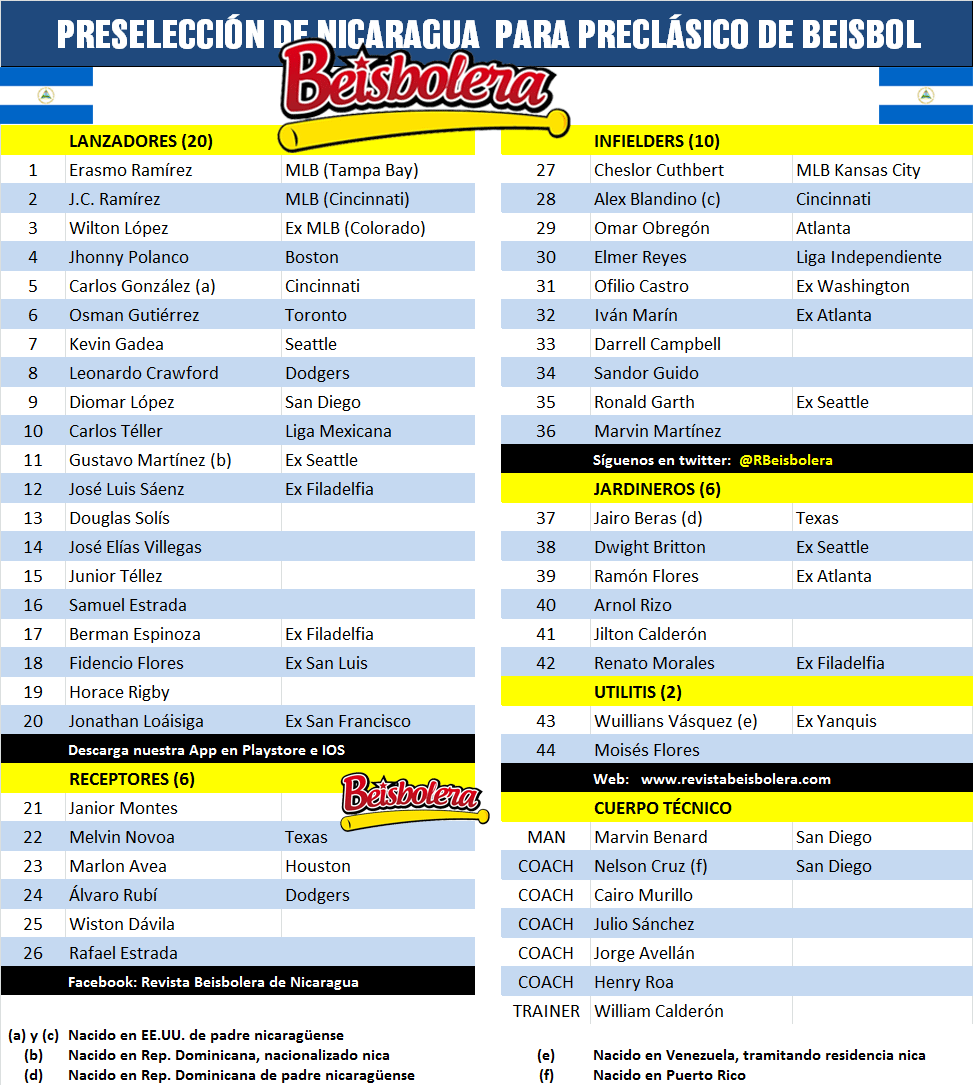
A preliminary roster for Team Nicaragua (thanks to Max Wildstein) was released. This roster has since changed (you can find how it has in some of the other items) and would be pared down to 28 anyway, but it gives you a good idea of some of the players who will be on the team:
Omar Vizquel will be the manager of Team Venezuela next year. Bobby Abreu and Magglio Ordonez were candidates for the batting coach position, and it appears that Magglio won the job. Other tweets have confirmed that Eduardo Perez will be a bench coach, Roberto Espinoza will be the pitching coach, and Henry Blanco will be a bullpen coach. Also in Venezuelan news: Gregor Blanco wants to play for his country in the 2017 WBC.
The Spanish have announced their coaching staff for the upcoming qualifiers, led by Tigers Latin American director Manny Crespo.
Quebecois closing great Eric Gagne, meanwhile, will helm Team France.
Mike Griffin will manage the Czech team, while Trot Nixon (!) will be hitting coach.
Speaking of the Czechs, it appears that they will have more players with North American experience than last time thanks to players of Czech ancestry, such as John Straka, Brett Tomko, Mike Cervenak, and Alex Sogard. However, apparently Eric Sogard has been denied, unless if he hasn’t. I find it much less likely that he will take part, though. The Czechs will be playing exhibitions in Arizona ahead of the qualifiers.
Donovan Solano, now in the Yankees organization, is still deciding whether he will play for Colombia in the qualifiers or if he will stay in camp. However, he is listed in a list of MLB-affiliated players who are “confirmed” for Colombia:
Peloteros de organizaciones de Grandes Ligas que están confirmados para jugar por Colombia. (vía @Beisbol2600mts) pic.twitter.com/RXbeWFd6bw
— Pinceladas del CMB (@pinceladascmb) February 26, 2016
//platform.twitter.com/widgets.js
Dilson Herrera of the Mets, as said above, will definitely suit up for Team Colombia. Others listed in the above tweet (if it doesn’t show up): William Cuevas, Carlos Mario Diaz, Kevin Escorcia, Tayron Guerrero, Gregory Nappo, Jesus Posso, Mauricio Ramos, Reynaldo Rodriguez, Tito Polo, Harold Ramirez, and Carlos Vidal. Apparently a complete list for Colombia will be out on Saturday.
David Ortiz doesn’t think he’ll play for Team Dominican Republic next spring.
Carlos Ruiz has been authorized to play for Team Panama, which is huge, even if he isn’t as good as he used to be.
Dean Kremer, a pitcher for UNLV who’s parents are from Israel and who lives there during summers when he isn’t playing, hopes to play for Team Israel in the WBC qualifiers.
Elmer Reyes of the Braves organization will play for Nicaragua. Wuillian Vasquez, a Venezuelan-born player who has lived and played in Nicaragua for several years while also playing in Europe, is also eligible.
The German National team will have a exhibition game against the Tijuana Toros on March 9.
Quick run-down of other players who have been confirmed in/out for certain qualifying teams (from various Twitter sources found by @MaxWildstein):
Randall Delgado is out for Panama but Andy Otero is in.
Cheslor Cuthbert is out for Nicaragua, as is Wilton Lopez, who has an injury.
Luis Guillorme is in for Spain.
–
Now, this was a lot of news. Maybe too much. And I probably missed some. And for that reason, I’m glad to say that starting now, WBC Updates will be FAR more frequent, occurring AT LEAST once a week, but at times happening on a daily or every-other-daily basis.
This guest-post is part of the 2016 Baseball Continuum Blogathon For Charity, benefiting the Roswell Park Alliance Foundation. The Roswell Park Alliance Foundation is the charitable arm of Roswell Park Cancer Institute and funds raised will be “put to immediate use to increase the pace from research trials into improved clinical care, to ensure state-of-the-art facilities, and to help improve the quality of life for patients and their families.” Please donate through the Blogathon’s GoFundMe page. Also, please note that the opinions and statements of the writer are not necessarily those of the Baseball Continuum or it’s webmaster.
Book Review – Wild and Outside: How a Renegade Minor League Revived the Spirit of Baseball in America’s Heartland, by Stefan Fatsis
As a writer about independent baseball (Indy Ball Island), I am always curious to read more about the history surrounding the indy leagues. I was given a recommendation to check out Wild and Outside, a book that covers the independent Northern League during their second season. While major league baseball came to a halt in the summer of 1994, the Northern League was flourishing and bringing hope back to baseball.
This book, much like independent baseball itself, is a little all over the place. It bounces back and forth from teams to players frequently, but always in a way that keeps you following along all season long. Their second season of existence didn’t happen without some bumps in the road, but the league stayed strong and survived. Through all the ups and downs, readers are given an inside look at everything that went on behind the scenes with the league, in every city, and in each locker room.
The book’s introduction says it best:
“This is the story of how a game of rebels – from the purist Miles Wolff to the chip-off-the-block son of showman Bill Veeck to a happy-go-lucky career minor leaguer named Ed Nottle – battled the big leagues, and some times each other. It is about players who, despite being told they aren’t good enough, refuse to loosen their grip on a dream born in childhood. It is about communities that rally around something as innocent and traditional as a baseball team. And it is about a place where baseball can still be fun.”
Wild and Outside follows league owner Miles Wolff as he explains just why he wanted to bring baseball to cities in the northern mid-west. Readers get a chance to see how the six towns (Duluth, Minnesota; St. Paul, Minnesota; Sioux Falls, South Dakota; Sioux City, Iowa; Thunder Bay, Ontario and Winnipeg, Manitoba) bonded with a group of misfits and brought the spirit of baseball back when it was going through its roughest patch. Meet the owners and managers who have to deal with the trials and tribulations that come with independent baseball. And finally, read about the players who are just trying to keep their dreams alive anyway they can.
While the book does cover all six teams to some extent, some teams and players are covered in much more detail than others. The Duluth-Superior Dukes with their owner Ted Cushmore is one story that really gets to the essence of independent baseball. Readers will find themselves growing sympathetic to their issues and begin rooting for the real underdogs in a league that is filled with them. Cushmore is thrust into owning the struggling Dukes, and with little help from others around him, including a manager who rarely communicated with him, faces many challenges that are a part of independent baseball teams everywhere.
In addition, hard working players such as Stephen Bishop, Vince Castaldo, Pedro Guerrero and many others have their stories weaved into the book effortlessly. The reader can follow their journeys throughout the season as they try to rekindle their love for baseball through indy ball all while still trying to reach their ultimate goal of making it (back) to affiliated ball.
Although the book is over two decades old, and the Northern League is no longer in existence (the league folded after the 2010 season), it is still a great read for baseball fans especially those that are a fan of minor league baseball and the true love of the game. This book could really be a number of stories around the country right now… the heart, the passion, the drive and determination are still in small towns all across America every summer. Get away from the big MLB contracts and fall in love with baseball again.
4 out of 5 stars
–
A copy of Wild and Outside will be a giveaway to a lucky person who donates through the Blogathon’s GoFundMe page. A special thanks to Kayla for contributing a copy!
–
This guest-post has been part of the 2016 Baseball Continuum Blogathon For Charity, benefiting the Roswell Park Alliance Foundation. The Roswell Park Alliance Foundation is the charitable arm of Roswell Park Cancer Institute and funds raised will be “put to immediate use to increase the pace from research trials into improved clinical care, to ensure state-of-the-art facilities, and to help improve the quality of life for patients and their families.” Please donate through the Blogathon’s GoFundMe page. Also, please note that the opinions and statements of the writer were not necessarily those of the Baseball Continuum or it’s webmaster.
This piece from the blog’s archives is part of the 2016 Baseball Continuum Blogathon For Charity, benefiting the Roswell Park Alliance Foundation. The Roswell Park Alliance Foundation is the charitable arm of Roswell Park Cancer Institute and funds raised will be “put to immediate use to increase the pace from research trials into improved clinical care, to ensure state-of-the-art facilities, and to help improve the quality of life for patients and their families.” Please donate through the Blogathon’s GoFundMe page.
Originally published August 15, 2014.
As you may know, I am a big fan of the old Backyard Baseball video games. In fact, I have a low-burn campaign to get the original games on Steam. So, with the Little League World Series here, I got to thinking: Whatever happened to those kids? Where are they now? I mean, I presume they lived in California, since that’s where Humongous Entertainment was, and I’m going to guess they’d be in their 20s nowadays (the oldest of them would have been, like, 13 in 1997 and the release of the first game, and the youngest would have probably been 6 or 7. Most of them seemed to be be around 10, 11 or 12), but… what would they be doing now? How did their lives turn out?
I did some research, and here’s what I found. It was a high-achieving group, with three individuals playing professional baseball, several others playing sports in college or professionally, and others going on to stardom or at least happy lives. Sadly, as with any large group of people, there were some who never achieved their dreams, others who lost their way, and even one who who is no longer with us. And then, there is one final person who is a story all of his own…
Pablo Sanchez. The Secret Weapon. The undisputed greatest of all the backyard kids, who was great no matter the sport but was greatest of all in baseball. Nobody ever truly knew much about him, as he only seemed to know Spanish and usually just let his skills do the talking. At least, that’s what everybody thought. In reality, Pablo spoke perfect English, he had learned Spanish- and become instantly fluent in it- in school. And, as he continued to rule anything and everything he tried his hand at, certain eyes were drawn to him. Rumors began to spread of a child who would break all existing sports paradigms, the sports equivalent of a nuclear weapon. Whatever team that would get him would instantly become the greatest on earth, whatever league that had him would become the most popular in the nation, and whatever he endorsed would instantly become the best-selling.
He would upset the balance of all sports and all the economies connected to them, bringing about chaos. Quite simply, the lords of sports decided, Pablo Sanchez could never be allowed to play sports above the youth level.
They came to him a few days before he started High School. All four commissioners of the Big 4, the heads of the IOC, FIFA, NASCAR, and ESPN’s X-Games divisions. Several major CEOs and a few big-name agents. Some say that even a few senators showed up. Never before or since had such a conglomeration come together.
They made Pablo and his family a simple offer: In exchange for not disrupting the natural order of competition and business in the sports world, they would give him a half-billion dollars. A year. Until the age of 50, at which point it would merely become a million dollars a year.
You’d like to think that Pablo would have been incorruptible. But, alas, even he had a price. And so, the greatest athlete of all time never stepped on the field.
Instead, he became something so much greater. You see, while others would have just taken that money, gotten a nice mansion, and lived a life of leisure, Pablo would have no such things. After college (where he was Summa Cum Laude, of course), he began to travel. And he began to help people. You see, over the years, Pablo looked out for his friends. It was he who saved Marky Dubois from the deepest part of the Bayou, it was he who wrote that letter to Mikey Thomas, it was he who helped fund Annie Frazier’s business, it was he who paid Ricky Johnson’s bills, and it was he who gave the tip that led the police to the man who had killed Jorge Garcia. And, yes, it was he who was the one who helped Vicki Kawaguchi turn her life around, something for which she dedicated her book to him for.
Yes, the Secret Weapon still has been amazing, and still can do no wrong. And to this day, if you see a man driving a purple car going “putt-putt-putt” down the road, know that he probably is on his way to do something amazing again, perhaps finding out what really happened with Vinnie the Gooch or looking for what happened to Earl Grey, the soccer announcer who hasn’t been seen in nearly a decade. And you can know that he has made a difference, even if it wasn’t on a sports field…
…well… maybe.
You see, once, during his travels, he came to a town in New Jersey. While there, he went to a youth baseball practice. He saw something in one of the players, something like he once was. He went up to that player. And, in the next few hours, he taught nearly everything he knew to that kid.
You may know that “kid” as Mike Trout.
The Secret Weapon lives on.
–
This piece from the blog’s archives has been part of the 2016 Baseball Continuum Blogathon For Charity, benefiting the Roswell Park Alliance Foundation. The Roswell Park Alliance Foundation is the charitable arm of Roswell Park Cancer Institute and funds raised will be “put to immediate use to increase the pace from research trials into improved clinical care, to ensure state-of-the-art facilities, and to help improve the quality of life for patients and their families.” Please donate through the Blogathon’s GoFundMe page.
This post is part of the 2016 Baseball Continuum Blogathon For Charity, benefiting the Roswell Park Alliance Foundation. The Roswell Park Alliance Foundation is the charitable arm of Roswell Park Cancer Institute and funds raised will be “put to immediate use to increase the pace from research trials into improved clinical care, to ensure state-of-the-art facilities, and to help improve the quality of life for patients and their families.” Please donate through the Blogathon’s GoFundMe page.
—
In International Baseball Culture, I look at baseball-related entertainment from outside the USA that isn’t bizarre, but is interesting, perhaps learning some new things along the way!
In 2005, the Japanese television station TV Asahi held a special on the 100 most popular anime (animation) in history, as voted on by Japanese viewers. While many of the most popular programs were fantasy, adventure or science fiction, such as the Gundam series of giant robot programs (at number two) or Dragon Ball (at number three), the top ten also had a baseball anime: Touch, which was seventh.
What is Touch? Well, to put it in simple terms, it’s a tale of two stories: the baseball one and the off-the-field one. It’s about three teenagers (twin boys and their girl-next-door neighbor) who navigate high-school, relationships and their pitfalls while trying to bring their school glory on the diamond as they try to reach Koshien, Japan’s national high school baseball tournament, which is like March Madness and a Friday night in Texas combined.
Needless to say, it struck a nerve with Japanese audiences, and the 2005 program’s polling was not that out of the ordinary: A follow-up list that included votes from after the TV Asahi special was aired also had Touch in the top ten, at number nine. Nor was this a recent phenomena, either: during it’s original run in the 1980s, it was, according to some sources, the most watched anime in the history of Japan. Ever.
The series was, in itself, adapted from a manga (comic) of the same name, written and illustrated by Mitsuru Adachi, that saw it’s volumes sell over an estimated 100 million copies. Just to put that in perspective, in 2010 the population of Japan was around 128 million. Of course, that doesn’t mean over three out of four Japanese people owned at least one copy of a volume of Touch… but it does mean that those who did liked it very much, buying every volume.
From what I’ve read about the series, it’s not hard to see why it would have such broad appeal, as it apparently has something for everyone. It has baseball action (and also some detours into boxing and other sports) for the boys, romance for the girls, and drama and comedy for everyone. And apparently all of those things are done well enough where even people who normally can’t stand stuff like that seem to like it- I’ve come across several reviews that include lines like “I don’t even like baseball but I was enthralled by the game episodes” or “the romance plot is actually realistic and well-handled.”
And yet, despite the fact that Touch is one of the most successful anime and manga in the history of Japan, it has never seen official release in the United States, and it’s unlikely that it will anytime soon, either (the anime and manga import market is mainly focused on recent releases, and what old ones that do happen are usually Sci-Fi or Fantasy). However, there is apparently a unspoken agreement between the Japanese entertainment industry and it’s English-speaking fans that they won’t sue anybody who translates and distributes translated versions of the show/book, so long as they stop doing it if an actual agreement to distribute them in the USA is made, so I was able to find copies of both the anime and manga online.
But anyway: a baseball-centric story that is one of the most popular and well-regarded anime/manga in Japanese history, and it’s almost completely unknown to American audiences? What better way to start International Baseball Culture? (after the jump)
This post is part of the 2016 Baseball Continuum Blogathon For Charity, benefiting the Roswell Park Alliance Foundation. The Roswell Park Alliance Foundation is the charitable arm of Roswell Park Cancer Institute and funds raised will be “put to immediate use to increase the pace from research trials into improved clinical care, to ensure state-of-the-art facilities, and to help improve the quality of life for patients and their families.” Please donate through the Blogathon’s GoFundMe page.
I’m not much of a wrestling fan, but I know a great meme when I see one, and the meme related to WWE Superstar John Cena is a good one:
For those of you who don’t want to watch that, in essence, it is what happens when a completely unrelated scene is suddenly interrupted by the cry of “JOHN CENA!” or “HIS NAME IS JOHN CENA!” and his theme music begins to play. It’s very stupid, but also hilarious.
But, did you know that the “public face” of the WWE is the grandson of a baseball player? And not just any baseball player, but an honest-to-goodness MLB player: Tony Lupien of the 1940s Red Sox, Phillies and White Sox. In fact, the first-baseman even received MVP votes during the depleted years of WWII:
 Here are his Minor League stats:
 After his career, Lupien went on to be manager and coach, including bringing Dartmouth University to the 1970 College World Series. He was also involved- both during and after his career- with the labor movement, including help co-author The Imperfect Diamond, a history of baseball’s labor relations up through the 1970s.
–
At 8 AM: The start of “International Morning”, several hours of international baseball content
–
This post has been part of the 2016 Baseball Continuum Blogathon For Charity, benefiting the Roswell Park Alliance Foundation. The Roswell Park Alliance Foundation is the charitable arm of Roswell Park Cancer Institute and funds raised will be “put to immediate use to increase the pace from research trials into improved clinical care, to ensure state-of-the-art facilities, and to help improve the quality of life for patients and their families.” Please donate through the Blogathon’s GoFundMe page.
This post is part of the 2016 Baseball Continuum Blogathon For Charity, benefiting the Roswell Park Alliance Foundation. The Roswell Park Alliance Foundation is the charitable arm of Roswell Park Cancer Institute and funds raised will be “put to immediate use to increase the pace from research trials into improved clinical care, to ensure state-of-the-art facilities, and to help improve the quality of life for patients and their families.” Please donate through the Blogathon’s GoFundMe page.
—
Tons of people play Little League Baseball or have played Little League Baseball when they were of the age where you can.
This is not a story about my actual time on the Little League field, where my greatest moment was the time I drew a walk with the bases loaded to force in the walk-off run. No, this is about something else: the Fairport Little League money-grabbing promotion, a crazy promotion in which a pre-teen ballplayer was put into a box full of money, a blower was turned on to send that money flying around, and the kid had to try and grab as much money as possible, which he (or she) would be able to keep.
There were many thoughts on strategy for this. Some kids thought you should try to trap it against the sides of the box and then pull it on. Others thought you should just grab wildly and hope for the best. A few suggested using a loose jersey as a net to catch the dollars and then try to grab from the “net” since you were only allowed to keep the money you had in your hands. Still others thought that it was stupid and that you should just keep the entrance fee and use it to buy a candy bar from the concession stand.
That last group, while probably wise beyond their years, were absolutely no fun.
And then there was the question of what you’d do with the money. Maybe you’d use it to buy candy at the concession stand (always a great choice), maybe you’d rent a video game (this was back when there were actual stores that rented video games), or maybe you’d just put it into your piggy bank.
When I walked in to the box, all those years ago, I wasn’t sure what my strategy was. I think it was a mixture of the various strategies. And I can’t remember what I used the money I got for. Heck, I can’t even remember how much money I grabbed, period.
And yet, despite the fact that I’ve forgotten the end result, I still can remember that big box that sent money flying around you…. a piece of childhood and Little League.
—
At 5 AM: A “Songs of October” Update
—
This post has been part of the 2016 Baseball Continuum Blogathon For Charity, benefiting the Roswell Park Alliance Foundation. The Roswell Park Alliance Foundation is the charitable arm of Roswell Park Cancer Institute and funds raised will be “put to immediate use to increase the pace from research trials into improved clinical care, to ensure state-of-the-art facilities, and to help improve the quality of life for patients and their families.” Please donate through the Blogathon’s GoFundMe page.
 The Baseball Continuum