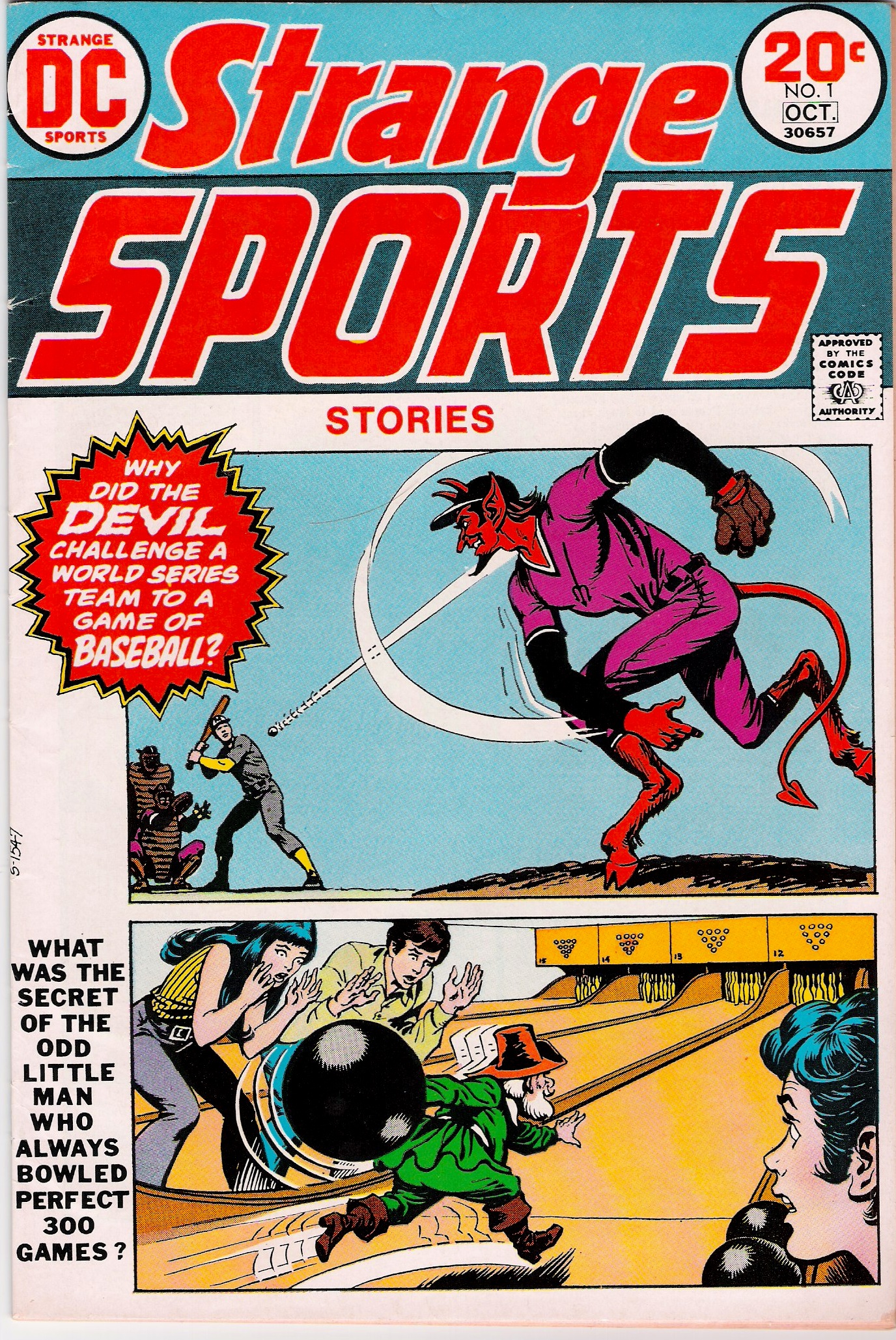
BIZARRE BASEBALL CULTURE: Strange Sports Stories #1… “TO BEAT THE DEVIL!”

In Bizarre Baseball Culture, I take a look at some of the more unusual places where baseball has reared it’s head in pop culture and fiction.

Last time, I introduced you to “Strange Sports Stories”, the on-and-off anthology of DC Comics’ Science-Fiction and/or Fantasy tales involving sports. That past installment was from the 1960s Brave and The Bold run of SSS, but this time, we’re looking at the Strange Sports Stories stand-alone series, from 1973. It only lasted six issues, but it’s first issue prominently featured baseball (amazingly, it wasn’t in any of the other five issues, and as far as I can tell no sport was featured more than once) in a tale called “To Beat The Devil!”

DevilBallcover

Written by Frank Robbins (who was primarily an artist, most notable for having helped create the character of the Man-Bat for DC Comics), penciled by Curt Swan (who is best known for his work on Superman comics) and inked by Dick Giordano (best known for his partnership with artist Neal Adams on Batman and the socially-conscious Green Lantern/Green Arrow book), this tale, as the cover (done by Nick Cardy, who according to Wikipedia is best known for his work with Aquaman and the Teen Titans) indicates, is about a face-off between a baseball team and the devil himself. The Devil, of course, is no stranger to baseball, primarily known for his involvement in baseball-themed musicals, but this is the first appearance by Satan in Bizarre Baseball Culture. Well, unless you count this weird guy from the second AAA Baseball/Marvel comic. I don’t.

Anyway, go below the jump for more:

Continue reading

Do you want to be a racing mascot? Well… GOOD NEWS!

There is good news for those of you who aim to win athletic glory while wearing a big-headed mascot uniform: the Oakland Athletics are hiring for just such a position! Yes, you can be a racing mascot, defeating your foes and amusing the masses while in a caricature version of somebody like Rollie Fingers, Rickey Henderson or Dennis Eckersley. Wait… no Connie Mack? No Jimmie Foxx? No Reggie Jackson?

Jeez, Athletics, are you even TRYING in this racing mascot thing? Oh well, I guess I’ll have to make due. Let’s see what this requires….

• Prior experience in promotions, performing in costume and customer service preferred.

Well, two out of three isn’t too bad, although one of those two I wasn’t a professi-… wait… preferred? Ha! That means it isn’t required! I’m good!

• Must be comfortable performing and interacting with fans in front of large crowds and on camera.

Full disclosure: When I was like eight, I jumped on top of a dugout and danced on it. Everybody thought it was hilarious except for my parents and the security guards. Tough crowd. So… I’m good!

• Must be reliable, punctual, courteous, have good listening skills and ability to multi-task.

Standard stuff, I’m good!

• Must have high energy, enthusiasm and excitement to promote the A’s brand.

I wrote an article on how the A’s brand should survive even if they move to San Jose! That’s total promotion and excitement about the brand! I’m good!

• Must have strong ability to work well with all employees in a team environment.

Okay, this may be a problem, because I think of myself as something of a method actor. If I’m in the costume, I am the costume. So, it’s entirely possible that I’d start referring to myself in the third person or something, which would be weird. Still, I’m sure I’d be able to manage it, so I’m good!

• Must have ability to run a minimum of 250 yards in a 50 pound costume. Running skills will be tested.

It wouldn’t be graceful at all, but I’d probably be able to handle it. So I’m good!

• Must have ability to perform and entertain while wearing a 50 pound costume for extended periods of time.

See above.

• Must be able to lift and carry items up to 50lbs.

Shouldn’t be too much of a problem, hopefully.

• Must be available to work during all A’s home games and outside appearances as needed, including days, nights, weekends and holidays, throughout the 2015 baseball season.

Hey, if they are willing to get me to Oakland, I’m willing to…

• Must have reliable transportation and live in or close to the Oakland area.

CRAP.


Well, maybe one day I shall win glory as a racing mascot. Maybe one day….


Famous For Something Else: NBA Ref David Guthrie

David Guthrie is a referee in the National Basketball Association. But before he was a ref on the hardwood, he played hardball in the Reds organization. Drafted in the 26th round of the 1995 draft out of NC State, Guthrie played infield positions from 1995 to 1998. Although he never hit well, he did reach AA by the end of his career:

Year Age AgeDif Tm Lg Lev Aff G PA AB R H 2B 3B HR RBI SB CS BB SO BA OBP SLG OPS TB GDP HBP SH SF IBB
1995 21 1.1 Princeton APPY Rk CIN 55 207 181 28 37 11 0 0 13 7 1 18 41 .204 .286 .265 .551 48 4 3 4 1 1
1996 22 1.4 Billings PION Rk CIN 48 219 181 45 41 6 3 4 28 10 1 26 48 .227 .343 .359 .702 65 4 7 3 2 0
1997 23 1.5 Charleston WV SALL A CIN 73 264 233 27 50 7 2 3 26 6 2 20 75 .215 .295 .300 .595 70 5 7 3 1 0
1998 24 -0.1 Chattanooga SOUL AA CIN 67 225 203 23 39 5 4 0 9 1 1 16 58 .192 .261 .256 .517 52 3 3 3 0 0
4 Seasons 243 915 798 123 167 29 9 7 76 24 5 80 222 .209 .296 .294 .590 235 16 20 13 4 1
Rk (2 seasons) Rk 103 426 362 73 78 17 3 4 41 17 2 44 89 .215 .315 .312 .627 113 8 10 7 3 1
A (1 season) A 73 264 233 27 50 7 2 3 26 6 2 20 75 .215 .295 .300 .595 70 5 7 3 1 0
AA (1 season) AA 67 225 203 23 39 5 4 0 9 1 1 16 58 .192 .261 .256 .517 52 3 3 3 0 0
Provided by Baseball-Reference.com: View Original Table
Generated 1/9/2015.

By the way, the players who Guthrie was drafted before in the 1995 draft and signed a contract include Pedro Feliciano, Justin Speier, and Gabe Kapler.

IT CAME FROM eBAY: Lefty Grove’s Tax Returns!

In the grand tradition of previous blog entries on weird baseball auctions, I now give you…LEFTY GROVE’S TAX RETURNS!

Screen Shot 2015-01-08 at 2.00.02 PMYes, you can, for the low price of $995.00, own Lefty Grove’s tax returns from 1925. His rookie year! Yes, YOU can own the tax returns of a Hall of Famer. It’s not quite Stan Musial’s wallet or Reggie Jackson’s pal Mr. Peanut, but it’s something.

So… what did Lefty make his rookie year?

Screen Shot 2015-01-08 at 2.12.44 PMOkay, so…. he made $7404.00. That’s $101,600 in 2015 money! That would be below the minimum MLB salary today!

Also, I like the occupation of “Ball Player”. That’s a cool thing to have on a tax form.

Best of 2014- A History of Player-Licensed/Sponsored Video Games

This was originally a piece of a “Wisdom and Links” article at Hall of Very Good. Thanks to Shawn Anderson for giving me permission to put it up here.

Let me tell you of a time. A time before the sports video game-scape was homogenized and turned into a few companies putting out slightly different versions of the same game every year. In this wonderful time, lasting from the late 80s to around the turn of our century, there were countless baseball games. And they were often branded to a certain player. This wasn’t just baseball, of course- to this day you can find John Madden’s last name on Electronic Arts’ NFL franchise- but for baseball, it seemed to have it’s own special charm. Maybe it was the fact that many of them didn’t have any real players other than the sponsor, or maybe it was just because I was of the age where, to paraphrase the “The Lego Movie”…“everything was awesome”. Or maybe it’s just because baseball was and is my favorite sport and thus I am biased.

Still, let us travel back to that wonderful time and look at some of the greatest player-or-manager sponsored games in history.

(JUMP)

Continue reading

Argument: The Padres Are The Most Non-Descript Team In Baseball’s History

Okay, I may be wrong here, and I’ll get to the point in a second, but far as I can tell, here’s what the “All-Time San Diego Padres” team would look like going by WAR, minimum five years with appearances on the team:

Starting Pitchers: Jake Peavy, Andy Ashby, Andy Benes, Randy Jones, Eric Show

Relievers: Trevor Hoffman, Heath Bell, Mark Davis, Scott Linebrink, Craig Lefferts, Luke Gregerson

Catchers: Terry Kennedy, Benito Santiago

First Basemen: Adrian Gonzalez, Nate Colbert, Ryan Klesko (also OF)

Second Basemen: Tim Flannery

Third Basemen: Chase Headley, Phil Nevin

Shortstops: Garry Templeton, Khalil Greene

Outfielders: Tony Gwynn, Dave Winfield, Gene Richards, Brian Giles

Tell me, oh reader, does that strike the fear of god into you? The answer: No, not really. I mean, yeah, it’s got two Hall of Famers and another likely one (Hoffman), but it doesn’t look like an “All-Time Team”, but rather a “Probably going to win a Wild Card if there aren’t too many injuries” type of team.

And that’s what leads me to this: The Padres may well be the most non-descript team in Baseball’s history. They aren’t good, they aren’t bad, they just usually seem to be… there, as if they exist only to make sure the schedule is full and that the divisions are even. Sometimes it seems as if they don’t even exist at all outside of box scores and the bottom-ticker of ESPN.

To put it another way: I once took a online quiz where I had to name all 30 MLB teams. The Padres were the last ones I remembered to put in.

And that’s why it is a bit surprising to see the Padres make so many deals this off-season- just yesterday they acquired Justin Upton and Will Middlebrooks, not long after they had acquired Matt Kemp and Wil Myers, leading me to say this:

But why is it in the first place that the Padres seem to far down in the Baseball Zeitgeist?

I have some ideas:

1) Lack of Postseason Success

The Padres have been to two World Series- 1984 and 1998. Both times, they got to play Washington Generals to some of the greatest teams in history, going down to the 1984 Tigers in five games and being swept by the 1998 Yankees. And the road to those World Series aren’t particularly notable outside of San Diego. The 1984 NLCS, for example, is more known for a Leon Durham E3 that set-up a big Padres inning that doomed the Cubs.

2) They traded away Ozzie Smith and Roberto Alomar

Fun fact: If I hadn’t had the “minimum five years” thing for the All-Padres team, the Shortstop would have been a young Ozzie Smith and his double-play partner would be a young Roberto Alomar. Problem for the Padres: they traded both of them away. And it’s not like they were nobodies treading around in the minors when the Padres traded them away- they were both traded coming off of All-Star seasons. One would think the Padres’ history wouldn’t be so nondescript if they had had them for most of their careers.

3) No No-Hitters

The Padres are the only team in baseball without a no-hitter. That means that they lack one of the signature moments that every other MLB team has.

4) They are crowded out

They share the same division as the Giants and Dodgers, who suck up almost all of the attention given to NL West. Not having the history of other “stuck in the division of giants” teams like Baltimore, Pittsburgh, or Cincinnati means that they look even more non-descript by comparison.

This is all a shame, really. They have a beautiful stadium and lovely weather, and San Diego has a good baseball culture (amateur, etc.) even if their team doesn’t get much attention outside of the area. Perhaps the Padres’ moves this off-season will finally get the franchise that big moment that we can remember it by.

Off-Topic: On Sony, “The Interview”, and a very poor precedent

It is rare that I say anything political on this blog, only slightly less rare that I say anything political on my Twitter account. This is not because I am not political, or because I am afraid to ruffle some feathers, but rather because this blog (and to a certain extent my Twitter account) is about baseball. I am actually rather interested in political and global events, but I know full well that that isn’t what you come here for and probably not what you follow me on Twitter for, so I keep it to a minimum. I don’t have a problem with people who do interject their political opinions, but it’s not really my style, and when I do say things on Twitter about politics, it’s usually either something everybody agrees with (tragedies are tragic, etc.) or more to give interesting factoids about things related to what’s going on.

But today, I am going to say something that’s a little bit political: Sony Pictures should be ashamed for pulling The Interview because of the demands of hackers suspected to be from (or at least hired by) North Korea. To be sure, there are far bigger things in the world to be angry over- just this week terrorists in Pakistan massacred innocent children, after all. But this move by Sony strikes at something I hold very dear: freedom of expression. It’s what makes this blog possible. It’s what makes Twitter possible. It’s what makes television, video games, movies, novels, comic books and basically anything else that entertains or informs us possible.

And Sony just let their freedom of expression- and by association the freedom of expression of everyone involved with the making of The Interview– be dictated by exposés and threats from cowards who don’t like the theme of their film.

Let that sink in: because some people didn’t like that The Interview made fun of Kim Jong-Un and was about a (completely fictional) assassination plot against him, the film is now indefinitely cancelled less than two weeks from it’s release. This is an unprecedented occurrence in Cinema. Oh, to be sure, there have been films who have had their release delayed or cancelled here and there before, but only on small scales, such as in certain cities or certain countries. This is a worldwide delay/cancellation.

Sony and the many movie theater chains (who had started cancelling appearances before Sony pulled the plug on the movie in general) may have their reasons (on the off-chance that there *was* actually a North Korean-fueled terrorist attack on a theater showing, the companies would have been in deep legal and insurance troubles since there had technically been a threat), but this is a horrible and dangerous precedent, as it now appears that now all somebody needs to do to stop a movie is make a threat about it. This time it was North Koreans, but next time it could be Iranians, or White Supremacists, or Russians.

Or maybe this is, in fact, a isolated incident. Maybe this is Sony trying to make lemonade out of lemons, delaying the film so that when it does get released it will be an even bigger deal than it initially would have been. After all, early reviews weren’t good anyway, perhaps they think it would be better released on a non-competitive weekend in late January or early February even without the surrounding controversy. Maybe nothing more will come of it and future attempts at bullying by people angry about movies will be met with silence, or at least with the release of the film going on as planned.

Only time will tell, but if this is just the start of future studio cowardice in face of criticism and threats, then it is bad thing indeed.


The Best of 2014: First References in “The Sporting News”: Japan

This was originally published on November 13, 2014.

One of the great perks of SABR membership is access online to The Sporting News’ archives. While it now is dedicated to all sports, for a good chunk of it’s earlier history it was almost entirely focused on baseball (with some boxing, horse-racing and college football thrown in here and there). So, today, I take a look at some early references to things in The Sporting News. In this case, in the spirit of MLB’s current tour of Japan, I’m looking at certain topics related to baseball in Japan.

Baseball in Japan in General

While there were some references to Japan as far back as the 1880s, they either are references to other things or exceedingly brief and vague, like this item from the November 13, 1886 issue that I honestly do not understand whatsoever (although John Thorn has thankfully given some insight as to what Copenhagen was– it was a game played by young children):

Screen Shot 2014-11-13 at 11.28.29 AMThe first real, unequivocal reference to baseball in Japanese baseball in The Sporting News was in 1897, as the December 4 issue had this headline:

Screen Shot 2014-11-13 at 11.38.13 AM

It began like this:

Base ball (sic) has invaded Japan and to such an extent that the Tokio (sic) Athletic Association has written to President James A. Hart of Chicago for rules and suggestions relative to the furthering of the American national game in the land of the Mikado.

The article goes on to say how “last summer” a “lively little gentlemen” name Tora Hiraoka of “Tokio” attended games in Chicago with Hart (who owned the team we now know as the Chicago Cubs at the time) and had told him of how baseball had been introduced to Japan (“displaying two or three crooked fingers as indisputable evidence”) and that he was sure it could be “immensely popular” if “generally introduced”. The rest of the article is on how Hart had received a letter from Japan and how he believes that the Japanese should take to the game because they are “agile and naturally like athletic sports”, also mentioning how maybe they could play a Australian team that had visited America “last season”.

Koshien Stadium

The most famous stadium in Japan and site of the country’s High School Championships, the first reference to Koshien came in the November 8, 1934 edition of Sporting News, when it was mentioned that Babe Ruth’s tour would likely see even greater crowds in Osaka, since that was where “the Koshien Stadium seats 80,000″.

Tokyo/Yomiuri Giants

The “Yankees of Japan” and winners of 22 Japan Series titles, the Yomiuri Giants were first referenced in the January 23, 1936 issue of The Sporting News, where it was reported that they (as the “Tokyo Giants”, their name before their owners at the Yomiuri Group changed it to better advertise themselves) would be coming to America to tour the Pacific Coast, Texas, and the Northwest. The first reference to the Yomiuri Giants under their current name came in 1951. In the November 7 issue, a story on a tour led by Lefty O’Doul and featuring players like Joe DiMaggio and Mel Parnell was printed, and it covered the team’s 6-3 victory over Yomiuri on October 25.

Masanori Murakami

The first Japanese player in MLB history, Murakami was a pitcher who had been sent to the San Francisco Giants as something of a exchange student to play in their minor leagues. However, he pitched so well that the Giants called him up and then refused to send him back to Japan when it was time. The baseball version of a international incident occurred, and it eventually led to the end of Japanese players in North American baseball until Hideo Nomo came over in the 90s.

The first reference to Murakami in The Sporting News was on March 7, 1964, in a story by Bob Stevens on how he and two other Japanese players (Tatsuhiko Tanaka and Hiroshi Takahashi) would be in the Giants’ organization that season. Funnily enough, the story includes a note that neither San Francisco or the Nankai Hawks (their Japanese team) thought any of them would be able to crack a National League roster. Whoops.

Sadaharu Oh

Probably the greatest player in the history of Nippon Pro Baseball and owner of the all-time professional record for HRs (868), the first reference to Oh in The Sporting News came in the Jan. 2, 1965 issue, as writer Jim Sheen looked back on some of the biggest accomplishments in the sports world in 1964:

Screen Shot 2014-11-13 at 12.33.56 PMHideo Nomo

Interestingly, the first mention of Nomo in The Sporting News was a single item in Bob Nightengale’s baseball report on January 30, 1995, where he mentions that he is one of the hottest free-agent pitchers on the market and that the Dodgers, Blue Jays and Mariners were all pursuing him.

Ichiro Suzuki

Finally, the first reference to Ichiro in The Sporting News also was rather matter-of-fact, coming in a preview issue on Valentine’s Day in 2000, where he was mentioned not because he was joining the Mariners (he wouldn’t until 2001), but because his spring training stint in 1999 had given Seattle some experience with the throngs of Japanese press they would receive for their new reliever, Kaz Sasaki.

Screen Shot 2014-11-13 at 12.52.47 PM

Thank you to SABR and their “Paper of Record” database for making this article possible. Also, thank you to @YakyuNightOwl for correcting me on the history of Yomiuri’s name- it was always owned and run by Yomiuri, it’s just that Yomiuri didn’t put their name in the team name until later.
FINALLY UPDATED FOR 2014! Songs of October: A Retrospective (Because Why Not?)- 2014 Edition

For the far-too-late update on what happened in 2014, go to the bottom of the post after the jump.

In 2013, there was a sensation that spread across the nation: Mups. Their spread was unstoppable, to the point where some like the “Cespedes Family BBQ” and Jesse Spector had begun to engage in a “#Mupwatch”. But some wondered: What was a Mup? Were they some sort of Muppet? Were they dangerous? And why were they being lit on fire?

Well, the answer lay in the commercials that had been playing in the lead-up to and during the post-season, featuring Fall Out Boy’s “My Songs Know What You Did In The Dark”. Here is an example of such a commercial. While officially they were saying “Light ’em up”, it sounded, especially during the echoing segments, like they were actually talking about things called “mups”.

And thus continued a long tradition of October songs that have graced our televisions and infected our ears, whether we liked them or not. And, usually, if we DID like them at the start of the postseason, we ended up being sick of them by the end just from hearing them so many times.

And, what’s more, these songs and how they have become memes aren’t from a universal source. Most of them, for example, have been part of TBS’ coverage, but others, including the Fall Out Boy song, have actually been of MLB’s doing. In 2013, for example, TBS was using a different song*, and MLB Network itself also had a different song for the commercials for it’s two games**. Rarely if ever have they been actually about baseball, usually selected more for their choruses or imagery.

*Using Google searches of the lyrics I was able to decipher, I’ve figured out it’s 30 Seconds to Mars’ “Do or Die”.

**Again using Google, I’ve found that the commercials use the chorus from Papa Roach’s “Still Swingin’“.

Still, with that out of the way, here’s a history (after the jump) of the Songs of October:

Continue reading

Famous For Something Else: Herman Wedemeyer (College Football HOFer and ‘Hawaii Five-O” Actor)

Herman Wedemeyer was a All-American football player at St. Mary’s College and would later go on to be elected to College Football’s Hall of Fame. He also played two years of professional football and was a politician in his native Hawaii- where he also dabbled in acting, appearing as “Duke” Lukela in 143 episodes of the original Hawaii Five-O.

However, he also had a brief baseball career, playing in 15 games in 1950 for Sal Lake City in the Pioneer League, where he played alongside future MLB player Mike Baxes and also Wally Yonamine, who would be the first American to play in Japan after WWII.

Here are his stats:

Year Age AgeDif Tm Lg Lev G AB H 2B 3B HR BA SLG TB
1950 26 2.8 Salt Lake City PION C 15 48 12 0 1 0 .250 .292 14
1 Season 15 48 12 0 1 0 .250 .292 14
Provided by Baseball-Reference.com: View Original Table
Generated 12/6/2014.