PACES! (As of May 29, 2013)

  • Miguel Cabrera is on pace for 185 RBIs. The single-season record of 191 is held by Hack Wilson of the 1930 Chicago Cubs. The AL single-season record, held by Lou Gehrig of the 1931 Yankees, is 184.
  • Chris Davis is on pace for 53 HR. The Baltimore single-season record is 50, by Brady Anderson in 1995.
  • Jason Grilli is on pace for 65 saves. The single-season record is 62, held by Francisco Rodriguez in 2008.
  • The Miami Marlins are on pace for either 40 or 41 wins (depending on how you round it). Want to know what other team only had 40 wins? The 1962 New York Mets.

What does this mean? Well, nobody can be 100% sure, since keeping up a pace, especially one of historic significance, is hard. But it’s an interesting thing to think about…

Crazy Question: Should Surgeons be in the Hall of Fame? (AKA: The Importance of Tommy John Surgery)

A man who had a major impact in baseball passed today, someone who helped teams win championships and aided some of the biggest names in the sport.

That man was Lewis Yocum, and he was a orthopedic surgeon specializing in sports surgeries like Tommy John Surgery, in addition to serving as the team physician for the Angels. His passing has been commented upon by many in the baseball community, with some declaring that they owed him their careers.

Which leads to this: should surgeons and doctors be considered for the Hall of Fame?

Well, the answer is probably no. After all, they aren’t in this for fame, and to try and say what makes a “Hall of Fame Surgeon” is fraught with questions I don’t think can be answered.

But, let’s just consider for a second the impact that some of these surgeons have had on baseball.

Imagine what the world of baseball pitching looked like before Frank Jobe. Who’s Frank Jobe? He’s the guy who first performed ulnar collateral ligament (UCL) reconstruction surgery, where a UCL is replaced by a tendon from elsewhere. You probably know it as Tommy John Surgery.

Before TJ Surgery, to have a dead arm was a death sentence for a career. Let that sink in and then remember the full implications of that statement:

  • Without TJS, Stephen Strasburg‘s career would be done.
  • Without TJS, Jim Morris would never have been portrayed by Dennis Quaid in a movie.
  • Without TJS, Hyun-Jin Ryu never gets out of high school, much less comes to America and becomes one of the few bright spots of the 2013 Dodgers season.
  • Without TJS, Chris Carpenter‘s career probably would have ended on Opening Day, 2007. Adam Wainwright‘s career would have ended in 2011.
  • Without TJS, Eric Gagne‘s career probably have ended in the minors. Same goes for Kenny Rogers, C.J. Wilson and David Wells.
  • Without TJS, Tim Hudson wouldn’t have won the 55 games he’s won since 2009.
  • Without TJS, Phil Humber never has his perfect game. Francisco Liriano doesn’t have his no-hitter. Neither does Anibal Sanchez.
  • Without TJS, Kerry Wood‘s career would have been an even bigger “what might have been” than it ended up being.
  • Without TJS, John Smoltz‘s career ended in 2000, with 56 wins and 154 saves never happening.
  • Without TJS, we MAYBE might never have even heard of Mariano Rivera. (There is some confusion over whether or not Rivera had a TJS in the minors, or if it was a different type of surgery).

Hmm… maybe surgeons should be in the Hall of Fame. At least Jobe should.

Classic Continuum: Ballplayers who gave everything

This article was initially published on Memorial Day, 2012.

On this Memorial Day, it is as good a time as any to mention some of the ballplayers who gave their lives serving in America’s armed forces. The DeadBallEra site has a list of those who died while serving America, and there is also a good site entirely about Baseball in Wartime (primarily focused on WWII), but here are some notables (although, in the end, everyone who gives the ultimate sacrifice is notable). Not all of them died in combat, but all of them died while in military service or (in the case of people like Christy Mathewson) as a result of those actions:

  • Eddie Grant was a Harvard-educated infielder who spent time with Cleveland, Philly, Cincinnati and the Giants. On October 15, 1918, he died after being wounded by a artillery shell in the Argonne Forest of France. His unit had been fighting to rescue the “Lost Battalion” that had been pinned down by German forces. He was 35. A memorial to him was placed in the Polo Grounds (it is one of the plaques that can be seen in the expanded version of the Willie Mays catch photo), and a replica of it is now apparently in San Francisco.
  • Larry Chappell was a light-hitting outfielder in the 1910s who was at one point part of a trade for Shoeless Joe Jackson. In 1918, he died while in Army service only a few days before the armistice from the Spanish Flu pandemic that killed tens of millions of people. He was 28.
  • Ralph Sharman was a young outfielder who did well in a September stint with the Phillies in 1917. After the ’17 season, however, he was inducted into the army. He died in May, 1918 when he drowned while in Alabama, where he was undergoing training. He was only 23.
  • Christy Mathewson had retired from pitching by the beginning of America’s involvement in WWI, and was manager of the Cincinnati Reds. He left the club in the middle of the 1918 season, going to France, where he served in the Army’s chemical division. While there, he suffered the effects of poison gas, which left him with various respiratory ailments, including the tuberculosis that took his life in 1925.
  • Elmer Gedeon, who had had a cup of coffee with Washington in 1939, died while piloting a B-26 Marauder over France on April 20, 1944. He was 27.  He was one of only two people with Major League experience who died in WWII. The other being…
  • Harry O’Neill, who was a catcher in one game (with no plate appearances) for the Athletics in 1939. He was killed by a sniper on Iwo Jima on March 6, 1945.
  • Bob Neighbors, who had a cup of coffee with the Browns in 1939. In 1941, his baseball career came to an end when he had a poor season and, perhaps more importantly, lost his wife of only six months in a car accident while he was away on a road trip. He signed up for the United States Army Air Force after Pearl Harbor, and became a career military man from that point on. He went Missing In Action (and presumed dead) in 1952 when his B-26 went down over North Korea. He was both the only MLB-experienced man to die during the Korean War, and the last to have died in active service, period.

Of course, there were plenty of players who never made it to the big leagues who died in the line of duty, some of whom may have one day become Major Leaguers if not for the cruelty of war:


To them and all who have given the ultimate sacrifice, and to those who made it home, we salute you.

434.2 milliseconds

434.2 milliseconds. That’s about how long it takes a 95 MPH fastball to reach home plate.

It’s only about 34 milliseconds more than what it takes some people blink. Only 134 more milliseconds than it takes the slowest of us to act on reflex based on visual stimuli. Only slightly less time than it takes for a satellite communications system to receive and transmit information.

In the time it took you to read this blog post up to this line, about 13 seconds had past if you are an average silent reader. In that time, you could have had 28 fastballs go past you with another one about a third of the way towards you.

That sound you hear is your mind getting blown. Or maybe it’s of a fastball hitting the catcher’s glove.

How Don Mattingly can try to get fired (HUMOR)

In a Ken Rosenthal article earlier today, a rival GM said that Dodgers Manager Don Mattingly is practically trying to get fired after his infamous ripping into of longtime RF Andre Ethier on Wednesday. However, despite that and the horrible 19-26 start for the Dodgers, he is expected to still be the skipper of Los Angeles when the sun rises on Friday.

Therefore, if we were to foolishly take the rival GM’s quotation literally, we can only guess that Mattingly has not done enough to get fired. Therefore, I have suggestions for him as he tries to escape the black hole of horrible the Dodgers’ season has been so far:

  • Accuse Tommy Lasorda of not actually bleeding Dodger Blue, but instead bleeding the red that everyone else has.
  • Hit the pitcher in the clean-up spot for kicks.
  • Leave game in the 7th inning to beat traffic.
  • Criticize Vin Scully. Note that doing this is not just grounds for termination, but is grounds for being shot into the heart of the sun.
  • Say that you wish the Dodgers had go-getters like Carlos Quentin.
  • Call AJ Ellis by the name of “DJ Elliot” for no apparent reason whatsoever.
  • Show up in Anaheim in a Angels uniform, see if you can get past security.
  • Sign Dwight Howard to play CF.
  • Give a long discussion on how you would approach 5-base baseball.
  • Donald Duck suit.
  • And the easiest way of all to get fired: keep having the team play .422 baseball.

Chris Sale (or at least his appetite) is not human

Chris Sale‘s eating habits were recently unveiled to the world in a Wall Street Journal article, and they are sickening but impressive.

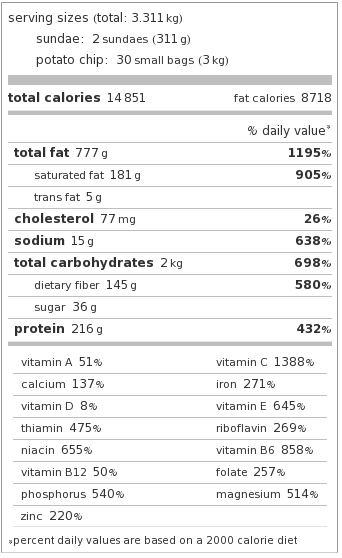
For example, it is said that during a four-hour flight, the 6’6”, 180 lb pitcher ate 2 ice cream sundaes and 30 bags of potato chips.

Now, admittedly this is likely just another tale of athletes exaggerating, but, just for kicks, this is roughly what the nutritional info for such a meal would be:

Screen Shot 2013-05-22 at 4.23.41 PMI’m not entirely sure how he would survive such a eating frenzy without throwing up. His metabolism must be something completely unlike anything else on this earth. There must be something unique about him. If everyone could have such a metabolism, obesity could disappear overnight.

In other words, I ask that Chris Sale reconsider his career in baseball and donate his body to science. Within his body may be the secrets of ending obesity and who knows what else.

Make it happen!

A Day With Legends: The 2013 Pepsi Max Field of Dreams Game

You may have heard of the Pepsi Max Field of Dreams game, probably semi-heard during commercial breaks of MLB Network. Well, basically, it’s part old-timers game, and part fantasy camp. Two teams play a 6-inning game… with the catch being that each team is half made up of former MLB stars (almost all of them either Hall of Famers and ones that one day will be) and the other half is made up of ordinary Joes who won a contest. There are also some ringers (mainly guys who either play or coach locally and had professional careers) thrown in to fill spots in later innings. This year, it was was in my home town of Rochester, New York, and myself and 13,715 of my closest friends were there to see it.

(By the way, any picture you see in this was taken by me, and can be enlarged if you click it.)

Go below the jump for more, this is a photo-heavy post.

Continue reading

The Unwritten Rules of Watching Baseball

There are unwritten rules of playing baseball, but what are the unwritten rules of watching baseball? Or at least rules of thumbs or something…

Well….

  1. Veeck’s Law: The knowledge of baseball at a major league game is usually inverse the price of tickets.
  2. Don’t mention a no-hitter in progress, unless you do.
  3. Don’t mention a perfect game in progress, unless you do.
  4. If you mention how quickly a game is moving, it will grind to a halt.
  5. The players coming in from the field after a half-inning will throw a ball to either the cutest kid or the sexiest girl.
  6. If you catch a foul ball, and you are near a cute kid, you had better give him or her the ball.
  7. Every stadium should have at least one “regular” who’s voice can carry into the neighboring county.
  8. The official attendance of the game is always higher than the actual attendance.
  9. When a pitcher turns and fakes a pickoff towards second, at least one person will claim it’s a balk. It isn’t.
  10. The scrappier the player, the more liked he will be, no matter what his batting average.
  11. When there is a stadium trivia question and three of the choices are Hall of Famers and the fourth is somebody like Rusty Staub or Mike Timlin, then the answer is probably Rusty Staub or Mike Timlin.
  12. The temperature of the in-stadium thermometer is always at least four degrees higher or lower than it actually is.
  13. Any close call that goes against the home team is to be considered an insult by a blind umpire, even if it was relatively obvious it was the right call.
  14. After a few drinks, the person a few seats away from you will suddenly become an expert in when to send a runner, when not to send the runner, how to cover home plate, when to pull the pitcher and whether to swing, bunt or take a pitch.
  15. The batboy won’t give anyone a ball, but everyone will try and ask him for one anyway.


And that’s just the first 15!

How the Yankees are pulling it off

As of this writing, the New York Yankees are in first place in the American League East with a 25-14 record, despite the fact that they are supposed to be old, injured and dysfunctional. I mean, that’s what everyone was saying (or at least thinking) before the season. It’s what I thought, what you thought. Heck, it’s probably what the Yankees themselves thought.

And yet, there they are, in first place. Again.

So how are they doing it?

I have four theories, and three of them are actually legitimate theories and not me trying to be funny!

1. Pitching

While injuries ravaged the lineup, the pitchers have been comparatively unscathed. Sports Illustrated noted, for example, that the starting rotation is sixth in the American League in ERA, and, of course, Mariano Rivera still exists. Seriously, that guy is not human. No guy can be that good and that classy for so long and still be human.

Anyway, if you have good pitching, sometimes it doesn’t matter what type of offense you have. And the Yankees have had good pitching.

2. The Last Stand of The Old Guys

Hey, remember when everyone was joking about the fact that the Yankees acquisition of Lyle Overbay, Travis Hafner and Vernon Wells had locked up the 2006 World Series for the Yankees? Yeah, well, they are hitting a combined .276. Go figure.

3. They are winning the close ones

Much like the Orioles last season, the Yankees record is actually better than their Runs Scored vs. Runs Allowed would suggest. In fact, if they were playing to their pythagorean record of 22-17, they’d be either one game behind or would be tied with the Orioles (depending on whether you assume the Orioles would be playing to their pythagorean as well). So why do they have a better record than they “should”, anyway? It’s probably because they are 8-2 in one-run games. This fact and Mariano Rivera are probably related.

4. A Deal with the Devil

The dark truth, however, is likely more terrifying than you can imagine. You know all these injuries the Yankees have had? They actually are sacrifices to some sort of devil, demon, or other evil entity in exchange for a hot start before Jeter and friends return from the DL.

Or maybe it’s one of the first three. Yeah, probably.

The All-Announcer Team

This certainly has been done before, but I thought I’d do it: What if you had to make a team made up of announcers and color commentators (either as regulars or as common fill-ins) from either TV or Radio, assuming you could have them in their prime? Well, it’d probably look something like this (there is a jump after the pitchers). I note what team or, in cases where they work for a national network, network they are currently commentating for.

Starting Pitching Staff: This is one of the big strengths, with Jim Palmer (Orioles), Bert Blyleven (Twins) and Don Sutton (Braves) already in the Hall of Fame and with Tom Glavine (Braves) and John Smoltz (Braves and TBS) are going to join them one day. How you’d order such a rotation is anyone’s guess.

Relievers: Dennis Eckersley (TBS), of course, is the closer. Jeff Montgomery (Royals), Larry Andersen (Phillies), Al Hrabosky (Cardinals), Dan Plesac (MLB Network), Rob Dibble (the obscure Compass Media Network radio broadcast) and Mitch Williams (MLB Network) form the rest of the bullpen.

(JUMP)

Continue reading