CONTINUUCAST 5: Rich Grisham of OOTP Developments

It’s time for the return of the Baseball Continuum’s Continuucast! Hit play above, download by right-clicking here, follow the RSS feed here or follow on iTunes here (if the latest episode isn’t up yet, it will be shortly).

Dan Glickman returns to bring the Baseball Continuum Continuucast BACK from obscurity! And, for the first time, he has a guest, as he speaks to Rich Grisham, the Chief Marketing Officer of OOTP Developments, the creators of Out of the Park Baseball. Their latest version, OOTP 17, is now available on Steam and on the OOTP website (https://www.ootpdevelopments.com/out-of-the-park-baseball/). Dan asks Rich about what’s new in OOTP, just how big/small the development team is, OOTP’s modding community, fan feedback, their partnership with MLB Players Association, and whether we may one day see the WBC in a OOTP game. After that, Dan talks a bit about how impressed he was with South Africa, France and the Czech Republic in recent WBC qualifiers, before previewing next week’s guest: Brandon DuBreuil of CPBLEnglish.com.


Music/Sounds Featured:


“The National Game” by John Phillip Sousa


The sound of the TARDIS from Doctor Who


Excerpt of the theme of Hardball Baseball 5


Excerpt from the World Baseball Classic theme


Excerpt of “Pennant Fever” from the Major League soundtrack


All sound and music used is either public domain or is a short snippet that falls under fair use.

“30 Teams, 30 Posts” (2016): OOTP ’17 (almost) determines the greatest Marlins team of all

In 30 Teams, 30 Posts, I write a post (of varying amounts of seriousness) about every MLB team in some way in the lead-up to the beginning of the 2016 season. Earlier installments can be found here. Today, the Marlins.

I am lucky enough to have on my hard drive a reviewer’s copy of Out Of The Park 17. While obviously the review will not be out for a few more days, I decided that for today’s “30 Teams, 30 Posts” I would use one of OOTP’s newest features to answer a question:

What was the greatest Marlins team of all time? Was it the 1997 Florida Marlins helmed by Jim Leyland or was it Jack McKeon’s 2003 Marlins?

Using the “Historical Exhibition” feature of OOTP 17, I’m going to find out… after the jump:

Continue reading

Breaking OOTP…. ON THE OUT OF THE PARK BASEBALL WEBSITE!

Hello. Just wanted to let everybody know that a very special edition of BREAKING OOTP is now available. Just not here. Oh, no, it’s in an even cooler place (hard to believe, I know): the official blog of Out Of The Park Baseball! So, if you want to see what happens when the entire field is shaped like a literal diamond and the outfield walls are 700 feet tall, GO THERE NOW!

Continuum Classic- Bizarre Baseball Culture: Pokémon in “The Double Trouble Header”

Today, February 27, is the 20th anniversary of the release of the first Pokémon games in their native Japan. In honor of that feat, here’s the classic Bizarre Baseball Culture look at “The Double Trouble Header”, an episode about baseball fandom and the world of Pocket Monsters.

In Bizarre Baseball Culture, I take a look at some of the more unusual places where baseball has reared it’s head in pop culture and fiction.

In a first for Bizarre Baseball Culture, we’re going international to look at one of the more strange appearances of baseball in Japanese culture. To be more exact, we’re looking at an old episode of the Pokémon anime, entitled “The Double Trouble Header”.

Okay, are you done laughing/rolling your eyes? Good. Now go below the jump for this installment, which has been weeks in the making:

Continue reading

What I’m Looking Forward To In “Out Of The Park ’17”

Out Of The Park Baseball 2017 is coming next month. And I’ve got some thoughts on what I’m most looking forward to:

  • Historical Minor Leagues!

Minor League teams from 1919 to 2015 will be available for the first time. This is going to be really neat. I can presumably do a tournament of the best affiliation-era Red Wings teams now, and others probably will be able to do things like having an “independent” Pacific Coast League during the 40s and early 50s.

  • Historic Exhibition Mode!

In past OOTP, to have the 1927 Yankees play the 1975 Reds required making your own league that happened have both of them. This time, though, there will be a option that means you can just do that. Here’s hoping OOTP Developments also allows minor league teams, international teams, and fictional teams (like the MARIOners) to be used in this.

  • Real player photos out of the box!

In the past, you had to download the faces from modders to appear in the game’s “FaceGen” system. But due to a license with the MLBPA, that no longer is going to be an issue.

  • Better 3D!

The 3D engine of OOTP has always been better in theory than it has in practice, but judging by the images shown on the preview page, it’s going to be making a significant improvement. Something much needed.

  • Improvements to other parts of the game!

More realistic career arcs, auto-created game stories, a better interface… while they won’t be as “sexy” as the better 3D, Minor Leagues, or exhibitions, these are all going to make the product a better game as a whole.

Get hype!

(Blogathon ’16) CONTINUUM CLASSIC: The “Backyard Baseball” Kids: Where Are They Now?

This piece from the blog’s archives is part of the 2016 Baseball Continuum Blogathon For Charity, benefiting the Roswell Park Alliance Foundation. The Roswell Park Alliance Foundation is the charitable arm of Roswell Park Cancer Institute and funds raised will be “put to immediate use to increase the pace from research trials into improved clinical care, to ensure state-of-the-art facilities, and to help improve the quality of life for patients and their families.” Please donate through the Blogathon’s GoFundMe page.

Originally published August 15, 2014.

As you may know, I am a big fan of the old Backyard Baseball video games. In fact, I have a low-burn campaign to get the original games on Steam. So, with the Little League World Series here, I got to thinking: Whatever happened to those kids? Where are they now? I mean, I presume they lived in California, since that’s where Humongous Entertainment was, and I’m going to guess they’d be in their 20s nowadays (the oldest of them would have been, like, 13 in 1997 and the release of the first game, and the youngest would have probably been 6 or 7. Most of them seemed to be be around 10, 11 or 12), but… what would they be doing now? How did their lives turn out?

I did some research, and here’s what I found. It was a high-achieving group, with three individuals playing professional baseball, several others playing sports in college or professionally, and others going on to stardom or at least happy lives. Sadly, as with any large group of people, there were some who never achieved their dreams, others who lost their way, and even one who who is no longer with us. And then, there is one final person who is a story all of his own…

  • Kenny Kawaguchi, the wheelchair-bound player who appeared in early games of the series but later disappeared, currently runs a music-and-sports podcast in Los Angeles, where he works as a consultant to various tech companies.
  • Tony Delvecchio had a brief career in the Mets organization and Indy-ball. A proud Italian-American, he represented Italy in some minor international tournaments. He now is a bartender in Las Vegas and is married with two kids.
  • Although Tony would refuse to ever admit it, his sister, Angela Delvecchio, fared far better at baseball, playing on the boys team at a small NAIA school before causing a brief media stir when she was signed by a team in the Golden Baseball League in the 2000s. She continues to pitch in the Girls Professional Baseball League in Japan and is a member of the United States Womens National Baseball Team.
  • Pete Wheeler joined the Army and won a Silver Star and Purple Heart for his actions overseas, and is currently being considered for a Congressional Medal of Honor for his role in rescuing his commander from enemy fire. He also has taken up ping-pong.
  • Brothers Achmed and Amir Khan, as well as Amir’s wife Maria (née Luna), now tour the nation as America’s number one Pakistani/Mexican Fusion Metal-Rock Trio, the Wrath of Khans.
  • Ashley and Sidney Webber‘s tennis careers floundered shortly after they turned pro, with neither of them getting past the second round of any major tournament and only reaching the third round of a major tournament as a pair. The two, who often appear on lists of “greatest sports phenom busts”, recently wrote a controversial book in which they blamed their domineering father for their issues, saying that he took away a normal childhood from them. Both now retired, Ashley is an assistant coach at Notre Dame (ironically, her father’s alma mater) while Sidney has started a program meant to bring tennis to children of low-income families.
  • Dante Robinson is now a competitive eater, holding the record for most hamburgers eaten and is second in the world in several categories, including pickles, bananas, and peanut butter. When not competing, he sells insurance and is in a steady relationship with another competitive eater, Kimmy Eckman (female champion in candy bars).
  • Vicki Kawaguchi, Kenny’s little sister, has had a tough life. While rumors that she for a time turned to a seedier form of dancing after her ballet career never took off have neither been confirmed nor denied, it is known that she was, in Kenny’s words, “disowned” from the family at one point and had problems with substance abuse. Thankfully, things have seemingly turned around for Vicki, who wrote and drew a best-selling manga-inspired graphic novel on her experiences, entitled “The Pointe in Life”, which she mysteriously dedicates to a “P.S.”
  • Dmitri Petrovich, contrary to popular belief, does not work at the NSA. Nor does he work at DARPA. The report that he was arrested for being a Russian spy is also completely false. No, the truth is much more mundane: Dmitri Petrovich actually works at Virgin Galactic. Well… I guess that’s not that mundane. Oh well.
  • Stephanie Morgan‘s baseball career came to a tragic end when she suffered a catastrophic leg injury during a game at Tin Can Alley. Thankfully, the experiences that came from that injury led her to pursue a life in medicine. One of the oldest of the backyard gang, she now works as a orthopedic surgeon in Los Angeles.
  • Annie Frazier later turned full-time to soccer, playing in High School and College. She now runs a co-op food market in San Francisco after funding from an unknown source saved it from financial ruin.
  • Vinnie the Gooch is currently serving time for fraud and money-laundering, but swears he was framed because “The Gooch wouldn’t do that stuff”.
  • Ernie Steele was heavily recruited by Division I basketball teams and eventually signed a letter of intent at Syracuse. Jim Boeheim kicked him off the team after one practice after a joke that centered on a particularly bad pun about the zone defense. After some time playing in Europe and several dozen standup classes, “Funnybones” is now a member of the Harlem Globetrotters.
  • Sally Dobbs is an attorney, while her little brother Ronny is a firefighter, having grown up both in size but also in courage.
  • Mikey Thomas kept playing baseball and bloomed into quite the slugger as he defeated his childhood sicknesses. He was given a scholarship to Humungous University. However, he then found himself unable to keep up with D1 pitching, and his slow speed and so-so fielding caused him to be benched. Seeking an edge, Mike turned to steroids. It was then, according to him, that he received an anonymous letter that told him that cheating was the easy way out, and then went on to give him a few good tips. Thomas then broke out, hitting home runs in five consecutive games and winning back a starting position. Thomas reached as high as AA in the Red Sox organization before a knee injury took him out of affiliated ball (ironically, Stephanie Morgan, then in her residency, helped with the surgery). He now coaches baseball not far from where he and the others played in their childhood.
  • Jocinda Smith’s played for the University of Connecticut women’s basketball team and now plays in the WNBA, where she is a perennial All-Star.
  • Kiesha Phillips later turned to softball and was an All-American in college. She now works as a school counselor in her hometown.
  • Gretchen Hasselhoff is now a voice actress, best known for doing those disclaimers at the end of commercials that are spoken so fast you can barely understand them.
  • Ricky Johnson played for a mid-major Division I football team but has since fallen on hard times due to heavy medical bills and post-concussion problems. A recent mysterious donation has helped ease the financial problems, but sadly nobody is sure if Ricky will ever be the same again.
  • Marky Dubois was for a time missing, and presumed dead, somewhere in the Louisiana Bayou, where he went saying he would find the legendary “Skunk Ape” and bring it back to civilization. Nobody, apparently, told him that the Skunk Ape is said to live in Florida. Late last year, however, he traipsed out, a frog in one hand and some hairs he claimed to be from the “Skunk Ape” in another. He has yet to discuss his ordeal.
  • Billy Jean Blackwood’s modeling career never panned out, so she instead went into the hospitality industry. She currently is an assistant manager at a hotel in New Orleans.
  • Luanne Lui, the youngest of all the backyard kids, recently graduated from Humongous State University, where she played softball. She is pursuing a graduate degree but has not yet decided in what yet.
  • Reese Worthington played soccer in college and has begun a career in finance and was recently featured in a news story about his large stamp collection.
  • Every “Where Are They Now” article has a sob story. And in this case, it’s the fate of Jorge Garcia, the bespectacled kid with a weird swing. Garcia passed away at the age of 16 when he was killed in a hit-and-run not far from Parks Department Field #2, where his family had recently sponsored the building of a new concession stand. Despite a hefty reward offered by his family, no perpetrator was found until several years later, when an anonymous tip led police to a man who quickly confessed to the crime. Due to the tip being anonymous, the reward money was donated to the local Backyard Sports organization and also used to create a scholarship in Jorge’s name.
  • Although she was probably the last one anyone expected to do so, Lisa Crocket eventually blossomed into a beautiful and outgoing woman and became a actress who is best known for her role as Cynthia Coat in “Pajama” Sam Peterson’s gritty reboot of Pajama Man.
  • Sunny Day currently works behind the scenes at BNN, which you may be familiar with if you play Out of the Park Baseball.
  • And finally…

Pablo Sanchez. The Secret Weapon. The undisputed greatest of all the backyard kids, who was great no matter the sport but was greatest of all in baseball. Nobody ever truly knew much about him, as he only seemed to know Spanish and usually just let his skills do the talking. At least, that’s what everybody thought. In reality, Pablo spoke perfect English, he had learned Spanish- and become instantly fluent in it- in school. And, as he continued to rule anything and everything he tried his hand at, certain eyes were drawn to him. Rumors began to spread of a child who would break all existing sports paradigms, the sports equivalent of a nuclear weapon. Whatever team that would get him would instantly become the greatest on earth, whatever league that had him would become the most popular in the nation, and whatever he endorsed would instantly become the best-selling.

He would upset the balance of all sports and all the economies connected to them, bringing about chaos. Quite simply, the lords of sports decided, Pablo Sanchez could never be allowed to play sports above the youth level.

They came to him a few days before he started High School. All four commissioners of the Big 4, the heads of the IOC, FIFA, NASCAR, and ESPN’s X-Games divisions. Several major CEOs and a few big-name agents. Some say that even a few senators showed up.  Never before or since had such a conglomeration come together.

They made Pablo and his family a simple offer: In exchange for not disrupting the natural order of competition and business in the sports world, they would give him a half-billion dollars. A year. Until the age of 50, at which point it would merely become a million dollars a year.

You’d like to think that Pablo would have been incorruptible. But, alas, even he had a price. And so, the greatest athlete of all time never stepped on the field.

Instead, he became something so much greater. You see, while others would have just taken that money, gotten a nice mansion, and lived a life of leisure, Pablo would have no such things. After college (where he was Summa Cum Laude, of course), he began to travel. And he began to help people. You see, over the years, Pablo looked out for his friends. It was he who saved Marky Dubois from the deepest part of the Bayou, it was he who wrote that letter to Mikey Thomas, it was he who helped fund Annie Frazier’s business, it was he who paid Ricky Johnson’s bills, and it was he who gave the tip that led the police to the man who had killed Jorge Garcia. And, yes, it was he who was the one who helped Vicki Kawaguchi turn her life around, something for which she dedicated her book to him for.

Yes, the Secret Weapon still has been amazing, and still can do no wrong. And to this day, if you see a man driving a purple car going “putt-putt-putt” down the road, know that he probably is on his way to do something amazing again, perhaps finding out what really happened with Vinnie the Gooch or looking for what happened to Earl Grey, the soccer announcer who hasn’t been seen in nearly a decade. And you can know that he has made a difference, even if it wasn’t on a sports field…

…well… maybe.

You see, once, during his travels, he came to a town in New Jersey. While there, he went to a youth baseball practice. He saw something in one of the players, something like he once was. He went up to that player. And, in the next few hours, he taught nearly everything he knew to that kid.

You may know that “kid” as Mike Trout.

The Secret Weapon lives on.

This piece from the blog’s archives has been part of the 2016 Baseball Continuum Blogathon For Charity, benefiting the Roswell Park Alliance Foundation. The Roswell Park Alliance Foundation is the charitable arm of Roswell Park Cancer Institute and funds raised will be “put to immediate use to increase the pace from research trials into improved clinical care, to ensure state-of-the-art facilities, and to help improve the quality of life for patients and their families.” Please donate through the Blogathon’s GoFundMe page.
(Blogathon ’16) BREAKING OOTP, Ep. 5: The No-Homers Club

This post is part of the 2016 Baseball Continuum Blogathon For Charity, benefiting the Roswell Park Alliance Foundation. The Roswell Park Alliance Foundation is the charitable arm of Roswell Park Cancer Institute and funds raised will be “put to immediate use to increase the pace from research trials into improved clinical care, to ensure state-of-the-art facilities, and to help improve the quality of life for patients and their families.” Please donate through the Blogathon’s GoFundMe page.

In BREAKING OOTP, I push Out Of The Park Baseball to it’s limits in various scenarios. Some will answer questions, some will settle scores, and some will push Out Of The Park Baseball to it’s very limits, to see if I can literally cause the game engine to beg for mercy.

Do you remember the Arena Baseball League? Y’know, the league where only an infield existed, an MVP had 213 HRs and a Cy Young winner had a ERA over 7? Well, now we are going in the opposite direction.
BEHOLD THE GIGANTOFIELD!

Gigantofield_webcastYes, it’s a field so big it can’t even fit in the picture. 500 foot walls to all fields. And, what’s more, it has a domed roof, a wild grass field that probably was last mowed reliably three months ago, and enough foul space to qualify for statehood.

And now, the Arena Baseball League will play in this monstrosity. Let’s look at it’s OOTP park factors:

Screen Shot 2016-01-29 at 3.39.13 PMSo, let’s see, according to this, batting averages will be cut in half from a neutral environment, but doubles will be twice as frequent and triples one-and-a-half times as frequent. Also, outside the park HRs should not exist.

Mommy.

So, after the now-anachronistically named “Arena Baseball League” expanded by two at the end of last season, ten teams will struggle against the darkness. No hope for hitters.

OR IS THERE?!?!

Let’s get started by simulating the opening month of April and then looking at the leaderboards… hmmm…

YEAAARRRGGGH:

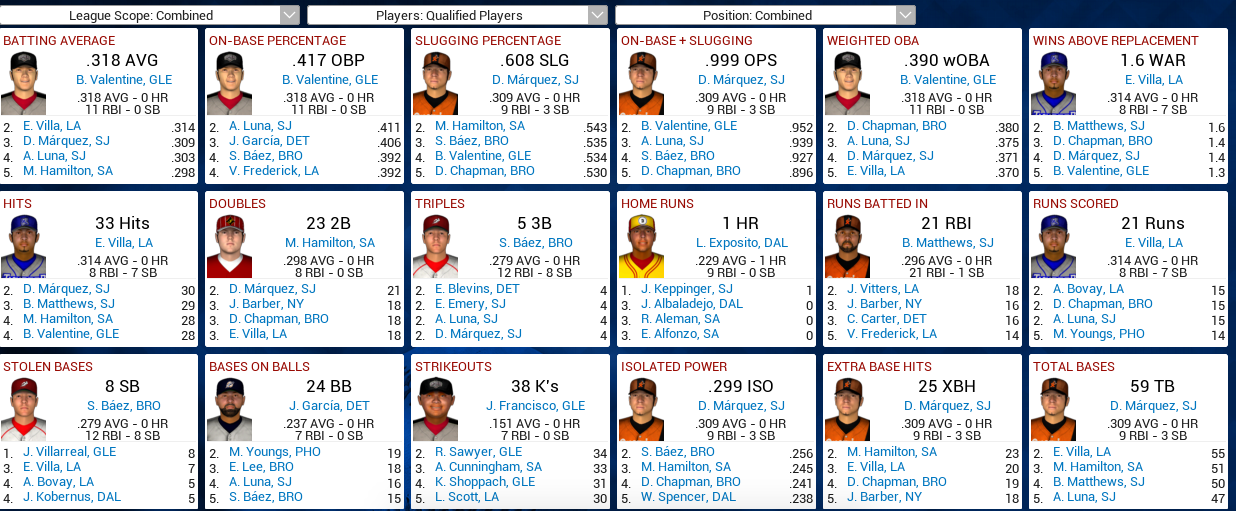
Screen Shot 2016-01-29 at 3.46.28 PMThere have been two HRs (both inside-the-park) hit in the entire league. The batting leader is hitting just .318. Mark Hamilton of the San Antonio Coyotes has 28 hits… 23 of them doubles.

Now, let’s look at the pitchers:

Screen Shot 2016-01-29 at 3.50.34 PM0.58 is leading the league in ERA amongst starters. Manny Lopez, by the way, had a 8.53 ERA back when the Arena Baseball League lived up to it’s name.

Okay, now let’s zoom to the All-Star Break…

Screen Shot 2016-01-29 at 3.56.45 PMOof. As you can see, the total number of Home Runs now stands at 3. The leading batting average is .312, and that’s the only BA over 300. The leader in doubles would already be tied for 30th all-time in a single season in the real world.

The pitching standings similarly continue to be a bit off-kilter:

Screen Shot 2016-01-29 at 4.05.39 PMAmazingly, despite how good all of these pitchers seems to be, there has only been one no-hitter in the first half of the season… and it was barely in the top ten best pitching performances of the half!

Screen Shot 2016-01-29 at 4.06.45 PMWowzers.

Now, let’s go to the end of the regular season and look at what has come:

Oh. Oh dear…

Screen Shot 2016-01-29 at 4.14.51 PMThe best batting average is a .304. .304. That is 1968 level of bad hitting (in 1968, Yastrzemski won the AL title with a .301). However, the doubles record of 67 has been demolished, and Arturo Luna had more triples than any MLB player has had since 1925.

Now, how about pitchers?

Screen Shot 2016-01-29 at 4.21.00 PMA 0.99 ERA in 208.2 IP is very impressive, needless to say, and 306 strikeouts is more in a season than any pitcher has had since Randy Johnson was in his prime. Amazingly, there was only one no-hitter: Ron Turner’s in the first half.

Now, let’s look at the league as whole, shall we?

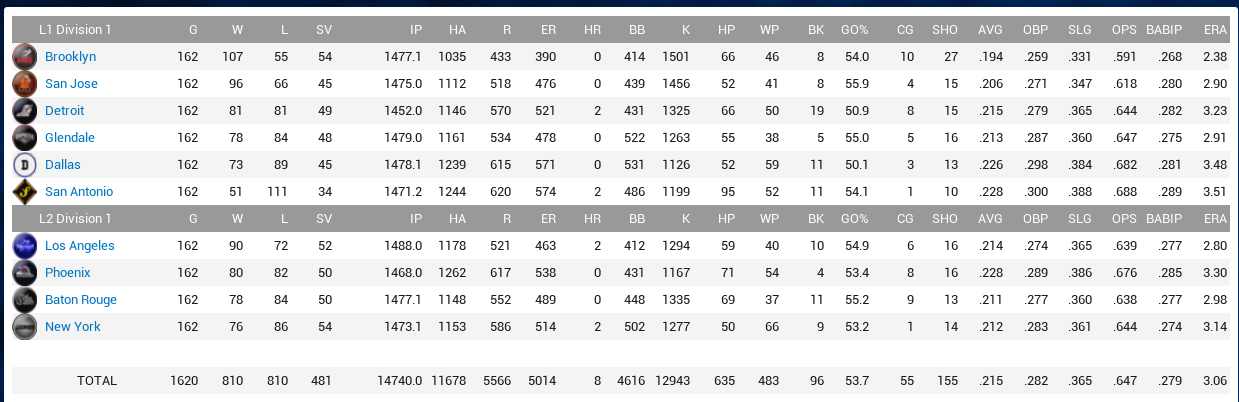
Screen Shot 2016-01-29 at 4.26.17 PM8 total home runs. 6998 total doubles. 564 total triples. The league as a total hit .215. Well, at least what hits did happen were usually exciting, right?

Screen Shot 2016-01-29 at 4.29.26 PMKind of surprised the league ERA was 3.06. I thought it’d be a little lower.

So… what did we learn? We learned that pushing the fences way back is bad for offense but will cause any balls that get past the outfielders to allow for extra bases. We learned that nothing particularly “game-breaking” occurs in OOTP if you do this. And, uhm, we learned that having deep outfield fences is nowhere near as fun to write about as arena-ball fences. I mean, yes, this is partly because I’m distracted by other blogathon concerns, but it was way more fun writing about insane scores statistics as opposed to what more-or-less was just a deadball era.

Next Time on Breaking OOTP: The most controversial Breaking OOTP yet

At 8 PM: BIZARRE BASEBALL CULTURE

This post has been part of the 2016 Baseball Continuum Blogathon For Charity, benefiting the Roswell Park Alliance Foundation. The Roswell Park Alliance Foundation is the charitable arm of Roswell Park Cancer Institute and funds raised will be “put to immediate use to increase the pace from research trials into improved clinical care, to ensure state-of-the-art facilities, and to help improve the quality of life for patients and their families.” Please donate through the Blogathon’s GoFundMe page.


(Blogathon ’16!) The Sliding Scale of Fictional Baseball Realism

This post is part of the 2016 Baseball Continuum Blogathon For Charity, benefiting the Roswell Park Alliance Foundation. The Roswell Park Alliance Foundation is the charitable arm of Roswell Park Cancer Institute and funds raised will be “put to immediate use to increase the pace from research trials into improved clinical care, to ensure state-of-the-art facilities, and to help improve the quality of life for patients and their families.” Please donate through the Blogathon’s GoFundMe page.

Earlier today, in my look at Touch, I mentioned that you can make a 0-10 scale of baseball realism in works of fiction, with zero being baseball-in-name-only and ten being actual footage of a game.

Well, I’m going to expand upon that:

0: Baseball In Name Only

In this category, it’s not really baseball at all. They may call it baseball, but it certainly isn’t the actual sport that we know. The Moe Cronin version of baseball fits here.

1: Utterly Absurd

In this category, while it’s clearly meant to be baseball, the rules of the game and the laws of physics have clearly taken a vacation. Some classic cartoons fall into this category.

2: Very Absurd, but still with some realism

In this category, the work might have cartoonish physics and occurrences, but it still is grounded in reality enough to have the rules of baseball still be mostly the same. In theory, a baseball movie where the rules are not consistent or are wildly different but where everything else is played straight could also qualify here. Classic cartoons that aren’t “utterly absurd” usually fall in this category.

3: Absurd, but mostly consistent

Works in this category are clearly absurd and cartoonish, but are at least consistent: the laws of physics may not be what they are in the real world, but they don’t suddenly change mid-game, nor do the rules suddenly change simply because the story demands it. Most “cartoon” baseball video games, like Backyard Baseball and the Mario Baseball series, fit in this category.

4: Many absurd elements

While clearly meant to be a realistic world that has our baseball’s rules and our laws of physics, the amount of absurd, cartoonish or unrealistic elements in the work make it more strange than realistic. Consider Mr. Go, for example, which has two baseball-playing gorillas, a little girl acting as a first-base coach and a finale that involves the baseball coming undone into a million pieces, which sort of overwhelms what would probably otherwise be a 6 if, say, it only had one gorilla.

5: Equal Mix of Realism and Fantasy

A work that sort of teeters between being realistic and being bizarre. This is more of a transitional spot on the scale, as it’s rare that anything ever stays at 5, inevitably going to 4 or 6 instead.

6: Realistic, but with one or two “big lies”

This is mostly realistic but it has one or two big elements (or the equivalent of one or two big elements made up of lots of smaller elements) that keep it from being something that you can honestly expect to ever happen in the real world. Sidd Finch could fit here, as could most of the movies in which a kid becomes a big league skipper or ballplayer.

7: Realistic, but highly unlikely

There’s nothing in this work that couldn’t happen, but it’s highly unlikely and any real event like this would probably instantly become one of the most notable things in baseball history. You could argue that Major League fits here, sort of.

8: Near total-realism

While some rules might be bent or not enforced on a strict basis, and some things might happen that are unlikely (although not nearly as unlikely as things that fall at seven on the scale), this is pretty realistic. Casey At The Bat, the classic poem, could be considered as this, with only the ability of everybody to seemingly hear everything keeping it from being a nine.

9: Utter realism

The only things that are not realistic in works of this category are omnipresent techniques like camerawork and editing for time, or stylish touches added in to indicate, say, that a player is angry. Bull Durham could, in theory, fit in this category, as could most (but not all) fairly true-to-history biopics and most realistic baseball video games.

10: Actual Baseball Footage used/Documentary

If you are watching an actual baseball game, or watching a documentary that uses baseball footage and does so without changing things for dramatic effect, you are watching a 10.


Feel free to consider where on the sliding scale your favorite piece of baseball fiction would fall!

6 PM: First References

This post has been part of the 2016 Baseball Continuum Blogathon For Charity, benefiting the Roswell Park Alliance Foundation. The Roswell Park Alliance Foundation is the charitable arm of Roswell Park Cancer Institute and funds raised will be “put to immediate use to increase the pace from research trials into improved clinical care, to ensure state-of-the-art facilities, and to help improve the quality of life for patients and their families.” Please donate through the Blogathon’s GoFundMe page.


Best of 2015- Bizarre Baseball Culture: Fallout 4’s surprisingly-high level of Baseball

Originally published November 24, 2015.

In Bizarre Baseball Culture, I take a look at some of the more unusual places where baseball has reared it’s head in pop culture and fiction.

(Note: The following contains spoilers for Fallout 4. Click on each picture to make it larger if you are having trouble reading text or seeing something.)

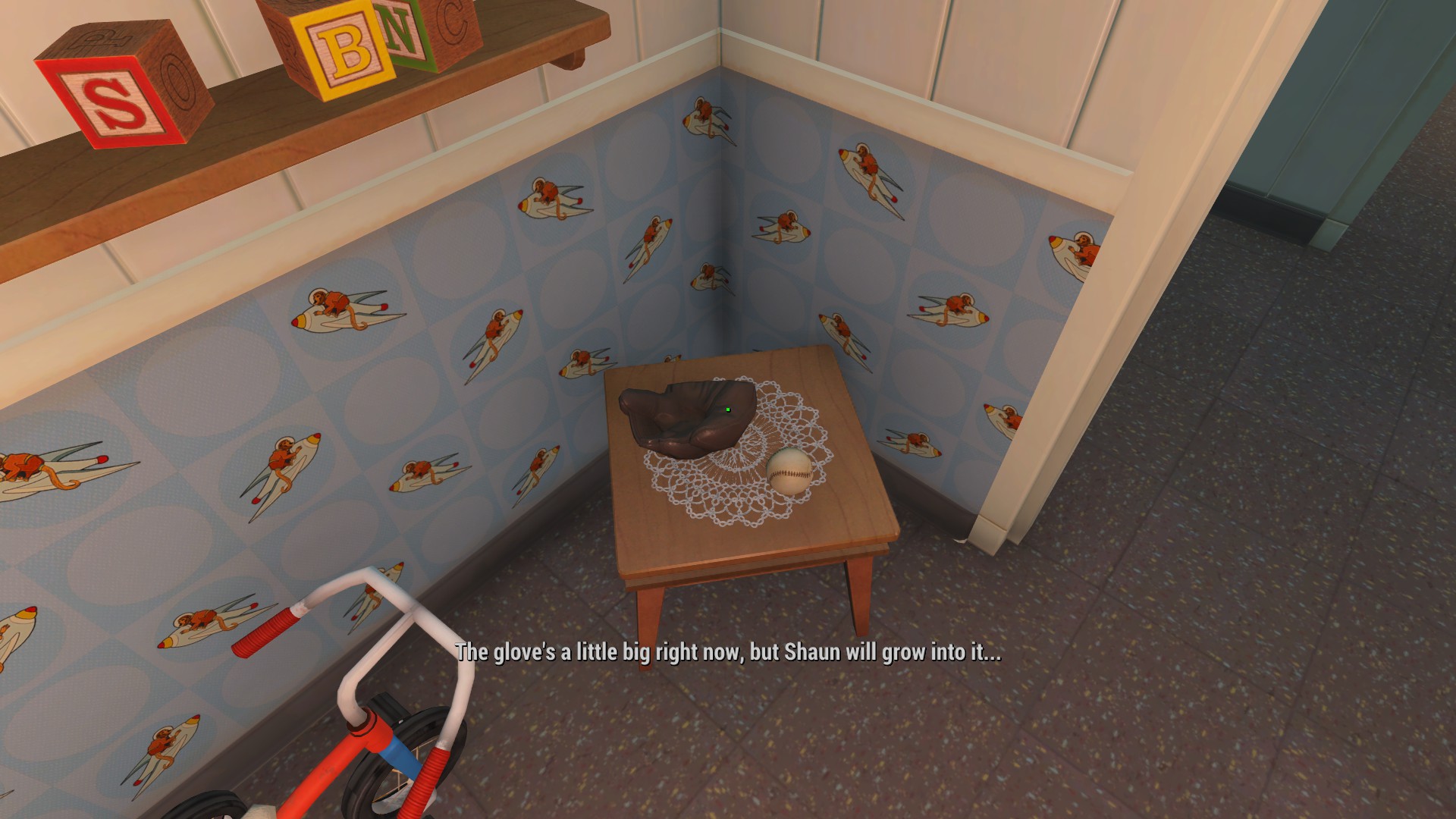
It is October 23, 2077. The world is at war, and fear of nuclear annihilation is high. However, for you, it is just another day in a Boston suburb with your spouse and your young son. And, obviously, your son, Shaun, is a baseball fan in the making, as you can see a small glove and ball that you can comment on:

ShaunGlove

shaunball

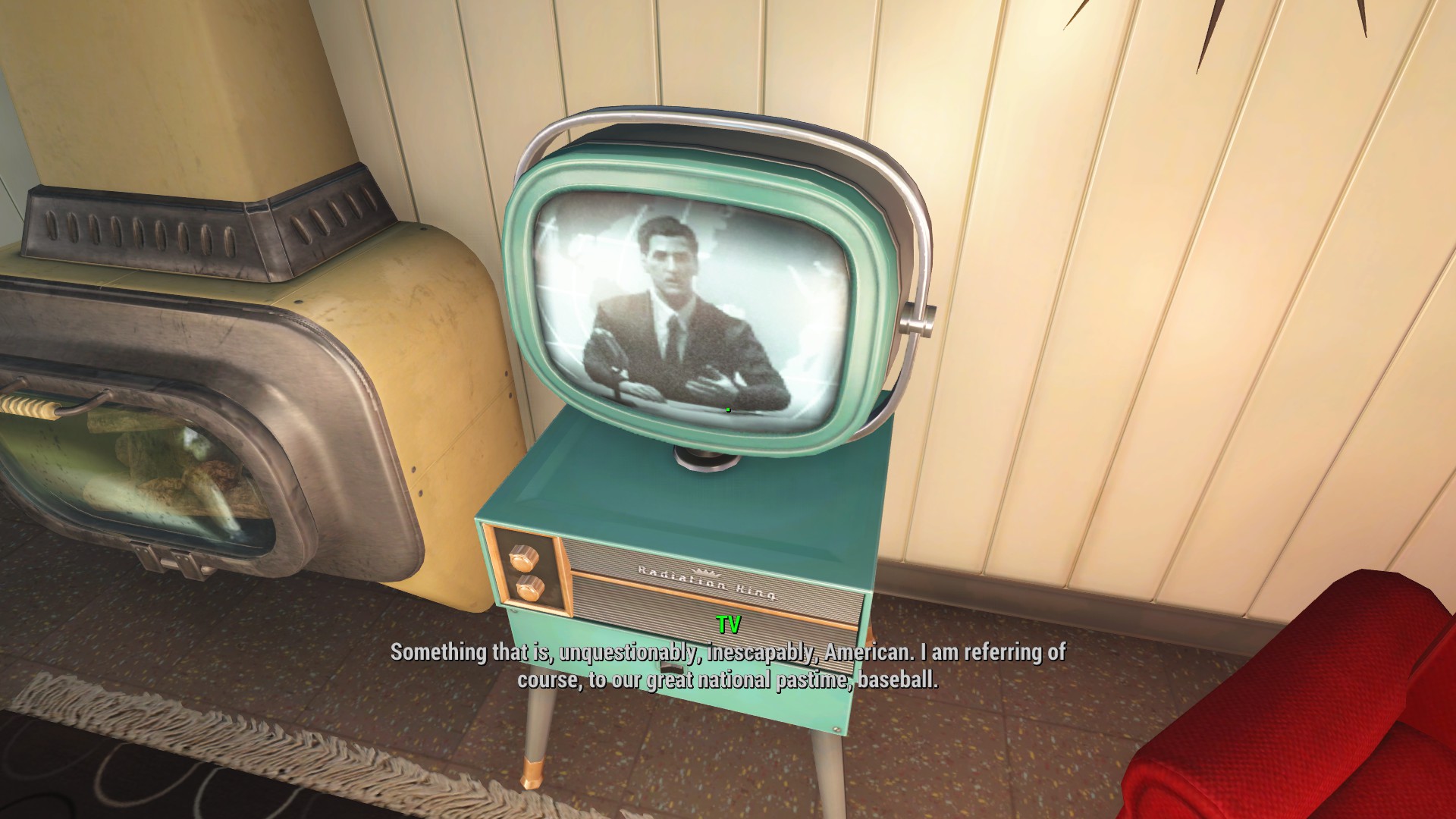
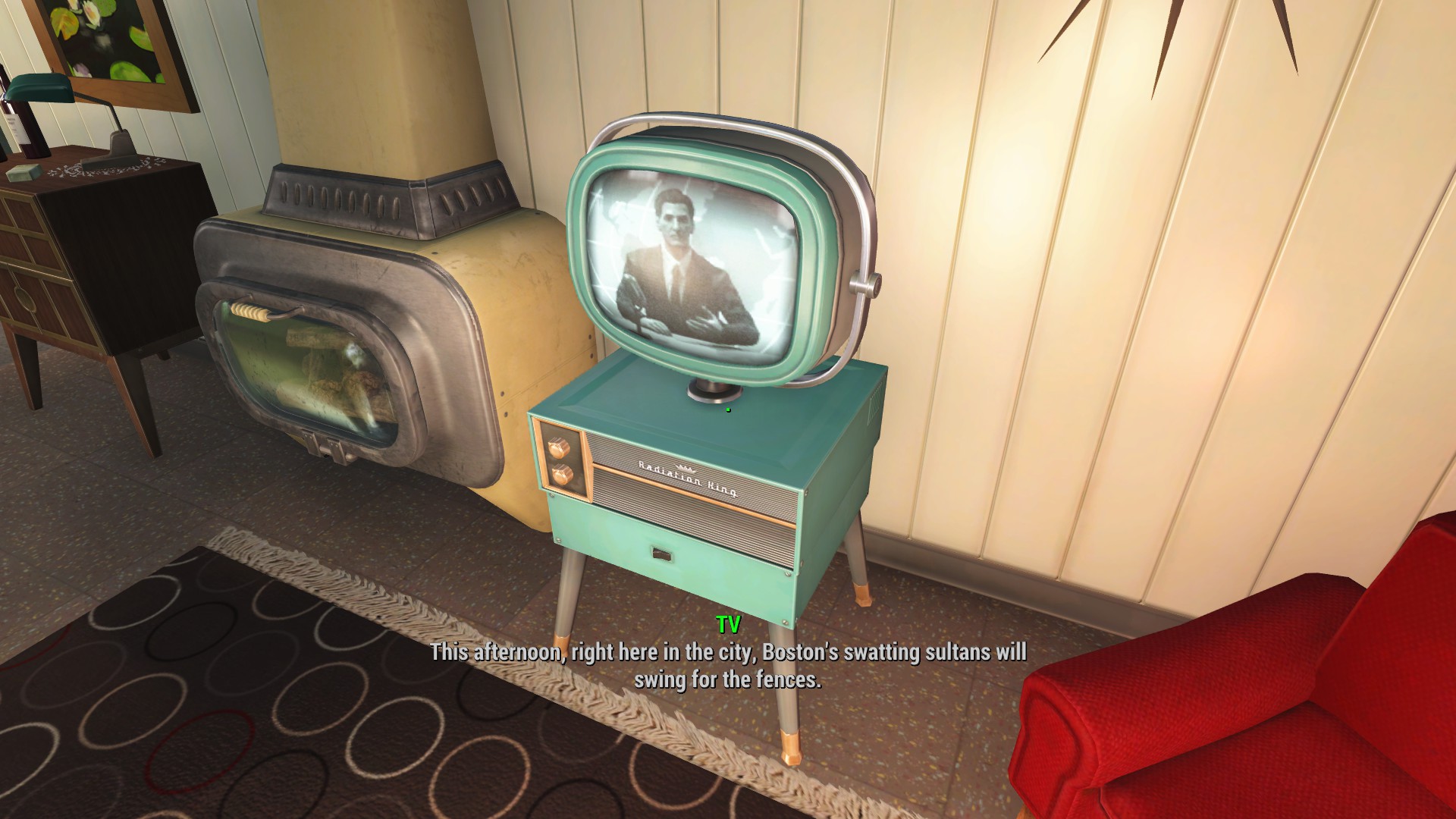
As you receive your coffee and paper from your robotic butler, Codsworth, you hear something in the corner of your living room. On a black-and-white TV, a newsman with the voice of Ron Perlman (who has a role in every Fallout game, usually as a narrator of some kind) updates you on the day’s events and weather before going to sports:

perlman1

perlman2

perlman3

Yes, it’s World Series time in Boston, as the Red Sox are looking to win their first title in over a century and a half!

You are then interrupted by a salesman selling a spot in a underground fallout shelter, called a Vault. After that’s done, you go check on your son and talk to your wife. She thinks maybe everyone should go for a walk in the park this afternoon. Pffft, you say:

misstheworldseries

Of course, you do end up missing the World Series. After this conversation, you get news that atomic missiles are incoming. You rush to the nearest vault. Stuff happens, and you wake up 210 years later with your wife gone and your son missing.

(More below the jump!)

Continue reading

Best of 2015- How many sports has Mario played?

Originally published on September 12, 2015.

The question of who the greatest video game athlete of all time is a hard one. Many go with Bo Jackson, with good reason. Still others (such as the Cespedes BBQ duo) wisely go with the Secret Weapon himself, Pablo Sanchez. But for sheer variety, none can defeat Mario, the most versatile athlete in video game history, who, by coincidence, celebrates the 30th anniversary of the release of Super Mario Brothers today!

And today, to honor National Video Games Day, which I just found out exists like ten minutes ago on Twitter, I’m running down every single sport Mario has ever played.

(Go below the jump for more)

Continue reading