“30 Teams, 30 Posts” (2016): OOTP ’17 (almost) determines the greatest Marlins team of all

In 30 Teams, 30 Posts, I write a post (of varying amounts of seriousness) about every MLB team in some way in the lead-up to the beginning of the 2016 season. Earlier installments can be found here. Today, the Marlins.

I am lucky enough to have on my hard drive a reviewer’s copy of Out Of The Park 17. While obviously the review will not be out for a few more days, I decided that for today’s “30 Teams, 30 Posts” I would use one of OOTP’s newest features to answer a question:

What was the greatest Marlins team of all time? Was it the 1997 Florida Marlins helmed by Jim Leyland or was it Jack McKeon’s 2003 Marlins?

Using the “Historical Exhibition” feature of OOTP 17, I’m going to find out… after the jump:

Continue reading

“30 Teams, 30 Posts” (2016): A stream of consciousness on Greinke being on the Diamondbacks

In 30 Teams, 30 Posts, I write a post (of varying amounts of seriousness) about every MLB team in some way in the lead-up to the beginning of the 2016 season. Earlier installments can be found here. Today, the D-Backs.

I know, as a fact, that Zack Greinke is now a member of the Arizona Diamondbacks. That is something I am 100% sure of.

That still doesn’t mean I truly believe it, though.

I mean, this was Zack Greinke. He’s admitted in the past that he follows the money. And he was in Los Angeles, the richest team in the league in one of the biggest markets in the country.

And yet, he ended up in Arizona. Phoenix. For the Diamondbacks.

I mean, if it was the Yankees or Red Sox, I could see it. Heck, I’d even go with someplace like San Francisco or one of the Chicago teams.

But he went to Arizona. The Diamondbacks.

I still haven’t fully processed this.

I’m not sure when I will.

An @HOVG Addendum: The biggest baseball alum of NCAA Snubs

Over at Hall of Very Good, I looked at the best baseball alums of every team in the NCAA Tournament.

Consider this an addendum: the best baseball alums of various NCAA snubs!

Monmouth: The best Monmouth baseball alum is active now: Brad Brach. Three other Monmouth grads have made the show, however. They are Ed Halicki, Bob Hooper, and Tom Kelly.

St. Bonaventure: This is an easy one, as John McGraw played for (and coached) Bonaventure in the 1890s, even though he already had played a bit professionally (the idea of the strict separation of amateur and professional was not yet completely solidified). There’s also some evidence that Hugh Jennings was involved with Bonaventure, but it’s not listed at Baseball Reference. Danny McDevitt is the most recent MLB player who was a Bonnie.

St. Mary’s: Hall of Famers Harry Hooper and Hank O’Day are St. Mary’s grads, although I’d give the edge to Hooper. Honorable mentions: Von Hayes, Gus Triandos, Duffy Lewis, Tom Candiotti, Dutch Leonard, and Mark Teahen.

South Carolina: A baseball power in recent years, I’d say Brian Roberts (who had transferred there from UNC) is the best Gamecock alum, although you certainly can make arguments for Dave Hollins, Mookie Wilson and Bill Landrum. Current Gamecocks include Justin Smoak, Steve Pearce, and Jackie Bradley Jr.

San Diego State: Tony Gwynn. Done. (Other alums include: Stephen Strasburg, Graig Nettles, Mark Grace, Tony Clark, Harold Reynolds, and Dave Roberts.)

Valparaiso: Lloyd McClendon, apologies to guys like Al Pilcarik and Freddy Spurgeon.

So, there you have it. Make sure to go to Hall of Very Good to see the best alums of those who DID make the bracket.


World Baseball Classic Update for March 11, 2016

Finally, the rosters for the Panama and Mexicali qualifiers of the WBC have been unveiled. I’ll go deeper when I do the previews for the tournaments, but a quick rundown:

  • Mexicali:
    • It appears, on paper, that this is going to be Mexico’s pool to lose. They have by far the most experienced and MLB-related of the rosters in the pool, led by All-Star Adrian Gonzalez and Oliver Perez.
    • The Czechs are generally using their own players (such as Cleveland farmhand Martin Cervenka), which is commendable, but they have a few guys who are there due to Czech heritage, such as Mike Cervenak.
    • Nicaragua is probably Mexico’s biggest threat in the Mexicali bracket, with 11 MLB-affiliated players, as well as some players who used to be in affiliated ball.
    • Germany is hurt by not having Max Kepler, but still has six affiliated players, including Donald Lutz, who has MLB experience. They also will have former MLB player Will Ohman on the squad- he was born in Germany.
  • Panama City:
    • The home team Panamanians are led on the field by former All-Star Carlos Ruiz, and possess nine other affiliated players. Many of the other players on the team have also played affiliated ball, with Manny Corpas having reached the Majors.
    • The biggest threat to Panama is Colombia, with 16 affiliated players led by MLB or soon-to-be MLB players in Dilson Herrera and Harold Ramirez. They also have four players in AAA.
    • The Spanish are one teams in the WBC that are most blatant in their use of “Passport” players who are only eligible for their team due to lax citizenship rules. Almost all of their players, as far as I can tell, are expats from the Caribbean. None of their four affiliated players (Rogelio Armenteros of the Astros organization, Luis Guillorme of the Mets organization, Lazaro Leyva of the Orioles and Carlos Sierra of the Astros’ organization) are from Spain, for example.
    • France is probably the team in this pool most likely to go 2-and-out. Only one- Andy Paz- is MLB-affiliated, although some, like Rene Leveret, have been in affiliated baseball in the past.

Finally one last other piece of news:

There is some exhibition action, as Germany split a two-game series with the Tijuana Toros, France beat Seminole State College, and the Czechs lost to a Brewers’ minor league squad.

“30 Teams, 30 Posts” (2016): Carlos Correa is the next face of baseball

In 30 Teams, 30 Posts, I write a post (of varying amounts of seriousness) about every MLB team in some way in the lead-up to the beginning of the 2016 season. Earlier installments can be found here. Today, the Houston Astros and their young star, Carlos Correa.

If I was making a computer program to pick out the next “Face of Baseball”, I’d tell it to find a young position-player phenom who was bilingual and played in a large city, who has already tasted both the highs and the lows of Major League Baseball.

In other words, I’d basically force it to pick Carlos Correa of the Houston Astros. Just 21, the Houston shortstop is perhaps everything that baseball would want in a new superstar.

Here’s why:

  1. He’s young. Even younger than Harper and Trout.
  2. He’s bilingual, able to speak both his native Spanish (he’s from Puerto Rico) and English. With the great internationalization of baseball, this allows him to reach fans around the Western Hemisphere regardless of what language they speak.
  3. While he plays with joy and confidence, he also doesn’t seem to be one to make enemies or ruffle too many feathers. Not that there’s anything wrong with ruffling feathers when they need to ruffled, of course.
  4. He already knows joy and pain. He helped lead the Astros to the playoffs last season, but also was somewhat responsible for their shocking blow-up in the ALDS against the Royals.
  5. He plays in a big market- Houston is the fourth largest city in the United States!
  6. Most importantly of all… he’s good! Really good! He had 22 HRs last season despite only appearing in 99 games. He showed great speed on the bases, swiping 14 bags while only getting caught four times. And while his “slash stats” show some room for improvement, they still are remarkable for somebody so young playing at shortstop, and will probably improve in the coming years.

So, in short, Carlos Correa is awesome.


“30 Teams, 30 Posts” (2016): A Lost Year for Atlanta

In 30 Teams, 30 Posts, I write a post (of varying amounts of seriousness) about every MLB team in some way in the lead-up to the beginning of the 2016 season. Earlier installments can be found here. Today, the Atlanta Braves.

Yesterday, it was announced that the Atlanta Braves and Miami Marlins would play a regular season game at Fort Bragg in North Carolina. In most years, one would think this would mean the Marlins were giving up a home game. However, it’s the Braves who are.

And that seems fitting for Atlanta, a team that will be going nowhere this season as they turn their eyes almost entirely to the future. Defensive wizard Andrelton Simmons is gone. All-Star pitcher Shelby Miller is gone. Guys like Jason Heyward and Craig Kimbrel are now distant memories. The acquisitions by the Braves this off-season have either been entirely aimed at the future (former Number 1 pick Dansby Swanson, for example) or meant to fill a spot and keep the team from being a complete joke. Oh, Freddie Freeman is still there… although you can bet there will be talk of him possibly being traded, even if it could end up as just that: speculation.

The plan is clear: After this season, the Braves will move to the wealthier suburbs up in Cobb County, playing in a new stadium called SunTrust Park. The first year or two there, the thought is, will be a honeymoon, as people will go there just because it’s new.

The Braves hope that by the time the honeymoon ends, the team will be good enough to get people to come to games to see a winning team.

Only time will tell if they are right. But I don’t think it will take much time for the 2016 Braves to stink up the joint. It could get ugly really fast.


30 Teams, 30 Posts (2016): What is Raymond?

In 30 Teams, 30 Posts, I write a post (of varying amounts of seriousness) about every MLB team in some way in the lead-up to the beginning of the 2016 season. Earlier installments can be found here. Today, I reveal the truth about one of the AL East’s mascots- Raymond of the Tampa Bay Rays.

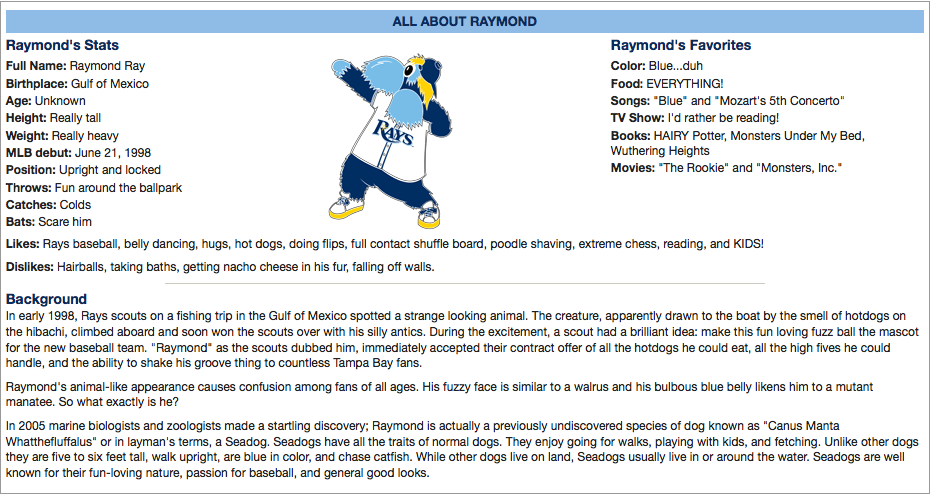
Below you can see Raymond, the mascot of the Tampa Bay Rays:

You may be thinking that, given the fact that he is the mascot for the Rays, that he would be a Ray. You would be wrong. It turns out that he is NOT a Ray.

Here’s some information about Ray from Tampa’s website:

Screen Shot 2016-02-29 at 8.02.56 PMDo you see the relevant thing, here?

Screen Shot 2016-03-08 at 10.23.35 AMYes, he is, apparently, a “seadog”. However, according to Wikipedia, there is no such thing as a seadog. Oh, it’s a slang term for seals, or for people (or dogs) that spend a lot of time at sea, but there is no such thing as a sea dog. Nothing of the species Canus Manta Whatthefluffalus. In fact, there isn’t even a genis called Canus. There is, obviously, Canis, which is where dogs are, but Canus (Latin for “aging”) does not.

So, what is it, Tampa? What is Raymond? What scientists truly discovered him? Could he be… (GASP) a mere man in a suit!?!?!

Tell us the truth, Tampa. We know you are hiding something.


World Baseball Classic Update For March 7, 2016

It’s been a fairly quiet week in WBC news, as we await the official release of the rosters for the next round of qualifiers. Still, there has been some news:


Jon Morosi on the Czech Republic’s WBC team and how the country’s hockey heritage has led to a lot of left-handed hitters.

The Japanese National Team swept Taiwan in a 3-game early warm-up for next year’s WBC.

Nicaragua leads Panama 2-1 in a warm-up series.

Alex Rodriguez, who famously has hemmed and hawed between playing for the USA (the land of his birth) and the Dominican (the land where he spent significant parts of his childhood), has said if he takes part in 2017 it’ll be for the Dominican.

Alex Cora will be the General Manager of Team Puerto Rico for the 2017 WBC.

ESPN Deportes will be showing the Mexicali qualifying round this month for any Spanish-speaking fans in the USA.

As expected, Max Kepler will not be playing for Germany in the qualifiers, as he will be staying in camp. It was thought that it was unlikely anyway given how he has an outside chance at making the opening day roster, but this is further confirmation.

…And that’s it for now. More soon, hopefully.


“30 Teams, 30 Posts” (2016) has it’s Blue Jays installment at the Hall of Very Good!

The latest “30 Teams, 30 Posts” installment, about the Blue Jays, is part of this week’s “Wisdom and Links” at Hall of Very Good!

30 Teams, 30 Posts (2016): The Tale of Dandy, the Short-Lived Yankees Mascot

In 30 Teams, 30 Posts, I write a post (of varying amounts of seriousness) about every MLB team in some way in the lead-up to the beginning of the 2016 season. Earlier installments can be found here. Today, I speak of Dandy, the short-lived Yankees mascot.

Every team in MLB has a mascot, with three exceptions: the Angels (although they do have the Rally Monkey), the Dodgers… and the Yankees.

But, believe it or not, the Yankees did indeed have a mascot at one point! His name was Dandy, and he looked like this:

dandyCreated by Bonnie Erickson (who also designed Miss Piggy) and her husband and creative partner Wayde Harrison (together, they created the Phillie Phanatic, Youppi!, and other famed mascots), Dandy came to be in an attempt for the Yankees to replicate Phanatic Phever. With the Erickson/Harrison pedigree, a friendly and huggable shape, and a epic mustache, Dandy seemed destined for success. Even George Steinbrenner seemed interested in him, haggling with Erickson and Harrison to make sure that the color of Dandy’s pinstripes were the right shade.

And Dandy may have gotten away with it too, if not for that meddling Chicken. Two weeks before Dandy was to debut in 1979, Lou Piniella took umbrage at the San Diego Chicken (on loan to the Mariners) putting a hex on Ron Guidry and threw his mitt at him. After this incident, Steinbrenner declared that mascots had no place in baseball.

Still, a deal was a deal, so Dandy went into action- in a greatly reduced capacity. His opening debut, which would have involved a pre-set routine and theme music, was scrapped, never to be seen. The Yankees did everything in their power to make him as unimportant as possible, even saying in their team guide that he was just there to amuse the kiddies and stay as far away from the action as possible. True to their word, he was confined up in the cheap-seats.

To make matters worse, for a time Dandy was banned from the stadium outright because his mustache called to mind Thurman Munson, who died in a tragic plane crash.

So, perhaps it isn’t surprising that the few years that Dandy existed were ones of obscurity. As early as the 1990s, people who worked for the Yankees claimed that there never even was a mascot. At one point, during a rare public appearance, Dandy was attacked by a group of drunk bankers, causing the guy inside of the costume- somebody named Rick Ford- to hold it for ransom.

Amazingly, though, it wasn’t the Yankees who cancelled Dandy. It was Erickson and Harrison, who hated how marginalized their creation was. They took him and went home when his lease was up, despite the fact the Yankees were interested in renewing it. To this day, they still own the rights and design, so if you are an eclectic millionaire looking to have a obscure mascot at your next birthday party… give them a call.

Sources:

“Mascots R Them” by Erin St. John Kelly

“Not so Fine and Dandy: The History of The Yankees Mascot” by Josh Eisenberg

“The Short, Sad History Of The Yankees 1980s Mascot, Dandy” by Jen Carlson

“Yankees’ Long-Forgotten Mascot” by Scott Cacciola