Giancarlo Stanton’s $325 Million Dollars in perspective

Giancarlo Stanton will, likely, get $325 million dollars in exchange for playing for the Miami Marlins for 13 more years (assuming he doesn’t get traded or opts out).

That, scientifically, is known as a buttload of money. How much money? Let’s go through it…

$500 Million: The value of the Miami Marlins, according to Forbes. Yes, Jeffrey Loria is basically saying that Giancarlo Stanton represents 65% of the value of the team itself.

It is over 20 times Babe Ruth‘s career earnings after inflation.

It is over 1.6 times Ken Griffey Jr.’s career earnings after inflation.

It is over 1.2 times Barry Bonds‘ career earnings after inflation.

$311 Million: The GDP of Sao Tome and Principe, a island nation in the Gulf of Guinea

$785.20: The amount of money every person in the City of Miami would receive if Giancarlo’s next contract was split up equally amongst them.

Giancarlo would be able to buy eight 1962-63 Ferrari 250 GTOs (which sold for $38 million dollars in August) with his proposed new contract’s money.

$294 Million: The cost, adjusted for inflation, of Titanic, the second most expensive (when adjusted for inflation) movie production of all time.

812.5 years: How long the President of United States would have to be in office to make that amount of money ($325 million) from the job.

$292,198,327: Total salary earnings (without inflation) of Shaquille O’Neil over his entire NBA career.

10: The number of NHL franchises, according to Forbes, with a value below $325 million dollars.

All of them: The number of MLS teams, according to Forbes, with a value below $325 million dollars. If he were in a soccer sort of mood, Giancarlo could afford to buy both the most and the third most valuable MLS team at the same time with the money he will earn over his next deal.

The original cost to build Fenway Park was $650,000 dollars, which is $15.9 million dollars when adjusted for inflation. That means that Giancarlo Stanton over the span of his hypothetical new contract would be able to build 20 Fenway Parks circa 1912, and he’d have enough money left to do just under half of a 21st.

$25 Million: How much Giancarlo would make in an average year under his new contract.

$10 Million: GDP of the island country of Niue. It would take Niue two and a half years of it’s entire gross domestic product to pay for one year of Giancarlo Stanton.

I don’t think anyone can imagine how big Mike Trout‘s deal will be if this is anything to go on.


Rise of the Machines

Video

Researchers in Japan are hard at work creating robots that will one day combine, Voltron-style, and play baseball after our robot overlords have taken control of the planet:

First References in “The Sporting News”: Japan

One of the great perks of SABR membership is access online to The Sporting News’ archives. While it now is dedicated to all sports, for a good chunk of it’s earlier history it was almost entirely focused on baseball (with some boxing, horse-racing and college football thrown in here and there). So, today, I take a look at some early references to things in The Sporting News. In this case, in the spirit of MLB’s current tour of Japan, I’m looking at certain topics related to baseball in Japan.

Baseball in Japan in General

While there were some references to Japan as far back as the 1880s, they either are references to other things or exceedingly brief and vague, like this item from the November 13, 1886 issue that I honestly do not understand whatsoever (although John Thorn has thankfully given some insight as to what Copenhagen was– it was a game played by young children):

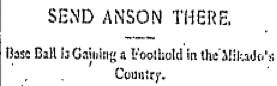
Screen Shot 2014-11-13 at 11.28.29 AMThe first real, unequivocal reference to baseball in Japanese baseball in The Sporting News was in 1897, as the December 4 issue had this headline:
Screen Shot 2014-11-13 at 11.38.13 AM

“Mikado” is a now-obsolete term used in the 19th century to refer to Japan’s Emperor. It also was the name of a Gilbert and Sullivan opera.

It began like this:

Base ball (sic) has invaded Japan and to such an extent that the Tokio (sic) Athletic Association has written to President James A. Hart of Chicago for rules and suggestions relative to the furthering of the American national game in the land of the Mikado.

The article goes on to say how “last summer” a “lively little gentlemen” name Tora Hiraoka of “Tokio” attended games in Chicago with Hart (who owned the team we now know as the Chicago Cubs at the time) and had told him of how baseball had been introduced to Japan (“displaying two or three crooked fingers as indisputable evidence”) and that he was sure it could be “immensely popular” if “generally introduced”. The rest of the article is on how Hart had received a letter from Japan and how he believes that the Japanese should take to the game because they are “agile and naturally like athletic sports”, also mentioning how maybe they could play a Australian team that had visited America “last season”.

Koshien Stadium

The most famous stadium in Japan and site of the country’s High School Championships, the first reference to Koshien came in the November 8, 1934 edition of Sporting News, when it was mentioned that Babe Ruth’s tour would likely see even greater crowds in Osaka, since that was where “the Koshien Stadium seats 80,000”.

Tokyo/Yomiuri Giants

The “Yankees of Japan” and winners of 22 Japan Series titles, the Yomiuri Giants were first referenced in the January 23, 1936 issue of The Sporting News, where it was reported that they (as the “Tokyo Giants”, their name before their owners at the Yomiuri Group changed it to better advertise themselves) would be coming to America to tour the Pacific Coast, Texas, and the Northwest. The first reference to the Yomiuri Giants under their current name came in 1951. In the November 7 issue, a story on a tour led by Lefty O’Doul and featuring players like Joe DiMaggio and Mel Parnell was printed, and it covered the team’s 6-3 victory over Yomiuri on October 25.

Masanori Murakami

The first Japanese player in MLB history, Murakami was a pitcher who had been sent to the San Francisco Giants as something of a exchange student to play in their minor leagues. However, he pitched so well that the Giants called him up and then refused to send him back to Japan when it was time. The baseball version of a international incident occurred, and it eventually led to the end of Japanese players in North American baseball until Hideo Nomo came over in the 90s.

The first reference to Murakami in The Sporting News was on March 7, 1964, in a story by Bob Stevens on how he and two other Japanese players (Tatsuhiko Tanaka and Hiroshi Takahashi) would be in the Giants’ organization that season. Funnily enough, the story includes a note that neither San Francisco or the Nankai Hawks (their Japanese team) thought any of them would be able to crack a National League roster. Whoops.

Sadaharu Oh

Probably the greatest player in the history of Nippon Pro Baseball and owner of the all-time professional record for HRs (868), the first reference to Oh in The Sporting News came in the Jan. 2, 1965 issue, as writer Jim Sheen looked back on some of the biggest accomplishments in the sports world in 1964:

Screen Shot 2014-11-13 at 12.33.56 PMHideo Nomo

Interestingly, the first mention of Nomo in The Sporting News was a single item in Bob Nightengale’s baseball report on January 30, 1995, where he mentions that he is one of the hottest free-agent pitchers on the market and that the Dodgers, Blue Jays and Mariners were all pursuing him.

Ichiro Suzuki

Finally, the first reference to Ichiro in The Sporting News also was rather matter-of-fact, coming in a preview issue on Valentine’s Day in 2000, where he was mentioned not because he was joining the Mariners (he wouldn’t until 2001), but because his spring training stint in 1999 had given Seattle some experience with the throngs of Japanese press they would receive for their new reliever, Kaz Sasaki.

Screen Shot 2014-11-13 at 12.52.47 PM

Thank you to SABR and their “Paper of Record” database for making this article possible. Also, thank you to @YakyuNightOwl for correcting me on the history of Yomiuri’s name- it was always owned and run by Yomiuri, it’s just that Yomiuri didn’t put their name in the team name until later.

Famous For Something Else: Reece “Goose” Tatum, Harlem Globetrotter Legend

It’s time for another “Famous for Something Else”.

Today’s individual who is far more famous for something else is Reece “Goose” Tatum. Tatum was the original “Clown Prince” of the Harlem Globetrotters, one of the finest basketball players of his era (back during a time when the Globetrotters would play and often beat actual NBA teams), and said to be the inventor of the hook shot/skyhook that Kareem Abdul-Jabbar would later make famous.

But before his basketball career really took off, Goose played some baseball in the Negro Leagues. While his stats are a bit spotty due to the less-than-excellent record-keeping of the day, here they are:

Year Age AgeDif Tm Lg Lev PA AB R H 2B 3B HR RBI SB BB BA OBP SLG OPS TB SH
1941 20 Birmingham NAL NgM 6 5 1 3 0 0 0 2 0 0 .600 .600 .600 1.200 3 1
1941 20 Birmingham NAL NgM
1942 21 Birmingham NAL NgM 3 3 0 0 0 0 0 0 0 0 .000 .000 .000 .000 0 0
1942 21 Birmingham NAL NgM
1943 22 Cincinnati NAL NgM 3 3 0 0 0 0 0 0 0 0 .000 .000 .000 .000 0 0
1943 22 Cincinnati NAL NgM
1945 24 Cincinnati/Indianapolis NAL NgM 3 3 0 1 0 0 0 0 0 0 .333 .333 .333 .667 1 0
1945 24 Cincinnati/Indianapolis NAL NgM
1946 25 Indianapolis NAL NgM 19 18 6 8 2 0 0 3 0 1 .444 .474 .556 1.029 10 0
1946 25 Indianapolis NAL NgM
1947 26 Indianapolis NAL NgM 32 29 5 10 1 0 0 2 0 3 .345 .406 .379 .786 11 0
1947 26 Indianapolis NAL NgM
1948 27 Indianapolis NAL NgM 23 19 1 5 1 0 0 5 0 1 .263 .300 .316 .616 6 3
1948 27 Indianapolis NAL NgM
7 Seasons 89 80 13 27 4 0 0 12 0 5 .338 .376 .388 .764 31 4
Provided by Baseball-Reference.com: View Original Table
Generated 11/13/2014.

Bizarre Baseball Culture: Post-Schulz Peanuts go to Japan in “It’s Tokyo, Charlie Brown!”

In Bizarre Baseball Culture, I take a look at some of the more unusual places where baseball has reared it’s head in pop culture and fiction.

Today, we look at an odd duck: a Peanuts story. Only it’s not from the classic comics by Charles Schulz, it’s instead a long-form post-Schulz comic book in which Charlie Brown and friends go to Japan after being selected to represent America as Little League ambassadors. Hilarity ensues.

Released in 2012 by KaBOOM! Press (part of BOOM! Studios) and authorized by the Schulz estate (which provided the actual creative team), It’s Tokyo, Charlie Brown! was written and penciled by Vicki Scott and had colored by Paige Braddock. Both had worked as assistants at Schulz’s studio before his death, which famously occurred the day his final Peanuts strip came out. In fact, Braddock apparently did the inking of the comic using a pen nib that “Chuck” had given her.

Still, I don’t know, despite that pedigree, I’m not so sure about this. I mean, I’m still weary about the the upcoming Peanuts CGI film, despite the fact that it’s teaser trailer was actually pretty good.

Well, we’ll have to see…. after the jump:

It only says "Charles M. Schulz" because they are his characters and he did the original drawing of them in baseball garb.

It only says “Charles M. Schulz” because they are his characters and he did the original drawing of them in baseball garb.

Continue reading

Over at Hall of Very Good, yet another “Wisdom and Links”

Aside

Another “Wisdom and Links” is up, so check it out for some good links, some quick musings on barnstorming, and  bad “Too Many Cooks” joke.

Bizarre Baseball Culture is Returning…

Starting this week, Bizarre Baseball Culture comes back with a vengeance. Among the things we will be studying in the coming months:

  • A post-Charles Schultz Peanuts story
  • A public domain bio-comic on Stan Musial
  • A blast-from-the-past Strange Sports Stories from a Brave and The Bold comic in 1963… and another from Strange Sports Stories in 1973
  • A return to Ultimate Sports Force
  • A classic cartoon or two
  • And, sometime around Spring Training, if the baseball gods be willing, THE ULTIMATE BIZARRE BASEBALL CULTURE STORY. Yes, even more so than Mr. Go.

So… get hyped.


Looking at the Team MLB roster for the Japan All-Star Series

Above, you can see the roster for the Japan All-Star Series for Team MLB. As you can see, the term “All-Star” is sort of loose. Oh, yes, it’s a good team, and there are plenty of All-Stars on it. It’s definitely a team you’d be able to make the post-season with in a 162 game schedule. But on the other hand, the pitching staff isn’t exactly world-beating and the outfield is thin due to the pull-outs of Bryce Harper and Adam Jones, meaning a utility player like Ben Zobrist or Chris Carter will be playing a bit there. Another worry is that Evan Longoria might have to leave early because his fiancee is very pregnant, and, honestly, I’m surprised he’s going in the first place with something like that going on.

Anyway, here’s a bit of a run-down on the MLB roster… after the jump:

Continue reading

Micro-Update on the MLB-Japan Series: Adam Jones not playing after all

Aside

Okay, micro-update to the previous story I did on the MLB-Japan All-Star Series: Adam Jones actually won’t be taking part, as another commitment came up. So if you go back to that old story, feel free to mentally erase Adam Jones’ name.

Neat Link: Cespedes Family BBQ

While adding in the link yesterday, I realized that there was a site that belonged on the Blogroll that I somehow had never placed in it: The Cespedes Family BBQ. Run by two college students (Jake Mintz and Jordan Shusterman), it features their hilariously offbeat podcast (a recent episode dealt with whether it was safe to eat a baseball and how much Jake’s mom disapproved of the idea), as well as articles on various things, most of them involving their unhealthy obsession with Barry Bonds, shirseys, Yoennis Cespedes, and Backyard Baseball‘s Pablo Sanchez. It all makes no sense, and yet it also makes all the sense in the world.

Their Twitter account is arguably even better.

So, if my “Bizarre Baseball Culture” installments and weird eBay finds aren’t weird enough for you, check out Jake and Jordan’s stuff.