World Baseball Classic Qualifier Preview: Sydney (Australia, New Zealand, the Philippines, South Africa)

The first qualifier for the World Baseball Classic will feature an eclectic group of three “Commonwealth” nations in addition to the Philippines, and while it’s likely that the host Australians will come out on top, it will be interesting to see how the others do, especially New Zealand, which arguably has the fastest-growing baseball program in the world.

Go below the jump for the more:

Continue reading

World Baseball Classic Update for February 9, 2016

As we barrel towards the World Baseball Classic Qualifiers, here’s the latest news:


The Run-Up to the Sydney Qualifiers:

First off, the most important news for all of us is how we’ll be able to watch it. And good news! In the USA and Canada, all games will be on the World Baseball Classic website! Go to the link to see how else you can watch it, as select games will be on TV on MLB Network and all games will be on ESPN in the Pacific Rim area, although some games will be tape-delayed.

There have been some changes to rosters since they were first announced. Perhaps the most notable addition has been that infielder Gift Ngoepe has been added to South Africa. Probably the best African baseball player in history, Gift is now on the Pirates’ 40-man roster, which probably delayed it being official.

Various teams have been playing informal warm-up games in the run-up to the qualifiers. You can see pictures and info on some of New Zealand’s play on their Facebook page, for example.

The New Zealanders will be wearing #37 on their uniforms in memory of Lincoln Holdzkom, who died in a car accident last year.

In other WBC news:

Tickets are now on sale for the Panama City portion of the Qualifiers.

Attention Britons and people with fairly close British ancestry: the United Kingdom’s baseball team is holding open tryouts on Sunday, March 6th!

Athletics catching prospect Bruce Maxwell, who was born in Germany, will be part of the German team in their qualifying tournament.

There are a few other stories I’ve missed, but I’m hard at work on the WBC Qualifier preview for Sydney, so those other stories will have to wait until next time!


A Thank You, a Reminder and some other things about the 2016 Blogathon

It’s now almost two days since the last post of the 2016 Blogathon went up, and we are at $610 dollars, over $110 over our $500 goal for Roswell Park Alliance Foundation and Roswell Park Cancer Institute. That is great, and I have a lot of people that I have to thank: the various people who have contributed books and other possible giveaways (I’ll be letting you know the winners once the donations are done), the people who donated, and, of course, the many people contributed pieces to the Blogathon.

However, the drive is not yet over! As I mentioned in the previous paragraph, the donations are not yet done! They are open until Super Bowl Sunday! And remember, if you donate, you have a chance to get…

  • Playing With The Enemy by Gary W. Moore
  • A “Living Baseball Card” mini-documentary on Andre Dawson
  • 2007 AAA Baseball Heroes comic
  • Signed copy of 501 Baseball Books Fans Must Read Before They Die by Ron Kaplan (contributed by Kaplan)
  • Wild and Inside by Stefan Fatsis (Contributed by Kayla Thompson)
  • Signed Copy of The Baseball Codes by Jason Turbow and Michael Duca (contributed by the authors)
  • One of three copies of Out of the Park Baseball (Contributed by Out of the Park Developments)
  • Hank Greenberg: The Hero of Heroes, by John Rosengren (Contributed by Sean Lahman)
  • The Last Hero: A Life of Henry Aaron,  by Howard Bryant (Contributed by Lahman)


So, please, donate!

And, what’s more, I am proud to announce that THE BASEBALL CONTINUUM BLOGATHON FOR CHARITY WILL RETURN IN 2017.

But, again, until then… DONATE!


Every Piece from the 2016 Blogathon

The Blogathon’s written portion is over. We had a great bunch of pieces from people from all across the spectrum of baseball: we had people from all over the world write pieces, and they ranged from award-winning pro writers all the way down to college students who are just getting started. And they wrote about all different kinds of things! In addition, I contributed pieces throughout Friday and pulled some pieces out of the archives to fill in those parts of the morning where nobody was awake for. And, remember, you can still donate until next Sunday.

Anyway, if you missed anything, here are links to all of the pieces from the #Blogathon (not counting “breather” posts where I posted about giveaways, who was writing, what you missed during the night, etc.), in chronological order (if you want to skip nearly all of my stuff, scroll down to Day 2):

Day 1 (all done by Dan Glickman):

Introduction

Famous For Something Else: Eddy Alvarez, Silver Medal Speed Skater

Baseball Card Haikus

Moe Berg’s Secret Agent Files

A Random Musing on the Fairport Little League Money-Grabbing Promotion

Songs of October (Post-2015 update)

On The Joe Maddon Head

Related To Somebody Famous For Something Else: Tony Lupien, WWE Star John Cena’s Grandpa

WBC News for January 29, 2016

International Baseball Culture: Mitsuru Adachi’s “Touch”, Part 1, which ironically doesn’t have much baseball in it

2017 WBC Team USA Projections Version 0.1

2017 WBC Team Dominican Republic projections Version 0.1

Three Mini-Book Reviews

Renaming Moved Teams

Mr. Go, if adapted for American audiences

Musings on AAA Baseball

The Sliding Scale of Fictional Baseball Realism

First References to Off-The-Field Innovations and Innovators

BREAKING OOTP, Ep. 5: The No-Homers Club

The 50th BIZARRE BASEBALL CULTURE: DC’s greatest heroes and villains… PLAY BASEBALL?

Rochester Red Wings Programs of the Past: 1990

Scanned Hats

Day 2:

Jonathan Weeks: The Greatest Man I Have Known

Mets Daddy: The Highs And Lows of 1986

Seth Poho: The 2016 Nuclear Plant Team

CONTINUUM CLASSIC: The “Backyard Baseball” Kids: Where Are They Now?

CONTINUUM CLASSIC: 2007 AAA BASEBALL HEROES

CONTINUUM CLASSIC- The time I wrote an obituary for the 2012 Baltimore Orioles’ playoff hopes. Whoops.

Yakyu Night Owl: Dreams of Kenji-kun

Matt Wojciak: 2015 Middle Relief Report

Matt Taylor: Adam Jones Is a Difference Maker for Baltimore

Diane Firstman: Baseball Crossword Puzzle

Kayla Thompson: “Wild And Outside” Review

Dan Hirsch: The Most Average Player in Baseball History

Dan Szymborski: Doughy Nerd Gets A Job

Stacey Gotsulias: Sonnet 13

Jason Cohen: Reminiscing about Chien-Ming Wang and What Could Have Been

Eric Stephen: On Baseball and Brothers

Jake Mintz and Jordan Shusterman: Nelly’s “Batter Up”

Sean Lahman: How Soon is Now? Reds Fans React to Rebuild Plan

Howard Cole: Thoughts on Retiring Roberto Clemente’s Number 21

Jeff Katz: Anniversaries and World Series

Matthew Kory: “My Friend Bud”

Mike Oz: The History of Baseball Players Rapping, Abridged

Graveyard Baseball- Your guide to adopting an NPB team Part 12: Saitama Seibu Lions (埼玉西武ライオンズ)

Nate Fish: Ezra, the Ballplayer

Day 3:

Ron Kaplan- Read All About It: Blogs That Will Keep You Up on Baseball Books

Chris Kabout: Former Red Sox farmhand gives a hand in battle against cancer

Andrew Martin: A talk with Alex George

CLASSIC CONTINUUM- Bizarre Baseball Culture’s “SHORTSTOP SQUAD”

CLASSIC CONTINUUM- BIZARRE BASEBALL CULTURE: COSMIC SLAM

Greg Gay: Victim of Circumstance

Hawkins DuBois- Searching for Baseball’s New Frontier: Examining the World of Mental Skills Training

Dan Weigel: Ranking the 15 most entertaining European baseball team names

James Attwood: Slow to Change is Not Always a Bad Thing

The Answer Key to Diane Firstman’s Crossword Puzzle

Stacey Folkemer: Baseball is more than a game, it’s part of the family

Stephanie Liscio- Forgotten Champions: The 1945 Cleveland Buckeyes

Patrick Dubuque: A Ghost Among Cardboard

Alex Skillin: Are we entering the Golden Age of Shortstops?

Gary Cieradkowski: Win Ballou

Jessica Quiroli- The Minor League Baseball Lawsuit: Wealth vs. the Working Class

The Author of @OldHossRadbourn: Three Catches

Kazuto Yamazaki: NPB Bat-Flip Juggernauts to Watch For

Jason Turbow: Thon-A-Thon

David Brown- Taters, tobacco and terror: Baseball in the Future

Marc Normandin: Bret Saberhagen’s case for the Hall of Nearly Great

Dan Epstein: The First Time

Michael Clair: An (Abbreviated) People’s History of the World Through Baseball Cards

Jen Mac Ramos: Baseball Bonds


So, thank you!


(Blogathon ’16) Michael Clair: An (Abbreviated) People’s History of the World Through Baseball Cards

This guest-post is part of the 2016 Baseball Continuum Blogathon For Charity, benefiting the Roswell Park Alliance Foundation. The Roswell Park Alliance Foundation is the charitable arm of Roswell Park Cancer Institute and funds raised will be “put to immediate use to increase the pace from research trials into improved clinical care, to ensure state-of-the-art facilities, and to help improve the quality of life for patients and their families.” Please donate through the Blogathon’s GoFundMe page. Also, please note that the opinions and statements of the writer are not necessarily those of the Baseball Continuum or it’s webmaster.

In the beginning, there was nothing. Just a swirl of atoms and gasses mixing about in a sort of cosmic stew. Perhaps there were some Lovecraftian elder gods with tentacle faces flitting about but honestly, that’s all just conjecture.

And then, for some unknown reason, everything smashed together. This was the Big Bang.

From there … everything was set into motion, like when you’re playing Mouse Trap and you flip the switch that starts the aforementioned trap. Eventually, single celled organisms had to combine into fish who had to crawl out of the ocean and onto land.

Those things then turned into dinosaurs. I think.

Of course, Carl Everett may disagree with that.

Humanity eventually showed up, evolving from apes. Somehow,like Leo DiCaprio in “The Revenant,” they survived against the cold and the dark and the ancient beasts that wandered the world. After stumbling around, smashing rocks into things, the first farmers showed up about 8,500 years ago to plant crops.

It was at this time that animals were first domesticated, too. Little could these wild and violent creatures have imagined what would one day become of them:

With our faithful Labradoodles by our side, humans were safe to grow and learn. 5,000 years later, the first signs of writing appeared. Some say this was the first thing a homo sapien ever scratched out:

Flash forward to 800 BC and not only do we see the very first Homer, who is busy penning the Odyssey (side note: I can’t believe Topps has never come out with a Homer’s Odyssey line of cards, with dinger gods receiving Grecian-style prints), but, fittingly, that’s also when the Iron Age began.

Jacked bros will tell you that it’s never ended.

A few hundred years later, alchemists got busy looking for the philosopher’s stone that could transmute base metals into gold. They generally dressed like this:

Then in the 5th century King Arthur and his McKnights of the Round Table showed up. If you’re trying to tell me that Lancelot did not look like this, then you clearly haven’t been attending many Ren Fairs.

Soon enough, the Renaissance was upon us, ushering in a new world of emerging thought and, most importantly, art. A new understanding of human physics and how to depict them made humans look almost lifelike. Almost.

But the Renaissance would eventually be swept away under the coal-fueled wheels of the Industrial Revolution. Soon, the repeatable precision that came from factories and cameras forced man to become machine and art to change its very definition.

Soon after, the Wright Brothers would get tired of riding bikes all the time and they discovered flight. Sadly, it left poor Sean Lowe without a purpose any longer.

After some of the worst wars man had ever seen (shockingly, not a whole lot of World War I baseball cards featuring the poetry of Wilfred Owen), man discovered nuclear fusion and the world would be plunged into a new terror.

That fear would force humans to look to the stars. And if you believe the “official story”, we walked upon the moon. Yeah, right. Wake up sheeple.

Not much happened after that until the internet was created. Finally, people could send letters without having to write anything down, while also doing sex stuff without ever leaving their houses.

And cell phones were invented. And people could do more types of sex stuff without leaving their houses.

What will the future bring? Will we soon walk amongst the stars? Will we discover the purpose of existence? Will we be able to order pizza through emoji? Humans may have no idea, but baseball cards do.

(Image sources: Baseball Card Bust, eBay, Trading Card Database, Stunning Purple, This Card is Cool, Garvey Cey Russell Lopes, and probably more.)

Michael Clair writes for MLB.com’s Cut4 and will likely one day suffocate under his baseball card collection. Follow him @clairbearattack.

This guest-post was part of the 2016 Baseball Continuum Blogathon For Charity, benefiting the Roswell Park Alliance Foundation. The Roswell Park Alliance Foundation is the charitable arm of Roswell Park Cancer Institute and funds raised will be “put to immediate use to increase the pace from research trials into improved clinical care, to ensure state-of-the-art facilities, and to help improve the quality of life for patients and their families.” Please donate through the Blogathon’s GoFundMe page. Also, please note that the opinions and statements of the writer were not necessarily those of the Baseball Continuum or it’s webmaster.

(Blogathon ’16) Marc Normandin: Bret Saberhagen’s case for the Hall of Nearly Great

This guest-post is part of the 2016 Baseball Continuum Blogathon For Charity, benefiting the Roswell Park Alliance Foundation. The Roswell Park Alliance Foundation is the charitable arm of Roswell Park Cancer Institute and funds raised will be “put to immediate use to increase the pace from research trials into improved clinical care, to ensure state-of-the-art facilities, and to help improve the quality of life for patients and their families.” Please donate through the Blogathon’s GoFundMe page. Also, please note that the opinions and statements of the writer are not necessarily those of the Baseball Continuum or it’s webmaster.

Back in the mid-1990s, baseball was a significant part of my life. I was under 10 years old, and it was the sport my parents enrolled me in as soon as I was able to hold a bat and glove, the one my father had played even after school. His father was a Red Sox fan, and so was my dad, and that—at the time, burden—was passed on to me as well.

I attended Red Sox games, and watched Red Sox games, but until 1999, I just wasn’t crazy about following one team every day. It was all so new, this game of organized baseball. Ken Griffey Jr., Randy Johnson, and Edgar Martinez were all exciting, and the Mariners were great. Jeff Bagwell and the Astros had a roster that was loaded with players I had been introduced to through baseball cards and video games, and it was easy to like them, especially with the Killer B’s in tow. This is an exercise that could go on for some time, but the key point here is that, as much as the Red Sox were my team, as much as anyone could be the team of someone who is yet to hit double-digits in their age, they were also one of many. It was the sport that drew me in, more so than any one club.

Part of that had to do with my age, but also the Sox. The 1995 club won the American League East, but did so with an ever-changing cast of characters. For a nine-year-old, keeping track of the roster that set the record for most players used in a season—and in a shortened 144-game schedule—is asking a bit much, especially when the yearbooks and video games that accompany the season don’t go into that kind of detail. It also didn’t help that Boston was dismissed, and quickly, by the Cleveland Indians in the first-ever American League Division Series.

The Red Sox wouldn’t make the postseason again until 1998, and, while I began to appreciate players who were sticking around in the interim—John Valentin, Tim Wakefield, Troy O’Leary, Tom Gordon—and those who were new to the club—Nomar Garciaparra, Derek Lowe—something was missing. The excitement wasn’t quite there, like it was for the game as a whole, because the Red Sox weren’t quite there.

Then, things started to change. General manager Dan Duquette sent a few pitching prospects over the border to his former club in Montreal, and acquired Pedro Martinez. I had never seen Pedro pitch, but—and this might seem repetitive, but bear with 12-year-old me—I had seen his numbers in video games and used his likeness in them, I had cards of his in my collection, I had a hefty baseball encyclopedia with even more information on him, and I knew that this was a big deal. The Red Sox had recently lost Roger Clemens, the only ace they ever had in my life to that point, and I barely ever knew him. There isn’t a game of his I remember watching besides his second 20-strikeout performance against the Detroit Tigers in 1996—if there’s a game that was going to stick in your head from the time when you were 10, one of that magnitude is the way to go.

Pedro was more real to me, in a way, and now he was with the Red Sox. This was exciting! The most exciting thing since following Nomar’s promotion to the majors, and these things happened back-to-back. That’s how you get someone young to stay interested in just about anything: bombard them with reasons to pay attention.

Boston had also retained Bret Saberhagen, who they had signed while he recovered from shoulder surgery back in 1996. Saberhagen threw 26 uninspiring innings for the Red Sox in ’97, but he was a player I rooted for and was excited about, for many of the same reasons that Pedro intrigued me. Here was a pitcher who had done nothing but succeed in his career, and for a long time, and the Red Sox were hoping he could once again be useful after recovering from major surgery. That’s the way Boston’s front office operated, hoping to hit on enough lottery tickets to fill out the roster, but for a young kid who doesn’t know anything but optimism, there was something charming about the strategy. Especially when it brought players with impressive baseball cards to town.

The 1998 season was the first that was a big deal for me, from start to finish, because it was the follow-up to Nomar’s Rookie of the Year campaign, Pedro’s first season with the Sox, and Saberhagen’s chance to recapture some of his former glory. None of these three items disappointed, and when Boston took home the Wild Card, everything seemed right. That is, until the Indians once again bullied the Sox out of the first round.

This was good, though. It left me hungry as a fan for the first time, left me feeling like the Red Sox could have won, should have won, and that just made me want the 1999 season to happen. I cared that it was Mo Vaughn’s last year. I cared that Valentin just wasn’t the same after moving off of shortstop. I cared that Pedro didn’t win his second-consecutive Cy Young, and instead finished in second, in his first year in the AL. I cared about the Red Sox, and that’s what made 1999 the most incredible Red Sox season of my life to that point, the one I still to this day hold just as dear as the successful 2004, 2007, and 2013 campaigns that brought World Series to Boston.

Bret Saberhagen was, somewhat surprisingly, a huge part of that for me.

*****

Saberhagen was a 19th-round selection of the Royals in the 1982 MLB draft. He was just 19 when he first suited up professionally in 1983, but he finished the year at Double A thanks to a dominating showing at Low A Fort Myers. That was the last time Saberhagen would pitch in the minors, until he was working his way back from surgery 13 years later.

The 1984 Royals moved Sabes between starting and relief, and the rookie logged 157 innings in the process. He didn’t miss bats, but he didn’t miss the strike zone, either, and this led to a 115 ERA+ as a 20-year-old major leaguer. Things would only improve for him from there.

In 1985, Saberhagen was the best pitcher on the World Series-winning Royals. He won 20 games, a number cited here only because he deserved them: his ERA was 2.87, 43 percent better than average, and thanks to a league-best 1.5 walks per nine, he also led the AL in K/BB at 4.2. He won the Cy Young, finished 10th in MVP balloting, and gave up just one run in 18 innings in the World Series., taking home Series MVP honors. No sophomore slump here.

Amazingly, this was not to be his best season with the Royals. That would come in 1989, when Saberhagen led the league in win percentage (.793), ERA (2.16), complete games (12), innings (262), ERA+ (180), WHIP (0.96), and K/BB (4.5). He won his second of two Cy Youngs, finished eighth in the MVP vote, and took home a Gold Glove as well. It’s not quite a World Series victory, but as a runner-up, you could do a lot worse than this.

All told, Saberhagen posted a 128 ERA+ with the Royals from 1984 through 1991, tossing 1,660 innings in that stretch. As a full-time starter (1985 onward), he averaged 215 innings per season, and 30 starts. That average is a bit misleading, too, as Saberhagen missed time due to injury that cut into that figure—likely due to the workload from the seasons in which he was healthy.

Saberhagen threw 235 innings as a 21-year-old in 1985, and that doesn’t count the additional 25 postseason frames. In 1986, the right-hander managed just 156, and, according to a 1987 Peter Gammons profile of the young hurler at Sports Illustrated, much of that was physical: “I hurt in so many places that I felt 37 and had no way to answer the people who thought it had all gone to—or through—my head.”

Whatever ailed him in ’86 vanished in ’87, when he threw 257 innings with a 136 ERA+. In 1988, it was more of the same, at least in terms of usage: 260 frames, 3.80 ERA, 106 ERA+. The 1980s just didn’t pay attention to workload and fatigue in the same way the 2000s do, though, and it didn’t help that Saberhagen handled another 260 innings just fine in 1989, his greatest season of 16.

The problems, they came after 1989. Not only was that the last time Saberhagen reached the 260 inning mark, but it was the last time he crossed the 200 inning line. From 1984 through 1989, a six-year stretch, Saberhagen threw 1,329 innings, but in the last 12 years of his career, he wouldn’t be able to exceed that figure.

This isn’t to say that Saberhagen vanished from relevance. He completed his eight-year stint with the Royals in 1991, after tossing two Saberhagen-esque years, albeit with a new career-low for innings in a season. He was dealt to the Mets after the 1991 campaign, along with Bill Pecota, in exchange for Gregg Jefferies, Kevin McReynolds, and Keith Miller. In three-and-a-half years with the Mets, Saberhagen amassed just 524 innings, but within those, he was the pitcher he had always been—in some ways, a better one. He walked just 1.3 hitters per nine, half-a-walk fewer than while with the Royals. He struck out 6.7 per nine, a figure that seems low now, but just 20 years ago was more than a full strikeout better than average per nine. The issue was the amount of time he was that good; it just wasn’t enough, when stacked up against the immense totals of his Royals’ days.

The Mets dealt Saberhagen to the playoff-hopeful Rockies in mid-1995, receiving Arnold Gooch and Juan Acevedo in return. Saberhagen, now 31, and no stranger to arm problems, was now faced with the task of pitching a mile above sea level, in an environment that hated not only his numbers, but his body. He posted his worst numbers to that point, in terms of walks and ERA, and gave the Rockies just 43 innings over nine starts, as well as one poor playoff start.

This, mercifully, was Saberhagen’s only stint with the Rockies. But with the conclusion of that contract also came shoulder surgery that caused him to miss all of 1996 and nearly all of 1997, and made him available to the Red Sox in the first place. The payoff wasn’t immediate, but when slotted into the rotation in 1998 alongside an even more recent addition in Pedro Martinez, Saberhagen did what he was known for: limited walks, missed (enough) bats, and finished with a 119 ERA+ and 175 innings pitched, his most since the strike-shortened 1994.

*****

Now we’re caught up. Saberhagen and this story are back in 1999, in the season that might define Saberhagen’s career more than any other. You see, this is the year in which Saberhagen was both at his best, and also his most vulnerable. It’s the one that exemplifies best just who Bret Saberhagen was, and what his career was made up of. He threw only 119 innings, and visited the disabled list on three separation occasions due to fraying in his rotator cuff, but nearly every one of those frames was a gem. Saberhagen struck out 6.1 batters per nine—his highest rate since 1994, when he finished third for the Cy Young—posted a 171 ERA+ thanks to a 2.95 ERA in the middle of the greatest league-wide offensive performance in the history of the game, and walked a career-best 0.8 walks per nine. Over the course of 22 starts, the 35-year-old Bret Saberhagen, who was dealing with a rotator cuff that was fraying all year long, walked fewer than one batter per nine innings pitched. This was Saberhagen at his best, even if his body wanted no part of it.

That’s what makes his playoff performance that season memorable as well. He was lit up by the Indians in Game Two of the ALDS, a little less than a month after returning from his third DL stint of the year, and was pulled before finishing the third frame. The Red Sox would lose that game, as they had lost the first of the series, as it seemed they always did against the Tribe in the 90s.

Boston won the next two contests, though, forcing a Game 5 in Cleveland. The problem with that, as exhilarating as this all was (especially for a young, impressionable Red Sox fan who was nearing the tail-end of a thrilling ’99 season that included an All-Star game at Fenway Park, Pedro’s first real Pedro! season, and couldn’t wait to return fire to an Indians team that had just seemed impossible to beat over his short life), was that Pedro Martinez wasn’t ready to start Game 5.

Any time your ace can’t start a deciding playoff game, there’s bound to be panic. But, lest you’ve forgotten your lessons, Pedro’s 1999 was essentially a 213-inning instructional guide on how to have The Greatest Season Ever. He struck out 100 more batters than he threw innings. His ERA+ was 243, or, 143 percent better than average. If it was a pitching category that was a positive, Pedro probably was better at it than whoever your childhood favorite hurler was, and in no time in his career—except maybe 2000—was he more ridiculous than he was in 1999. Not having him available to start wasn’t panic-inducing—it was devastating, the one thing that could kill the buzz gained from outscoring the Indians 32-10 in the two victories prior.

Maybe it was stupid for Saberhagen to line up to start, days removed from his own disaster, and weeks removed from sitting on the DL. Maybe it’s just the kind of gutsy thing we should hate athletes for doing, for putting themselves at risk of further injury. But it’s hard for 13-year-old me to do anything but enjoy Saberhagen more for slotting in as the Game 5 starter. He was 35, had made his millions, and hadn’t won anything in the postseason since 1985. The shoulder he had repaired just a few years before was betraying him once more—maybe now was the time to push the issue, if any time were to suffice.

Saberhagen predictably lasted just one inning, giving up five runs (and two homers) to a lineup that had scored 1,009 runs in the regular season. Boston’s story didn’t end there, though, thanks to a cast of characters already mentioned in this essay: Troy O’Leary’s two homers and seven RBI, Nomar’s two intentional walks (that preceded those O’Leary bombs) and a dinger of his own, and six no-hit innings of relief from a Pedro Martinez that couldn’t find his old velocity, but still had his plus secondary offerings and necessary junk in tow. Because of the efforts of his teammates, Saberhagen’s one inning in this series, the first the Red Sox had won in my conscious lifetime, is one I remember vividly, and without the normal recoiling five-run firsts provide.

Saberhagen would show he still had something left for postseason play against the Yankees soon after, throwing six frames with five punch outs and just the one walk, but lost despite just one earned run. It would be his final start with the Red Sox until 2001, as he missed the entire 2000 campaign recovering from the injuries that he pitched through the year prior.

His brief attempt at a comeback in 2001 showed that he was done, that everything he had left had been spent in those last seven innings of the 1999 playoffs. Saberhagen said he felt 37 back when he was all of 22, but this time around, the 37-year-old likely felt even older than that, and he called it a career.

Like many hurlers from the 1980s, Saberhagen’s career is considered more for what it could have been than what it was. That misses the point of what he did accomplish, though. Here’s a pitcher with over 2,500 career innings, whose ERA+ figures with the three teams he spent the most time with are nearly identical (Royals, 128; Mets, 126; Red Sox, 124). The only thing that ever changed was how many innings he could throw, and while he didn’t maintain the pace he set with the Royals, few hurlers in history ever have thrived under that kind of consistent abuse.

Even with the issues, Saberhagen ranked seventh in baseball in ERA+, minimum 2,000 innings pitched, over the course of his entire career, behind only Greg Maddux, Roger Clemens, Randy Johnson, Mike Mussina, Kevin Brown, and Curt Schilling. Just 48 pitchers even reached the 2,000 inning plateau over that 18-year stretch, and Saberhagen was right near the top of the list, in spite of all those shoulder problems.

Appreciating Saberhagen for what he could have been is fine and all, but when you get lost down that daydreamy rabbit hole, you lose sight of what he actually was. If it isn’t clear by now, Bret Saberhagen was one of the greatest pitchers of his generation, in a 20-year period marked by some of baseball’s finest hurlers ever. Who needs could have, should have, when you have that to cling to?

Marc Normandin is the editor of Red Sox site Over the Monster, as well SB Nation MLB. You can find him on Twitter at @Marc_Normandin, assuming you like wrestling as much as you do baseball.

This essay originally appeared in the ebook, “The Hall of Nearly Great”, in 2012, and will once again be featured in a revised edition later this spring.

This guest-post has been part of the 2016 Baseball Continuum Blogathon For Charity, benefiting the Roswell Park Alliance Foundation. The Roswell Park Alliance Foundation is the charitable arm of Roswell Park Cancer Institute and funds raised will be “put to immediate use to increase the pace from research trials into improved clinical care, to ensure state-of-the-art facilities, and to help improve the quality of life for patients and their families.” Please donate through the Blogathon’s GoFundMe page. Also, please note that the opinions and statements of the writer were not necessarily those of the Baseball Continuum or it’s webmaster.

(Blogathon ’16) David Brown- Taters, tobacco and terror: Baseball in the Future

This guest-post is part of the 2016 Baseball Continuum Blogathon For Charity, benefiting the Roswell Park Alliance Foundation. The Roswell Park Alliance Foundation is the charitable arm of Roswell Park Cancer Institute and funds raised will be “put to immediate use to increase the pace from research trials into improved clinical care, to ensure state-of-the-art facilities, and to help improve the quality of life for patients and their families.” Please donate through the Blogathon’s GoFundMe page. Also, please note that the opinions and statements of the writer are not necessarily those of the Baseball Continuum or it’s webmaster.

In the year 2025 — if man is still alive, anyway — attending a Major League Baseball game might be very different than what fans experience today. Sound unlikely on the surface? Just look at what’s going on in the news recently. Changes won’t happen overnight, but…

In the year 2025…

• Pitchers, like the great Bartolo Colon, might not hit for themselves anymore in the National League. And not just because Colon would be in his early 50s by then.

• Sluggers like David Ortiz might not dip smokeless tobacco when they stroll the plate. Grab yourself, spit and repeat.

• Fans like you and me might not be allowed to consume ballpark food such as hot dogs, popcorn, peanuts and Cracker Jack because of ISIS.

Taters, tobacco and terror. What in the name of Aldous Huxley is going on here?

Granted, we’re in the annual baseball no-man’s land right now, in which we’ve got more time and less to write about. Free-agency has stalled, spring training isn’t ready yet. We’re caught between seasons and we’ve got writers digging deep into the minutiae.

In other words, the NL isn’t about to adopt the designated hitter in 2016 or 2017. The sight of tobacco isn’t going to disappear from MLB ballparks overnight, no matter that it will be illegal at three stadiums in 2016. And there’s no chance you won’t be able to try the 9-9-9 challenge (consuming nine hot dogs and nine beers over nine innings) in the coming season.

But in another decade, it might be different. Can you handle it?

Anyone who has grown up with baseball over the past 40 years has done so with the DH in the AL and eight-men lineups in the NL. With the introduction of interleague play in 1997 and the elimination of the league presidents, the differences between leagues are not so distinct anymore. The DH is really the only thing. And its existence represents a competition issue. It’s not fair for either side when it comes to regular season or the World Series. Beyond the quaintness of it all, MLB should have one set of rules.

Although he has since “hit the brakes,” on expanding the DH, MLB commissioner Rob Manfred is on the record saying that it’s more likely to come to the NL than it was, say, 20 years ago. This is him, via ESPN:

“Twenty years ago, when you talked to National League owners about the DH, you’d think you were talking some sort of heretical comment,” Manfred said Thursday. “But we have a newer group. There’s been turnover. And I think our owners in general have demonstrated a willingness to change the game in ways that we think would be good for the fans, always respecting the history and traditions of the sport.”

While lots of owners, players and fans like the status quo, the quality of hitting among pitchers has really waned. Not that it ever was great. But they can’t all be Madison Bumgarner or Colon, who at least entertains if not produces at the plate.

Smokeless tobacco is in the news because Los Angeles became the third major city Tuesday to ban chaw at ballparks — from municipal Little League fields to Dodger Stadium. Boston, with Fenway Park, and San Francisco, with AT&T, have done likewise. You can’t dip if you sit in the stands or play on the field. Some will complain about government continuing to meddle in individual lives, and they have a point — although worrying about what the NSA does is a little more troubling — but it’s also a public health issue. It’s a disgusting and dangerous habit, and kids don’t need to see ballplayers doing it.

That’s how representatives of the San Francisco Giants look at it — somewhat surprisingly — via MLB.com:

After considering the issue carefully, left-hander Madison Bumgarner issued a statement: “Hopefully it will be a positive thing for us players. It’s not an easy thing to stop doing, but I support the city.”

Manager Bruce Bochy approved of the law.

“It’s a step in the right direction,” he said. “I think it can be a good thing. It’s going to be hard to enforce. It’s a tough habit to break.”

Smokeless-tobacco use has been banned in the Minor Leagues since June 15, 1993. Major Leaguers cannot be prohibited from chewing or dipping tobacco without an agreement from the Players Association.

Still, Lenny Dykstra, you know? The sight of a ballplayer putting a pinch between his cheek and gum, hocking a loogie and swinging the bat is indelible. Dipping tobacco, while disgusting, is “baseball tradition,” as John Ferrell put it. It’s ubiquitous with the sport. If it disappeared tomorrow, we’d all be better off. But it would be weird.

The last big change would be the weirdest. No concessions, at least as we’ve come to know them, at the ballpark. Jeh Johnson, the Secretary of Homeland Security, suggested last week that MLB parks could be made safer by not selling food. Marlins president David Samson said as much via ESPN:

According to Samson, Johnson told the group a stadium could be 100 percent secure if additional steps were taken, such as prohibiting fans from bringing any bags and eliminating food and food-services workers. Checking the trunks and bottoms of cars entering parking lots outside ballparks could be another step discussed at some point.

No pitchers hitting. No tobacco. No hot dogs. What’s next? No beer? Baseball in the future sounds fun! When do we get there?

A member of the Baseball Writers Association of America, Dave has worked for CBS Sports, Yahoo, the Northwest Herald, and the Associated Press. He grew up in Chicago and resides with his family in Kansas City.

This guest-post was part of the 2016 Baseball Continuum Blogathon For Charity, benefiting the Roswell Park Alliance Foundation. The Roswell Park Alliance Foundation is the charitable arm of Roswell Park Cancer Institute and funds raised will be “put to immediate use to increase the pace from research trials into improved clinical care, to ensure state-of-the-art facilities, and to help improve the quality of life for patients and their families.” Please donate through the Blogathon’s GoFundMe page. Also, please note that the opinions and statements of the writer were not necessarily those of the Baseball Continuum or it’s webmaster.


(Blogathon ’16) Jason Turbow: Thon-A-Thon

This guest-post is part of the 2016 Baseball Continuum Blogathon For Charity, benefiting the Roswell Park Alliance Foundation. The Roswell Park Alliance Foundation is the charitable arm of Roswell Park Cancer Institute and funds raised will be “put to immediate use to increase the pace from research trials into improved clinical care, to ensure state-of-the-art facilities, and to help improve the quality of life for patients and their families.” Please donate through the Blogathon’s GoFundMe page. Also, please note that the opinions and statements of the writer are not necessarily those of the Baseball Continuum or it’s webmaster.

It’s a newfangled idea, this blogathon, a creation of the digital age. The new-school twist is that it has an old-school standard bearer—somebody so integral that his name is right there in the title. All it takes is one capital letter to get a blog-a-Thon.

Dickie Thon, of course, has one of the sport’s more interesting stories. In 1983 he was a would-be superstar, whose Silver Slugger season as a 25-year-old shortstop with Houston inspired then-Astros GM Al Rosen to label him a future Hall of Famer. Only five games into the following campaign, however, a Mike Torrez fastball shattered Thon’s eye socket, permanently impairing his vision. He returned to play nine more years in the big leagues, but never approached the type of success for which he’d once been predicted.

That chapter of Thon’s career has been documented to the point that it’s pretty much all anybody remembers about him. So I set out to do an interview in which I didn’t ask a single question about that fateful day. He spoke to me from his home in Puerto Rico, about topics that included ranching for Nolan Ryan and taking out the garbage for Joe Maddon—both of which, frankly, are way more interesting than ocular impairment. He also discussed Mike Scott’s scuffball, while opting against labeling it as such. “That pitch that was impossible to hit,” was as close as he came.

(My only regret: Being sidetracked from a follow-up question about mustache dominance in the Astros clubhouse between Thon and Phil Garner. Gotta leave something for the next blogathon, I suppose.)

That said, I bring you the Thonathon. Take it away, Dickie:

You played with Nolan Ryan on three teams. Did you guys mingle at all?

I met Nolan at first big league spring training in 1977. I was 18 and Nolan was the star of team. He was always very nice, very cordial with me.

Mike Krukow once told me that, after playing with Manny Trillo on three different teams, he was especially protective should an opposing pitcher come inside on him. With that in mind, did Nolan take special care of you?

I don’t think I ever got hit when Nolan was pitching. [Laughs.] It was a known fact that he would protect his players.

When I got hit [in the eye] in 1984, I couldn’t play for the whole year, and Nolan gave me a job at his ranch. I didn’t make that much money at the time, and I needed to work. Nolan was that type of guy. He had farm in Alvin, Tex., about a half-hour from where I lived in Sugarland. He had me packing hay for the horses into a truck. That was my job, to pick up the hay and put it in a truck. He used to do that, too, himself.

Had you ever worked on a farm?

I’m a city guy. I grew up in the city. I had no experience. I did that for a couple weeks, then I went to Puerto Rico and worked there.

Who was your most memorable teammate?

Nolan was one. Jose Cruz was another. Every time Jose Cruz didn’t get a hit in a game, he’d walk from the stadium back to the hotel. I was a young guy, and because he didn’t want to go by himself, he’d ask me to walk with him. I didn’t think we were going to walk that far, but we’d walk miles and miles. He wanted to get his frustration out. If he went hitless and thought he should have had a hit, he’d go crazy. The furthest we walked was maybe 10 miles. Nobody ever knew who we were.

I’ve spent enough time around big league teams to know that generations of position players have chased the pursuit of throwing a perfect knuckleball during pregame warmups. Please tell me that Joe Niekro inspired Houston players to new heights in this regard.

Alan Ashby wanted to throw—and did throw—a very good knuckleball. Ashby caught Neikro a lot. He was very good. I’d warm up with him once in a while, and he threw a lot of knuckleballs to me. I never did try it myself.

You were managed in Milwaukee by your keystone partner in Houston, Phil Garner. What was the difference between Scrap Iron as a teammate and as manager?

As a player, he was more vocal. As a manager, he was more serious. We were very good friends. As a manager, he didn’t treat me like a special friend. He treated me like another player who had a job to do. As a player, he’d get into your face and tell you if things needed doing. He helped me a lot. He told me to relax and let the game come to me. When I first came to the Astros, Craig Reynolds was the shortstop, and an All-Star. They had won the division the year before, and at beginning I didn’t get to play too often. Garner used to tell me to relax and play the game and don’t think about it. Just let it go.

That leads into another question. Your son, Dickie Jr., is trying to follow in your footsteps as a minor leaguer in the Blue Jays organization. I’ll give you two options, but you can only pick one. You can help him the same way Garner helped you—with emotional matters, like how to handle road life or troublesome teammates or the simple grind of the game, OR you can offer advice on practical matters, like fixing a hitch in his swing or helping him throw across his body while charging a grounder. Which of those would you choose, and why?

I think mechanics. Nowadays kids don’t play enough games. In the 1970s I played winter ball in Puerto Rico against other big leaguers. I learned a lot of mechanics from those players—Reggie Jackson, Dusty Baker, Thurman Munson, Tony Gwynn, Wade Boggs, Rickey Henderson. There were lots of very good players, and you’d learn so much from them. Nowadays they don’t have that, because those kinds of players don’t play there anymore. The league here [in Puerto Rico] was special. Some of the teams were better than some of the teams in the big leagues. That’s why learning how to play the game right is so important.

Dickie Jr. probably will start in Class-A this year. He had some kidney problems and lost most of his first two years. He’s a little behind, but he’s much better physically now.

Speaking of managers, you played Single-A ball at two stops—Quad Cities [Iowa] and Salinas [California], in 1978 and ’79—with Joe Maddon, when he was 22 and 23 years old. You were a teenager. Please tell me you have a great Joe Maddon-as-a-young-man story.

We were roommates for two years. He was my cook. He loved to cook Italian. I used to eat so, so good. He told me I needed to take the garbage out. That was my job. His was to cook. One time [in Iowa] I forgot to take the garbage out after we ate. That was my job, but I went out without doing it. When I got back, all the garbage was in my bedroom, all over my bed. He taught me a lesson: always take your job seriously. I never did it again.

Mike Torrez said he didn’t throw the fateful pitch on purpose, and you’ve said that you believe him. Tell me about one time you thought you were drilled on purpose.

Tom Seaver hit me on purpose. I hit a homer in my first at-bat against him one day, and in my second at-bat he hit me in the shoulder. He hit me pretty good. That’s the way veteran pitchers would let you know they were there. You’re a young guy. Stay away from the plate. In my next at-bat, I took him deep again to let him know I was not afraid. I didn’t take it as if he was doing something to hurt me. It was just part of the game. [On July 9, 1983, Thon homered as the third batter of the game, on the back end of back-to-back shots with Terry Puhl. After Puhl popped up to third to open the third inning, Seaver hit Thon. Thon homered in his next at-bat, leading off the fifth, to give Houston a 6-2 lead. The Astros won, 7-3, handing Seaver his ninth loss of the season.]

After you left the Astros, you went 7-for-14 against Mike Scott with a triple and two homers. Was any of that success because you knew his secrets?

Mike was very aggressive pitcher, so I knew he was going to come after me, and I was ready to hit against him. I didn’t want him to get ahead of me because he had that pitch that was impossible to hit. I wanted to hit his first pitch.

The pitch that was impossible to hit had its own secrets behind it. Did knowing some of those secrets help you?

He would not throw it right away. Usually he would throw it to strike you out. That was an advantage I had because I saw him pitch so much. He was very aggressive with his fastball, and would then go to his slider and that pitch that would move like crazy. I didn’t want to get to two strikes on him. I’m pretty sure I never did. I was swinging.

When you were playing behind him defensively on the Astros, did you know when that pitch was coming?

Usually they gave the sign for the split-finger fastball. That’s when the pitch was coming. He had signs for a fastball, slider, changeup and the split-finger. That was the pitch. I knew when it was coming.

Speaking of opponents, you faced the only other Dickie in modern big league history, Dickie Noles, five times. You ended up with two hits, one of them a triple, and a .400 batting average. It’s difficult to compare your careers because he was a pitcher, so I’ll use your head-to-head record to declare you the greatest Dickie in the history of the game. This is your chance for an acceptance speech.

Dickie was a tough pitcher. He’d knock you down in a hurry. I always respected him because he very aggressive and had good stuff. Knowing Dickie Noles, I don’t accept that I’m the best Dickie. We’re probably about the same.

Because the admittedly weak conceit of this post is a Thon-a-thon, in addition to the very worthy cause at hand, do have a charity you’d like to direct readers to?

I always felt the Sunshine Kids, the cancer research institute is a good thing. Anything that has to do with helping kids with cancer is a good thing.

Jason Turbow is the author of “The Baseball Codes.” His next book, “Dynastic, Bombastic, Fantastic,” about the championship A’s teams of the early 1970s, will be released by Houghton Mifflin Harcourt in spring 2017.

This guest-post has been part of the 2016 Baseball Continuum Blogathon For Charity, benefiting the Roswell Park Alliance Foundation. The Roswell Park Alliance Foundation is the charitable arm of Roswell Park Cancer Institute and funds raised will be “put to immediate use to increase the pace from research trials into improved clinical care, to ensure state-of-the-art facilities, and to help improve the quality of life for patients and their families.” Please donate through the Blogathon’s GoFundMe page. Also, please note that the opinions and statements of the writer were not necessarily those of the Baseball Continuum or it’s webmaster.

(Blogathon ’16) Kazuto Yamazaki: NPB Bat-Flip Juggernauts to Watch For

This guest-post is part of the 2016 Baseball Continuum Blogathon For Charity, benefiting the Roswell Park Alliance Foundation. The Roswell Park Alliance Foundation is the charitable arm of Roswell Park Cancer Institute and funds raised will be “put to immediate use to increase the pace from research trials into improved clinical care, to ensure state-of-the-art facilities, and to help improve the quality of life for patients and their families.” Please donate through the Blogathon’s GoFundMe page. Also, please note that the opinions and statements of the writer are not necessarily those of the Baseball Continuum or it’s webmaster.

Baseball in Asia offers so many obscurities to the fans on the other side of the sea; Relentless, boisterous chants throughout a game. Incomprehensible, yet fascinating amount of pitches in bullpen sessions. Towering eephus pitches. And, of course,  glorious bat flips that make rounds on the Internet every now and then.

Lately, it’s the KBO who usually demonstrate those mind-boggling pieces of fine art. However, while getting its thunder stolen by the neighbor league, the NPB remains a goldmine of awesome bat flips.  In this post, I’ll introduce some bat-flip extraordinaires to keep an eye for the upcoming 2016 season.

Yoshio Itoi

Despite the down year he had in 2015, in which he slashed .262/.366/.413 – pedestrian for his standards with the worst average and on-base percentage in a full season -, Itoi is still considered one of,  if not the most, talented players in the NPB. At thirty-four, he’s stepping into the decline phase of his career. But if he recovers from the knee problems that bothered him for the entire 2015 season, he’s on track to display some more of these magnificent flips in 2016.

Takahiro Arai

Some bat flips are not like the others. And when it comes to bat flip inordinateness, Takahiro Arai is the one excelles. Every single time he knows he got it, bar none, he finishes his swing two-handed, takes a step or two towards to first base, then gently jettisons the bat, as if he’s putting  it on the top of a Jenga tower made of bats.

Alas, he just turned thirty-nine on January 30th, the 17-year NPB veteran’s peak is far behind in the rearview mirror, and the clock for him as a player is about strike midnight. Yet he may have gotten just enough in the tank to reach the 300 career home runs plateau, which he’s just 13 more trips around the diamond away.

Ryota Arai

Unlike his brother, the younger Arai does it in a more traditional way. Unlike his brother, Ryota has smashed just thirty-two long balls in his ten-year career. But on most of them, he’s display the iconic, sky-high bat flips that seem to be in the air as long as the ball.

Norihiro Nakamura

The Bat Flip Emperor, Nakamura clubbed 404 dingers – 382 in twenty-two years in Japan and twenty-two more in his one-year stint in the States, in which he spent more of the season at Triple-A. In his heyday, both his power and flips were prodigious. Sadly, at forty-two, his career is likely to be over. But his legacy lives forever. Watch the video above. It captures some Crème de la crème flips the human race ever seen.


Taiga Egoshi

After reading about the four players  I mentioned above, you may be thinking all the spectacular flippers in the NPB are either old or not good enough to secure a full-time role. No worries. We’ve got some young, up-and-coming potential stars with magnificent bat-flip ability.

Taiga Egoshi is the one whom I believe will become the next big thing in the bat flip industry. In 2015, his rookie campaign, the twenty-two year-old unleashed five homers with sumptuous flips, like the one captured in the video, on all of them.

Entering his sophomore year, Egoshi is seen as the frontrunner for the Hanshin Tigers’ starting centerfielder job. If he does win the position, we could count on him to flourish.


Yuto Takahama (Click for video)

Takahama is another rookie who made debut in 2015. Though he had just two plate appearances with the ichi-gun (top level) squad. But down on the farm, he flipped the heck outta the bat here and there, every now and then. He doesn’t give a damn if it actually clears the wall or not. Ladies and gentlemen, we might be witnessing the dawn of the career of a legendary bat flipper.

And here are compilations of the rest of bat flippers in the NPB. Enjoy:


Kaz is a Tokyo-based baseball fanatic. He contributes to multiple websites in multiple languages. You can follow him on Twitter @Kazuto_Yamazaki.

This guest-post has been part of the 2016 Baseball Continuum Blogathon For Charity, benefiting the Roswell Park Alliance Foundation. The Roswell Park Alliance Foundation is the charitable arm of Roswell Park Cancer Institute and funds raised will be “put to immediate use to increase the pace from research trials into improved clinical care, to ensure state-of-the-art facilities, and to help improve the quality of life for patients and their families.” Please donate through the Blogathon’s GoFundMe page. Also, please note that the opinions and statements of the writer are not necessarily those of the Baseball Continuum or it’s webmaster.

(Blogathon ’16) Andrew Mearns: The 2015 All Out-of-Position Team

This guest-post is part of the 2016 Baseball Continuum Blogathon For Charity, benefiting the Roswell Park Alliance Foundation. The Roswell Park Alliance Foundation is the charitable arm of Roswell Park Cancer Institute and funds raised will be “put to immediate use to increase the pace from research trials into improved clinical care, to ensure state-of-the-art facilities, and to help improve the quality of life for patients and their families.” Please donate through the Blogathon’s GoFundMe page. Also, please note that the opinions and statements of the writer are not necessarily those of the Baseball Continuum or it’s webmaster.

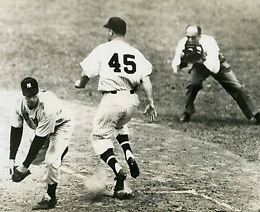
Joe DiMaggio was petrified.

This was a sensation he had almost never experienced on a baseball field in his life. On July 3, 1950, after 1,550 major league games and a Hall of Fame resume already on the ledger, DiMaggio jogged onto the field at Griffith Stadium in Washington, D.C, but instead of heading to his customary position in center, he stopped at first base. It was the first time DiMaggio had ever played anywhere other than the outfield in his storied career.

DiMaggio was only there because manager Casey Stengel was desperate. Incumbent first baseman Tommy Henrich’s career ended due to injury in 1950, and Stengel didn’t think replacement Joe Collins hit well enough to man the position. So through owner Dan Topping, Stengel had asked DiMaggio if he would try first base for a game.

It was a press frenzy—the iconic “Yankee Clipper” at first and not in center? Photos had to be taken, and the results weren’t pretty. As recalled in Jerome Charyn’s Joe DiMaggio: The Last Vigil, although DiMaggio did not make any errors, he stumbled a couple times, was nervous the whole game, and drenched his uniform in sweat. The immensely proud Yankee was furious at Stengel for not coming to him directly about the idea and that he made him look bad. It was indeed the only game of DiMaggio’s career spent away from the outfield.

Nonetheless, it probably would have been an amusing sight for modern baseball fans. A player appearing out of position is one of the more entertaining aspects of the game. Perhaps that’s because it seems to humanize these great athletes. For the past two years, I wrote guest posts at Baseball Prospectus that revealed each season’s “All Out-of-Position Team.” It’s always fun putting this together, and I’m happy to do so this year for Baseball Continuum’s 2016 Blogathon for Charity.

As one might guess, this is a lineup of nine players at nine positions where they absolutely do not belong. Yet for one reason or another, each ended up there at one point in 2015. Kneel and tremor before this fierce defense.

Pitcher: Jonny Gomes

The 13-year veteran Gomes had an up-and-down season that led to his second World Series ring even though he didn’t make the Royals’ playoff roster. Unfortunately, most of his intrigue came from off-the-field entertainment, such as accidentally helicoptering his daughter into a child running at him or having his status as a good luck charm turn into an “Effectively Wild” podcast meme.

Before he joined Kansas City though, he was on a dismal Atlanta Braves team that was sinking like an anchor. Through June 21st, they were actually .500 at 35-35. Then they went 32-60 the rest of the way. The absolute nadir was a three-game series against the Yankees from August 28th through the 30th. This was the middle of a 12-game losing streak, and in that sweep, the Yankees outscored them 38-11.

Atlanta’s bullpen was getting destroyed in the first game, and manager Fredi Gonzalez decided to take pity on his relievers by asking Gomes if he could pitch one of the innings. Give credit to Gomes—he was a team player on a club going nowhere. He took the lump. Chris Young was the first hitter to face him, and he quickly gave Gomes a scare:


The ball jumps off the bat a lot faster from sixty feet, six inches away rather than in the outfield. That pitch ended up in the seats, the Yankees crushed two more doubles, and another run scored. Mercifully, the inning ended on a strikeout. Yes, pitcher Jonny Gomes got a strikeout. Pay no attention to the fact that it was Yankees reliever Bryan Mitchell taking his first MLB at-bat.

Catcher: Wilin Rosario

Everyone who caught at least a portion of an inning in 2015 was a legitimate catcher at one point. So instead, we will pay our final respects to Rosario’s career behind the plate.

Rosario was once an exciting Rockies prospect, particularly when he hit 28 homers and finished fourth in the 2012 NL Rookie of the Year voting. Defense was always a question for him though, and by BP metrics, he struggled with framing and blocking pitches. The most damage was done on passed balls; he led the NL for three years in a row from 2012-14. In 307 games, he had 42 passed balls. Only one other catcher in all of baseball even had more than 30—Josh Thole, knuckleballer R.A. Dickey’s personal catcher.

Despite his offensive potential, Colorado could no longer bear watching Rosario fumble around. They moved him to first base in 2015; the switch coincided with an offensive malaise that led to a demotion to Triple-A. He eventually returned and spent just two games at catcher, both meaningless September starts. Nothing bad in particular happened in either of them, but it was clear that Rosario was no longer a major league catcher.

Earlier in January, Rosario signed a deal with the Hanwha Eagles of the Korean Baseball Organization. The word is that he will continue to fight the good fight and try to keep catching there. Even with only two games caught in 2015, he remains the MLB leaders in passed balls since 2012.

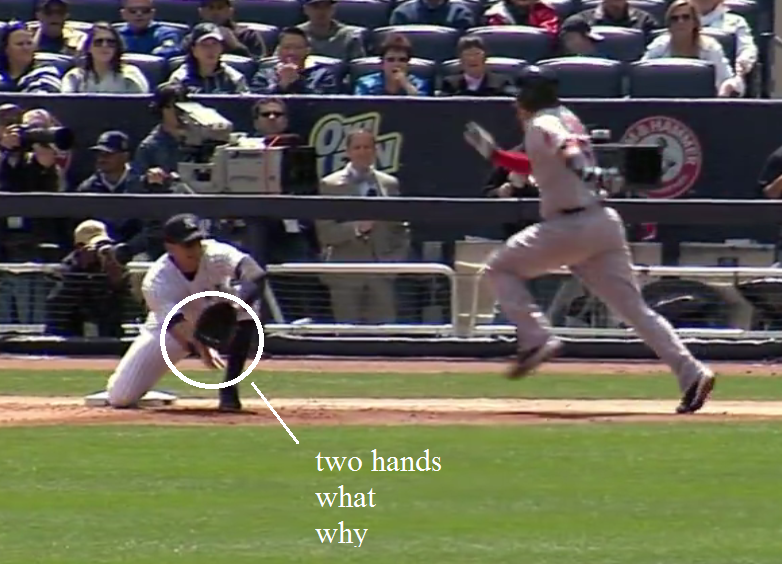
First base: Alex Rodriguez

Like him or not, A-Rod has to be considered among the greatest infielders in baseball history. He spent 1,272 games at shortstop, where he was not only a tremendous hitter but also among baseball’s defensive elite. When he moved to third base upon the Yankees’ trade for him in 2004, it obviously wasn’t because Derek Jeter was the superior defender. While A-Rod had never played third base in his life beforehand, he worked hard and became an excellent defender there as well until his hips began to fail him.

A player on the left side moving down the defensive spectrum to first base is far from unprecedented. Ernie Banks spent over half his career at first, and George Brett made just 14 starts at third in his final seven seasons. So when the Yankees suggested in spring training that A-Rod would get some reps at first base, it wasn’t stunning. He looked shaky in camp, but they gave him a shot anyway on April 11th against the Red Sox.

Boy, was it awkward.

Um, Alex…

That’s not how you…

a-rod

Well… okay then. Unsurprisingly, A-Rod made just one emergency appearance at first for the remainder of the season. “DH-Rod” worked out pretty well, but first base was just bizarre.

Second base: Carlos Gomez

Few centerfielders in baseball cover the position like Gomez, who has both the defensive skill and flair of Willie Mays out there. In 12 years of professional baseball though, he had never played the infield. Why should he?

Well, the early 2015 Brewers made it happen. Skipper Ron Roenicke was not long for the campaign, dismissed after a 7-18 start that included a game when his superstar had to play second base. They were about to lose their fourth straight to begin the season. Roenicke had already used infielders Luis Jimenez and Hector Gomez to pinch-hit for pitchers when second baseman Scooter Gennett lost his temper on a called strike three to end the eighth and was ejected by home plate umpire Mike Estabrook.

With no infielders left, Roenicke was forced to choose between Carlos Gomez and Ryan Braun to cover second (Braun would have also been a good pick for the All Out-of-Position Team had he been selected). Roenicke let Gomez do it since he occasionally took ground balls in the infield during practice for fun. He never got a chance to field anything during his one inning, but it was quite a sight to see a Gold Glove-caliber outfielder stuck in the infield.

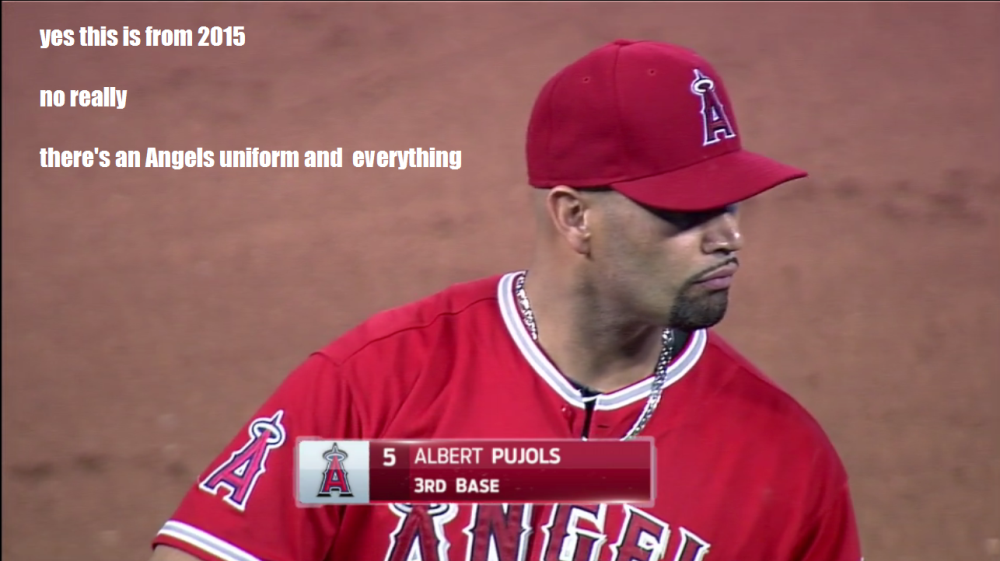
Third base: Albert Pujols

albert

For the second consecutive year, an aged Pujols somehow made an appearance at third base, and accordingly, he must appear on the All Out-of-Position team again. As noted last year, Pujols won his 2001 NL Rookie of the Year award playing most of his games at third; Mark McGwire was still active for the Cardinals. He spent a little time there again in 2002, but in the past 13 years, it’s pretty much been only in an emergency.

The Angels/Royals game on August 13th was weird enough anyway. Iron man catcher Sal Perez actually got a day off. The steady Garrett Richards was outpitched by Jeremy Guthrie, who carried an unsightly 5.84 ERA into action. The overpowering Wade Davis shockingly gave up two runs in the eighth, allowing the Angels to get back into the game with a 5-3 deficit. They went on to score four in the ninth against ailing closer Greg Holland. It was the first time in 114 games that Davis had allowed a multi-run inning.

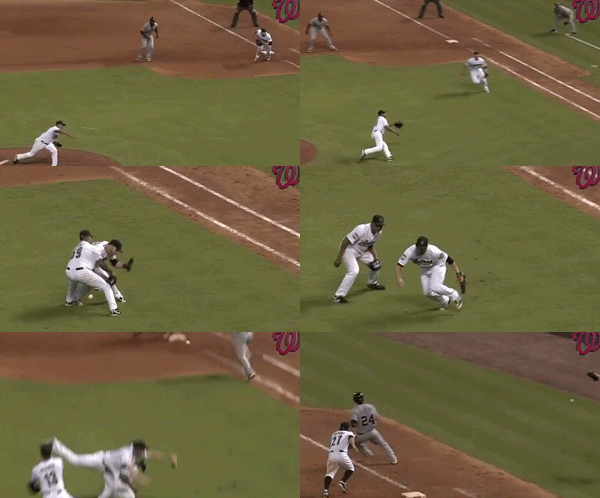
Then, of course, there was Pujols at third. During the rally off Holland, Angels manager Mike Scioscia gambled by pinch-hitting the powerful C.J. Cron for shortstop Taylor Featherston. It paid off, as Cron launched the game-tying two-run double. Scioscia took another risk by pinch-running Shane Victorino for Cron, and he scored the go-ahead run on Kole Calhoun’s two-run double. Armed with a 7-5 lead but a short bench thanks to both the moves and normal shortstop Erick Aybar’s tight lower back, Scioscia went full ¯\_(ツ)_/¯.

Victorino went to right field. Calhoun shifted from right to first base. Third baseman Conor Gillaspie moved to second for the first time in his eight-year professional career, forcing Johnny Giavotella to play shortstop for the first time in his eight-year professional career. Pujols took over at third. It worked out for Scioscia, as closer Huston Street kept the ball from going to any of the numerous inexperienced players, and the Angels won, 7-6.

That makes two straight years of Scioscia ending up victorious in a game with Pujols at third. What a time to be alive.

Shortstop: Brandon Phillips

brandon

Whenever Phillips chooses to retire from this game, his legacy will be intrinsically tied to defensive excellence at second base. There are nigh-countless highlight reels of his amazing work there, and he’s been doing it for a decade now, no easy feat.

That’s what makes it so jarring to see Phillips at shortstop, much like it was when Robinson Cano appeared there in 2013. All but six of his 1,582 career games have been spent at second, and he had not appeared there even in an emergency role since July 25, 2007. It was almost eight years to the day on July 19th of this year when Phillips reemerged at the position he called home when he was a mere Montreal Expos prospect.

Like Scioscia, Reds manager Bryan Price did not have much of a bench at that point in the game. It was the 11th inning, and Price had already used 19 players. In a failed 10th inning rally where Aroldis Chapman was due up, Price pinch-hit the last position player on his roster, Tucker Barnhart. Clearly unwilling to make the 2015 All Out-of-Position team even more entertaining with a pitcher in the field (shortstop Raisel Iglesias, anyone?), Price replaced Chapman on the mound with Pedro Villareal, put Barnhart in right, and made a series of moves that ended up with Phillips at shortstop. The Indians assembled a game-winning rally, but Phillips’ defense played no role in it.

Left field: Hanley Ramirez

There was a lot to write about with the circumstances that led to the other people on this team ending up at their positions. This was ludicrous though—the Red Sox tried to use the defensively inept Ramirez in left field at Fenway Park all season long. This was their plan. It should surprise no one that he is preparing for 2017 at first base.

So since Shakespeare once said “Brevity is the soul of wit,” this entry simply needs the outstanding tweet video by Joon Lee:

//platform.twitter.com/widgets.js

Center field: Joey Gallo

Most of the players on the All Out-of-Position team are old veterans who wind up at odd places in the field. That’s the nature of the beast—the hypothetical of David Ortiz in center field is just far more amusing than, say, Francisco Lindor out there. Sure, Lindor would be out of position, but he’s young and athletic enough that it makes some sense in a pinch.

The idea of rookie masher Joey Gallo playing center field, however, seemed completely absurd. In fact, when Baseball America writer Josh Norris heard that Gallo played a 2014 instructional league game in center field, he thought it was “more as a goof than anything.” After all, Gallo was a third baseman and occasional left fielder, and he still needed considerable defensive work.

When Rangers manager Jeff Banister said that he was going to start Gallo in center field on June 27th in Toronto, Adam J. Morris of Lone Star Ball succinctly summed up baseball Twitter’s reaction:

//platform.twitter.com/widgets.js

Although Gallo had never played center in a professional game, Banister had mentioned a week prior that he was shagging fly balls there “just in case.” Baseball Twitter was bemused then, but casual talk became reality.

Look at the big guy go. Gallo only played five innings in center before Banister subbed Leonys Martin for Ryan Rua in the sixth, putting Martin in center and bumping Gallo to left. If Gallo goes on to become one of the great power hitters of his generation as some suspect, then this detour to center will be something to remember.

Right field: John Jaso

jaso

A catcher his entire career, the 32-year-old Jaso is still primarily associated with that position. Unfortunately, his exile from catching was the result of too many concussions behind the plate. So when the Rays brought him back to Tampa this year, he was to be a DH only.

There were eight games though when Jaso had to appear in the outfield, and since he was originally a catcher, it was a strange sight. He actually started seven games in left, but his appearance in right field was a unique occasion. Jaso pinch-hit for Brandon Guyer in a game on August 17th and came up with a single that jumped the Rays’ lead to 6-2.

Rays skipper Kevin Cash didn’t want to lose Jaso’s bat since it was only the sixth inning at the time, so during the home half, Jaso moved to Guyer’s spot in right field. Since being drafted by Tampa Bay in 2003, he had never played there. It was a strange situation, and the look on Jaso’s face says it all. He received no chances and departed for a defensive replacement in the eighth.

So behold this team:

diamond

Remarkable. Yet still probably a better defense than the 2013 Astros.

Andrew Mearns has been a writer and editor for the SB Nation Yankees blog Pinstripe Alley since 2012. He hosts the site’s podcast and has also had work published by Baseball Prospectus, Sports on Earth, and BP Bronx. He aspires to keep his writer value higher than Andy Stankiewicz’s player value. You’ll most often find him tweeting nonsense @pinstripealley or @MearnsPSA.

This guest-post has been part of the 2016 Baseball Continuum Blogathon For Charity, benefiting the Roswell Park Alliance Foundation. The Roswell Park Alliance Foundation is the charitable arm of Roswell Park Cancer Institute and funds raised will be “put to immediate use to increase the pace from research trials into improved clinical care, to ensure state-of-the-art facilities, and to help improve the quality of life for patients and their families.” Please donate through the Blogathon’s GoFundMe page. Also, please note that the opinions and statements of the writer were not necessarily those of the Baseball Continuum or it’s webmaster.


//s.imgur.com/min/embed.js

//platform.twitter.com/widgets.js