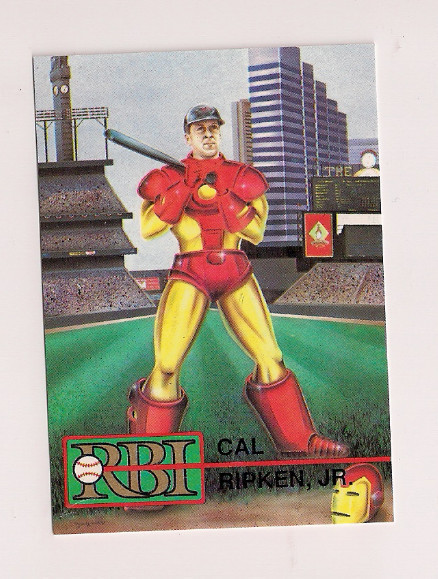
Found this online. I must one day buy it and then have it framed and placed upon my desk:
Yes, that’s a baseball card of Cal Ripken wearing an Iron Man suit.
Your mind… is now blown.
Found this online. I must one day buy it and then have it framed and placed upon my desk:
Yes, that’s a baseball card of Cal Ripken wearing an Iron Man suit.
Your mind… is now blown.
It’s Friday the 13th, so here are my greatest baseball fears (these are mostly meant to be humorous):
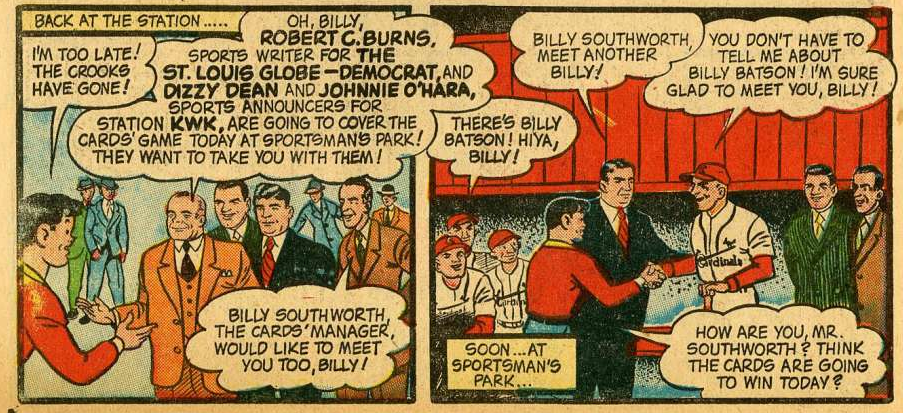
Miss Bizarre Baseball Culture? Don’t worry, it’ll be back soon, but to hold you over, here’s a bit from Captain Marvel Adventures #36, from June 1944, in which Billy Batson (who transforms into Captain Marvel with one cry of SHAZAM!) meets some of movers-and-shakers at Sportsman’s Park in St. Louis, including Dizzy Dean (who was an announcer for the Browns at the time) and HOF Cardinals manager Billy Southworth.
It’s not quite teaching baseball to Martians, but maybe it’ll hold some of you over.
The (exhibition) return of Olympic Stadium got me to thinking for no real reason: What are other former MLB stadiums that are still standing? I don’t mean cases where they knocked down almost the whole thing but kept the diamond there (as has happened at Tiger Stadium), or cases where they demolished most but not all of the stadium and then it was made into something totally different (as with what used to be Braves Field). I’m talking about actual former stadiums that are still standing and could, in theory, still be used for baseball.
I came up with this list:
I can’t think of any others… can you?
I’ve posted this before, but it’s still a classic, and in honor of the start of the NFL season, I’m posting it again: George Carlin on the differences between baseball and football.
September 9th, 1992. At the end of the day, after a 13-8 victory over the Cubs, the record of the Pittsburgh Pirates showed that they had 81 wins.
It never happened again. Until yesterday.
How long ago was 9-9-92? Well…
In other words: It was a long time ago.
With Baseball Reference adding Japanese stats, it’s time to look at some of the coolest stuff from it.
First off, of course, there is arguably the greatest Japanese player ever and one of the greatest hitters on any continent: Sadaharu Oh. You probably know about his 868 HRs, but you probably didn’t know about his impressive 2786 hits. Going on a tangent here, I remember reading somewhere that, after statistical conversions between the leagues, it’s thought that Oh would have had a career in MLB similar to Mel Ott.
Much like how Babe Ruth had Lou Gehrig behind him, Oh had Shigeo Nagashima, who formed the N in what was called the Yomiuri Giants’ “O-N Cannon”. Together, they helped the “Yankees of Japan” win nine straight titles.
However, had you looked hard enough, you probably could have found their statistics elsewhere, and the same probably goes for Americans and other westerners who spent time in Japan since the 1970s, like Charlie Manuel and Randy Bass and recent Japanese imports like Yu Darvish. What makes the Baseball Reference data awesome is that it goes beyond that to Japanese baseball’s earliest professional seasons.
For example, I can’t ever remember seeing the stats of Wally Yonamine, the first American to play in Japan post-WWII. Nor do I ever remember seeing statistics for Eiji Sawamura, the ace pitcher (Japan’s Cy Young Award equivalent is named for him) who once struck out Charlie Gehringer, Babe Ruth, Lou Gehrig and Jimmie Foxx in succession during one of Ruth’s famous tours of Japan, but whose career ended premature when he died during WWII.
As a third example of a early-years Japanese player who has interesting stats to look at: Victor Starfin (sometimes spelled Starffin). The first pitcher to win 300 games in Japan, Starfin was able to (mostly) avoid WWII’s effects on Japanese baseball. Well, until he was released in 1944 due to “security concerns” and thrown into a detention camp for being a foreign national. That, by the way, is like the fourth most interesting thing in his SABR biography. Seriously, it starts with his family fleeing the Russian Revolution and ends with him tragically dying in a drunk-driving accident in January, 1957- not long after his final season (1955).
Those just scratch the surface of the treasures in Baseball Reference’s new Japanese pages… go check them out.
When announcing lineups, the Rochester Red Wings often play “Love Rollercoaster”. It fits this season, as the AAA Twins affiliate seemed to be on one that had highs, lows, loops,
corkscrews and no shortage of screaming and yelling. And now, after a blowout 13-3 victory on the final day of the season and a stunning 1-0 extra-inning defeat by the Norfolk Tides (AAA Orioles), the Wings now have made the playoffs for the first time since 2006 by virtue of holding a tie-breaker against Norfolk.
It was by no means a sure thing. Then again, there was very little “sure” about this season. The Wings started 2-11, they were in last place as late as May 29, they were in first later in the year, only to lose both that lead and also seemingly the wild card in a late skid after their best player (Chris Colabello) and best pitcher (Andrew Albers) were called up… and then, finally, at the end, they were able to pick themselves up and get to the playoffs, with a little luck.
(Go below the jump for more)
Some of you may be wondering what the next installments of Bizarre Baseball Culture will be. Well, here’s a little sneak preview- not really giving out exactly what and exactly when, but some good hints:
Actual Books: There hasn’t been a Bizarre Baseball Culture on fully-written material since the short story that acted as a prologue to this feature. That will soon change, as I am currently reading two books that fit into the realm of Bizarre Baseball Culture. One of them involves time travel, the other involves the Frankenstein Monster. I’m not sure what one I will do, but one of these WILL be the next installment.
Ultimate Sports Force: At the turn of the century, there was a comic company called Ultimate Sports Force that made it’s name making giveaway comics that depicted athletes as actually being superheroes. I have obtained some of these comics, and I can confirm they are as crazy as you could think. How crazy? Well, as I told Michael “Old Time Family Baseball” Clair on Twitter, one of them involves four members of the New York Yankees fighting off meteor-monsters by order of Cal Ripken Jr. and the United States Military. Go back and read that sentence again, and not look for the pieces of your mind, as it has just been blown. Expect to see some Ultimate Sports Force comics between now and winter, although I’m not quite sure of the order yet.
Public Domain Comics: The backbone of early Bizarre Baseball Culture installments, there still are some tales left to tell from way back. There is, however, one public domain story I will not be doing, at least anytime soon: a Captain Marvel Jr. story in which he goes and helps American POWs in a game against the Japanese. The reason I am not covering it is because it is incredibly racist, and even considering that it was a product of being in wartime, I don’t feel comfortable printing any images of it here.
Television: There are other television things I’ll be covering, both live action and cartoon. They will range from shorts like the Goofy segment to longer-form things like the Pokemon and the Pinky and the Brain episodes.
So, keep an eye open….
Do you have any suggestions for “Bizarre Baseball Culture”? Let me know.
Matt Harvey has a UCL injury and will miss the rest of the season and probably longer, since he will likely have to undergo TJ Surgery. Upon seeing some of the online reaction to this, I believe it can be summed up by clicking here. Note that certain parts of that reaction are not-safe-for-work.
As a fan of baseball and great pitching, I agree with the above assessment.