Bizarre Baseball Culture: Hideki Matsui’s Godzilla Cameo

So, where exactly was this picture taken? AKA: Where the heck would they play baseball in Dubai?

You may have seen this picture online a few days ago (click to enlarge):

As you can see, it’s a baseball game being played outside of Dubai, with the world’s tallest building, the Burj Khalifa (formerly known as the Burj Dubai) rising in the distance.

Of course, the United Arab Emirates isn’t exactly a baseball hot bed. So I was wondering where this picture was taken. So I did some research… and found it!

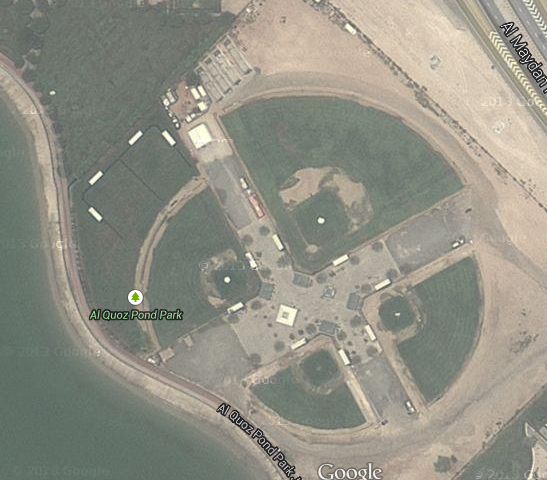
Screen Shot 2014-04-24 at 1.26.41 PMAt Al Quoz Pond Park south of Dubai’s downtown is the site of the Dubai Little League. To be more specific, the picture of the game with the Burj in the distance was taken at the large, adult-sized north field. As you can see below, this Little League facility is definitely close enough and in the right direction relative to Dubai’s downtown where the view in the top picture is what batters would see:

Screen Shot 2014-04-24 at 1.31.21 PMSo, there you have it: Not only are there baseball fields in Dubai, but at least one of them has a killer view.

Coming Soon: First Impressions of OOTP Baseball ’15!

Sometime soon, my first impressions of OOTP Baseball ’15, which is due out later this month:

Screen Shot 2014-04-09 at 10.09.25 PM

2014 SEASON PREVIEW (PART 8): Everything you wanted to know about the opening series in Australia but didn’t ask

So, it won’t be long before the 2014 MLB Regular Season starts… in Australia. Yes, this year, it starts in Sydney, Australia. You may or may not have questions about this, but I don’t particularly care what you think, so for our latest preview, we look at these two games that will start off the season.

Okay, first thing’s first, give me the basic details of this thing again?

The LA Dodgers and Arizona Diamondbacks are going to play a two-game series at Sydney’s Sydney Cricket Grounds. These are regular season games that count in the standings.

Okay, so when are they taking place?

Game one takes place around 4 AM Eastern (1 AM Pacific) on March 22nd, with the second game taking place later that date at around 10 PM Eastern (7 PM Pacific). The reason for that is due to the international date line- locally the first game takes place a bit past 7 PM on the 22nd and a bit past 1 PM on the 23rd. Fun fact: Due to these games being in the Southern Hemisphere, the MLB season will, for the first time, START in Fall, as opposed to merely ending in it.

In addition, both the Dodgers and Diamondbacks will have exhibitions against the Australian National Team on the 20th (Dodgers) and 21st (Diamondbacks).

Who’s the home team here?

The Diamondbacks will be the “home” team.

Is it on TV here in America?

Yup. They’ll be on MLB Network, with Matt Vasgersian and Tom Smoltz calling it, with Ian Chappell providing further commentary.

The games will also be on the local TV broadcasts in Arizona and LA. The games about the Australian National Team should be available online, for example on MLB.TV.

Who’s Ian Chappell?

One of the greatest Australian cricketers of all time and a major fixture of Australian TV coverage of Cricket, Chappell has a baseball pedigree, and his son had a brief stint in the minors. Presumably he will be there to provide some local flavor, such as information on the Sydney Cricket Ground, some Australian traditions, etc.

Speaking of which where is this being played, again?

The Sydney Cricket Ground, established in 1848 (although renovated and/or rebuilt several times since then), is one of the world’s most storied cricket venues. It has also been used for both rugby union and league, the Commonwealth Games (at the time called the “British Empire Games”), Australian Rules Football, soccer, concerts, and, yes, at one point baseball- the Chicago White Sox and New York Giants played there during their 1914 world tour.

For baseball, the fences have been set up as 328 down the lines, 370 in the gaps and 400 to straightaway center. Here’s how they changed it from cricket to baseball:

So, who’s pitching?

Game 1: Clayton Kershaw vs. Wade Miley (filling in for Patrick Corbin, who is hurt)

Game 2: Hyun-Jin Ryu vs. Trevor Cahill

Where’s Zack Greinke?

Partially not there because an injury screwed up his throwing schedule, partially not there because his rather… unfiltered… thoughts about how he felt about starting the season in Australia. Carl Crawford and Matt Kemp also didn’t make the trip due to injury.

Are there even any Australians on these teams?

Sort of. Ryan Rowland-Smith. AKA “Hyphen”, is fighting for a spot in the Diamondbacks bullpen. He definitely will be playing in the exhibition games- in fact, the Diamondbacks have given him permission to pitch for Team Australia against the Dodgers.

Can you give me a brief history of baseball in Australia?

From my 2013 WBC preview:

The first baseball in Australia was played by American expats and their friends in the 1850s, but it wasn’t until the 1870s that the first organized teams were formed. The sport received more attention during the World Tours of barnstorming MLB players in the 19th and early 20th century and by the time American servicemen arrived in Australia during WWII there was a small but devoted amateur culture of baseball, one that has survived to this day. However, baseball has not yet been able to get permanently get past that amateur status, with two professional leagues (the Australian Baseball league of 1989-99 and the International Baseball League of Australia of 1999-2002) failing and a complete lack of professional baseball until the new Australian Baseball League was formed with MLB help a few years ago.

What will the crowds be like? I mean, you just said that professional leagues have struggled to survive and that it’s amateur baseball is simply “small but devoted”.

Well, they’ve sold out (or come very close to selling out) both games. It’s also likely, if reports are anything to go on, that they are going to be Diamondbacks fans.

Is this going to be one-off, or a regular thing?

Well, baseball has becoming increasingly driven in expanding the game’s reach internationally, and just having the WBC and the occasional opener in Japan isn’t going to be enough. Already there is some talk that MLB could return to Australia in 2018 if this series is a success, and there have also been rumblings about games in the Netherlands. And, just this year, there have been exhibition games in Panama City and, later in the spring, a return to Montreal. So, yeah, this is going to be a regular thing. Maybe it won’t be in Sydney, maybe it won’t even be a return to Tokyo, Mexico or Puerto Rico (although all of those are certainly possible), but there will be more openers overseas in the future.

Like where?

Besides obvious suspects like Korea, Taiwan or the Dominican Republic (none of which, amazingly, have ever hosted an official MLB game), I wouldn’t be surprised if you see rumblings about maybe doing series in other countries that play cricket, since it’s a lot easier to turn a cricket ground into a baseball field than, say, a soccer pitch. So, don’t be surprised if we end up seeing games in New Zealand (where baseball is the fastest-growing team sport) and the United Kingdom (although the weather there could be a problem) in the not-that-distant future.

Can I see the picture of Vin Scully holding the Koala Bear?

Okay.

Next time: More baseball previewing!

Some minor movement in post-2014 Caribbean Series Continuum Baseball Rankings

The Caribbean Series is included in the Continuum Baseball Rankings because it’s between the champions of leagues, and usually are primarily made up of players from those countries anyway (the Asian Series isn’t included because the Australian League is full of North Americans on most teams).

So, Mexico won this year’s Caribbean Series, while Cuba’s champion surprisingly came up the rear. So, how did this affect the Continuum Rankings? Well, nothing major, but there were some small moves, such as the Dominican and Cuba switching around.

Go below the jump for it:

Continue reading

The USA returns to first in late January Continuum Rankings Update

It’s the Continuum Baseball Rankings! Thanks to good performances in basically every tournament that wasn’t the WBC, the United States went to number one in the IBAF’s world rankings, and that helped them also move to the top in the Continuum Rankings. Japan and Cuba also benefited from international play results that the IBAF rankings follow (but I don’t always follow), and Japan further benefited from a 3-game sweep over Taipei in November. This caused the Dominican to fall to fourth, mainly because they didn’t play much after the WBC and weren’t in the best of positions in the IBAF ratings.

Similar things happened to other Latin American teams, and that leads to another issue I’ll have to figure out: due to those country’s baseball systems, which often have financial problems outside of the WBC as far as going overseas. I’m going to try and figure out a way to try and counter this without bringing back in the number of MLB players and MLB Win Shares.

Anyway, these ratings include the 2013 end-of-year IBAF World Rankings, the three games “Samurai Japan” and the Chinese Taipei national team played, games between “professional or equivalent” teams in the East Asian Games and the entirety (since all teams in it were “professional or equivalent”… which is to say, they were all each country’s best players, in this case amateurs) of the West Asian Baseball Cup.

The next update will be after the Caribbean World Series in February.

Go below the jump to see it:

Continue reading

Quick Aside on Continuum Rankings

Aside

New Baseball Continuum Rankings will be up on Friday!

(This was just an aside, since I hadn’t posted anything yet today.)

Tanaka signing sets up what could be an Apocalyptic year for the Yankees

The word “apocalypse” does not, technically, mean the end of the world. It instead means “uncovering” or the revelation of something. In that truest sense, the New York Yankees have set themselves up for an apocalyptic year in 2014. Because with the signing of Masahiro Tanaka, they have turned their back on any semblance of the financial restraint they showed last year in a quest to possibly get under the luxury tax and are going with the good old fashion weapon of the Yankees of old: money. Lots and lots of money.

Problem is, with the team that that money has bought, it has yet to be uncovered whether that’s going to do it anymore… at least the way the Yankees did it this offseason.

What do I mean by the way the “Yankees did it” this offseason? Well, what I mean is that the Yankees have, for a lack of a better word, assembled a team that recalls the “Jurassic Park at Camden Yards” Orioles of 1998. Having fallen in the ALCS the past two years, Orioles ownership threw a bunch of money at the problem, signing past All-Stars and award-winners… leading to a team that actually had a higher total salary figure than the Yankees. Problem was, these are the past All-Stars and award-winners who they got (not counting re-signings of players like Harold Baines and Brady Anderson):

The 1998 Orioles average age was 33.3 years old, their most common batting orders had no players that were younger than 30 at the end of the season, and of the eight pitchers that would start 10 or more games that year, only two of them were under 30. The “Jurassic Park at Camden Yards” Orioles underachieved greatly, finishing 79-83, 4th in the AL East, and beginning the long string of under-.500 years that would last until 2012. Carter, Charlton and Guillen were all gone from the team by the end of the year (although Guillen, admittedly, had mainly been gotten as a backup infielder), while Drabek retired at year’s end.

Now, look at what the Yankees did this off-season:

  • Signed Brian McCann, who will be 30 in 2014
  • Signed Jacoby Ellsbury, who will be 30 in 2014 and has a history of injuries
  • Signed Carlos Beltran, who will be 37 in 2014
  • Signed Matt Thornton, who will be 37 in 2014
  • Signed Brian Roberts, who will be 36 in 2014 and has a history of injuries
  • Signed Masahiro Tanaka, who will be 25 in the 2014 season.

Other than Tanaka, the list looks shockingly like what the Orioles did- getting old all-stars. And, like the Orioles of 1998, the Yankees will likely have their line-up made up entirely of players older than 30-years old. Although, to be fair, the Yankees rotation is younger and I’d definitely take a 30-year-old McCann over a 33-year-old Lenny Webster or Chris Hoiles and a 30-year-old Ellsbury over a 34-year-old Brady Anderson. But still, you can’t help get this sinking feeling that maybe, just maybe, the Yankees money-hammer isn’t going to work this time, that the players they have acquired are too old and too injury prone to bring them to the promised land.

Still, It’s not hard to see why the Yankees are doing this. After all, they missed the playoffs last year and were lucky to end up tied for third with the Orioles in the AL East. And, as that happened, their ratings and attendance plummeted, and probably would have been even lower if not for the attention the grand Mariano Rivera farewell tour got. So, what were they going to do? Just spend money on some younger and cheaper players? Let Tanaka go to the Cubs or Dodgers? Pfft. They wouldn’t let that happen, they are the Yankees. And, hey, the money approach has worked before, and it may well work again. And they better hope it does, because if it doesn’t, it could turn into a baseball apocalypse in the Bronx of a somewhat more dire kind.

A Change in The Continuum Baseball Rankings method

As I mentioned yesterday, the latest installment of the Continuum Baseball Rankings is coming up.

However, there will be one major difference: I will not be taking into account the number of MLB players and Win Shares for each country, instead using only the input of the IBAF World Rankings and results from international tournaments in which a country’s “professional or equivalent” team took part.

There are a few reasons for this.

For one, using MLB players and MLB win shares in it heavily skews it towards the USA, Dominican Republic, etc.

For another, it skews away from countries that have their own leagues, such as Japan and Korea, as well as an isolated nation like Cuba.

Finally, they are at times incomplete, as the site I use to find the numbers for it goes by place of birth, not necessarily nationality, leading to, for example, Donald Lutz being listed as an American and not a German.

So, when the next Rankings update comes up, it’ll have used a different method for things that happened after July of this past year.

Catching up on what happened to some players after some previous posts…

What happened to some of the people in previous posts? Well….

…And now you know!